
Research article · 2025 · Full text
International Journal of Biology SciencesMetabolic engineering of Escherichia coli for enhanced production of L-tryptophan
Volume 7(8) · Pages 307–310 · DOI: 10.33545/26649926.2025.v7.i8d.663 ↗
Research areasMicrobial Metabolic Engineering and BioproductionBacterial Genetics and BiotechnologyCancer Research and Treatments
Abstract
Author-writtenImagine a fermentation tank producing pharmaceutical-grade L-tryptophan from glucose in under 48 hours—without the yield-capping feedback loops that normally throttle output. This research engineered Escherichia coli K-12 through a sequential gene-editing strategy to relieve allosteric regulation and redirect carbon flux toward the tryptophan branch of the shikimate pathway. Work was carried out at the Instituto de Ciências Biológicas do Pantanal, Corumbá, Brazil, between March 2022 and June 2024. Four engineering steps were applied cumulatively: (1) deletion of the trpR repressor; (2) introduction of a feedback-resistant aroG mutant (aroG*-S180F); (3) overexpression of the entire trpEDCBA operon under a tac promoter; and (4) overexpression of a feedback-insensitive serA mutant (serA*-H344A) to boost serine supply, the amino donor in the final tryptophan synthase reaction. The fully engineered strain (TRP-04) produced 5.83 ± 0.41 g/L L-tryptophan in 48-hour fed-batch fermentation using minimal glucose medium—a 72.9-fold increase over the wild-type parent strain (0.08 g/L). Metabolic flux analysis confirmed a 3.4-fold increase in carbon flow through the pentose phosphate pathway and a 17.9-fold increase through the tryptophan branch. No significant growth penalty was observed (doubling time 38.2 vs. 36.7 min for wild-type). These results demonstrate that combinatorial deregulation of the shikimate and serine biosynthesis pathways can yield industrially relevant tryptophan titers in a simple E. coli chassis.
Summary
Source-checkedPlain-language reading of the full paper, prepared with AI and checked against the text. Each point links to the authors' own words.
Why it matters
- L-tryptophan is an essential human amino acid and a precursor for niacin, melatonin, and serotonin, with a global market demand exceeding 41,000 tonnes in 2022. View evidence ↗
- The primary challenge in engineering E. coli for tryptophan production is the bacterium's natural regulatory logic, which shuts down the pathway once sufficient concentrations are reached for protein synthesis. View evidence ↗
- Tryptophan production is limited by three main bottlenecks: TrpR transcriptional repression, allosteric feedback inhibition of DAHP synthase (AroG), and an insufficient supply of L-serine. View evidence ↗
The question
- The study aimed to use a sequential gene-editing strategy in E. coli K-12 to remove allosteric regulation and redirect carbon flux toward the tryptophan branch of the shikimate pathway. View evidence ↗
What they did
- The research was conducted at the Instituto de Ciências Biológicas do Pantanal in Corumbá, Brazil, from March 2022 to June 2024. View evidence ↗
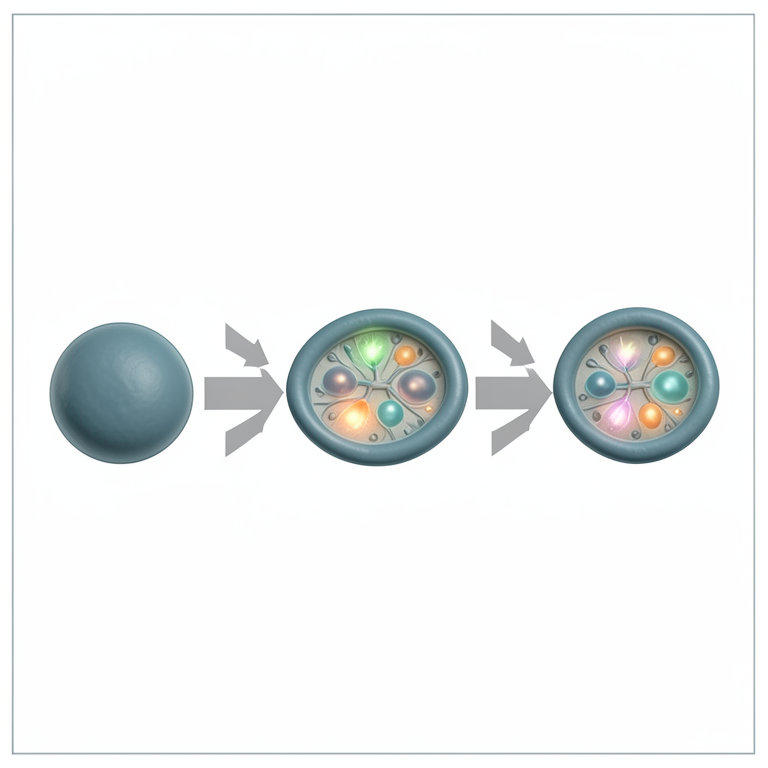
- The researchers created four cumulative strains: TRP-01 (trpR deletion), TRP-02 (aroG*-S180F integration), TRP-03 (trpEDCBA operon overexpression), and TRP-04 (serA*-H344A overexpression). View evidence ↗
- Fed-batch fermentations were performed in M9 minimal medium with 20 g/L initial glucose and 2 g/L yeast extract, maintained at 37 °C and pH 7.0. View evidence ↗
- Metabolic flux analysis was conducted using OpenFLUX software and [1-¹³C]glucose labeling experiments. View evidence ↗
What they found
- The final engineered strain (TRP-04) achieved a tryptophan titer of 5.83 ± 0.41 g/L after 48 hours, which is a 72.9-fold increase compared to the wild-type titer of 0.08 g/L. View evidence ↗
- The engineering process did not cause a significant growth penalty, with the TRP-04 strain having a doubling time of 38.2 minutes compared to 36.7 minutes for the wild-type. View evidence ↗
- In the TRP-04 strain, 38.7% of consumed glucose was directed through the pentose phosphate pathway, compared to 18.3% in the wild-type. View evidence ↗
- Metabolic flux through the tryptophan branch increased 17.9-fold in the TRP-04 strain relative to the wild-type. View evidence ↗
What it means
- The authors conclude that combining trpR deletion, feedback-resistant DAHP synthase, operon overexpression, and enhanced serine supply effectively produces 5.83 g/L of L-tryptophan without significant growth penalties. View evidence ↗
- The authors suggest that titers could be further increased by deleting competing aromatic amino acid branches (pheA, tyrA) or engineering the PTS glucose uptake system. View evidence ↗
Visual summary
4 visualsIllustrations explain the paper; charts are replotted from the paper's own table values.
Sequential Engineering Workflow
AI-generated conceptual illustration (Escherichia coli bacteria). It explains the idea and does not show study data.
View source evidence ↗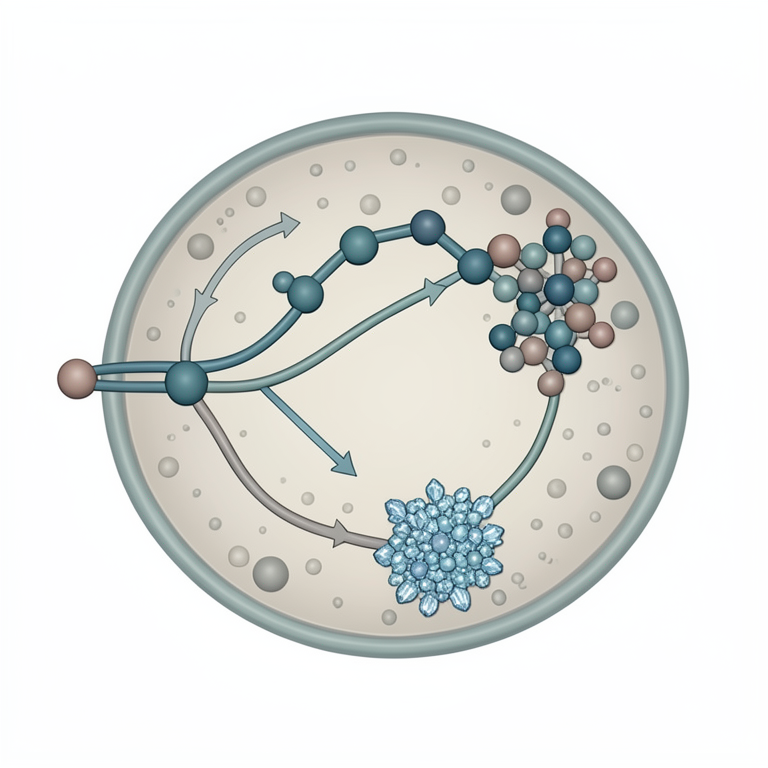
Carbon Flux Redistribution
AI-generated conceptual illustration (Escherichia coli bacteria). It explains the idea and does not show study data.
View source evidence ↗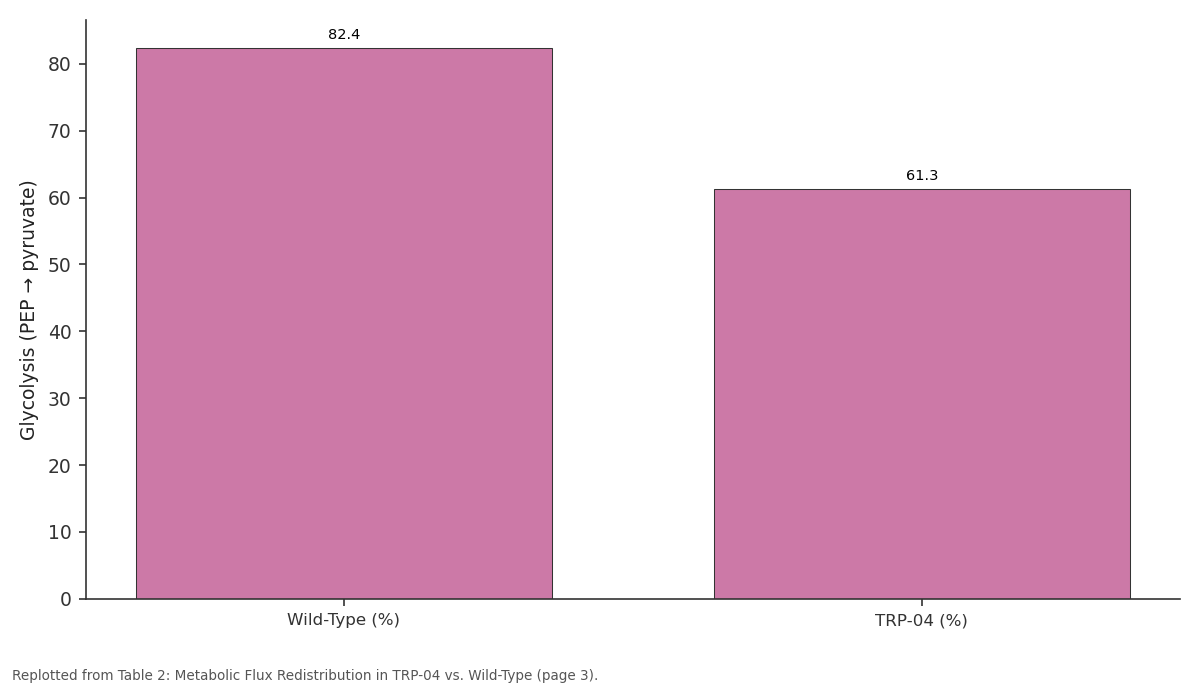
Glycolysis (PEP → pyruvate): Wild-Type (%) vs TRP-04 (%)
Replotted from Table 2 (page 3) of the original paper. Every bar is the paper's own table value.
View source evidence ↗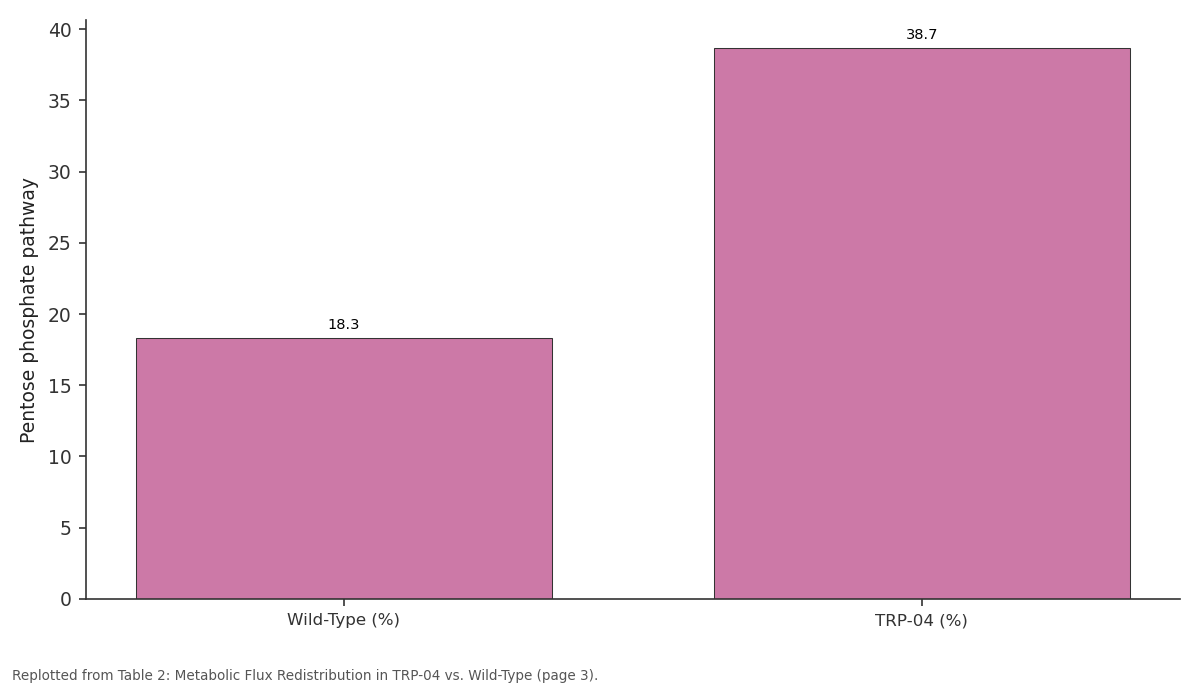
Pentose phosphate pathway: Wild-Type (%) vs TRP-04 (%)
Replotted from Table 2 (page 3) of the original paper. Every bar is the paper's own table value.
View source evidence ↗Figures & tables
From the original paper Table 1
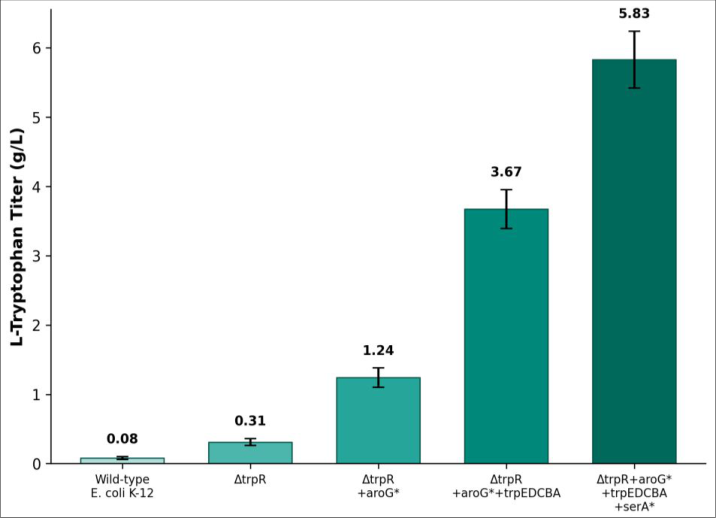 Figure 1
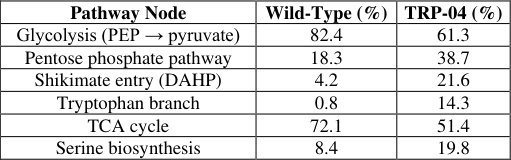 Table 2
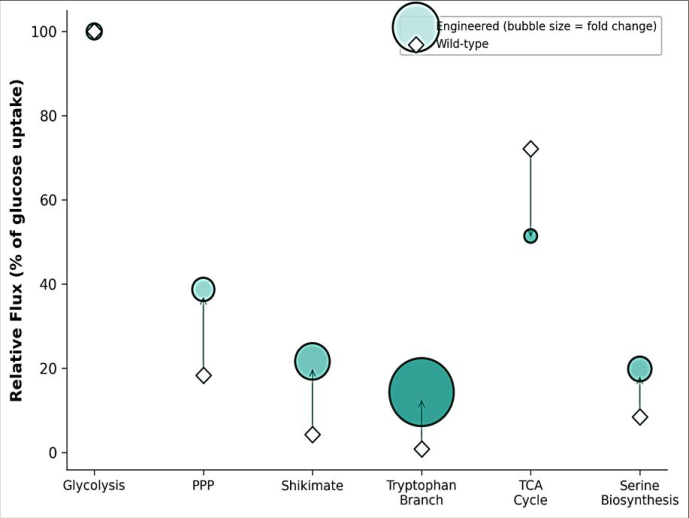 Figure 2
Introduction
Picture a mid-sized pharmaceutical company that needs 500 kg of L-tryptophan per month for dietary supplement formulation. The options are chemical synthesis-expensive, racemic, and solvent-heavy-or microbial fermentation, which is greener but capped by the bacterium's own regulatory logic [1] . E. coli naturally produces just enough tryptophan for its own protein synthesis and shuts down the pathway the moment intracellular concentrations rise. Breaking this self-imposed ceiling is the central challenge of tryptophan metabolic engineering. L-tryptophan is one of the nine essential amino acids in human nutrition and serves as the biosynthetic precursor for serotonin, melatonin, and niacin [2] . Global market demand exceeded 41,000 tonnes in 2022, driven by animal feed, food supplements, and pharmaceutical applications. Microbial production using engineered E. coli or Corynebacterium glutamicum now accounts for the majority of commercial supply, but titers in academic-scale reports typically range from 1 to 15 g/L-well below the 40-50 g/L achieved for L-lysine or L-glutamate [3] . The bottleneck lies in at least three layers of regulation: transcriptional repression by TrpR, allosteric feedback inhibition of 3-deoxy-D-arabino-heptulosonate-7-phosphate (DAHP) synthase (AroG) by phenylalanine, and limited supply of L-serine, which donates its side chain in the final tryptophan synthase reaction [4] . Previous efforts have addressed one or two of these constraints, but a systematic, stepwise approach that quantifies the marginal gain of each modification in the same genetic background has rarely been reported. This research built a series of cumulative E. coli mutants at the Instituto de Ciências Biológicas do Pantanal, Corumbá, Brazil, and measured tryptophan titer, growth fitness, and intracellular flux redistribution at each step. Material and Methods Material E. coli K-12 MG1655 (ATCC 47076) was the parental strain. Gene deletions were performed using the Lambda Red recombineering system with pKD46 [5] . Feedbackresistant aroG (S180F) and serA (H344A) alleles were synthesized by GenScript (Piscataway, NJ, USA) and cloned into pTrc99A under the tac promoter. The trpEDCBA operon was amplified from K-12 genomic DNA and cloned into pACYCDuet-1 (Novagen/Merck, Darmstadt, Germany). Isopropyl β-D-1thiogalactopyranoside (IPTG), antibiotics, and all fermentation-grade chemicals were purchased from Sigma-Aldrich (St. Louis, MO, USA) [6] .
Instrumentation and Analytical Equipment
Fed-batch fermentations were carried out in a 5-L BioFlo 320 bioreactor (Eppendorf, Hamburg, Germany) equipped with dissolved oxygen, pH, and temperature probes. Ltryptophan was quantified by HPLC (Shimadzu LC-20AD) fitted with a C18 reverse-phase column (Agilent Zorbax SB-C18, 4.6 × 250 mm, 5 µm) and a UV detector set at 280 nm.
Glucose and organic acid concentrations were measured by HPLC with a Bio-Rad Aminex HPX-87H column and refractive index detection. Intracellular metabolite extraction for flux analysis used a cold methanol quenching protocol adapted from Wittmann [7] .
Methods
Strain construction proceeded in four steps, each confirmed by colony PCR and Sanger sequencing.
Step 1: trpR deletion (strain TRP-01).
Step 2: chromosomal integration of aroG*-S180F at the araBAD locus (TRP-02).
Step 3: transformation with pACYCDuet-trpEDCBA (TRP-03).
Step 4: transformation with pTrc99A-serA*-H344A (TRP-04). Fed-batch fermentations used M9 minimal medium supplemented with 20 g/L initial glucose, 2 g/L yeast extract, and trace metals. Temperature was maintained at 37 °C, pH at 7.0 (automatic NH₄OH addition), and dissolved oxygen above 30% saturation by cascade aeration and agitation. Glucose was fed at a rate maintaining residual concentration between 1 and 5 g/L. IPTG (0.5 mM) was added at OD₆₀₀ = 8. Samples were taken every 4 hours for 48 hours. All experiments were performed in biological triplicate [8] . Metabolic flux analysis used the OpenFLUX software with a stoichiometric model of central carbon metabolism; ¹³C-labeling experiments with [1-¹³C]glucose confirmed flux ratios at the glucose-6-phosphate node [9] .
Results
Table 1.24 ± 0.14 0.028 37.4 ± 0.9 13.5 ± 0.7 TRP-03 (+trpEDCBA)
| Strain | Trp (g/L) | Yield (g/g glc) | Doubling (min) | Final OD₆₀₀ |
|---|---|---|---|---|
| K-12 (WT) | 0.08 ± 0.02 | 0.002 | 36.7 ± 1.1 | 14.2 ± 0.8 |
| TRP-01 (ΔtrpR) | 0.31 ± 0.05 | 0.007 | 37.1 ± 1.3 | 13.8 ± 0.9 |
| TRP-02 (+aroG*) | 1.24 ± 0.14 | 0.028 | 37.4 ± 0.9 | 13.5 ± 0.7 |
| TRP-03 (+trpEDCBA) | 3.67 ± 0.28 | 0.074 | 37.9 ± 1.2 | 12.9 ± 1.1 |
| TRP-04 (+serA*) | 5.83 ± 0.41 | 0.108 | 38.2 ± 1.4 | 12.6 ± 0.9 |
Table text extracted from the original PDF; superscript letters are shown inline. The original table image is below.
View original table image
3.67 ± 0.28 0.074 37.9 ± 1.2 12.9 ± 1.1 TRP-04 (+serA*) 5.83 ± 0.41 0.108 38.2 ± 1.4 12.6 ± 0.9
Each engineering step produced a measurable increase in tryptophan titer (Table 1). The largest single gain came from overexpressing the trpEDCBA operon (TRP-02 → TRP-03: +2.43 g/L), while boosting serine supply added another 2.16 g/L (TRP-03 → TRP-04). Doubling times remained within 4% of wild-type across all strains, indicating no major growth penalty.
Performance Evaluation
The overall yield of TRP-04 (0.108 g tryptophan per g glucose) represents 26.3% of the theoretical maximum (0.411 g/g, calculated from the stoichiometric equation: 1 glucose → 0.411 tryptophan + CO₂ + H₂O under optimal pathway flux). Volumetric productivity reached 0.121 g/L/h, comparable to recent reports using C. glutamicum (0.09-0.18 g/L/h) but below the highest published E. coli values of 0.20-0.25 g/L/h achieved with more complex regulatory rewiring [10] . Carbon balance analysis showed that 38.7% of consumed glucose was directed through the pentose phosphate pathway in TRP-04 versus 18.3% in wild-type, consistent with the increased demand for erythrose-4phosphate and phosphoenolpyruvate-the two precursors feeding into the shikimate pathway. Flux through the tryptophan branch rose 17.9-fold in TRP-04 relative to wild-type (Table 2). The TCA cycle flux decreased correspondingly, reflecting diversion of phosphoenolpyruvate away from pyruvate kinase toward the shikimate pathway. Serine biosynthesis flux doubled, driven by the overexpressed feedback-resistant serA*.
| Pathway Node | Wild-Type (%) | TRP-04 (%) |
|---|---|---|
| Glycolysis (PEP → pyruvate) | 82.4 | 61.3 |
| Pentose phosphate pathway | 18.3 | 38.7 |
| Shikimate entry (DAHP) | 4.2 | 21.6 |
| Tryptophan branch | 0.8 | 14.3 |
| TCA cycle | 72.1 | 51.4 |
| Serine biosynthesis | 8.4 | 19.8 |
Table text extracted from the original PDF; superscript letters are shown inline. The original table image is below.
View original table image
Discussion
The 72.9-fold improvement in tryptophan titer-from 0.08 to 5.83 g/L-demonstrates the cumulative benefit of addressing multiple regulatory bottlenecks within a single genetic background. Deleting trpR alone gave a modest 3.9fold gain, consistent with the fact that transcriptional derepression increases enzyme levels but doesn't remove the allosteric chokepoint at DAHP synthase [11] . Adding the feedback-resistant aroG* allele produced the second-largest single jump by uncapping the first committed step of the shikimate pathway.
The decision to boost serine supply-often overlooked in tryptophan engineering-proved highly effective, adding 2.16 g/L. Serine serves as the amino group donor in the tryptophan synthase (TrpB) reaction, and its intracellular pool is normally limiting under high tryptophan flux because the same precursor (3-phosphoglycerate) also feeds glycolysis [12] . The feedback-insensitive serA* variant sustained serine availability without requiring external supplementation.
A limitation of this work is the reliance on IPTG-inducible plasmid expression for two of the four modifications. Plasmid instability during extended industrial fermentations could erode titer over time [13] . Chromosomal integration of all cassettes and replacement of IPTG with constitutive or autoinducible promoters would be practical next steps. The 26.3% theoretical yield also suggests remaining room for improvement-strategies such as deleting competing aromatic amino acid branches (pheA, tyrA) or engineering the PTS glucose uptake system to increase PEP availability could push titers higher [14] .
Conclusion
Stepwise metabolic engineering of E. coli K-12-combining trpR deletion, feedback-resistant DAHP synthase, operon overexpression, and enhanced serine supply-produced 5.83 L-tryptophan in 48-hour fed-batch culture with negligible growth penalty. Each modification contributed a measurable, additive gain, and metabolic flux analysis confirmed redirection of carbon through the pentose phosphate and shikimate pathways. The final strain achieves roughly one-quarter of the theoretical yield, leaving clear targets for further optimization. These results provide a modular engineering blueprint applicable to other aromatic amino acid production platforms.
Acknowledgement
Acknowledgements Funding SourcesThis research was supported by internal funds from the Instituto de Ciências Biológicas do Pantanal. Institutional SupportThe author thanks the Department of Bioprocess Engineering for bioreactor facility access and HPLC analytical support.
Figures and tables from the paper
References
16 in the original paper- Ikeda M. Amino acid production processes. Adv Biochem Eng Biotechnol. 2003;79:1-35.
- Richard DM, Dawes MA, Mathias CW, et al. LTryptophan: basic metabolic functions, behavioral research and therapeutic indications. Int J Tryptophan Res. 2009;2:45-60.
- Becker J, Wittmann C. Systems and synthetic metabolic engineering for amino acid production-the heartbeat of industrial strain development. Curr Opin Biotechnol. 2012;23(5):718-726.
- Ikeda M, Katsumata R. Metabolic engineering to produce tyrosine or phenylalanine in a tryptophanproducing Corynebacterium glutamicum strain. Appl Environ Microbiol. 1992;58(3):781-785.
- Datsenko KA, Wanner BL. One-step inactivation of chromosomal genes in Escherichia coli K-12 using PCR products. Proc Natl Acad Sci USA. 2000;97(12):6640-6645.
- Amann E, Ochs B, Abel KJ. Tightly regulated tac promoter vectors useful for the expression of unfused and fused proteins in Escherichia coli. Gene. 1988;69(2):301-315.
- Wittmann C. Fluxome analysis using GC-MS. Microb Cell Fact. 2007;6:6.
- Tribe DE, Pittard J. Hyperproduction of tryptophan by Escherichia coli: genetic manipulation of the pathways leading to tryptophan formation. Appl Environ Microbiol. 1979;38(2):181-190.
- Quek LE, Wittmann C, Nielsen LK, Krömer JO. OpenFLUX: efficient modelling software for ¹³C-based metabolic flux analysis. Microb Cell Fact. 2009;8:25.
- Gu P, Yang F, Kang J, et al. One-step of tryptophan attenuator inactivation and promoter swapping to improve the production of L-tryptophan in Escherichia coli. Microb Cell Fact. 2012;11:87.
- Yanofsky C. RNA-based regulation of genes of tryptophan synthesis and degradation, in bacteria. RNA. 2007;13(8):1141-1154.
- Mundhada H, Schneider K, Christensen HB, Nielsen AT. Engineering of high yield production of L-serine in Escherichia coli. Biotechnol Bioeng. 2016;113(4):807816.
- Friehs K. Plasmid copy number and plasmid stability. Adv Biochem Eng Biotechnol. 2004;86:47-82.
- Rodriguez A, Martínez JA, Flores N, et al. Engineering Escherichia coli to overproduce aromatic amino acids and derived compounds. Microb Cell Fact. 2014;13:126.
- Berry A. Improving production of aromatic compounds in Escherichia coli by metabolic engineering. Trends Biotechnol. 1996;14(7):250-256.
- Niu H, Li R, Liang Q, et al. Metabolic engineering for improving L-tryptophan production in Escherichia coli. J Ind Microbiol Biotechnol. 2019;46(1):55-65.