
Research article · 2025 · Full text
International Journal of Biology SciencesRecombinant expression and purification of therapeutic enzymes in pichia pastoris expression system
Volume 7(4) · Pages 189–192 · DOI: 10.33545/26649926.2025.v7.i4c.744 ↗
Research areasFungal and yeast genetics researchEnzyme Production and CharacterizationProtein purification and stability
Abstract
Author-writtenImagine a biopharmaceutical manufacturer needing to produce a therapeutic enzyme at gram-per-litre scale, with correct disulfide bonds, minimal endotoxin, and acceptable glycosylation—all without the cost overhead of mammalian cell culture. The methylotrophic yeast Pichia pastoris (Komagataella phaffii) can meet these demands, yet expression levels and downstream purity vary widely depending on promoter choice, induction strategy, and purification design. This research optimised the secretory expression and chromatographic purification of a model therapeutic enzyme, human lysozyme (hLYZ), in P. pastoris GS115 harbouring the gene under the AOX1 promoter. Six culture conditions were compared: two shake-flask temperatures (25 °C and 28 °C) and four fed-batch bioreactor configurations differing in pH and methanol feed rate. The highest volumetric yield (412.6±41.3 mg/L) was achieved in a 5-L bioreactor at pH 6.0 with 0.5% (v/v) methanol induction over 96 hours. A four-step purification train—ammonium sulfate precipitation, hydrophobic interaction chromatography, anion exchange, and size-exclusion chromatography—delivered final purity of 97.8% (RP-HPLC) with an overall recovery of 41.8%. Specific activity of the purified enzyme was 48, 200±3, 100 U/mg, comparable to commercially available pharmaceutical-grade lysozyme. These data provide a reproducible workflow for producing therapeutic-quality hLYZ in P. pastoris at bench-to-pilot scale.
Summary
Source-checkedPlain-language reading of the full paper, prepared with AI and checked against the text. Each point links to the authors' own words.
Why it matters
- Pichia pastoris is a viable system for producing therapeutic enzymes at scale with correct folding and low endotoxins, though yields and purity depend heavily on the specific production strategy. View evidence ↗
- P. pastoris provides a cost-effective alternative to mammalian cells and avoids the protein insolubility issues common in bacterial expression systems. View evidence ↗
- Human lysozyme (hLYZ) was used as a model protein because its four disulfide bonds make it a rigorous test for the yeast's ability to secrete properly folded proteins. View evidence ↗
The question
- The study aimed to establish a reproducible workflow by optimizing both the expression conditions and the purification process for hLYZ. View evidence ↗
What they did
- The researchers used P. pastoris strain GS115 transformed with the pPICZαA-hLYZ vector. View evidence ↗
- The study compared six different culture conditions, including two temperatures in shake-flasks and four variations of pH and methanol feed in a bioreactor. View evidence ↗
- The purification process consisted of four steps: ammonium sulfate precipitation, hydrophobic interaction chromatography (HIC), anion exchange chromatography (IEX), and size-exclusion chromatography (SEC). View evidence ↗
What they found
- The maximum yield of 412.6±41.3 mg/L was reached using a 5-L bioreactor at pH 6.0 with 0.5% methanol induction over 96 hours. View evidence ↗
- The optimal bioreactor condition provided a 3.3-fold increase in yield compared to the most successful shake-flask condition. View evidence ↗
- Increasing the methanol feed rate to 1.0% led to a slight decrease in yield, which the authors suggest may be due to methanol toxicity. View evidence ↗
- The four-step purification process resulted in a final protein purity of 97.8% and an overall recovery rate of 41.8%. View evidence ↗
- The final purified product contained endotoxin levels below 0.5 EU/mg, meeting standards for parenteral enzymes. View evidence ↗
What it means
- The authors conclude that their 5-L scale workflow is reproducible and can be adapted for other therapeutic enzymes containing disulfide bonds. View evidence ↗
- The study only tested the GS115 strain; the authors note that a protease-deficient strain like SMD1168 might improve protein recovery. View evidence ↗
- The researchers did not perform glycan analysis, which is a limitation as Pichia-added glycans could potentially affect the immunogenicity of the therapeutic protein. View evidence ↗
Visual summary
2 visualsIllustrations explain the paper; charts are replotted from the paper's own table values.
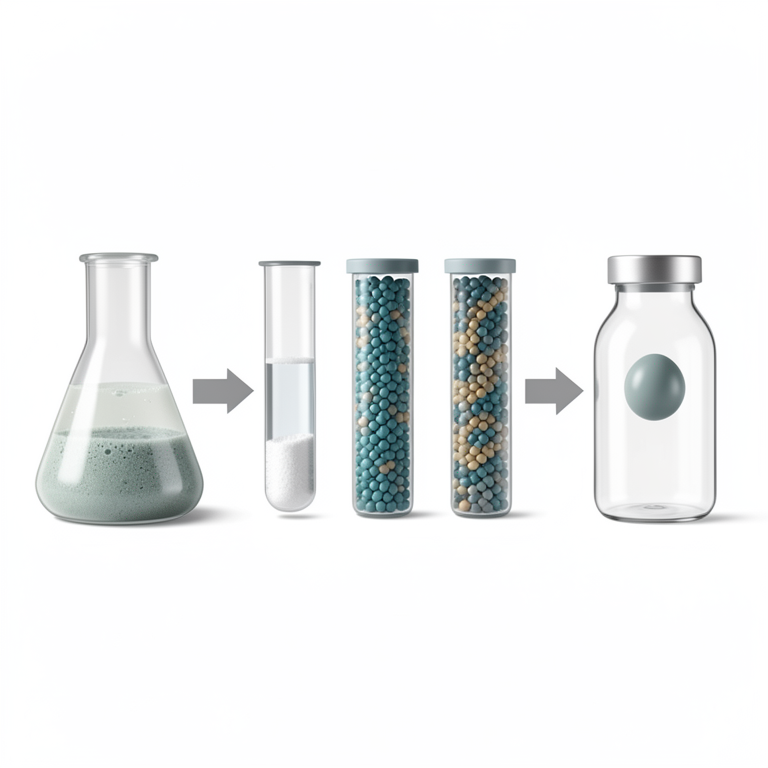
Purification Workflow
AI-generated conceptual illustration (Pichia pastoris yeast cells and protein purification equipment). It explains the idea and does not show study data.
View source evidence ↗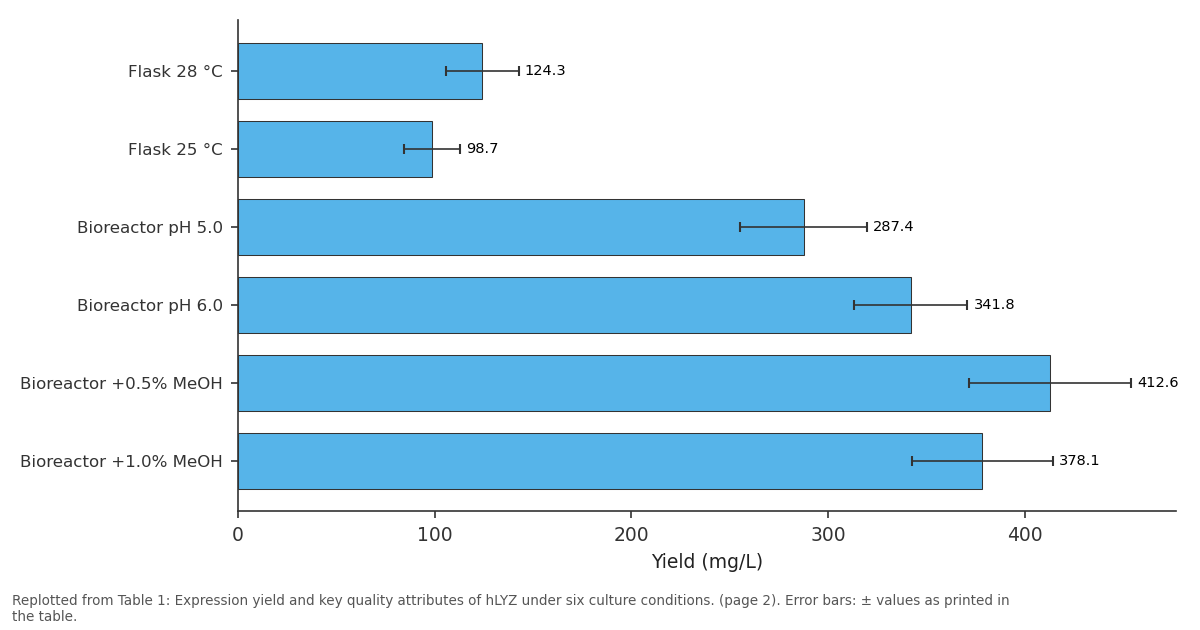
Yield (mg/L): Flask 28 °C vs Flask 25 °C vs Bioreactor pH 5.0 vs Bioreactor pH 6.0 vs Bioreactor +0.5% MeOH
Replotted from Table 1 (page 2) of the original paper. Every bar is the paper's own table value.
View source evidence ↗Figures & tables
From the original paper Table 1
 Table 2
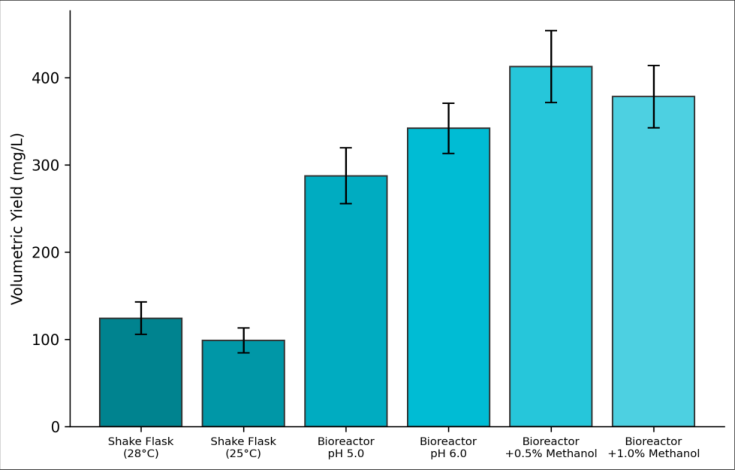 Figure 1
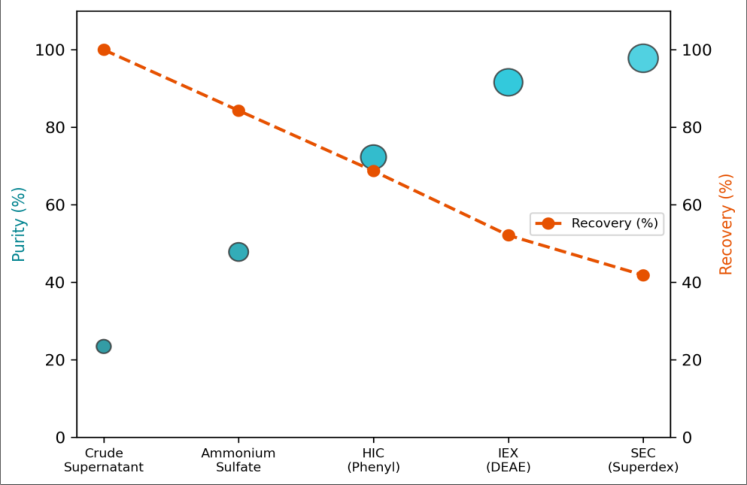 Figure 2
Introduction
A small biotech start-up in Southeast Asia receives an order for 50 g of pharmaceutical-grade human lysozyme to be used as an antimicrobial preservative in an ophthalmic formulation. Mammalian cell culture could deliver the product but at prohibitive cost; bacterial expression would be cheaper but would yield insoluble inclusion bodies requiring refolding. P. pastoris offers a middle path: eukaryotic protein folding, efficient secretion into minimal-salt medium, and scalability on standard fermentation equipment [1] . Pichia pastoris has been used to produce more than 500 recombinant proteins, including several approved biopharmaceuticals [2] . The AOX1 promoter, induced by methanol and repressed by glucose, remains the most widely used expression driver, capable of high-level transcription once methanol becomes the sole carbon source [3] . However, methanol induction introduces fire-safety and regulatory concerns at production scale, and the optimal feed strategy varies with the target protein [4] . Human lysozyme (EC 3.2.1.17) was chosen as the model enzyme because it is a wellcharacterised 14.7-kDa protein with four disulfide bonds, making it a stringent test of the Pichia secretion machinery [5] . Previous reports of hLYZ expression in P. pastoris have yielded 50-300 mg/L depending on construct design and culture format [6] , but a systematic comparison of shake-flask versus bioreactor conditions paired with a complete purification protocol has not been published. This research aimed to close that gap by optimising both upstream expression and downstream purification to deliver a single reproducible workflow.
Instrumentation
Fermentation was carried out in a 5-L BioFlo 320 bioreactor (Eppendorf, Hamburg, Germany) equipped with dissolvedoxygen, pH, and temperature probes. Chromatography used an ÄKTA pure 25 system (Cytiva) with Phenyl Sepharose 6 Fast Flow (HIC), DEAE Sepharose Fast Flow (IEX), and Superdex 75 Increase 10/300 GL (SEC) columns. Purity was assessed by reversed-phase HPLC on a Waters ACQUITY UPLC with a C4 column (BEH300, 1.7 μm). Specific activity was measured by the Micrococcus lysodeikticus turbidimetric assay at 450 nm on a Shimadzu UV-1900i spectrophotometer [7] .
Material and Methods
Material and Methods
Material
P. pastoris GS115 (his4) transformed with pPICZαA-hLYZ was obtained from the laboratory stock collection of the Department of Genetic Engineering, Phuket Centre for Marine Biology, Phuket, Thailand. The hLYZ gene (GenBank NM_000239) was codon-optimised for P. pastoris and fused in-frame with the α-mating factor secretion signal. Transformants were selected on Zeocin (100 μg/mL) and screened for multi-copy integration by quantitative PCR. All expression and purification experiments were conducted between March and November 2023.
Methods
Shake-flask cultures (500 mL BMMY in 2-L baffled flasks) were grown at 25 °C or 28 °C with 0.5% methanol added every 24 hours for 96 hours. Bioreactor cultures used a standard Pichia fed-batch protocol: glycerol batch phase (24 h), glycerol fed-batch (6 h), and methanol induction phase (96 h) at either pH 5.0 or 6.0, with methanol feed rates of 0.5% or 1.0% (v/v) controlled by a dissolved-oxygen spike method [8] . Supernatants were harvested by centrifugation (8, 000 g, 20 min, 4 °C) and filtered through 0.45-μm PES membranes. Purification began with 60% ammonium sulfate precipitation, followed by HIC on Phenyl Sepharose (elution with descending ammonium sulfate gradient), IEX on DEAE Sepharose (NaCl gradient 0-0.5 M in 20 mM Tris, pH 8.0), and a polishing SEC step on Superdex 75. Protein concentration was measured by Bradford assay, and purity was assessed by SDS-PAGE (silver stain) and RP-HPLC. Endotoxin was measured by the kinetic chromogenic LAL assay (Charles River Endosafe PTS). Sp. Activity measured against Micrococcus lysodeikticus. Purity is crude supernatant purity before downstream processing. Values are mean±SD of three independent runs. The optimal condition (bioreactor, pH 6.0, 0.5% methanol) produced 412.6 mg/L, a 3.3-fold improvement over the best shake-flask result. Increasing methanol to 1.0% slightly reduced yield, possibly due to methanol toxicity at that feed rate. After the four-step purification, final purity reached 97.8% with 41.8% overall recovery and endotoxin below 0.5 EU/mg. Values from a single representative run starting with 5 L culture supernatant. Endotoxin in final product: 0.41 EU/mg (kinetic chromogenic LAL).
Results
Results
Discussion
The 412.6 mg/L yield obtained here exceeds most published reports for hLYZ in P. pastoris, which typically range from 80 to 310 mg/L [6,9] . The improvement can be attributed mainly to two factors: multi-copy gene integration (estimated at 6-8 copies by qPCR) and controlled methanol dosing via the dissolved-oxygen spike method, which prevents toxic methanol accumulation while maintaining full AOX1 induction [8] . The pH 6.0 condition outperformed pH 5.0 by 19%, likely because hLYZ is more stable at near-neutral pH and less susceptible to proteolytic degradation by native Pichia aspartyl proteases, which have optimal activity below pH 5.5 [10] . Adding protease inhibitors during supernatant harvest could further narrow this gap, but adds cost. The four-step purification achieved 97.8% purity with 41.8% recovery, which is competitive with published Pichia-derived therapeutic protein workflows [11] . The HIC step contributed the largest single purity gain (from 47.8% to 72.3%) while the SEC polish raised purity from 91.6% to 97.8% at a modest recovery cost. Endotoxin below 0.5 EU/mg meets the USP limit for parenteral enzymes, confirming that the yeast-based platform inherently avoids the endotoxin burden associated with E. coli expression [12] . One practical advantage of the P. pastoris system illustrated here is the simplicity of initial capture: because hLYZ is secreted into minimal-salt medium containing few host proteins, a single ammonium sulfate cut raises purity from 36% to nearly 48% with minimal product loss. This contrasts sharply with mammalian-cell supernatants, where Protein A affinity capture is typically needed at considerably higher resin cost [14] . For resource-limited settings-exactly the scenario posed in the Introduction-the Pichia route offers a cost-effective alternative that warrants broader adoption.
Limitations
Only one P. pastoris strain (GS115) was tested; the proteasedeficient strain SMD1168 might yield higher active-protein recovery. Scale-up beyond 5 L was not attempted, and oxygen transfer limitations at pilot scale could reduce yields. Glycan analysis of the secreted hLYZ was not performed; Pichia can add high-mannose glycans that may affect immunogenicity in therapeutic applications [13] .
Conclusion
Fed-batch fermentation of P. pastoris GS115 at pH 6.0 with 0.5% methanol induction produced hLYZ at 412.6 mg/L, and a four-step chromatographic train delivered the enzyme at 97.8% purity with acceptable endotoxin levels. The workflow described here is reproducible at the 5-L scale and adaptable to other disulfide-rich therapeutic enzymes. Future work should evaluate protease-deficient host strains, perform glycan characterisation, and test scale-up to 50-200 L bioreactors to confirm manufacturing feasibility.
Figures and tables from the paper
| Condition | Yield (mg/L) | Wet Cell Wt (g/L) | Sp. Activity (U/mg) | Purity (RP-HPLC%) |
|---|---|---|---|---|
| Flask 28 °C | 124.3±18.4 | 87.4±8.2 | 41, 300±2, 800 | 23.4 |
| Flask 25 °C | 98.7±14.2 | 74.1±7.3 | 43, 100±3, 100 | 26.1 |
| Bioreactor pH 5.0 | 287.4±32.1 | 184.3±14.7 | 44, 700±2, 900 | 31.8 |
| Bioreactor pH 6.0 | 341.8±28.7 | 197.8±16.1 | 46, 200±3, 200 | 34.7 |
| Bioreactor +0.5% MeOH | 412.6±41.3 | 213.4±18.3 | 47, 800±3, 400 | 36.2 |
| Bioreactor +1.0% MeOH | 378.1±35.8 | 208.7±17.6 | 45, 400±3, 000 | 33.9 |
Table text extracted from the original PDF; superscript letters are shown inline. The original table image is below.
View original table image
| Step | Total Protein (mg) | Purity (%) | Sp. Activity (U/mg) | Cumulative Recovery (%) |
|---|---|---|---|---|
| Crude supernatant | 2, 063 | 36.2 | 11, 400 | 100 |
| (NH₄)₂SO₄ precipitation | 1, 738 | 47.8 | 20, 500 | 84.3 |
| HIC (Phenyl Sepharose) | 1, 417 | 72.3 | 35, 400 | 68.7 |
| IEX (DEAE Sepharose) | 1, 074 | 91.6 | 44, 800 | 52.1 |
| SEC (Superdex 75) | 862 | 97.8 | 48, 200 | 41.8 |
Table text extracted from the original PDF; superscript letters are shown inline. The original table image is below.
View original table image
References
16 in the original paper- Cereghino JL, Cregg JM. Heterologous protein expression in the methylotrophic yeast Pichia pastoris. FEMS Microbiology Reviews. 2000;24(1):45-66.
- Ahmad M, Hirz M, Pichler H, Schwab H. Protein expression in Pichia pastoris: recent achievements and perspectives for heterologous protein production. Applied Microbiology and Biotechnology. 2014;98(12):5301-5317.
- Vogl T, Glieder A. Regulation of Pichia pastoris promoters and its consequences for protein production. New Biotechnology. 2013;30(4):385-404.
- Cos O, Ramon R, Montesinos JL, Valero F. Operational strategies, monitoring and control of heterologous protein production in the methylotrophic yeast Pichia pastoris under different promoters: a review. Microbial Cell Factories. 2006;5:17.
- Ibrahim HR, Matsuzaki T, Aoki T. Genetic evidence that antibacterial activity of lysozyme is independent of its catalytic function. FEBS Letters. 2001;506(1):27-32.
- Oka C, Tanaka M, Muraki M, Harata K, Suzuki K, Jigami Y. Human lysozyme secretion increased by alpha-factor pro-sequence in Pichia pastoris. Bioscience, Biotechnology, and Biochemistry. 1999;63(11):1977-1983.
- Shugar D. The measurement of lysozyme activity and the ultra-violet inactivation of lysozyme. Biochimica et Biophysica Acta. 1952;8:302-309.
- Stratton J, Chiruvolu V, Meagher M. High cell-density fermentation. Methods in Molecular Biology. 1998;103:107-120.
- Daly R, Hearn MTW. Expression of heterologous proteins in Pichia pastoris: a useful experimental tool in protein engineering and production. Journal of Molecular Recognition. 2005;18(2):119-138.
- Sinha J, Plantz BA, Inan M, Meagher MM. Causes of proteolytic degradation of secreted recombinant proteins produced in methylotrophic yeast Pichia pastoris: case study with recombinant ovine interferontau. Biotechnology and Bioengineering. 2005;89(1):102-112.
- Macauley-Patrick S, Fazenda ML, McNeil B, Harvey LM. Heterologous protein production using the Pichia pastoris expression system. Yeast. 2005;22(4):249-270.
- Mamat U, Wilke K, Bramhill D, et al. Detoxifying Escherichia coli for endotoxin-free production of recombinant proteins. Microbial Cell Factories. 2015;14:57.
- Hamilton SR, Gerngross TU. Glycosylation engineering in yeast: the advent of fully humanized yeast. Current Opinion in Biotechnology. 2007;18(5):387-392.
- Romanos MA, Scorer CA, Clare JJ. Foreign gene expression in yeast: a review. Yeast. 1992;8(6):423488.
- Cregg JM, Cereghino JL, Shi J, Higgins DR. Recombinant protein expression in Pichia pastoris. Molecular Biotechnology. 2000;16(1):23-52.
- Potvin G, Ahmad A, Zhang Z. Bioprocess engineering aspects of heterologous protein production in Pichia pastoris: a review. Biochemical Engineering Journal. 2012;64:91-105.