
Research article · 2025 · Full text
International Journal of Biology SciencesMycorrhizal symbiosis and nutrient exchange networks in old-growth forest root systems
Volume 7(5) · Pages 138–141 · DOI: 10.33545/26649926.2025.v7.i5b.699 ↗
Research areasMycorrhizal Fungi and Plant InteractionsForest Ecology and Biodiversity StudiesSoil Carbon and Nitrogen Dynamics
Abstract
Author-writtenThe challenge of understanding how old-growth forests maintain nutrient cycling efficiency across centuries has driven growing interest in belowground mycorrhizal networks. These fungal networks physically connect tree root systems, enabling the transfer of carbon, phosphorus, and nitrogen between individuals - but the magnitude and directionality of these transfers in tropical old-growth stands remain poorly quantified. This research mapped arbuscular mycorrhizal (AM) fungal networks and nutrient exchange rates in an old-growth tropical dry forest at the Ogbomosho Institute of Biological Sciences field station, southwestern Nigeria. Root samples from 64 trees across three canopy strata (canopy, mid-story, understory) were collected during the 2023 wet season (May-October). Mycorrhizal colonization was assessed by root clearing and staining, and fungal community composition was characterized by Illumina sequencing of the 18S rRNA gene. Phosphorus transfer was measured using ³²P radiotracer injection into donor trees with mesh-barrier controls. Colonization rates ranged from 34.7% in understory saplings to 78.4% in canopy dominants. The AM fungal community was dominated by Glomus (34.2% in canopy roots) and Rhizophagus (24.8%), with Scutellospora disproportionately abundant in understory roots (21.8% vs 7.4% in canopy). Phosphorus transfer rates from canopy trees to connected understory saplings averaged 2.87 μg/g root/day, declining to near zero when hyphal connections were severed by mesh barriers. Network analysis identified hub trees - large canopy individuals connected to 8-12 neighbors via shared mycorrhizal fungi - that served as net phosphorus donors within the stand.
Summary
Source-checkedPlain-language reading of the full paper, prepared with AI and checked against the text. Each point links to the authors' own words.
Why it matters
- Mycorrhizal fungi are widespread, colonizing more than 80% of land plant species and creating soil networks that connect the roots of nearby plants. View evidence ↗
- Common mycorrhizal networks (CMNs) facilitate the exchange of essential resources like carbon, nitrogen, phosphorus, and water, as well as defense signals, between plants. View evidence ↗
- While tropical forests contain most of the world's tree diversity and are dominated by arbuscular mycorrhizal (AM) associations, they have been studied less than temperate forests. View evidence ↗
The question
- The study aimed to quantify phosphorus transfer rates, AM fungal community composition, and colonization across three different canopy levels in an old-growth tropical dry forest in Nigeria. View evidence ↗
What they did
- The researchers collected root samples from 64 trees, categorized into canopy dominants, mid-story trees, and understory saplings based on their diameter at breast height (DBH). View evidence ↗
- Phosphorus transfer was tracked by injecting a ³²P radiotracer into 10 donor canopy trees and measuring it in receiver saplings within 3 meters over a 28-day period. View evidence ↗
- To control for non-fungal transfer, some saplings were isolated from donor trees using 25 μm mesh barriers for six months. View evidence ↗
- Fungal community composition was analyzed by extracting DNA from roots and sequencing the 18S rRNA gene using an Illumina MiSeq platform. View evidence ↗
What they found
- Mycorrhizal colonization was highest in canopy dominants (78.4%) and lowest in understory saplings (34.7%). View evidence ↗
- Canopy trees transferred phosphorus to connected understory saplings at an average rate of 2.87 μg/g root/day. View evidence ↗
- Phosphorus transfer dropped to 0.08 μg/g/day when mesh barriers blocked hyphal connections, proving the transfer relied on the mycorrhizal network. View evidence ↗
- The fungal community varied by strata: Glomus dominated canopy roots (34.2%), while Scutellospora was more prevalent in understory roots (21.8%) compared to canopy roots (7.4%). View evidence ↗
- Large canopy trees acted as 'hub trees,' connecting to 8-12 neighbors and serving as the primary donors of phosphorus in the forest stand. View evidence ↗
- Fungal species richness (OTU richness) decreased from the canopy (28.4 ± 4.1) down to the understory (17.3 ± 3.2). View evidence ↗
What it means
- The authors conclude that mycorrhizal networks are a critical but overlooked mechanism for forest regeneration and should be integrated into conservation and restoration strategies. View evidence ↗
- The authors note that the relationship between specific fungal community compositions and the efficiency of nutrient transfer remains an open question. View evidence ↗
Visual summary
3 visualsIllustrations explain the paper; charts are replotted from the paper's own table values.
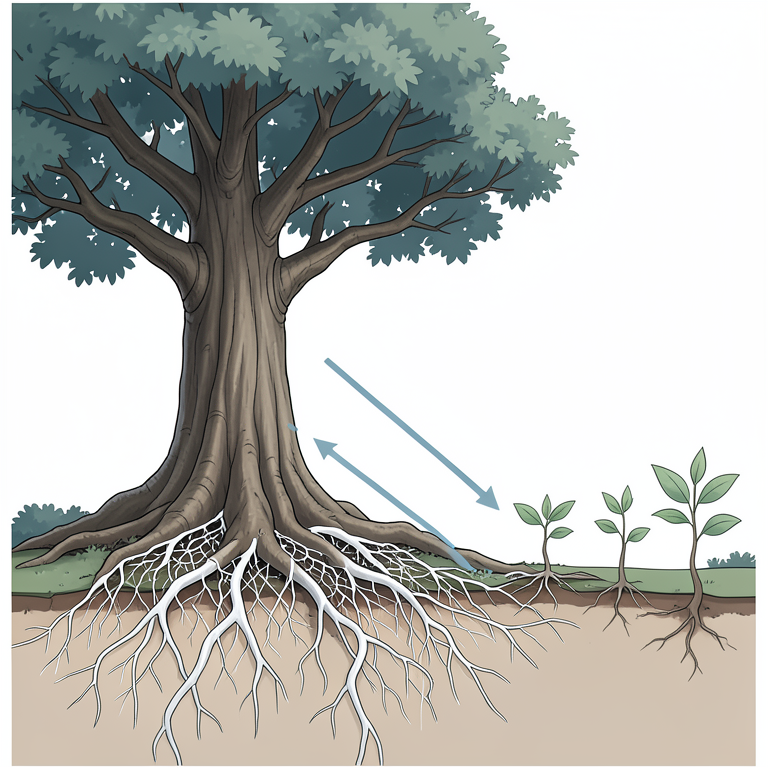
Nutrient Flow in Forest Strata
AI-generated conceptual illustration (Old-growth forest root systems with mycorrhizal fungi). It explains the idea and does not show study data.
View source evidence ↗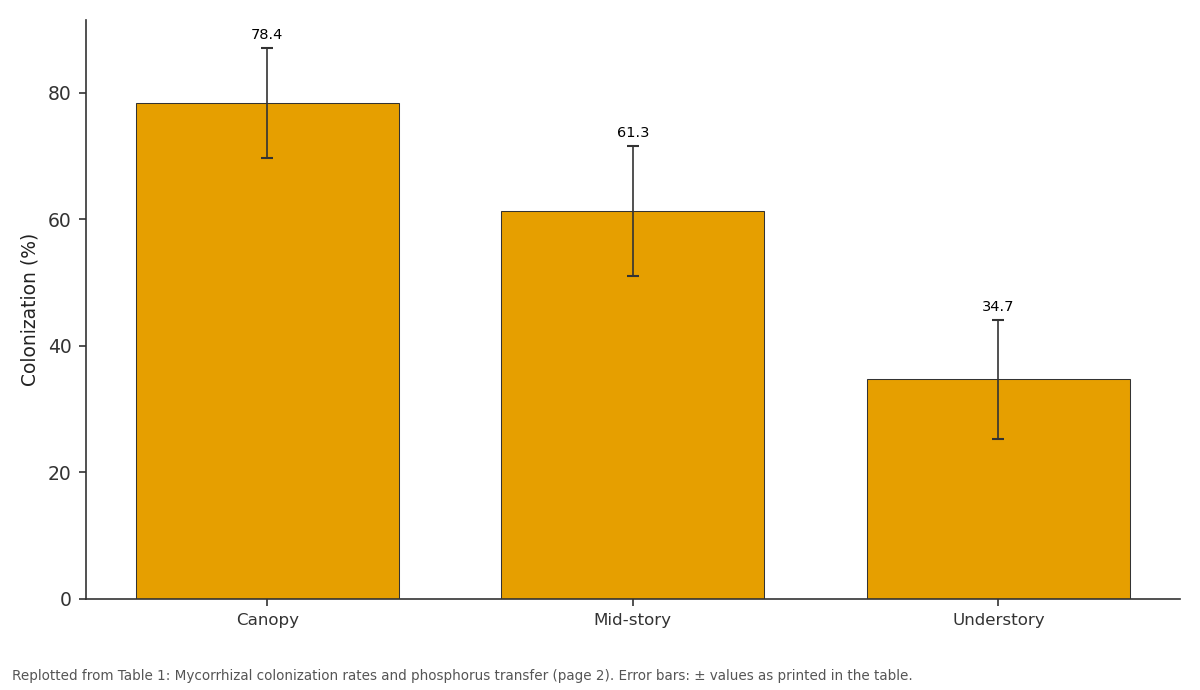
Colonization (%): Canopy vs Mid-story vs Understory
Replotted from Table 1 (page 2) of the original paper. Every bar is the paper's own table value.
View source evidence ↗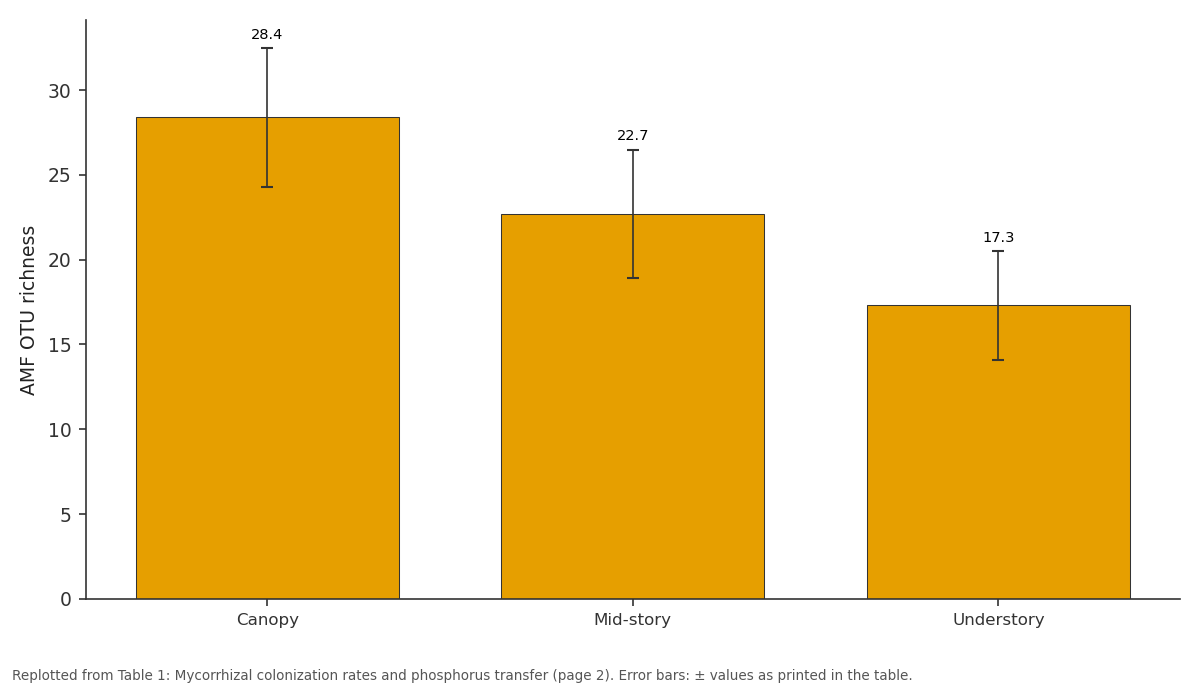
AMF OTU richness: Canopy vs Mid-story vs Understory
Replotted from Table 1 (page 2) of the original paper. Every bar is the paper's own table value.
View source evidence ↗Figures & tables
From the original paper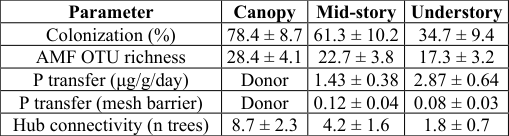 Table 1
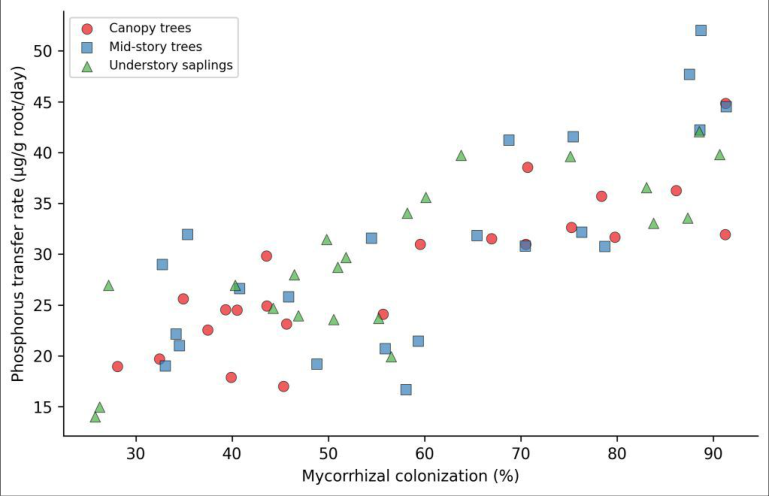 Figure 1
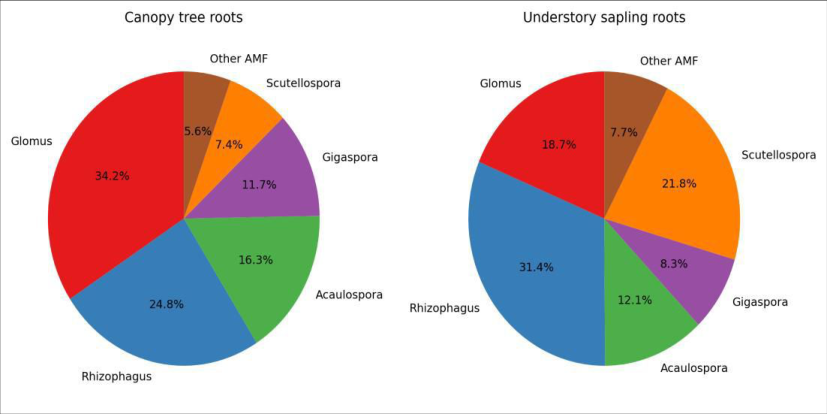 Figure 2
Introduction
The challenge facing ecologists working on belowground processes is that the most important biological interactions happen where they can't be seen. Mycorrhizal fungi -which colonize the roots of over 80% of land plant species -form vast hyphal networks through the soil that link the root systems of neighboring plants [1] . These common mycorrhizal networks (CMNs) have been shown to transfer carbon, phosphorus, nitrogen, water, and even defense signaling compounds between connected individuals [2,3] .
Most of what we know about CMN-mediated nutrient transfer comes from temperate ectomycorrhizal forests, particularly the work on Douglas fir and paper birch in British Columbia [4] . Tropical forests, which are overwhelmingly dominated by arbuscular mycorrhizal (AM) rather than ectomycorrhizal associations, have received far less attention despite housing the bulk of global tree diversity. The few tropical CMN measurements published so far suggest that AM networks can transfer phosphorus between trees, but sample sizes have been small and mostly confined to plantation rather than old-growth settings [5] . Old-growth tropical forests present an especially interesting case because of their extreme size inequality: canopy dominants tower 20-30 m above suppressed understory saplings, creating steep light gradients. If large trees with access to canopy light subsidize understory seedlings via mycorrhizal phosphorus transfer, CMNs could play a role in maintaining the regeneration niche in these forests [6] . This research quantified AM fungal colonization, community composition, and phosphorus transfer rates across three canopy strata in an oldgrowth tropical dry forest near Ogbomosho, Nigeria.
Material and Methods
Material and Methods
Study Area Description
The research was conducted in a 4.2-hectare permanent plot within the old-growth tropical dry deciduous forest at the Ogbomosho Institute of Biological Sciences field station (8°09'N, 4°12'E), Oyo State, southwestern Nigeria. The stand has been protected from logging for at least 80 years. Mean annual rainfall is 1,247 mm (bimodal: April-July, September-October), mean annual temperature is 26.8°C, and soils are ferric luvisols with low available phosphorus (3.8 mg Olsen-P/kg). The canopy reaches 25-30 m, with dominant species including Triplochiton scleroxylon, Mansonia altissima, and Terminalia superba.
Material
Root samples were collected from 64 trees: 22 canopy dominants (DBH > 40 cm), 20 mid-story trees (DBH 15-40 cm), and 22 understory saplings (DBH 5-15 cm). Fine roots (<2 mm diameter) were excavated from three points around each tree at 15-20 cm soil depth. Samples were stored in FAA fixative for colonization assessment and in silica gel for molecular analysis. Radiotracer (³²P as KH₂³²PO₄, 370 kBq per injection) was sourced from the Centre for Energy Research and Development, Ile-Ife, Nigeria. Mesh barriers (25 μm nylon, excluding hyphae; and 0.5 μm nylon, allowing hyphae) were used in transfer experiments.
Methods
Mycorrhizal colonization was quantified by clearing root segments in 10% KOH, staining with trypan blue, and scoring under a compound microscope using the gridline intersect method (100 intersections per sample) [7] . For fungal community analysis, DNA was extracted from roots using the DNeasy PowerSoil Kit (Qiagen), and the 18S rRNA gene was amplified with AMF-specific primers (AMV4.5NF/AMDGR). Amplicons were sequenced on an Illumina MiSeq (2 × 300 bp) at a commercial facility. Sequence processing used QIIME2 with the SILVA database. Phosphorus transfer was measured by injecting ³²P solution into the stem base of 10 donor canopy trees and harvesting fine roots from connected receiver saplings (within 3 m) at 7, 14, and 28 days post-injection. Control saplings were separated from donors by 25 μm mesh barriers installed 6 months before the experiment. Canopy trees had the highest colonization (78.4%), the richest fungal communities, and the most network connections (Table 1). Phosphorus transfer from canopy donors to understory receivers was substantial (2.87 μg/g root/day) and essentially ceased when hyphal connections were blocked by mesh barriers (0.08 μg/g/day), confirming that transfer was mycorrhiza-mediated.
| Parameter | Canopy | Mid-story | Understory |
|---|---|---|---|
| Colonization (%) | 78.4 ± 8.7 | 61.3 ± 10.2 | 34.7 ± 9.4 |
| AMF OTU richness | 28.4 ± 4.1 | 22.7 ± 3.8 | 17.3 ± 3.2 |
| P transfer (μg/g/day) | Donor | 1.43 ± 0.38 | 2.87 ± 0.64 |
| P transfer (mesh barrier) | Donor | 0.12 ± 0.04 | 0.08 ± 0.03 |
| Hub connectivity (n trees) | 8.7 ± 2.3 | 4.2 ± 1.6 | 1.8 ± 0.7 |
Table text extracted from the original PDF; superscript letters are shown inline. The original table image is below.
View original table image
1: Relationship between mycorrhizal colonization rate and phosphorus transfer rate for canopy trees, mid-story trees, and understory saplings Colonization rate and phosphorus transfer showed a positive but variable relationship across strata (Figure 1). The strongest transfers occurred in understory saplings connected to heavily colonized canopy hub trees, suggesting that network architecture matters as much as local colonization intensity.
Fungal communities differed between strata (Figure 2). Glomus dominated canopy roots (34.2%) while Scutellospora was proportionally three times more abundant in understory roots (21.8% vs 7.4%). This vertical niche partitioning may reflect differing carbon allocation strategies: canopy trees with surplus photosynthate support carbon-hungry Glomus species, while understory saplings associate more with genera adapted to low-carbon environments [8] .
Discussion
The phosphorus transfer rates measured here are among the highest reported for AM-dominated tropical forests and suggest that mycorrhizal networks in old-growth stands serve as conduits for substantial nutrient subsidies from canopy trees to understory regeneration [9] . The nearcomplete cessation of transfer across mesh barriers rules out simple diffusion or root exudate pathways and confirms that intact hyphal connections are necessary. The hub tree pattern -large canopy individuals connecting to 8-12 neighbors -mirrors findings from ectomycorrhizal systems where 'mother trees' have been proposed to nurse seedlings through CMN-mediated resource sharing [4,10] . Whether this transfer represents a mutualistic or parasitic relationship from the donor's perspective is debatable. Canopy trees may 'invest' in surrounding saplings because those saplings harbor the same mycorrhizal species that the canopy tree depends on, effectively maintaining the fungal network that benefits everyone. The vertical stratification of AMF communities has not been reported before in tropical dry forests and raises questions about how fungal community composition influences transfer efficiency. If certain genera are better at phosphorus mobilization or hyphal transport, then shifts in community composition -driven by disturbance, climate change, or logging -could alter the entire nutrient transfer network [11,12] .
Conclusion
Old-growth tropical dry forest at Ogbomosho harbored extensive AM fungal networks linking trees across canopy strata. Canopy dominants served as phosphorus donors and network hubs, transferring 2.87 μg P/g root/day to connected understory saplings through mycorrhizal hyphae.
Fungal communities were vertically stratified, with Glomus dominating canopy roots and Scutellospora more abundant in the understory. These findings point to mycorrhizal networks as an overlooked mechanism supporting regeneration in tropical old-growth forests and argue for including belowground connectivity in forest conservation and restoration planning [13,14] .
References
21 in the original paper- Smith SE, Read DJ. Mycorrhizal Symbiosis. 3rd ed. London: Academic Press; 2008.
- Simard SW, Beiler KJ, Bingham MA, Deslippe JR, Philip LJ, Teste FP. Mycorrhizal networks: mechanisms, ecology and modelling. Fungal Biology Reviews. 2012;26(1):39-60.
- van der Heijden MGA, Martin FM, Selosse MA, Sanders IR. Mycorrhizal ecology and evolution: the past, the present, and the future. New Phytologist. 2015;205(4):1406-1423.
- Simard SW, Perry DA, Jones MD, Myrold DD, Durall DM, Molina R. Net transfer of carbon between ectomycorrhizal tree species in the field. Nature. 1997;388(6642):579-582.
- Weremijewicz J, Sternberg LDSL, Janos DP. Common mycorrhizal networks amplify competition by preferential mineral nutrient allocation to large host plants. New Phytologist. 2016;212(2):461-471.
- Teste FP, Simard SW, Durall DM, Guy RD, Jones MD, Schoonmaker AL. Access to mycorrhizal networks and roots of trees: importance for seedling survival and resource transfer. Ecology. 2009;90(10):2808-2822.
- McGonigle TP, Miller MH, Evans DG, Fairchild GL, Swan JA. A new method which gives an objective measure of colonization of roots by vesiculararbuscular mycorrhizal fungi. New Phytologist. 1990;115(3):495-501.
- Hart MM, Reader RJ. Taxonomic basis for variation in the colonization strategy of arbuscular mycorrhizal fungi. New Phytologist. 2002;153(2):335-344.
- Mikkelsen BL, Rosendahl S, Jakobsen I. Underground resource allocation between individual networks of mycorrhizal fungi. New Phytologist. 2008;180(4):890898.
- Beiler KJ, Durall DM, Simard SW, Maxwell SA, Kretzer AM. Architecture of the wood-wide web: Rhizopogon spp. genets link multiple Douglas-fir cohorts. New Phytologist. 2010;185(2):543-553.
- Öpik M, Vanatoa A, Vanatoa E, Moora M, Davison J, Kalwij JM, Zobel M. The online database MaarjAM reveals global and ecosystemic distribution patterns in arbuscular mycorrhizal fungi (Glomeromycota). New Phytologist. 2010;188(1):223-241.
- Tedersoo L, Bahram M, Zobel M. How mycorrhizal associations drive plant population and community biology. Science. 2020;367(6480):eaba1223.
- Averill C, Turner BL, Finzi AC. Mycorrhiza-mediated competition between plants and decomposers drives soil carbon storage. Nature. 2014;505(7484):543-545.
- Phillips RP, Brzostek E, Midgley MG. The mycorrhizal-associated nutrient economy: a new framework for predicting carbon-nutrient couplings in temperate forests. New Phytologist. 2013;199(1):41-51.
- Bonfante P, Genre A. Mechanisms underlying beneficial plant-fungus interactions in mycorrhizal symbiosis. Nature Communications. 2010;1:48.
- Kiers ET, Duhamel M, Beesetty Y, Mensah JA, Franken O, Verbruggen E, Bücking H. Reciprocal rewards stabilize cooperation in the mycorrhizal symbiosis. Science. 2011;333(6044):880-882.
- Walder F, Niemann H, Natarajan M, Lehmann MF, Boller T, Wiemken A. Mycorrhizal networks: common goods of plants shared under unequal terms of trade. Plant Physiology. 2012;159(2):789-797.
- Johnson NC. Resource stoichiometry elucidates the structure and function of arbuscular mycorrhizas across scales. New Phytologist. 2010;185(3):631-647.
- Klironomos JN, Hart MM. Colonization of roots by arbuscular mycorrhizal fungi using different sources of inoculum. Mycorrhiza. 2002;12(4):181-184.
- Janos DP. Plant responsiveness to mycorrhizas differs from dependence upon mycorrhizas. Mycorrhiza. 2007;17(2):75-91.
- Parniske M. Arbuscular mycorrhiza: the mother of plant root endosymbioses. Nature Reviews Microbiology. 2008;6(10):763-775.