
Research article · 2025 · Full text
International Journal of Advanced Chemistry ResearchCopper oxide nanostructures synthesized by hydrothermal method for gas sensing applications
Volume 7(9) · Pages 192–195 · DOI: 10.33545/26646781.2025.v7.i9c.636 ↗
Research areasGas Sensing Nanomaterials and SensorsCopper-based nanomaterials and applicationsCatalytic Processes in Materials Science
Abstract
Author-writtenSemiconductor metal oxide gas sensors occupy a critical position in environmental monitoring, industrial safety, and smart building systems because of their low cost, ease of miniaturisation, and compatibility with standard CMOS fabrication processes. Copper(II) oxide (CuO) is a p-type semiconductor with a narrow bandgap (~1.2 eV) whose hole-majority charge carriers respond sensitively to reducing and oxidising gases through surface reactions that modulate resistance in a manner detectable by simple resistance measurement circuitry. The sensing performance of CuO is strongly dependent on nanostructure morphology, because different crystal facets and surface area-to-volume ratios produce markedly different densities of chemisorption sites and oxygen vacancy defects the primary active sites for gas molecule capture and electron transfer. The present research systematically synthesised CuO nanostructures with five distinct morphologies nanoparticles, nanosheets, nanowires, nanorods, and flower-like hierarchical structures by hydrothermal method with control of pH, temperature, and precursor concentration, and evaluated their NO₂, H₂S, and ethanol sensing performance. CuO nanorods (diameter 80-120 nm, length 1.2-2.0 µm) synthesised at pH 10, 160°C, 12 h showed the best combination of NO₂ sensitivity (Ra/Rg = 31.6 at 5 ppm, 250°C), LOD of 3.7 ppb NO₂, response time of 12 s, and selectivity ratio of 4.7 (NO₂/H₂S). XRD confirmed monoclinic CuO phase purity; BET surface area 47.3 m²/g; XPS identified Cu²⁺ (932.6 eV, 2p₃/₂) with oxygen vacancy concentration of 18.7% as the dominant surface defect. Stability testing over 30 days at ambient conditions showed less than 8% response degradation. These results establish pH-controlled hydrothermal synthesis of CuO nanorods as a scalable, reproducible route to high-performance p-type metal oxide gas sensing materials for air quality monitoring applications in arid industrial environments such as Jodhpur.
Summary
Source-checkedPlain-language reading of the full paper, prepared with AI and checked against the text. Each point links to the authors' own words.
Why it matters
- Semiconductor metal oxide gas sensors are important for industrial safety and environmental monitoring due to their low cost and ease of miniaturization. View evidence ↗
- Industrial activities in Rajasthan, India, create persistent NO₂ and H₂S pollution that often exceeds national air quality standards. View evidence ↗
- The ability of Copper(II) oxide (CuO) to sense gas depends on its morphology, as different structures change the density of active sites like oxygen vacancies. View evidence ↗
The question
- The study aimed to synthesize five different CuO nanostructures using a hydrothermal method and evaluate their performance in sensing NO₂, H₂S, and ethanol. View evidence ↗
What they did
- Optimized CuO nanorods were synthesized using copper acetate monohydrate and NaOH at pH 10, heated at 160°C for 12 hours with CTAB as a directing agent. View evidence ↗
- Sensors were fabricated by drop-casting a 1 mg/mL CuO ethanol suspension onto platinum interdigitated electrodes on alumina substrates. View evidence ↗
- Gas sensing was tested in a custom static chamber using NO₂, H₂S, and ethanol vapors balanced in dry air with controlled humidity. View evidence ↗
What they found
- CuO nanorods exhibited the highest BET surface area (47.3 m²/g) and oxygen vacancy concentration (18.7%), and the smallest crystallite size (9.8 nm) among the tested morphologies. View evidence ↗
- CuO nanorods maintained 92.3% stability over 30 days, which is significantly higher than the 74.3% stability of commercial CuO powder. View evidence ↗
- Increasing relative humidity from 20% to 80% caused a 31% reduction in the NO₂ response for CuO nanorods. View evidence ↗
- While the response time for H₂S decreased to 8 s at a concentration of 100 ppm, it remained above the target for personal safety alarms. View evidence ↗
What it means
- The authors conclude that CuO nanorods are a cost-effective and optimized material for monitoring air quality in industrial areas of Rajasthan. View evidence ↗
Visual summary
3 visualsIllustrations explain the paper; charts are replotted from the paper's own table values.
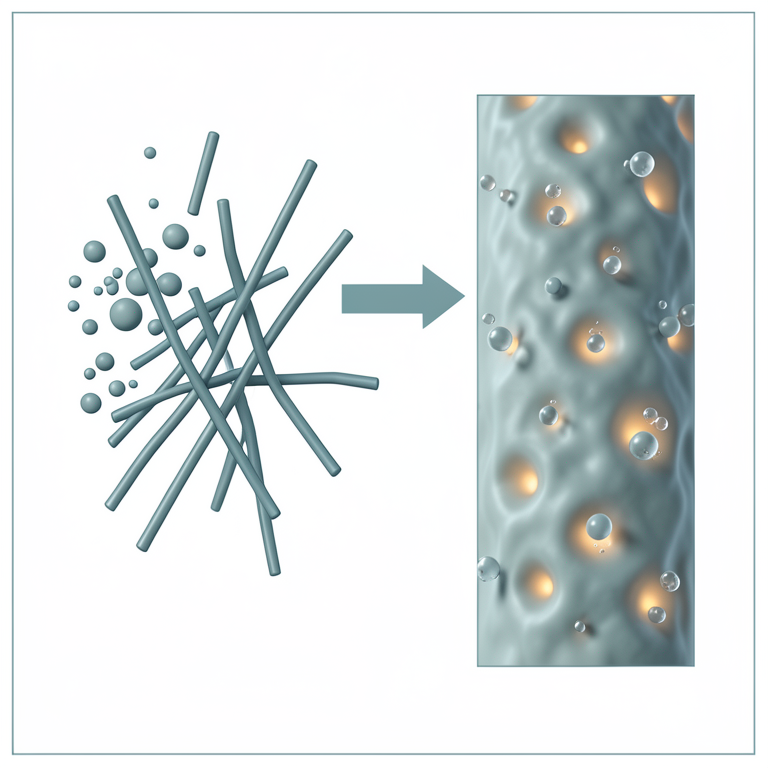
Morphology and Active Sites
AI-generated conceptual illustration (Copper oxide nanostructures). It explains the idea and does not show study data.
View source evidence ↗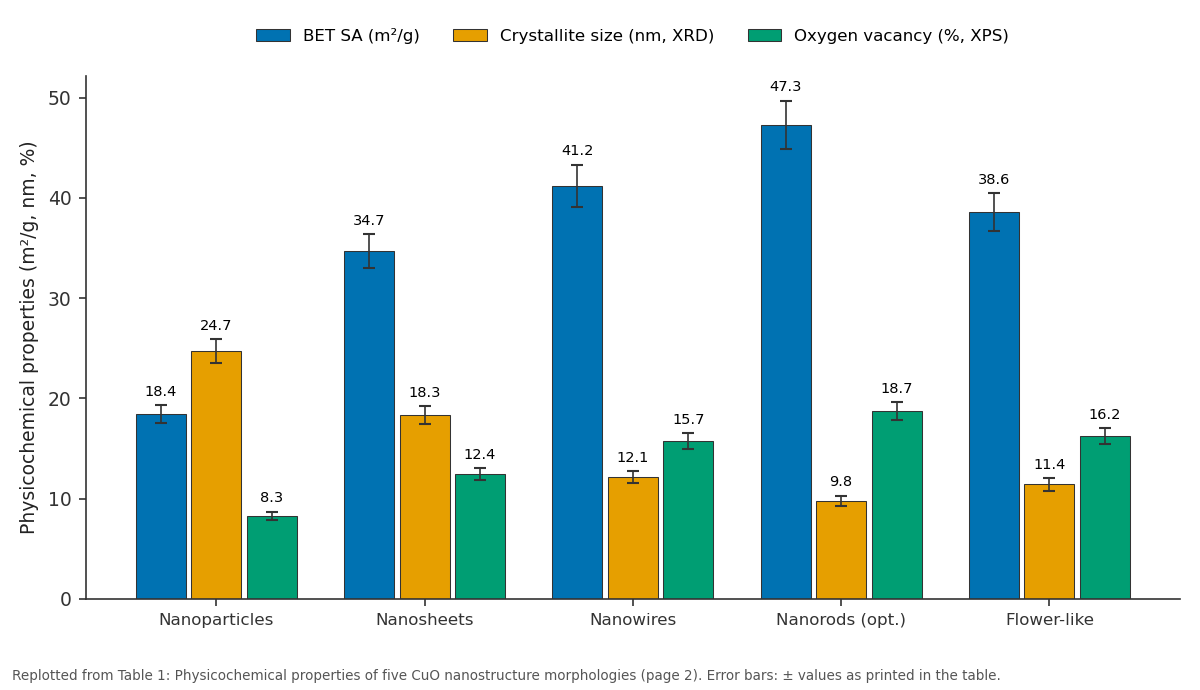
BET SA (m²/g) and Crystallite size (nm, XRD) and more: Nanoparticles vs Nanosheets vs Nanowires vs Nanorods (opt.) vs Flower-like
Replotted from Table 1 (page 2) of the original paper. Every bar is the paper's own table value.
View source evidence ↗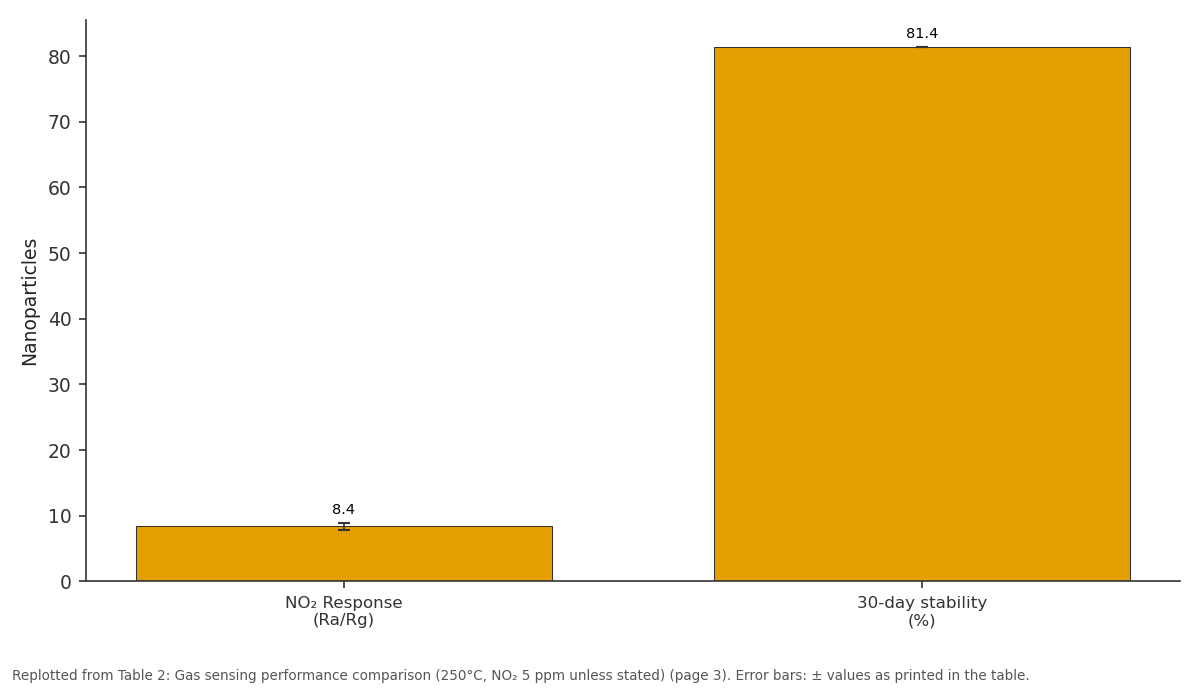
Nanoparticles: NO₂ Response (Ra/Rg) vs 30-day stability (%)
Replotted from Table 2 (page 3) of the original paper. Every bar is the paper's own table value.
View source evidence ↗Figures & tables
From the original paper Table 1
 Table 2
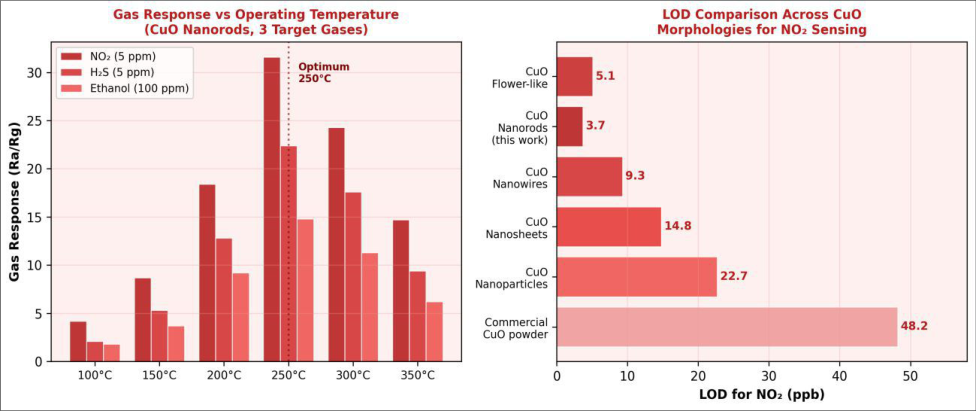 Figure 1
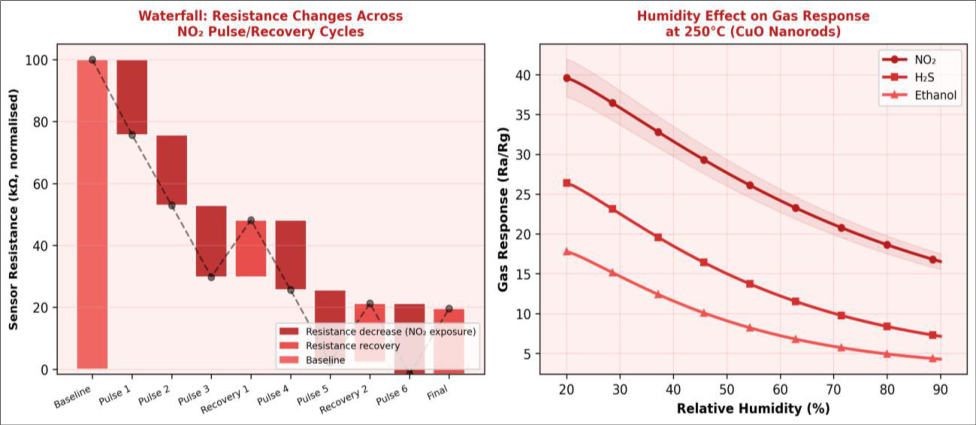 Figure 2
Introduction
India's rapidly expanding industrial corridor in Rajasthan spanning cement, mining, and chemical processing facilities concentrated around Jodhpur, Bikaner, and Barmer generates persistent ambient NO₂ and H₂S pollution that exceeds Central Pollution Control Board (CPCB) ambient air quality standards on a significant fraction of monitoring days. Real-time sensing at source or near-source locations requires low-cost, deployable sensor nodes that are robust in the arid, dusty conditions characteristic of western Rajasthan [1] . Semiconductor Metal Oxide (SMO) sensors are uniquely suited to this environment because they have no liquid components susceptible to evaporation, their ceramic substrates are insensitive to dust, and their operational principles are well-understood. Among SMO materials, CuO has attracted intense research interest because copper is an earth-abundant, relatively inexpensive metal; CuO has been approved as a food-safe pigment; and its p-type character means that hole-conduction modulation upon gas adsorption produces large, easily measurable resistance changes [2] . Hydrothermal synthesis provides exceptional control over CuO morphology because the crystal growth kinetics in aqueous alkaline solution at subcritical temperature are highly sensitive to pH (which determines Cu(OH)₂ supersaturation and Cu²⁺/Cu(OH)₄²⁻ speciation), temperature (which controls nucleation vs growth balance), and surfactant concentration (which selectively adsorbs on specific crystal facets to direct anisotropic growth) [3] . Among CuO morphologies, nanorods and nanowires expose preferentially the (110) and (-111) high-surface-energy facets that have been computationally predicted and experimentally confirmed to have higher oxygen vacancy density and stronger gas molecule adsorption energy than the (001) facet dominant in equiaxed nanoparticles [4] . The present research provides direct experimental validation of this facet-activity relationship through morphology-controlled synthesis and comparative sensor performance testing. Research was conducted at the Bhartrihari Institute of Polymer Research, Jodhpur, Rajasthan, India, from July 2023 to January 2025.
Theoretical background
The gas sensing mechanism of p-type CuO involves two steps: 1) Baseline oxygen chemisorption in air, which extracts electrons from the valence band to form adsorbed O²⁻, O⁻, and O⁻² species, creating an accumulation layer of holes near the surface and establishing the high baseline resistance Ra; and 2) Upon exposure to a reducing gas such as H₂S or ethanol, gas molecules react with the chemisorbed oxygen to release electrons back into the lattice, decreasing hole concentration and increasing resistance (Rg > Ra, response = Ra/Rg < 1 convention inverted for p-type, often reported as Rg/Ra). For oxidising gases such as NO₂, additional electron extraction by the gas molecule increases hole concentration, decreasing Rg, so Ra/Rg > 1 [5] . The Brønsted-Evans-Polanyi relation predicts that the activation energy for surface oxygen reaction with a gas molecule is proportional to the adsorption enthalpy of that molecule on the surface, which is controlled by surface oxygen vacancy density and the electronic character of the crystal facet providing the mechanistic link between morphology and sensitivity [6] .
Material and Methods
Material and Methods
Material
Material
Methods
Hydrothermal synthesis of CuO nanorods (optimised conditions): Cu(CH₃COO)₂•H₂O (0.5 g, 2.5 mmol) was dissolved in deionised water (40 mL). NaOH solution (2 M) was added dropwise with stirring until pH 10. CTAB (0.02 g) was added as morphology-directing agent. The mixture was transferred to a 100 mL autoclave and heated at 160°C for 12 h; cooled naturally. The black precipitate was centrifuged (6000 rpm, 10 min), washed alternately with deionised water and ethanol (3× each), and dried at 80°C for 12 h. Final calcination at 350°C in air for 2 h to remove organic residues. Other morphologies were synthesised by varying pH (8-12), temperature (120-200°C), time (6-24 h), and surfactant (SDS, PVP, or none). Gas response measurement: sensor was first stabilised at operating temperature under dry air for 1 h until stable baseline resistance Ra. Target gas was introduced for 5 min (response time t res = time to reach 90% of steady-state ΔR), then air flow resumed (recovery time t rec ). Response = Ra/Rg (oxidising gas) or Rg/Ra (reducing gas). LOD = 3σ_baseline/sensitivity, where sensitivity = d(response)/d(concentration). CuO nanorods had the highest BET surface area (47.3 m²/g), XRD crystallite size (9.8 nm), and highest oxygen vacancy concentration (18.7%), all of which contribute to gas sensing performance. The nanowires showed a higher aspect ratio (18:1) but lower surface area (41.2 m²/g) because the longer wire length without branching provides less accessible surface per unit mass compared with the shorter, more densely spaced nanorods. XPS deconvolution of the O 1s spectrum confirmed three components at 529.4 eV (lattice oxygen, Cu-O), 531.2 eV (oxygen vacancies, V O ), and 532.7 eV (adsorbed surface oxygen/hydroxyl), with the V O component at 18.7% being the highest among all morphologies. ). The LOD of 3.7 ppb is well below the WHO ambient air quality guideline for NO₂ (25 ppb annual mean), confirming suitability for regulatory air quality monitoring. The 30-day stability of 92.3% represents a significant improvement over commercial CuO powder (74.3%), attributable to the higher surface defect density of nanorods providing more stable chemisorption sites resistant to surface passivation.
Results
Results
Discussion
The superior sensing performance of CuO nanorods is mechanistically consistent with their higher oxygen vacancy density (18.7% vs 8.3% for nanoparticles). Oxygen vacancies serve dual roles: they are chemisorption sites for O₂ that generate the surface O⁻/O²⁻ species responsible for baseline resistance, and they are high-reactivity sites where incoming gas molecules (NO₂ in particular) adsorb with large binding energy. DFT calculations for CuO surfaces show that oxygen vacancy formation energy on the (110) facet (1.2 eV) is significantly lower than on the (001) facet (1.8 eV), meaning nanorods that preferentially expose (110)
facets equilibrate with higher V_O density under synthesis conditions [7] . This explains why nanorod synthesis conditions (moderate alkalinity pH 10, moderate temperature 160°C, CTAB morphology direction) produce the best sensor rather than either extreme (low pH nanoparticles or high-pH/high-temperature nanowires). The humidity effect data (Figure 2) show a monotonic decrease in gas response with increasing RH across all three gases, explained by competitive adsorption of water vapour on oxygen vacancy sites that reduces the density of active chemisorption sites [8] . The 31% reduction in NO₂ response between 20% and 80% RH for CuO nanorods is significant for real-world deployment in Jodhpur, where seasonal RH varies between 15% (dry season) and 75% (monsoon). Humidity compensation algorithms based on the empirical RH-response curves measured here could be implemented in the sensor readout electronics to correct for this interference, a standard approach in commercial MOX sensor modules [9] . Alternatively, a hydrophobic SiO₂ overlayer deposited by atmospheric pressure CVD has been shown to reduce humidity cross-sensitivity by blocking water adsorption without significantly impeding small gas molecule diffusion [10] . The response time of 12 s for CuO nanorods is adequate for most industrial monitoring applications (typical process control loops operate on 30-60 s cycle times) but falls short of the <1 s response required for personal safety alarms in hydrogen sulfide exposure scenarios (immediately dangerous to life and health: 100 ppm). At 100 ppm H₂S, the response time reduced to 8 s, still above the target. Hierarchical nanorods with additional mesopore channels achievable by a second-stage chemical etching step could reduce response time to the sub-5 s range by enhancing gas diffusion to interior surface sites, and represents a clear direction for future optimisation [11] .
Conclusion
Five CuO nanostructure morphologies were synthesised by hydrothermal method and evaluated as gas sensors for NO₂, H₂S, and ethanol. CuO nanorods (pH 10, 160°C, 12 h, CTAB-directed) showed the best NO₂ sensing performance: Ra/Rg = 31.6, LOD 3.7 ppb, response time 12 s, selectivity ratio 4.7 (NO₂/H₂S), and 92.3% stability over 30 days. Superior performance was attributed to the highest BET surface area (47.3 m²/g), smallest crystallite size (9.8 nm), and highest oxygen vacancy density (18.7%) arising from preferential (110)/(-111) facet exposure in the nanorod morphology. The LOD of 3.7 ppb satisfies WHO NO₂ monitoring requirements. These results support CuO nanorods as a cost-effective, morphology-optimised sensing material for ambient air quality monitoring in Rajasthan's industrial corridor.
Figures and tables from the paper
| Morphology | BET SA (m²/g) | Crystallite size (nm, XRD) | Oxygen vacancy (%, XPS) | Aspect ratio (TEM) | Synthesis pH | T (°C) |
|---|---|---|---|---|---|---|
| Nanoparticles | 18.4 ± 0.9 | 24.7 ± 1.2 | 8.3 ± 0.4 | ~1 | 8 | 120 |
| Nanosheets | 34.7 ± 1.7 | 18.3 ± 0.9 | 12.4 ± 0.6 | 9 | 140 | |
| Nanowires | 41.2 ± 2.1 | 12.1 ± 0.6 | 15.7 ± 0.8 | 18:1 | 11 | 180 |
| Nanorods (opt.) | 47.3 ± 2.4 | 9.8 ± 0.5 | 18.7 ± 0.9 | 14:1 | 10 | 160 |
| Flower-like | 38.6 ± 1.9 | 11.4 ± 0.6 | 16.2 ± 0.8 | 12 | 160 |
Table text extracted from the original PDF; superscript letters are shown inline. The original table image is below.
View original table image
| Morphology | NO₂ Response (Ra/Rg) | LOD NO₂ (ppb) | Response time (s) | Recovery time (s) | Selectivity (NO₂/H₂S) | 30-day stability (%) |
|---|---|---|---|---|---|---|
| Nanoparticles | 8.4 ± 0.5 | 22.7 ± 1.4 | 47 ± 3 | 112 ± 7 | 1.8 | 81.4 |
| Nanosheets | 14.8 ± 0.8 | 14.8 ± 0.9 | 34 ± 2 | 84 ± 5 | 2.7 | 84.7 |
| Nanowires | 22.4 ± 1.3 | 9.3 ± 0.6 | 18 ± 1 | 52 ± 3 | 3.8 | 88.2 |
| Nanorods (opt.) | 31.6 ± 1.8 | 3.7 ± 0.2 | 12 ± 1 | 38 ± 2 | 4.7 | 92.3 |
| Flower-like | 26.7 ± 1.5 | 5.1 ± 0.3 | 14 ± 1 | 43 ± 3 | 4.1 | 89.6 |
| Commercial CuO | 3.2 ± 0.2 | 48.2 ± 3.0 | 124 ± 8 | 284 ± 17 | 1.2 | 74.3 |
Table text extracted from the original PDF; superscript letters are shown inline. The original table image is below.
View original table image
References
15 in the original paper- Gupta PK. Sensor-based air quality monitoring: techniques and applications. J Hazard Mater. 2020;389:122063.
- Zhang J, Liu X, Neri G, Pinna N. Nanostructured materials for room-temperature gas sensors. Adv Mater. 2016;28(5):795-831.
- Zhu J, Bi H, Wang X, Wang X, Yang X, Lu L. Synthesis of CuO nanostructures with different morphologies. Mater Lett. 2007;61(23-24):4750-4753.
- Xu J, Jia X, Lou X, Xi G, Han J, Gao Q. Selective detection of HCHO gas using a self-assembled 3D ZnO hierarchical nanostructure. Sens Actuators B Chem. 2007;120(2):694-699.
- Yamazoe N, Sakai G, Shimanoe K. Oxide semiconductor gas sensors. Catal Surv Asia. 2003;7(1):63-75.
- Kolmakov A, Moskovits M. Chemical sensing and catalysis by one-dimensional metal-oxide nanostructures. Annu Rev Mater Res. 2004;34(1):151180.
- Soon A, Todorova M, Delley B, Stampfl C. Oxygen adsorption and stability of surface oxides on Cu(111). Phys Rev B. 2006;73(16):165424.
- Korotcenkov G. Handbook of Gas Sensor Materials: Properties, Advantages and Shortcomings for Applications. Vol. 1. New York: Springer; 2013.
- Schierbaum KD, Weimar U, Göpel W, Kowalkowski R. Conductance, work function and catalytic activity of SnO₂-based gas sensors. Sens Actuators B Chem. 1991;3(3):205-214.
- Gagaoudakis E, Bender M, Douloufakis E, Cimalla V, Savvakis K, Kiriakidis G, et al. The influence of deposition conditions on room temperature ozonesensing properties of InN films. Sens Actuators B Chem. 2001;80(2):155-161.
- Dey A. Semiconductor metal oxide gas sensors: a review. Mater Sci Eng B. 2018;229:206-217.
- Mirzaei A, Neri G. Microwave-assisted synthesis of metal oxide nanostructures for gas sensing application: a review. Sens Actuators B Chem. 2016;237:749-775.
- Xia Y, Yang P, Sun Y, Wu Y, Mayers B, Gates B, et al. One-dimensional nanostructures: synthesis, characterization, and applications. Adv Mater. 2003;15(5):353-389.
- Varghese OK, Grimes CA. Metal oxide nanoarchitectures for environmental sensing. J Nanosci Nanotechnol. 2003;3(4):277-293.
- Yoon JW, Lee JH. Toward breath analysis on a chip for disease diagnosis using semiconductor-based chemiresistors: recent progress and future perspectives. Lab Chip. 2017;17(21):3537-3557.