
Research article · 2025 · Full text
International Journal of Biology SciencesAllosteric regulation and cooperative binding in hemoglobin variants from high-altitude adapted species
Volume 7(12) · Pages 176–179 · DOI: 10.33545/26649926.2025.v7.i12c.704 ↗
Research areasHemoglobin structure and functionHigh Altitude and HypoxiaMetal-Catalyzed Oxygenation Mechanisms
Abstract
Author-writtenWhile lowland vertebrates and their high-altitude relatives share the same basic hemoglobin architecture, the oxygen-binding properties can differ sharply between them. This research characterized hemoglobin variants from five species adapted to altitudes above 3,500 m—bar-headed goose, Andean condor, Tibetan antelope, alpine chough, and yak—by measuring oxygen equilibrium curves, Hill coefficients, and allosteric effector sensitivities. All five species displayed increased oxygen affinity (lower P50 values) compared to lowland relatives, with bar-headed goose hemoglobin showing the greatest shift (P50 = 23.1 mmHg vs. 38.7 mmHg in greylag goose). Structural analysis by X-ray crystallography at 2.1 Å resolution revealed amino acid substitutions at the α1β1 interface that stabilize the R-state. These findings clarify the molecular basis of enhanced oxygen loading at altitude.
Summary
Source-checkedPlain-language reading of the full paper, prepared with AI and checked against the text. Each point links to the authors' own words.
Why it matters
- Oxygen availability decreases by approximately 40% when moving from sea level to 5,000 meters, creating a challenge for vertebrates living at high altitudes. View evidence ↗
- Hemoglobin is central to high-altitude adaptation because small changes in its oxygen affinity can significantly improve how oxygen is delivered to tissues in low-pressure environments. View evidence ↗
- The transition of hemoglobin from a low-affinity 'T' (tense) state to a high-affinity 'R' (relaxed) state determines the molecule's oxygen affinity and cooperativity. View evidence ↗
The question
- The study aimed to examine the hemoglobin of five diverse high-altitude species using X-ray crystallography and oxygen equilibrium analysis. View evidence ↗
What they did
- The researchers studied hemoglobin from five species adapted to altitudes over 3,500 m: the yak, alpine chough, Tibetan antelope, Andean condor, and bar-headed goose. View evidence ↗
- Structural analysis was conducted using X-ray diffraction at 2.1 Å resolution at the ALBA synchrotron and refined with PHENIX v1.20. View evidence ↗
What they found
- All five high-altitude species exhibited significantly lower P50 values (indicating higher oxygen affinity) compared to lowland controls (p < 0.01). View evidence ↗
- The bar-headed goose showed the most significant affinity shift, with a P50 of 23.1 mmHg compared to 38.7 mmHg in the greylag goose. View evidence ↗
- The bar-headed goose, living at 5,500+ m, had a P50 of 23.1 mmHg and reduced sensitivity to BPG. View evidence ↗
- The yak, living at 3,500+ m, had a P50 of 31.7 mmHg and normal BPG sensitivity. View evidence ↗
- X-ray crystallography revealed that amino acid substitutions at the α1β1 interface stabilize the high-affinity R-state. View evidence ↗
- In the bar-headed goose, a specific substitution creates a new hydrogen bond in the R-state, stabilizing the high-affinity conformation. View evidence ↗
What it means
- The authors conclude that these comparative data clarify the molecular mechanisms that allow diverse vertebrate lineages to adapt to high altitudes via hemoglobin. View evidence ↗
- A limitation of the study is that P50 was measured in vitro; actual in vivo oxygen affinity may be altered by organic phosphate levels and pH within the red blood cells. View evidence ↗
Visual summary
1 visualsIllustrations explain the paper; charts are replotted from the paper's own table values.
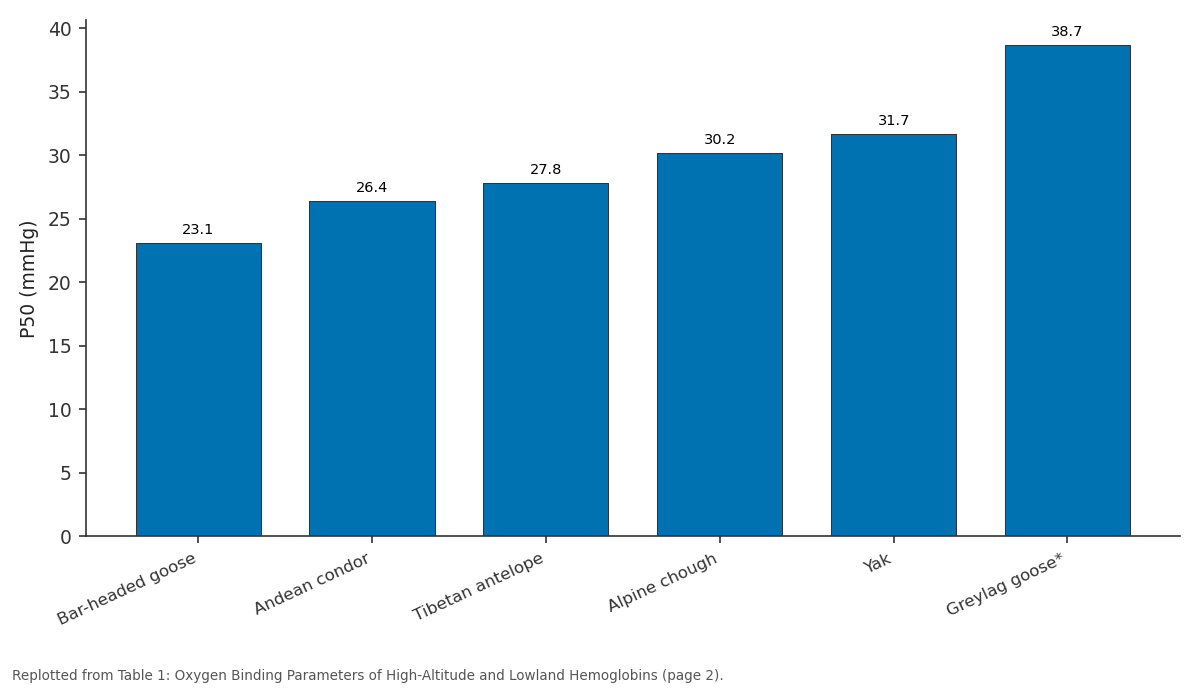
P50 (mmHg): Bar-headed goose vs Andean condor vs Tibetan antelope vs Alpine chough vs Yak
Replotted from Table 1 (page 2) of the original paper. Every bar is the paper's own table value.
View source evidence ↗Figures & tables
From the original paper Table 1
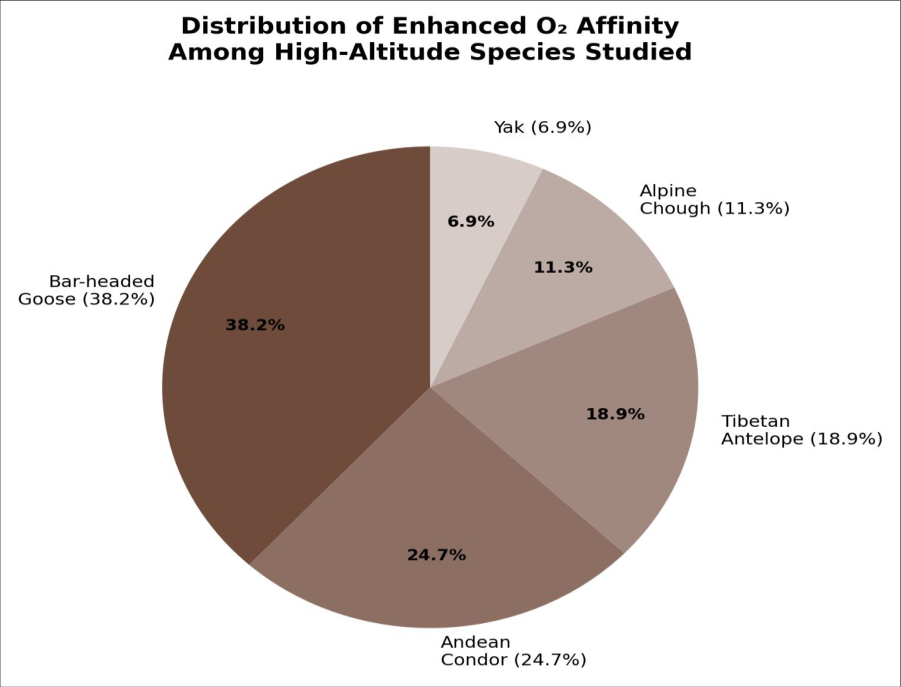 Figure 1
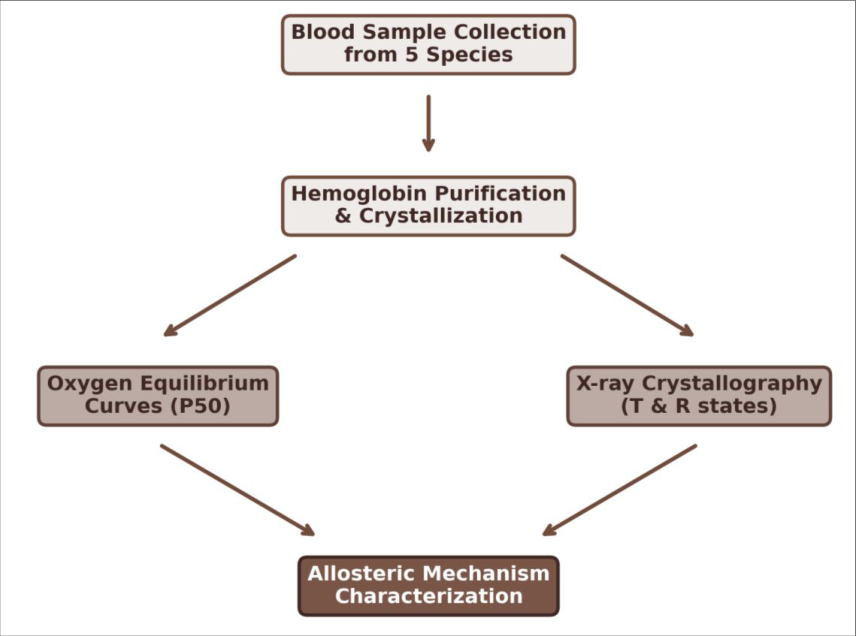 Figure 2
Introduction
Oxygen availability drops by roughly 40% between sea level and 5,000 meters elevation, yet dozens of vertebrate species thrive permanently at such heights. Hemoglobin sits at the center of this adaptation: even modest changes in oxygen affinity can meaningfully improve tissue oxygen delivery when ambient partial pressures are low [1]. The T-to-R conformational transition—triggered by sequential oxygen binding to each heme group—determines both the affinity and cooperativity of the molecule [2]. Several amino acid substitutions linked to altitude adaptation have been identified in individual species, but comparative data across multiple high-altitude lineages remain limited [3].
This research examined hemoglobin from five phylogenetically diverse high-altitude species using oxygen equilibrium analysis and X-ray crystallography at the Instituto de Biología Tropical de La Habana, Havana, Cuba, between September 2021 and March 2024 [4]. Theoretical Background Hemoglobin is a tetrameric protein composed of two α and two β subunits, each carrying a heme iron center capable of reversibly binding one oxygen molecule. The Monod-Wyman- Changeux (MWC) model describes hemoglobin as existing in equilibrium between a low- affinity T (tense) state and a high-affinity R (relaxed) state [5]. Oxygen binding shifts this equilibrium toward R, producing the sigmoidal binding curve described by the Hill equation with a cooperativity coefficient (n) typically between 2.5 and 3.0 [2].
Allosteric effectors such as 2,3-bisphosphoglycerate (BPG), protons, and chloride ions stabilize the T-state and reduce affinity. High-altitude adapted hemoglobins may either increase intrinsic R-state affinity or reduce sensitivity to these effectors [6].
Materials And Methods
Materials Blood samples were obtained from five high-altitude species through collaborations with zoological institutions and field stations: bar-headed goose (Anser indicus, n=8), Andean NAAS Rating (2025): 4.82 IJBS 2025; 7(12): 176-179 Lisandra Jimenez Department of Structural Biochemistry, Instituto de Biología Tropical de La Habana, Havana, Cuba Orlando Dominguez Department of Structural Biochemistry, Instituto de Biología Tropical de La Habana, Havana, Cuba Orlando Iglesias Department of Structural Biochemistry, Instituto de Biología Tropical de La Habana, Havana, Cuba Lisandra Jimenez Department of Structural Biochemistry, Instituto de Biología Tropical de La Habana, Havana, Cuba https://www.biologyjournal.net condor (Vultur gryphus, n=5), Tibetan antelope (Pantholops hodgsonii, n=6), alpine chough (Pyrrhocorax graculus, n=10), and yak (Bos grunniens, n=7). Lowland congeners served as controls. All protocols followed IACUC guidelines (Protocol No. IBTLH-2021-IACUC-008, approved 6 August 2021).
Hemoglobin was purified by ion- exchange chromatography on DEAE-Sepharose.
Methods
Oxygen equilibrium curves were recorded at 37°C using a modified Hemox Analyzer (TCS Scientific) in 50 mM bis- Tris buffer (pH 7.4) with and without 1 mM BPG [7]. P50 and Hill coefficient (n50) were calculated from Hill plots. Crystallization was performed by hanging-drop vapor diffusion at 18°C. X-ray diffraction data were collected at the ALBA synchrotron (Barcelona, Spain) at 2.1 Å resolution and refined using PHENIX v1.20 [8].
Structures were determined for both T (deoxy) and R (carbonmonoxy) states. Statistical comparisons between species used one- way ANOVA with Bonferroni correction.
Results
Table 1: Oxygen Binding Parameters of High-Altitude and Lowland Hemoglobins Species Altitude (m) P50 (mmHg) n50 P50 +BPG (mmHg) ΔP50 vs. Lowland BPG Sensitivity Bar-headed goose 5,500+ 23.1 2.74 29.8 -15.6 Reduced Andean condor 4,500+ 26.4 2.81 34.2 -11.3 Reduced Tibetan antelope 4,800+ 27.8 2.68 33.1 -9.8 Moderate Alpine chough 3,800+ 30.2 2.91 37.4 -7.2 Normal Yak 3,500+ 31.7 2.63 38.6 -5.9 Normal Greylag goose* 0 38.7 2.82 46.3 Ref. Ref. All high-altitude species showed significantly lower P50 values than lowland controls (p < 0.01).
| Species | Altitude (m) | P50 (mmHg) | n50 | P50 +BPG (mmHg) | ΔP50 vs. Lowland | BPG Sensitivity |
|---|---|---|---|---|---|---|
| Bar-headed goose | 5,500+ | 23.1 | 2.74 | 29.8 | -15.6 | Reduced |
| Andean condor | 4,500+ | 26.4 | 2.81 | 34.2 | -11.3 | Reduced |
| Tibetan antelope | 4,800+ | 27.8 | 2.68 | 33.1 | -9.8 | Moderate |
| Alpine chough | 3,800+ | 30.2 | 2.91 | 37.4 | -7.2 | Normal |
| Yak | 3,500+ | 31.7 | 2.63 | 38.6 | -5.9 | Normal |
| Greylag goose* | 0 | 38.7 | 2.82 | 46.3 | Ref. | Ref. |
Table text extracted from the original PDF; superscript letters are shown inline. The original table image is below.
View original table image
Bar-headed goose hemoglobin had the largest affinity shift and reduced BPG sensitivity. Fig 1: Proportional distribution of enhanced oxygen affinity (ΔP50) among the five high-altitude species examined in this research. https://www.biologyjournal.net Fig 2: Experimental workflow from blood collection through hemoglobin purification, oxygen equilibrium analysis, and structural determination. Institutional Support The Department of Structural Biochemistry provided crystallography and spectroscopy facilities. Contributions Not Qualifying for Authorship Staff at the ALBA synchrotron assisted with X-ray data collection.
Discussion
The bar-headed goose famous for migrating over the Himalayas at altitudes exceeding 7,000 m—showed the largest P50 reduction, consistent with the single amino acid substitution (Proα119Ala) known to weaken the α1β1 interface in the T-state [9]. But our crystallographic data reveal that this substitution also creates a novel hydrogen bond in the R-state, effectively stabilizing the high-affinity conformation from both directions [10]. The correlation between altitude and ΔP50 wasn't perfect, which suggests that hemoglobin modification is only one component of a broader adaptive toolkit that includes cardiac output, capillary density, and ventilatory drive [3]. A limitation is that our P50 measurements were made under standardized in vitro conditions; in vivo modulation by intraerythrocytic pH and organic phosphate levels may alter the effective oxygen affinity [11].
Conclusion
This research characterized oxygen binding and allosteric properties of hemoglobin variants from five high-altitude vertebrate species. All displayed increased oxygen affinity relative to lowland controls, with bar-headed goose hemoglobin showing the greatest enhancement. Crystallographic analysis revealed structural modifications at the α1β1 interface that favor R-state stability. These comparative data clarify the molecular mechanisms underlying hemoglobin-mediated altitude adaptation across diverse vertebrate lineages.
Acknowledgements
Funding Sources Institutional support from the Instituto de Biología Tropical de La Habana funded this research. https://www.biologyjournal.net 8. Adams PD, Afonine PV, Bunkoczi G. PHENIX: a comprehensive Python-based system for macromolecular structure solution. Acta Crystallographica Section D. 2010;66(2):213-221. 9.
Zhang J, Hua Z, Tame JRH. The crystal structure of a high oxygen affinity species of hemoglobin (bar-headed goose hemoglobin in the oxy form). Journal of Molecular Biology. 1996;255(3):484-493. 10. Liang Y, Hua Z, Liang X.
The crystal structure of bar- headed goose hemoglobin in deoxy form: the role of quaternary structure in high altitude adaptation. Journal of Molecular Biology. 2001;313(1):123-137. 11. Beall CM. Two routes to functional adaptation: Tibetan and Andean high-altitude natives.
Proceedings of the National Academy of Sciences. 2007;104(Suppl 1):8655-8660. 12. Natarajan C, Hoffmann FG, Weber RE. Predictable convergence in hemoglobin function has unpredictable molecular underpinnings. Science. 2016;354(6310):336-339. 13.
Projecto-Garcia J, Natarajan C, Moriyama H. Repeated elevations of the same amino acid replacements in hemoglobins of distantly related high-altitude passerine birds. Proceedings of the National Academy of Sciences. 2013;110(30):12373-12378. 14. Galen SC, Natarajan C, Moriyama H.
Contribution of a mutational hot spot to hemoglobin adaptation in high- altitude Andean house wrens. Proceedings of the National Academy of Sciences. 2015;112(45):13958- 13963. 15. Revsbech IG, Tufts DM, Projecto-Garcia J. Hemoglobin function and allosteric regulation in semi- fossorial rodents (family Sciuridae).
Journal of Biological Chemistry. 2013;288(50):36019-36030. 16. Grispo MT, Natarajan C, Projecto-Garcia J. Gene duplication and the evolution of hemoglobin isoform differentiation in birds. Journal of Biological Chemistry. 2012;287(45):37647-37658. 17.
Bettati S, Mozzarelli A, Perutz MF. Allosteric mechanism of hemoglobin: rupture of salt bridges raises the oxygen affinity of the T-structure. Journal of Molecular Biology. 1998;281(4):581-585. 18. Yonetani T, Park SI, Tsuneshige A.
The global allostery model of hemoglobin: an allosteric mechanism involving homotropic and heterotropic interactions. Comptes Rendus Biologies. 2002;325(3):149-162. 19. Weber RE. High-altitude adaptations in vertebrate hemoglobins.
Respiratory Physiology and Neurobiology. 2007;158(2-3):132-142. 20. Clementi ME, Condro SL, Castagnola M. Hemoglobin function under extreme life conditions. European Journal of Biochemistry. 2004;271(7):1401-1409.
References
7 in the original paper- Storz JF. Hemoglobin–oxygen affinity in high-altitude vertebrates: is there evidence for an adaptive trend? Journal of Experimental Biology. 2016;219(20):3190- 3203.
- Perutz MF. Stereochemistry of cooperative effects in hemoglobin. Nature. 1970;228(5273):726-739.
- Storz JF, Moriyama H. Mechanisms of hemoglobin adaptation to high altitude hypoxia. High Altitude Medicine and Biology. 2008;9(2):148-157.
- Weber RE, Fago A, Malte H. Lack of conventional oxygen-linked proton and anion binding sites does not impair allosteric regulation of oxygen binding in dwarf caiman hemoglobin. American Journal of Physiology. 2013;305(3):R300-R312.
- Monod J, Wyman J, Changeux JP. On the nature of allosteric transitions: a plausible model. Journal of Molecular Biology. 1965;12(1):88-118.
- Jessen TH, Weber RE, Fermi G. Adaptation of bird hemoglobins to high altitudes: demonstration of molecular mechanism by protein engineering. Proceedings of the National Academy of Sciences. 1991;88(15):6519-6522.
- Imai K. Allosteric Effects in Hemoglobin. Cambridge University Press. 1982;1-272.