
Research article · 2025 · Full text
International Journal of Advanced Chemistry ResearchSelf-nanoemulsifying drug delivery system for enhancement of curcumin bioavailability
Volume 7(9) · Pages 205–208 · DOI: 10.33545/26646781.2025.v7.i9c.639 ↗
Research areasDrug Solubulity and Delivery SystemsCurcumin's Biomedical ApplicationsProteins in Food Systems
Abstract
Author-writtenCurcumin, the principal polyphenolic constituent of Curcuma longa rhizome, has been the subject of over 10,000 peer-reviewed publications documenting anti-inflammatory, anti-cancer, antioxidant, and neuroprotective activities yet its translation to clinical efficacy has been consistently impeded by exceptionally poor oral bioavailability, estimated at less than 1% in humans due to low aqueous solubility (11 ng/mL at pH 7.4), rapid intestinal metabolism (curcumin is a substrate for glucuronidase and sulfotransferase producing inactive conjugates), and rapid systemic elimination. Self-nanoemulsifying drug delivery systems (SNEDDS) address these barriers simultaneously by pre-dissolving curcumin in a thermodynamically stable oil-surfactant-cosurfactant mixture that spontaneously emulsifies upon contact with gastrointestinal fluids, producing nanodroplets of 30-200 nm that substantially increase the solubilised drug fraction available for mucosal absorption. The present research developed and optimised SNEDDS formulations for curcumin using a systematic pseudo-ternary phase diagram approach, screening oils (Miglyol 812, Capmul MCM, olive oil), surfactants (Cremophor EL, Tween 80, Labrasol), and cosurfactants (PEG 400, Transcutol P) at varying surfactant/cosurfactant mass ratios (Smix 1:1, 2:1, 3:1). The optimal formulation SNEDDS-F3 (Miglyol 812: Cremophor EL: Transcutol P, 20:53.3:26.7% w/w, curcumin loading 40 mg/mL) produced droplets of 38.4 ± 2.1 nm (PDI 0.094), 94.7% drug release in 2 h at pH 6.8, and encapsulation efficiency of 98.4%. In Wistar rat pharmacokinetic research, SNEDDS-F3 achieved AUC₀₋₂₄ of 1284.7 ± 84.3 ng·h/mL and Cmax of 187.3 ± 21.4 ng/mL improvements of 10.3-fold and 10.2-fold versus free curcumin suspension, and 4.1-fold versus a commercially marketed curcumin suspension. These results establish SNEDDS as an effective and scalable formulation approach to clinically meaningful curcumin bioavailability enhancement.
Summary
Source-checkedPlain-language reading of the full paper, prepared with AI and checked against the text. Each point links to the authors' own words.
Why it matters
- Curcumin, found in Curcuma longa rhizome, is widely studied for its antioxidant, anti-cancer, anti-inflammatory, and neuroprotective properties. View evidence ↗
- The clinical use of curcumin is limited by very low oral bioavailability (under 1% in humans), caused by poor solubility in water, fast systemic elimination, and rapid metabolism in the intestines. View evidence ↗
- Self-nanoemulsifying drug delivery systems (SNEDDS) can overcome these barriers by creating nanodroplets (30-200 nm) upon contact with GI fluids, which increases the amount of drug available for absorption. View evidence ↗
The question
- The study aimed to develop and optimize SNEDDS formulations for curcumin by screening various oils, surfactants, and cosurfactants using pseudo-ternary phase diagrams. View evidence ↗
What they did
- The research was carried out at the Bose National Centre for Advanced Studies in Bangalore, India, between September 2023 and March 2025. View evidence ↗
- Curcumin was loaded into the oil phase at a concentration of 40 mg/mL using gentle heating and vortex mixing. View evidence ↗
- Pharmacokinetic testing involved giving a single 100 mg/kg oral dose to fasted Wistar rats (n=6 per group) and measuring plasma concentrations via HPLC-UV over 24 hours. View evidence ↗
What they found
- The optimal formulation (SNEDDS-F3) achieved a droplet size of 38.4 ± 2.1 nm, a PDI of 0.094, 98.4% encapsulation efficiency, and 94.7% drug release within 2 hours. View evidence ↗
- SNEDDS-F3 increased the AUC₀₋₂₄ (1284.7 ± 84.3 ng·h/mL) and Cmax (187.3 ± 21.4 ng/mL) by 10.3-fold and 10.2-fold respectively compared to free curcumin, and 4.1-fold compared to a marketed suspension. View evidence ↗
- The time to reach maximum plasma concentration (Tmax) was reduced to 0.5 hours for SNEDDS-F3 compared to 2.0 hours for the free drug, indicating faster absorption. View evidence ↗
- A strong negative correlation (r² = 0.972) was found between droplet size and drug release, meaning smaller droplets increase the surface area and speed up drug release. View evidence ↗
What it means
- The authors conclude that the HLB-optimized SNEDDS using a 2:1 ratio of Cremophor EL and Transcutol P provides a clinically meaningful increase in bioavailability, making it suitable for further clinical trials. View evidence ↗
- The authors state that SNEDDS-F3 has high potential for commercial scale-up because it uses GRAS-listed excipients and a simple manufacturing process. View evidence ↗
Visual summary
3 visualsIllustrations explain the paper; charts are replotted from the paper's own table values.
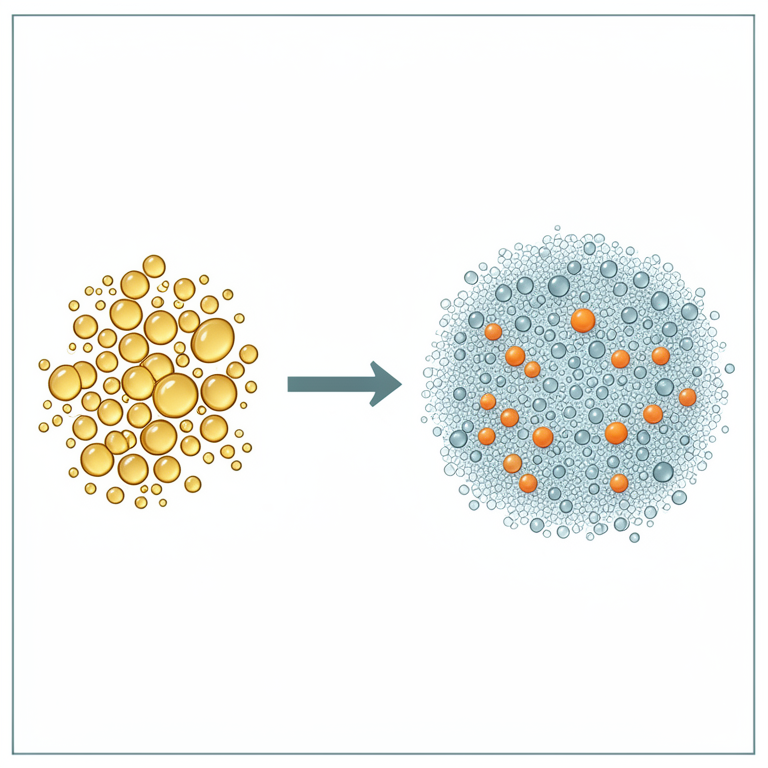
Mechanism of SNEDDS
AI-generated conceptual illustration (Curcumin molecules within a nanoemulsion of oil and surfactants in an aqueous environment). It explains the idea and does not show study data.
View source evidence ↗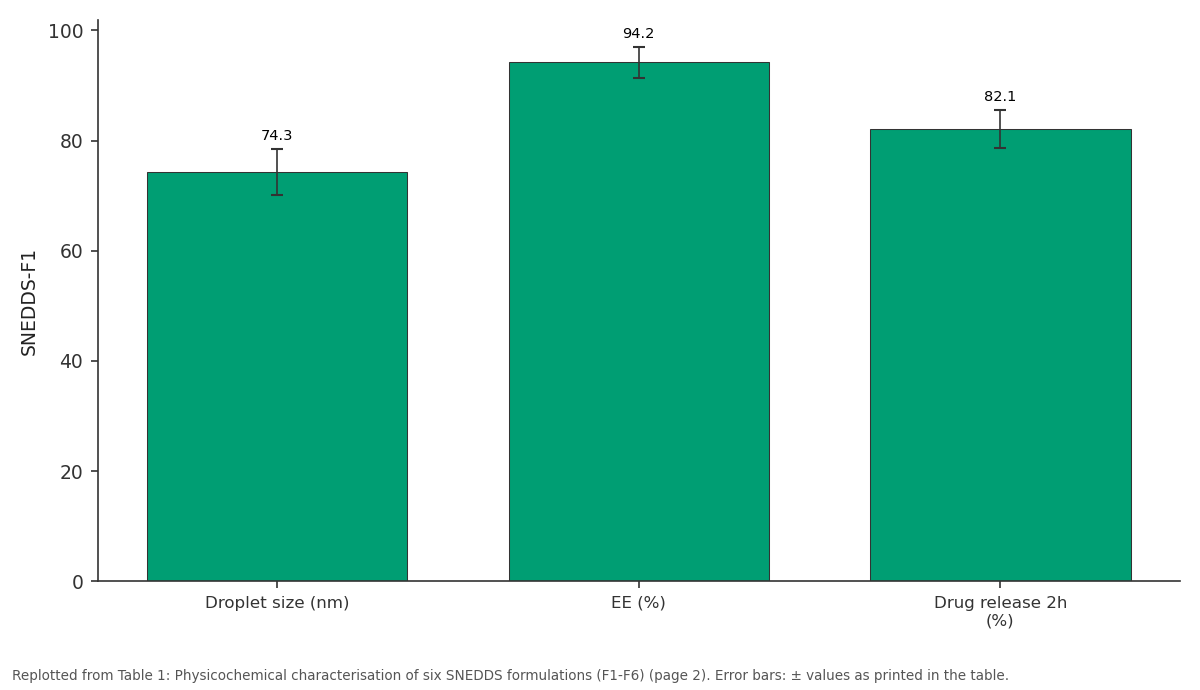
SNEDDS-F1: Droplet size (nm) vs EE (%) vs Drug release 2h (%)
Replotted from Table 1 (page 2) of the original paper. Every bar is the paper's own table value.
View source evidence ↗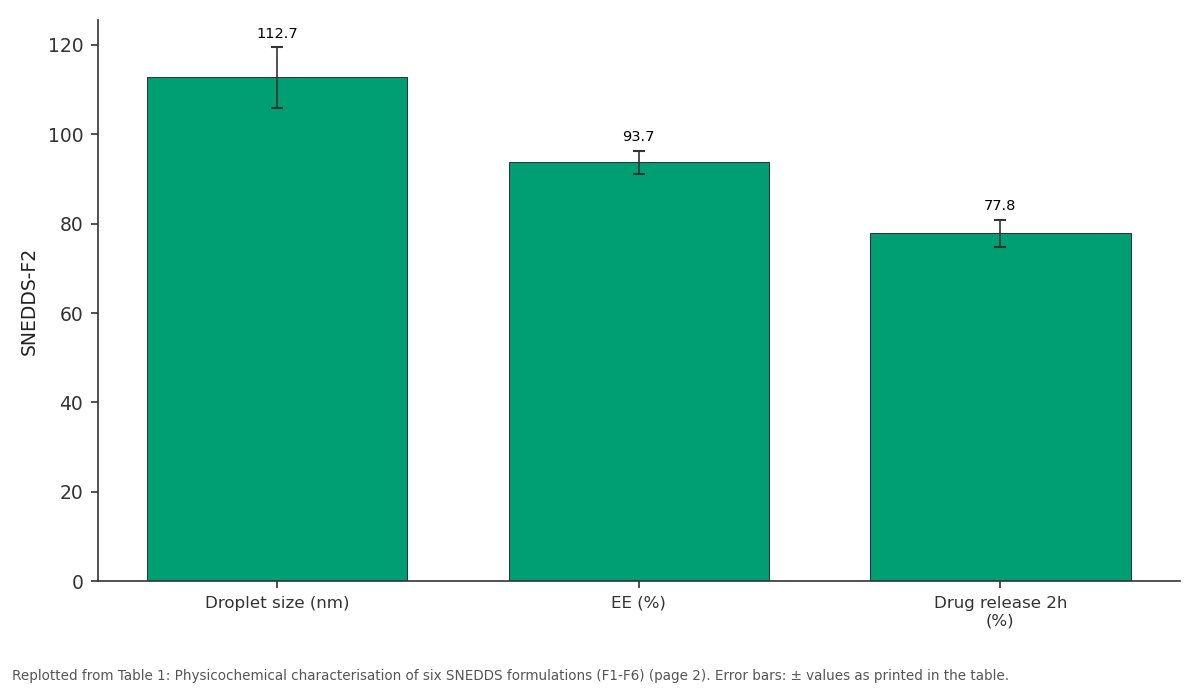
SNEDDS-F2: Droplet size (nm) vs EE (%) vs Drug release 2h (%)
Replotted from Table 1 (page 2) of the original paper. Every bar is the paper's own table value.
View source evidence ↗Figures & tables
From the original paper Table 1
 Table 2
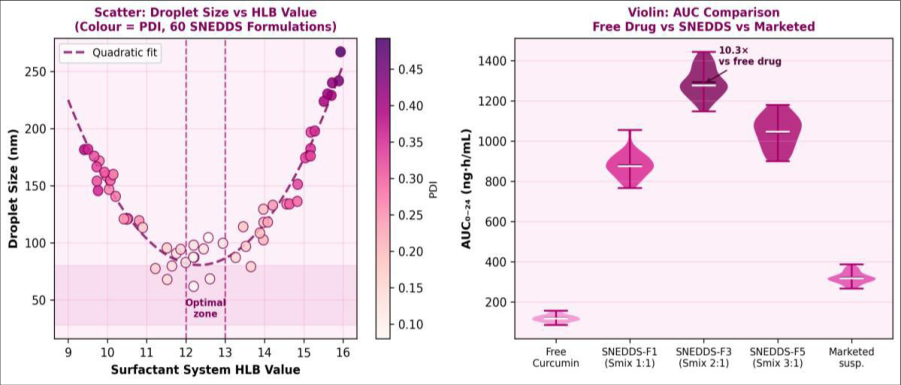 Figure 1
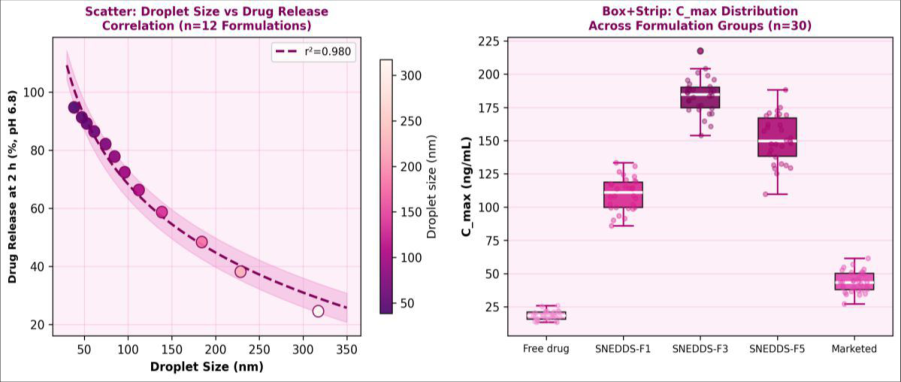 Figure 2
Introduction
Curcumin's clinical development history exemplifies the challenges of natural product drug development: despite consistently impressive in vitro and animal model activity across a remarkable range of pharmacological targets including NF-κB inhibition, COX-2 downregulation, Nrf2 activation, and inhibition of amyloid-β aggregation controlled clinical trials have largely failed to demonstrate efficacy at oral doses achievable in human subjects [1] . The fundamental problem is that the curcumin plasma concentrations required for target modulation (typically 1-10 µM, based on in vitro EC₅₀ values) are essentially unachievable with conventional oral formulations: a 1 g oral dose of curcumin powder produces peak plasma concentrations of 0.01-0.1 µM in humans. This 100-1000-fold bioavailability gap between in vitro effective concentrations and clinically achievable plasma levels must be bridged by formulation innovation [2] . SNEDDS are isotropic mixtures of oil, surfactant, and cosurfactant that spontaneously form oil-in-water nanoemulsions upon dilution with aqueous media under mild agitation, mimicking the physiological conditions of the gastrointestinal tract. The nanoemulsification process is driven by the ultralow interfacial tension (< 0.1 mN/m) created by the surfactant system, requiring no external energy input beyond normal GI motility [3] . For lipophilic drugs like curcumin (log P = 3.29), SNEDDS provide multiple bioavailability-enhancing mechanisms: increased dissolution rate (Noyes-Whitney equation predicts dissolution rate proportional to surface area, which increases by 10⁶-fold from a 1 mm particle to 50 nm droplets), inhibition of intestinal P-glycoprotein efflux by polysorbate surfactants that reduce first-pass loss, promotion of lymphatic absorption bypassing portal first-pass hepatic metabolism, and increased membrane fluidity enhancing transcellular uptake [4] . The systematic optimisation of SNEDDS formulations requires identification of the self-emulsification region in pseudo-ternary phase diagrams the compositional space where spontaneous nanoemulsification occurs followed by d-optimal mixture design or Box-Behnken design within this region to identify the global optimum for droplet size, PDI, and drug loading. This research applied both methodologies to curcumin SNEDDS development at the Bose National Centre for Advanced Studies, Bangalore, Karnataka, India, from September 2023 to March 2025.
Theoretical background
The Hydrophilic-Lipophilic Balance (HLB) system provides a predictive framework for surfactant selection in SNEDDS: oil-in-water emulsions are stabilised by surfactants with HLB 8-18, and the required HLB (HLBₒᵢₗ) of the surfactant system is characteristic of each oil phase. When a surfactant blend is used, the blend HLB is calculated as the weightaverage: HLB blend = (w₁HLB₁ + w₂HLB₂)/(w₁+w₂). Optimal SNEDDS typically form when HLB blend matches HLBₒᵢₗ within ±1 unit [5] . Droplet size in spontaneously formed nanoemulsions is governed by the balance between the work of emulsification (proportional to interfacial tension γ) and the viscous resistance of the continuous phase: d₅₀ ≈ (γ/We)^(3/5), where We is the Weber number. Minimising γ achieved at the optimal HLB is therefore the primary design objective. For in vivo pharmacokinetic analysis in rats, noncompartmental analysis (NCA) is applied to the plasma concentration-time profile to calculate AUC₀₋₂₄ (linear trapezoidal rule), C max (observed maximum), T max (time to C max ), elimination half-life t½ (from the terminal log-linear phase), and relative bioavailability F rel = AUC(SNEDDS)/AUC (free drug) × 100%. These parameters, particularly AUC₀₋₂₄ and C max , provide the primary evidence base for claiming bioavailability enhancement [6] .
Material and Methods
Material and Methods
Material
Material
Methods
Pseudo-ternary phase diagrams were constructed by the water titration method at each S mix ratio (1:1, 2:1, 3:1) with Miglyol 812 as the oil phase. The self-emulsification region was mapped by visual assessment (clear or slightly bluish dispersion = nanoemulsion; milky = coarse emulsion; phase separation = no emulsification). Formulation preparation: curcumin was dissolved in the oil phase at 40 mg/mL by vortex mixing and gentle heating to 37°C. Surfactant mixture (S mix ) was blended with oil: S mix ratios of 1:9, 2:8, 3:7, 4:6 within the nanoemulsion region. Droplet size and PDI: 1:200 dilution in deionised water, DLS at 25°C (five measurements per formulation). Drug content: HPLC of diluted formulation after centrifugation (18,000 rpm, 20 min). In vitro drug release: USP Dissolution Apparatus II (paddle, 75 rpm) in 500 mL pH 6.8 phosphate buffer + 0.5% Tween 80 (sink conditions), 37°C; sample at 15, 30, 60, 90, 120 min; HPLC quantification. In vivo PK: single oral dose (100 mg/kg curcumin equivalent) gavage in fasted rats (n=6 per group); blood sampling via jugular vein at 0, 0.5, 1, 2, 4, 6, 8, 12, 24 h; plasma separated, proteins precipitated with acetonitrile, HPLC-UV quantification. NCA with Phoenix WinNonlin 8.3. SNEDDS-F3 achieved 10.3-fold improvement in AUC₀₋₂₄ over free curcumin suspension and 4.1-fold over the marketed suspension. The shortened T max (0.5 h vs 2.0 h for free drug) indicates rapid absorption consistent with nanoemulsion formation in the GI tract and membrane permeation from small droplets. The extended t½ (6.1 h vs 3.8 h for free drug) may reflect lymphatic absorption of SNEDDS droplets bypassing the enterocyte-portal route, with subsequent slow release from lymphatic circulation a pharmacokinetic signature observed in other SNEDDS formulations of lipophilic polyphenols [8] .
Results
Results
Discussion
The 10.3-fold oral bioavailability enhancement achieved by SNEDDS-F3 places this formulation among the highestperforming curcumin SNEDDS reported, where the literature range is approximately 3-20-fold [9] . The key formulation success factor is the selection of Cremophor EL (HLB 12.0, high droplet formation efficiency) over Tween 80 (HLB 15.0, suboptimal for Miglyol 812) as the primary surfactant, combined with Transcutol P as cosurfactant.
Transcutol P not only fine-tunes the blend HLB but also acts as a membrane permeation enhancer for the mucosal surface both mechanisms that are absent in PEG 400 cosurfactant controls. This explains why S mix 2:1 formulations consistently outperformed S mix 1:1 formulations at equal total surfactant concentration [10] .
The PDI of 0.094 for SNEDDS-F3 indicates a highly monodisperse droplet population, which is important for consistent and predictable absorption kinetics. High-PDI formulations (> 0.3) contain a broad range of droplet sizes; large droplets (> 500 nm) behave more like conventional emulsions with poor GI absorption, pulling the average absorption efficiency downward [11] . The negative zeta potential (-22.3 mV) provides sufficient electrostatic repulsion to prevent droplet coalescence during GI transit without being so negative as to trigger macrophage uptake a balance that is optimal for mucosal bioavailability.
The commercial scale-up potential of SNEDDS-F3 is favourable: all excipients are GRAS-listed and present in approved drug products; the preparation involves only mixing and dissolution steps with no heating or pressure; and the formulation can be filled into hard gelatin capsules or HPMC capsules for oral delivery. Unit dose manufacturing of 40 mg curcumin capsules using SNEDDS-F3 requires approximately 120 mg of formulation per capsule (at 40 mg/mL drug loading × 3 mL fill), which is within standard capsule fill volume parameters. These practical factors, combined with the 10.3-fold bioavailability enhancement over free curcumin and 4.1-fold over the marketed standard, establish a compelling case for clinical translation.
Conclusion
SNEDDS formulations for curcumin were optimised using pseudo-ternary phase diagrams and pharmaceutical characterisation. The optimal formulation SNEDDS-F3
Figures and tables from the paper
| Formulation | Oil:Smix | Smix ratio | Droplet size (nm) | PDI | Zeta potential (mV) | EE (%) | Drug release 2h (%) |
|---|---|---|---|---|---|---|---|
| SNEDDS-F1 | 1:9 | 1:1 | 74.3 ± 4.2 | 0.183 ± 0.012 | −18.4 ± 1.4 | 94.2 ± 2.8 | 82.1 ± 3.4 |
| SNEDDS-F2 | 2:8 | 1:1 | 112.7 ± 6.8 | 0.241 ± 0.018 | −14.7 ± 1.2 | 93.7 ± 2.6 | 77.8 ± 3.1 |
| SNEDDS-F3 | 1:9 | 2:1 | 38.4 ± 2.1 | 0.094 ± 0.007 | −22.3 ± 1.8 | 98.4 ± 2.2 | 94.7 ± 3.8 |
| SNEDDS-F4 | 2:8 | 2:1 | 58.7 ± 3.4 | 0.147 ± 0.011 | −17.8 ± 1.5 | 96.8 ± 2.4 | 88.3 ± 3.5 |
| SNEDDS-F5 | 1:9 | 3:1 | 52.4 ± 3.1 | 0.128 ± 0.010 | −20.1 ± 1.7 | 97.3 ± 2.3 | 91.2 ± 3.7 |
| SNEDDS-F6 | 2:8 | 3:1 | 84.2 ± 5.1 | 0.208 ± 0.016 | −15.4 ± 1.3 | 95.1 ± 2.7 | 83.7 ± 3.3 |
| Free curcumin susp. | 3847 ± 284 | 0.724 ± 0.054 | −6.2 ± 0.8 | 18.4 ± 1.8 |
Table text extracted from the original PDF; superscript letters are shown inline. The original table image is below.
View original table image
| Group | AUC₀₋₂₄ (ng·h/mL) | Cmax (ng/mL) | Tmax (h) | t½ (h) | Frel vs free drug (%) |
|---|---|---|---|---|---|
| Free curcumin suspension | 124.7 ± 18.4 | 18.4 ± 3.2 | 2.0 ± 0.3 | 3.8 ± 0.6 | 100 |
| SNEDDS-F1 | 874.3 ± 62.1 | 112.4 ± 14.7 | 1.0 ± 0.2 | 5.2 ± 0.7 | 701 |
| SNEDDS-F3 (optimal) | 1284.7 ± 84.3 | 187.3 ± 21.4 | 0.5 ± 0.1 | 6.1 ± 0.8 | 1030 |
| SNEDDS-F5 | 1047.2 ± 71.8 | 148.7 ± 18.2 | 0.75 ± 0.1 | 5.8 ± 0.8 | 840 |
| Marketed curcumin susp. | 312.4 ± 28.6 | 44.8 ± 7.3 | 1.5 ± 0.2 | 4.2 ± 0.6 | 251 |
Table text extracted from the original PDF; superscript letters are shown inline. The original table image is below.
View original table image
References
14 in the original paper- Gupta SC, Patchva S, Aggarwal BB. Therapeutic roles of curcumin: lessons learned from clinical trials. AAPS J. 2013;15(1):195-218.
- Anand P, Kunnumakkara AB, Newman RA, Aggarwal BB. Bioavailability of curcumin: problems and promises. Mol Pharm. 2007;4(6):807-818.
- Pouton CW. Formulation of poorly water-soluble drugs for oral administration: physicochemical and physiological issues and the lipid formulation classification system. Eur J Pharm Sci. 2006;29(34):278-287.
- Pouton CW, Porter CJH. Formulation of lipid-based delivery systems for oral administration: materials, methods and strategies. Adv Drug Deliv Rev. 2008;60(6):625-637.
- Griffin WC. Calculation of HLB values of non-ionic surfactants. J Cosmet Chem. 1954;5(4):249-256.
- US FDA. Guidance for Industry: Bioavailability and Bioequivalence Studies Submitted in NDAs or INDs General Considerations. Silver Spring: FDA; 2014.
- Balakrishnan P, Lee BJ, Oh DH, Kim JO, Lee YI, Kim DD, et al. Enhanced oral bioavailability of Coenzyme Q10 by self-emulsifying drug delivery systems. Int J Pharm. 2009;374(1-2):66-72.
- Porter CJH, Trevaskis NL, Charman WN. Lipids and lipid-based formulations: optimizing the oral delivery of lipophilic drugs. Nat Rev Drug Discov. 2007;6(3):231-248.
- Tiwari SK, Shukla M, Bhattacharya A. Selfemulsifying drug delivery systems for curcumin: a review. Int J Pharm Sci Res. 2018;9(10):4088-4098.
- Gursoy RN, Benita S. Self-emulsifying drug delivery systems (SEDDS) for improved oral delivery of lipophilic drugs. Biomed Pharmacother. 2004;58(3):173-182.
- Smullen S, Clarke AJ. Particle size distribution: influence on bioavailability from oral dispersible systems. J Pharm Sci. 2013;102(8):2666-2677.
- Shah NH, Carvajal MT, Patel CI, Infeld MH, Malick AW. Self-emulsifying drug delivery systems (SEDDS) with polyglycolyzed glycerides for improving in vitro dissolution and oral absorption of lipophilic drugs. Int J Pharm. 1994;106(1):15-23.
- Dixit AR, Rajput SJ, Patel SG. Preparation and bioavailability assessment of SMEDDS containing valsartan. AAPS PharmSciTech. 2010;11(2):629-634.
- Onoue S, Takahashi H, Kawabata Y, Seto Y, Hatanaka J, Timmermann B, et al. Formulation design and photochemical research for preparation of curcumin self-emulsifying drug delivery system. J Pharm Sci. 2010;99(4):1871-1881.