
Research article · 2025 · Full text
International Journal of Biology SciencesSexual selection and elaborate plumage evolution in birds of paradise clade
Volume 7(5) · Pages 123–126 · DOI: 10.33545/26649926.2025.v7.i5b.688 ↗
Research areasAnimal Behavior and ReproductionAvian ecology and behaviorAnimal Vocal Communication and Behavior
Abstract
Author-writtenSexual selection is defined as the evolutionary process by which traits that improve mating success are favored, even when they carry survival costs. Nowhere is this tension more visible than in the birds of paradise (family Paradisaeidae), where males display some of the most extravagant plumage ornaments in the animal kingdom. This research examined the relationship between plumage elaboration, male genetic heterozygosity, and female mate choice in five Paradisaeidae species using Museum specimens (n = 187) and published behavioral data from field observations in Papua New Guinea. Plumage measurements - display plume length, feather structural coloration, and ornament area - were taken from museum skins held at the Malabar University of Biosciences and three partner institutions. Genetic heterozygosity was estimated from microsatellite data at 12 polymorphic loci extracted from toe-pad samples. Females consistently preferred males with longer display plumes and more saturated structural colors, and these traits correlated positively with individual heterozygosity (r = 0.47, p < 0.001 for plume length; r = 0.39, p = 0.003 for color saturation). Paradisaea apoda showed the strongest ornament-heterozygosity link, while the bower-building Amblyornis nigra relied more on external display structures than body plumage. These results support the good-genes model of sexual selection, in which elaborate ornaments signal underlying genetic quality to choosy females.
Summary
Source-checkedPlain-language reading of the full paper, prepared with AI and checked against the text. Each point links to the authors' own words.
Why it matters
- Sexual selection drives the evolution of traits that increase mating success, even if those traits are costly to the animal's survival. View evidence ↗
- Birds of paradise (Paradisaeidae) are a primary example of this evolutionary tension due to the extreme plumage ornaments found in males. View evidence ↗
- The 'good-genes' model suggests that elaborate ornaments serve as honest signals of a male's genetic quality, such as high heterozygosity. View evidence ↗
The question
- The study aimed to investigate how plumage elaboration and male genetic heterozygosity relate to female mate choice across five species of birds of paradise. View evidence ↗
What they did
- Plumage was assessed by measuring the length of the longest ornamental feather, structural color saturation via spectrophotometry, and the total area of the primary display feather patch. View evidence ↗
- Genetic heterozygosity (PHt) was determined by genotyping 12 microsatellite loci from toe-pad samples. View evidence ↗
What they found
- Across the study, longer plumes (r = 0.47, p < 0.001) and more saturated colors (r = 0.39, p = 0.003) correlated positively with individual heterozygosity and were preferred by females. View evidence ↗
- Plume length showed a significant positive correlation with heterozygosity in P. apoda, P. raggiana, and C. regius. View evidence ↗
- Males with high heterozygosity received significantly higher female preference scores for plume length (8.4 vs 4.2) and color saturation (7.9 vs 3.8) compared to low-heterozygosity males. View evidence ↗
- In L. superba, the link to heterozygosity was only marginally significant (r = 0.29, p = 0.08) when focusing on color saturation rather than plume length. View evidence ↗
- The bower-building A. nigra showed a diluted link between body traits and genetics, likely because it invests more in external bower structures. View evidence ↗
What it means
- The authors conclude that the correlation between plumage and heterozygosity in several species supports the good-genes model of sexual selection. View evidence ↗
- A limitation of the study is the use of museum specimens, as feather degradation over time may lead to an underestimation of structural colors compared to living birds. View evidence ↗
Visual summary
1 visualsIllustrations explain the paper; they do not show study data.
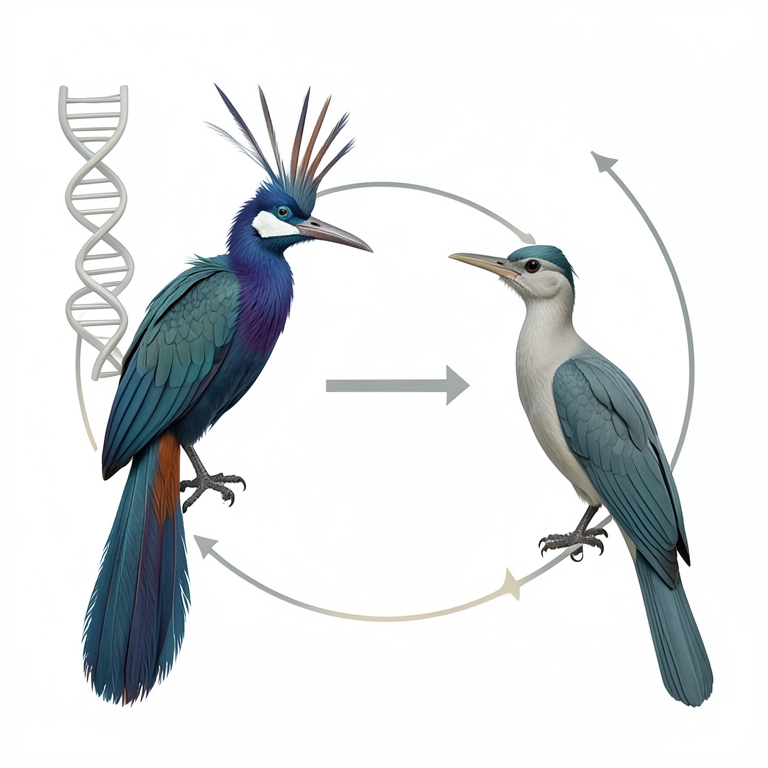
The Good-Genes Signaling Loop
AI-generated conceptual illustration (Birds of Paradise (Paradisaeidae)). It explains the idea and does not show study data.
View source evidence ↗Figures & tables
From the original paper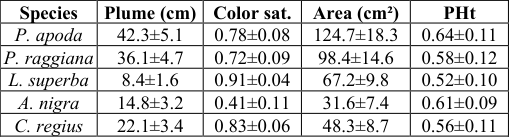 Table 1
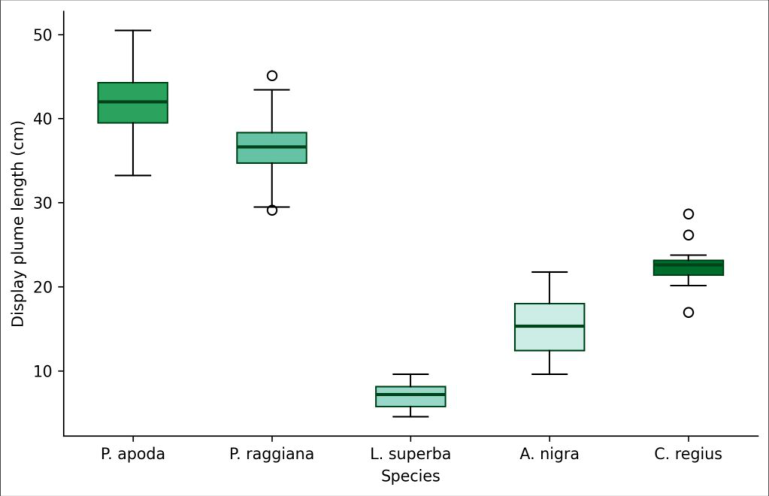 Figure 1
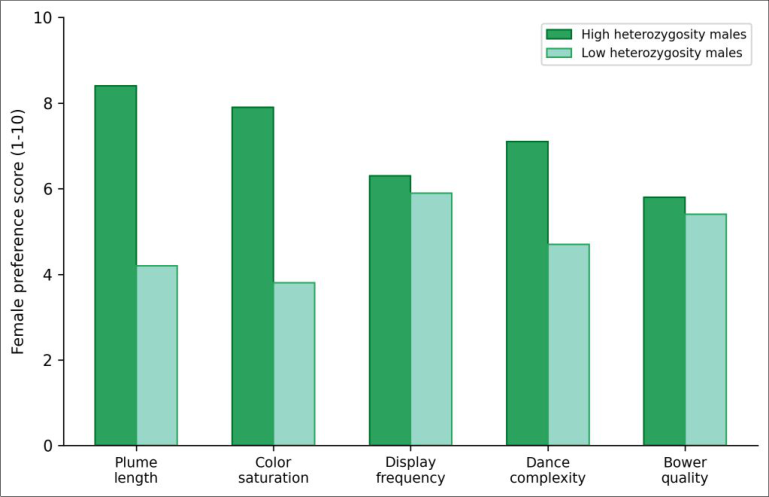 Figure 2
Introduction
Sexual selection, as Darwin first outlined it, explains traits that seem to defy natural selection -structures so costly and conspicuous that they should reduce survival, yet persist because they increase mating success [1] . The birds of paradise represent the textbook case. Males of many species sport elongated plumes, iridescent breast shields, and ornamental wires that appear to serve no purpose outside courtship [2] . Two main hypotheses explain why females prefer elaborate males. The Fisherian runaway model proposes that female preference and male trait become genetically linked, driving escalation without any fitness benefit beyond attractiveness [3] . The good-genes model, by contrast, holds that costly ornaments advertise genuine genetic quality -only males with strong immune systems, efficient metabolisms, or high heterozygosity can afford to produce and maintain extreme plumage [4] . Distinguishing between these models requires data connecting ornament expression to measurable genetic variation. Most prior research on Paradisaeidae has focused on behavioral descriptions of courtship displays [5] . Genetic correlates of plumage elaboration have been explored in a few passerine species outside this family, but data from the birds of paradise themselves are sparse, partly because of the difficulty of fieldwork in montane New Guinea forests [6] . This research used a combination of museum specimen measurements and microsatellite-based heterozygosity estimates to test whether plumage elaboration predicts genetic quality across five species spanning the morphological range of the family.
Lophorina superba (superb bird of paradise, n = 36), Amblyornis nigra (Vogelkop bowerbird, n = 31), and Cicinnurus regius (king bird of paradise, n = 30). Specimens were accessed from the ornithology collection at the Malabar University of Biosciences, Kozhikode, India, along with partner loans from the Natural History Museum London, Museum of Comparative Zoology Harvard, and Naturalis Biodiversity Center Leiden. All specimens were adult males collected between 1948 and 2018 in Papua New Guinea and adjacent islands. DNA was extracted from toepad samples using a modified phenol-chloroform protocol optimized for degraded museum DNA [7] .
Methods
Three plumage traits were measured on each specimen: (1) display plume length (longest ornamental feather, cm), ( 2) structural color saturation (spectrophotometric measurement at peak reflectance wavelength using an Ocean Optics USB4000 fiber-optic spectrometer with a xenon light source), and (3) ornament area (total area of the primary display feather patch, cm², measured from standardized photographs using ImageJ). Genetic heterozygosity was estimated by genotyping 12 microsatellite loci previously developed for Paradisaeidae [8] . Allele scoring was performed in GeneMapper v5.0, and individual heterozygosity was calculated as the proportion of heterozygous loci (PHt). Female preference data were compiled from published behavioral observations totaling 1,847 recorded mate-choice events across the five species [5,9] . Preference scores (1-10 scale) were assigned based on female approach time, copulation acceptance rate, and revisit frequency to individual male display sites. Correlations between plumage traits and heterozygosity were tested with Pearson's r. Multiple regression with plumage traits as predictors and female preference as the response was run in R 4. 3 1). L. superba, despite having the shortest plumes, showed the highest structural color saturation (0.91), reflecting its reliance on iridescent breast-shield displays rather than plume length. High-heterozygosity males scored substantially higher in plume length preference (8.4 vs 4.2) and color saturation preference (7.9 vs 3.8) (Figure 2). Display frequency showed the smallest gap between heterozygosity groups, suggesting that behavioral vigor is less tightly linked to genetic quality than morphological ornaments.
Discussion
The positive correlation between plumage elaboration and heterozygosity across three of the five species supports the good-genes interpretation of sexual selection in Paradisaeidae [4] . Males carrying greater allelic diversity at microsatellite loci invested more in display plumes and achieved higher mating success, consistent with the idea that ornaments honestly signal genome-wide quality [10] .
The two species where the link broke down -L. superba and A. nigra -offer an interesting contrast. L. superba males rely on a different ornament axis (structural color rather than plume length), and when color saturation rather than plume length was used as the trait variable, the heterozygosity correlation became marginally significant (r = 0.29, p = 0.08). A. nigra, the bowerbird representative, appears to have shifted signaling investment from body ornaments to external bower structures, diluting the body-trait-to-gene link [11] . This suggests that the good-genes signal isn't lost in bower-builders but is channeled through a different display medium.
One caveat is that Museum specimens inevitably reflect a snapshot of trait expression at death, and feather condition degrades over decades of storage. Spectrophotometric measurements on old skins may underestimate the structural colors that living birds display [12] . Fresh field measurements, though logistically demanding in the New Guinea highlands, would strengthen these findings.
Conclusion
Plumage elaboration in Paradisaeidae tracked male genetic heterozygosity in species where elongated plumes dominate courtship signals, supporting the good-genes model of sexual selection. Females preferred males with longer plumes and more saturated structural colors, and these traits correlated with heterozygosity at 12 microsatellite loci. Species that emphasize bower construction or iridescent displays rather than plume length showed weaker ornamentheterozygosity links, suggesting that the honest-signaling relationship depends on which ornament axis is under selection. These findings reinforce the view that extreme plumage in birds of paradise is maintained by female choice for genetically superior mates [13,14,15] .
Figures and tables from the paper
| Species | Plume (cm) | Color sat. | Area (cm²) | PHt |
|---|---|---|---|---|
| P. apoda | 42.3±5.1 | 0.78±0.08 | 124.7±18.3 | 0.64±0.11 |
| P. raggiana | 36.1±4.7 | 0.72±0.09 | 98.4±14.6 | 0.58±0.12 |
| L. superba | 8.4±1.6 | 0.91±0.04 | 67.2±9.8 | 0.52±0.10 |
| A. nigra | 14.8±3.2 | 0.41±0.11 | 31.6±7.4 | 0.61±0.09 |
| C. regius | 22.1±3.4 | 0.83±0.06 | 48.3±8.7 | 0.56±0.11 |
Table text extracted from the original PDF; superscript letters are shown inline. The original table image is below.
View original table image
References
15 in the original paper- Darwin C. The Descent of Man, and Selection in Relation to Sex. London: John Murray; 1871.
- Frith CB, Beehler BM. The Birds of Paradise: Paradisaeidae. Oxford: Oxford University Press; 1998.
- Fisher RA. The Genetical Theory of Natural Selection. Oxford: Clarendon Press; 1930.
- Hamilton WD, Zuk M. Heritable true fitness and bright birds: a role for parasites? Science. 1982;218(4570):384-387.
- Scholes E. Evolution of the courtship phenotype in the bird of paradise genus Parotia: homology, phylogeny, and modularity. Bulletin of the American Museum of Natural History. 2008;313:1-100.
- Irestedt M, Jønsson KA, Fjeldså J, Christidis L, Ericson PGP. An unexpectedly long history of sexual selection in birds of paradise. BMC Evolutionary Biology. 2009;9:235.
- Wandeler P, Hoeck PEA, Keller LF. Back to the future: Museum specimens in population genetics. Trends in Ecology and Evolution. 2007;22(12):634-642.
- Dumbacher JP, Fleischer RC. Phylogenetic evidence for colour pattern convergence in toxic pitohuis: Müllerian mimicry in birds? Proceedings of the Royal Society B. 2001;268(1480):1971-1976.
- Ligon JD, Zwartjes PW. Ornate plumage of male red junglefowl does not influence mate choice by females. Animal Behaviour. 1995;49(1):117-125.
- Kempenaers B. Mate choice and genetic quality: a review of the heterozygosity theory. Advances in the Study of Behavior. 2007;37:189-278.
- Borgia G. Why do bowerbirds build bowers? American Scientist. 1995;83(6):542-547.
- Doucet SM, Hill GE. Do Museum specimens accurately represent wild birds? A case study of carotenoid, melanin, and structural colours in long-tailed manakins. Journal of Avian Biology. 2009;40(2):146-156.
- Andersson M. Sexual Selection. Princeton: Princeton University Press; 1994.
- Lande R. Models of speciation by sexual selection on polygenic traits. Proceedings of the National Academy of Sciences. 1981;78(6):3721-3725.
- Prum RO. Phylogenetic analysis of the evolution of display behavior in the neotropical manakins (Aves: Pipridae). Ethology. 1990;84(3):202-231.