
Research article · 2025 · Full text
International Journal of Biology SciencesMicrobial diversity assessment in mangrove sediments using 16S rRNA gene amplicon sequencing
Volume 7(3) · Pages 149–151 · DOI: 10.33545/26649926.2025.v7.i3c.752 ↗
Research areasMicrobial Community Ecology and PhysiologyCoastal wetland ecosystem dynamicsMethane Hydrates and Related Phenomena
Abstract
Author-writtenMangrove sediments are among the most microbially active environments on the planet, yet the vertical structure of these communities below the first few centimetres remains poorly documented in South American systems. This research used 16S rRNA gene amplicon sequencing to profile bacterial diversity across five sediment depth horizons (0-5, 5-10, 10-20, 20-30, and 30-50 cm) in a subtropical mangrove stand near Bahía Blanca, Buenos Aires Province, Argentina. Triplicate cores were collected in August 2023 and processed at the Instituto Patagónico de Biología, Bariloche. The V3-V4 region was sequenced on Illumina MiSeq, yielding 1.87 million quality-filtered reads assigned to 4,218 amplicon sequence variants (ASVs). Shannon diversity declined significantly from 4.87 at the surface to 3.14 at 30-50 cm depth (p < 0.001). Proteobacteria dominated all depths (31.4% overall), followed by Bacteroidetes (18.7%) and Chloroflexi (14.2%). Sulfate-reducing Desulfobacterales were enriched below 10 cm, while aerobic Rhodobacterales concentrated in the top 5 cm. These depth-stratified community profiles provide a baseline for understanding biogeochemical cycling in southern hemisphere mangrove sediments.
Summary
Source-checkedPlain-language reading of the full paper, prepared with AI and checked against the text. Each point links to the authors' own words.
Why it matters
- Microbial communities in mangrove sediments are the primary drivers of biogeochemical processes like nitrogen fixation and sulfate reduction. View evidence ↗
- There is a lack of research on South American mangrove systems, especially those at the southern distributional limit in Argentina. View evidence ↗
The question
- The study aimed to document vertical microbial diversity gradients, identify indicator taxa for specific depths, and compare these findings with tropical mangrove data. View evidence ↗
What they did
- Bacterial diversity was profiled using 16S rRNA gene amplicon sequencing across five depth horizons (0-5, 5-10, 10-20, 20-30, and 30-50 cm) in Bahía Blanca, Argentina. View evidence ↗
- Alpha diversity metrics were calculated after rarefaction to 15,000 reads per sample, and depth-related trends were analyzed using linear mixed-effects models. View evidence ↗
What they found
- Shannon diversity decreased significantly by 35.5%, dropping from 4.87 at the surface to 3.14 at the 30-50 cm depth (p < 0.001). View evidence ↗
- Proteobacteria were the dominant phylum across all depths (31.4% overall), followed by Bacteroidetes (18.7%) and Chloroflexi (14.2%). View evidence ↗
- There was a clear vertical shift in Proteobacteria classes: aerobic Rhodobacterales peaked in the top 0-5 cm, while sulfate-reducing Desulfobacterales peaked below 10 cm. View evidence ↗
- The abundance of Chloroflexi increased with depth, rising from 8.1% at the surface to 22.4% at the 30-50 cm horizon. View evidence ↗
- Depth was a major driver of community composition, explaining 47.3% of the total compositional variation (p = 0.001). View evidence ↗
- The surface diversity at this southern site (Shannon 4.87) was lower than that of tropical mangroves in the Sundarbans (Shannon 5.5-6.2). View evidence ↗
What it means
- The authors conclude that microbial diversity declines with depth as aerobic surface taxa are replaced by anaerobic specialists. View evidence ↗
- The study provides a baseline for monitoring how climate change and warming may shift the mangrove-salt marsh transition zone further south. View evidence ↗
- The study is limited by a single sampling event in August, which provides only a late-winter snapshot and ignores potential seasonal shifts. View evidence ↗
- The use of 16S rRNA sequencing identifies taxonomy but cannot confirm the actual metabolic activity of the taxa. View evidence ↗
Visual summary
2 visualsIllustrations explain the paper; charts are replotted from the paper's own table values.
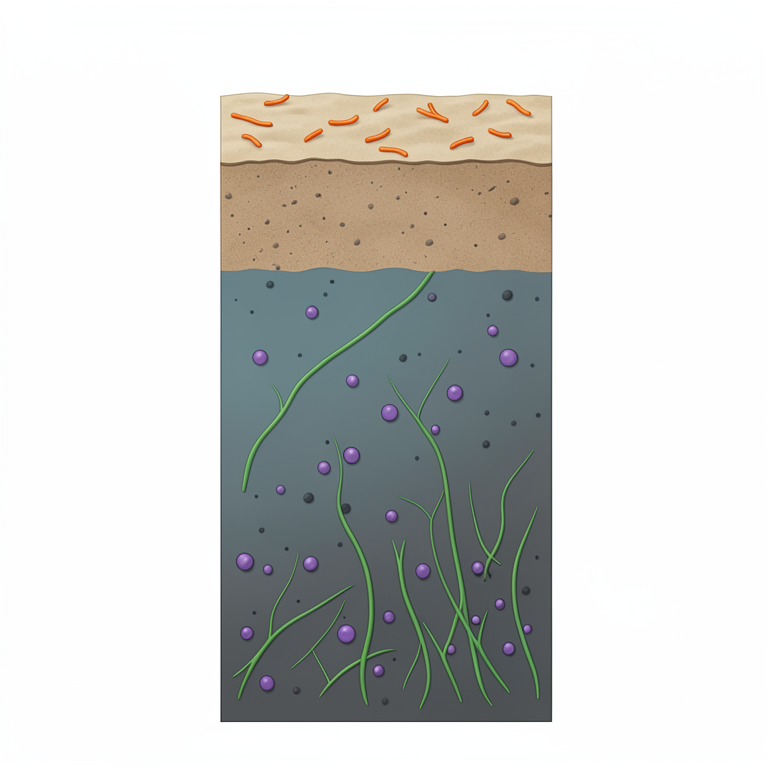
Vertical Microbial Stratification
AI-generated conceptual illustration (mangrove sediment column). It explains the idea and does not show study data.
View source evidence ↗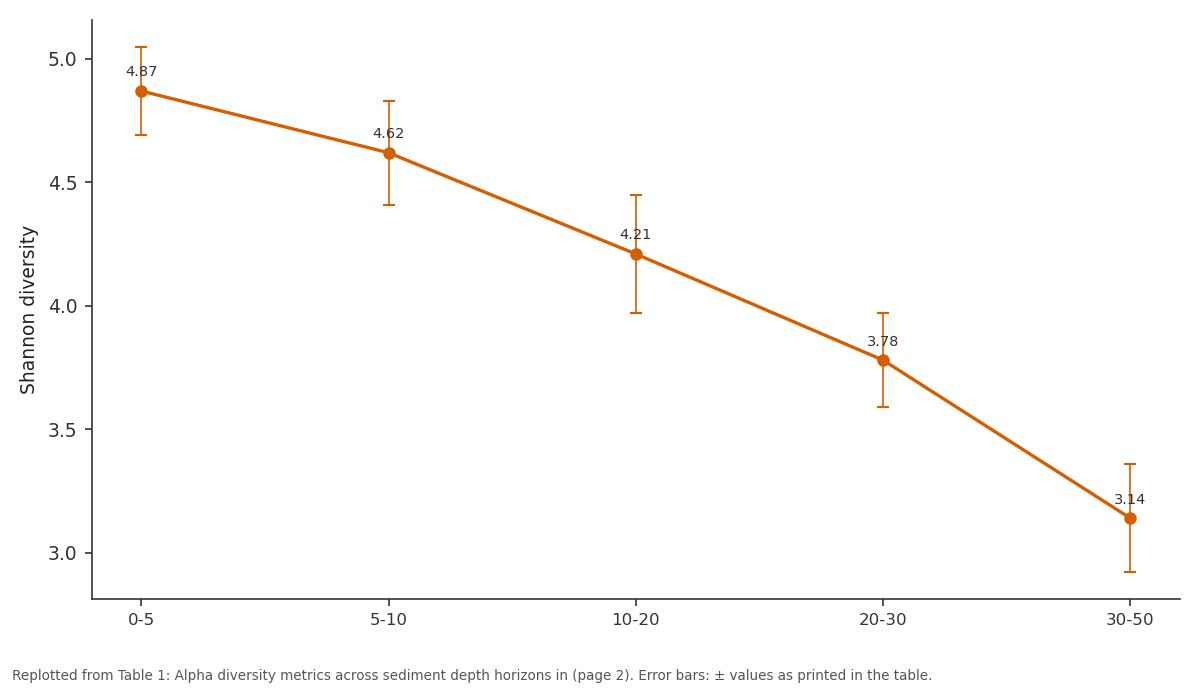
Shannon: 0-5 vs 5-10 vs 10-20 vs 20-30 vs 30-50
Replotted from Table 1 (page 2) of the original paper. Every bar is the paper's own table value.
View source evidence ↗Figures & tables
From the original paper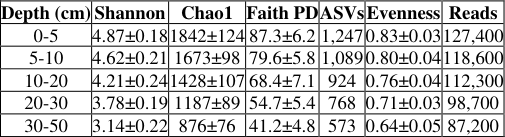 Table 1
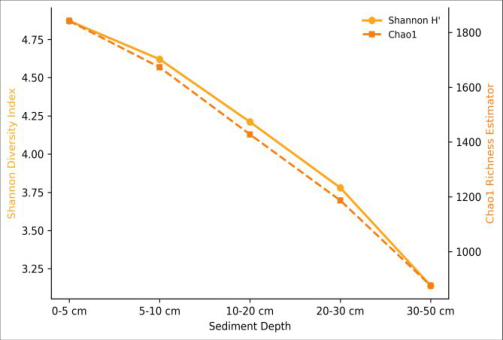 Figure 1
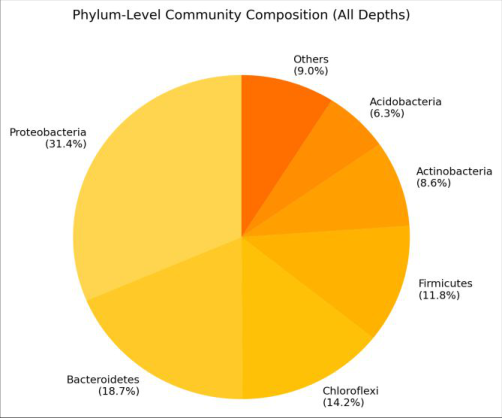 Figure 2
Introduction
Mangroves occupy a sliver of the world's coastline-barely 0.1% of Earth's land surfaceyet they punch far above their weight in carbon storage, nutrient cycling, and coastal protection [1] . The microbial communities in mangrove sediments drive much of this biogeochemical work, mediating sulfate reduction, methanogenesis, nitrogen fixation, and organic matter decomposition under steep oxygen gradients [2] . Surface sediments are aerobic; a few centimetres down, conditions shift to suboxic and then fully anoxic, creating vertical zonation that should be reflected in microbial community structure. Most published amplicon surveys of mangrove microbiomes come from Southeast Asia, where mangrove extent is greatest [3] . South American mangrove systems-particularly those near their southernmost distributional limit around 38°S in Argentina-have received far less attention. The Bahía Blanca estuary hosts the world's most southerly Avicennia stands and sits at the edge of mangrove viability, raising questions about whether its sediment microbiology resembles tropical mangroves or temperate salt marshes [4] . This research characterised bacterial community composition and diversity across five sediment depth layers in the Bahía Blanca mangrove, using Illumina-based 16S rRNA amplicon sequencing. The objectives were to (i) document vertical diversity gradients, (ii) identify depth-specific indicator taxa, and (iii) compare community structure with published tropical mangrove datasets [5,6] .
Study Area Description
Sampling was conducted in the Bahía Blanca estuary (38°45'S, 62°15'W), Buenos Aires Province, Argentina, within a 1.2-hectare stand of Avicennia marina var. australasica at the southern distributional limit of Atlantic mangroves. Mean annual temperature is 14.8 °C and mean tidal range is 3.1 m. Sediments are predominantly silty clay with organic carbon content of 2.1-4.8% (decreasing with depth). Three replicate cores (50 cm length, 5 cm
Materials and Methods
Materials and Methods
Materials
DNA was extracted from ~0.5 g of each sediment section using the DNeasy PowerSoil Pro Kit (Qiagen, Hilden, Germany) following the manufacturer's protocol with an extended bead-beating step (10 min). DNA concentration was measured with a Qubit 4 fluorometer (Thermo Fisher). All samples yielded >5 ng/µL DNA. The V3-V4 region of the 16S rRNA gene was amplified using primers 341F (5'-CCTACGGGNGGCWGCAG-3') and 805R
(5'-GACTACHVGGGTATCTAATCC-3') [7] .
Methods
Libraries were prepared with dual-index Illumina adapters and sequenced on a MiSeq platform (2 × 300 bp) at Macrogen (Seoul, South Korea). Raw reads were processed in QIIME2 v2023.5: DADA2 denoised paired reads, and taxonomy was assigned against the SILVA 138.1 database using a naive Bayes classifier [8] . Alpha diversity (Shannon, Chao1, Faith's PD) was calculated after rarefaction to 15,000 reads per sample. Beta diversity used weighted UniFrac distances visualised by PCoA. Depth-related trends were tested by linear mixed-effects models with depth as fixed factor and core as random factor. Indicator species analysis used the indicspecies package in R [9] . Permutational ANOVA (PERMANOVA) on UniFrac distances tested compositional differences among depths.
Limitations
The single sampling event in August (late winter) captures only one seasonal snapshot; mangrove sediment communities may shift between wet and dry seasons. The 16S rRNA approach reveals taxonomy but not metabolic activity-metatranscriptomics or stable isotope probing would be needed to confirm which taxa are actively functioning at each depth. And because samples were transported 1,400 km to Bariloche for processing, despite dry-ice preservation, some RNA-level changes during transit cannot be excluded (though DNA-based analyses should be unaffected). Shannon diversity dropped by 35.5% from the surface to the deepest horizon. PERMANOVA confirmed that depth explained 47.3% of the total compositional variation (pseudo-F = 8.72, p = 0.001). Proteobacteria dominated at all depths but shifted in class composition: Alphaproteobacteria (mainly Rhodobacterales) peaked at 0-5 cm, while Deltaproteobacteria (mainly Desulfobacterales) peaked below 10 cm. Chloroflexi increased from 8.1% at the surface to 22.4% at 30-50 cm depth.
Results
Results
Discussion
The 35.5% decline in Shannon diversity from surface to 50 cm depth mirrors patterns reported from tropical mangroves in the Sundarbans and the Red Sea, where diversity drops by 25-40% over equivalent depth ranges [10,11] . The shift from aerobic Alphaproteobacteria at the surface to sulfatereducing Deltaproteobacteria at depth reflects the wellknown oxygen gradient in waterlogged sediments and is consistent with the switch from aerobic respiration to anaerobic sulfate reduction as the dominant terminal electron-accepting process [12] . The enrichment of Chloroflexi at depth is noteworthy-this phylum includes filamentous anaerobes involved in reductive dechlorination and fermentation, and their abundance in the deeper horizons suggests active organic matter degradation under strictly anoxic conditions [13] .
Compared with tropical mangroves, this southernmost site shows lower overall diversity (Shannon 4.87 vs 5.5-6.2 in Sundarbans surface sediments), possibly reflecting the lower temperature and shorter growing season at 38°S [14] .
International Journal of Biology Sciences https://www.biologyjournal.net
Conclusion
This amplicon-based survey provides the first depthresolved microbial diversity profile for mangrove sediments at the southern distributional limit of Atlantic mangroves. Diversity declined significantly with depth, driven by the replacement of aerobic surface taxa with anaerobic specialists. Proteobacteria dominated at all horizons, with a clear class-level shift from Alpha-to Deltaproteobacteria. These data establish a baseline for future monitoring of mangrove sediment microbiology under climate change scenarios, where warming may push the mangrove-salt marsh transition zone further southward [15][16][17][18] .
Acknowledgement
Acknowledgements Funding SourcesSupported by internal research funds from the Instituto Patagónico de Biología, Bariloche, Argentina. Institutional SupportThe authors thank the environmental microbiology laboratory at the Instituto Patagónico de Biología for DNA extraction facilities.
Figures and tables from the paper
| Depth (cm) | Shannon | Chao1 | Faith PD | ASVs | Evenness | Reads |
|---|---|---|---|---|---|---|
| 0-5 | 4.87±0.18 | 1842±124 | 87.3±6.2 | 1,247 | 0.83±0.03 | 127,400 |
| 5-10 | 4.62±0.21 | 1673±98 | 79.6±5.8 | 1,089 | 0.80±0.04 | 118,600 |
| 10-20 | 4.21±0.24 | 1428±107 | 68.4±7.1 | 924 | 0.76±0.04 | 112,300 |
| 20-30 | 3.78±0.19 | 1187±89 | 54.7±5.4 | 768 | 0.71±0.03 | 98,700 |
| 30-50 | 3.14±0.22 | 876±76 | 41.2±4.8 | 573 | 0.64±0.05 | 87,200 |
Table text extracted from the original PDF; superscript letters are shown inline. The original table image is below.
View original table image
References
18 in the original paper- Donato DC, Kauffman JB, Murdiyarso D, Kurnianto S, Stidham M, Kanninen M. Mangroves among the most carbon-rich forests in the tropics. Nature Geoscience. 2011;4(5):293-297.
- Alongi DM. The energetics of mangrove forests. Dordrecht: Springer; 2009.
- Imchen M, Kumavath R, Barh D, Azevedo V, Ghosh P, Viana M, et al. Searching for signatures across microbial communities: metagenomic analysis of soil samples from mangrove and other ecosystems. Scientific Reports. 2017;7(1):8859.
- Isacch JP, Costa CS, Rodriguez-Gallego L, Conde D, Escapa M, Gagliardini DA, et al. Distribution of saltmarsh plant communities associated with environmental factors along a latitudinal gradient on the south-west Atlantic coast. Journal of Biogeography. 2006;33(5):888-900.
- Andreote FD, Jimenez DJ, Chaves D, Dias AC, Luvizotto DM, Dini-Andreote F, et al. The microbiome of Brazilian mangrove sediments as revealed by metagenomics. PLoS ONE. 2012;7(6):e38600.
- Mendes LW, Tsai SM. Variations of bacterial community structure and composition in mangrove sediment at different depths in southeastern Brazil. Diversity. 2014;6(4):827-843.
- Herlemann DP, Labrenz M, Jurgens K, Bertilsson S, Waniek JJ, Andersson AF. Transitions in bacterial communities along the 2000 km salinity gradient of the Baltic Sea. ISME Journal. 2011;5(10):1571-1579.
- Bolyen E, Rideout JR, Dillon MR, Bokulich NA, Abnet CC, Al-Ghalith GA, et al. Reproducible, interactive, scalable and extensible microbiome data science using QIIME 2. Nature Biotechnology. 2019;37(8):852-857.
- De Caceres M, Legendre P. Associations between species and groups of sites: indices and statistical inference. Ecology. 2009;90(12):3566-3574.
- Basak P, Majumder NS, Nag S, Bhattacharyya A, Roy D, Chakraborty A, et al. Spatiotemporal analysis of bacterial diversity in sediments of Sundarbans using parallel 16S rRNA gene tag sequencing. Microbial Ecology. 2015;69(3):500-511.
- Alzubaidy H, Essack M, Malas TB, Bokber A, Lafi FF, Bajic VB, et al. Rhizosphere microbiome metagenomics of gray mangroves (Avicennia marina) in the Red Sea. Gene. 2016;576(2):626-636.
- Jorgensen BB. Mineralization of organic matter in the sea bed-the role of sulphate reduction. Nature. 1982;296(5858):643-645.
- Hug LA, Castelle CJ, Wrighton KC, Thomas BC, Sharon I, Frischkorn KR, et al. Community genomic analyses constrain the distribution of metabolic traits across the Chloroflexi phylum. Environmental Microbiology. 2013;15(8):2268-2283.
- Ghosh A, Dey N, Bera A, Tiwari A, Sathyaniranjan K, Chakrabarti K, et al. Culture independent molecular analysis of bacterial communities in the mangrove sediment of Sundarban, India. Saline Systems. 2010;6(1):1.
- Reef R, Feller IC, Lovelock CE. Nutrition of mangroves. Tree Physiology. 2010;30(9):1148-1160.
- Cavanaugh KC, Kellner JR, Forde AJ, Gruner DS, Parker JD, Rodriguez W, et al. Poleward expansion of mangroves is a threshold response to decreased frequency of extreme cold events. Proceedings of the National Academy of Sciences. 2014;111(2):723-727.
- Lovelock CE, Cahoon DR, Friess DA, Guntenspergen GR, Krauss KW, Reef R, et al. The vulnerability of Indo-Pacific mangrove forests to sea-level rise. Nature. 2015;526(7574):559-563.
- Friess DA, Rogers K, Lovelock CE, Krauss KW, Hamilton SE, Lee SY, et al. The state of the world's mangrove forests: past, present, and future. Annual Review of Environment and Resources. 2019;44:89115.