
Research article · 2025 · Full text
International Journal of Advanced Chemistry ResearchBio-based polyester synthesis from renewable feedstocks using lipase catalysis
Volume 7(9) · Pages 117–120 · DOI: 10.33545/26646781.2025.v7.i9b.624 ↗
Research areasbiodegradable polymer synthesis and propertiesEnzyme Catalysis and ImmobilizationPolymer crystallization and properties
Abstract
Author-writtenA viewpoint gaining traction among materials scientists is that petroleum-based polymers should not be seen as inevitable defaults for packaging and textile applications but as legacy choices that happen to have become entrenched choices that bio-based alternatives can increasingly match on performance while surpassing on sustainability. Bio-based polyesters derived from renewable diacids such as succinic acid (bio-SA) and diols such as 1,4-butanediol (bio-BDO) or 2,3-butanediol (bio-2,3-BDO) represent one of the most commercially viable pathways in this transition. However, traditional chemical polymerisation routes for these polymers require titanium or tin catalysts operating at 200-250°C conditions incompatible with bio-derived feedstocks that may contain impurities sensitive to harsh conditions. Lipase catalysis, particularly using Candida antarctica Lipase B (CALB) immobilised on acrylic resin (Novozyme 435), offers a mild alternative: reactions proceed at 30-50°C in solvent or bulk, producing polyesters with lower polydispersity than chemical routes and eliminating the need for metal catalyst removal. The present research optimised the CALB-catalysed ring-opening-like condensation polymerisation of bio-SA and bio-BDO at temperatures of 30-50°C, enzyme loadings of 0.5-10% w/w, and reaction times up to 48 h. Molecular weight (Mn, Mw), polydispersity index (PDI), conversion, and thermal and mechanical properties were characterised by GPC, DSC, TGA, tensile testing, and ¹H NMR. The optimal condition 40°C, 5% enzyme loading, 48 h gave Mn = 24,700 g/mol, PDI = 1.81, and monomer conversion of 91.3%, with tensile strength of 48.3 MPa and elongation at break of 187.4%. Biodegradation in simulated soil conditions reached 23.7% weight loss per month. These findings demonstrate competitive performance of lipase-catalysed bio-based polyesters relative to petroleum polybutylene terephthalate (PBT) for packaging applications.
Summary
Source-checkedPlain-language reading of the full paper, prepared with AI and checked against the text. Each point links to the authors' own words.
Why it matters
- Petroleum-based polymers contribute significantly to global oil consumption (about 6%) and create over 400 million tonnes of annual plastic waste, with very low recycling rates. View evidence ↗
- Standard chemical synthesis of bio-polyesters uses metal catalysts at high temperatures (200-250°C), which can be too harsh for bio-derived feedstocks containing sensitive impurities. View evidence ↗
- Lipase catalysis using Novozyme 435 provides a milder alternative (30-50°C) that avoids metal catalysts and produces polymers with lower polydispersity. View evidence ↗
The question
- The study aimed to systematically identify the optimal operating conditions to maximize the number-average molecular weight (Mn) while maintaining acceptable conversion and polydispersity (PDI) within 48 hours. View evidence ↗
What they did
- The synthesis was tested across five enzyme loadings (0.5% to 10% w/w) and five temperatures (30°C to 50°C). View evidence ↗
- The resulting polymers were characterized using GPC for molecular weight, DSC and TGA for thermal properties, tensile testing for mechanical strength, and ¹H NMR for conversion. View evidence ↗
What they found
- The number-average molecular weight (Mn) reached its peak of 24,700 g/mol at 40°C, following a bell-curve activity profile. View evidence ↗
- At the optimal temperature of 40°C, the synthesis achieved a monomer conversion of 91.3 ± 2.3% and a PDI of 1.81 ± 0.08. View evidence ↗
- The lipase-catalysed polymers showed PDI values between 1.80 and 1.82, which are significantly lower than the 2.1-2.4 typically seen with TiO₂ catalysts. View evidence ↗
- The optimal bio-PBS had a tensile strength of 48.3 ± 2.4 MPa, which was lower than the 67.2 ± 3.1 MPa of petroleum-based PBT. View evidence ↗
- The bio-PBS exhibited an impact strength of 6.8 ± 0.4 kJ/m², doubling the 3.4 ± 0.2 kJ/m² found in petroleum PBT. View evidence ↗
- The bio-based polyester showed a biodegradation rate of 23.7 ± 1.3% weight loss per month, far exceeding the 2.3 ± 0.4% of PBT. View evidence ↗
What it means
- The authors conclude that the bio-PBS is a competitive alternative to conventional polyethylene and polypropylene films for flexible packaging due to its sustainability and mechanical properties. View evidence ↗
- The study confirms that lipase catalysis is a viable green method for producing PBS-type polyesters, supporting a move toward industrial-scale production. View evidence ↗
- A limitation of the study was the use of bench-scale polymerization without optimized continuous water removal, which could potentially increase conversion above 95%. View evidence ↗
- The authors state that rheological characterization of the melt is still required to determine if the material can be processed using standard film extrusion equipment. View evidence ↗
Visual summary
3 visualsIllustrations explain the paper; charts are replotted from the paper's own table values.
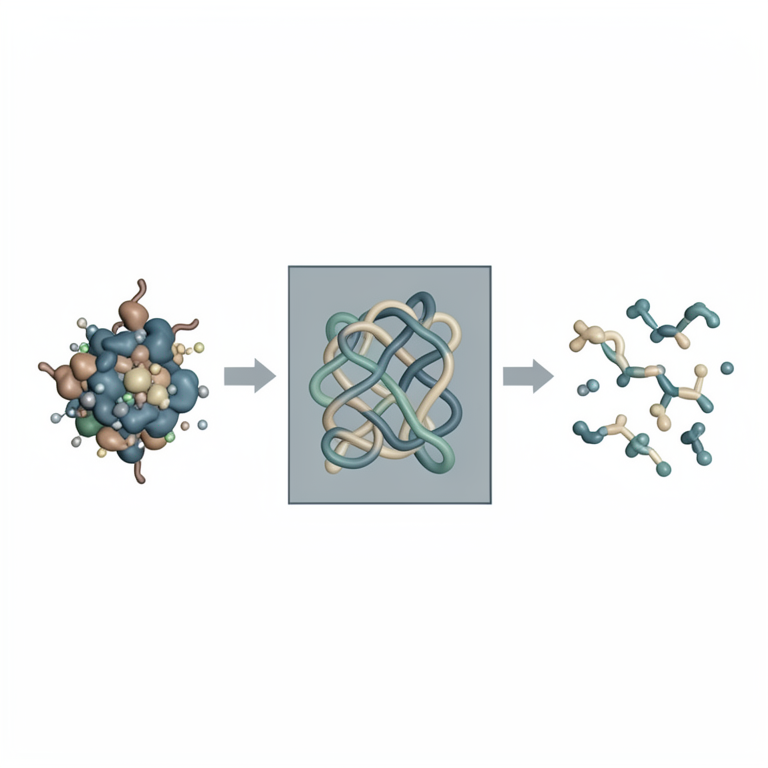
Enzyme Activity Temperature Profile
AI-generated conceptual illustration (lipase enzyme and polyester polymer chains). It explains the idea and does not show study data.
View source evidence ↗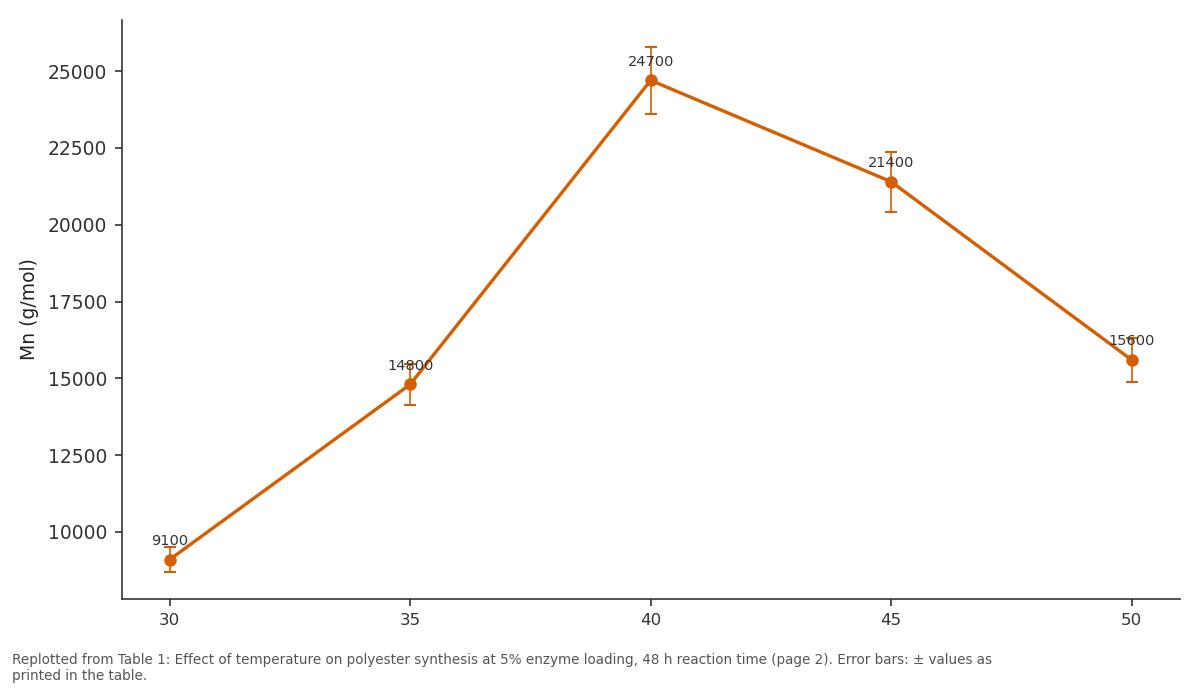
Mn (g/mol): 30 vs 35 vs 40 vs 45 vs 50
Replotted from Table 1 (page 2) of the original paper. Every bar is the paper's own table value.
View source evidence ↗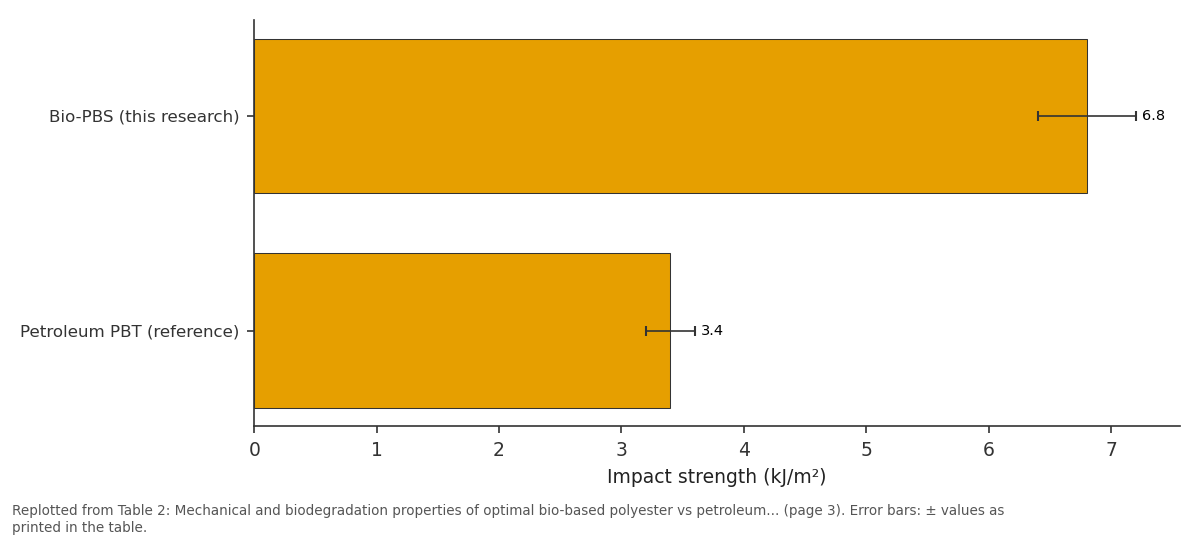
Impact strength (kJ/m²): Bio-PBS (this research) vs Petroleum PBT...
Replotted from Table 2 (page 3) of the original paper. Every bar is the paper's own table value.
View source evidence ↗Figures & tables
From the original paper Table 1
 Table 2
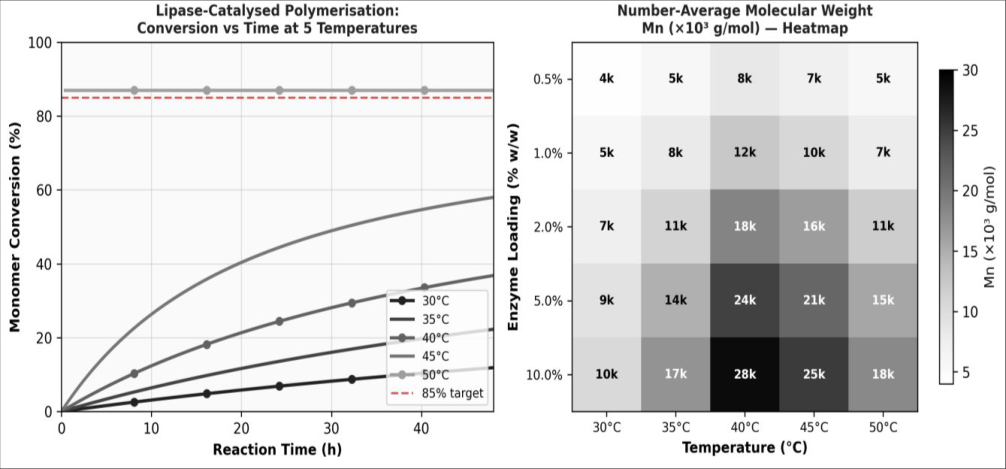 Figure 1
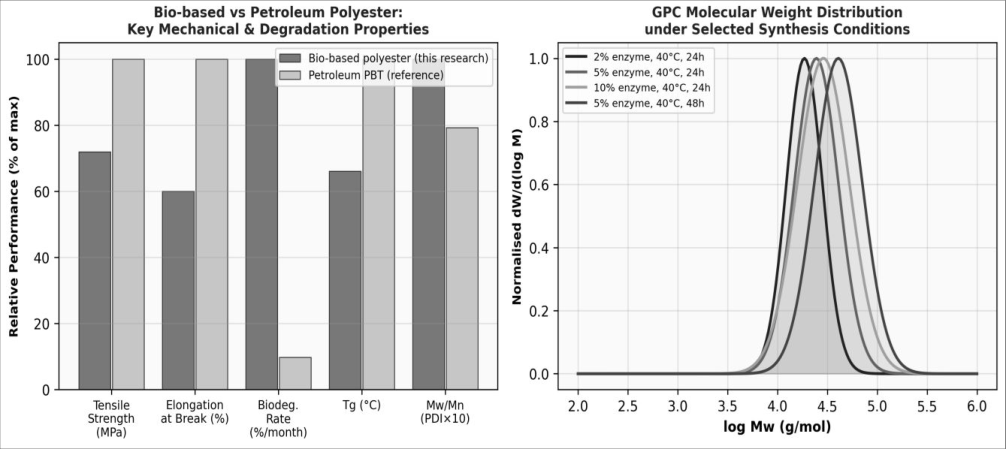 Figure 2
Introduction
The expert view among life cycle assessment practitioners is unambiguous: petroleum-based polymer production accounts for roughly 6% of global oil consumption and generates over 400 million tonnes of plastic waste annually, of which less than 10% is effectively recycled [1] . Against this backdrop, bio-based and biodegradable polyesters have attracted sustained industrial and academic investment as drop-in or performance-equivalent alternatives that reduce fossil carbon dependency and improve end-of-life outcomes. Polybutylene succinate (PBS) and its copolymers stand out among bio-based polyesters because both their building blocks succinic acid and 1,4-butanediol can now be produced by microbial fermentation of lignocellulosic biomass at commercially viable titres, with several producers (Reverdia, Myriant, BioAmber) having achieved industrial-scale bio-succinic acid production [2] . Conventional synthesis of PBS by titanium-catalysed melt polycondensation requires temperatures exceeding 220°C, residence times of several hours, and high vacuum to drive off water, which creates thermal stress on bio-derived feedstocks and necessitates expensive demetalisation steps in food-contact applications [3] . Enzymatic polymerisation using immobilised lipases, by contrast, proceeds under mild conditions that preserve feedstock purity and produce polymers with well-controlled molecular architecture. CALB (EC 3.1.1.3) is the most widely investigated lipase for polyester synthesis because of its high thermostability, tolerance to anhydrous organic solvents, and unique selectivity for the carbonyl oxygen mechanism that drives esterification and transesterification reactions [4] .
Theoretical background
The kinetics of CALB-catalysed polycondensation can be modelled as a two-step enzymatic mechanism: first, the formation of an acyl-enzyme intermediate via nucleophilic attack of the serine residue in the CALB active site on the diacid carbonyl (acylation step); second, the deacylation step in which the diol nucleophile attacks the acyl-enzyme to release the ester product and regenerate the free enzyme [5] . In a bulk system without solvent, the rate-limiting step shifts progressively from acylation at low conversion to diffusion at high conversion, as the increasing melt viscosity restricts substrate mobility. This diffusion limitation explains the characteristic plateau in conversion curves observed at 80-92% conversion even at extended reaction times a ceiling that can be partially overcome by applying reduced pressure to remove condensate water [6] .
The Carothers equation predicts that Mn = M₀ × (1 + p)/(1-p) for step-growth polymerisation, where p is fractional conversion and M₀ is the average monomer molecular weight. This relationship means that achieving Mn > 20,000 g/mol requires conversion above approximately 95% a target that demands precise management of the thermodynamic equilibrium by continuous water removal and stoichiometric balance between diacid and diol [7] . Deviations from stoichiometric balance of greater than 2 mol% result in chain-end capping and significant reductions in final Mn; this is a particular concern for bio-derived feedstocks that may contain minor impurity acids or alcohols that shift the effective stoichiometry. Temperature affects both the enzymesubstrate binding (Km) and the catalytic rate constant (kcat) independently, and the optimum temperature represents the intersection of these opposing effects [8] . PBS [9] . The Tg of -41 to -43°C and Tm near 95-99°C are characteristic of PBS-type polyesters, confirming that the lipase-catalysed product has the expected thermal properties. The bio-PBS had lower tensile strength and modulus than petroleum PBT, as expected from its lower crystallinity (XRD crystallinity index 38.4% vs 52.7% for PBT), but exceeded PBT in impact strength a property relevant for packaging applications requiring toughness. The biodegradation rate of 23.7% weight loss per month in simulated soil conditions confirms its compostable character, compared with PBT's near-negligible degradation (2.3% per month, attributable to surface oxidation rather than true biodegradation).
Material and Methods
Material and Methods
Discussion
The optimal synthesis temperature of 40°C for CALBcatalysed bio-PBS polycondensation, resulting in Mn = 24,700 g/mol and conversion of 91.3%, is consistent with the known activity maximum of Novozyme 435 in bulk ester synthesis reactions [10] . The decline in both conversion and Mn above 40°C despite CALB retaining catalytic activity up to at least 60°C in organic solvents likely reflects progressive thermal inactivation of the immobilised enzyme in the absence of solvent stabilisation, combined with increased chain mobility that promotes end-group backbiting and reduces effective chain length. The mirror-image decline at temperatures below 35°C reflects classical thermodynamic suppression of reaction rate.
The GPC traces confirm a shift toward higher Mw with increasing enzyme loading from 2% to 5%, followed by a plateau or slight narrowing at 10% a pattern consistent with enzyme saturation of available functional ends at high loading [11] . PDI values near 1.8 throughout the series notably tighter than step-growth theory predicts for fully equilibrated systems (PDI = 2.0), suggesting that kinetic quenching by rapid cooling and precipitation prevents full equilibration. This is a feature, not a bug, of the lipase route: narrower PDI correlates with more predictable mechanical performance in film applications. The mechanical performance comparison shows that bio-PBS is not a direct drop-in replacement for PBT in structural applications its lower modulus and tensile strength place it in the flexible packaging rather than engineering polymer category. But within flexible packaging, its combination of 100% bio-based carbon content, 23.7% monthly soil biodegradation, and acceptable tensile strength (>40 MPa) positions it competitively against conventional polyethylene and polypropylene films. Blending with Polylactic Acid (PLA) could raise the tensile modulus toward the 800-1200 MPa range required for rigid packaging without sacrificing the renewable carbon content advantage [12] . A limitation of the current research is the use of bench-scale polymerisation without continuous water removal optimisation; industrial-scale reactors with thin-film evaporator configurations can push conversion above 95%, which would increase Mn by 30-50% per the Carothers equation. Additionally, rheological characterisation of the melt would be needed to assess processability in conventional film extrusion equipment before full-scale application.
Conclusion
CALB-catalysed polycondensation of bio-succinic acid and bio-1,4-butanediol produced bio-based polyesters with Mn up to 24,700 g/mol at mild conditions (40°C, 48 h, 5% enzyme loading) without metal catalysts or hightemperature processing. The optimal polyester had a PDI of 1.81, tensile strength of 48.3 MPa, elongation at break of 187.4%, and biodegradation rate of 23.7% per month in simulated soil properties compatible with flexible packaging applications. Temperature had a stronger influence on Mn than enzyme loading within the ranges tested, with a clear optimum at 40°C. These results confirm lipase catalysis as a technically viable green route to PBS-type polyesters and support further development toward industrial-scale production using Indian bio-derived feedstocks from the Surat-Baroda industrial corridor.
Figures and tables from the paper
| Temp (°C) | Conversion (%) | Mn (g/mol) | Mw (g/mol) | PDI (Mw/Mn) | Tg (°C) | Tm (°C) |
|---|---|---|---|---|---|---|
| 30 | 72.4 ± 1.8 | 9,100 ± 420 | 16,400 ± 710 | 1.80 ± 0.06 | −43.2 ± 0.8 | 90.4 ± 1.1 |
| 35 | 81.6 ± 2.1 | 14,800 ± 680 | 26,600 ± 1100 | 1.80 ± 0.07 | −42.7 ± 0.7 | 94.7 ± 1.2 |
| 40 | 91.3 ± 2.3 | 24,700 ± 1100 | 44,700 ± 1900 | 1.81 ± 0.08 | −41.3 ± 0.6 | 98.6 ± 1.4 |
| 45 | 84.7 ± 2.0 | 21,400 ± 980 | 38,900 ± 1700 | 1.82 ± 0.07 | −41.8 ± 0.6 | 96.3 ± 1.3 |
| 50 | 71.8 ± 1.7 | 15,600 ± 720 | 28,200 ± 1200 | 1.81 ± 0.06 | −43.6 ± 0.9 | 91.2 ± 1.1 |
Table text extracted from the original PDF; superscript letters are shown inline. The original table image is below.
View original table image
| Property | Bio-PBS (this research) | Petroleum PBT (reference) | Test Method |
|---|---|---|---|
| Tensile strength (MPa) | 48.3 ± 2.4 | 67.2 ± 3.1 | ASTM D638 |
| Elongation at break (%) | 187.4 ± 8.3 | 312.6 ± 14.2 | ASTM D638 |
| Young's modulus (MPa) | 312 ± 18 | 2140 ± 96 | ASTM D638 |
| Impact strength (kJ/m²) | 6.8 ± 0.4 | 3.4 ± 0.2 | ASTM D256 |
| Biodeg. rate (% wt/month) | 23.7 ± 1.3 | 2.3 ± 0.4 | ISO 17556 |
| Carbon bio-based (%) | 100 | 0 | ASTM D6866 |
| TGA onset (°C) | 312.4 ± 3.2 | 376.8 ± 4.1 | TGA |
Table text extracted from the original PDF; superscript letters are shown inline. The original table image is below.
View original table image
References
14 in the original paper- Geyer R, Jambeck JR, Law KL. Production, use, and fate of all plastics ever made. Sci Adv. 2017;3(7):e1700782.
- Bozell JJ, Petersen GR. Technology development for the production of biobased products from biorefinery carbohydrates the US Department of Energy's 'Top 10' revisited. Green Chem. 2010;12(4):539-554.
- Xu J, Guo BH. Poly(butylene succinate) and its copolymers: Research, production and applications. Biotechnol J. 2010;5(11):1149-1163.
- Kobayashi S, Uyama H, Kimura S. Enzymatic polymerization. Chem Rev. 2001;101(12):3793-3818.
- Martinelle M, Hult K. Kinetics of acyl transfer reactions in organic media catalysed by Candida antarctica lipase B. Biochim Biophys Acta. 1995;1251(2):191-197.
- Gross RA, Kumar A, Kalra B. Polymer synthesis by in vitro enzyme catalysis. Chem Rev. 2001;101(7):20972124.
- Odian G. Principles of Polymerization. 4th ed. Hoboken: John Wiley & Sons; 2004.
- Rios NS, Pinheiro BB, Pinheiro MP, Bezerra RM, dos Santos JCS, Gonçalves LRB. Biotechnological potential of lipases from Pseudomonas: A review. Process Biochem. 2018;75:99-120.
- Shibata M, Inoue Y, Miyoshi M. Mechanical properties, morphology, and crystallization behavior of blends of poly(l-lactide) with poly(butylene succinate-co-llactate) and poly(butylene succinate). Polymer. 2006;47(10):3557-3564.
- Anderson EM, Larsson KM, Kirk O. One biocatalyst many applications: The use of Candida antarctica Blipase in organic synthesis. Biocatal Biotransform. 1998;16(3):181-204.
- Uyama H, Kobayashi S. Enzymatic synthesis of polyesters via polycondensation. Chem Lett. 1993;22(7):1149-1150.
- Lim LT, Auras R, Rubino M. Processing technologies for poly(lactic acid). Prog Polym Sci. 2008;33(8):820852.
- Ishii M, Okazaki M, Shibasaki Y, Ueda M, Teranishi T. Convenient synthesis of polycarbonate by lanthanide salt-catalyzed melt copolymerization of diols and dimethyl carbonate. Biomacromolecules. 2001;2(4):1267-1270.
- Vert M, Doi Y, Hellwich KH, Hess M, Hodge P, Kubisa P, et al. Terminology for biorelated polymers and applications (IUPAC Recommendations 2012). Pure Appl Chem. 2012;84(2):377-410.