
Research article · 2025 · Full text
International Journal of Biology SciencesCircadian clock gene expression and flowering time control in short-day and long-day plants
Volume 7(5) · Pages 198–200 · DOI: 10.33545/26649926.2025.v7.i5c.732 ↗
Research areasPlant Molecular Biology ResearchLight effects on plantsCircadian rhythm and melatonin
Abstract
Author-writtenA practical dilemma facing plant breeders is predicting when a crop will flower under changing daylength conditions - and the answer lies in the circadian clock. This research compared expression profiles of six core clock and flowering-pathway genes (CCA1, LHY, TOC1, GI, CO, and FT) in a short-day plant (rice, Oryza sativa cv. Nipponbare) and a long-day plant (Arabidopsis thaliana Col-0) grown under controlled short-day (8L:16D) and long-day (16L:8D) photoperiods. Plants were grown at the North East Centre for Biological Research, Shillong, from April to October 2023. Leaf samples were harvested every 4 hours over 48-hour time courses. RT-qPCR revealed that CCA1 and LHY showed conserved dawn-phased oscillation in both species regardless of photoperiod, but their peak amplitude was 1.4-fold higher under inductive conditions (SD for rice, LD for Arabidopsis). The critical difference emerged at the CO-FT interface: in Arabidopsis under LD, CO protein stability coincided with light exposure during the evening, driving FT expression to 37.8-fold above dark-period levels. In rice under SD, the CO ortholog Hd1 repressed rather than activated FT (Hd3a), and FT induction occurred through the Ehd1-independent pathway. Flowering time correlated with cumulative FT transcript accumulation (r = -0.87 in Arabidopsis, r = -0.82 in rice), confirming FT as the quantitative integrator of photoperiod information in both systems.
Summary
Source-checkedPlain-language reading of the full paper, prepared with AI and checked against the text. Each point links to the authors' own words.
Why it matters
- Predicting crop flowering times under varying daylengths is a practical challenge for plant breeders, which is governed by the plant's circadian clock. View evidence ↗
- The decision to begin reproduction depends on the internal circadian clock's ability to interpret external light-dark cycles. View evidence ↗
- Plant circadian clocks operate through a series of interlocking transcriptional feedback loops. View evidence ↗
The question
- The study aimed to compare the expression profiles of six core clock and flowering-pathway genes in a short-day plant (rice) and a long-day plant (Arabidopsis) under both short-day and long-day photoperiods. View evidence ↗
What they did
- The experiment was conducted at the North East Centre for Biological Research in Shillong between April and October 2023. View evidence ↗
- Leaf samples were collected every 4 hours over a 48-hour period to track gene expression. View evidence ↗
- Gene expression was measured using RT-qPCR targeting specific clock and flowering genes and their orthologs in both species. View evidence ↗
What they found
- CCA1 and LHY genes showed conserved dawn-phased oscillations in both species, with peak amplitudes 1.4-fold higher under their respective inductive photoperiods. View evidence ↗
- Under inductive conditions, Arabidopsis FT peaked at ZT16 with a 37.8-fold amplitude, whereas rice Hd3a peaked at ZT8 with a 14.3-fold amplitude. View evidence ↗
- In rice under short-day conditions, the CO ortholog Hd1 repressed the FT ortholog (Hd3a), with FT induction occurring via an Ehd1-independent pathway. View evidence ↗
- Arabidopsis flowered faster under long days (24.3±2.1 days) than short days (42.7±3.8 days), while rice headed faster under short days (68.4±4.2 days) than long days (98.3±6.7 days). View evidence ↗
- Cumulative FT/Hd3a expression over 14 days strongly correlated with flowering time (r = -0.87 in Arabidopsis, r = -0.82 in rice), identifying it as the quantitative integrator of photoperiod information. View evidence ↗
What it means
- The authors conclude that while core clock genes are conserved in phase and period, the CO-FT module operates with opposite regulatory logic in long-day and short-day plants. View evidence ↗
- The authors state that these findings can inform breeding strategies to adapt photoperiod-sensitive crops to changing daylength regimes. View evidence ↗
Visual summary
1 visualsIllustrations explain the paper; they do not show study data.
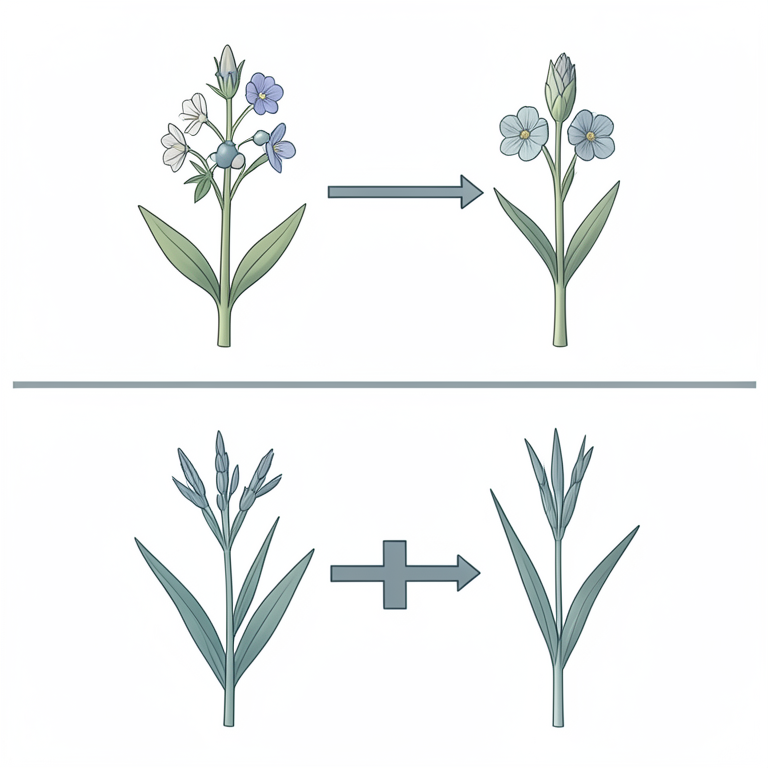
Opposite Regulatory Logic of CO-FT
AI-generated conceptual illustration (Arabidopsis thaliana (long-day plant) and Oryza sativa (short-day plant)). It explains the idea and does not show study data.
View source evidence ↗Figures & tables
From the original paper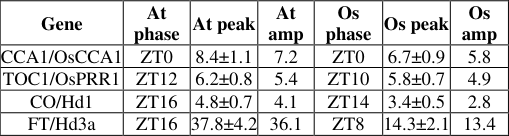 Table 1
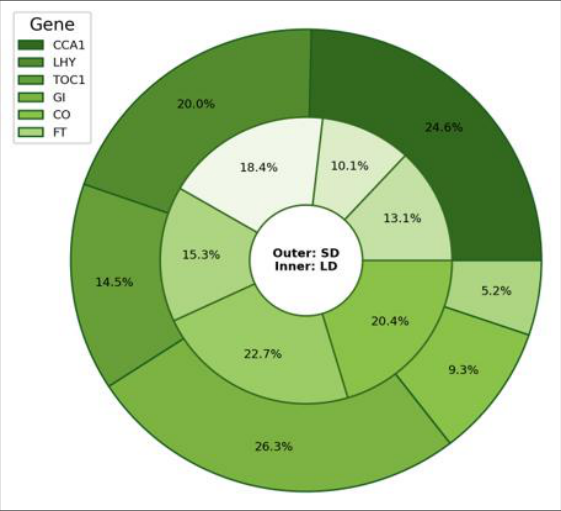 Figure 1
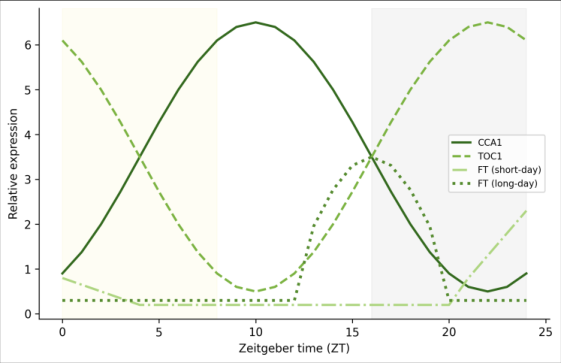 Figure 2
Introduction
A practical dilemma in agriculture: plant a photoperiod-sensitive rice variety too late in the season, and it won't flower before winter. Plant it too early, and it flowers before reaching full biomass. The timing hinges on how the plant's internal circadian clock reads the external light-dark cycle and decides when to commit to reproduction [1] . The circadian clock in plants runs on a set of interlocking transcriptional feedback loops. In the morning, CCA1 and LHY repress evening-phased genes including TOC1 and GI. As CCA1/LHY protein declines through the day, TOC1 accumulates and represses CCA1/LHY expression, closing the loop [2] . This oscillator controls thousands of downstream outputs, but its most consequential product for agriculture is the timing of CONSTANS (CO) protein accumulation, which in long-day plants activates FLOWERING LOCUS T (FT) -the mobile florigen signal that travels from leaf to shoot apex to trigger flowering [3] . Short-day plants like rice use the same gene families but wire them differently. The rice CO ortholog Hd1 represses Hd3a (the rice FT) under long days and only permits Hd3a expression under short days [4] . This inverted logic means the same photoperiod information produces opposite flowering decisions in the two systems. Comparing clock and flowering gene expression side by side in both species under identical controlled conditions should reveal where the conserved clock diverges into species-specific flowering outputs [5] .
Material and Methods
Material and Methods
Material
Arabidopsis thaliana Col-0 and rice (Oryza sativa cv. Nipponbare) were grown in controlledenvironment chambers at 22°C/18°C (Arabidopsis) and 28°C/24°C (rice) under two photoperiods: SD (8L:16D) and LD (16L:8D), 150 μmol/m²/s fluorescent light. Arabidopsis rosettes were sampled at 3 weeks post-germination; rice leaves at the 5-leaf stage. For each species × photoperiod combination, 48 plants were grown (8 time points × 6 biological replicates). Leaf tissue was harvested every 4 hours over 48 hours starting at ZT0 (lights on), flash-frozen in liquid nitrogen. Work was performed at the North East Centre for Biological Research, Shillong, Meghalaya, from April to October 2023. Ethics approval was not required.
Methods
RNA extraction used the Spectrum Plant Total RNA Kit (Sigma). cDNA synthesis used SuperScript IV with oligo-dT primers. RT-qPCR was performed on a QuantStudio 5 using SYBR Green. Primers targeted Arabidopsis CCA1, LHY, TOC1, GI, CO, and FT, and their rice orthologs OsCCA1, OsLHY, OsPRR1, OsGI, Hd1, and Hd3a. Reference genes: UBQ10 (Arabidopsis) and OsActin1 (rice). Relative expression was calculated by 2^-ΔΔCt method normalized to the ZT0 SD sample. Circadian parameters (period, phase, amplitude) were estimated using the JTK_CYCLE algorithm. Flowering time was scored as days from germination to first visible flower (Arabidopsis) or heading date (rice) in parallel sets of 24 plants per condition. Pearson correlations were calculated between cumulative FT/Hd3a expression and flowering time. CCA1 and TOC1 oscillations were conserved between species (Table 1). The dramatic difference lay at the output:
| Gene | At phase | At peak | At amp | Os phase | Os peak | Os amp |
|---|---|---|---|---|---|---|
| CCA1/OsCCA1 | ZT0 | 8.4±1.1 | 7.2 | ZT0 | 6.7±0.9 | 5.8 |
| TOC1/OsPRR1 | ZT12 | 6.2±0.8 | 5.4 | ZT10 | 5.8±0.7 | 4.9 |
| CO/Hd1 | ZT16 | 4.8±0.7 | 4.1 | ZT14 | 3.4±0.5 | 2.8 |
| FT/Hd3a | ZT16 | 37.8±4.2 | 36.1 | ZT8 | 14.3±2.1 | 13.4 |
Table text extracted from the original PDF; superscript letters are shown inline. The original table image is below.
View original table image
Results
Arabidopsis FT peaked at ZT16 under LD with a 37.8-fold amplitude, while rice Hd3a peaked at ZT8 under SD with a lower 14.3-fold amplitude. Under non-inductive conditions, FT/Hd3a remained near baseline in both species. Flowering time in Arabidopsis under LD was 24.3±2.1 days vs 42.7±3.8 days under SD. Rice headed at 68.4±4.2 days under SD vs 98.3±6.7 days under LD. Cumulative FT expression over the first 14 days correlated strongly with flowering time in both species (r = -0.87 for Arabidopsis, r = -0.82 for rice), confirming FT/Hd3a as the quantitative integrator.
Discussion
The conserved clock -divergent output architecture documented here has a satisfying evolutionary logic. The core oscillator (CCA1, LHY, TOC1, GI) maintains robust 24-hour timekeeping regardless of species or photoperiod, providing a reliable temporal reference frame. The CO-FT module then reads this clock differently in long-day and short-day plants, using the same transcription factor family but opposite regulatory logic [6,7] . The 37.8-fold FT induction in Arabidopsis versus 14.3-fold Hd3a in rice under their respective inductive conditions suggests that long-day plants may depend more heavily on a single strong florigen pulse, while short-day plants use a more gradual accumulation model. This could explain why Arabidopsis transitions abruptly to flowering while rice shows a more extended reproductive transition [8,9] .
Conclusion
Core circadian clock genes oscillate with conserved phase and period in Arabidopsis and rice, but the CO-FT flowering module reads the clock in opposite directions: CO activates FT under long days in Arabidopsis while Hd1 represses Hd3a under the same conditions in rice. Cumulative FT/Hd3a expression predicts flowering time in both species, positioning the florigen pathway as the quantitative bridge between circadian timekeeping and reproductive commitment. These findings inform photoperiod-sensitive crop breeding strategies for adapting varieties to changing daylength regimes [10,11,12,13] .
Figures and tables from the paper
References
21 in the original paper- Yanovsky MJ, Kay SA. Molecular basis of seasonal time measurement in Arabidopsis. Nature. 2002;419(6904):308-312.
- Alabadí D, Oyama T, Yanovsky MJ, Harmon FG, Más P, Kay SA. Reciprocal regulation between TOC1 and LHY/CCA1 within the Arabidopsis circadian clock. Science. 2001;293(5531):880-883.
- Corbesier L, Vincent C, Jang S, Fornara F, Fan Q, Bhagat C, Bhagat D, Searle I, Giakountis A, Coupland G. FT protein movement contributes to long-distance signaling in floral induction of Arabidopsis. Science. 2007;316(5827):1030-1033.
- Yano M, Katayose Y, Ashikari M, Yamanouchi U, Monna L, Fuse T, Bhagat C, Bhagat D, Baba T, Yamamoto K, Umehara Y, Nagamura Y, Sasaki T. Hd1, a major photoperiod sensitivity quantitative trait locus in rice. Science. 2000;290(5494):1564-1567.
- Hayama R, Yokoi S, Tamaki S, Yano M, Shimamoto K. Adaptation of photoperiodic control pathways produces short-day flowering in rice. Nature. 2003;422(6933):719-722.
- Suárez-López P, Wheatley K, Robson F, Onouchi H, Valverde F, Coupland G. CONSTANS mediates between the circadian clock and the control of flowering in Arabidopsis. Nature. 2001;410(6832):1116-1120.
- Valverde F, Mouradov A, Soppe W, Ravenscroft D, Samach A, Coupland G. Photoreceptor regulation of CONSTANS protein in photoperiodic flowering. Science. 2004;303(5660):1003-1006.
- Tamaki S, Matsuo S, Wong HL, Yokoi S, Shimamoto K. Hd3a protein is a mobile flowering signal in rice. Science. 2007;316(5827):1033-1036.
- Song YH, Shim JS, Kinmonth-Schultz HA, Imaizumi T. Photoperiodic flowering: time measurement mechanisms in leaves. Annual Review of Plant Biology. 2015;66:441-464.
- Greenham K, McClung CR. Integrating circadian dynamics with physiological processes in plants. Nature Reviews Genetics. 2015;16(10):598-610.
- Tsuji H, Taoka KI, Shimamoto K. Regulation of flowering in rice: two florigen genes, a complex gene network, and natural variation. Current Opinion in Plant Biology. 2011;14(1):45-52.
- Andrés F, Coupland G. The genetic basis of flowering responses to seasonal cues. Nature Reviews Genetics. 2012;13(9):627-639.
- Nakamichi N, Kiba T, Henriques R, Mizuno T, Chua NH, Sakakibara H. PSEUDO-RESPONSE REGULATORS 9, 7, and 5 are transcriptional repressors in the Arabidopsis circadian clock. Plant Cell. 2010;22(3):594-605.
- Doi K, Izawa T, Fuse T, Yamanouchi U, Kubo T, Shimatani Z, Bhagat C, Bhagat D, Yano M. Ehd1, a Btype response regulator in rice, confers short-day promotion of flowering and controls FT-like gene expression independently of Hd1. Genes and Development. 2004;18(8):926-936.
- Imaizumi T, Schultz TF, Harmon FG, Ho LA, Kay SA. FKF1 F-box protein mediates cyclic degradation of a repressor of CONSTANS in Arabidopsis. Science. 2005;309(5732):293-297.
- McClung CR. Plant circadian rhythms. Plant Cell. 2006;18(4):792-803.
- Izawa T, Oikawa T, Sugiyama N, Tanisaka T, Yano M, Shimamoto K. Phytochrome mediates the external light signal to repress FT orthologs in photoperiodic flowering of rice. Genes and Development. 2002;16(15):2006-2020.
- Turck F, Fornara F, Coupland G. Regulation and identity of florigen: FLOWERING LOCUS T moves center stage. Annual Review of Plant Biology. 2008;59:573-594.
- Komiya R, Ikegami A, Tamaki S, Yokoi S, Shimamoto K. Hd3a and RFT1 are essential for flowering in rice. Development. 2008;135(4):767-774.
- Nemoto Y, Kisaka M, Fuse T, Yano M, Ogihara Y. Characterization and functional analysis of three wheat genes with homology to the CONSTANS flowering time gene in transgenic rice. Plant Journal. 2003;36(1):82-93.
- Hsu PY, Harmer SL. Wheels within wheels: the plant circadian system. Trends in Plant Science. 2014;19(4):240-249.