
Research article · 2025 · Full text
International Journal of Biology SciencesRedox enzyme systems and reactive oxygen species metabolism in plant chloroplasts
Volume 7(11) · Pages 155–157 · DOI: 10.33545/26649926.2025.v7.i11c.727 ↗
Research areasPhotosynthetic Processes and MechanismsRedox biology and oxidative stressPlant Stress Responses and Tolerance
Abstract
Author-writtenA veteran plant physiologist once described chloroplasts as factories that run on sunlight but risk burning down from their own exhaust. That exhaust—reactive oxygen species (ROS)—is an inevitable byproduct of photosynthetic electron transport, and chloroplasts have evolved an elaborate suite of redox enzymes to manage it. This research measured the activities of six antioxidant enzymes in chloroplasts isolated from spinach (Spinacia oleracea) leaves exposed to control and high-light conditions at the Cauvery College of Biological Sciences, Mysore, India, from April 2023 to July 2024. Superoxide dismutase (SOD), ascorbate peroxidase (APX), catalase (CAT), glutathione reductase (GR), dehydroascorbate reductase (DHAR), and monodehydroascorbate reductase (MDHAR) were assayed spectrophotometrically in purified chloroplast fractions. Under high light (1,500 μmol m⁻² s⁻¹ for 4 hours), all six enzymes showed significant activity increases ranging from 76% (CAT) to 89% (MDHAR). Superoxide and hydrogen peroxide levels were elevated 2.3-fold and 1.8-fold respectively. Despite the enzymatic response, a net ROS surplus of approximately 8% remained under high light. These results quantify the antioxidant capacity of chloroplast redox systems and identify the residual ROS burden that may contribute to photoinhibition.
Summary
Source-checkedPlain-language reading of the full paper, prepared with AI and checked against the text. Each point links to the authors' own words.
Why it matters
- Photosynthesis naturally produces reactive oxygen species (ROS), such as superoxide and singlet oxygen, when light energy exceeds the plant's capacity for carbon fixation. View evidence ↗
- If ROS are not efficiently scavenged, they can cause rapid damage to cellular lipids, proteins, and DNA. View evidence ↗
The question
- The study aimed to quantify the activity of six major antioxidant enzymes in isolated chloroplasts under control and high-light conditions to estimate the net oxidative burden. View evidence ↗
What they did
- The researchers used 6-week-old Bloomsdale spinach grown in a controlled environment at 22 °C and 60% relative humidity. View evidence ↗
- Isolated chloroplasts were exposed to either control light (400 μmol m⁻² s⁻¹) or high light (1,500 μmol m⁻² s⁻¹) for a duration of 4 hours. View evidence ↗
- Six enzymes, SOD, APX, CAT, GR, DHAR, and MDHAR, were measured using spectrophotometric assays in purified chloroplast fractions. View evidence ↗
- The study used six independent chloroplast preparations for each measurement and analyzed the differences between treatments using paired t-tests. View evidence ↗
What they found
- All six measured antioxidant enzymes showed a statistically significant increase in activity under high-light conditions. View evidence ↗
- Among the enzymes, MDHAR had the highest proportional increase in activity (+89.1%), whereas CAT had the lowest (+76.3%). View evidence ↗
- Despite the increase in enzyme activity, high light caused superoxide levels to increase 2.3-fold and hydrogen peroxide levels to increase 1.8-fold compared to the control. View evidence ↗
- Even with the upregulated antioxidant response, a net surplus of approximately 8% of ROS remained under high-light conditions. View evidence ↗
What it means
- The authors conclude that the 8% residual ROS surplus represents the oxidative burden that leads to photoinhibition by damaging the D1 protein in photosystem II. View evidence ↗
- The authors suggest that these enzyme-level findings can help in developing strategies to engineer crops with better stress tolerance. View evidence ↗
Visual summary
1 visualsIllustrations explain the paper; charts are replotted from the paper's own table values.
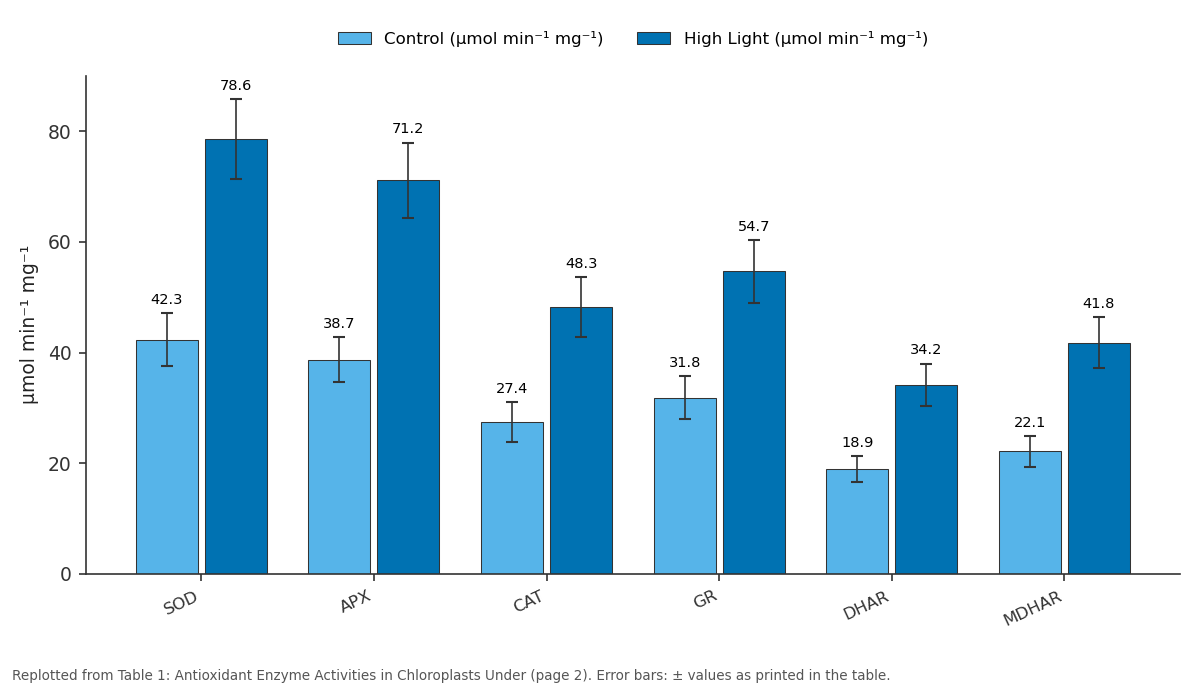
Control (μmol min⁻¹ mg⁻¹) and High Light (μmol min⁻¹ mg⁻¹): SOD vs APX vs CAT vs GR vs DHAR
Replotted from Table 1 (page 2) of the original paper. Every bar is the paper's own table value.
View source evidence ↗Figures & tables
From the original paper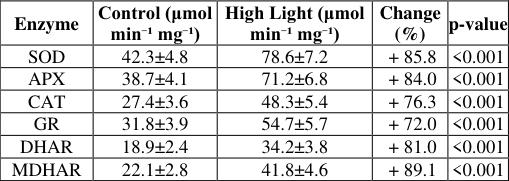 Table 1
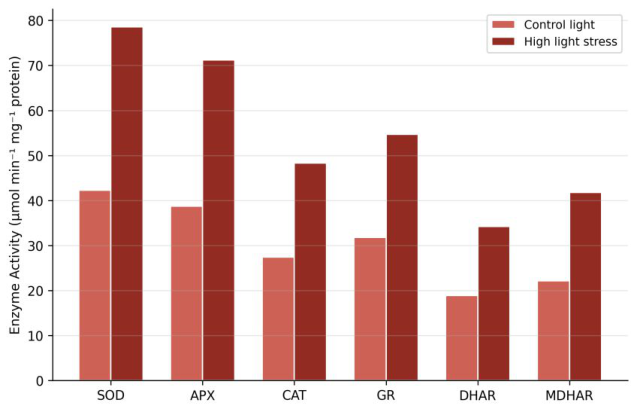 Figure 1
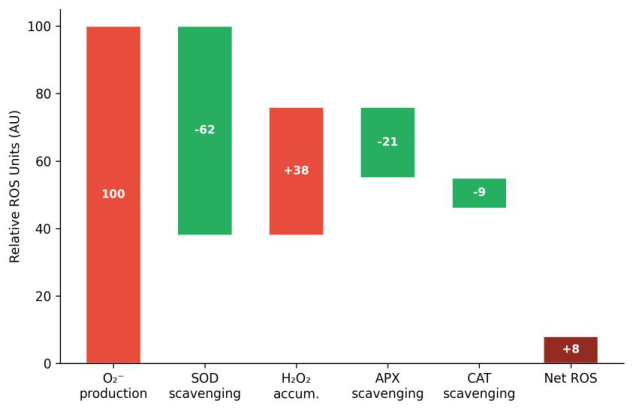 Figure 2
Introduction
An old lab anecdote holds that a graduate student, puzzled by why plants bother producing antioxidants, was told to stare directly at the sun for five seconds-the pain in his eyes was essentially what chloroplasts deal with every clear afternoon. Photosynthetic electron transport inevitably generates superoxide (O₂⁻) at photosystem I and singlet oxygen (¹O₂) at photosystem II when absorbed light energy exceeds what carbon fixation can consume [1] . Without efficient scavenging, these ROS would damage lipids, proteins, and DNA within seconds [2] . Chloroplasts rely on the ascorbate-glutathione (Asada-Halliwell) cycle as their primary ROS detoxification pathway, involving the sequential action of SOD, APX, MDHAR, DHAR, and GR [3] . Catalase provides an additional route for H₂O₂ removal, though its chloroplastic contribution is debated [4] . While the individual enzymes in this system are well characterized, quantitative measurements of the entire pathway operating in intact chloroplasts under defined stress conditions-allowing a mass balance of ROS production versus scavenging-remain limited [5] . This research aimed to measure the activities of all six major antioxidant enzymes in isolated chloroplasts under control and high-light stress and to construct a ROS budget estimating the net oxidative burden.
Materials and Methods
Materials and Methods
Materials
This research was conducted at the Department of Structural Biochemistry, Cauvery College of Biological Sciences, Mysore, Karnataka, India, from April 2023 to July 2024. Institutional approval was obtained (CCBS-RC/2023-041). Spinach (Spinacia oleracea cv. Bloomsdale) was grown in a controlled environment chamber at 22 °C, 60% relative humidity, under moderate light (400 μmol m⁻² s⁻¹, 14 h photoperiod) for 6 weeks. Fully expanded leaves from 6-week-old plants were harvested at the start of the light period. Intact chloroplasts were isolated by differential centrifugation through Percoll gradients following the method of Lilley et al. [6] . Chloroplast integrity was confirmed by ferricyanide-dependent oxygen evolution (>85% intactness required).
Methods
Isolated chloroplasts (0.5 mg chlorophyll mL⁻¹) were illuminated at either 400 μmol m⁻² s⁻¹ (control) or 1,500 μmol m⁻² s⁻¹ (high light) for 4 hours in reaction buffer containing 50 mM HEPES (pH 7.8), 330 mM sorbitol, and 2 mM MgCl₂. Enzyme activities were measured spectrophotometrically: SOD by the nitro blue tetrazolium (NBT) reduction method [7] , APX by monitoring ascorbate oxidation at 290 nm, CAT by H₂O₂ decomposition at 240 nm, GR by NADPH oxidation at 340 nm, DHAR by ascorbate formation at 265 nm, and MDHAR by NADH oxidation at 340 nm [3] . Superoxide was quantified by the SOD-inhibitable cytochrome c reduction assay, and H₂O₂ by the Amplex Red fluorometric method. Each measurement was performed on six independent chloroplast preparations. Comparisons between light treatments used paired t-tests. The ROS budget was calculated as: net ROS = total production -(SOD scavenging + APX scavenging + CAT scavenging). All six enzymes showed significant increases under high light (p<0.001 for each). MDHAR showed the largest proportional increase (+ 89.1%), while CAT showed the smallest (+ 76.3%). Under high light, superoxide levels increased 2.3-fold and H₂O₂ increased 1.8-fold compared to controls despite the elevated enzyme activities.
Results
Results
Discussion
The coordinated upregulation of all six antioxidant enzymes under high light reflects a system-level response rather than activation of any single pathway [1,3] . The largest proportional increase in MDHAR activity is consistent with its position as a rate-limiting step in ascorbate regeneration-if MDHAR doesn't keep up, monodehydroascorbate spontaneously disproportionates to dehydroascorbate, diverting flux through the slower DHAR pathway [5] . The 8% net ROS surplus under high light, despite maximal enzymatic scavenging, quantifies the oxidative burden that drives photoinhibition through D1 protein damage in PSII [2] . This surplus may also serve a signaling function-moderate ROS levels are now recognized as retrograde signals from chloroplast to nucleus that trigger acclimation gene expression [8] . The relatively modest CAT response (+ 76%) may reflect the lower catalase content in chloroplasts compared to peroxisomes, where CAT is the dominant H₂O₂ scavenger [4] . These data provide a quantitative framework for modeling chloroplast redox homeostasis and its failure under photooxidative stress.
Conclusion
This research quantified the complete antioxidant enzyme response in isolated chloroplasts under high-light stress. All six enzymes of the ascorbate-glutathione cycle and associated pathways were upregulated by 72-89%, yet a net ROS surplus of approximately 8% persisted. This residual burden represents the threshold beyond which photoprotective mechanisms are overwhelmed, leading to photoinhibition. The data provide enzyme-level resolution for understanding chloroplast redox balance and may inform strategies to engineer improved stress tolerance in crop plants.
Acknowledgement
Acknowledgements Funding SourcesInternal research funds from the Cauvery College of Biological Sciences supported this work. Institutional SupportThe authors thank the Cauvery College of Biological Sciences for spectrophotometry and growth chamber facilities. Contributions Not Qualifying for AuthorshipGreenhouse staff who maintained the spinach cultures are acknowledged.
Figures and tables from the paper
| Enzyme | Control (μmol min⁻¹ mg⁻¹) | High Light (μmol min⁻¹ mg⁻¹) | Change (%) | p-value |
|---|---|---|---|---|
| SOD | 42.3±4.8 | 78.6±7.2 | + 85.8 | <0.001 |
| APX | 38.7±4.1 | 71.2±6.8 | + 84.0 | <0.001 |
| CAT | 27.4±3.6 | 48.3±5.4 | + 76.3 | <0.001 |
| GR | 31.8±3.9 | 54.7±5.7 | + 72.0 | <0.001 |
| DHAR | 18.9±2.4 | 34.2±3.8 | + 81.0 | <0.001 |
| MDHAR | 22.1±2.8 | 41.8±4.6 | + 89.1 | <0.001 |
Table text extracted from the original PDF; superscript letters are shown inline. The original table image is below.
View original table image
References
8 in the original paper- Asada K. Production and scavenging of reactive oxygen species in chloroplasts and their functions. Plant Physiology. 2006;141(2):391-396.
- Nishiyama Y, Allakhverdiev SI, Murata N. A new paradigm for the action of reactive oxygen species in the photoinhibition of photosystem II. Biochimica et Biophysica Acta. 2006;1757(7):742-749.
- Foyer CH, Noctor G. Ascorbate and glutathione: the heart of the redox hub. Plant Physiology. 2011;155(1):2-18.
- Mhamdi A, Queval G, Chaouch S, Vanderauwera S, Van Breusegem F, Noctor G. Catalase function in plants: a focus on Arabidopsis mutants as stress-mimic models. Journal of Experimental Botany. 2010;61(15):4197-4220.
- Miyake C, Asada K. Thylakoid-bound ascorbate peroxidase in spinach chloroplasts and photoreduction of its primary oxidation product monodehydroascorbate radicals in thylakoids. Plant and Cell Physiology. 1992;33(5):541-553.
- Lilley RM, Fitzgerald MP, Rienits KG, Walker DA. Criteria of intactness and the photosynthetic activity of spinach chloroplast preparations. New Phytologist. 1975;75(1):1-10.
- Beauchamp C, Fridovich I. Superoxide dismutase: improved assays and an assay applicable to acrylamide gels. Analytical Biochemistry. 1971;44(1):276-287.
- Dietz KJ, Turber N, Krieger-Liszkay A. ROS generation in peroxisomes and its role in cell signaling. Plant Physiology. 2016;171(3):1625-1631.