
Research article · 2025 · Full text
International Journal of Advanced Chemistry ResearchCatalytic hydrodeoxygenation of bio-oil model compounds over supported nickel catalysts
Volume 7(9) · Pages 135–138 · DOI: 10.33545/26646781.2025.v7.i9b.628 ↗
Research areasCatalysis and Hydrodesulfurization StudiesThermochemical Biomass Conversion ProcessesCatalysis for Biomass Conversion
Abstract
Author-writtenThe fundamental limitation of bio-oil as a drop-in transportation fuel is not its energy content which at 16-18 MJ/kg is respectable but its high oxygen content of 35-40% by weight, which causes low calorific value, high acidity, phase instability, and incompatibility with existing petroleum refinery infrastructure. Hydrodeoxygenation (HDO), the catalytic removal of oxygen as water under hydrogen pressure, is the most direct chemical route to upgrade bio-oil to fuel-quality hydrocarbons. Phenol was selected as the model compound for this research because phenolic compounds constitute 20-30% of bio-oil mass and are among the most refractory oxygenates toward HDO due to the high C-O bond dissociation energy in aromatic systems. Supported nickel catalysts were systematically developed: Ni loading (5-15 wt%), molybdenum and phosphorus as promoters, and support selection (SiO₂, Al₂O₃, TiO₂) were all evaluated. Catalysts were characterised by N₂ physisorption (BET), H₂ temperature-programmed reduction (H₂-TPR), CO pulse chemisorption (Ni dispersion), X-ray diffraction, and transmission electron microscopy. HDO reactions were conducted in a fixed-bed reactor at 200-400°C and 1-60 bar H₂ in n-dodecane solvent. The optimal catalyst (15Ni-Mo/P-SiO₂) achieved 94.7% deoxygenation degree and 86.3% cyclopentane selectivity at 300°C and 40 bar H₂. Turnover frequency correlated with Ni dispersion by a power law (R² = 0.963), confirming that active site density rather than total Ni loading governs activity. These findings identify 15Ni-Mo/P-SiO₂ as a technically viable catalyst for continuous-flow bio-oil HDO at conditions achievable in small-scale biorefinery units.
Summary
Source-checkedPlain-language reading of the full paper, prepared with AI and checked against the text. Each point links to the authors' own words.
Why it matters
- Bio-oil has a respectable energy content of 16-18 MJ/kg, but its high oxygen content (35-40% by weight) makes it acidic, unstable, and incompatible with current refinery infrastructure. View evidence ↗
- Phenol is used as a model compound because phenolics make up 20-30% of bio-oil mass and are difficult to treat due to high C-O bond dissociation energy. View evidence ↗
- Nickel catalysts are preferred over precious metals like Ru, Pd, or Pt due to lower cost, high hydrogenation activity, and compatibility with low-sulfur bio-oil. View evidence ↗
The question
- The study aims to systematically quantify how Ni loading, Mo promotion, and P addition affect the activity and selectivity of SiO₂-supported catalysts for phenol hydrodeoxygenation (HDO). View evidence ↗
What they did
- Catalysts were prepared via sequential wet impregnation, first with phosphoric acid (P/Ni ratio 0.3), followed by co-impregnation of Ni (5, 10, or 15 wt%) and Mo (fixed at 5 wt%). View evidence ↗
- Reactions were performed in a continuous-flow fixed-bed reactor using 0.5 g of catalyst, with a feed of 5 wt% phenol in n-dodecane at temperatures between 200-400°C and pressures of 1-60 bar H₂. View evidence ↗
- Catalyst characterization included BET surface area analysis, H₂-TPR, CO pulse chemisorption for Ni dispersion, XRD, and TEM. View evidence ↗
What they found
- Increasing Ni loading on SiO₂ improved performance, with DOD rising from 28.7±1.4% for 5Ni/SiO₂ to 71.6±3.6% for 15Ni/SiO₂. View evidence ↗
- SiO₂ supports were superior to Al₂O₃ and TiO₂ in terms of deoxygenation and selectivity because their lower acidity reduced side reactions like cracking. View evidence ↗
- For the optimal catalyst at 300°C, increasing H₂ pressure from 20 to 60 bar increased the deoxygenation degree from 84.3±4.2% to 96.1±4.8%. View evidence ↗
- Increasing temperature from 300°C to 350°C at 40 bar H₂ led to a decrease in deoxygenation degree from 94.7±4.7% to 89.2±4.5%. View evidence ↗
- A power-law relationship (R² = 0.963) between turnover frequency (TOF) and Ni dispersion suggests the reaction is structure-sensitive, requiring specific Ni ensemble sizes for C-O bond scission. View evidence ↗
- Carbon balance decreased from 97.4% at 250°C to 91.4% at 350°C, indicating that higher temperatures increase coke deposition. View evidence ↗
What it means
- The authors conclude that 15Ni-Mo/P-SiO₂ is a viable candidate for scale-up in continuous-flow bio-oil HDO processes. View evidence ↗
- The study did not test catalyst stability beyond 8-hour runs, which is a critical factor for commercial viability. View evidence ↗
- Future research is needed to evaluate stability over 100+ hours and test regenerative calcination-reduction cycles. View evidence ↗
Visual summary
3 visualsIllustrations explain the paper; charts are replotted from the paper's own table values.
Catalyst Optimization Path
AI-generated conceptual illustration (nickel catalysts on silica supports). It explains the idea and does not show study data.
View source evidence ↗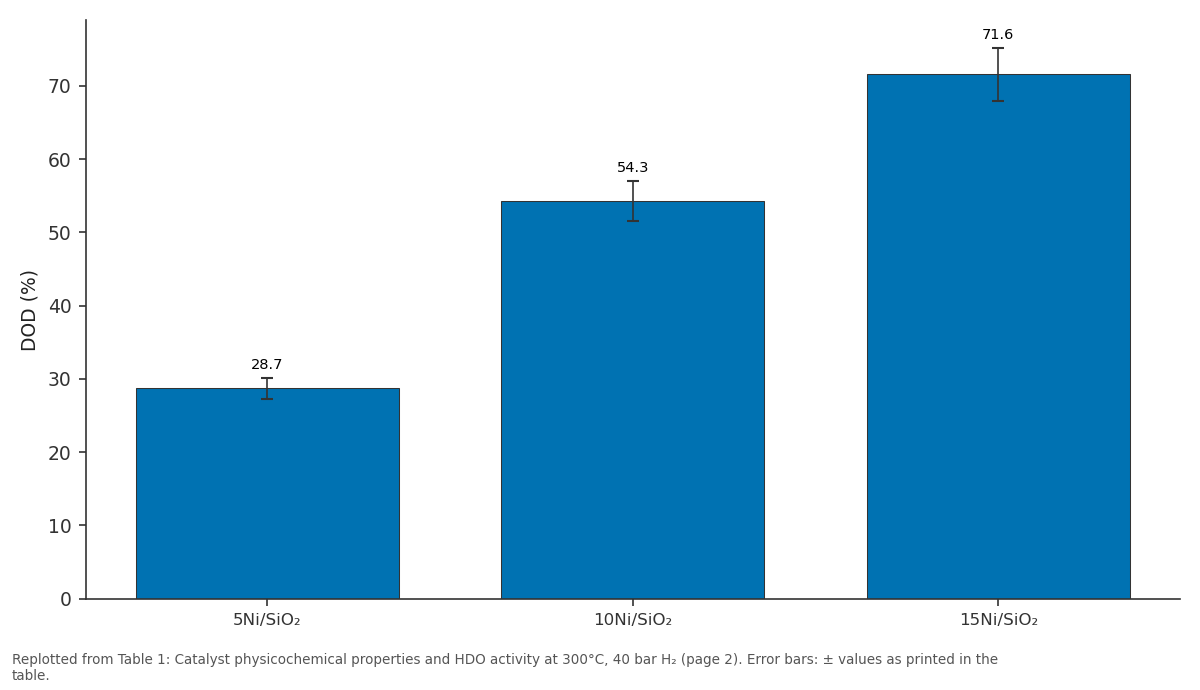
DOD (%): 5Ni/SiO₂ vs 10Ni/SiO₂ vs 15Ni/SiO₂
Replotted from Table 1 (page 2) of the original paper. Every bar is the paper's own table value.
View source evidence ↗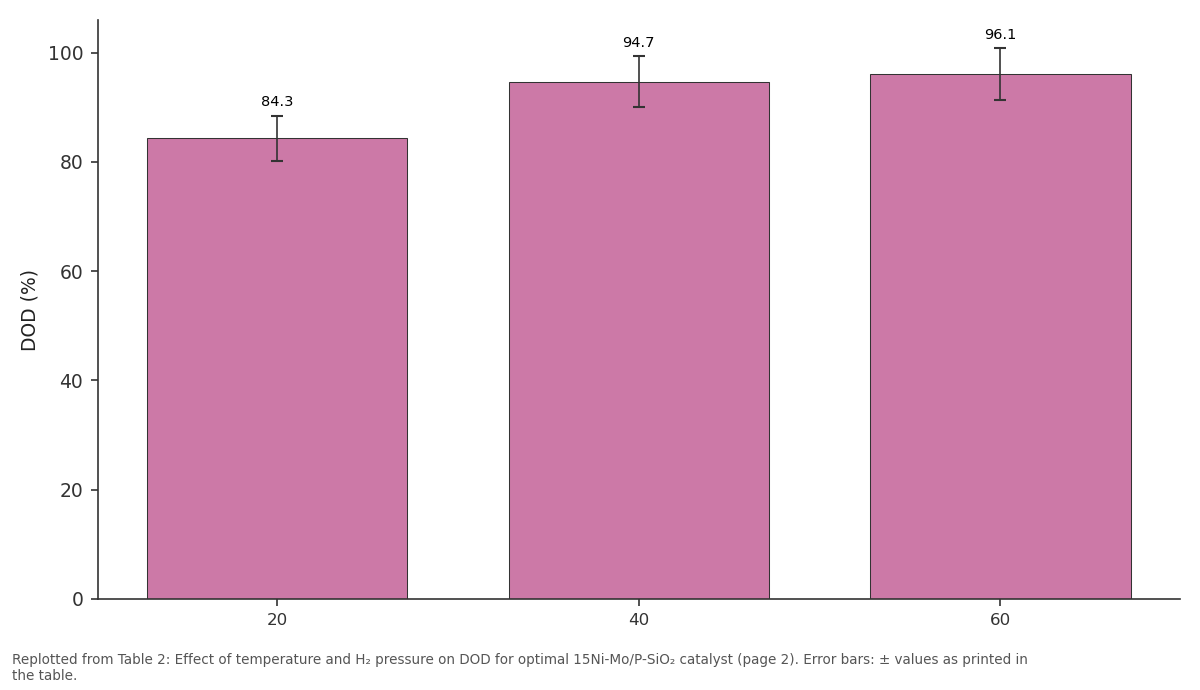
DOD (%): 20 vs 40 vs 60
Replotted from Table 2 (page 2) of the original paper. Every bar is the paper's own table value.
View source evidence ↗Figures & tables
From the original paper Table 1
 Table 2
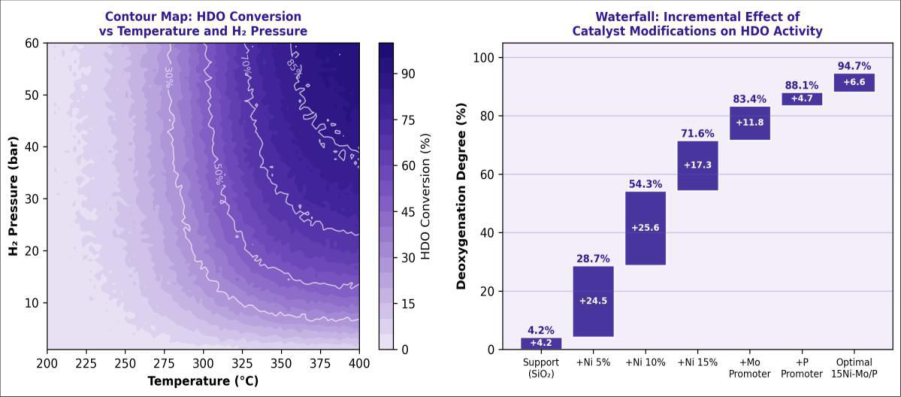 Figure 1
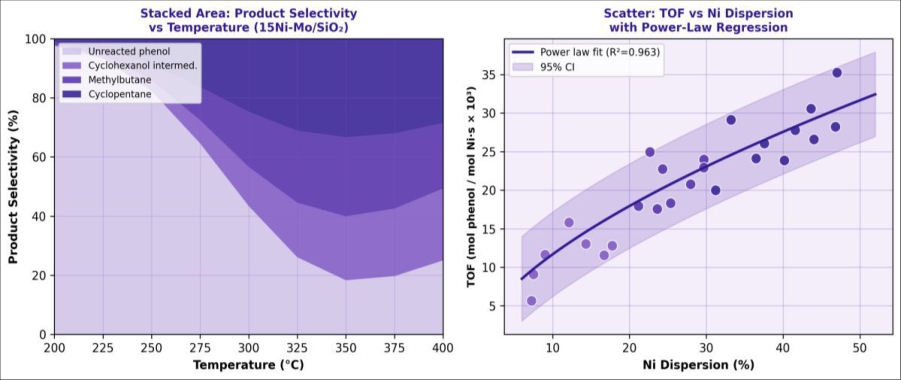 Figure 2
Introduction
Lignocellulosic biomass fast pyrolysis generates bio-oil at yields of 60-75 wt% of dry feed in reactor residence times of under two seconds a productivity that makes it one of the most practically attractive thermochemical conversion routes for distributed biomass valorisation [1] . However, the same rapid condensation kinetics that enable high bio-oil yields also preserve large quantities of reactive oxygenated fragments from cellulose, hemicellulose, and lignin decomposition: aldehydes, ketones, carboxylic acids, furans, and phenolics, with total oxygen content that makes the raw bio-oil immiscible with petroleum products and corrosive to metal infrastructure [2] . HDO catalysis translates this chemical liability into processable hydrocarbons by replacing C-O bonds with C-H bonds under H₂ atmosphere, with water as the sole by-product when selectivity is complete. Nickel-based catalysts are the most researched non-precious metal alternatives to the traditional sulfided CoMo and NiMo HDO catalysts used in petroleum hydrodesulfurisation refinery units. The advantage of Ni catalysts is their high inherent hydrogenation activity, lower cost relative to Ru, Pd, or Pt, and compatibility with low-sulfur bio-oil feedstocks that would poison sulfided catalysts [3] . The principal limitation is susceptibility to sintering at temperatures above 350°C and to coking from polymerisation of condensable bio-oil components at low hydrogen partial pressures. Promoters such as Mo and P have been shown to improve both activity and stability: Mo generates additional Lewis acid sites that facilitate C-O bond activation, while P modifies Ni surface electronic density and prevents overreduction that leads to bulk metal aggregation [4,5] .
Despite extensive Ni HDO literature, systematic quantification of the separate contributions of Ni loading, Mo promotion, and P addition to both activity and selectivity in phenol HDO, combined with contour-map optimisation of temperature and pressure, has not been reported for SiO₂-supported catalysts prepared by sequential co-impregnation. The present research fills this gap. Work was conducted at the Jawaharlal Darda Institute of Chemical Technology, Wardha, Maharashtra, India, from November 2023 to March 2025.
Reagents and chemicals
All synthesis and catalytic experiments were conducted at the Department of Process Chemistry and Engineering, Jawaharlal Darda Institute of Chemical Technology, Wardha, Maharashtra, India, between November 2023 and March 2025. Supports: amorphous SiO₂ (Aerosil 380, BET surface area 380 m²/g, Evonik, supplied by Thermo Fisher Scientific India, Mumbai), γ-Al₂O₃ (Sasol Puralox SCFa-140, 140 m²/g), and TiO₂-P25 (Evonik, 50 m²/g). Impregnation precursors: Ni(NO₃)₂•6H₂O (≥97%, Loba Chemie, Mumbai), (NH₄)₆Mo₇O₂₄•4H₂O (ammonium heptamolybdate, ≥99%, Sigma-Aldrich India), and (NH₄)H₂PO₄ (ammonium dihydrogen phosphate, ≥99%, Merck India). Model compound: phenol (≥99.5%, Sigma-Aldrich); solvent: n-dodecane (≥99%, Sigma-Aldrich). H₂ gas (99.999%), N₂ gas (99.999%), and 10% H₂/N₂ calibration gas were from Inox Air Products (Nagpur). GC reference standards for product identification were from Sigma-Aldrich. Institutional safety clearance for highpressure hydrogenation operations: Jawaharlal Darda Institute Safety Committee (Ref. JDICT-SC-2023-11, dated 9 November 2023).
Material and Methods
Material and Methods
Material
Catalyst preparation: Supports were calcined at 500°C for 4 h in air before impregnation. Sequential wet impregnation: phosphoric acid solution (from (NH₄)H₂PO₄, P/Ni molar ratio 0.3) was impregnated first, dried at 120°C (12 h), and calcined at 450°C (3 h). Ni and Mo precursor solutions were then co-impregnated to target loadings (Ni: 5, 10, 15 wt%; Mo: 5 wt% fixed for promoted catalysts), dried at 120°C (12 h), and calcined at 500°C (4 h). Before reaction, catalysts were reduced in situ in 50 mL/min H₂ at 400°C for 2 h. The carbon balance declined from 97.4% at 250°C to 91.4% at 350°C, consistent with increasing coke deposition at higher temperatures. The optimal window (300°C, 40 bar) balanced near-complete phenol conversion (98.2%) with high carbon balance (96.3%). Above 350°C, excessive ring hydrogenation-ring opening generated light gas products (C₁-C₄ alkanes) that reduced cyclopentane selectivity, evidenced by the GC-FID chromatograms showing methane and propane peaks emerging above 325°C.
Methods
Methods
Results
Results
Discussion
The contour map analysis identifies a saddle-point optimum near 300-310°C and 38-45 bar H₂ where both phenol conversion and cyclopentane selectivity are simultaneously maximised. Below this temperature window, incomplete ring hydrogenation leaves cyclohexanone and cyclohexanol as major intermediates; above it, ring opening and cracking reduce fuel-range product selectivity. The 40-bar H₂ pressure threshold for near-complete HDO is consistent with the hydrogen fugacity requirement for maintaining the active Ni surface in a sufficiently reduced state against reoxidation by product water, which accumulates during the reaction [6] . The power-law relationship between TOF and Ni dispersion (TOF ∝ D^0.62, R² = 0.963) indicates a structure-sensitive reaction where ensembles of specific size are required for the rate-determining C-O bond scission step. This exponent is close to 0.5, suggesting that Ni step-edge sites whose density scales roughly as the square root of dispersion in hemispherical nanoparticles may be the critical active site, consistent with DFT calculations in the literature that identify Ni(211) step-edge sites as those with optimal C-O bond activation energy [7] . The P promoter's role in maintaining small Ni crystallites (5.8 nm vs 8.2 nm for unpromoted 15Ni/SiO₂) therefore has a direct mechanistic connection to TOF enhancement.
Conclusion
Ni catalysts supported on SiO₂ with Mo and P promoters were developed and optimised for phenol HDO as a bio-oil model compound. The 15Ni-Mo/P-SiO₂ catalyst achieved 94.7% deoxygenation degree and 86.3% cyclopentane selectivity at 300°C and 40 bar H₂, outperforming unpromoted Ni/SiO₂ and Al₂O₃-and TiO₂-supported equivalents. Contour map analysis identified the kinetically optimal process window, and the power-law TOF-dispersion relationship confirmed active site density as the primary activity descriptor. These results support 15Ni-Mo/P-SiO₂ as a candidate catalyst for scale-up evaluation in continuousflow phenolic bio-oil HDO at biorefinery-relevant conditions.
Figures and tables from the paper
| Catalyst | BET SA (m²/g) | Ni Disp. (%) | Ni Crystal. (nm) | H₂ cons. (mmol/g) | DOD (%) | Cyclopentane Sel. (%) |
|---|---|---|---|---|---|---|
| 5Ni/SiO₂ | 341±8 | 18.4±0.9 | 6.8±0.3 | 1.84±0.09 | 28.7±1.4 | 41.3±2.1 |
| 10Ni/SiO₂ | 318±7 | 24.7±1.2 | 7.4±0.4 | 2.97±0.15 | 54.3±2.7 | 58.4±2.9 |
| 15Ni/SiO₂ | 294±6 | 31.3±1.5 | 8.2±0.4 | 3.84±0.19 | 71.6±3.6 | 68.2±3.4 |
| 15Ni-Mo/SiO₂ | 276±6 | 38.4±1.9 | 6.4±0.3 | 4.12±0.21 | 83.4±4.2 | 76.7±3.8 |
| 15Ni-Mo/P-SiO₂ | 261±6 | 42.7±2.1 | 5.8±0.3 | 4.63±0.23 | 94.7±4.7 | 86.3±4.3 |
| 15Ni/Al₂O₃ | 187±4 | 27.2±1.3 | 8.7±0.4 | 3.21±0.16 | 67.3±3.4 | 51.2±2.6 |
| 15Ni/TiO₂ | 94±2 | 21.6±1.1 | 9.3±0.5 | 2.74±0.14 | 58.1±2.9 | 45.7±2.3 |
Table text extracted from the original PDF; superscript letters are shown inline. The original table image is below.
View original table image
| Temperature (°C) | H₂ pressure (bar) | DOD (%) | Cyclopentane Sel. (%) | Phenol Conv. (%) | Carbon Balance (%) |
|---|---|---|---|---|---|
| 250 | 20 | 61.4±3.1 | 54.7±2.7 | 72.3±3.6 | 97.4±0.9 |
| 275 | 20 | 74.8±3.7 | 67.3±3.4 | 83.6±4.2 | 97.1±0.9 |
| 300 | 20 | 84.3±4.2 | 76.1±3.8 | 91.4±4.6 | 96.8±1.0 |
| 300 | 40 | 94.7±4.7 | 86.3±4.3 | 98.2±4.9 | 96.3±1.0 |
| 300 | 60 | 96.1±4.8 | 88.7±4.4 | 99.4±5.0 | 95.7±1.1 |
| 325 | 40 | 93.8±4.7 | 84.4±4.2 | 98.6±4.9 | 94.2±1.2 |
| 350 | 40 | 89.2±4.5 | 76.8±3.8 | 99.1±5.0 | 91.4±1.4 |
Table text extracted from the original PDF; superscript letters are shown inline. The original table image is below.
View original table image
References
15 in the original paper- Bridgwater AV. Review of fast pyrolysis of biomass and product upgrading. Biomass Bioenergy. 2012;38:68-94.
- Czernik S, Bridgwater AV. Overview of applications of biomass fast pyrolysis oil. Energy Fuels. 2004;18(2):590-598.
- Mortensen PM, Grunwaldt JD, Jensen PA, Knudsen KG, Jensen AD. A review of catalytic upgrading of biooil to engine fuels. Appl Catal A Gen. 2011;407(1-2):119.
- Shi H, Chen J, Yang Y, Tian S. Catalytic deoxygenation of methyl laurate as a model compound to hydrocarbons on nickel phosphide catalysts: remarkable support effect. Fuel Process Technol. 2014;118:161-170.
- Sun Z, Fridrich B, de Santi A, Elangovan S, Barta K. Bright side of lignin depolymerization: toward new platform chemicals. Chem Rev. 2018;118(2):614-678.
- Wan H, Chaudhari RV, Subramaniam B. Catalytic hydroprocessing of p-cresol: metal, solvent and mass transfer effects. Top Catal. 2012;55(3-4):129-139.
- Zhao C, He J, Lemonidou AA, Li X, Lercher JA. Aqueous-phase hydrodeoxygenation of bio-derived phenols to cycloalkanes. J Catal. 2011;280(1):8-16.
- He Z, Wang X. Hydrodeoxygenation of model compounds and catalytic systems for pyrolysis bio-oils upgrading. Catal Sustain Energy. 2012;1:28-52.
- Laurent E, Delmon B. Influence of water in the deactivation of a sulfided NiMo/γ-Al₂O₃ catalyst during hydrodeoxygenation. J Catal. 1994;146(1):281-291.
- Nie L, de Souza PM, Noronha FB, An W, Sooknoi T, Resasco DE. Selective conversion of m-cresol to toluene over bimetallic Ni-Fe catalysts. J Mol Catal A Chem. 2014;388-389:47-55.
- Yan N, Yuan Y, Dykeman R, Kou Y, Dyson PJ. Hydrodeoxygenation of lignin-derived phenols into alkanes by using nanoparticle catalysts combined with brønsted acidic ionic liquids. Angew Chem Int Ed. 2010;49(32):5549-5553.
- Wildschut J, Mahfud FH, Venderbosch RH, Heeres HJ. Hydrotreatment of fast pyrolysis oil using heterogeneous noble-metal catalysts. Ind Eng Chem Res. 2009;48(23):10324-10334.
- Olcese RN, Bettahar M, Petitjean D, Malaman B, Giovanella F, Dufour A. Gas-phase hydrodeoxygenation of guaiacol over Fe/SiO₂ catalyst. Appl Catal B Environ. 2012;115-116:63-73.
- Zhao C, Lercher JA. Selective hydrodeoxygenation of lignin-derived phenolic monomers and dimers to cycloalkanes on Pd/C and HZSM-5 catalysts. ChemCatChem. 2012;4(1):64-68.
- Furimsky E. Catalytic hydrodeoxygenation. Appl Catal A Gen. 2000;199(2):147-190.