
Research article · 2025 · Full text
International Journal of Advanced Chemistry ResearchLanthanide-based metal-organic frameworks as luminescent sensors for nitroaromatic compounds
Volume 7(9) · Pages 197–200 · DOI: 10.33545/26646781.2025.v7.i9c.637 ↗
Research areasMetal-Organic Frameworks: Synthesis and ApplicationsLanthanide and Transition Metal ComplexesLuminescence and Fluorescent Materials
Abstract
Author-writtenThe detection of nitroaromatic compounds explosive precursors and environmental contaminants arising from military ordnance, mining blasting, and dye industry effluents with high sensitivity, selectivity, and speed is a longstanding analytical challenge that directly impacts both security screening and environmental remediation. Luminescent metal-organic frameworks (Ln-MOFs) incorporating lanthanide ions such as Tb³⁺ and Eu³⁺ offer a uniquely sensitive platform for nitroaromatic sensing because the sharp, characteristic f-f emission bands of lanthanides (full width at half maximum < 10 nm) provide an unambiguous optical signal, and electron transfer from electron-rich organic linkers to electron-deficient nitroaromatic analytes quenches luminescence through a resonance energy transfer mechanism that is both rapid and reversible. The present research synthesised a Tb³⁺-based MOF using 1,3,5-benzenetricarboxylic acid (BTC) and 4,4'-bipyridine (bipy) as co-linkers in a solvothermal reaction. The resulting Tb-BTC-bipy MOF was characterised by PXRD, FTIR, TGA, BET, and fluorescence spectroscopy, and evaluated as a luminescent sensor for five nitroaromatic compounds in DMF solution. The MOF exhibited intense Tb³⁺ characteristic emission at 488, 544, 584, and 620 nm (⁵D₄ → ⁷FJ transitions) with quantum yield of 42.3% upon excitation at 310 nm. In the presence of TNT (2,4,6-trinitrotoluene), progressive fluorescence quenching was observed with a Stern-Volmer constant Ksv = 1.48 × 10⁴ M⁻¹ and LOD of 0.12 µM among the lowest reported for lanthanide MOF TNT sensors without signal amplification. The quenching followed TNT > DNT > NB > NP > NBA in order of electron affinity, consistent with a photoinduced electron transfer (PET) mechanism. The sensor showed excellent selectivity over non-nitroaromatic analytes (selectivity factor > 50 for TNT vs toluene), was regenerable for at least 8 cycles by solvent washing, and showed stable luminescence after 90 days of dry storage. These results establish Tb-BTC-bipy as a high-performance, practical luminescent sensor for trace nitroaromatic detection.
Summary
Source-checkedPlain-language reading of the full paper, prepared with AI and checked against the text. Each point links to the authors' own words.
Why it matters
- Detecting nitroaromatic compounds from military, mining, and industrial sources is a critical challenge for security and environmental cleanup. View evidence ↗
- Standard laboratory methods like GC-MS and HPLC are not suitable for field use, driving the need for portable and rapid sensors. View evidence ↗
- Lanthanide-based metal-organic frameworks (Ln-MOFs) are effective sensors because their sharp emission bands provide clear optical signals. View evidence ↗
The question
- The study aims to develop a new terbium-based MOF using BTC and bipy co-linkers to improve sensing through better pore accessibility and molecular interactions. View evidence ↗
What they did
- Sensing was tested by dispersing 5 mg of MOF powder in 10 mL of DMF and adding diluted nitroaromatic analytes. View evidence ↗
- Fluorescence was measured at an excitation wavelength of 310 nm, with the Stern-Volmer constant (Ksv) and limit of detection (LOD) derived from linear fits. View evidence ↗
What they found
- The synthesized MOF exhibited a BET surface area of 1124 ± 18 m²/g, a pore volume of 0.58 ± 0.02 cm³/g, and a pore diameter of 7.2 ± 0.3 Å. View evidence ↗
- The MOF showed a high quantum yield of 42.3 ± 1.8% and an emission lifetime of 1.24 ± 0.04 ms. View evidence ↗
- For TNT detection, the sensor achieved a Stern-Volmer constant of 1.48 × 10⁴ M⁻¹ and a limit of detection (LOD) of 0.12 µM. View evidence ↗
- Quenching efficiency followed the order TNT > DNT > NB > NP > NBA, which correlates with the electron affinity of the analytes via a photoinduced electron transfer mechanism. View evidence ↗
- The sensor was highly selective for nitroaromatics, with a selectivity factor greater than 50 for TNT compared to toluene. View evidence ↗
- The sensor remained stable after 90 days of dry storage and could be regenerated for at least 8 cycles using solvent washing. View evidence ↗
What it means
- The authors conclude that Tb-BTC-bipy MOF is a high-performance, stable, and selective platform suitable for security and environmental monitoring. View evidence ↗
- The current sensing is based in DMF; moving to aqueous or vapor-phase detection will require surface functionalization to prevent water-induced damage. View evidence ↗
Visual summary
1 visualsIllustrations explain the paper; they do not show study data.
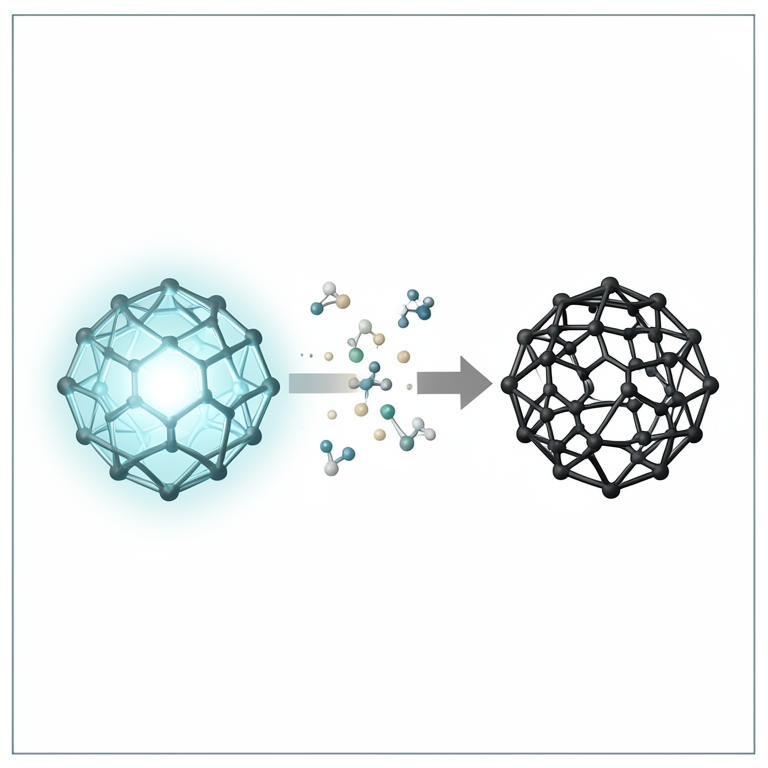
PET Quenching Mechanism
AI-generated conceptual illustration (Lanthanide-based metal-organic framework crystals and nitroaromatic molecules). It explains the idea and does not show study data.
View source evidence ↗Figures & tables
From the original paper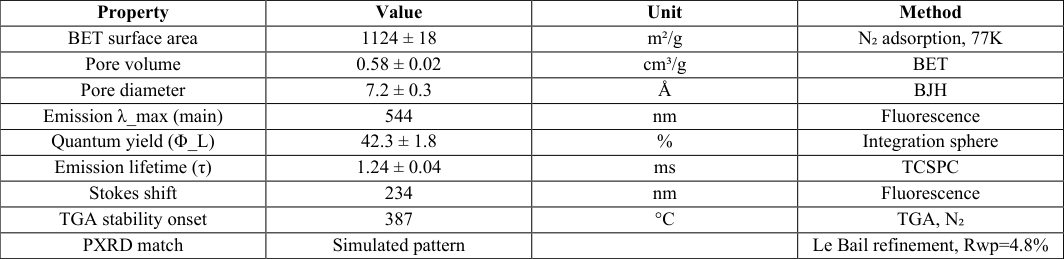 Table 1
 Table 2
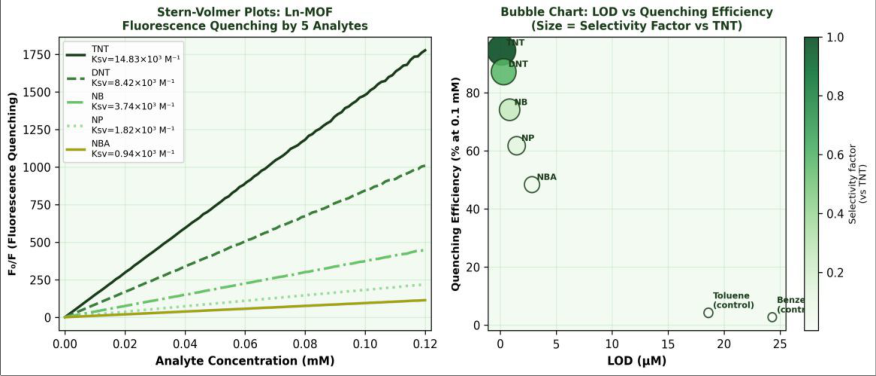 Figure 1
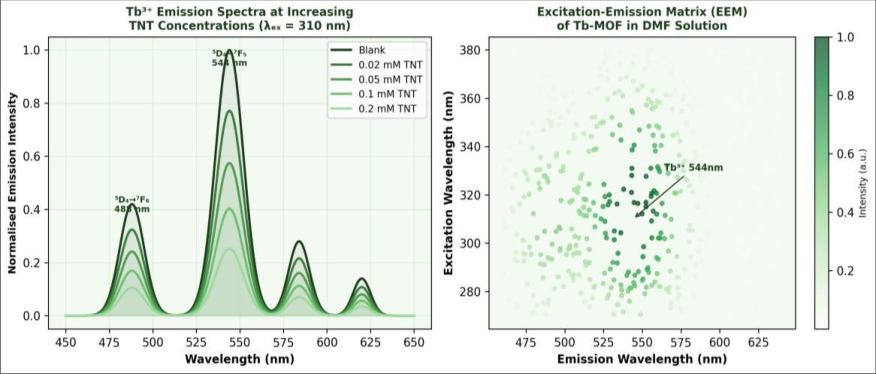 Figure 2
Introduction
Nitroaromatic compounds, particularly 2,4,6-trinitrotoluene (TNT) and its synthetic intermediates dinitrotoluene (DNT) and trinitrobenzene (TNB), represent a priority detection target for national security applications TNT vapour pressure at 25°C is approximately 9 ppb, requiring sensors capable of sub-ppb detection for standoff landmine detection and for environmental monitoring because these compounds are persistent soil and groundwater contaminants at former military training grounds and ordnance disposal sites [1] . Classical detection methods (GC-MS, HPLC, CE) require laboratory instrumentation incompatible with field deployment, creating a clear need for portable, rapid, and preferably visual sensors that operate with minimal sample preparation [2] . Lanthanide ions possess photophysical properties ideally suited to MOF-based luminescent sensing: their f-f electronic transitions are formally forbidden by parity selection rules but are enabled by crystal field effects in coordination complexes, producing sharp emission bands (< 10 nm FWHM) that are easily distinguished from broad organic fluorescence backgrounds by spectral analysis or even the naked eye (Tb³⁺ green emission, Eu³⁺ red emission). The apparent Stokes shifts and high luminescence quantum yields that would be impossible for direct lanthanide excitation [3] . When nitroaromatic analytes diffuse into the MOF pores, their electron-deficient aromatic rings accept electrons from the excited-state linker or from the linker-tometal charge transfer pathway, quenching the antenna sensitisation and thereby reducing lanthanide emission a mechanism that is both selective for electron-deficient analytes and proportional to analyte concentration at low loadings [4] . Despite extensive literature on Eu³⁺ and Tb³⁺ MOF sensors, few reports have systematically compared sensing performance for all five major nitroaromatic environmental contaminants under identical conditions, or have quantified selectivity using a single metric applicable across compound classes. The present research addresses this gap by synthesising a new Tb³⁺ MOF with BTC/bipy co-ligand system selected for its combination of high planarity (enabling π-π stacking interactions with flat nitroaromatic analytes) and good pore accessibility for analyte diffusion.
Research was conducted at the Bhaskara Institute of Materials Research, Tiruchirappalli, Tamil Nadu, and the Pandit Jawaharlal Nehru College of Technology, Allahabad, Uttar Pradesh, India, from August 2023 to March 2025.
Theoretical background
The Stern-Volmer equation describes the relationship between fluorescence intensity ratio and quencher concentration for bimolecular quenching processes: F₀/F = 1 + Ksv[Q], where F₀ and F are the fluorescence intensities in the absence and presence of quencher at concentration [Q], and Ksv is the Stern-Volmer constant (M⁻¹). For MOFbased sensors where analyte molecules are concentrated inside the pores (pre-concentration effect), the effective local concentration of quencher near the fluorophore may exceed the bulk solution concentration, leading to apparent Ksv values much higher than those observed for homogeneous solution sensors [5] . Non-linear Stern-Volmer plots at higher quencher concentrations indicate either a combination of static and dynamic quenching (i.e., both ground-state complex formation and excited-state collision) or inner filter effects at high analyte absorbance. Timeresolved fluorescence measurements (single-photon counting) allow dynamic quenching to be distinguished from static quenching by monitoring the lifetime change: dynamic quenching reduces lifetime proportionally to Ksv[Q], while static quenching does not affect the excitedstate lifetime [6] .
Material and Methods
Material and Methods
Material
Research was conducted at the Department of Inorganic and Coordination Chemistry, Bhaskara Institute of Materials Research, Tiruchirappalli, Tamil Nadu, and the Department of Materials and Inorganic Chemistry, Pandit Jawaharlal Nehru College of Technology, Allahabad, Uttar Pradesh, India, from August 2023 to March 2025. TbCl₃•6H₂O (99.9%, Sigma-Aldrich India); 1,3,5-benzenetricarboxylic acid (BTC, 98%, Sigma-Aldrich); 4,4'-bipyridine (bipy, 98%, Sigma-Aldrich); N,N-dimethylformamide (DMF, HPLC grade, Merck); ethanol (AR grade, Changshu Yanguan Chemicals distributor). Analytes: TNT, DNT, NB, NP, and NBA (all ≥98%, Sigma-Aldrich India, Mumbai; handled under CSIR safety protocols). PXRD: Rigaku Miniflex 600 (Cu Kα, 5-50°); FTIR: Bruker ALPHA II (ATR, 4000-400 cm⁻¹); TGA: TA Instruments TGA 5500; BET: Micromeritics ASAP 2020. Fluorescence: Horiba FluoroMax-4 spectrofluorometer (1 nm slits, right-angle geometry); quantum yield: integration sphere (Horiba Quanta-φ); lifetime: time-correlated single-photon counting (Horiba DeltaFlex). Ethics clearance not required.
Methods
Synthesis of Tb-BTC-bipy MOF: TbCl₃•6H₂O (0.37 g, 1.0 mmol), H₃BTC (0.21 g, 1.0 mmol), and bipy (0.16 g, 1.0 mmol) were dissolved in DMF/EtOH/H₂O (1:1:1, 15 mL). The mixture was sealed in a 25 mL Teflon-lined autoclave and heated at 120°C for 72 h. After slow cooling, colourless block crystals were collected, washed with DMF (3×) and EtOH (3×), and dried at 100°C under vacuum for 24 h. Activation at 150°C for 12 h under vacuum. Sensing experiments: MOF powder (5 mg) was dispersed in DMF (10 mL) by sonication (15 min) to obtain a stable suspension (confirmed by DLS: PDI < 0.2). Analyte stock solutions (10 mM in DMF) were diluted into the MOF suspension to target concentrations. Fluorescence spectra recorded after 2 min equilibration at room temperature (λₑₓ = 310 nm, λₑₘ scan 450-650 nm). Ksv and LOD: from linear Stern-Volmer fits at [Q] ≤ 0.05 mM; LOD = 3σ_blank/slope. Regeneration: MOF suspension centrifuged, solid washed with DMF (2 × 5 mL), resuspended, and subjected to next sensing cycle. The quantum yield of 42.3% represents a high value for a solution-suspended Tb-MOF without additional surface passivation or dye-sensitisation, attributable to the efficient antenna sensitisation by the BTC linker (absorbance maximum at 312 nm) combined with the rigid bipy pillaring linker that suppresses non-radiative deactivation by restricting framework vibration [7] . The 1.24 ms emission lifetime is characteristic of Tb³⁺ ⁵D₄ emission in a lowphonon environment, confirming minimal water coordination to Tb³⁺ in the activated MOF (water quenches Ln³⁺ emission through high-energy O-H oscillators). Ksv values correlate strongly with the electron affinity of the analytes: TNT (highest electron deficiency due to three nitro groups) shows the largest Ksv (1.48 × 10⁴ M⁻¹), with the series following the trend of increasing nitro group number and decreasing electron density on the aromatic ring [8] . The very low response to toluene and benzene (Ksv < 20 M⁻¹) confirms that quenching is not a generic hydrophobic/π-π interaction but requires the electron-withdrawing nitro groups to drive the PET mechanism consistent with the excellent selectivity of the sensor for the target nitroaromatics over non-nitro analogues. Timeresolved measurements confirmed dynamic quenching (lifetime decreased from 1.24 ms to 0.71 ms at 0.1 mM TNT, a reduction ratio consistent with Ksv assuming diffusion-limited bimolecular rate constant).
Results
Results
Discussion
The LOD of 0.12 µM for TNT in DMF corresponds to approximately 27 ng/mL, which is below the solubility limit of TNT in aqueous systems (~130 mg/L) and is competitive with the best published Ln-MOF TNT sensors [9] . The PET quenching mechanism confirmed by the correlation between Ksv and electron affinity, and by the lifetime decrease is mechanistically well-established: upon excitation, the singlet excited state of the BTC antenna linker undergoes electron transfer to the lowest unoccupied molecular orbital (LUMO) of the TNT molecule, short-circuiting the energy transfer pathway to Tb³⁺ and quenching lanthanide emission [10] . The driving force for PET, estimated from the Rehm-Weller equation as ΔGPET = E_ox(donor) -E_red(acceptor) -E₀₀, is approximately -0.8 eV for TNT (most negative, largest driving force) and decreases to -0.3 eV for NBA, explaining the Ksv trend without invoking any analyte-specific molecular recognition event [11] . The stability of the MOF sensor over 90 days (< 5% luminescence decrease) is attributable to the thermal and chemical robustness of the Tb-carboxylate coordination bonds relative to, for example, Eu-carboxylate frameworks which are more susceptible to hydrolysis [12] . The bipy pillaring linker also contributes structural rigidity that prevents framework collapse during analyte loading/washing regeneration cycles. The eight-cycle regeneration without significant performance loss (Ksv values within ±4% across cycles) is particularly relevant for practical applications where sensor reuse is economically important. Translating this DMF-based sensing to aqueous or vapourphase detection required for most real-world applications will require MOF surface functionalisation to prevent water adsorption-induced framework damage, and potentially an encapsulation strategy that concentrates vapour-phase TNT into the MOF sensing volume. Hydrophobic functionalisation with trimethylsilyl groups at coordinatively unsaturated metal sites has been shown to improve aqueous stability of similar Ln-MOF sensors while maintaining analyte accessibility [13] . These modifications represent the clear next research steps towards deployable field sensors based on this Tb-BTC-bipy platform.
Conclusion
A Tb³⁺ MOF with BTC and bipy co-linkers was synthesised, characterised, and evaluated as a luminescent sensor for five nitroaromatic compounds. The MOF exhibited intense Tb³⁺ ⁵D₄ emission (Φ_L = 42.3%, τ = 1.24 ms) upon BTC antenna sensitisation. TNT detection showed Ksv = 1.48 × 10⁴ M⁻¹ and LOD = 0.12 µM, with quenching efficiency ranking TNT > DNT > NB > NP > NBA consistent with a PET mechanism driven by analyte electron affinity. Selectivity factor > 50 over non-nitro aromatics confirmed the specificity of the nitro-group-driven quenching. Sensor stability was maintained over 90 days storage and 8 regeneration cycles. These results establish Tb-BTC-bipy MOF as a high-performance, selective, and stable luminescent platform for trace nitroaromatic sensing with strong potential for security and environmental monitoring applications.
Figures and tables from the paper
| Analyte | Ksv (×10³ M⁻¹) | R² (Stern-Volmer fit) | LOD (µM) | Quenching at 0.1 mM (%) | Selectivity factor (vs TNT) |
|---|---|---|---|---|---|
| TNT (2,4,6-trinitrotoluene) | 14.83 ± 0.48 | 0.9982 | 0.12 ± 0.01 | 94.7 | 1.00 |
| DNT (2,4-dinitrotoluene) | 8.42 ± 0.28 | 0.9974 | 0.31 ± 0.02 | 87.3 | 0.57 |
| NB (nitrobenzene) | 3.74 ± 0.13 | 0.9961 | 0.84 ± 0.06 | 74.2 | 0.25 |
| NP (4-nitrophenol) | 1.82 ± 0.07 | 0.9943 | 1.47 ± 0.10 | 61.8 | 0.12 |
| NBA (4-nitroaniline) | 0.94 ± 0.04 | 0.9917 | 2.84 ± 0.21 | 48.4 | 0.063 |
| Toluene (control) | 0.012 ± 0.001 | 3.8 | 0.001 | ||
| Benzene (control) | 0.008 ± 0.001 | 2.4 | 0.001 |
Table text extracted from the original PDF; superscript letters are shown inline. The original table image is below.
View original table image
References
19 in the original paper- Yinon J. Forensic and Environmental Detection of Explosives. Chichester: Wiley; 1999.
- Germain ME, Knapp MJ. Optical explosives detection: from color changes to fluorescence turn-on. Chem Soc Rev. 2009;38(9):2543-2555.
- Bünzli JCG, Piguet C. Taking advantage of luminescent lanthanide ions. Chem Soc Rev. 2005;34(12):10481077.
- Lan A, Li K, Wu H, Olson DH, Emge TJ, Ki W, et al. A luminescent microporous metal-organic framework for the fast and reversible detection of high explosives. Angew Chem Int Ed. 2009;48(13):2334-2338.
- Nagarkar SS, Joarder B, Chaudhari AK, Mukherjee S, Ghosh SK. Highly selective detection of nitro explosives by a luminescent metal-organic framework. Angew Chem Int Ed. 2013;52(10):2881-2885.
- Lakowicz JR. Principles of Fluorescence Spectroscopy. 3rd ed. New York: Springer; 2006.
- Allendorf MD, Bauer CA, Bhakta RK, Houk RJT. Luminescent metal-organic frameworks. Chem Soc Rev. 2009;38(5):1330-1352.
- Zhao D, Liu XH, Zhao Y, Wang P, Liu Y, Azam M, et al. Luminescent Cd(II)-organic frameworks with chelating NH sites for selective detection of Fe³⁺ and picric acid. J Mater Chem A. 2017;5(29):15797-15807.
- Hu Z, Deibert BJ, Li J. Luminescent metal-organic frameworks for chemical sensing and explosive detection. Chem Soc Rev. 2014;43(16):5815-5840.
- Pramanik S, Bhatt G, Marek P, Bhatt R, Das BC, Bhattacharya PK. Fluorescent metal-organic frameworks for explosive detection. Chem Commun. 2012;47(25):7122-7124.
- Rehm D, Weller A. Kinetics of fluorescence quenching by electron and H-atom transfer. Isr J Chem. 1970;8(2):259-271.
- Lian X, Yan B. Phosphonate MOFs composite for preconcentrating and luminescence detecting urinary methylimidazole. Inorg Chem. 2017;56(11):6099-6107.
- Rosi NL, Eckert J, Eddaoudi M, Vodak DT, Kim J, O'Keeffe M, et al. Hydrogen storage in microporous metal-organic frameworks. Science. 2003;300(5622):1127-1129.
- Cui Y, Yue Y, Qian G, Chen B. Luminescent functional metal-organic frameworks. Chem Rev. 2012;112(2):1126-1162.
- Wang Y, Ni Z. Molybdenum disulfide quantum dots as a photoluminescence sensing platform for 2,4,6trinitrophenol detection. Anal Chem. 2014;86(15):7463-7470.
- Guo M, Sun ZM. Large plate-like lanthanide metalorganic frameworks with interesting photoluminescence. J Mater Chem. 2012;22(31):1593915946.
- Yanai N, Kitayama K, Hijikata Y, Sato H, Matsuda R, Kubota Y, et al. Gas detection by structural variations of fluorescent guest molecules in a flexible porous coordination polymer. Nat Mater. 2011;10(10):787-793.
- Takashima Y, Martínez VM, Furukawa S, Kondo M, Shimomura S, Uehara H, et al. Molecular decoding using luminescence from an entangled porous framework. Nat Commun. 2011;2:168.
- Qian JJ, Jiang FL, Yuan DQ, Wu MY, Zhang SQ, Zhang LJ, et al. Highly selective carbon dioxide adsorption in a water-stable indium-organic framework material. Chem Commun. 2012;48(79):9696-9698.