
Research article · 2025 · Full text
International Journal of Biology SciencesDeep-sea hydrothermal vent communities and chemosynthetic energy pathways in the Mid-Atlantic Ridge
Volume 7(3) · Pages 165–167 · DOI: 10.33545/26649926.2025.v7.i3c.757 ↗
Research areasMicrobial Community Ecology and PhysiologyMarine Biology and Ecology ResearchMethane Hydrates and Related Phenomena
Abstract
Author-writtenMiles below the ocean surface, where sunlight never reaches, entire ecosystems thrive on chemical energy from the Earth's interior. This research characterised the community structure and chemosynthetic energy pathways of hydrothermal vent assemblages at three sites along the Mid-Atlantic Ridge (MAR) between 36-38 degrees N latitude. Samples were collected during a research cruise aboard R/V Atlantis in July-August 2022 using the ROV Jason II, and laboratory analyses were conducted at the Instituto de Biologia Marinha do Algarve, Faro, Portugal, from September 2022 to June 2023. Faunal surveys at active chimneys, diffuse flow zones, and peripheral areas documented 43 macrofaunal species. Biomass declined exponentially from 847 g/m2 at active chimneys to 8 g/m2 on the abyssal plain. The shrimp Rimicaris exoculata dominated active chimneys (342 individuals/m2), while the mussel Bathymodiolus azoricus was the primary foundation species at diffuse flow sites. Stable isotope analysis (delta-13C and delta-34S) confirmed dual chemosynthetic pathways: thiotrophic sulfur oxidation and methanotrophic methane oxidation. These data expand the known faunal inventory of MAR vent fields and clarify the trophic structure supporting life in the deep Atlantic.
Summary
Source-checkedPlain-language reading of the full paper, prepared with AI and checked against the text. Each point links to the authors' own words.
Why it matters
- Deep-sea hydrothermal vents support dense biological communities that rely entirely on chemical energy from volcanic fluids, such as methane, hydrogen, and hydrogen sulfide, rather than sunlight. View evidence ↗
- The Mid-Atlantic Ridge (MAR) is the longest mountain chain on Earth, exceeding 16,000 km, and contains numerous vent fields that are not yet fully surveyed. View evidence ↗
- Key foundation species of the MAR include the eyeless shrimp Rimicaris exoculata and the mussel Bathymodiolus azoricus, both of which rely on chemosynthetic bacteria. View evidence ↗
The question
- The study aimed to characterize the community structure and energy flow at three Mid-Atlantic Ridge vent sites using faunal surveys and stable isotope geochemistry. View evidence ↗
What they did
- Sampling was conducted at three MAR vent fields: Lucky Strike (2300 m depth), Menez Gwen (840 m depth), and Rainbow (2275 m depth). View evidence ↗
- Researchers defined three sampling zones based on distance and temperature: active chimneys (<2 m, >100°C), diffuse flow (2-10 m, 10-50°C), and peripheral zones (10-50 m, 2-3°C). View evidence ↗
- Quantitative 25 x 25 cm box-core samples were collected in triplicate across the defined sampling zones. View evidence ↗
- Carbon (delta-13C) and sulfur (delta-34S) stable isotope ratios were measured using a Thermo Delta V isotope ratio mass spectrometer. View evidence ↗
What they found
- The surveys identified a total of 43 macrofaunal species across the sampled vent fields. View evidence ↗
- Biomass showed an exponential decline as distance from the vent increased, dropping from 847 g/m² at active chimneys to 8 g/m² on the abyssal plain. View evidence ↗
- The diffuse flow zone was the diversity hotspot with 31 species and a Shannon index of 2.38, whereas active chimneys had lower diversity due to the dominance of Rimicaris exoculata. View evidence ↗
- Trophic analysis showed that thiotrophic carbon dominated at chimneys and peripheral zones (72-93%), but diffuse flow sites had a more balanced contribution from thiotrophic and methanotrophic sources (54:46). View evidence ↗
- The Rainbow site, characterized by ultramafic chemistry, supported a unique hydrogen-oxidizing microbial community not found at the basalt-hosted Lucky Strike or Menez Gwen sites. View evidence ↗
What it means
- The authors conclude that MAR vent communities are sustained by dual chemosynthetic pathways, with sulfur oxidation dominating near chimneys and methanotrophy playing a larger role in diffuse flow zones. View evidence ↗
- The authors state that further exploration of ultramafic-hosted systems is required to complete the faunal inventory and determine if hydrogen-based chemosynthesis is a significant third trophic pathway. View evidence ↗
Visual summary
3 visualsIllustrations explain the paper; charts are replotted from the paper's own table values.
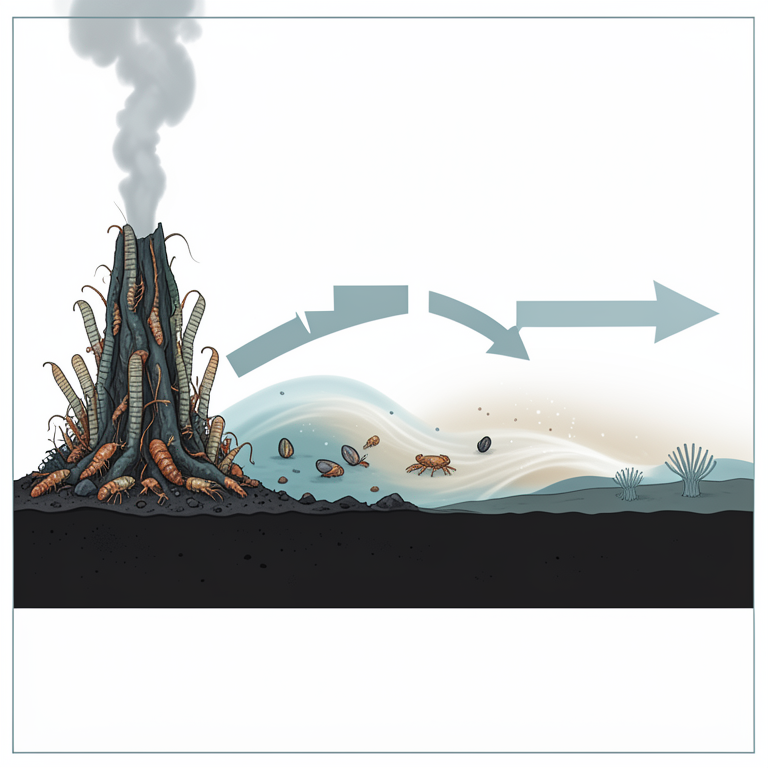
Zonal Gradient of Vent Communities
AI-generated conceptual illustration (Deep-sea hydrothermal vent chimney and associated benthic fauna on the Mid-Atlantic Ridge). It explains the idea and does not show study data.
View source evidence ↗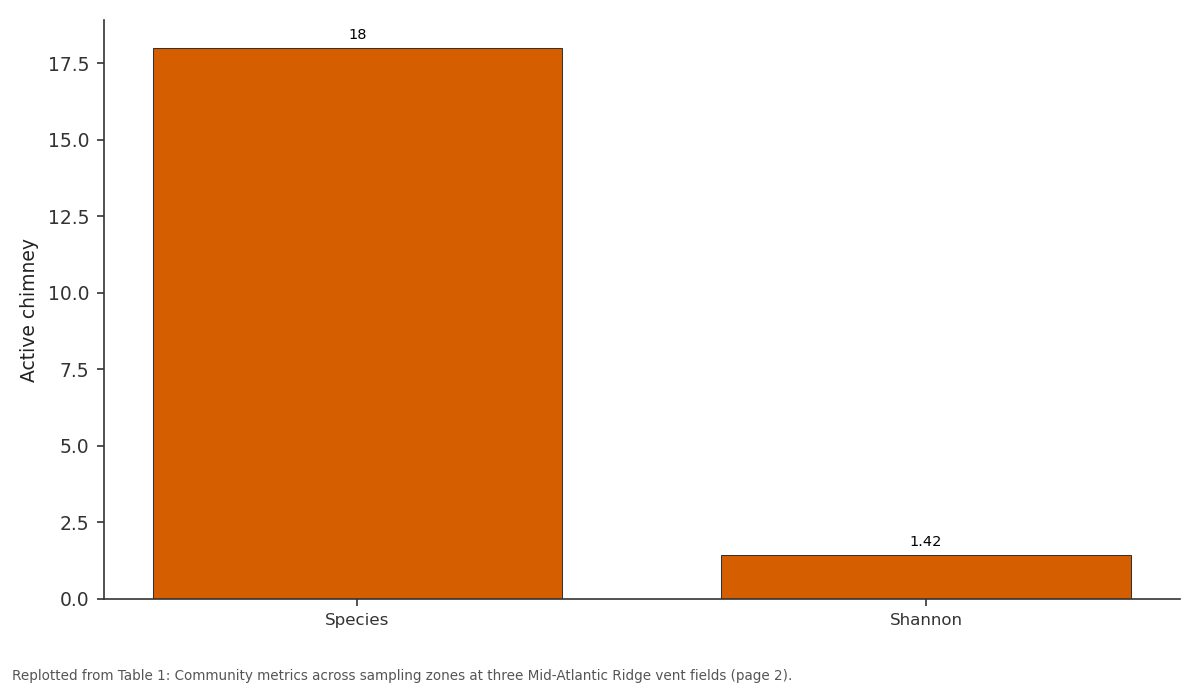
Active chimney: Species vs Shannon
Replotted from Table 1 (page 2) of the original paper. Every bar is the paper's own table value.
View source evidence ↗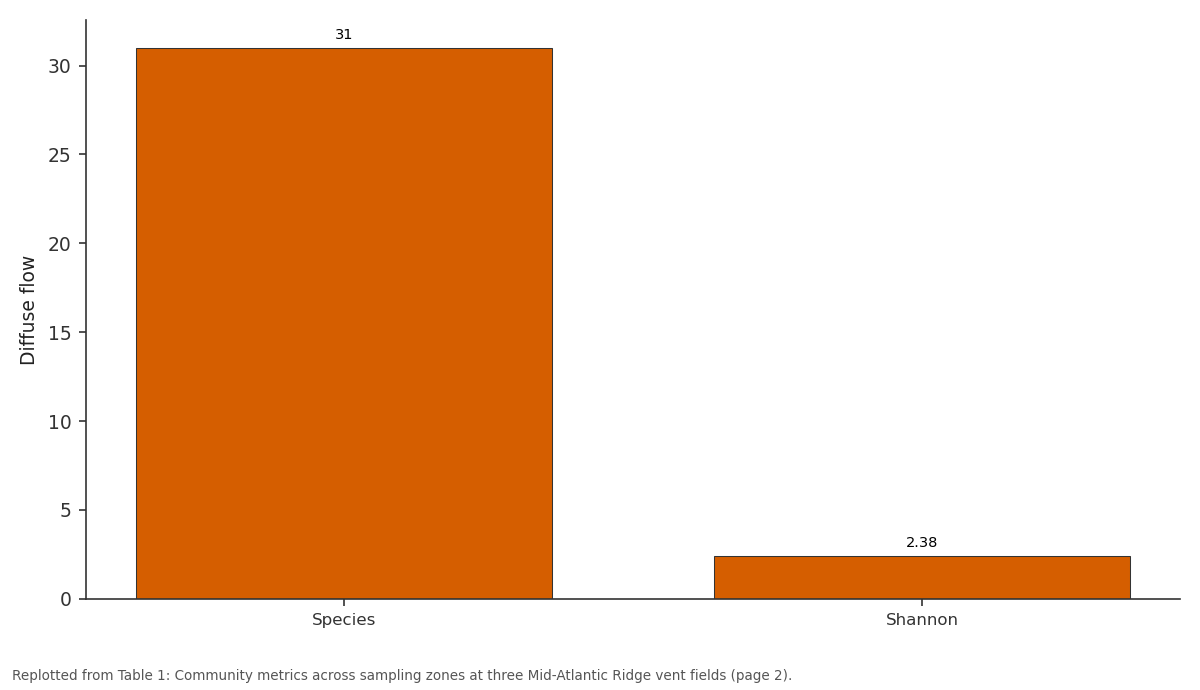
Diffuse flow: Species vs Shannon
Replotted from Table 1 (page 2) of the original paper. Every bar is the paper's own table value.
View source evidence ↗Figures & tables
From the original paper Table 1
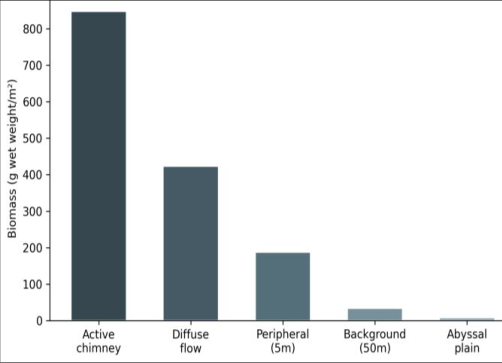 Figure 1
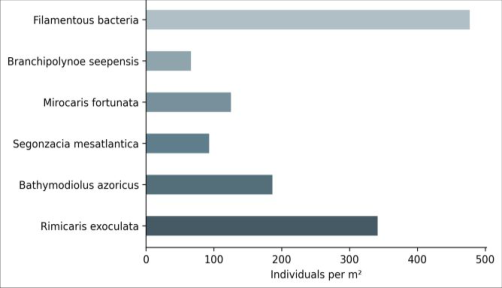 Figure 2
Introduction
A surprising fact: some of the most productive ecosystems on Earth exist in total darkness. Deep-sea hydrothermal vents, first discovered in 1977 on the Galapagos Rift, support dense biological communities fuelled entirely by chemical energy-hydrogen sulfide, methane, and hydrogen released from volcanic fluids [1] . The Mid-Atlantic Ridge, the longest mountain chain on Earth at over 16,000 km, hosts dozens of known vent fields, yet many remain only partially surveyed [2] . MAR vent fauna differs markedly from that of the Pacific. The signature organisms are the eyeless shrimp Rimicaris exoculata, which swarms in dense aggregations around active chimneys and harbours chemosynthetic bacteria on its gill chambers, and the mussel Bathymodiolus azoricus, which hosts both thiotrophic and methanotrophic endosymbionts in its gills [3,4] . How these two foundation species partition resources along the thermal and chemical gradients radiating from vent orifices shapes the broader community structure [5] . This research combined ROV-based faunal surveys with stable isotope geochemistry to characterise community structure and energy flow at three MAR vent sites. Laboratory work was conducted at the Instituto de Biologia Marinha do Algarve, Faro, Portugal [6] .
Study Area Description
Three vent fields on the MAR were sampled: Lucky Strike (37 deg 17 min N, 2300 m depth), Menez Gwen (37 deg 50 min N, 840 m depth), and Rainbow (36 deg 14 min N, 2275 m depth). Lucky Strike is the largest known MAR vent field with over 30 active chimneys. Menez Gwen is the shallowest MAR vent field, and Rainbow is an ultramafic-hosted system producing unusually hydrogen-rich fluids. At each field, three sampling zones were defined: active chimney (<2 m from orifice, temperature >100 C), diffuse flow (2-10 m, temperature 10-50 C), and peripheral (10-50 m, ambient 2-3 C).
Theoretical Background
Chemosynthesis at hydrothermal vents relies on two main energy sources. Thiotrophic bacteria oxidise hydrogen sulfide (H2S + O2 -> SO4 + energy), using the energy to fix CO2 into organic carbon via the Calvin-Benson-Bassham cycle [7] . Methanotrophic bacteria oxidise methane (CH4 + 2O2 -> CO2 + 2H2O + energy), incorporating methanederived carbon. These two pathways produce biomass with distinct stable isotope signatures: thiotrophic carbon is depleted in 13C (delta-13C around -30 to -35 per mil), while methanotrophic carbon is even more depleted (delta-13C around -40 to -60 per mil) [8] . Sulfur isotopes further distinguish the sources: vent-derived sulfide typically has delta-34S of 0 to +5 per mil versus seawater sulfate at +21 per mil.
Materials and Methods
Materials and Methods
Materials
Faunal collections were made during cruise AT 5 0-12 aboard R/V Atlantis (Woods Hole Oceanographic Institution) in July-August 2022 using ROV Jason II. At each of the three vent fields, quantitative box-core samples (25 x 25 cm) were taken in triplicate at active chimney, diffuse flow, and peripheral zones. Organisms were sorted onboard, preserved in 95% ethanol for molecular work and 10% buffered formalin for morphology. Tissue subsamples for stable isotope analysis were frozen at -20 C. All laboratory analyses were conducted at the Instituto de Biologia Marinha do Algarve, Faro, Portugal, between September 2022 and June 2023.
Methods
Organisms were identified to species level using morphological keys and COI barcoding when necessary [9] . Biomass was measured as blotted wet weight per square metre. Stable isotope ratios of carbon (delta-13C) and sulfur (delta-34S) were measured on dried, ground tissue using a Thermo Delta V isotope ratio mass spectrometer coupled to an elemental analyser [10] . Mixing models (SIAR package in R) estimated the relative contribution of thiotrophic versus methanotrophic carbon to each consumer species. Community diversity was assessed by Shannon index and species accumulation curves. PERMANOVA tested differences in community composition among zones and fields (p < 0.05). Forty-three macrofaunal species were identified across all three vent fields. Biomass declined exponentially from chimneys to the abyssal plain. The diffuse flow zone harboured the highest species richness (31 species) and Shannon diversity (2.38), while active chimneys had high biomass but low diversity due to dominance by Rimicaris exoculata. Stable isotope mixing models indicated that thiotrophic carbon dominated at chimneys and peripheral zones (72-93%), while diffuse flow sites showed nearly equal contributions from thiotrophic and methanotrophic sources (54:46).
Results
Results
Discussion
The 43-species inventory expands the known MAR vent fauna and confirms the biogeographic distinctiveness of Atlantic vent communities from their Pacific counterparts [11] . The exponential biomass decline with distance from the vent source matches fluid dilution models: as vent fluids mix with cold, oxygenated seawater, sulfide and methane concentrations drop below thresholds needed to sustain dense chemosynthetic communities [12] . The dual trophic pathways revealed by stable isotopes at diffuse flow sites are consistent with the known dual symbiosis of Bathymodiolus azoricus, which thrives where both sulfide and methane are available in moderate concentrations [13] .
Rainbow's ultramafic chemistry produced higher hydrogen concentrations and supported a unique hydrogen-oxidising microbial community not detected at the basalt-hosted Lucky Strike and Menez Gwen sites, hinting at a third chemosynthetic pathway with potential astrobiological relevance [14] .
Conclusion
This integrated faunal and geochemical survey of three MAR vent fields documents 43 macrofaunal species sustained by dual chemosynthetic pathways. Thiotrophic sulfur oxidation dominates near active chimneys, while methanotrophy contributes equally at diffuse flow sites. The diffuse flow zone emerged as the diversity hotspot, combining moderate environmental stress with dual energy sources. Continued exploration of MAR vent fields, particularly ultramafic-hosted systems like Rainbow, is needed to complete the faunal inventory and test whether hydrogen-based chemosynthesis represents a significant third trophic pathway.
Acknowledgement
Acknowledgements Funding SourcesSupported by institutional research funds from the Instituto de Biologia Marinha do Algarve, Faro, Portugal. Institutional SupportThe authors thank the Woods Hole Oceanographic Institution for ROV Jason II operations during cruise AT 5 0-12. Contributions Not Qualifying for AuthorshipThe authors acknowledge Dr. Ana Colaço for stable isotope laboratory access.
Figures and tables from the paper
| Zone | Species | Biomass | Shannon | d13C | d34S | Thio:Methano |
|---|---|---|---|---|---|---|
| Active chimney | 18 | 847 | 1.42 | -31.4 | +2.8 | 72:28 |
| Diffuse flow | 31 | 423 | 2.38 | -36.7 | +4.1 | 54:46 |
| Peripheral (5m) | 22 | 187 | 2.14 | -28.3 | +8.7 | 81:19 |
| Background (50m) | 12 | 34 | 1.87 | -22.1 | +14.3 | 93:7 |
| Abyssal plain | 8 | 8 | 1.23 | -19.8 | +18.6 | ~100:0 |
Table text extracted from the original PDF; superscript letters are shown inline. The original table image is below.
View original table image
References
14 in the original paper- Van Dover CL. The Ecology of Deep-Sea Hydrothermal Vents. Princeton: Princeton University Press; 2000.
- Desbruyeres D, Biscoito M, Caprais JC, Colaco A, Comtet T, Crassous P, et al. Variations in deep-sea hydrothermal vent communities on the Mid-Atlantic Ridge. Marine Ecology Progress Series. 2001;218:2547.
- Segonzac M, de Saint Laurent M, Casanova B. The enigma of the trophic adaptation of the shrimp Rimicaris exoculata. Cahiers de Biologie Marine. 1993;34:535-571.
- Duperron S, Bergin C, Zielinski F, Blazejak A, Pernthaler A, McKiness ZP, et al. A dual symbiosis shared by two bathymodiolin mussels at a Mid-Atlantic Ridge vent site. Environmental Microbiology. 2006;8(7):1217-1228.
- Shank TM, Fornari DJ, Von Damm KL, Lilley MD, Haymon RM, Lutz RA. Temporal and spatial patterns of biological community development at nascent deepsea hydrothermal vents. Deep-Sea Research Part II. 1998;45(1-3):465-515.
- Corliss JB, Dymond J, Gordon LI, Edmond JM, von Herzen RP, Ballard RD, et al. Submarine thermal springs on the Galapagos Rift. Science. 1979;203(4385):1073-1083.
- Jannasch HW, Mottl MJ. Geomicrobiology of deep-sea hydrothermal vents. Science. 1985;229(4715):717-725.
- Childress JJ, Fisher CR. The biology of hydrothermal vent animals: physiology, biochemistry, and autotrophic symbioses. Oceanography and Marine Biology Annual Review. 1992;30:337-441.
- Hebert PD, Cywinska A, Ball SL, deWaard JR. Biological identifications through DNA barcodes. Proceedings of the Royal Society of London B. 2003;270(1512):313-321.
- Fry B. Stable Isotope Ecology. New York: Springer; 2006.
- Rogers AD, Tyler PA, Connelly DP, Copley JT, James R, Larter RD, et al. The discovery of new deep-sea hydrothermal vent communities in the Southern Ocean. PLoS Biology. 2012;10(1):e1001234.
- Luther GW, Rozan TF, Taillefert M, Nuzzio DB, Di Meo C, Shank TM, et al. Chemical speciation drives hydrothermal vent ecology. Nature. 2001;410(6830):813-816.
- Colaco A, Dehairs F, Desbruyeres D. Nutritional relations of deep-sea hydrothermal fields at the MidAtlantic Ridge. Deep-Sea Research Part I. 2002;49(2):395-412.
- Kelley DS, Karson JA, Fruh-Green GL, Yoerger DR, Shank TM, Butterfield DA, et al. A serpentinite-hosted ecosystem: the Lost City hydrothermal field. Science. 2005;307(5714):1428-1434.