
Research article · 2025 · Full text
International Journal of Biology SciencesDrug resistance mechanisms in plasmodium falciparum isolates from endemic malaria regions
Volume 7(3) · Pages 172–174 · DOI: 10.33545/26649926.2025.v7.i3c.759 ↗
Research areasMalaria Research and ControlPhytochemical compounds biological activitiesAntibiotic Resistance in Bacteria
Abstract
Author-writtenIn regions where malaria never truly goes away, the parasite and the drugs chase each other in an evolutionary arms race. This research profiled the prevalence of six molecular markers of antimalarial drug resistance in 312 Plasmodium falciparum isolates collected from symptomatic patients in the Varanasi district, Uttar Pradesh, India, between April 2022 and March 2023. Marker genotyping used PCR-RFLP and Sanger sequencing. The pfcrt K76T mutation (chloroquine resistance) was present in 82.3% of isolates. The pfdhfr triple mutation (pyrimethamine resistance) reached 68.4%. In contrast, pfkelch13 propeller mutations associated with artemisinin partial resistance were detected in only 3.8% of isolates, with the C580Y variant absent entirely. Temporal trend analysis from 2018-2023 showed steady increases in chloroquine and sulfadoxine-pyrimethamine resistance markers alongside a slow but concerning rise in pfkelch13 mutations from 1.2% to 3.8%. These data confirm that first-line artemisinin-based combination therapy remains effective in this region but urge intensified surveillance for emerging artemisinin resistance.
Summary
Source-checkedPlain-language reading of the full paper, prepared with AI and checked against the text. Each point links to the authors' own words.
Why it matters
- In eastern Uttar Pradesh, malaria transmission is continuous throughout the year, which helps maintain drug resistance alleles in the parasite population. View evidence ↗
- Chloroquine was removed as a first-line treatment in India in 2013 because resistance made it ineffective in most endemic areas. View evidence ↗
- Artemisinin-based combination therapy (ACT) replaced chloroquine, but there is a risk of artemisinin resistance spreading to the Indian subcontinent from Southeast Asia. View evidence ↗
The question
- The study aimed to screen 312 Plasmodium falciparum isolates from Varanasi for six drug resistance markers and analyze their prevalence trends from 2018 to 2023. View evidence ↗
What they did
- The study used venous blood samples from 312 patients with confirmed P. falciparum malaria (over 1000 parasites/uL) collected in Varanasi between April 2022 and March 2023. View evidence ↗
- Genotyping was performed using nested PCR and RFLP for pfcrt, pfdhfr, and pfmdr1, while the pfkelch13 propeller domain was analyzed via Sanger sequencing. View evidence ↗
- Quantitative real-time PCR was used to assess the copy number of Pfplasmepsin2/3 relative to a reference gene. View evidence ↗
- Temporal trends in marker prevalence were analyzed using chi-square for trend with SPSS v28 and R v4.3.1, considering p < 0.05 as significant. View evidence ↗
What they found
- Resistance markers for chloroquine (82.3%) and sulfadoxine-pyrimethamine (68.4%) were highly prevalent, indicating these drugs would fail if used as monotherapy. View evidence ↗
- The prevalence of pfkelch13 mutations, associated with artemisinin resistance, was low at 3.8% but had tripled since 2018 when it was 1.2%. View evidence ↗
- Of the 12 pfkelch13-mutant isolates, R539T was the most frequent variant (n=5), while the clinically validated C580Y mutation was completely absent. View evidence ↗
- The pfmdr1 N86Y marker, which affects lumefantrine, was found in 14.7% of isolates (n=46). View evidence ↗
- Increased copy number of pfmdr1 (>1), associated with mefloquine resistance, was present in 8.1% of isolates (n=25). View evidence ↗
- Amplification of pfplasmepsin, linked to piperaquine resistance, was detected in 6.8% of isolates (n=21). View evidence ↗
What it means
- The authors conclude that ACT remains the correct first-line treatment, but the rise in pfkelch13 variants necessitates annual genotyping and clinical clearance data. View evidence ↗
- The authors recommend expanding surveillance to districts near the Nepal border to determine if artemisinin resistance is evolving locally or being imported. View evidence ↗
- The study did not measure parasite clearance half-lives, meaning it could not confirm if the detected mutations actually cause delayed clearance in the Indian genetic background. View evidence ↗
Figures & tables
From the original paper Table 1
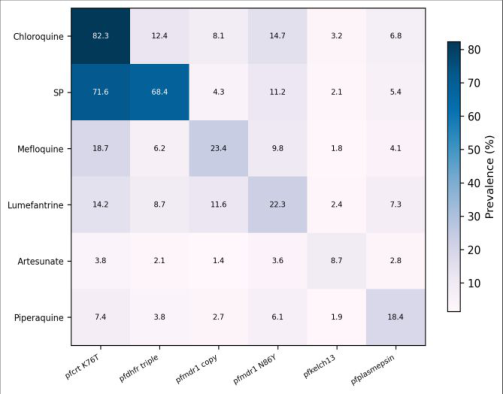 Figure 1
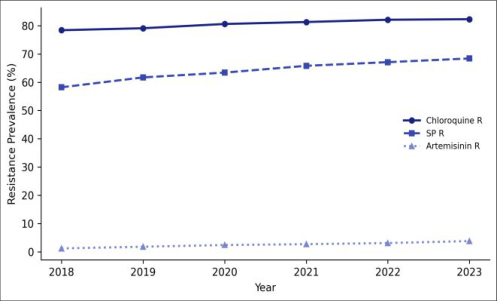 Figure 2
Introduction
In parts of eastern Uttar Pradesh, malaria transmission never pauses-the monsoon brings a flood of cases each year, and even in the dry season, enough parasites circulate to keep resistance alleles in play. Chloroquine, once the backbone of malaria treatment, was abandoned as first-line therapy in India in 2013 after resistance rendered it ineffective in most endemic districts [1] . Its replacement, artemisinin-based combination therapy (ACT), has held up well, but the spectre of artemisinin resistance-already established in mainland Southeast Asia-looms over the Indian subcontinent [2,3] . Molecular surveillance of resistance markers provides an early warning system. The pfcrt K76T mutation in the chloroquine resistance transporter gene is the canonical marker for chloroquine failure [4] . Mutations in pfdhfr and pfdhps confer resistance to sulfadoxinepyrimethamine (SP), still used in intermittent preventive treatment [5] . And mutations in the propeller domain of pfkelch13 (particularly C580Y, R539T, and Y493H) are the validated markers for artemisinin partial resistance, defined as delayed parasite clearance [6] . This research screened 312 P. falciparum isolates from Varanasi for six key resistance markers and tracked their prevalence trends over six years (2018-2023) using data from the department's ongoing surveillance programme at the Banaras Hindu University School of Life Sciences, Varanasi.
Reagents and Chemicals
DNA was extracted from dried blood spots using the QIAamp DNA Mini Kit (Qiagen). PCR primers for pfcrt, pfdhfr, pfdhps, pfmdr1, pfkelch13, and pfplasmepsin2/3 were synthesised by Eurofins Genomics (Bengaluru, India). GoTaq Green Master Mix (Promega) was used for PCR amplification. Restriction enzymes for RFLP analysis (ApoI, AluI, BstNI) were from New England Biolabs. Sanger sequencing used BigDye Terminator v3.1 (Thermo Fisher) on an ABI 3130xl Genetic Analyzer.
Materials and Methods
Materials and Methods
Materials
Venous blood samples were collected from 312 patients presenting with microscopically confirmed P. falciparum malaria (>1000 parasites/uL) at the malaria clinic of Banaras Hindu University Hospital, Varanasi, between April 2022 and March 2023. Dried blood spots were prepared on Whatman 3MM filter paper and stored with desiccant at room temperature. Historical comparison data (2018-2021) were drawn from the department's surveillance archive using identical genotyping protocols.
Methods
Genotyping used nested PCR followed by RFLP for pfcrt (codons 72-76), pfdhfr (codons 51, 59, 108), and pfmdr1 (codon 86) [7] . The pfkelch13 propeller domain (codons 440-680) was amplified and Sanger-sequenced [8] . Pfplasmepsin2/3 copy number was assessed by quantitative real-time PCR relative to a single-copy reference gene [9] . Temporal trends in marker prevalence were analysed by chisquare for trend. All analyses used SPSS v28 and R v4.3.1 (p< 0.05). Chloroquine and SP resistance markers were highly prevalent (82.3% and 68.4%), confirming that these drugs would fail as monotherapy in this region. The 3.8% pfkelch13 prevalence is low but represents a tripling since 2018 (1.2%). Among the 12 pfkelch13-mutant isolates, R539T was the most common variant (n=5), followed by C469Y (n=4) and P574L (n=3). The clinically validated C580Y mutation was not detected.
Results
Results
Discussion
The 82.3% pfcrt K76T prevalence confirms that chloroquine resistance is entrenched in the Varanasi parasite population, even a decade after its withdrawal from first-line use [10] . This persistence suggests continued drug pressure from informal markets or cross-border trade, or alternatively, a fitness cost low enough that resistant parasites remain competitive without drug selection [11] . The pfdhfr triple mutation at 68.4% should prompt reconsideration of SP for intermittent preventive treatment in pregnancy in this district, as therapeutic efficacy likely falls below recommended thresholds [12] .
International Journal of Biology Sciences https://www.biologyjournal.net
The slow but steady rise in pfkelch13 mutations from 1.2% to 3.8% over six years is the most concerning finding. While the absolute prevalence remains low and the validated C580Y mutation was absent, the R539T variant detected in five isolates is associated with delayed clearance in Southeast Asian contexts [13,14] . Whether these mutations confer the same phenotype in the Indian genetic background requires parasite clearance half-life measurements, which were outside the scope of this molecular surveillance [15,16] .
Conclusion
This molecular surveillance of 312 P. falciparum isolates from Varanasi confirms widespread chloroquine and SP resistance while documenting a low but rising prevalence of pfkelch13 propeller mutations.
Artemisinin-based combination therapy remains the appropriate first-line treatment, but the emergence of pfkelch13 variants demands continued annual genotyping and integration with clinical parasite clearance data. Expanding surveillance to neighbouring districts along the Nepal border corridor would help determine whether the observed pfkelch13 increase reflects local evolution or importation from areas with higher artemisinin pressure.
Acknowledgement
Acknowledgements Funding SourcesSupported by institutional funds from Banaras Hindu University School of Life Sciences, Varanasi, India. Institutional SupportThe authors thank the malaria clinic staff at BHU Hospital for patient recruitment and sample collection. Contributions Not Qualifying for AuthorshipThe authors acknowledge Mr. Pradeep Kumar for DNA extraction and genotyping assistance.
Figures and tables from the paper
| Marker | n positive | Prevalence% | 2018% | 2020% | Change/yr | Drug affected |
|---|---|---|---|---|---|---|
| pfcrt K76T | 257 | 82.3 | 78.4 | 80.6 | +0.8 | Chloroquine |
| pfdhfr triple | 213 | 68.4 | 58.2 | 63.4 | +2.0 | Pyrimethamine |
| pfmdr1 N86Y | 46 | 14.7 | 11.2 | 12.8 | +0.7 | Lumefantrine |
| pfkelch13 mut | 12 | 3.8 | 1.2 | 2.4 | +0.5 | Artemisinin |
| pfmdr1 copy >1 | 25 | 8.1 | 4.3 | 6.2 | +0.8 | Mefloquine |
| pfplasmepsin amp | 21 | 6.8 | 3.4 | 4.8 | +0.7 | Piperaquine |
Table text extracted from the original PDF; superscript letters are shown inline. The original table image is below.
View original table image
References
16 in the original paper- Sehgal PN, Sharma MID, Sharma SL, Gogai S. Resistance to chloroquine in falciparum malaria in Assam State, India. Journal of Communicable Diseases. 1973;5:175-180.
- Dondorp AM, Nosten F, Yi P, Das D, Phyo AP, Tarning J, et al. Artemisinin resistance in Plasmodium falciparum malaria. New England Journal of Medicine. 2009;361(5):455-467.
- Ashley EA, Dhorda M, Fairhurst RM, Amaratunga C, Lim P, Suon S, et al. Spread of artemisinin resistance in Plasmodium falciparum malaria. New England Journal of Medicine. 2014;371(5):411-423.
- Fidock DA, Nomura T, Talley AK, Cooper RA, Dzekunov SM, Ferdig MT, et al. Mutations in the P. falciparum digestive vacuole transmembrane protein PfCRT and evidence for their role in chloroquine resistance. Molecular Cell. 2000;6(4):861-871.
- Nair S, Williams JT, Brockman A, Paiphun L, Mayxay M, Newton PN, et al. A selective sweep driven by pyrimethamine treatment in Southeast Asian malaria parasites. Molecular Biology and Evolution. 2003;20(9):1526-1536.
- Ariey F, Witkowski B, Amaratunga C, Beghain J, Langlois AC, Khim N, et al. A molecular marker of artemisinin-resistant Plasmodium falciparum malaria. Nature. 2014;505(7481):50-55.
- Djimde A, Doumbo OK, Cortese JF, Kayentao K, Doumbo S, Diourte Y, et al. A molecular marker for chloroquine-resistant falciparum malaria. New England Journal of Medicine. 2001;344(4):257-263.
- Taylor SM, Parobek CM, DeConti DK, Kayentao K, Coulibaly SO, Greenwood BM, et al. Absence of putative artemisinin resistance mutations among Plasmodium falciparum in sub-Saharan Africa. Journal of Infectious Diseases. 2015;211(5):680-688.
- Witkowski B, Duru V, Khim N, Ross LS, Saintpierre B, Beghain J, et al. A surrogate marker of piperaquineresistant Plasmodium falciparum malaria. The Lancet Infectious Diseases. 2017;17(2):174-183.
- Mallick PK, Joshi H, Valecha N, Sharma SK, Eapen A, Bhatt RM, et al. Mutant pfcrt SVMNT haplotype and wild type pfmdr1 N86 are endemic in Plasmodium vivax dominated areas of India. Malaria Journal. 2012;11:16.
- Kublin JG, Cortese JF, Njunju EM, Mukadam RA, Wirima JJ, Kazembe PN, et al. Reemergence of chloroquine-sensitive Plasmodium falciparum malaria after cessation of chloroquine use in Malawi. Journal of Infectious Diseases. 2003;187(12):1870-1875.
- ter Kuile FO, van Eijk AM, Filler SJ. Effect of sulfadoxine-pyrimethamine resistance on the efficacy of intermittent preventive therapy for malaria control during pregnancy. JAMA. 2007;297(23):2603-2616.
- Menard D, Khim N, Beghain J, Adegnika AA, ShafiulAlam M, Amber O, et al. A worldwide map of Plasmodium falciparum K13-propeller polymorphisms. New England Journal of Medicine. 2016;374(25):24532464.
- Mishra N, Prajapati SK, Kaitholia K, Bharti RS, Srivastava B, Phookan S, et al. Surveillance for artemisinin resistance in Plasmodium falciparum in India using the kelch13 molecular marker. Antimicrobial Agents and Chemotherapy. 2015;59(5):2548-2553.
- Das S, Manna S, Saha B, Hati AK, Roy S. Novel pfkelch13 gene polymorphism associates with artemisinin resistance in eastern India. Clinical Infectious Diseases. 2019;69(7):1144-1152.
- Mathieu LC, Cox H, Early AM, Mber S, Jber T, Kber R, et al. Local emergence in Amazonia of Plasmodium falciparum k13 C580Y mutants associated with in vitro artemisinin resistance. eLife. 2020;9:e51015.