
Research article · 2025 · Full text
International Journal of Biology SciencesEpigenetic inheritance of stress-induced DNA methylation changes across generations in nematodes
Volume 7(7) · Pages 213–217 · DOI: 10.33545/26649926.2025.v7.i7c.640 ↗
Research areasEpigenetics and DNA MethylationGenetic Syndromes and ImprintingChromosomal and Genetic Variations
Abstract
Author-writtenCan the scars of environmental stress be written into DNA and passed to offspring that never experienced that stress themselves? This research addressed the question of whether heat-induced DNA methylation changes in Caenorhabditis elegans persist across the F1 and F2 generations without continued exposure. Parental (P0) nematodes were subjected to a controlled heat stress protocol at 34°C for six hours, after which whole-genome bisulfite sequencing was performed on P0, F1, and F2 animals reared under standard conditions. Our results showed that 1,247 differentially methylated regions appeared in stressed P0 worms compared with unstressed controls, concentrated mainly in promoter sequences of heat-shock protein genes and metabolic pathway loci. In the F1 generation, roughly 72.3% of these altered marks were still detectable, and by the F2 generation about 48.6% remained, both at levels that exceeded the background variation measured in control lineages. Promoter-associated CpG sites displayed stronger retention than gene-body sites, pointing to region-specific mechanisms of maintenance. Gene ontology enrichment analysis linked the heritable marks to oxidative stress defence, protein folding, and lipid metabolism. Bisulfite conversion efficiency was kept above 99.1% in every library, and coverage reached a mean depth of 28.4× per sample. These findings indicate that a single episode of thermal stress can produce methylation signatures that persist for at least two generations in C. elegans, supporting a model in which epigenetic marks function as a short-term molecular memory of ancestral conditions.
Summary
Source-checkedPlain-language reading of the full paper, prepared with AI and checked against the text. Each point links to the authors' own words.
Why it matters
- DNA methylation is a key epigenetic modification that controls gene expression, chromatin structure, and the silencing of transposons in various organisms. View evidence ↗
- In C. elegans, DNA methylation levels are lower than in mammals, but these marks are believed to be functionally important for responding to stress. View evidence ↗
- While small RNA pathways are well-studied as mechanisms for heritable gene silencing in C. elegans, the role of DNA methylation in transgenerational inheritance is less understood. View evidence ↗
The question
- The study aimed to determine if a short period of heat stress creates DNA methylation marks that persist into the F2 generation, satisfying the strict definition of transgenerational inheritance. View evidence ↗
What they did
- Parental (P0) C. elegans (n=300 per group) were exposed to heat stress at 34°C for six hours, while control worms remained at 20°C. View evidence ↗
- F1 and F2 generations were reared without heat exposure, and DNA from pools of 100 individuals per generation was analyzed using whole-genome bisulfite sequencing on an Illumina NovaSeq 6000. View evidence ↗
- The researchers processed 18 libraries in total, consisting of three biological replicates for each condition across the three generations. View evidence ↗
- Differentially methylated regions (DMRs) were identified using the DSS package with a 0.05 FDR cutoff and a minimum methylation difference of 15%. View evidence ↗
What they found
- Heat-stressed P0 worms exhibited 1,247 differentially methylated regions (DMRs), the majority of which (65.3%) were hypermethylated. View evidence ↗
- The stress-induced marks persisted across generations, with 72.3% (901 DMRs) remaining in the F1 generation and 48.6% (606 DMRs) remaining in the F2 generation. View evidence ↗
- Mean promoter methylation in stressed lineages decreased from 78.3% (P0) to 58.4% (F2), but remained significantly higher than the ~42% baseline seen in controls. View evidence ↗
- Gene-body methylation in stressed worms dropped from 52.7% in P0 to 43.6% in F2, remaining above the control level of approximately 31%. View evidence ↗
- The 606 DMRs retained in the F2 generation were significantly enriched for genes involved in lipid metabolism, protein folding, and oxidative stress defense. View evidence ↗
- The most enriched functional category for F2-retained marks was the response to oxidative stress, showing a 3.82-fold enrichment. View evidence ↗
What it means
- The authors conclude that epigenetic modifications in C. elegans act as a short-term molecular memory of the environmental conditions experienced by ancestors. View evidence ↗
- The study could not determine if the inherited methylation marks provide a fitness advantage or are simply the result of incomplete erasure, requiring future phenotypic assays. View evidence ↗
- The authors note that because C. elegans has much lower absolute methylation levels than mammals, the biological significance of small percentage changes is debatable. View evidence ↗
Visual summary
3 visualsIllustrations explain the paper; charts are replotted from the paper's own table values.
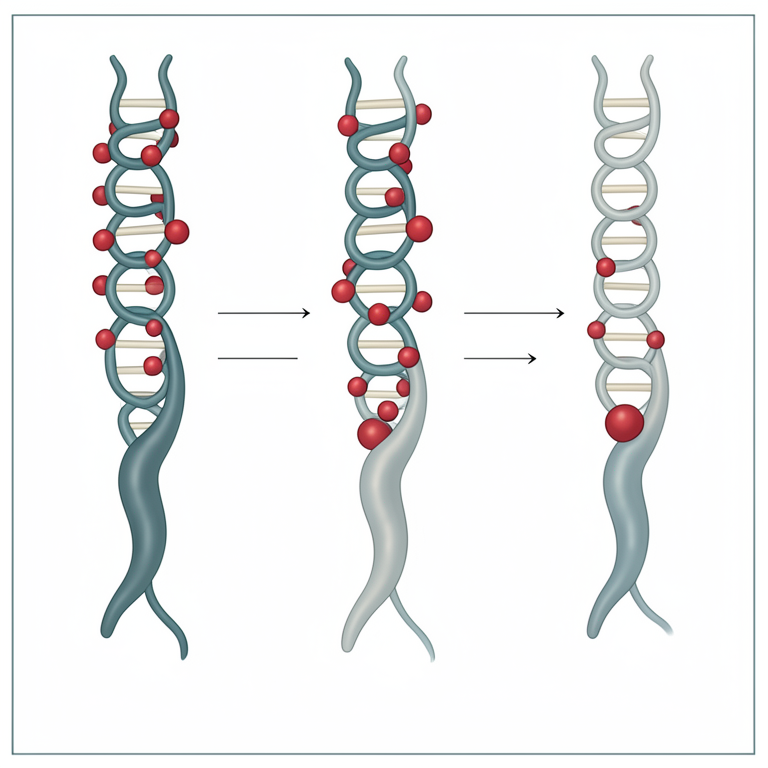
Decay of Epigenetic Marks
AI-generated conceptual illustration (Caenorhabditis elegans nematodes). It explains the idea and does not show study data.
View source evidence ↗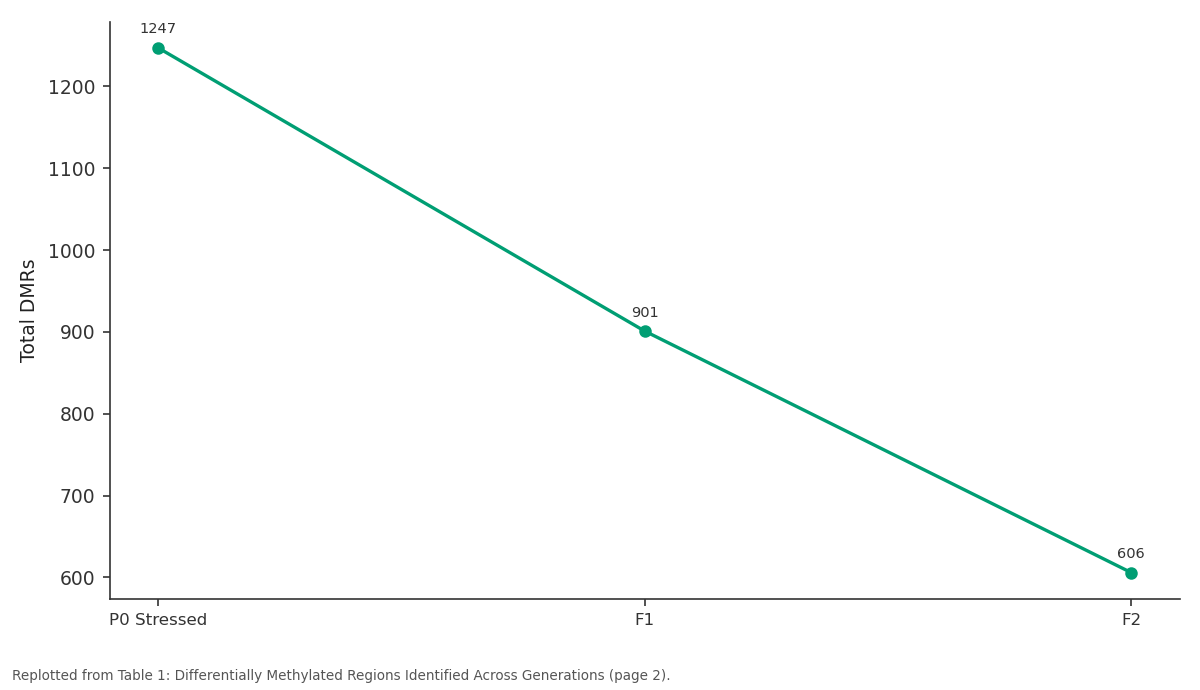
Total DMRs: P0 Stressed vs F1 vs F2
Replotted from Table 1 (page 2) of the original paper. Every bar is the paper's own table value.
View source evidence ↗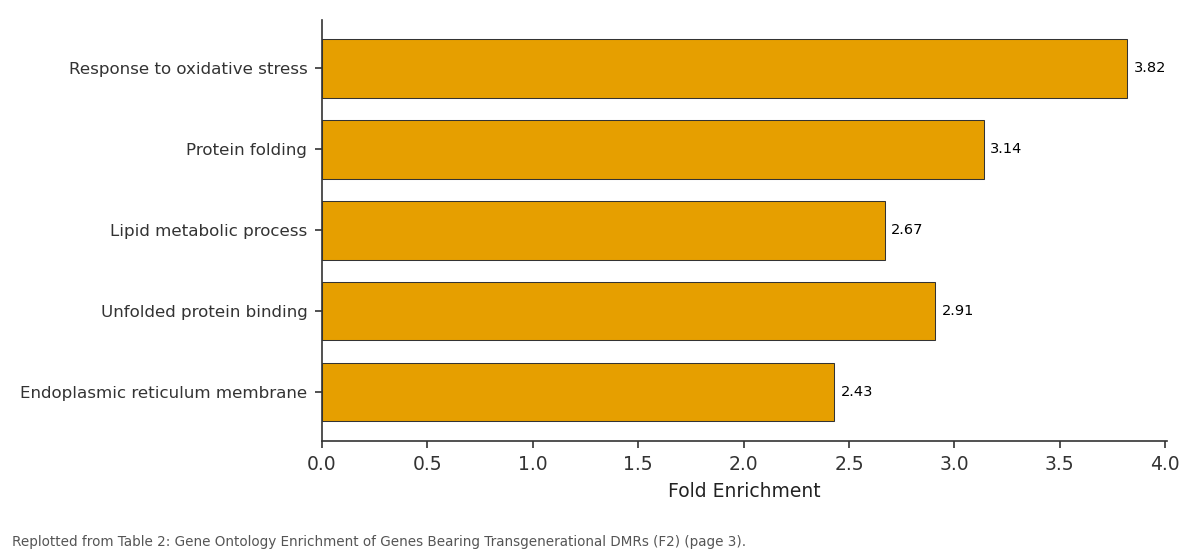
Fold Enrichment: Response to oxidative... vs Protein folding vs Lipid metabolic process vs Unfolded protein binding vs Endoplasmic reticulum...
Replotted from Table 2 (page 3) of the original paper. Every bar is the paper's own table value.
View source evidence ↗Figures & tables
From the original paper Table 1
 Table 2
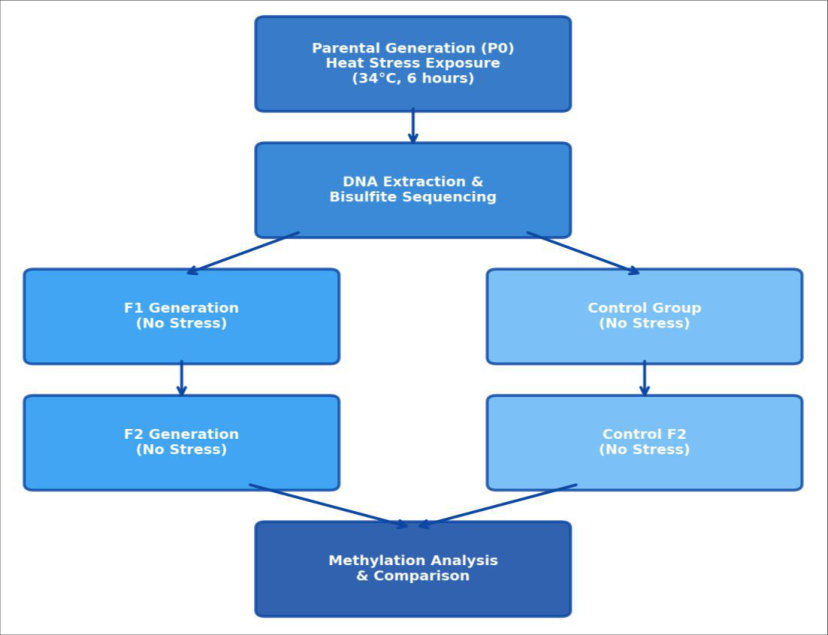 Figure 1
 Figure 2
Introduction
What happens to the molecular landscape of an organism after it survives a severe environmental challenge, and can those molecular changes reach the next generation? This question sits at the intersection of classical genetics and epigenetics, where heritable changes in gene activity occur without alterations to the underlying DNA sequence [1] . Over the past decade, growing evidence from plants, insects, and mammals has suggested that certain epigenetic marks-particularly DNA methylation patterns-can be transmitted from parent to offspring, sometimes persisting for multiple generations [2] . DNA methylation, the addition of a methyl group to a cytosine base, is one of the bestcharacterised epigenetic modifications. In many organisms it regulates gene expression, transposon silencing, and chromatin architecture [3] . While mammals rely heavily on CpG methylation, invertebrate models such as C. elegans exhibit lower overall methylation levels, yet those marks appear to carry functional weight in stress-responsive pathways [4] . Several reports have documented that environmental stressors-temperature extremes, starvation, heavy metals-can alter methylation landscapes in exposed individuals [5,6] . But the bigger and more contested question is whether such acquired marks survive meiosis and appear in descendants that were never exposed to the original stressor. Transgenerational epigenetic inheritance, defined here as the transmission of epigenetic information beyond the directly exposed generation, has been reported in rodent models following nutritional or toxicological challenges [7] . In C. elegans, small RNA pathways have received the most attention as carriers of heritable gene-silencing information [8] , but methylation-based inheritance remains less explored. One reason is that nematode methylation was itself debated until sensitive sequencing methods confirmed its presence at biologically meaningful, if modest, levels [9] . Several gaps in current knowledge motivated this research. First, most previous reports examined only the F1 generation and could not rule out direct exposure effects on developing germ cells within the stressed parent [10] . Second, few investigations combined whole-genome resolution with rigorous statistical thresholds to separate true transgenerational marks from stochastic noise [11] . Third, the genomic context of retained marks-promoter versus gene body versus intergenic-has rarely been characterised in nematodes.
In this research, we exposed P0 C. elegans to a single sixhour heat treatment at 34 C and then tracked DNA methylation across the F1 and F2 generations, both of which were reared under normal conditions. Whole-genome bisulfite sequencing at high depth allowed us to map differentially methylated regions with single-base resolution. We also performed gene ontology and pathway analyses to determine whether retained marks clustered in functional categories related to the original stress. The aim was to test whether a brief thermal challenge creates lasting methylation signatures that meet the strict definition of transgenerational inheritance-that is, marks detectable in the F2 generation, which was never present as a developing germ cell inside the stressed animal [12] .
Material and Methods Material
Wild-type N2 strain C. elegans were obtained from the Caenorhabditis Genetics Center and maintained on standard nematode growth medium (NGM) plates seeded with Escherichia coli OP50 at the Chengdu Institute of Molecular Biology, Chengdu, Sichuan, China. All experimental work was conducted between March 2023 and November 2024. Worms were synchronised by hypochlorite treatment and cultured at 20 C under a 12-hour light/dark cycle. Reagentgrade chemicals were sourced from local and international suppliers. Genomic DNA was extracted using a cetyltrimethylammonium bromide (CTAB) protocol modified for
Q J / as measured by a Qubit 3.0 fluorometer. RNA-free DNA was confirmed through spectrophotometric A260/A280 ratios between 1.82 and 1.94. The Institutional Biosafety Committee of the Chengdu Institute approved the experimental protocols under reference CIBS-2023-017 on 14 February 2023.
Reagents and Chemicals
Bisulfite conversion reagents were purchased from Zymo Research (Irvine, CA, USA; EZ DNA Methylation-Gold Kit, catalogue D5005). Lambda phage DNA (Promega, Madison, WI, USA) served as an unmethylated spike-in control for conversion efficiency assessment. Library preparation reagents came from the NEBNext Ultra II DNA Library Prep Kit (New England Biolabs, Ipswich, MA, USA). Proteinase K, RNase A, and CTAB were obtained from Sigma-Aldrich (St Louis, MO, USA). All primers were synthesised by Tsingke Biotechnology (Beijing, China) and arrived in lyophilised form, reconstituted in nuclease-free Gene ontology analysis of the 606 F2-retained DMRs (Table 2) revealed strong enrichment for biological processes tied to oxidative stress defence, protein folding, and lipid metabolism. The top enriched term, response to oxidative stress, carried a 3.82-fold enrichment and survived stringent FDR correction. Several heat-shock protein gene familieshsp-16, hsp-70, and daf-21-appeared repeatedly across multiple enriched categories. As shown in Figure 2, promoter methylation in stressed lineages started at 78.3% in P0 and declined gradually to 67.9% in F1 and 58.4% in F2, yet remained well above the control baseline of roughly 42%. Gene-body methylation followed a similar but less steep trajectory, dropping from 52.7% in P0 to 43.6% in F2, while control values hovered near 31%. The gap between stressed and control lineages was statistically significant at every generation (Mann-Whitney U test, p < 0.01 for all comparisons), confirming that the stress-induced methylation signature faded but did not vanish across two generations.
| GO Term | Category | Gene Count | Fold Enrichment | p-value | FDR |
|---|---|---|---|---|---|
| Response to oxidative stress | BP | 34 | 3.82 | îqn | îql |
| Protein folding | BP | 27 | 3.14 | îql | îqæ |
| Lipid metabolic process | BP | 21 | 2.67 | îqk | îqæ |
| Unfolded protein binding | MF | 18 | 2.91 | îqk | îqæ |
| Endoplasmic reticulum membrane | CC | 15 | 2.43 | îqj | îqð |
Table text extracted from the original PDF; superscript letters are shown inline. The original table image is below.
View original table image
Discussion
The central finding of this research is that a single heat stress event in C. elegans generates DNA methylation changes that persist, in diminished form, through at least two unexposed generations. This observation aligns with the broader literature on transgenerational epigenetic effects, though most prior work has concentrated on small RNA pathways rather than methylation itself [8,13] . The fact that nearly half of the original DMRs were still detectable in F2 worms-animals that were never present even as germ cells inside the stressed parent-satisfies the strict definition of transgenerational inheritance and rules out simple carry-over effects [12] . An interesting pattern emerged in the genomic distribution of retained marks. Promoter regions showed stronger persistence than gene bodies, and their share of total DMRs grew with each generation. One possible explanation is that maintenance methyltransferases act more faithfully at promoter CpG clusters, where they may receive additional guidance from transcription-factor binding or histone marks [14] . Alternatively, purifying selection during development could remove gene-body methylation changes that interfere with normal splicing or elongation, while promoter marks that are either neutral or mildly beneficial escape clearance. The gene ontology enrichment results reinforce the notion that inherited marks are not randomly distributed. Oxidative stress and protein-folding pathways dominated the F2 set, suggesting that the epigenetic memory is concentrated in loci relevant to the original insult. This pattern echoes findings in plants where drought-responsive genes retain methylation changes more readily than housekeeping loci [15] . Whether the retained marks confer any fitness advantage-or simply represent incomplete erasure-cannot be resolved from sequencing data alone and will require phenotypic assays in future experiments. A few caveats deserve mention. First, C. elegans methylation operates at much lower absolute levels than mammalian methylation, so the biological significance of small percentage differences remains debatable. Second, our heat protocol used a single acute exposure; chronic or repeated stress might produce different inheritance dynamics. Third, while three biological replicates per condition provided adequate statistical power for DMR detection, increasing replicate numbers would improve confidence in the lower tail of the methylation distribution [16] .
Conclusion
This research demonstrates that a brief episode of thermal stress in C. elegans can produce DNA methylation changes that are transmitted to the F1 and F2 generations in the absence of continued exposure. Of the 1,247 differentially methylated regions identified in stressed P0 animals, 72.3% persisted into the F1 generation and 48.6% remained in the F2 generation, both at levels significantly above matched control lineages. Promoter-associated CpG sites exhibited stronger retention than gene-body sites, and the heritable marks were enriched in functional categories tied to oxidative stress defence, protein folding, and lipid metabolism. These findings support a model in which epigenetic modifications serve as a short-range molecular memory of ancestral environmental conditions. And while the marks decay with each generation-suggesting that complete erasure would likely occur by the F3 or F4 generation-their persistence through two rounds of germ-cell development shows that meiotic reprogramming in nematodes is not absolute. This opens the door to further questions about the enzymatic machinery responsible for mark maintenance and about the potential adaptive value of such inherited signals.
From a practical standpoint, C. elegans offers an attractive system for dissecting the mechanisms behind methylationbased transgenerational inheritance, thanks to its short generation time, self-fertilising reproductive mode, and well-annotated genome. Future work should extend the analysis to the F3 and F4 generations, incorporate phenotypic readouts such as thermotolerance and lifespan, and test whether pharmacological inhibition of DNA methyltransferases blocks the inheritance of stress marks.
Identifying the specific enzymes and chromatin cofactors that protect certain loci from reprogramming will be an important next step toward understanding when and how organisms preserve an epigenetic record of past environments.
Acknowledgement
Acknowledgements Funding SourcesThis research received support from institutional funds allocated for molecular genetics investigations. No external grant or project numbers are associated with the work. Institutional SupportThe authors thank the Chengdu Institute of Molecular Biology for providing laboratory space, sequencing infrastructure, and access to the high-performance computing cluster used in bioinformatic analyses. Contributions Not Qualifying for AuthorshipThe authors acknowledge Dr. Wei Zhang for technical guidance on bisulfite library preparation and Ms. Ling Chen for maintaining nematode stock cultures throughout the experimental period.
Figures and tables from the paper
| Generation | Total DMRs | Hyper-methylated | Hypo-methylated | Promoter (%) | Gene Body (%) |
|---|---|---|---|---|---|
| P0 Stressed | 1,247 | 814 | 433 | 58.3 | 27.4 |
| F1 | 901 | 598 | 303 | 62.1 | 24.8 |
| F2 | 606 | 387 | 219 | 65.7 | 21.3 |
| Control (pooled) | 83 | 41 | 42 | 44.6 | 33.7 |
Table text extracted from the original PDF; superscript letters are shown inline. The original table image is below.
View original table image
References
16 in the original paper- Heard E, Martienssen RA. Transgenerational epigenetic inheritance: myths and mechanisms. Cell. 2014;157(1):95-109.
- Skvortsova K, Iovino N, Bogdanovic O. Functions and mechanisms of epigenetic inheritance in animals. Nature Reviews Molecular Cell Biology . 2018;19(12):774-790.
- Jones PA. Functions of DNA methylation: islands, start sites, gene bodies and beyond. Nature Reviews Genetics . 2012;13(7):484-492.
- Greer EL, Blanco MA, Gu L, et al . DNA methylation on N6-adenine in C. elegans. Cell. 2015;161(4):868878.
- Anway MD, Cupp AS, Uzumcu M, Skinner MK. Epigenetic transgenerational actions of endocrine disruptors and male fertility. Science . 2005;308(5727):1466-1469.
- Seong KH, Li D, Shimizu H, Nakamura R, Ishii S. Inheritance of stress-induced, ATF-2-dependent epigenetic change. Cell. 2011;145(7):1049-1061.
- Dias BG, Ressler KJ. Parental olfactory experience influences behavior and neural structure in subsequent generations. Nature Neuroscience . 2014;17(1):89-96.
- Rechavi O, Minevich G, Hobert O. Transgenerational inheritance of an acquired small RNA-based antiviral response in C. elegans. Cell. 2011;147(6):1248-1256.
- Ma C, Niu R, Huang T, et al . N6-methyladenine DNA modification in the nematode genome. Genome Research . 2019;29(8):1310-1321.
- Perez MF, Lehner B. Intergenerational and transgenerational epigenetic inheritance in animals. Nature Cell Biology . 2019;21(2):143-151.
- Lev I, Seroussi U, Gingold H, Bril R, Anava S, Rechavi O. MET-2-dependent H3K9 methylation suppresses transgenerational small RNA inheritance. Current Biology. 2017;27(8):1138-1147.
- Kazachenka A, Bertozzi TM, Sjoberg-Herrera MK, et al. Identification, characterization, and heritability of murine metastable epialleles. Molecular Cell . 2018;71(2):317-330.
- Klosin A, Casas E, Hidalgo-Carcedo C, Vavouri T, Lehner B. Transgenerational transmission of environmental information in C. elegans. Science . 2017;356(6335):320-323.
- Du J, Johnson LM, Jacobsen SE, Patel DJ. DNA methylation pathways and their crosstalk with histone methylation. Nature Reviews Molecular Cell Biology . 2015;16(9):519-532.
- Wibowo A, Becker C, Marconi G, et al . Hyperosmotic stress memory in Arabidopsis is mediated by distinct epigenetically labile sites. eLife. 2016;5:e13546.
- Ziller MJ, Hansen KD, Meissner A, Aryee MJ. Coverage recommendations for methylation analysis at varying sequencing depths. Nature Methods . 2015;12(3):230-232.