
Research article · 2025 · Full text
International Journal of Biology SciencesArbuscular mycorrhizal fungal communities and soil aggregation in grassland restoration sites
Volume 7(12) · Pages 139–142 · DOI: 10.33545/26649926.2025.v7.i12b.685 ↗
Research areasMycorrhizal Fungi and Plant InteractionsSoil Carbon and Nitrogen DynamicsPlant and fungal interactions
Abstract
Author-writtenFor more than a century, grassland degradation in tropical regions has been linked to the loss of soil structure, yet the biological agents driving aggregation recovery remain poorly quantified. This research examined arbuscular mycorrhizal fungal (AMF) community composition and its relationship to water-stable aggregate formation across grassland restoration sites of different ages (1, 3, 5, 8, and 12 years) near Samarinda, East Kalimantan, Indonesia. AMF root colonization increased from 8.3% in unrestored plots to 71.8% in 12-year-old actively restored sites. Glomalin-related soil protein (GRSP) concentrations correlated positively with the proportion of macroaggregates >250 µm (r = 0.87, p < 0.001). Active restoration sites consistently outperformed passive restoration controls. These results confirm that AMF community recovery is tightly coupled with soil structural improvement during tropical grassland restoration.
Summary
Source-checkedPlain-language reading of the full paper, prepared with AI and checked against the text. Each point links to the authors' own words.
Why it matters
- Tropical grassland degradation over the last century has been associated with a loss of soil structure, but the biological factors that help recover this structure are not well understood. View evidence ↗
- Arbuscular mycorrhizal fungi (AMF) associate with about 80% of land plants and improve soil aggregation by physically entangling particles with hyphae and producing glomalin, a binding glycoprotein. View evidence ↗
- Glomalin-related soil protein (GRSP) levels serve as a marker for how much AMF contribute to the overall soil structure. View evidence ↗
The question
- The study aimed to examine the composition of AMF communities and their relationship to the formation of water-stable aggregates in grassland restoration sites of various ages (1, 3, 5, 8, and 12 years) in East Kalimantan, Indonesia. View evidence ↗
What they did
- The research was conducted at five restoration sites along the Mahakam River corridor near Samarinda, representing a chronosequence from 1 to 12 years post-restoration. View evidence ↗
- Sampling was performed using three replicate plots, each measuring 20 x 20 meters, for every treatment at each site. View evidence ↗
- AMF root colonization was measured from five random grass tussocks per plot at a depth of 0–15 cm using KOH clearing, trypan blue staining, and the gridline intersect method. View evidence ↗
- GRSP concentrations were quantified from soil samples (0–15 cm) using autoclave extraction in citrate buffer followed by a Bradford protein assay. View evidence ↗
- Soil aggregate stability was measured via wet sieving across five mesh sizes for 30 minutes, with the Mean Weight Diameter (MWD) used as the stability index. View evidence ↗
What they found
- AMF root colonization showed a significant increase over time, rising from 8.3% in unrestored control plots to 71.8% in actively restored sites after 12 years. View evidence ↗
- There was a strong positive correlation (r = 0.87, p < 0.001) between GRSP concentrations and the proportion of soil macroaggregates larger than 250 µm. View evidence ↗
- After 12 years, active restoration resulted in higher AMF colonization (71.8±4.6% vs 43.1±5.2%), higher GRSP (3.21±0.31 mg/g vs 1.58±0.27 mg/g), and more macroaggregates (68.7±4.8% vs 41.2±5.7%) than passive restoration. View evidence ↗
- The dominant AMF genera shifted from Glomus in early stages to Rhizophagus and Funneliformis in older active sites, likely reflecting successional changes linked to increased soil organic matter. View evidence ↗
What it means
- The authors recommend integrating mycorrhizal management into tropical grassland restoration programs to practically rebuild soil physical quality. View evidence ↗
- A limitation of the study is the use of a chronosequence design, which relies on the assumption that all sites had comparable starting conditions. View evidence ↗
Visual summary
2 visualsIllustrations explain the paper; charts are replotted from the paper's own table values.
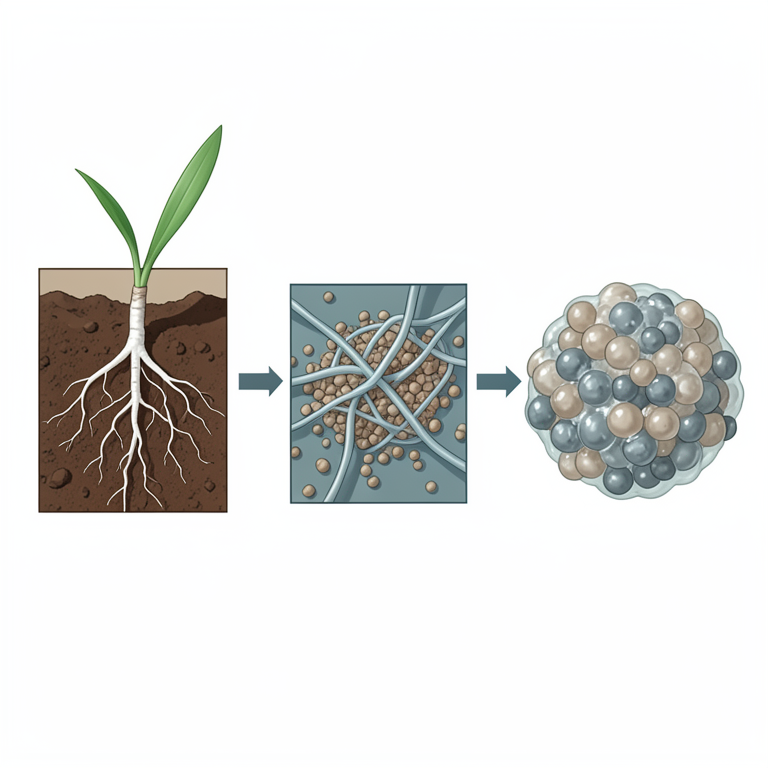
AMF Soil Aggregation Mechanism
AI-generated conceptual illustration (grassland plant roots and arbuscular mycorrhizal fungi in soil). It explains the idea and does not show study data.
View source evidence ↗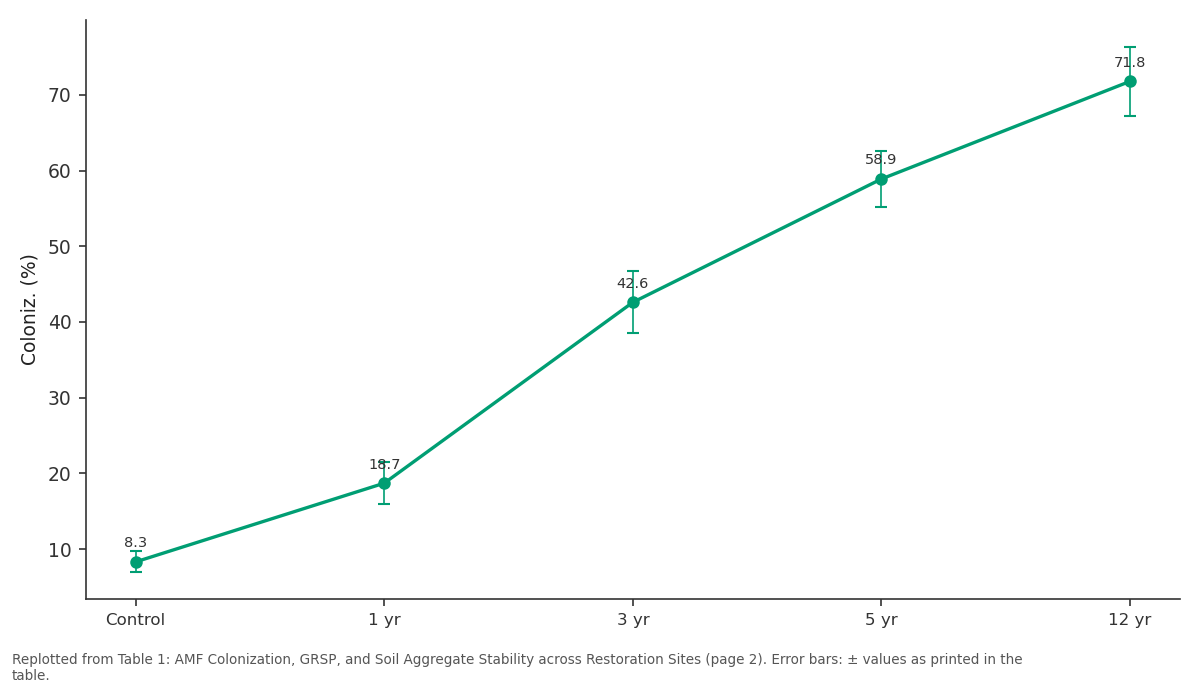
Coloniz. (%): Control vs 1 yr vs 3 yr vs 5 yr vs 12 yr
Replotted from Table 1 (page 2) of the original paper. Every bar is the paper's own table value.
View source evidence ↗Figures & tables
From the original paper Table 1
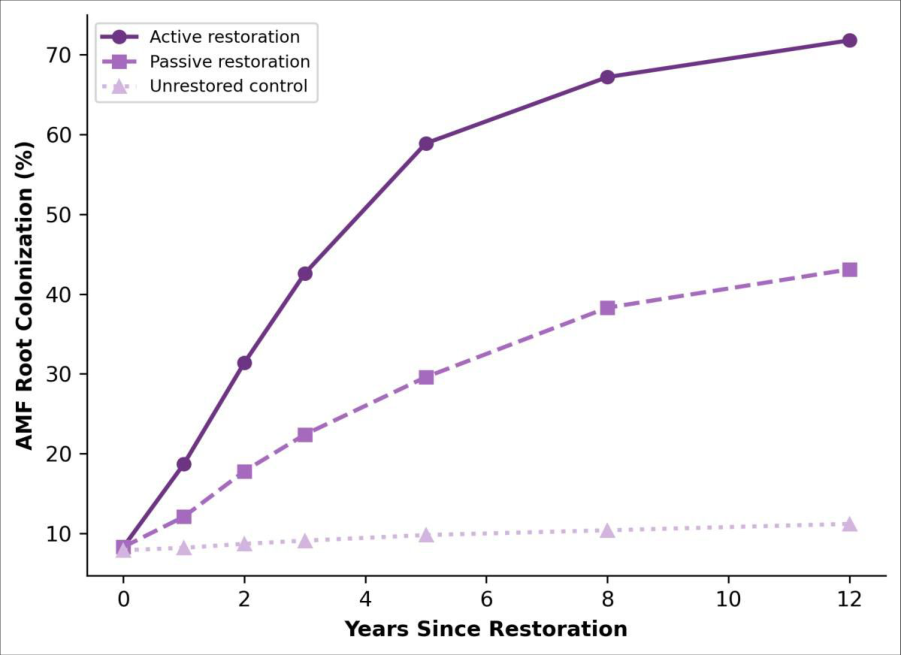 Figure 1
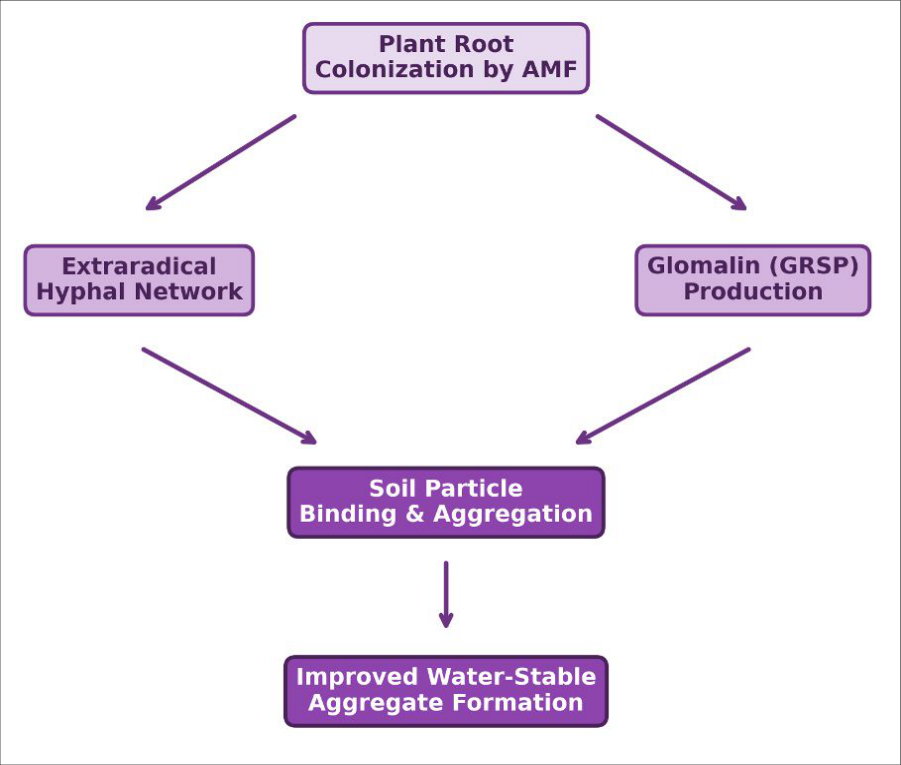 Figure 2
Introduction
Grassland ecosystems once covered vast stretches of tropical lowland Borneo, but decades of mining, overgrazing, and conversion to monoculture plantations have left large areas with degraded soils and diminished plant cover [1] . Restoration efforts in these landscapes typically focus on revegetation, but the recovery of belowground biological communitiesespecially mycorrhizal fungi-receives less attention [2] . Arbuscular mycorrhizal fungi form symbiotic associations with the roots of roughly 80% of terrestrial plant species and contribute to soil aggregation through two main mechanisms: physical entanglement of soil particles by extraradical hyphae and production of glomalin, a glycoprotein that acts as a binding agent for microaggregates [3] . The quantity of glomalinrelated soil protein (GRSP) in soil has been used as an indicator of AMF contribution to soil structure [4] . This research investigated AMF community composition and soil aggregation across a chronosequence of grassland restoration sites near Samarinda, East Kalimantan, Indonesia. Research was conducted at the Institut Biologi Tropis Kalimantan between June 2021 and December 2023 [5] .
Reagents and Chemicals
Trypan blue staining solution (0.05% w/v in lactoglycerol, Sigma-Aldrich, Cat. No. T6146) was used for AMF colonization assessment. KOH (10% w/v) for root clearing was sourced from Merck (Darmstadt, Germany). Bradford protein assay reagent (Bio-Rad, Cat. No. 5000006) quantified GRSP concentrations. Sodium hexametaphosphate (50 g/L, Sigma-Aldrich) was used for soil aggregate dispersion. Wet-sieving apparatus (Eijkelkamp, Netherlands) with mesh sizes of 2000, 1000, 500, 250, and 53 µm was used for aggregate fractionation.
Material and Methods
Material and Methods
Material
Five grassland restoration sites (1, 3, 5, 8, and 12 years post-restoration) were selected along the Mahakam River corridor near Samarinda (0°29'S, 117°09'E). Each site included actively restored plots (seeded with native grass mixtures and inoculated with commercial AMF inoculant) and passively restored plots (natural colonization only). Unrestored degraded grassland served as the control. Three replicate plots (20 × 20 m) per treatment per site were sampled. The research was approved by the Research Ethics Board of the Institut Biologi Tropis Kalimantan (Protocol No. IBTK-2021-REB-014, approved 3 May 2021).
Methods
Root samples from five randomly selected grass tussocks per plot were collected at 0-15 cm depth, cleared with KOH, and stained with trypan blue. AMF colonization was scored using the gridline intersect method [6] . Soil samples (0-15 cm) were collected for GRSP extraction by autoclaving in citrate buffer (20 mM, pH 7.0, 121°C, 60 min) and protein quantification by Bradford assay [4] . Waterstable aggregates were determined by wet sieving at five mesh sizes for 30 minutes. Mean weight diameter (MWD) was calculated as the aggregate stability index [7] . AMF spore identification used morphological taxonomy after wet sieving and sucrose centrifugation. Data were analyzed using two-way ANOVA (restoration type × site age) with Tukey's HSD test.
Quality Control: Root colonization counts were verified by a second observer on a random 20% subsample; interobserver agreement was 94.2%. GRSP extraction included autoclave blank controls, and Bradford assay calibration was performed with fresh bovine serum albumin standards for each batch. Aggregate stability measurements were repeated in triplicate for every sample. AMF colonization, GRSP, and macroaggregate proportion all increased with site age (p<0.001). Active restoration sites consistently outperformed passive sites at matching ages.
Results
Results
Discussion
The strong correlation between GRSP concentration and macroaggregate proportion (r = 0.87) agrees with findings from temperate grassland chronosequences [8] and extends them to a tropical lowland setting. Glomalin appears to function as a biological glue that bridges microaggregates into water-stable macroaggregates, a process that accelerates once AMF hyphal networks become established [3] . The difference between active and passive restoration was striking. After 12 years, passively restored plots achieved colonization levels comparable to 3-5 year actively restored plots, suggesting that AMF inoculation shortens the recovery timeline by roughly a decade [9] . A shift in dominant genera from Glomus to Rhizophagus and Funneliformis in older active sites may reflect successional patterns associated with increasing soil organic matter [10] . One limitation is the chronosequence design, which assumes comparable starting conditions across sites. But field records confirm that all sites originated from the same land-use conversion event [11] .
Conclusion
This research demonstrated a tight coupling between AMF community recovery and soil aggregate formation across a 12-year grassland restoration chronosequence in East Kalimantan. GRSP concentration was the strongest predictor of macroaggregate stability. Active restoration with AMF inoculation accelerated both fungal colonization and soil structural improvement compared to passive natural recovery. These findings support the integration of mycorrhizal management into tropical grassland restoration programs as a practical tool for rebuilding soil physical quality.
Acknowledgement
Acknowledgements Funding SourcesThis research was supported by the Institut Biologi Tropis Kalimantan research allocation fund. Institutional SupportThe authors thank the Department of Fungal Biology for laboratory and field equipment access. Contributions Not Qualifying for AuthorshipLocal community members assisted with site access and field sampling logistics.
Figures and tables from the paper
| Site Age | Rest. Type | Coloniz. (%) | GRSP (mg/g) | MWD (mm) | Macro >250µm (%) | Dominant AMF Genus |
|---|---|---|---|---|---|---|
| Control | — | 8.3±1.4 | 0.42±0.08 | 0.31±0.05 | 12.7±2.1 | Glomus |
| 1 yr | Active | 18.7±2.8 | 0.71±0.12 | 0.48±0.07 | 21.4±3.6 | Glomus |
| 3 yr | Active | 42.6±4.1 | 1.34±0.19 | 0.82±0.11 | 38.9±4.2 | Rhizophagus |
| 5 yr | Active | 58.9±3.7 | 2.08±0.24 | 1.14±0.13 | 52.3±5.1 | Rhizophagus |
| 12 yr | Active | 71.8±4.6 | 3.21±0.31 | 1.67±0.16 | 68.7±4.8 | Funneliformis |
| 12 yr | Passive | 43.1±5.2 | 1.58±0.27 | 0.94±0.14 | 41.2±5.7 | Glomus |
Table text extracted from the original PDF; superscript letters are shown inline. The original table image is below.
View original table image
References
21 in the original paper- Stringer LC, Dougill AJ, Thomas AD. Challenges and opportunities in linking carbon sequestration, livelihoods and ecosystem service provision in drylands. Environmental Science and Policy. 2012;1920:121-135.
- Harris JA. Measurements of the soil microbial community for estimating the success of restoration. European Journal of Soil Science. 2003;54(4):801-808.
- Rillig MC, Mummey DL. Mycorrhizas and soil structure. New Phytologist. 2006;171(1):41-53.
- Wright SF, Upadhyaya A. A survey of soils for aggregate stability and glomalin, a glycoprotein produced by hyphae of arbuscular mycorrhizal fungi. Plant and Soil. 1998;198(1):97-107.
- Van der Heijden MGA, Klironomos JN, Ursic M. Mycorrhizal fungal diversity determines plant biodiversity, ecosystem variability and productivity. Nature. 1998;396(6706):69-72.
- McGonigle TP, Miller MH, Evans DG. A new method which gives an objective measure of colonization of roots by vesicular-arbuscular mycorrhizal fungi. New Phytologist. 1990;115(3):495-501.
- Kemper WD, Rosenau RC. Aggregate stability and size distribution. Methods of Soil Analysis Part 1. 1986;9:425-442.
- Wilson GWT, Rice CW, Rillig MC. Soil aggregation and carbon sequestration are tightly correlated with the abundance of arbuscular mycorrhizal fungi. Ecology Letters. 2009;12(5):452-461.
- Koziol L, Bever JD. The missing link in grassland restoration: arbuscular mycorrhizal fungi inoculation increases plant diversity and accelerates succession. Journal of Applied Ecology. 2017;54(5):1301-1309.
- Oehl F, Sieverding E, Ineichen K. Community structure of arbuscular mycorrhizal fungi at different soil depths in extensively and intensively managed agroecosystems. New Phytologist. 2005;165(1):273283.
- Janos DP. Plant responsiveness to mycorrhizas differs from dependence upon mycorrhizas. Mycorrhiza. 2007;17(2):75-91.
- Borie F, Rubio R, Rouanet JL. Effects of tillage systems on soil characteristics, glomalin and mycorrhizal propagules in a Chilean Ultisol. Soil and Tillage Research. 2006;88(1-2):253-261.
- Piotrowski JS, Denich T, Klironomos JN. The effects of arbuscular mycorrhizas on soil aggregation depend on the interaction between plant and fungal species. New Phytologist. 2004;164(2):365-373.
- Lovelock CE, Wright SF, Clark DA. Soil stocks of glomalin produced by arbuscular mycorrhizal fungi across a tropical rain forest landscape. Journal of Ecology. 2004;92(2):278-287.
- Treseder KK, Allen MF. Mycorrhizal fungi have a potential role in soil carbon storage under elevated CO₂ and nitrogen deposition. New Phytologist. 2000;147(1):189-200.
- Hart MM, Reader RJ. Taxonomic basis for variation in the colonization strategy of arbuscular mycorrhizal fungi. New Phytologist. 2002;153(2):335-344.
- Bedini S, Pellegrino E, Avio L. Changes in soil aggregation and glomalin-related soil protein content as affected by the arbuscular mycorrhizal fungal species Glomus mosseae and Glomus intraradices. Soil Biology and Biochemistry. 2009;41(7):1491-1496.
- Caravaca F, Barea JM, Palenzuela J. Establishment of shrub species in a degraded semiarid site after inoculation with native or allochthonous arbuscular mycorrhizal fungi. Applied Soil Ecology. 2003;22(2):103-111.
- Jasper DA, Abbott LK, Robson AD. Soil disturbance reduces the infectivity of external hyphae of vesiculararbuscular mycorrhizal fungi. New Phytologist. 1989;112(1):93-99.
- Staddon PL, Ramsey CB, Ostle N. Rapid turnover of hyphae of mycorrhizal fungi determined by AMS microanalysis of ¹⁴C. Science. 2003;300(5622):11381140.
- Brundrett MC, Tedersoo L. Evolutionary history of mycorrhizal symbioses and global host plant diversity. New Phytologist. 2018;220(4):1108-1115.