
Research article · 2026 · Full text
International Journal of Advanced Chemistry ResearchTechnological advancements in chemical spaces: Outlook on chemoinformatics
Volume 8(1) · Pages 52–54 · DOI: 10.33545/26646781.2026.v8.i1a.615 ↗
Research areasComputational Drug Discovery MethodsHistory and advancements in chemistryMachine Learning in Materials Science
Abstract
Author-writtenChemoinformatics, a relatively new discipline that integrates established fields like QSAR and chemical database development, is nearing maturity. It is widely utilized in both academic and industrial settings, particularly in drug design, and is now taught at various levels in many universities. Additionally, there are numerous specialized international journals and annual conferences dedicated to the field. However, it has yet to be fully recognized as a distinct scientific discipline; instead, it is often viewed as a bridge between chemistry and informatics or as a set of methods tailored for drug design. This is evident in early definitions proposed by researchers such as Brown, Paris, Gasteiger, and Faulon. For a field to be considered a scientific discipline, it should possess its own concepts and approaches, and clearly distinguish itself from related areas. One of the key applications of chemoinformatics is creating models that connect chemical structures with various molecular properties. This positions chemoinformatics alongside two other modeling techniques: quantum chemistry and force-field simulations. While these three fields share complementary roles, they differ in their molecular model representations, foundational concepts, inference methods, and application areas.
Summary
Source-checkedPlain-language reading of the full paper, prepared with AI and checked against the text. Each point links to the authors' own words.
Why it matters
- Chemoinformatics is an emerging field that combines chemical database development and Quantitative Structure-Activity Relationship (QSAR) studies. View evidence ↗
- The field is extensively used in industry and academia, with a primary application in the design of new drugs. View evidence ↗
- Despite its utility, chemoinformatics is often perceived as a set of tools or a bridge between disciplines rather than a standalone scientific discipline. View evidence ↗
The question
- The author aims to highlight the key conceptual points that justify defining chemoinformatics as an independent scientific discipline. View evidence ↗
What they did
- In chemoinformatics, molecules are represented as either molecular graphs or descriptor vectors linked to biological activity, 3D geometry, and physicochemical properties. View evidence ↗
- The aggregation of these molecular representations forms a 'chemical space' used to establish relationships between different chemical objects. View evidence ↗
- Graph-based representations use labeled vertices to represent atoms and edges to represent chemical bonds. View evidence ↗
- Molecular descriptors are numerical values derived from chemical information through logical and mathematical processes. View evidence ↗
What they found
- The potential number of chemical compounds is estimated to exceed 10^60, making it impossible to synthesize or compute every structure. View evidence ↗
- More than 5,000 types of molecular descriptors have been reported for use in similarity searching, model building, and database processing. View evidence ↗
- The fundamental principle of molecular similarity suggests that compounds with similar structures tend to share similar properties or biological activities. View evidence ↗
- The size of the maximum common subgraph (MCS) is one of the most recognized methods for measuring similarity between molecular graphs. View evidence ↗
- Superstructure-based approaches are effective for building QSAR models, although they are limited to small sets of similar compounds. View evidence ↗
What it means
- The author concludes that chemoinformatics is a key theoretical discipline that complements force-field modeling and quantum chemistry. View evidence ↗
- The discipline is fundamentally based on two mathematical pillars: statistical learning theory and graph theory. View evidence ↗
- The author acknowledges that the paper does not cover all aspects of chemoinformatics and that the presented perspective may be incomplete. View evidence ↗
Visual summary
1 visualsIllustrations explain the paper; they do not show study data.
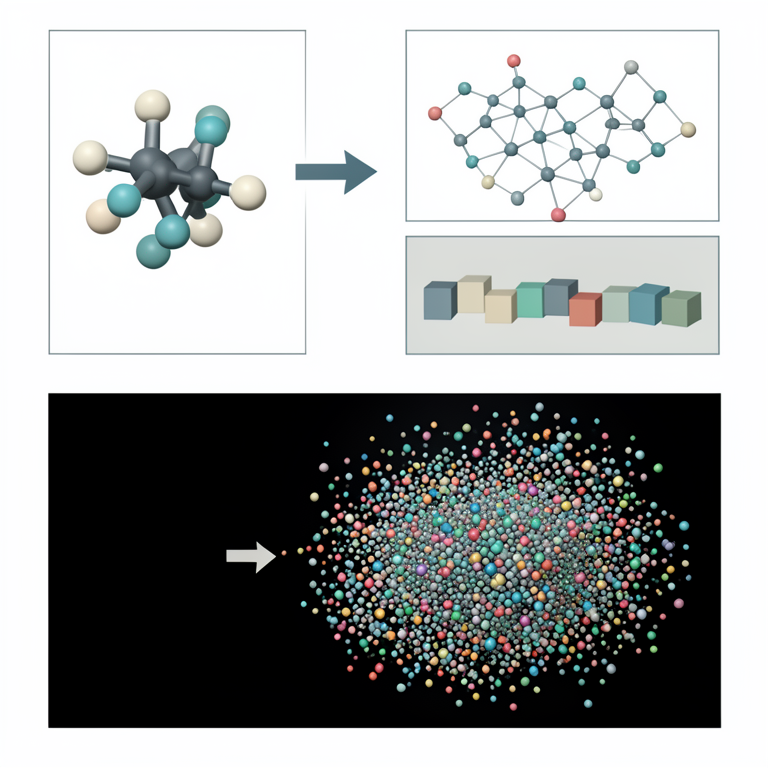
Molecular Representation to Chemical Space
AI-generated conceptual illustration (Small organic molecules and their digital representations). It explains the idea and does not show study data.
View source evidence ↗Introduction
Unlike the molecular models employed in quantum mechanics (which involve nuclei and electrons) and force-field modeling (which focuses on classical atoms and bonds), chemoinformatics represents molecules as molecular graphs or descriptor vectors, which are associated with features like physicochemical properties, biological activity, and 3D geometry. The collection of these graphs or descriptor vectors creates a chemical space, within which relationships between objects can be established. Unlike physical space, chemical space is not singular; each set of graphs and descriptors defines its own unique chemical space. Therefore, chemoinformatics can be characterized as a scientific field centered on the representation of molecules as objects (graphs or vectors) within a chemical space.
Chemical Spaces and Chemoinformatics
Chemical space can be likened to the vastness of the universe, populated by chemical compounds instead of stars. Even attempting to count all the potential chemical compounds leads to an overwhelming combinatorial explosion, resulting in estimates exceeding 10^60, a figure greater than the number of elemental particles in the universe. This staggering number makes it impractical not only to synthesize these compounds but also to compute their structures. The aim of chemoinformatics is to find a rational way to represent this virtually infinite chemical space and navigate within it. Effective strategies for exploring chemical space are essential for discovering new biologically active compounds and designing new drugs, as these compounds are not evenly distributed but rather cluster in compact regions, similar to galaxies. The term "chemography," akin to geography, has even been proposed to describe the skill of navigating this space. While "chemical space" is commonly referenced in chemoinformatics literature, it lacks a precise definition. Generally, "space" refers to a collection of objects with specific properties and relationships (metrics) among them. In chemoinformatics, molecules are seen as informational objects, focusing on their structures and properties. Two primary object types are used: graphs and descriptor vectors. In an undirected graph with labeled vertices and edges, vertices represent atoms and edges represent chemical bonds, with labels indicating the types of elements and bonds. For example, bond types may include coordination bonds in supramolecular systems or dynamic bonds that represent chemical reactions. More complex chemical systems, like polymers, can be represented by groups of graphs. For practical applications, generalized representations are often required. In pharmacophore analysis, graph vertices can denote pharmacophoric centers (like H-donors and H-acceptors), with edges representing distances between these centers. In patent searches, graph vertices may symbolize various individual atoms or entire substructures. However, graph theory has limitations in encoding complex chemical structures, prompting the suggestion of hypergraphs as a more suitable mathematical model for stereochemical information and multicenter bonds, though they are more challenging to work with. Another common representation of molecular structure involves molecular descriptors, defined by Todeschini and Consonni as the outcome of a logical and mathematical process that transforms chemical information from a molecular representation into useful numerical values. This representation is popular in chemoinformatics because it allows for the generation of various descriptors from the same molecular graph, remains invariant to vertex renumbering, is easy to interpret, facilitates knowledge transfer, and defines a mathematically manageable vector space. Descriptor vectors can be created not only for individual molecules but also for complex systems like chemical reactions or mixtures, with over 5,000 types of descriptors reported for various uses, including database processing, model building, and similarity searching. However, molecular descriptors have some weaknesses: poorly chosen descriptors can lead to different molecules being represented as a single point in chemical space; the sheer number of descriptors raises the risk of selecting irrelevant or redundant ones; and a significant drawback is the loss of direct correspondence with molecular structure. Reconstructing molecular graphs from descriptors, known as the "inverse problem," is often difficult or impossible. Practical attempts to address this have highlighted that multiple chemical structures can correspond to the same descriptor values, complicating reverse engineering. Nonetheless, this degeneracy can be advantageous for securely exchanging chemical information in the form of molecular descriptors.
Chemical or Molecular Similarities
Molecular similarity, or chemical similarity, is a fundamental concept in chemoinformatics, commonly applied in virtual screening and in silico compound design. This principle posits that similar compounds exhibit similar properties, which implies that similar chemical compounds tend to belong to the same class (such as sharing biological activity) in classification problems. For regression tasks, it suggests that the approximating function should be as smooth as possible. It's important to note that molecular similarity is influenced by the choice of descriptors and methods used to compare molecular graphs. Chemical similarity measures, as documented in literature, can be derived from (a) molecular graphs; (b) descriptor vectors; (c) molecular fields; and can also be evaluated using (d) kernels and (e) unsupervised or (f) supervised modeling techniques. This classification can be somewhat ambiguous, as some similarity measures may fall into multiple categories. One of the most recognized graph-based similarity measures is based on the size of the maximum common subgraph (MCS) for two graphs. However, due to the complexity and inefficiency of algorithms used to identify an MCS, this method is seldom used for similarity searches or clustering chemical databases. Another graph-based similarity measure involves graph kernels, which assign a positive real number to each pair of graphs to characterize their similarity. These kernels help map graph-based chemical space into a vector space, facilitating the construction of structure-property models, and have been effectively applied in SAR and QSAR studies. The most common similarity measures rely on fixed-sized descriptor vectors, using various distance metrics (like Euclidean, Manhattan, Mahalanobis, Minkowski) to quantify dissimilarity or indices (such as Tanimoto, Dice, cosine, Tversky) to assess similarity. These methods are widely discussed in the literature, including a review by Willett. Several methods have been devised for comparing molecular fields. For instance, the Carbo index is calculated by integrating the overlaps of electronic densities between two molecules using quantum-chemical methods. The SEAL index evaluates the alignment of steric and electrostatic fields. Since molecular fields can be represented as descriptor vectors based on their values at grid points, similarity can be computed as the product of two vectors. Similarity measures where all value matrices are semipositive definite (meaning their determinants are nonnegative) are referred to as "Mercer kernels." These kernels project objects (whether graphs or vectors) into a Hilbert feature space, where the similarity measure corresponds to the dot product of their projections. The dot product, which can be interpreted as cosine similarity for normalized vectors, represents the simplest form of a kernel. Unsupervised machine learning techniques, such as nonlinear neighborhood-preserving projections, can also evaluate similarity. A prime example is the Self-Organizing Map (SOM), where similarity is determined by the distance between different cells, making SOMs useful for property predictions and virtual screening. When multiple QSAR models predict properties for a series of compounds, similarity can be assessed in the "models' space." A vector can be formed for each compound based on the prediction results, and the dot product of these vectors can serve as a measure of molecular similarity. This method has been utilized by Tetko in the Associative Neural Networks (ASNN) approach. Overall, similarity measures can be employed for both similarity-based predictions and searches. Similarity-based prediction methods in the initial descriptor space typically utilize the k-nearest neighbors method (kNN), while kernel similarity measures in kernelbased machine learning often yield more computationally efficient and predictive models.
Representing Objects in Chemical Spaces
Each collection of molecular graphs creates a discrete metric topological space, where its topology is defined by all possible subsets. In this simplest discrete metric, the distance between two chemical objects is 0 if they are equivalent (i.e., their corresponding chemical graphs are isomorphic) and 1 otherwise. However, this basic metric is not particularly useful in practice since it implies all distinct objects are equally similar. A more nuanced relationship can be expressed through a measure of mutual similarity or dissimilarity, often established by mapping the graph ensemble into a descriptor vector space and applying standard similarity measures. There are three primary methods for describing and navigating a set of molecular graphs: (a) substructure-based, (b) superstructure-based, and (c) mutation-based. In the substructure-based approach, a specialized "navigation" graph is created, which facilitates visualization of chemical databases, exploration of compound relationships, and identification of uncharted areas in chemical space. In this navigation graph, nodes represent individual molecular graphs, while edges correspond to transition rules. Bemis and Mursko explored transitions from an unlabeled graph (framework) to a labeled graph (full chemical structure), introducing the concept of molecular frameworks to organize structural data by grouping atoms into categories such as rings, linkers, frameworks, and side chains. This allows a large database to be represented by a limited number of frameworks. Schuffenhauer proposed a "scaffold tree" graph, allowing transitions between a molecular graph and its subgraph, which enables efficient activity mapping and visualization, leading to correlations with bioactivity and subsequent compound design. Their hierarchical scaffold classification aids in charting biologically relevant chemical space using natural product data. The "scaffold tree" concept is implemented in the open-source "Scaffold Hunter" software, an interactive tool for navigating chemical space and identifying complex structural relationships related to bioactivity. To represent relationships among compounds with the same scaffold but different substitution patterns, Peltason et al. introduced multilayer-rooted "combinatorial analogue graphs" (CAGs). These graphs hierarchically organize compounds based on their substitution patterns and are annotated with SARI discontinuity scores to account for SAR discontinuities at the functional group level. This method helps identify underrepresented areas and highlights key substitution patterns that influence the SAR of a series of compounds. Agrafiotis et al. proposed "SAR maps," where each series is depicted as a rectangular matrix of cells representing unique combinations of substituents. Colorcoding these cells by potency reveals SAR patterns effectively. Pollock et al. introduced a scaffold topology approach that represents a connected graph with the minimal number of nodes and edges necessary to fully describe its ring structure. Their algorithm allows for systematic generation and analysis of scaffold topologies, covering a wide range of small molecules. They analyzed scaffold topology distributions across major chemical structure databases, uncovering many interesting features and suggesting that scaffold topologies could form an efficient classification scheme for molecules in chemical databases. In the superstructure-based approach, each molecular graph is viewed as a subgraph of a common supergraph that encompasses all individual graphs. While this method is limited to relatively small sets of similar compounds, it has proven effective for building QSAR models, as shown in various analyses and systems, including those by Magee, Mercier et al., Kurunczi et al., and Palyulin et al. For each chemical structure, the occupancy of supergraph nodes or local physicochemical descriptors corresponding to these nodes generates a fixed-size descriptor vector for machine learning applications. An alternative mutation-based method for exploring graph-based chemical space was proposed by van Deursen et al. They defined a chemical space as a graph where vertices represent individual molecules and edges denote structural mutations, like changes in atom type, inversion of stereochemical configuration, addition or removal of atoms, saturation and unsaturation of bonds, bond rearrangements, and aromatic ring additions. This allows for the discovery of novel structures along the trajectory from one active molecule to another, facilitating lead optimization. Bishop et al. used a similar method, employing chemical reactions as structural mutations connecting known organic compounds from the Beilstein database. Their created supergraph helped select a set of the "most useful compounds" from which many chemical compounds could be synthesized.
Brief Conclusion
Chemoinformatics is regarded as a key theoretical discipline within chemistry that complements both quantum chemistry and force-field molecular modeling. It conceptualizes molecules as graphs or descriptor vectors, with their collections forming either graph-based or descriptor-based spaces. Chemical similarity measures and hierarchical relationships between graphs function as metrics within this chemical space. Chemoinformatics employs two primary mathematical approaches: graph theory and statistical learning theory, the latter of which is briefly introduced here. This paper does not intend to cover all aspects of chemoinformatics but seeks to highlight important points that define it as an independent scientific discipline. While this perspective may be incomplete, we hope it will spark discussion within the chemoinformatics community.
References
7 in the original paper- Willett P. Chemical similarity in drug design: applications of similarity measures in drug discovery. Drug Discovery Today. 2023;11(11-12):569-577. DOI:10.1016/j.drudis.2023.09.002.
- Todeschini R, Consonni V. Molecular descriptors for chemoinformatics. Weinheim: Wiley-VCH; 2024.
- Bender A, Echevarria J. Chemoinformatics: understanding the impact of molecular similarity on drug discovery. Journal of Medicinal Chemistry. 2025;53(10):3947-3954.
- Bickerton GR, Paolini GV, Besnard J, Muresan S, Hopkins AL, et al. Quantifying the chemical space of natural products: the importance of diversity in drug discovery. Journal of Medicinal Chemistry. 2023;55(22):9741-9746.
- Schuffenhauer A, Ertl P, Roggo S, Wetzel S, Koch MA, Waldmann H, et al. The importance of structural information in chemoinformatics: the role of scaffold trees. Journal of Chemical Information and Modeling. 2024;47(5):1966-1974.
- van Deursen R, Blum LC, Reymond JL, et al. Exploring chemical space through structural mutations: a graph-based approach. Journal of Chemical Information and Modeling. 2025;51(6):1406-1415.
- Faulon JL, Visco DP, Pophale RS, et al. Chemoinformatics: a new perspective on drug discovery and development. Current Drug Targets. 2023;4(5):429-443.