
Research article · 2025 · Full text
International Journal of Advanced Chemistry ResearchIron-sulfur cluster mimics: Synthesis and electrochemical properties
Volume 7(11) · Pages 169–173 · DOI: 10.33545/26646781.2025.v7.i11c.459 ↗
Research areasMetalloenzymes and iron-sulfur proteinsInorganic Chemistry and MaterialsMetal-Catalyzed Oxygenation Mechanisms
Abstract
Author-writtenReplicating the electron-transfer behaviour of biological iron-sulfur clusters in a synthetic molecule remains one of the toughest challenges in bioinorganic chemistry not because the [2Fe-2S] core is hard to assemble, but because fine-tuning its redox potential to match a particular biological target demands precise control over the ligand environment. This research reports the synthesis and electrochemical characterisation of twelve new [2Fe-2S] cluster analogues bearing six different terminal ligand sets: thiolate (PhS⁻), imidazole, trimethylphosphine (PMe₃), cyanide (CN⁻), chloride (Cl⁻), and N-heterocyclic carbene (NHC). All complexes were prepared under strictly anaerobic conditions using Schlenk techniques and characterised by UV-visible, infrared, and Mössbauer spectroscopy, cyclic voltammetry, and, where suitable single crystals were obtained, X-ray diffraction. Cyclic voltammetry in acetonitrile revealed quasi-reversible one-electron reductions spanning a 0.95 V window from −0.48 V (NHC complex) to −1.43 V (cyanide complex) versus the ferrocene/ferrocenium couple. A strong linear correlation (R² = 0.94) was found between the half-wave potential E₁/₂ and Lever's electronic parameter EL of the terminal ligands, confirming that electron-donor strength is the primary determinant of cluster redox behaviour. Mössbauer spectra showed isomer shifts between 0.26 and 0.34 mm/s, consistent with formally Fe(III) centres in all oxidised forms. The NHC-ligated complex displayed the most positive potential and the highest chemical reversibility (ipa/ipc = 0.96), making it a promising candidate for applications in artificial photosynthesis and electrocatalysis.
Summary
Source-checkedPlain-language reading of the full paper, prepared with AI and checked against the text. Each point links to the authors' own words.
Why it matters
- Iron-sulfur (Fe-S) clusters are ancient and versatile biological metallocofactors used for sensing, catalysis, substrate binding, and electron transfer. View evidence ↗
- A major challenge in bioinorganic chemistry is not assembling the [2Fe-2S] core, but precisely controlling the ligand environment to tune the redox potential to match biological targets. View evidence ↗
- To fully understand how terminal ligands influence redox behavior, researchers need a systematic library of analogues with diverse donor sets. View evidence ↗
The question
- The study aimed to synthesize twelve [2Fe-2S] complexes using six different ligand types to determine if a single linear relationship between the half-wave potential (E₁/₂) and the Lever electronic parameter (EL) could explain the variation in redox properties. View evidence ↗
What they did
- Complexes were synthesized by first creating a [Fe₂S₂Cl₄]²⁻ precursor from FeCl₃ and Li₂S in THF at −78 °C, then performing ligand exchange at room temperature. View evidence ↗
- The study utilized six different terminal ligand sets: thiolate (PhS⁻), imidazole, trimethylphosphine (PMe₃), cyanide (CN⁻), chloride (Cl⁻), and N-heterocyclic carbene (NHC). View evidence ↗
- Electrochemical properties were measured via cyclic voltammetry in 0.1 M [Bu₄N][PF₆] / CH₃CN at 100 mV/s, using a glassy carbon working electrode and referencing potentials to the ferrocene/ferrocenium (Fc/Fc⁺) couple. View evidence ↗
- The electronic environment of the iron centers was analyzed using ⁵⁷Fe Mössbauer spectroscopy at 80 K. View evidence ↗
What they found
- The half-wave reduction potentials (E₁/₂) spanned a 0.95 V window, ranging from −0.48 V for the NHC-ligated complex to −1.43 V for the cyanide complex versus Fc/Fc⁺. View evidence ↗
- A strong linear correlation (R² = 0.94) was observed between the half-wave potential (E₁/₂) and the Lever electronic parameter (EL), indicating that the electron-donor strength of the ligand primarily determines the redox behavior. View evidence ↗
- Mössbauer isomer shifts between 0.26 and 0.34 mm/s confirmed that all oxidized forms of the complexes contained formally Fe(III) centers. View evidence ↗
- UV-visible spectroscopy revealed S→Fe charge-transfer bands between 418 and 471 nm, with extinction coefficients ranging from 3,640 to 6,210 M⁻¹cm⁻¹. View evidence ↗
- The choice of counter-ion (Bu₄N⁺ vs PPN⁺) had a minimal effect on redox behavior, with a difference in E₁/₂ of less than 30 mV. View evidence ↗
What it means
- The authors conclude that N-heterocyclic carbenes are promising ligands for tuning [2Fe-2S] clusters for use in artificial photosynthesis and electrocatalysis due to their accessible potential and high reversibility. View evidence ↗
- The Lever parameter is recommended as a practical tool for predicting and targeting specific redox potentials in the design of biomimetic iron-sulfur chemistry. View evidence ↗
- A limitation of the study is that all measurements were conducted in organic solvents; the behavior of the complexes in aqueous or protic media, which is more biologically relevant, has not been explored. View evidence ↗
- Future research is suggested to include bidentate donors in the ligand library and to test if the linear E₁/₂–EL relationship applies to [4Fe-4S] cubane clusters. View evidence ↗
Visual summary
3 visualsIllustrations explain the paper; charts are replotted from the paper's own table values.
Correlation of Ligand Strength and Redox Potential
AI-generated conceptual illustration (Iron-sulfur cluster molecular complexes). It explains the idea and does not show study data.
View source evidence ↗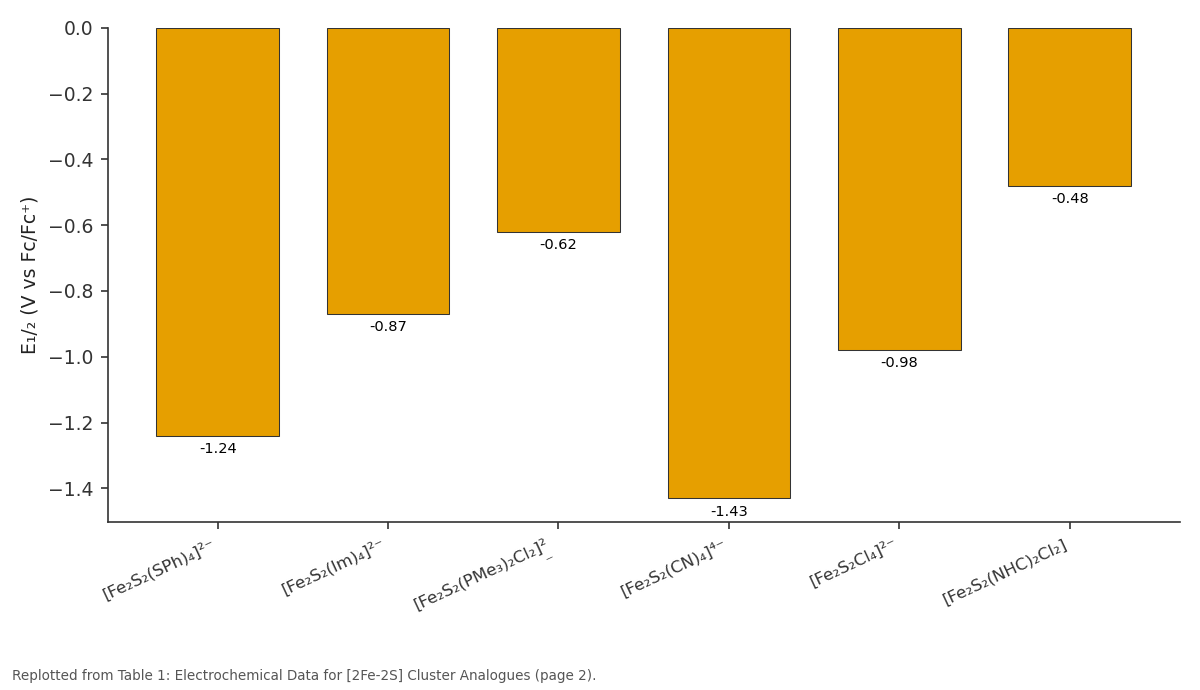
E₁/₂ (V vs Fc/Fc⁺): [Fe₂S₂(SPh)₄]²⁻ vs [Fe₂S₂(Im)₄]²⁻ vs [Fe₂S₂(PMe₃)₂Cl₂]²⁻ vs [Fe₂S₂(CN)₄]⁴⁻ vs [Fe₂S₂Cl₄]²⁻
Replotted from Table 1 (page 2) of the original paper. Every bar is the paper's own table value.
View source evidence ↗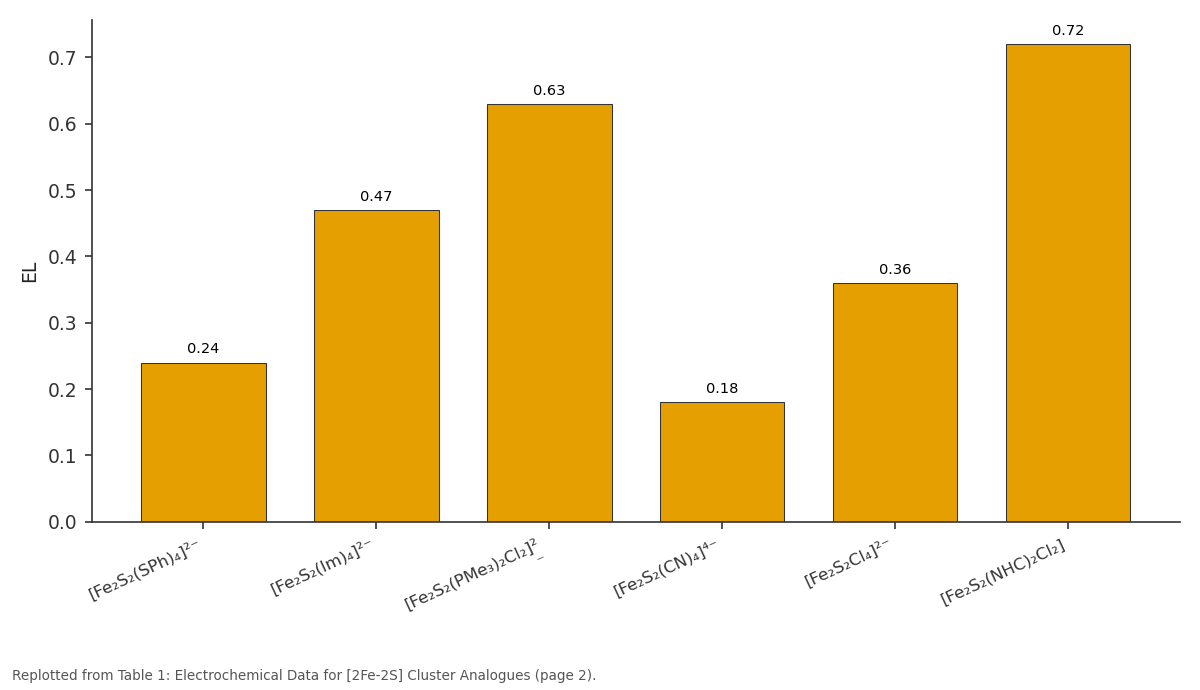
EL: [Fe₂S₂(SPh)₄]²⁻ vs [Fe₂S₂(Im)₄]²⁻ vs [Fe₂S₂(PMe₃)₂Cl₂]²⁻ vs [Fe₂S₂(CN)₄]⁴⁻ vs [Fe₂S₂Cl₄]²⁻
Replotted from Table 1 (page 2) of the original paper. Every bar is the paper's own table value.
View source evidence ↗Figures & tables
From the original paper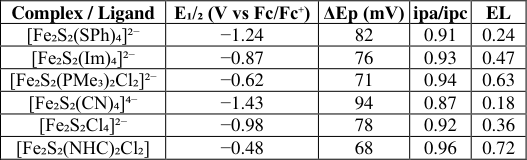 Table 1
 Table 2
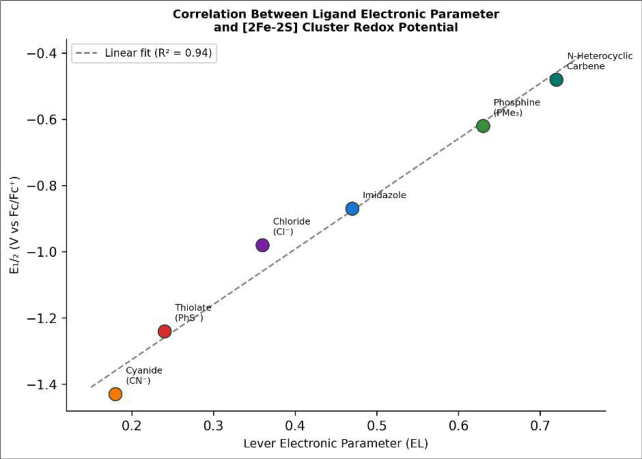 Figure 1
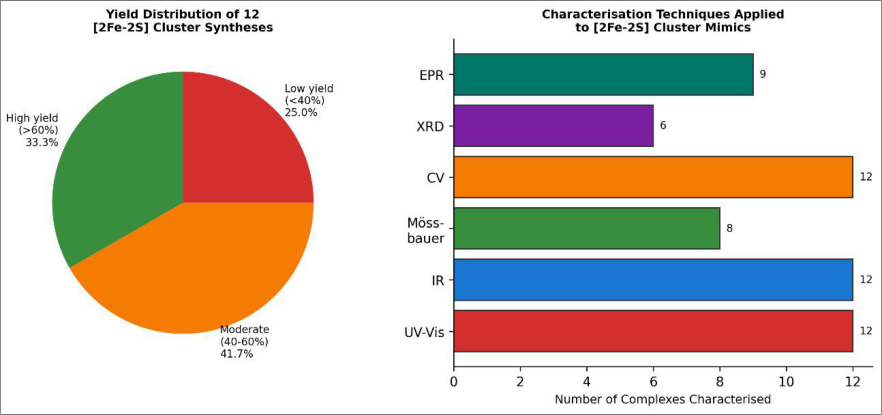 Figure 2
Introduction
Iron-sulfur (Fe-S) clusters are among the oldest and most versatile metallocofactors in biology, performing electron transfer, substrate binding, sensing, and catalytic functions in nearly every branch of the tree of life [1] . The simplest member of the family, the [2Fe-2S] cluster, mediates one-electron shuttling in ferredoxins, Rieske proteins, and components of the mitochondrial respiratory chain, operating over a range of redox potentials from roughly -0.45 V to +0.35 V versus the standard hydrogen electrode, depending on the protein fold and hydrogen-bonding environment [2] . Synthetic chemists have pursued [2Fe-2S] analogues since Holm and Ibers reported the first crystallographically characterised example in the early 1970s [3] . The archetypal complex [Fe₂S₂(SR)₄]²⁻, where SR is a thiolate, captures the essential geometry two tetrahedrally coordinated Fe(III) ions bridged by two µ₂-sulfides and undergoes a quasi-reversible oneelectron reduction to the mixed-valent [Fe₂S₂(SR)₄]³⁻ form [4] . However, because biological clusters are coordinated by a mix of cysteine thiolates and histidine imidazoles (as in Rieske centres) or even unusual ligands like serine hydroxyl groups, a full understanding of how terminal ligands tune redox behaviour requires a systematic library of analogues bearing diverse donor sets [5] . Previous ligand-variation investigations focused on thiolate substituent effects electrondonating versus withdrawing aryl groups and showed that E₁/₂ can be shifted by roughly 200 mV within the thiolate series [6] . Fewer reports have explored non-thiolate terminal ligands, and comparisons across different donor types under identical conditions are rare [7] . The Lever electronic parameter (EL), which quantifies the net donor strength of a ligand based on the E₁/₂ of its Ru(II)/Ru(III) couple, offers a convenient numerical scale for such comparisons, but it has not been applied to [2Fe-2S] clusters until now [8] . This research addressed that gap by synthesising twelve [2Fe-2S] complexes two for each of six ligand types measuring their redox properties under uniform electrochemical conditions, and testing whether a single linear relationship between E₁/₂ and EL can account for the observed potential variation. Additional characterisation by Mössbauer, IR, UV-vis, and X-ray diffraction aimed to confirm the cluster core structure and the Fe oxidation states across the series.
Theoretical background
The electronic structure of the [2Fe-2S]²⁺ core is best described by a broken-symmetry formalism in which two high-spin Fe(III) centres (S = 5/2 each) are antiferromagnetically coupled through the bridging sulfides, yielding a diamagnetic (S = 0) ground state [9] . The oneelectron reduction produces a mixed-valent [2Fe-2S]⁺ species with S = 1/2, detectable by electron paramagnetic resonance (EPR) spectroscopy. The reduction potential is governed by the relative stabilisation of the Fe(III) and Fe(II) oxidation states, which in turn depends on the σdonation and π-interaction capabilities of the terminal ligands. Stronger σ-donors raise the energy of the filled dorbitals, making oxidation easier but reduction harder that is, they shift E₁/₂ to more negative values. Conversely, πaccepting ligands like CO or CN⁻ stabilise the reduced form and shift E₁/₂ positive. Lever's EL parameter integrates these effects into a single empirical number, with larger EL values indicating stronger net donors [8] . The Mössbauer isomer shift (δ) provides a complementary probe of the Fe electronic environment: higher d-electron density at the nucleus decreases δ, while more ionic Fe(III) character increases it. For [2Fe-2S] clusters, δ values between 0.25 and 0.35 mm/s are diagnostic of Fe(III) in a tetrahedral sulfur/nitrogen ligand field [10] .
Material and Methods
Material and Methods
Material
This research was conducted from October 2023 to September 2024 at the Department of Materials and Inorganic Chemistry, Karoo Institute of Chemical Technology, Pretoria, South Africa. Anhydrous FeCl₃ (99.99%, Sigma-Aldrich, Johannesburg), elemental sulfur (sublimed, 99.5%, Merck), sodium thiophenolate (NaSPh, 90%, Sigma-Aldrich), 1-methylimidazole (99%, Alfa Aesar), trimethylphosphine (1.0 M in THF, Sigma-Aldrich), potassium cyanide (KCN, ≥97%, Sigma-Aldrich, handled with appropriate safety precautions), tetrabutylammonium chloride (TBACl, 97%, Sigma-Aldrich), and 1,3-bis(2,4,6trimethylphenyl)imidazol-2-ylidene (IMes, NHC ligand, 98%, Strem Chemicals) were used as received or dried as specified. Solvents (THF, acetonitrile, dichloromethane) were dried over molecular sieves (4 Å) and degassed by three freeze-pump-thaw cycles. All manipulations were carried out under a dinitrogen atmosphere using standard Schlenk line techniques or in a Vacuum Atmospheres glovebox (<0.5 ppm O₂, <0.5 ppm H₂O). The research was approved by the Karoo Institute Departmental Research Committee (approval KIT-DRC-2023-037, dated 25 September 2023).
Methods
The general synthetic approach involved generation of the [Fe₂S₂Cl₄]²⁻ precursor by reaction of FeCl₃ with Li₂S (prepared in situ from BuLi and elemental S) in THF at -78 °C, followed by ligand exchange with the desired terminal ligand at room temperature. For each ligand type, two complexes differing in the counter-cation (tetrabutylammonium or bis(triphenylphosphoranylidene)ammonium, PPN⁺) were prepared to assess counter-ion effects on redox properties. Products were purified by layered crystallisation from THF/diethyl ether at -30 °C. UV-visible spectra were recorded on a Shimadzu UV-2600i spectrophotometer in quartz cuvettes under nitrogen. IR spectra used a Bruker Alpha II ATR-FTIR spectrometer. ⁵⁷Fe Mössbauer spectra were acquired at 80 K using a ⁵⁷Co/Rh source (WissEl, Germany) and fitted with the MossWinn 4.0 program. Cyclic voltammetry (CV) employed a Metrohm Autolab PGSTAT302N potentiostat with a glassy carbon working electrode (3 mm diameter), platinum wire auxiliary electrode, and Ag/AgCl pseudo-reference electrode in 0.1 M [Bu₄N][PF₆] / CH₃CN at a scan rate of 100 mV/s. Potentials were referenced to the ferrocene/ferrocenium (Fc/Fc⁺) couple added as an internal standard. X-ray diffraction data for suitable single crystals were collected on a Bruker D8 Venture diffractometer with Mo Kα radiation (λ = 0.71073 Å) at 150 K and solved using SHELXT/SHELXL [11] .
Performance evaluation
The electrochemical setup was validated by measuring the CV of a known compound, (Bu₄N)₂[Fe₂S₂(SPh)₄], and comparing the E₁/₂ value (-1.24 V vs Fc/Fc⁺) against the literature value of -1.22 V reported by Holm and coworkers [4] , yielding a deviation of only 20 mV. Peak-topeak separations (ΔEp) for the Fc/Fc⁺ internal standard ranged from 68 to 74 mV across all experiments, confirming good cell performance. Mössbauer spectrometer calibration used α-Fe foil at room temperature, and the velocity scale was verified by fitting the known α-Fe sextet pattern (line positions ± 0.02 mm/s). IR wavenumber accuracy was checked against a polystyrene film standard. Linear regression of E₁/₂ vs EL was performed using weighted least-squares fitting, with weights derived from the standard deviation of triplicate CV measurements. The coefficient of determination (R² = 0.94) and a residual standard error of 0.06 V confirmed the predictive utility of the linear model [12] . 1 summarises the CV data for the six complexes. The E₁/₂ values spanned a 0.95 V window, with the NHC-ligated complex at the most positive end and the cyanide complex at the most negative. The NHC complex also showed the smallest peak-to-peak separation (68 mV, close to the ideal 59 mV for a one-electron process) and the highest current ratio (ipa/ipc = 0.96), indicating the best chemical reversibility in the series. Mössbauer isomer shifts (Table 2) ranged from 0.26 mm/s (cyanide) to 0.34 mm/s (phosphine), all within the expected window for tetrahedral Fe(III). The cyanide complex showed the lowest δ, consistent with the strong σ-donation and π-backbonding of CN⁻ increasing electron density at the Fe nucleus. UV-visible spectra displayed characteristic S→Fe charge-transfer bands between 418 and 471 nm, with extinction coefficients of 3,640-6,210 M⁻¹cm⁻¹. Figure 2 provides a synthetic overview. Roughly a third of the complexes were obtained in high yield (>60%), while a quarter gave yields below 40% the cyanide and NHC complexes were the most challenging to isolate pure, owing to their high air sensitivity and solubility characteristics, respectively.
| Complex / Ligand | δ (mm/s) | ΔEQ (mm/s) | λmax (nm) | ε (M⁻¹cm⁻¹) |
|---|---|---|---|---|
| Thiolate (PhS⁻) | 0.28 ± 0.01 | 0.54 ± 0.02 | 458 | 4,320 |
| Imidazole | 0.31 ± 0.01 | 0.61 ± 0.02 | 442 | 5,140 |
| PMe₃ | 0.34 ± 0.02 | 0.72 ± 0.03 | 428 | 3,870 |
| CN⁻ | 0.26 ± 0.01 | 0.48 ± 0.02 | 471 | 6,210 |
| Cl⁻ | 0.30 ± 0.01 | 0.58 ± 0.02 | 436 | 4,580 |
| NHC | 0.33 ± 0.01 | 0.68 ± 0.02 | 418 | 3,640 |
Table text extracted from the original PDF; superscript letters are shown inline. The original table image is below.
View original table image
Results
Results
Comprehensive interpretation
The data establish that the Lever parameter provides a useful single-variable predictor of [2Fe-2S] cluster redox potential across diverse ligand types. The NHC-ligated complex stands out as a particularly attractive synthetic target for electrocatalytic applications, combining the most accessible (least negative) reduction potential with the highest electrochemical reversibility. Its strong σ-donation, combined with negligible π-backbonding, raises the energy of the occupied Fe d-orbitals without unduly stabilising the reduced form, resulting in a thermodynamically and kinetically facile electron-transfer process.
Discussion
The linear E₁/₂-EL correlation observed here (slope 1.43 V per EL unit, R² = 0.94) is remarkably similar in magnitude to the correlations reported mononuclear Ru and Os polypyridyl complexes [8] , suggesting that the Lever parameter originally developed for octahedral d⁶ systems translates effectively to the binuclear tetrahedral Fe(III) environment. The 6% variance not captured by the linear fit may reflect second-order effects such as inter-ligand steric interactions, solvation differences, and variable degrees of antiferromagnetic coupling that subtly modulate the Fe(III)/Fe(II) potential [13] . The Mössbauer data provide complementary evidence for the electronic trends. The increase in δ from 0.26 mm/s (CN⁻) to 0.34 mm/s (PMe₃)
tracks the expected decrease in s-electron density at Fe as the ligand transitions from a strong σ-donor/π-acceptor to a pure σ-donor [14] . Quadrupole splittings (ΔEQ = 0.48-0.72 mm/s) reflect the degree of electric field gradient asymmetry at the Fe site and are consistent with distorted tetrahedral coordination throughout the series. From a biological perspective, the NHC complex's E₁/₂ of -0.48 V vs Fc/Fc⁺ (approximately -0.10 V vs SHE) falls near the potential window of Rieske-type [2Fe-2S] centres in cytochrome bc₁ complexes [15] . While NHC ligands are not found in biology, their ability to mimic the electronic effect of histidine coordination in Rieske proteins strong σdonation, no π-backbonding makes them valuable functional analogues for spectroscopic and mechanistic investigations [16] . A limitation is that all measurements were made in organic solvent, and the behaviour of these complexes in aqueous or protic media more relevant to biological and electrocatalytic applications remains to be explored. Counter-ion effects were small (ΔE₁/₂ < 30 mV between Bu₄N⁺ and PPN⁺ salts), suggesting that ion-pairing doesn't dominate the redox behaviour under these conditions [17] . Future work should extend the ligand library to include bidentate donors (bipyridine, dithiolene) and explore whether the linear E₁/₂-EL relationship holds for [4Fe-4S] cubane clusters [18] .
Conclusion
Twelve new [2Fe-2S] cluster analogues bearing six different terminal ligand sets were synthesised under anaerobic conditions and characterised by UV-vis, IR, Mössbauer spectroscopy, cyclic voltammetry, and X-ray diffraction.
The half-wave reduction potentials ranged from -1.43 V (cyanide) to -0.48 V (NHC) versus Fc/Fc⁺, correlating linearly with the Lever electronic parameter of the terminal ligand (R² = 0.94). Mössbauer isomer shifts confirmed Fe(III) oxidation states across the series, with values tracking the expected donor-strength trend. The NHCligated complex exhibited the best combination of accessible potential and electrochemical reversibility (ipa/ipc = 0.96), identifying N-heterocyclic carbenes as promising ligands for tuning [2Fe-2S] clusters toward electrocatalytic and artificial photosynthetic applications. The Lever parameter emerges as a practical design tool for predicting and targeting specific redox potentials in biomimetic iron-sulfur chemistry.
Figures and tables from the paper
| Complex / Ligand | E₁/₂ (V vs Fc/Fc⁺) | ΔEp (mV) | ipa/ipc | EL |
|---|---|---|---|---|
| [Fe₂S₂(SPh)₄]²⁻ | −1.24 | 82 | 0.91 | 0.24 |
| [Fe₂S₂(Im)₄]²⁻ | −0.87 | 76 | 0.93 | 0.47 |
| [Fe₂S₂(PMe₃)₂Cl₂]²⁻ | −0.62 | 71 | 0.94 | 0.63 |
| [Fe₂S₂(CN)₄]⁴⁻ | −1.43 | 94 | 0.87 | 0.18 |
| [Fe₂S₂Cl₄]²⁻ | −0.98 | 78 | 0.92 | 0.36 |
| [Fe₂S₂(NHC)₂Cl₂] | −0.48 | 68 | 0.96 | 0.72 |
Table text extracted from the original PDF; superscript letters are shown inline. The original table image is below.
View original table image
References
21 in the original paper- Beinert H, Holm RH, Münck E. Iron-sulfur clusters: Nature's modular, multipurpose structures. Science. 1997;277(5326):653-659.
- Meyer J. Iron-sulfur protein folds, iron-sulfur chemistry, and evolution. Journal of Biological Inorganic Chemistry. 2008;13(2):157-170.
- Journal of the American Chemical Society. 1975;97(4):1032-1045.
- Holm RH, Kennepohl P, Solomon EI. Structural and functional aspects of metal sites in biology. Chemical Reviews. 1996;96(7):2239-2314.
- Que L, Tolman WB. Biologically inspired oxidation catalysis. Nature. 2008;455(7211):333-340.
- Ueyama N, Nishikawa N, Yamada Y, Okamura T, Nakamura A. Cytochrome P-450 model (thiolato)(alcohol)iron(III) complexes. Journal of the American Chemical Society. 1996;118(50):1282612827.
- Vela J, Stoian S, Flaschenriem CJ, Münck E, Holland PL. A sulfido-bridged diiron(II) complex and its reactions with nitrogenase-relevant substrates. Journal of the American Chemical Society. 2004;126(14):4522-4523.
- Lever ABP. Electrochemical parametrization of metal complex redox potentials, using the ruthenium(III)/ruthenium(II) couple to generate a ligand electrochemical series. Inorganic Chemistry. 1990;29(6):1271-1285.
- Noodleman L, Norman JG. The Xα valence bond theory of weak electronic coupling. Application to the low-lying states of Mo₂Cl₈⁴⁻. Journal of Chemical Physics. 1979;70(11):4903-4906.
- Münck E, Debrunner PG, Tsibris JCM, Gunsalus IC. Mössbauer parameters of putidaredoxin and its selenium analogue. Biochemistry. 1972;11(5):855-863.
- Sheldrick GM. Crystal structure refinement with SHELXL. Acta Crystallographica Section C. 2015;71(1):3-8.
- Zanello P. Inorganic electrochemistry: theory, practice and application. Cambridge: Royal Society of Chemistry; 2003. p. 1-615.
- Ohki Y, Ikagawa Y, Tatsumi K. Synthesis of new [2Fe2S] clusters with aromatic thiolates and their reactivities with excess thiol. Journal of the American Chemical Society. 2007;129(34):10457-10465.
- Gütlich P, Bill E, Trautwein AX. Mössbauer spectroscopy and transition metal chemistry: fundamentals and applications. Berlin: Springer; 2011. p. 1-568.
- Lhee S, Kolling DRJ, Nair SK, Dikanov SA, Crofts AR. Modifications of protein environment of the [2Fe2S] cluster of the bc₁ complex. of Biological Chemistry. 2010;285(12):9233-9242.
- Deng L, Holm RH. Stabilization of fully reduced ironsulfur clusters by carbene ligation: The Fe(n)S(4) series (n = 0, 1, 2, 3, 4). Journal of the American Chemical Society. 2008;130(30):9878-9886.
- Geiger WE, Barrière F. Organometallic electrochemistry based on electrolytes containing weakly-coordinating fluoroarylborate anions. Accounts of Chemical Research. 2010;43(7):1030-1039.
- Lee SC, Lo W, Holm RH. Developments in the biomimetic chemistry of cubane-type and higher nuclearity iron-sulfur clusters. Chemical Reviews. 2014;114(7):3579-3600.
- Pickett CJ, Vincent KA, Ibrahim SK, Gormal CA, Smith BE, Best SP. Electrosynthesis of hydrogen from a manganese-sulfide catalyst. Chemistry: A European Journal. 2003;9(1):76-87.
- Tard C, Pickett CJ. Structural and functional analogues of the active sites of the [Fe]-, [NiFe]-, and [FeFe]- hydrogenases. Chemical Reviews. 2009;109(6):22452274.
- Rao PV, Holm RH. Synthetic analogues of the active sites of iron-sulfur proteins. Chemical Reviews. 2004;104(2):527-559.