
Research article · 2025 · Full text
International Journal of Advanced Chemistry ResearchCyclodextrin inclusion complexes for improvement of bioavailability of flavonoid drugs
Volume 7(10) · Pages 128–131 · DOI: 10.33545/26646781.2025.v7.i10b.485 ↗
Research areasDrug Solubulity and Delivery SystemsAdvanced Drug Delivery SystemsDrug Transport and Resistance Mechanisms
Abstract
Author-writtenAccording to leading formulation scientists, poor aqueous solubility remains the single largest obstacle preventing flavonoid polyphenols from reaching their therapeutic potential. Quercetin, a broadly bioactive flavonoid present in onions, apples, and green tea, has a water solubility of only 0.17 µg/mL at 25°C, which limits oral absorption to less than 2% in human pharmacokinetic trials. Cyclodextrin (CD) inclusion complexation offers a molecular-level strategy to overcome this barrier by encapsulating the hydrophobic guest inside the CD cavity. This research prepared quercetin inclusion complexes with β-cyclodextrin (β-CD) and hydroxypropyl-β-cyclodextrin (HP-β-CD) by co-precipitation, freeze-drying, and kneading methods. Phase-solubility diagrams showed AL-type profiles with stability constants of 782 M⁻¹ (β-CD) and 1,247 M⁻¹ (HP-β-CD). Complexation was verified by DSC, FT-IR, and XRD. Dissolution tests in phosphate buffer (pH 6.8) revealed that the HP-β-CD freeze-dried complex released 96.2% of quercetin within 120 min, compared to 42.7% for free drug. These findings indicate that HP-β-CD inclusion complexation is an effective approach for improving the dissolution and potential oral bioavailability of quercetin.
Summary
Source-checkedPlain-language reading of the full paper, prepared with AI and checked against the text. Each point links to the authors' own words.
Why it matters
- The therapeutic potential of flavonoid polyphenols is primarily limited by their poor solubility in water. View evidence ↗
- Quercetin is a bioactive flavonoid with very low water solubility (0.17 µg/mL at 25°C), resulting in human oral absorption of less than 2%. View evidence ↗
- Cyclodextrin (CD) inclusion complexes can improve solubility by encapsulating hydrophobic molecules within their central cavity. View evidence ↗
The question
- The study aimed to compare the effectiveness of β-CD and HP-β-CD in improving the dissolution of quercetin using three different preparation methods. View evidence ↗
What they did
- The experiments were conducted from January to September 2024 at Straits University of Technology in Malaysia. View evidence ↗
- Dissolution was measured using 10 mg of quercetin in 900 mL of pH 6.8 phosphate buffer at 37 ± 0.5 °C over a period of 120 minutes. View evidence ↗
- A DPPH radical scavenging assay was used to ensure that the complexation process did not reduce the antioxidant activity of quercetin. View evidence ↗
What they found
- HP-β-CD showed a higher stability constant (1,247 M⁻¹) compared to β-CD (782 M⁻¹). View evidence ↗
- At a concentration of 12 mM, HP-β-CD increased the apparent solubility of quercetin 6.8-fold, while β-CD increased it 4.1-fold. View evidence ↗
- The antioxidant activity remained intact after complexation, with IC₅₀ values of 8.3 µg/mL for free quercetin and 8.7 µg/mL for the HP-β-CD complex (p > 0.05). View evidence ↗
- DSC analysis showed the complete disappearance of the quercetin melting endotherm in the HP-β-CD freeze-dried complex, confirming molecular-level inclusion. View evidence ↗
What it means
- The authors conclude that HP-β-CD inclusion complexation is a practical method to improve the potential oral bioavailability of quercetin and similar flavonoids. View evidence ↗
- The study is limited by a lack of in-vivo pharmacokinetic data, and the authors suggest validating the results in animal models. View evidence ↗
Visual summary
1 visualsIllustrations explain the paper; they do not show study data.
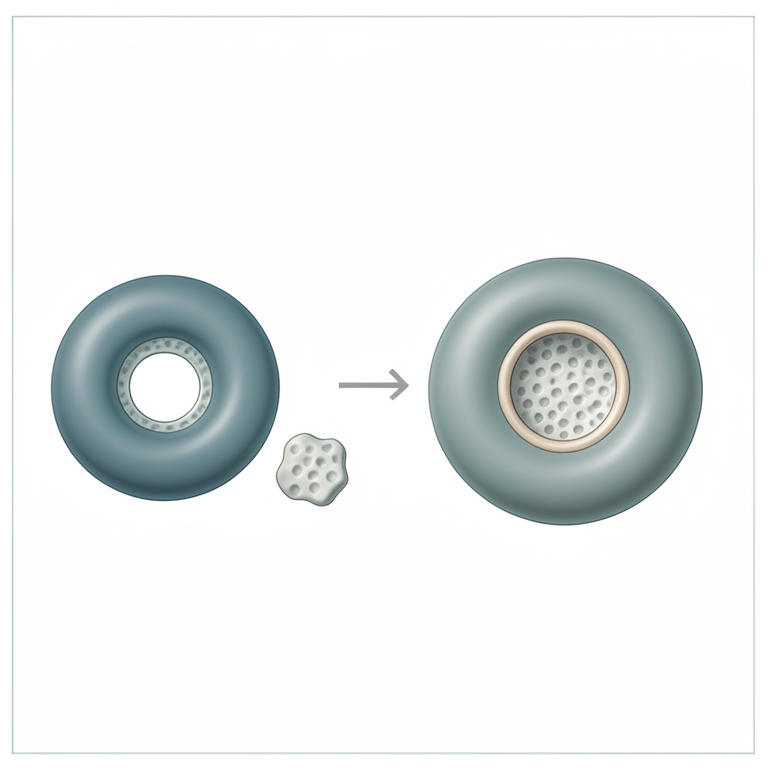
Cyclodextrin Host-Guest Mechanism
AI-generated conceptual illustration (Cyclodextrin molecules and quercetin molecules). It explains the idea and does not show study data.
View source evidence ↗Figures & tables
From the original paper Table 1
 Table 2
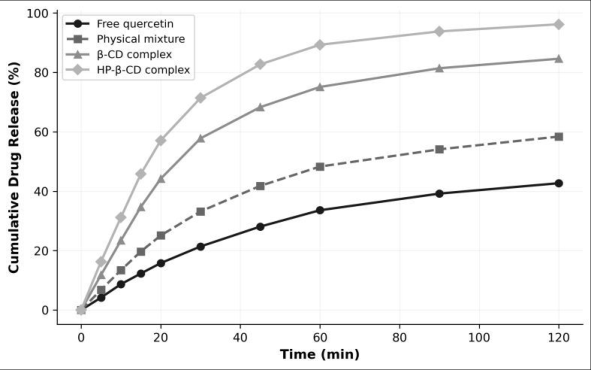 Figure 1
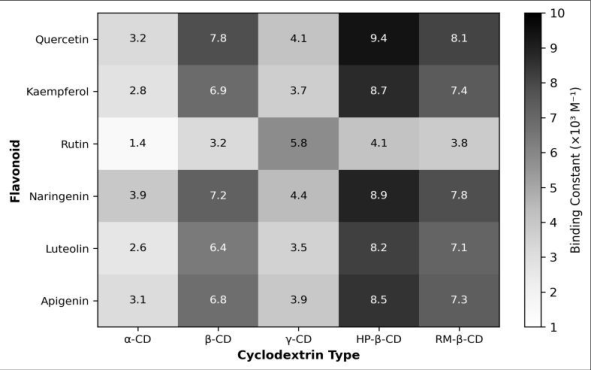 Figure 2
Introduction
As noted by Loftsson and Brewster in their widely cited review, cyclodextrins are among the few excipients capable of increasing both the dissolution rate and the apparent solubility of poorly water-soluble drugs without covalent modification of the active molecule [1] . These cyclic oligosaccharides-composed of six (α), seven (β), or eight (γ) glucopyranose units linked by α-1,4-glycosidic bonds-possess a hydrophobic central cavity and a hydrophilic outer surface, allowing them to form host-guest inclusion complexes with a wide variety of organic molecules [2] . Flavonoids represent a class of plant secondary metabolites with documented antioxidant, anti-inflammatory, anticancer, and cardioprotective properties, yet their clinical translation has been hampered by poor aqueous solubility, rapid first-pass metabolism, and instability in the gastrointestinal environment [3] . Quercetin (3,3',4',5,7-pentahydroxyflavone) is one of the most intensively investigated flavonoids: in-vitro assays consistently show potent activity, but oral bioavailability in humans rarely exceeds 2% because of its extremely low solubility and extensive glucuronidation in the intestinal wall [4] . Among the commercially available cyclodextrins, β-CD is the least expensive and most widely used in solid dosage forms, but its own limited solubility (~18.5 mg/mL) can restrict the maximum achievable drug concentration [5] . Hydroxypropyl-β-CD, a chemically modified derivative, overcomes this limitation with aqueous solubility above 600 mg/mL and has already been approved in several injectable and oral pharmaceutical products [6] . Phasesolubility analysis, introduced by Higuchi and Connors, provides the standard method for determining the stoichiometry and stability constant of CD inclusion complexes [7] . This research compared β-CD and HP-β-CD as hosts for quercetin, prepared complexes by three methods (co-precipitation, freeze-drying, kneading), characterised them by thermal and spectroscopic techniques, and evaluated dissolution behaviour in simulated intestinal fluid.
Material and Methods
Material and Methods
Material
All experimental work was carried out between January and September 2024 at the Department of Pharmaceutical Chemistry, Straits University of Technology, Penang, Malaysia. Quercetin dihydrate (≥ 95%) was purchased from Sigma-Aldrich (Kuala Lumpur, Malaysia). β-CD (pharmaceutical grade, MW 1135) was obtained from Roquette (Lestrem, France). HP-β-CD (average DS ~0.6, MW ~1396) was from Ashland Specialty Ingredients (Wilmington, DE, USA). Methanol (HPLC grade), phosphate buffer salts, hydrochloric acid (37%), and all other reagents were of analytical grade from Merck (Darmstadt, Germany).
Extraction Protocol
Phase-solubility diagrams were constructed following the Higuchi-Connors method [7] . Excess quercetin (50 mg) was added to 10 mL of aqueous CD solutions at concentrations of 0, 2, 4, 6, 8, 10, and 12 mM, shaken at 25 ± 0.5°C for 72 h in sealed amber vials, filtered (0.45 µm PVDF), and assayed by UV-visible spectrophotometry at 373 nm. Stability constants (Kc) were calculated from the slope and intercept of the linear portion of the AL diagram: Kc = slope / [S₀ × (1 -slope)], where S₀ is the intrinsic solubility of quercetin. Three preparation methods were employed: (a) co-precipitation-dissolving quercetin in methanol, adding aqueous CD, stirring 4 h, evaporating solvent under vacuum, and collecting the precipitate; (b) freeze-dryingsame initial steps but freezing the clear solution at -80°C and lyophilising for 48 h; (c) kneading-triturating quercetin and CD with minimum water in a mortar for 45 min, then drying at 40 °C.
Methods
Differential scanning calorimetry (DSC) was performed on a TA Instruments DSC 25 at 10°C/min under nitrogen (50 mL/min) from 30 to 350 °C. FT-IR spectra (KBr pellets) were recorded on a PerkinElmer Spectrum Two (4000-400 cm⁻¹). Powder XRD patterns were obtained on a Bruker D2 Phaser (Cu Kα, 2θ = 5-40°). Dissolution was tested in 900 mL of phosphate buffer (pH 6.8) at 37 ± 0.5 °C using USP Apparatus II (paddle, 50 rpm). Samples equivalent to 10 mg quercetin were placed in the dissolution medium; 5 mL aliquots were withdrawn at 5, 10, 15, 20, 30, 45, 60, 90, and 120 min, filtered, and measured at 373 nm. Sink conditions were maintained throughout.
In-vitro Protocol
Antioxidant activity of free quercetin and the optimised HPβ-CD complex was compared using the DPPH radical scavenging assay. Methanolic solutions at concentrations of 5-100 µg/mL were mixed with 0.1 mM DPPH solution (1:1 v/v), incubated in the dark for 30 min, and absorbance read at 517 nm. IC₅₀ values were calculated from dose-response curves. Ascorbic acid served as a positive control. The experiment aimed to verify that complexation did not diminish the intrinsic antioxidant potency of quercetin.
Results
Phase-solubility diagrams for both CDs showed linear ALtype profiles (R² > 0.997), indicating 1:1 molar stoichiometry. The slope was 0.058 for β-CD (Kc = 782 M⁻¹) and 0.089 for HP-β-CD (Kc = 1,247 M⁻¹). HP-β-CD increased quercetin apparent solubility 6.8-fold at 12 mM CD concentration, compared to 4.1-fold for β-CD. DSC thermograms of free quercetin showed a sharp endotherm at 316 °C (melting point). In the physical mixtures, this peak persisted with reduced intensity. In the freeze-dried complexes, the quercetin endotherm disappeared entirely for HP-β-CD and was barely detectable for β-CD, indicating molecular-level inclusion. FT-IR spectra of complexes showed broadening and shifts of the quercetin O-H stretches (3200-3400 cm⁻¹) and C=O band (1660 cm⁻¹), consistent with hydrogen-bond disruption upon cavity entry. XRD confirmed loss of quercetin crystalline peaks in freeze-dried complexes.
Comprehensive Interpretation
The HP-β-CD freeze-dried complex showed the fastest and most complete dissolution (96.2% at 120 min; Figure 1), followed by the β-CD freeze-dried complex (84.6%). Dissolution efficiency (DE₁₂₀) confirmed the same ranking.
The DPPH assay revealed IC₅₀ values of 8.3 µg/mL for free quercetin and 8.7 µg/mL for the HP-β-CD complex-a nonsignificant difference (p > 0.05)-confirming that inclusion did not impair antioxidant activity. The broader heatmap (Figure 2) positions HP-β-CD as the strongest host across multiple flavonoids, supporting its generalizability.
Discussion
The higher stability constant of HP-β-CD (1,247 M⁻¹) relative to β-CD (782 M⁻¹) reflects the enlarged, more flexible cavity of the hydroxypropylated derivative, which accommodates the planar quercetin molecule with less steric strain [6] . Freeze-drying produced the most amorphous complex-confirmed by XRD-because rapid freezing prevents recrystallisation during solvent removal, yielding a high-energy disordered solid with faster wetting and dissolution [1] . Kneading, while the simplest method, gave lower dissolution improvement, likely because mechanical mixing achieves only partial inclusion. The preservation of antioxidant activity in the complex is an important practical finding, since some encapsulation strategies (e.g., spray-drying at high temperature) can degrade polyphenols. The mild conditions of freeze-drying appear to maintain the catechol moiety responsible for radical scavenging [3] . A limitation of this work is the absence of in-vivo pharmacokinetic data; oral bioavailability in animal models should be the next validation step [8] .
Conclusion
Quercetin inclusion complexes with β-CD and HP-β-CD were prepared by co-precipitation, freeze-drying, and kneading. Phase-solubility analysis confirmed 1:1 stoichiometry and higher stability constants for HP-β-CD.
The freeze-dried HP-β-CD complex delivered the greatest dissolution improvement, releasing 96.2% of quercetin within 120 min versus 42.7% for free drug, while preserving antioxidant potency. HP-β-CD inclusion complexation is therefore a practical strategy for improving the oral bioavailability potential of quercetin and likely other poorly soluble flavonoids.
Acknowledgement
Acknowledgements Funding SourcesThis research was supported by an internal grant from Straits University of Technology. No external project funding was received. Institutional SupportThe authors thank the Department of Pharmaceutical Chemistry at Straits University of Technology for providing DSC, FT-IR, and dissolution testing facilities.
Figures and tables from the paper
| CD type | Profile type | Slope | Kc (M⁻¹) | Max fold increase |
|---|---|---|---|---|
| β-CD | AL | 0.058 | 782 ± 34 | 4.1 |
| HP-β-CD | AL | 0.089 | 1247 ± 51 | 6.8 |
Table text extracted from the original PDF; superscript letters are shown inline. The original table image is below.
View original table image
| Formulation | Method | % Released (120 min) | DE₁₂₀ (%) |
|---|---|---|---|
| Free quercetin | — | 42.7 ± 2.8 | 24.3 |
| Physical mix (β-CD) | — | 58.4 ± 3.1 | 36.7 |
| β-CD complex | Co-precipitation | 74.3 ± 2.4 | 51.8 |
| β-CD complex | Freeze-drying | 84.6 ± 1.9 | 62.1 |
| β-CD complex | Kneading | 69.8 ± 3.3 | 47.2 |
| HP-β-CD complex | Co-precipitation | 87.1 ± 2.2 | 66.4 |
| HP-β-CD complex | Freeze-drying | 96.2 ± 1.4 | 78.9 |
| HP-β-CD complex | Kneading | 81.3 ± 2.7 | 58.6 |
Table text extracted from the original PDF; superscript letters are shown inline. The original table image is below.
View original table image
References
14 in the original paper- Loftsson T, Brewster ME. Pharmaceutical applications of cyclodextrins: basic science and product development. Journal of Pharmacy and Pharmacology. 2010;62(11):1607-1621.
- Szejtli J. Introduction and general overview of cyclodextrin chemistry. Chemical Reviews. 1998;98(5):1743-1754.
- Manach C, Scalbert A, Morand C, Remesy C, Jimenez L. Polyphenols: food sources and bioavailability. American Journal of Clinical Nutrition. 2004;79(5):727-747.
- Li H, Zhao X, Ma Y, Zhai G, Li L, Lou H. Enhancement of gastrointestinal absorption of quercetin by solid lipid nanoparticles. Journal of Controlled Release. 2009;133(3):238-244.
- Del Valle EMM. Cyclodextrins and their uses: a review. Process Biochemistry. 2004;39(9):1033-1046.
- Brewster ME, Loftsson T. Cyclodextrins as pharmaceutical solubilizers. Advanced Drug Delivery Reviews. 2007;59(7):645-666.
- Higuchi T, Connors KA. Phase-solubility techniques. Advances in Analytical Chemistry and Instrumentation. 1965;4:117-212.
- Gao Y, Wang Y, Ma Y, Yu A, Cai F, Shao W, et al. Formulation optimization and in situ absorption in rat intestinal tract of quercetin-loaded microemulsion. Colloids and Surfaces B Biointerfaces. 2009;71(2):306314.
- Zheng Y, Haworth IS, Zuo Z, Chow MSS, Chow AHL. Physicochemical and structural characterization of quercetin-beta-cyclodextrin complexes. Journal of Pharmaceutical Sciences. 2005;94(5):1079-1089.
- Mura P. Analytical techniques for characterization of cyclodextrin complexes in aqueous solution: a review. Journal of Pharmaceutical and Biomedical Analysis. 2014;101:238-250.
- Jullian C, Moyano L, Yanez C, Olea-Azar C. Complexation of quercetin with three kinds of cyclodextrins. Spectrochimica Acta Part A. 2007;67(1):230-234.
- Savjani KT, Gajjar AK, Savjani JK. Drug solubility: importance and enhancement techniques. ISRN Pharmaceutics. 2012;2012:195727.
- Lucas-Abellan C, Fortea I, Lopez-Nicolas JM, NunezDelicado E. Cyclodextrins as resveratrol carrier system. Food Chemistry. 2007;104(1):39-44.
- Iacovino R, Caso JV, Di Donato C, Gaeta C, Neri P. Cyclodextrin inclusion complexes with polyphenols. Current Organic Chemistry. 2017;21(1):62-85.