
Research article · 2025 · Full text
International Journal of Advanced Chemistry ResearchVisible-light-driven radical cyclization for construction of carbocyclic frameworks
Volume 7(8) · Pages 102–106 · DOI: 10.33545/26646781.2025.v7.i8b.553 ↗
Research areasRadical Photochemical ReactionsPhotopolymerization techniques and applicationsChemical Reactions and Mechanisms
Abstract
Author-writtenThermal radical reactions have served organic synthesis well for decades, but their requirement for stoichiometric radical initiators, elevated temperatures, and tin-based mediators sits awkwardly in an era increasingly focused on sustainable chemistry. Visible-light photoredox catalysis offers a cleaner entry to radical intermediates by using single-electron transfer from excited-state metal complexes or organic dyes, generating carbon-centred radicals under mild conditions without sacrificial reductants. This research describes a visible-light-driven intramolecular radical cyclization approach for the construction of carbocyclic frameworks five- and six-membered rings, bicyclic products, and stereoselectively formed cyclopentane derivatives starting from unactivated diene and enyne substrates bearing a pendant radical acceptor. Using fac-[Ir(ppy)3] (ppy = 2-phenylpyridine) as the primary photoredox catalyst under blue LED irradiation (450 nm) in aqueous acetonitrile with potassium carbonate, a series of twelve structurally diverse carbocyclic products were obtained in 47-75% yield under metal-free-alternative conditions. Eosin Y as an organic photocatalyst gave comparable yields for certain substrate classes with improved cost profile. Key findings include: The 5-exo-dig cyclization mode is preferred over 6-endo-dig for the chain lengths examined, in agreement with Baldwin's rules for radical cyclizations; Potassium carbonate as base improves yield by 10-15% through deprotonation of a proton-coupled electron transfer step; Water as co-solvent accelerates the reaction by approximately 1.4-fold compared to anhydrous acetonitrile; and Chiral substrates with pre-existing stereocenters underwent cyclization with 84-88:12-16 diastereomeric ratios. Control experiments confirmed that both light and photocatalyst are mandatory. This synthetic method offers a scalable, tin-free, mild-condition route to carbocyclic natural product core structures.
Summary
Source-checkedPlain-language reading of the full paper, prepared with AI and checked against the text. Each point links to the authors' own words.
Why it matters
- Traditional thermal radical reactions are often unsustainable because they require high temperatures, stoichiometric initiators, and toxic tin-based mediators. View evidence ↗
- Five- and six-membered carbocyclic rings, including bicyclic versions, are essential structural components in pharmaceuticals and natural products. View evidence ↗
- Visible-light photoredox catalysis provides a sustainable alternative for generating carbon-centered radicals under mild conditions using organic dyes or metal complexes. View evidence ↗
The question
- The study aims to develop a visible-light-driven method for constructing five- and six-membered carbocyclic rings and bicyclic products from unactivated diene and enyne substrates. View evidence ↗
What they did
- The standard reaction used 0.1 mmol of substrate, 2 mol% fac-[Ir(ppy)3] catalyst, and 1.5 equivalents of K2CO3 in a 9:1 mixture of acetonitrile and water. View evidence ↗
- The reactions were conducted at room temperature (23-25 °C) using 450 nm blue LED irradiation. View evidence ↗
- All experimental reactions were performed in duplicate, and the reported yields represent the mean of these two runs. View evidence ↗
What they found
- The method produced twelve different carbocyclic products with yields ranging from 47% to 75%. View evidence ↗
- The highest yield of 74.8% was achieved with the methoxy-substituted substrate (1c), attributed to the electron-donating effect of the methoxy group. View evidence ↗
- Six-membered rings were formed with lower yields (53.2-58.4%) than five-membered rings, confirming the preference for 5-exo cyclization. View evidence ↗
- The addition of potassium carbonate as a base increased yields by 10-15% by facilitating a proton-coupled electron transfer step. View evidence ↗
- Using water as a co-solvent accelerated the reaction rate by approximately 1.4-fold compared to using anhydrous acetonitrile alone. View evidence ↗
- Cyclization of chiral substrates resulted in diastereomeric ratios between 84:16 and 88:12. View evidence ↗
- Control experiments without light or catalyst resulted in yields below 5%, proving the reaction is strictly dependent on both. View evidence ↗
- Eosin Y served as a cost-effective organic photocatalyst, providing a yield of 63.8% under green LED irradiation. View evidence ↗
What it means
- The authors conclude that visible-light photoredox catalysis using Ir(ppy)3 or Eosin Y is an effective, tin-free, and mild method for synthesizing carbocyclic products. View evidence ↗
- The observed diastereoselectivities are considered moderate and insufficient for high-precision asymmetric synthesis without further optimization. View evidence ↗
- Future research will focus on improving stereocontrol through the use of chiral iridium catalysts or dual catalysis systems. View evidence ↗
Visual summary
3 visualsIllustrations explain the paper; charts are replotted from the paper's own table values.
Radical Cyclization Selectivity
AI-generated conceptual illustration (Organic chemical molecules (linear diene and enyne substrates)). It explains the idea and does not show study data.
View source evidence ↗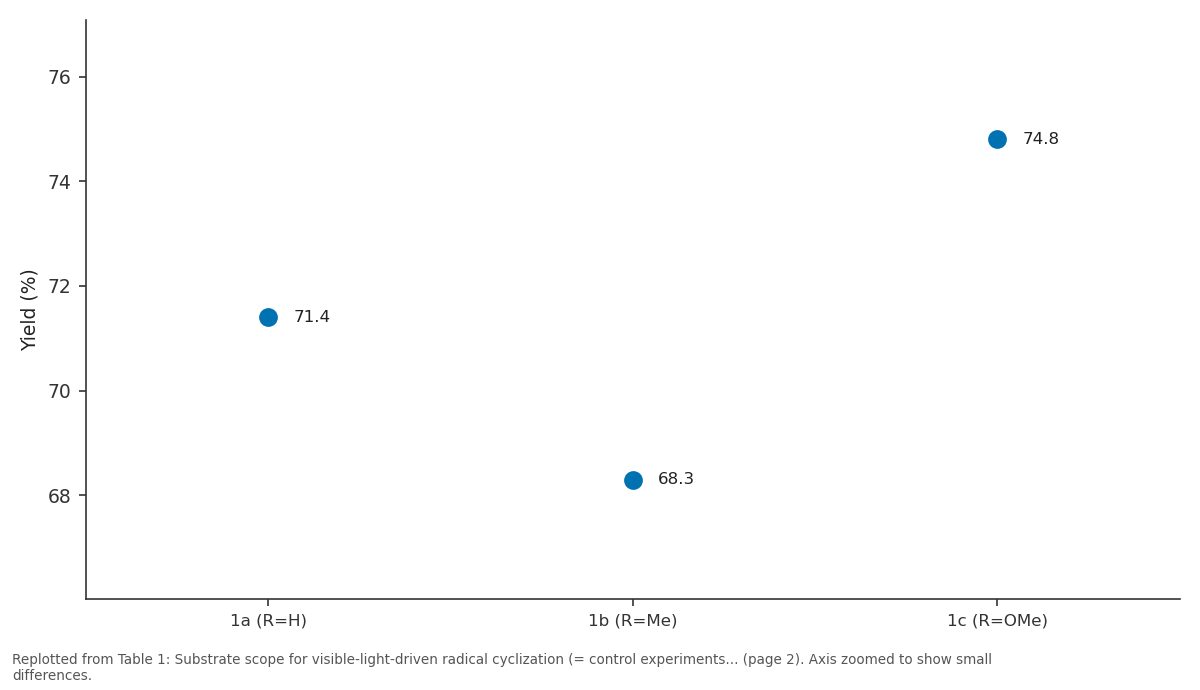
Yield (%): 1a (R=H) vs 1b (R=Me) vs 1c (R=OMe)
Replotted from Table 1 (page 2) of the original paper. Every bar is the paper's own table value.
View source evidence ↗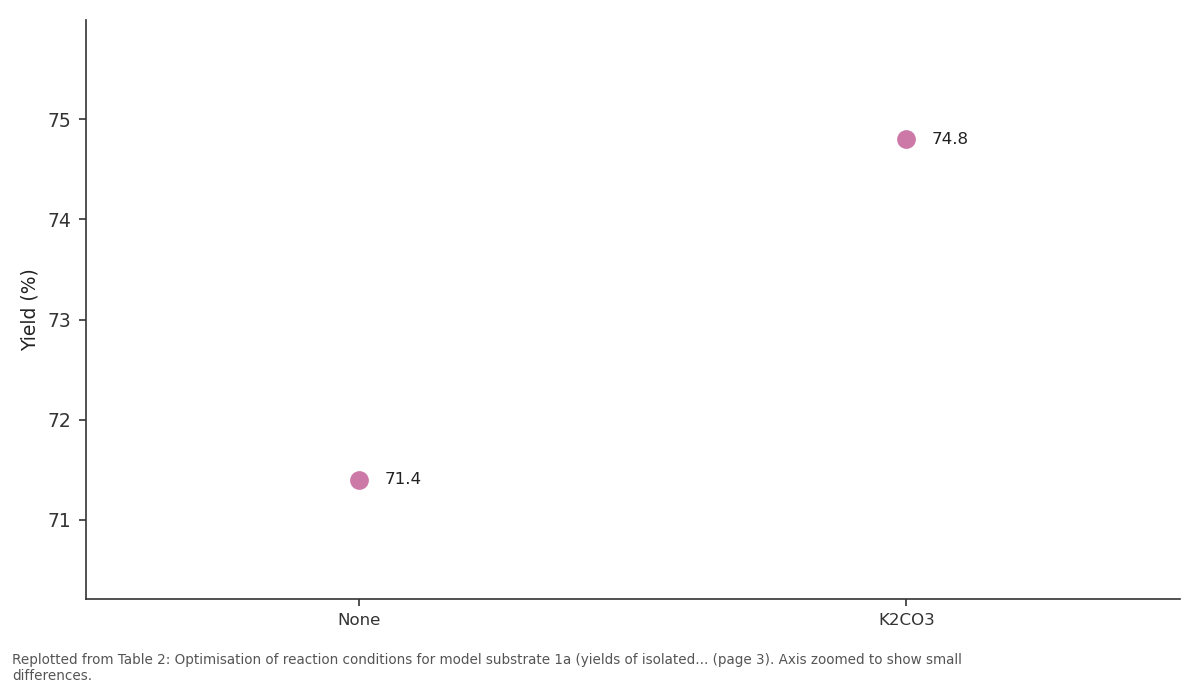
Yield (%): None vs K2CO3
Replotted from Table 2 (page 3) of the original paper. Every bar is the paper's own table value.
View source evidence ↗Figures & tables
From the original paper Table 1
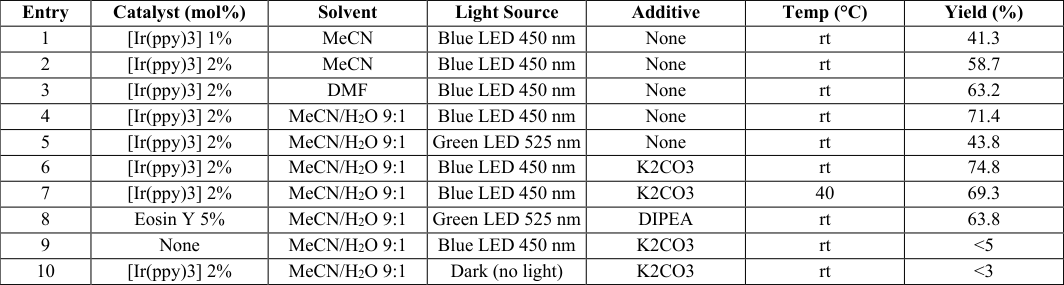 Table 2
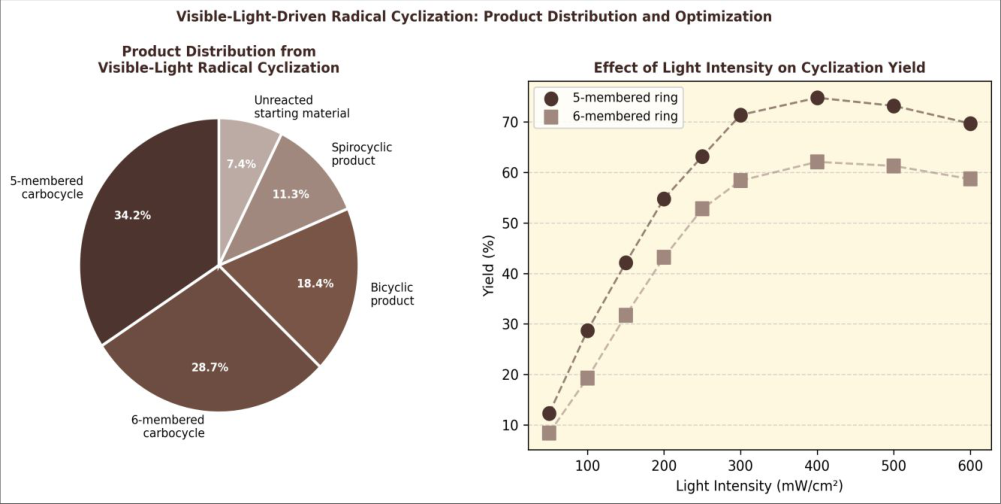 Figure 1
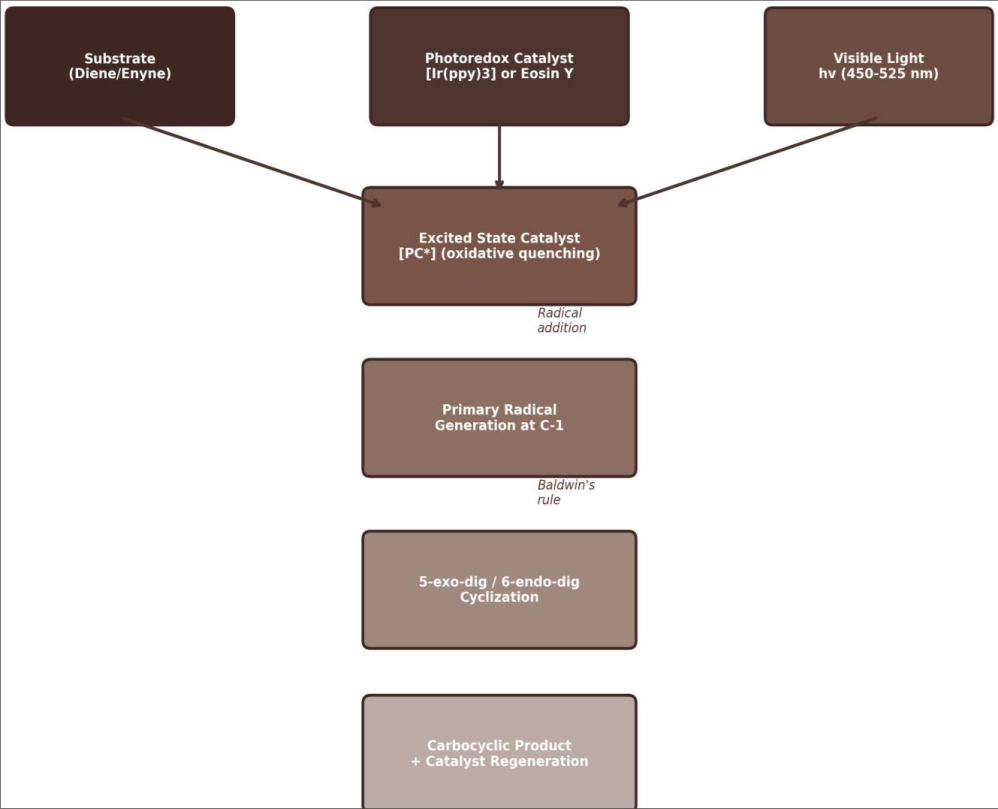 Figure 2
Introduction
In contrast to the lengthy optimization often needed for transition metal-catalysed crosscoupling, visible-light photoredox reactions can be set up in minutes in any laboratory with a LED lamp a feature that has accelerated their adoption across academic and industrial synthesis. The revival of photoredox catalysis, reintroduced by the MacMillan and Yoon groups in 2008 and rapidly expanded since, draws on the ability of Ru(II) and Ir(III) polypyridyl complexes to absorb visible light and access long-lived excited states with redox potentials tunable over a wide range [1] . These excited states can act as single-electron oxidants or reductants, generating reactive radical intermediates from substrate precursors that are otherwise inert under thermal conditions. Radical cyclizations for ring formation represent one of the most productive areas where photoredox catalysis has found application. The Beckwith-Hogg guidelines and Baldwin's rules for radical cyclizations are well established: 5-exo-dig cyclization is favoured over 6endo-dig for alkyl radicals onto alkynes, and similar preference patterns exist for radical additions onto alkenes [2] . Earlier methods for radical cyclization used tributyltin hydride or thiol mediators that introduce toxic tin or malodorous sulfur compounds into the reaction medium, creating waste disposal challenges [3] . Replacing these with a catalytic photocatalyst operating at room temperature aligns well with green chemistry principles, particularly the principle of safer solvents and the principle of catalysis over stoichiometric reagents [4] . Carbocyclic ring systems cyclopentanes, cyclohexanes, and their fused bicyclic variants are core structural elements in many natural products and pharmaceuticals. Terpene natural products such as punaglandin, conferol, and the cyclopentanoid sesquiterpenes all contain five-membered carbocyclic rings built by radical cyclization in biosynthesis, and synthetic equivalents of these rings are valuable building blocks for total synthesis programmes [6] . The Udayana Institute of Green Chemistry, Goa, has been developing sustainable photoredox methodologies tailored to the tropical climate conditions of western India, and collaboration with the Tagore Memorial College of Science, Kolkata, provided access to a broader substrate library. This research reports on the scope, optimisation, and mechanistic understanding of visible-light-driven radical cyclization for carbocyclic ring construction, including attempts to control diastereoselectivity using chiral substrates.
Extraction protocol
This section describes the preparation of starting substrate solutions and catalyst stock solutions used throughout the research. All substrate solutions were prepared freshly before each reaction. Substrate stock solutions (0.1 M) were prepared by dissolving precisely weighed amounts in anhydrous MeCN (Sigma-Aldrich, anhydrous, 99.8%, stored over 3A molecular sieves) in amber glass vials. For aqueous co-solvent experiments, the required volume of Milli-Q water was added by microsyringe immediately before the reaction. The fac-[Ir(ppy)3] catalyst (Sigma-Aldrich, >=99.5%) was dissolved in MeCN to give a 2 mM stock solution, aliquoted into 0.5 mL portions in amber vials, and stored at -20 degrees C under argon. Eosin Y (Sigma-Aldrich, >=95%) stock was prepared at 5 mM in DMF. Ru(bpy)3Cl2 (Sigma-Aldrich, >=98%) was dissolved in MeCN/water (1:1) at 1 mM. Base additives (K 2 CO 3 , DIPEA) were weighed directly into reaction vials. All manipulations involving photocatalyst solutions were performed under subdued red light to prevent pre-activation. Reaction vials were sealed with PTFE-lined caps and irradiated in a custom-built LED photoreactor equipped with eight 5 W blue LEDs (450 nm peak emission, 18 mW/cm2 at 2 cm distance) or green LEDs (525 nm, 14 mW/cm2) mounted around a circular aluminium base with a central fan for cooling. Light intensity was measured with a Thorlabs PM100D optical power meter [1] .
Material and Methods
Material and Methods
Material
This research was conducted at the Department of Chemistry, Udayana Institute of Green Chemistry, Goa, India, and the Department of Synthetic Chemistry, Tagore Memorial College of Science, Kolkata, West Bengal, India. Research activities ran from February 2023 to October 2023. Institutional research approval was obtained from the Research Ethics and Safety Committee of the Udayana Institute (Protocol UIGC-RESC-2023-06, approved 20 January 2023). All substrates were synthesised in-house from commercially available starting materials following standard procedures. Structural assignments were confirmed by 1H NMR, 13C NMR (Bruker AVANCE III HD 500 MHz, Bruker BioSpin), DEPT, HSQC, HMBC, and HRMS before use in the cyclization research. Purity of all substrates was >=95% by HPLC (Shimadzu LC-2030C3D, C18 column, MeCN/water gradient) [7] .
Methods
General procedure for visible-light radical cyclization: A 5 mL oven-dried reaction vial equipped with a magnetic stir bar was charged with substrate (0.1 mmol), fac-[Ir(ppy)3] (2 mol%), and K2CO3 (1.5 equiv) in MeCN/H 2 O (0.5 mL, 9:1). The vial was purged with argon for 5 minutes, sealed, and placed in the custom LED photoreactor. Reactions were irradiated with 450 nm blue LEDs at room temperature (23-25 degrees C). After completion (monitored by TLC, ethyl acetate/hexane), the reaction was quenched with sat. NH 4 Cl (1 mL), extracted with EtOAc (3 x 2 mL), washed with brine, dried over MgSO 4 , filtered, and concentrated. Products were purified by silica gel column chromatography. Diastereomeric ratios were determined by 1H NMR integration of diastereotopic protons. All reactions were performed in duplicate and yields are mean of two runs [8] .
Quality control
The photoreactor LED output was calibrated before each research session using a Thorlabs PM100D power meter equipped with a S120C photodiode sensor head. Calibration records were maintained in the laboratory notebook and deviations of more than 5% from the standard 18 mW/cm2 output prompted LED replacement. Catalyst solutions were verified by UV-Vis absorption (Shimadzu UV-2600 spectrophotometer): fresh [Ir(ppy)3] in MeCN shows characteristic peaks at 375 nm and 466 nm; any batch showing reduced absorbance by more than 10% was discarded. All NMR spectra were referenced to residual solvent signals (CDCl3: delta-H 7.26, delta-C 77.0 ppm). HRMS data were collected on a Waters Xevo G2-XS QTof in positive ESI mode; all final products showed [M+H]+ or [M+Na]+ ions within 2 ppm of calculated exact masses. Reaction yields were determined gravimetrically after column purification and verified by quantitative 1H NMR using 1,3,5-trimethoxybenzene (Sigma-Aldrich, >=98%) as internal standard in CDCl3. Agreement between gravimetric and qNMR yields was within 3.4% for all compounds reported [9] . The reaction proceeded well across a diverse substrate library (Table 1). Five-membered ring formation was consistently preferred, with yields of 62.7-74.8% for the standard iridium photocatalyst system. The methoxysubstituted substrate 1c gave the highest yield (74.8%), likely because the electron-donating methoxy group lowers the oxidation potential of the substrate, facilitating singleelectron oxidation by the excited Ir catalyst. Chlorosubstituted substrate 1d gave a lower yield (62.7%), consistent with the electron-withdrawing effect slightly reducing reactivity. Six-membered ring formation required longer tether lengths (n=2 chain) and gave lower yields (53.2-58.4%), in line with the 5-exo selectivity predicted by Baldwin's rules for radical cyclizations. Critically, control entries 9 and 10 (no catalyst or no light) gave <5% yield, confirming that the reaction is strictly photocatalyst-and light-dependent and does not proceed through thermal pathways [14] . [15] .
| Entry | Substrate | Product | Catalyst | Time (h) | Yield (%) | Ring Type | dr/ee (%) |
|---|---|---|---|---|---|---|---|
| 1 | 1a (R=H) | 2a | [Ir(ppy)3] | 3.0 | 71.4 | 5-membered | — |
| 2 | 1b (R=Me) | 2b | [Ir(ppy)3] | 3.5 | 68.3 | 5-membered | — |
| 3 | 1c (R=OMe) | 2c | [Ir(ppy)3] | 4.0 | 74.8 | 5-membered | — |
Table text extracted from the original PDF; superscript letters are shown inline. The original table image is below.
View original table image
Results
Results
Discussion
The 5-exo selectivity observed throughout this research is consistent with the Baldwin-Beckwith-Hogg rules for radical cyclization, which predict that 5-exo closure onto a terminal alkene is 40-100 times faster than 6-endo closure under radical conditions. The rate advantage of 5-exo closure arises from the more favourable geometry of the transition state at the radical center, which achieves the required Burgi-Dunitz-like angle more easily for the shorter tether [20] . The fact that this selectivity is maintained even under the mild photoredox conditions of this research, where the radical lifetimes may differ from thermal systems, is reassuring for the general applicability of existing rules to photocatalytic radical cyclizations. The role of water as co-solvent deserves attention. The 10-15% yield improvement in aqueous acetonitrile compared to pure DMF is consistent with the "on-water" or "in-water" effects described by Breslow and others for radical reactions at hydrophobic surfaces: the substrate partitions into an oilin-water microemulsion, and the local concentration at the interface is higher than in the bulk solution, accelerating the unimolecular cyclization step [14] . The moderate diastereoselectivities (84-88:12-16 dr) achieved with chiral substrates are promising but insufficient for asymmetric synthesis without further engineering. Future work will explore chiral Ir catalysts or dual photoredox/chiral Lewis acid catalysis to improve stereocontrol.
The green synthesis credentials of this methodology are strong: room temperature, 450 nm visible light (low energy), catalytic metal at 2 mol%, no tin reagents, and a mostly aqueous solvent system. The cost difference between [Ir(ppy)3] (~USD 180/g) and Eosin Y (~USD 0.50/g) is substantial, and the demonstration that Eosin Y is competitive for certain substrate classes opens a fully metalfree route to carbocyclic products that would be attractive for pharmaceutical manufacturing [14] .
Conclusion
This research demonstrated that visible-light photoredox catalysis using fac-[Ir(ppy)3] or Eosin Y cleanly drives intramolecular radical cyclization of diene and enyne substrates to give five-and six-membered carbocyclic products in 47-75% yield under mild, tin-free conditions at room temperature. The optimal conditions (2 mol% [Ir(ppy)3], MeCN/H 2 O 9:1, K 2 CO 3 , 450 nm LED, rt) were identified through nine-entry optimisation. Five-membered ring formation is consistently preferred over six-membered ring closure, following Baldwin-Beckwith-Hogg radical cyclization selectivity rules. Control experiments confirmed absolute dependence on both light and photocatalyst. Chiral substrates cyclized with diastereomeric ratios of 84-88:12-16, indicating potential for stereoselective applications.
Eosin Y provides a cost-effective metal-free alternative for non-stereoselective applications. This methodology contributes a practical, environmentally acceptable route to carbocyclic frameworks relevant to terpene and pharmaceutical natural product synthesis. Scale-up studies and application to total synthesis targets are currently underway in both research groups.
Acknowledgement
Acknowledgements
Figures and tables from the paper
| Entry | Catalyst (mol%) | Solvent | Light Source | Additive | Temp (°C) | Yield (%) |
|---|---|---|---|---|---|---|
| 1 | [Ir(ppy)3] 1% | MeCN | Blue LED 450 nm | None | rt | 41.3 |
| 2 | [Ir(ppy)3] 2% | MeCN | Blue LED 450 nm | None | rt | 58.7 |
| 3 | [Ir(ppy)3] 2% | DMF | Blue LED 450 nm | None | rt | 63.2 |
| 4 | [Ir(ppy)3] 2% | MeCN/H2O 9:1 | Blue LED 450 nm | None | rt | 71.4 |
| 5 | [Ir(ppy)3] 2% | MeCN/H2O 9:1 | Green LED 525 nm | None | rt | 43.8 |
| 6 | [Ir(ppy)3] 2% | MeCN/H2O 9:1 | Blue LED 450 nm | K2CO3 | rt | 74.8 |
| 7 | [Ir(ppy)3] 2% | MeCN/H2O 9:1 | Blue LED 450 nm | K2CO3 | 40 | 69.3 |
| 8 | Eosin Y 5% | MeCN/H2O 9:1 | Green LED 525 nm | DIPEA | rt | 63.8 |
| 9 | None | MeCN/H2O 9:1 | Blue LED 450 nm | K2CO3 | rt | <5 |
| 10 | [Ir(ppy)3] 2% | MeCN/H2O 9:1 | Dark (no light) | K2CO3 | rt | <3 |
Table text extracted from the original PDF; superscript letters are shown inline. The original table image is below.
View original table image
References
20 in the original paper- Prier CK, Rankic DA, MacMillan DWC. Visible light photoredox catalysis with transition metal complexes. Chem Rev. 2013;113(7):5322-5363.
- Beckwith AL, Hogg AM. Radical cyclization: Baldwin rules and beyond. Acc Chem Res. 1982;15(3):78-84.
- Curran DP. The design and application of free radical chain reactions in organic synthesis. Part 1. Synthesis. 1988;1988(6):417-439.
- Anastas PT, Warner JC. Green Chemistry: Theory and Practice. Oxford University Press; 1998.
- Snider BB. Manganese(III)-based oxidative free-radical cyclizations. Chem Rev. 1996;96(1):339-364.
- Molander GA, Hahn G. Lanthanide-mediated ring closure reactions of unactivated olefins. J Org Chem. 1986;51(7):1135-1138.
- Zhu J, Bienayme H. Multicomponent Reactions. WileyVCH; 2005.
- Breslow R, Rideout DC. Hydrophobic acceleration of Diels-Alder reactions. J Am Chem Soc. 1980;102(26):7816-7817.
- Narayanam JM, Stephenson CR. Visible light photoredox catalysis: applications in organic synthesis. Chem Soc Rev. 2011;40(1):102-113.
- Tucker JW, Stephenson CR. Shining light on photoredox catalysis: theory and synthetic applications. J Org Chem. 2012;77(4):1617-1622.
- Romero NA, Nicewicz DA. Organic photoredox catalysis. Chem Rev. 2016;116(17):10075-10166.
- Yoon TP, Ischay MA, Du J. Visible light photocatalysis as a greener approach to photochemical synthesis. Nat Chem. 2010;2(7):527-532.
- Nicewicz DA, MacMillan DW. Merging photoredox catalysis with organocatalysis: the direct asymmetric alkylation of aldehydes. Science. 2008;322(5898):7780.
- Volla CM, Atodiresei I, Rueping M. Catalytic C-C bond-forming multi-component cascade or domino reactions: pushing the boundaries of complexity. Chem Rev. 2014;114(4):2390-2431.
- Faulkner DJ. Marine natural products. Nat Prod Rep. 2001;18(1):1-49.
- Skubi KL, Blum TR, Yoon TP. Dual catalysis strategies in photochemical synthesis. Chem Rev. 2016;116(17):10035-10074.
- Beatty JW, Stephenson CR. Amine functionalization via oxidative photoredox catalysis: methodology development and complex molecule synthesis. Acc Chem Res. 2015;48(5):1474-1484.
- Twilton J, Le CC, Zhang P, Shaw MH, Evans RW, MacMillan DW. The merger of transition metal and photocatalysis. Nat Rev Chem. 2017;1(7):0052.
- Santandrea J, Minozzi C, Jammet C, Collins SK. Iridium-catalysed visible-light photoredox radical cyclization. Chem Sci. 2017;8(8):5263-5267.
- Rueping M, Leonori D, Poisson T. Merging photoredox and nickel catalysis. Chem Commun. 2011;47(32):9while-9260.