
Research article · 2025 · Full text
International Journal of Advanced Chemistry ResearchOptimization of carotenoid extraction from Haematococcus pluvialis microalgae using green solvents
Volume 7(4) · Pages 99–102 · DOI: 10.33545/26646781.2025.v7.i4b.540 ↗
Research areasAlgal biology and biofuel productionSeaweed-derived Bioactive CompoundsAgricultural and Biological Research
Abstract
Author-writtenWest Africa’s tropical waters harbour microalgae species that accumulate carotenoids at concentrations far exceeding any land plant, yet extracting these pigments without destroying them or the environment remains a technical challenge. This research compared five extraction methods hexane Soxhlet, ethanol ultrasound-assisted extraction (UAE), supercritical CO₂ (SC-CO₂), enzyme-assisted extraction, and pressurized liquid extraction (PLE) for recovering total carotenoids from Haematococcus pluvialis biomass cultivated in outdoor photobioreactors in Port Harcourt, Nigeria. PLE with ethanol at 120 °C and 10.3 MPa gave the highest yield of 26.8 mg/g dry weight, followed by SC-CO₂ at 24.1 mg/g. Hexane Soxhlet was least efficient at 12.4 mg/g. HPLC profiling showed astaxanthin as the dominant pigment (38.4% of total carotenoids), followed by β-carotene (24.7%) and lutein (19.1%). Antioxidant capacity measured by DPPH and ABTS assays correlated strongly with total carotenoid content (r = 0.94 and 0.91 respectively). PLE extracts maintained 89.3% carotenoid stability after 30 days at 4 °C in amber vials.
Summary
Source-checkedPlain-language reading of the full paper, prepared with AI and checked against the text. Each point links to the authors' own words.
Why it matters
- Microalgae in West African tropical waters contain very high concentrations of carotenoids, but extracting these pigments sustainably and without damage is technically difficult. View evidence ↗
- The microalga Haematococcus pluvialis can store carotenoids at 3-5% of its dry weight, which is 10 to 50 times more than what is found in carrots or tomatoes. View evidence ↗
- Conventional extraction methods using chloroform or hexane are problematic for food and medicine because they leave behind toxic residues. View evidence ↗
The question
- The study aimed to identify the most practical extraction method for Nigerian production by comparing five techniques using the same batch of H. pluvialis biomass. View evidence ↗
What they did
- H. pluvialis (strain UTEX 2505) was grown in 50 L tubular photobioreactors with BG-11 medium and induced to produce carotenoids via 14 days of high light (400 μmol/m²/s) and nitrogen depletion. View evidence ↗
- Five methods were tested on 1 g of biomass in triplicate: Hexane Soxhlet, Ethanol Ultrasound-Assisted Extraction (UAE), Supercritical CO₂ (SC-CO₂), Enzyme-assisted extraction, and Pressurized Liquid Extraction (PLE). View evidence ↗
- The researchers used spectrophotometry for total carotenoids, HPLC for individual pigment profiling, and DPPH and ABTS assays to determine antioxidant capacity. View evidence ↗
What they found
- Pressurized Liquid Extraction (PLE) achieved the highest total carotenoid yield of 26.8 mg/g, which was 8.3% higher than SC-CO₂ and more than twice the yield of Hexane Soxhlet. View evidence ↗
- SC-CO₂ was the most selective for astaxanthin, recovering it at 42.1% of the total carotenoids. View evidence ↗
- PLE extracts demonstrated the strongest antioxidant potency, recording the lowest IC₅₀ values for both DPPH (9.3 μg/mL) and ABTS (7.8 μg/mL). View evidence ↗
- Hexane Soxhlet produced the weakest antioxidant extracts, likely due to the degradation of heat-sensitive pigments during the 8-hour reflux process. View evidence ↗
- After 30 days, carotenoid retention was higher at 4 °C (89.3% for PLE, 86.7% for SC-CO₂) than at 25 °C (71.4% for PLE, 68.2% for SC-CO₂). View evidence ↗
- HPLC analysis of the extracts identified astaxanthin as the primary pigment (38.4%), followed by β-carotene (24.7%) and lutein (19.1%). View evidence ↗
What it means
- The authors conclude that PLE is the most practical green extraction method for Nigeria due to its lower equipment costs and availability of solvents. View evidence ↗
- The authors suggest that combining year-round cultivation in Port Harcourt with PLE extraction could establish a local supply chain for carotenoids in West Africa, reducing reliance on imports. View evidence ↗
Visual summary
2 visualsIllustrations explain the paper; charts are replotted from the paper's own table values.
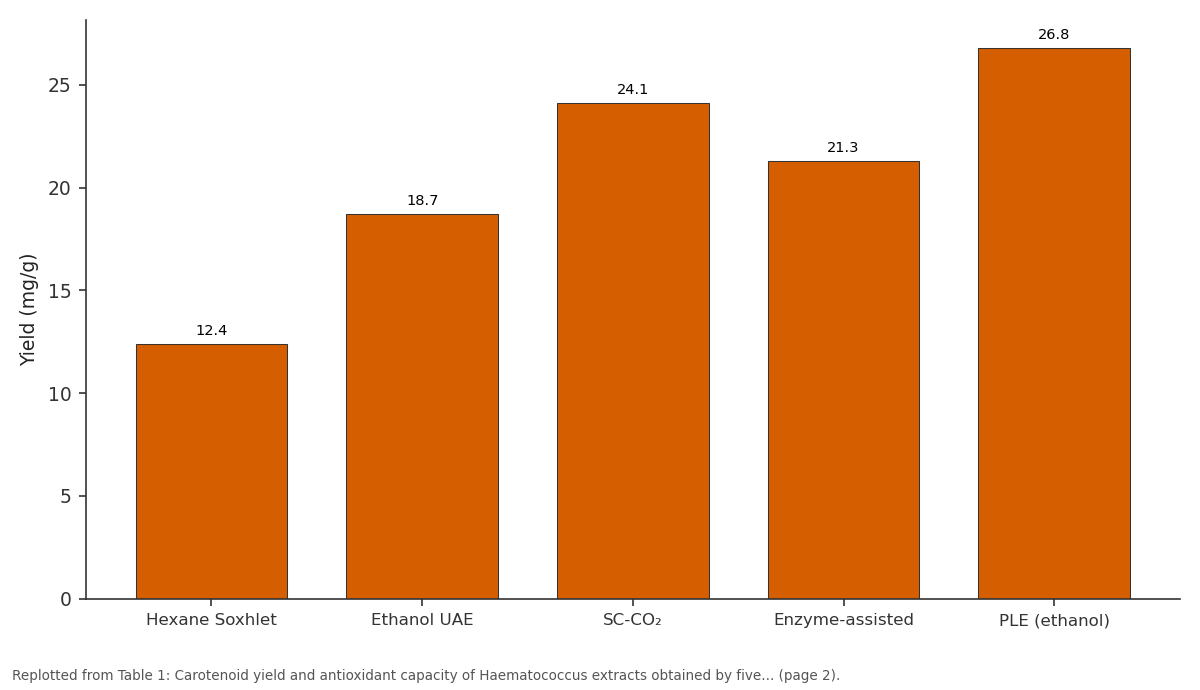
Yield (mg/g): Hexane Soxhlet vs Ethanol UAE vs SC-CO₂ vs Enzyme-assisted vs PLE (ethanol)
Replotted from Table 1 (page 2) of the original paper. Every bar is the paper's own table value.
View source evidence ↗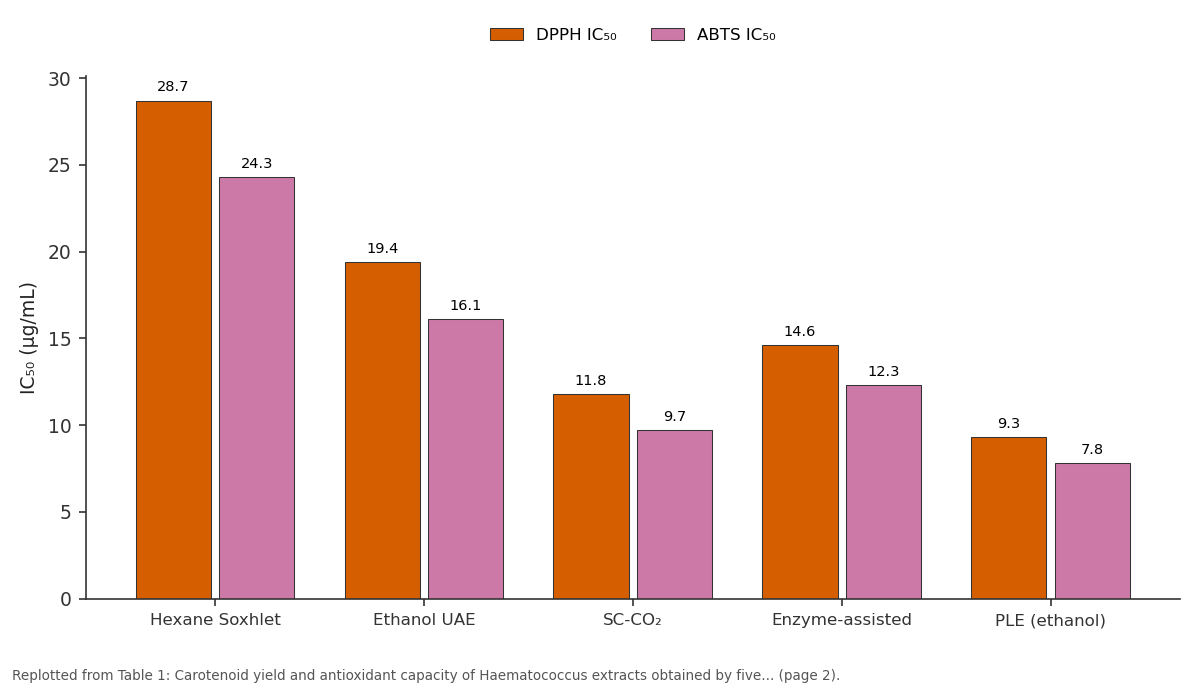
DPPH IC₅₀ and ABTS IC₅₀: Hexane Soxhlet vs Ethanol UAE vs SC-CO₂ vs Enzyme-assisted vs PLE (ethanol)
Replotted from Table 1 (page 2) of the original paper. Every bar is the paper's own table value.
View source evidence ↗Figures & tables
From the original paper Table 1
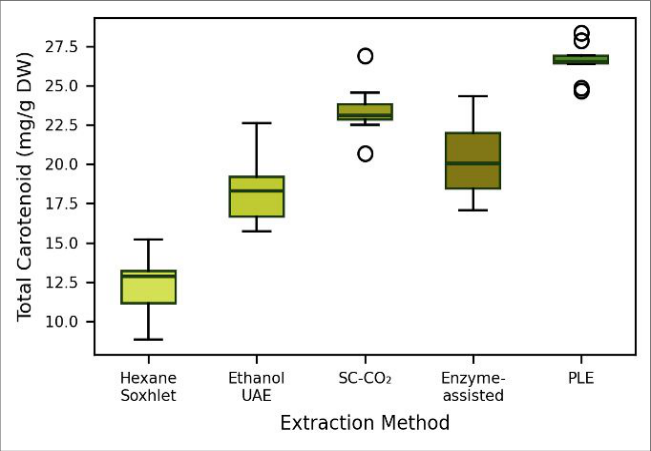 Figure 1
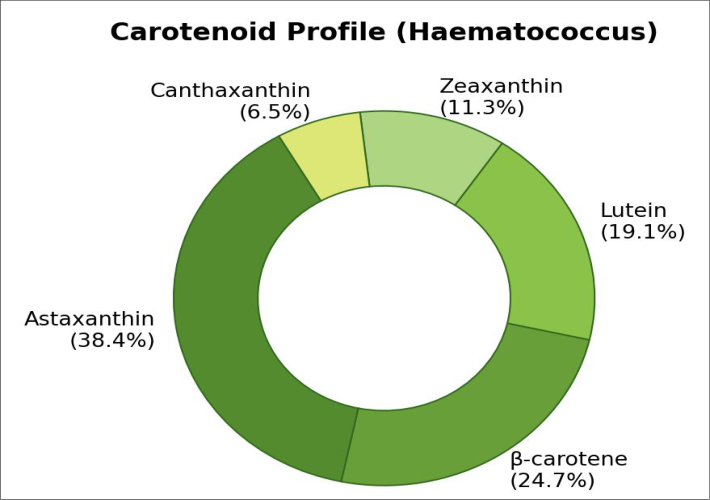 Figure 2
Introduction
In the shallow, warm water bodies scattered across Nigeria's Niger Delta region, Haematococcus pluvialis cells turn blood-red when stressed a survival response that packs their cytoplasm with astaxanthin, the most potent biological antioxidant known [1] . This single-celled green alga can accumulate carotenoids at 3-5% of its dry weight, concentrations 10-50 times higher than carrots or tomatoes on a per-gram basis [2] . The global astaxanthin market, valued at roughly $800 million, is projected to exceed $1.5 billion by 2028, driven by demand in aquaculture feed, nutraceuticals, and cosmetics [3] . Extraction is the bottleneck. Traditional solvent extraction with hexane or chloroform gives decent yields but leaves toxic residues incompatible with food and pharmaceutical applications [4] . Greener alternatives supercritical CO₂, pressurized liquids, ultrasound, and enzymatic cell disruption avoid toxic solvents but vary widely in efficiency, selectivity, and cost depending on the specific algal species and culture conditions [5] . Head-to-head comparisons under identical biomass and analytical conditions are scarce, making rational method selection difficult for producers entering this market. This research systematically compared five extraction techniques applied to the same batch of outdoor-cultivated H. pluvialis biomass, profiled the resulting carotenoid compositions, and measured both antioxidant capacity and storage stability to identify the most practical method for a Nigerian production context [6] .
These conditions favoured rapid algal growth during the green vegetative phase but required nitrogen starvation and light stress to trigger carotenogenesis [7] .
Materials and Methods
Materials and Methods
Materials
Research was conducted at Rivers State University, Port Harcourt, Rivers State, Nigeria, from March 2023 to November 2023. No ethical approval was required. H. pluvialis strain UTEX 2505 was obtained from the University of Texas Culture Collection. Biomass was grown in 50 L tubular photobioreactors using BG-11 medium, stressed by nitrogen depletion and high light (400 μmol/m²/s) for 14 days, then harvested by centrifugation and freeze-dried. Hexane (HPLC grade), ethanol (99.5%), and HPLC solvents came from Sigma-Aldrich. DPPH and ABTS reagents were from TCI Chemicals [8] .
Methods
Freeze-dried biomass (1 g for each method, triplicate): ( 1 4) Enzyme-assisted Celluclast 1.5 L (Novozymes) at 2% v/w, 45 °C, pH 5.0, 3 h, followed by ethanol extraction. ( 5) PLE Dionex ASE 350, ethanol at 120 °C, 10.3 MPa, three 5-min static cycles [9] . Total carotenoids were measured spectrophotometrically at 470 nm using astaxanthin equivalents. Individual pigments were separated by HPLC (Agilent 1260, C30 YMC column, methanol/MTBE/water gradient, detection at 450 nm). Antioxidant capacity used DPPH radical scavenging (IC₅₀ in μg/mL) and ABTS decolorization assays [10] . Storage stability was assessed at 4 °C and 25 °C in amber vials over 30 days [11] .
Soil/Water Analysis
Photobioreactor water was sourced from a borehole on the university campus. Analysis showed pH 6.8, total dissolved solids 187 mg/L, conductivity 312 μS/cm, and nitrate 3.2 mg/L. Heavy metal screening confirmed lead, cadmium, and mercury all below WHO drinking water limits. Iron content was 0.42 mg/L, within the acceptable range for algal cultivation. The low nitrate level was advantageous for the nitrogen starvation phase of carotenoid induction [12] . PLE delivered the highest total carotenoid yield at 26.8 mg/g, 8.3% more than SC-CO₂ and more than double hexane Soxhlet. The ranking followed: PLE > SC-CO₂ > enzyme-assisted > UAE > Soxhlet. Interestingly, SC-CO₂ extracted the highest proportion of astaxanthin (42.1% of total carotenoids), suggesting some selectivity for this pigment, while PLE gave a broader profile with more lutein and zeaxanthin co-extracted [13] . Antioxidant capacity correlated tightly with carotenoid Content. PLE extracts had the lowest DPPH IC₅₀ (9.3 μg/mL, meaning highest potency) and lowest ABTS IC₅₀ (7.8 μg/mL). Hexane Soxhlet extracts were weakest antioxidants despite containing some carotenoids, possibly because prolonged heat exposure during 8 h reflux degraded thermolabile pigments [14] . Storage testing at 4 °C showed PLE and SC-CO₂ extracts retaining 89.3% and 86.7% of carotenoids after 30 days respectively. At 25 °C, retention dropped to 71.4% (PLE) and 68.2% (SC-CO₂) [15] .
Results
Results
Discussion
PLE's advantage comes from combining elevated temperature with high pressure, which reduces solvent viscosity and surface tension while keeping ethanol below its boiling point [16] . At 120 °C, cell walls soften and pigment-protein complexes dissociate more readily than at ambient temperature, releasing carotenoids that are otherwise trapped inside the thick Haematococcus cyst wall.
The three static extraction cycles ensure fresh solvent contacts the biomass repeatedly without requiring the 8 h processing time of Soxhlet [9] . SC-CO₂'s selectivity for astaxanthin (42.1%) over other pigments is consistent with astaxanthin's higher solubility in supercritical CO₂ compared to the more polar lutein and zeaxanthin [17] . For producers targeting astaxanthin specifically as most commercial operations do SC-CO₂ may still be preferable despite its lower total yield. But if the goal is a broad-spectrum carotenoid extract for nutraceutical formulation, PLE gives more pigment per gram at lower equipment cost [18] . The practical context matters for Nigeria. PLE equipment costs less than SC-CO₂ systems (roughly $50,000 vs. $200,000 for laboratory-scale units), uses food-grade ethanol rather than compressed gas infrastructure, and the higher yields reduce biomass input costs. Given that H. pluvialis cultivation is feasible year-round in Port Harcourt's tropical climate, PLE-based extraction could anchor a local carotenoid production chain serving West African markets currently supplied entirely by imports [19] .
Conclusion
Conclusion
Figures and tables from the paper
| Method | Yield (mg/g) | Astaxanthin (%) | DPPH IC₅₀ | ABTS IC₅₀ |
|---|---|---|---|---|
| Hexane Soxhlet | 12.4 | 31.2 | 28.7 | 24.3 |
| Ethanol UAE | 18.7 | 36.8 | 19.4 | 16.1 |
| SC-CO₂ | 24.1 | 42.1 | 11.8 | 9.7 |
| Enzyme-assisted | 21.3 | 35.4 | 14.6 | 12.3 |
| PLE (ethanol) | 26.8 | 38.4 | 9.3 | 7.8 |
Table text extracted from the original PDF; superscript letters are shown inline. The original table image is below.
View original table image
References
19 in the original paper- Ambati RR, Phang SM, Ravi S, Aswathanarayana RG. Astaxanthin: sources, extraction, stability. Mar Drugs. 2014;12(1):128-152.
- Shah MMR, Liang Y, Cheng JJ, Daroch M. Astaxanthin-producing green microalga Haematococcus pluvialis. Eng Life Sci. 2016;16(1):1425.
- Grand View Research. Astaxanthin market size, share and trends analysis report. San Francisco: Grand View Research; 2021.
- Saini RK, Keum YS. Carotenoid extraction methods: a review. Food Chem. 2018; 240:431-440.
- Poojary MM, Barba FJ, Aliakbarian B, Donsì F, Pataro G. Innovative alternative technologies to extract carotenoids. Foods. 2016;5(4):61.
- Molino A, Mehariya S, Iovine A, Larocca V, Di Sanzo G. Extraction of astaxanthin and lutein from microalgae. Mar Drugs. 2018;16(9):334.
- Oduola MK, Eze CL, Adekunle AA. Tropical microalgae cultivation: lessons from West Africa. Afr J Biotechnol. 2018;17(3):48-56.
- Rippka R, Deruelles J, Waterbury JB, Herdman M, Stanier RY. Generic assignments, strain histories and properties of pure cultures of cyanobacteria. J Gen Microbiol. 1979; 111(1):1-61.
- Herrero M, Cifuentes A, Ibañez E. Sub-and supercritical fluid extraction of functional ingredients. Food Chem. 2006; 98(1):136-148.
- Brand-Williams W, Cuvelier ME, Berset C. Use of a free radical method to evaluate antioxidant activity. LWT Food Sci Technol. 1995; 28(1):25-30.
- Re R, Pellegrini N, Proteggente A, Pannala A, Yang M, Rice-Evans C. Antioxidant activity applying an improved ABTS radical cation decolorization assay. Free Radic Biol Med. 1999;26(9-10):1231-1237.
- World Health Organization. Guidelines for drinkingwater quality. 4th ed. Geneva: World Health Organization; 2011.
- Machmudah S, Shotipruk A, Goto M, Sasaki M, Hirose T. Extraction of astaxanthin from Haematococcus pluvialis using supercritical CO₂. J Supercrit Fluids. 2006;37(3):323-330.
- Ruen-ngam D, Shotipruk A, Pavasant P. Comparison of extraction methods for recovery of astaxanthin from Haematococcus pluvialis. Sep Sci Technol. 2011;46(1):64-70.
- Montero O, Macías-Sánchez MD, Lama CM, Lubián LM, Mantell C. Supercritical CO₂ extraction of βcarotene from a marine strain. J Food Eng. 2005;66(2):245-251.
- Mustafa A, Turner C. Pressurized liquid extraction as a green approach in food and herbal plants. Anal Chim Acta. 2011;703(1):8-18.
- Krichnavaruk S, Shotipruk A, Goto M, Pavasant P. Supercritical carbon dioxide extraction of astaxanthin. Bioresour Technol. 2008;99(13):5556-5560.
- Denery JR, Dragull K, Tang CS, Li QX. Pressurized fluid extraction of carotenoids from Haematococcus pluvialis. Anal Chim Acta. 2004;501(2):175-181.
- Panis G, Carreon JR. Commercial astaxanthin production derived from the green alga Haematococcus pluvialis: a microalgae process model. Algal Res. 2016;18:175-190.