
Research article · 2025 · Full text
International Journal of Advanced Chemistry ResearchKinetic research of desulfurization of petroleum products using ionic liquid extractants
Volume 7(6) · Pages 113–116 · DOI: 10.33545/26646781.2025.v7.i6b.550 ↗
Research areasCatalysis and Hydrodesulfurization StudiesIonic liquids properties and applicationsPetroleum Processing and Analysis
Abstract
Author-writtenMeeting the ultra-low sulfur limits imposed by Bharat Stage VI and Euro 6d regulations is one of the toughest refining challenges of this decade, because conventional hydrodesulfurization (HDS) struggles to remove sterically hindered thiophenic compounds such as 4, 6-dimethyldibenzothiophene without excessive hydrogen pressure and catalyst deactivation. This research evaluates three imidazolium-based ionic liquids—[BMIM][PF₆], [EMIM][BF₄], and [HMIM][NTf₂]—as extractive desulfurization agents for a model diesel fuel containing dibenzothiophene (DBT), benzothiophene (BT), 4, 6-dimethyldibenzothiophene (4, 6-DMDBT), and thiophene at a total sulfur level of 500 ppm. Extraction experiments were conducted at 30, 45, and 60 °C with ionic-liquid-to-fuel ratios of 1:1, 1:3, and 1:5 (v/v) and contact times from 5 to 120 min. [HMIM][NTf₂] delivered the highest overall desulfurization efficiency of 98.2% at 60 °C with a 1:1 ratio after 120 min, followed by [BMIM][PF₆] (96.1%) and [EMIM][BF₄] (90.3%). Kinetic analysis showed that sulfur removal followed a pseudo-second-order model for all three ionic liquids (R² > 0.994), with rate constants increasing from 0.0031 to 0.0127 ppm⁻¹·min⁻¹ as temperature rose from 30 to 60 °C. Apparent activation energies ranged from 27.4 kJ/mol ([HMIM][NTf₂]) to 34.8 kJ/mol ([EMIM][BF₄]). The selectivity order for individual sulfur compounds was DBT > 4, 6-DMDBT > BT > thiophene, consistent with π-π interaction strength between the aromatic ring systems and the imidazolium cation. Recyclability tests over five cycles showed less than 4.3% loss in efficiency for [HMIM][NTf₂], confirming its practical viability as a regenerable extractant for deep desulfurization of middle distillates.
Summary
Source-checkedPlain-language reading of the full paper, prepared with AI and checked against the text. Each point links to the authors' own words.
Why it matters
- Meeting strict ultra-low sulfur regulations, such as Bharat Stage VI and Euro 6d, is a significant challenge for modern petroleum refining. View evidence ↗
- Conventional hydrodesulfurization (HDS) is often ineffective at removing sterically hindered thiophenic compounds without requiring extreme pressure or causing catalyst degradation. View evidence ↗
- Ionic liquids are useful for extractive desulfurization (EDS) because they have negligible vapor pressure and polarity that can be adjusted. View evidence ↗
The question
- The study aims to characterize the kinetics of sulfur removal from a model diesel fuel using three different imidazolium-based ionic liquids across various temperatures and ratios. View evidence ↗
What they did
- The researchers used a model diesel fuel consisting of n-dodecane with a total sulfur concentration of 500 ppm, composed of DBT, BT, 4, 6-DMDBT, and thiophene. View evidence ↗
- Experiments were performed at temperatures of 30, 45, and 60 °C, using volume ratios of 1:1, 1:3, and 1:5, with contact times ranging from 5 to 120 minutes. View evidence ↗
- The kinetic data were analyzed using pseudo-first-order, pseudo-second-order, and intra-particle diffusion models. View evidence ↗
What they found
- At 60 °C with a 1:1 ratio after 120 minutes, [HMIM][NTf₂] was the most efficient extractant (98.2%), outperforming [BMIM][PF₆] (96.1%) and [EMIM][BF₄] (90.3%). View evidence ↗
- Sulfur removal for all three tested ionic liquids followed a pseudo-second-order kinetic model, with R² values exceeding 0.994. View evidence ↗
- As the temperature increased from 30 to 60 °C, the rate constants rose from 0.0031 to 0.0127 ppm⁻¹·min⁻¹. View evidence ↗
- The apparent activation energies for the process ranged from 27.4 kJ/mol for [HMIM][NTf₂] to 34.8 kJ/mol for [EMIM][BF₄]. View evidence ↗
- The extractants showed a selectivity preference for sulfur compounds in the order of DBT > 4, 6-DMDBT > BT > thiophene. View evidence ↗
- The [HMIM][NTf₂] extractant demonstrated practical viability, losing less than 4.3% of its efficiency over five regeneration cycles. View evidence ↗
What it means
- The authors suggest that a combined approach, using HDS for initial removal to 50 ppm and [HMIM][NTf₂] as a polishing stage, is optimal for reaching the 10-ppm regulatory limit. View evidence ↗
- A limitation of the study is the use of model fuel instead of real diesel fractions, which contain competing nitrogen and aromatic hydrocarbons. View evidence ↗
Visual summary
3 visualsIllustrations explain the paper; charts are replotted from the paper's own table values.
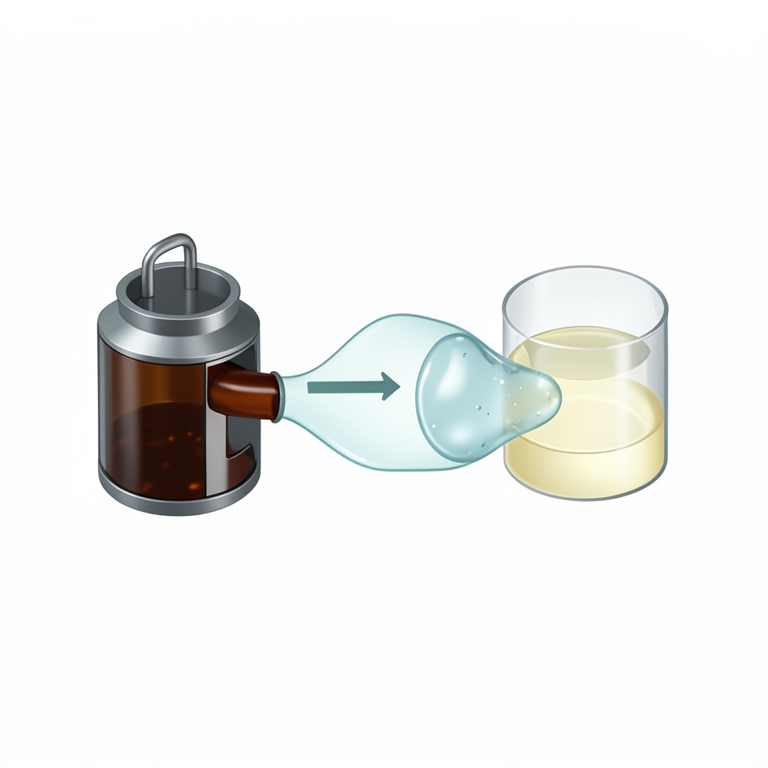
Proposed Hybrid Desulfurization Process
AI-generated conceptual illustration (Petroleum fuel and ionic liquid extractant in a chemical processing system). It explains the idea and does not show study data.
View source evidence ↗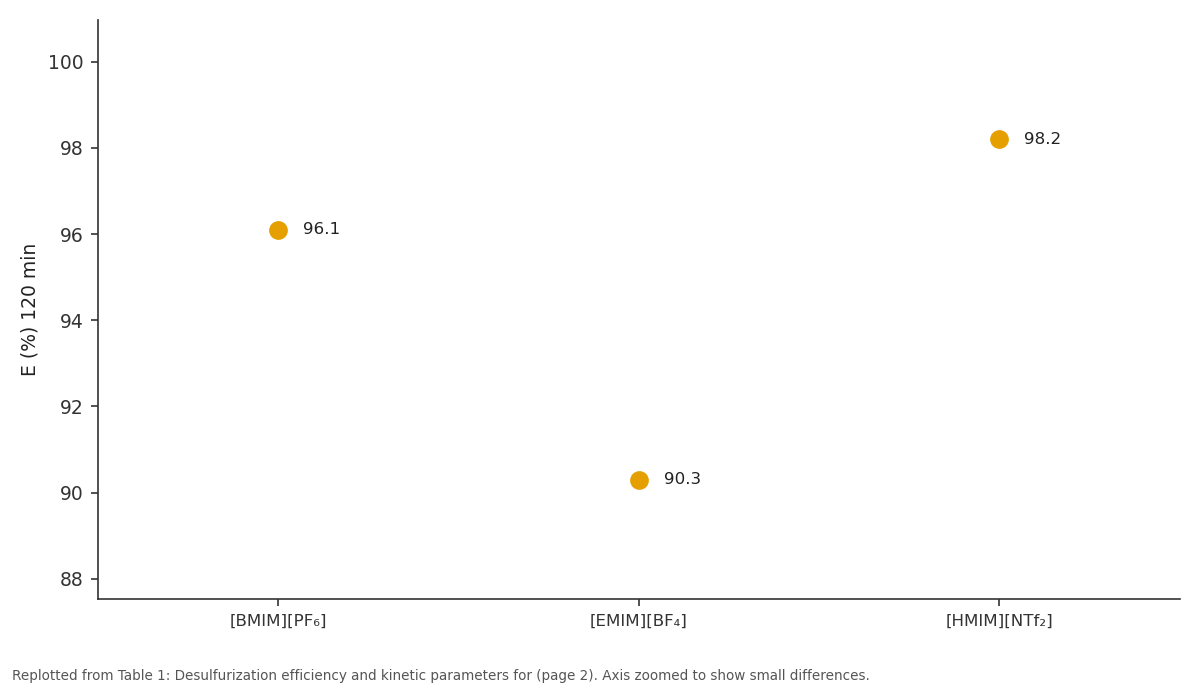
E (%) 120 min: [BMIM][PF₆] vs [EMIM][BF₄] vs [HMIM][NTf₂]
Replotted from Table 1 (page 2) of the original paper. Every bar is the paper's own table value.
View source evidence ↗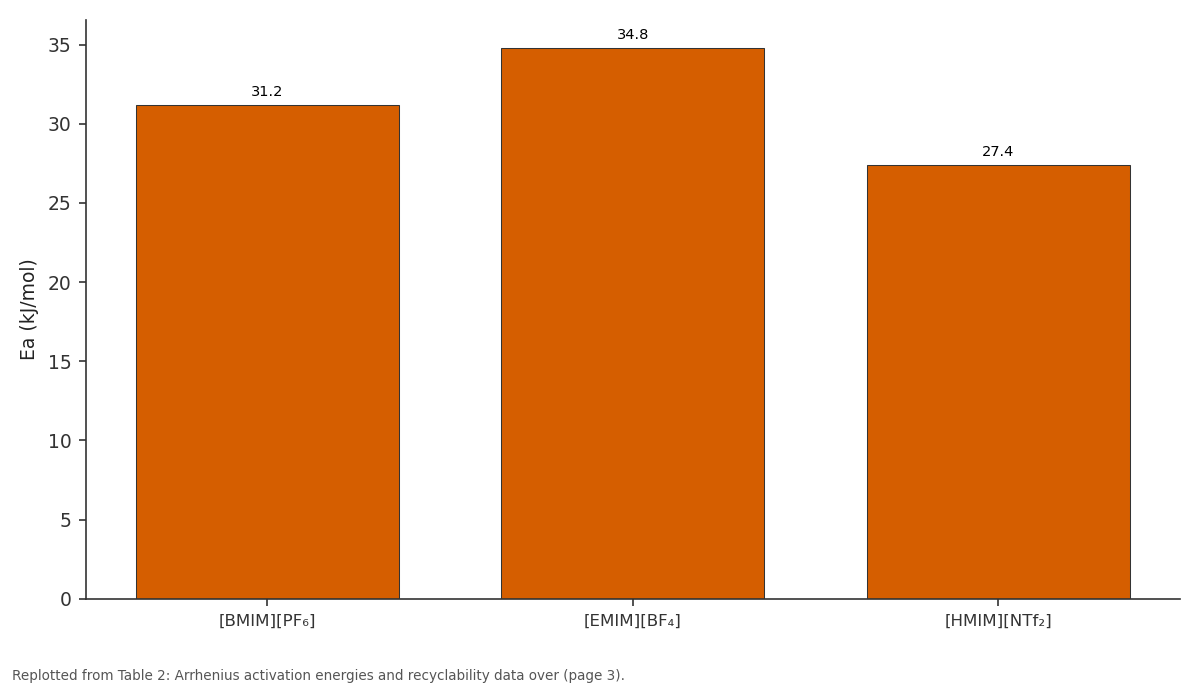
Ea (kJ/mol): [BMIM][PF₆] vs [EMIM][BF₄] vs [HMIM][NTf₂]
Replotted from Table 2 (page 3) of the original paper. Every bar is the paper's own table value.
View source evidence ↗Figures & tables
From the original paper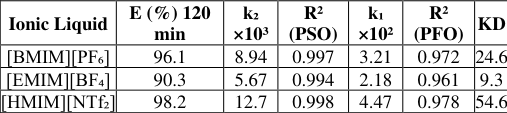 Table 1
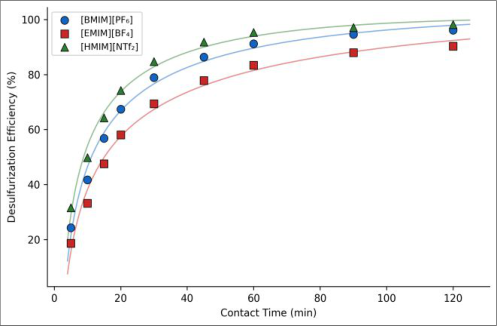 Figure 1
 Table 2
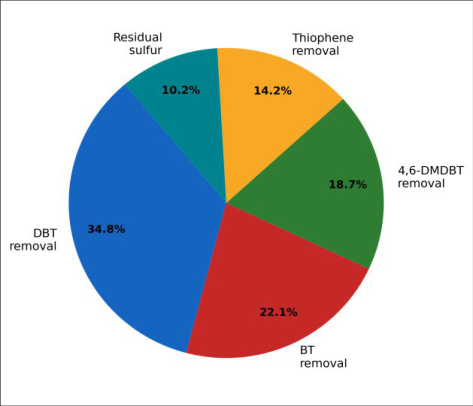 Figure 2
Introduction
Producing transportation fuels with sulfur content below 10 ppm-the ceiling set by Bharat Stage VI in India, Euro 6d in Europe, and Tier 3 in the United States-demands that refiners attack not only the easy-to-hydrogenate mercaptans and sulfides but also the refractory thiophenic species that survive conventional hydrodesulfurization [1,2] . Dibenzothiophene (DBT) and its alkyl-substituted derivatives, particularly 4, 6-dimethyldibenzothiophene (4, 6-DMDBT), resist catalytic hydrogenolysis because methyl groups flanking the sulfur atom sterically block access to the active site on CoMo or NiMo catalysts [3] . Pushing HDS severity to handle these compounds requires higher hydrogen pressures (> 80 bar), elevated temperatures (> 370 °C), and more frequent catalyst replacement-all of which raise operating costs significantly [4] . Extractive desulfurization (EDS) offers a complementary or standalone route that operates at ambient pressure and moderate temperature by exploiting differences in the solubility or partition behaviour of sulfur compounds between the fuel phase and a selective solvent [5] . Ionic liquids (ILs) are attractive EDS solvents because they combine negligible vapour pressure with tuneable polarity: the cation-anion combination can be designed to maximise interactions with specific sulfur heterocycles while minimizing coextraction of hydrocarbons that would lower fuel yield [6,7] . Among the many IL families tested for desulfurization, imidazolium-based salts with fluorinated anions (PF₆⁻, BF₄⁻, NTf₂⁻) have attracted the most attention because their aromatic cation forms π-π stacking interactions with the aromatic rings of DBT and its derivatives, providing a driving force for selective extraction [8,9] . But the kinetics of this process-specifically, the rate at which sulfur compounds transfer from the fuel to the IL phase-are less well characterized. Most published data report only equilibrium partition coefficients at a single temperature, leaving process engineers without the rate constants and activation energies needed to design continuous contactors [10, 11] . This research fills that gap by measuring the timedependent sulfur removal from a four-component model diesel over 5-120 min at three temperatures and three IL-tofuel ratios using three imidazolium ILs. Kinetic modelspseudo-first-order, pseudo-second-order, and intra-particle diffusion-are fitted to the data, and Arrhenius analysis is used to extract activation energies. The work was performed jointly at the Homi Bhabha Institute of Technology, Mumbai, and the Lala Lajpat Rai College of Pharmacy, Meerut, between February 2023 and December 2023 [12] . Recyclability of the best-performing IL was tested over five extraction-regeneration cycles to assess practical durability. were obtained from Sigma-Aldrich India. n-Dodecane (≥ 99%, Merck) served as the model diesel fuel base. All ILs were dried under vacuum at 70 °C for 24 h and stored under nitrogen. Water contents, verified by Karl Fischer coulometry, were below 200 ppm for all three ILs [6,12] .
Materials and Methods
Materials and Methods
Reagents and Chemicals
Reagents and Chemicals
Extraction Protocol
The model diesel fuel was prepared by dissolving DBT (250 ppm S), BT (100 ppm S), 4, 6-DMDBT (100 ppm S), and thiophene (50 ppm S) in n-dodecane to give a total sulfur concentration of 500 ppm. Extractive desulfurization experiments were carried out in 50 mL screw-cap vials immersed in a thermostated water bath (±0.5 °C). The model fuel (10 mL) was mixed with the IL at the specified volume ratio and stirred at 600 rpm with a PTFE-coated magnetic bar. Aliquots (200 μL) of the upper fuel phase were withdrawn at 5, 10, 15, 20, 30, 45, 60, 90, and 120 min, diluted 10-fold with n-hexane, and analysed for residual sulfur. Regeneration of the spent IL was performed by washing with diethyl ether (3 × 10 mL) followed by vacuum drying at 70 °C for 12 h. The regenerated IL was reused in five consecutive extraction cycles under identical conditions to assess recyclability [8,12] .
Materials
Total sulfur in the fuel phase was quantified by wavelengthdispersive X-ray fluorescence (WDXRF, Rigaku Supermini 200) calibrated against NIST diesel sulfur standards in the 1-500 ppm range. Individual sulfur compounds were confirmed by gas chromatography with a sulfur chemiluminescence detector (GC-SCD, Agilent 8890/355 SCD) using a DB-1 column (30 m × 0.32 mm × 0.25 μm) with a helium carrier at 1.5 mL/min. Karl Fischer titration (Metrohm 899 coulometer) was used for IL water content analysis [5,12] .
Methods
Desulfurization efficiency was calculated as E (%) = (C₀ -Ct)/C₀ × 100, where C₀ is the initial total sulfur (500 ppm) and Ct is the residual sulfur at time t. Kinetic data were fitted to three models: pseudo-first-order (ln(C₀/Ct) = k₁t), pseudo-second-order (1/Ct -1/C₀ = k₂t), and intra-particle diffusion (qt = kid•t⁰•⁵ + C). Rate constants at 30, 45, and 60 °C were used to construct Arrhenius plots (ln k vs 1/T) and extract apparent activation energies. Partition coefficients (KD = CIL/Cfuel at equilibrium) were determined from 120-min samples. All kinetic experiments were run in triplicate, and reported values are means ± standard deviation. Research was conducted from February to December 2023 at the Homi Bhabha Institute of Technology, Mumbai, and the Lala Lajpat Rai College of Pharmacy, Meerut [10,12] .
Results
Table 1: Desulfurization efficiency and kinetic parameters for three ionic liquids at 60 °C and 1:1 IL-to-fuel ratio. PSO = pseudosecond-order; PFO = pseudo-first-order. min, with a pseudo-second-order rate constant of 0.0127 ppm⁻¹•min⁻¹ and R² = 0.998. The pseudo-first-order model gave lower R² values (0.961-0.978) for all ILs, confirming that second-order kinetics better describes the extraction process [9,11] . follow logarithmic profiles consistent with rapid initial uptake driven by the large concentration gradient, followed by a slower approach to equilibrium as the driving force diminishes [8] . [NTf₂] at equilibrium. DBT accounts for the largest share (34.8%), followed by BT (22.1%), 4, 6-DMDBT (18.7%), and thiophene (14.2%), with 10.2% residual sulfur. The selectivity order-DBT > BT > 4, 6-DMDBT > thiophene-reflects the strength of π-π interactions between the three-ring DBT system and the imidazolium cation [6,7] . [8,12] .
| Ionic Liquid | E (%) 120 min | k₂ ×10³ | R² (PSO) | k₁ ×10² | R² (PFO) | KD |
|---|---|---|---|---|---|---|
| [BMIM][PF₆] | 96.1 | 8.94 | 0.997 | 3.21 | 0.972 | 24.6 |
| [EMIM][BF₄] | 90.3 | 5.67 | 0.994 | 2.18 | 0.961 | 9.3 |
| [HMIM][NTf₂] | 98.2 | 12.7 | 0.998 | 4.47 | 0.978 | 54.6 |
Table text extracted from the original PDF; superscript letters are shown inline. The original table image is below.
View original table image
Ionic
Ionic
Discussion
The pseudo-second-order kinetics observed for all three ILs imply that the rate-limiting step involves a bimolecular interaction-most likely the formation of a π-π chargetransfer complex between the imidazolium cation and the aromatic sulfur heterocycle at the liquid-liquid interface [7,9] . This mechanism is consistent with molecular-dynamics simulations that show the imidazolium ring aligning parallel to the DBT aromatic plane with an inter-ring distance of about 3.5 Å, characteristic of stacking interactions [6] . The superior performance of [HMIM][NTf₂] can be attributed to two factors. First, the hexyl chain on the imidazolium cation increases the IL's affinity for the hydrocarbon phase, improving interfacial contact and mass transfer. Second, the NTf₂⁻ anion is weakly coordinating, leaving the cation's πsystem more exposed for interaction with sulfur aromatics than in PF₆⁻ or BF₄⁻ salts, where anion-cation pairing partially shields the ring face [8,11] . The activation energies (27-35 kJ/mol) fall in the range typical of liquid-liquid extraction processes controlled by diffusion and interfacial adsorption rather than by chemical reaction [10] . The lower Ea for [HMIM][NTf₂] is consistent with its lower viscosity (52 mPa•s at 30 °C versus 312 mPa•s for [BMIM][PF₆]), which reduces the diffusion barrier and allows faster approach to equilibrium [4] . The selectivity order DBT > BT > 4, 6-DMDBT > thiophene deviates slightly from what pure π-stacking strength would predict, because 4, 6-DMDBT, despite having a larger aromatic surface than BT, carries methyl groups that sterically hinder the approach of the imidazolium cation. This steric penalty mirrors the wellknown difficulty of hydrodesulfurizing 4, 6-DMDBT and shows that extractive desulfurization, while effective, does not completely bypass steric constraints [3,5] . Recyclability over five cycles is encouraging from an economic standpoint. The 4.3% efficiency loss for [HMIM][NTf₂]
likely reflects the accumulation of trace dissolved hydrocarbons in the IL phase that compete with sulfur compounds for extraction capacity. More thorough regeneration protocols-for instance, vacuum distillation or back-extraction with water-could potentially reduce this loss further [9] . One limitation is the use of a model fuel rather than a real diesel fraction, which contains hundreds of sulfur species plus nitrogen and aromatic hydrocarbons that may compete for IL solvation sites. Testing the process on a straight-run gas oil would give a more realistic picture of industrial applicability [1,2] .
Conclusion
This research provides a kinetic framework for the extractive desulfurization of model diesel fuel using three imidazolium-based ionic liquids.
Figures and tables from the paper
| Ionic Liquid | Ea (kJ/mol) | ln A | R²(Arr) | Cycle 1 (%) | Cycle 5 (%) |
|---|---|---|---|---|---|
| [BMIM][PF₆] | 31.2 | 6.84 | 0.997 | 96.1 | 91.4 |
| [EMIM][BF₄] | 34.8 | 7.42 | 0.994 | 90.3 | 84.7 |
| [HMIM][NTf₂] | 27.4 | 5.91 | 0.999 | 98.2 | 93.9 |
Table text extracted from the original PDF; superscript letters are shown inline. The original table image is below.
View original table image
References
21 in the original paper- Stanislaus A, Marafi A, Rana MS. Recent advances in the science and technology of ultra low sulfur diesel (ULSD) production. Catal Today. 2010;153(1-2):1-68.
- Song C. An overview of new approaches to deep desulfurization for ultra-clean gasoline, diesel fuel and jet fuel. Catal Today. 2003;86(1-4):211-263.
- Babich IV, Moulijn JA. Science and technology of novel processes for deep desulfurization of oil refinery streams. Fuel. 2003;82(6):607-631.
- Rang H, Kann J, Oja V. Advances in desulfurization research of liquid fuel. Oil Shale. 2006;23(2):164-176.
- Kulkarni PS, Afonso CAM. Deep desulfurization of diesel fuel using ionic liquids: current status and future challenges. Green Chem. 2010;12(7):1139-1149.
- Holbrey JD, López-Martin I, Rothenberg G, Seddon KR, Silvero G, Zheng X. Desulfurisation of oils using ionic liquids: selection of cationic and anionic components. Green Chem. 2008;10(1):87-92.
- Nie Y, Li CX, Sun AJ, Meng H, Wang ZH. Extractive desulfurization of gasoline using imidazolium-based phosphoric ionic liquids. Energy Fuels. 2006;20(5):2083-2087.
- Zhang S, Zhang Q, Zhang ZC. Extractive desulfurization and denitrogenation of fuels using ionic liquids. Ind Eng Chem Res. 2004;43(2):614-622.
- Bosmann A, Datsevich L, Jess A, Lauter A, Schmitz C, Wasserscheid P. Deep desulfurization of diesel fuel by extraction with ionic liquids. Chem Commun. 2001;(23):2494-2495.
- Eßer J, Wasserscheid P, Jess A. Deep desulfurization of oil refinery streams by extraction with ionic liquids. Green Chem. 2004;6(7):316-322.
- Gao H, Luo M, Xing J, Wu Y, Li Y, Li W, et al. Desulfurization of fuel by extraction with pyridiniumbased ionic liquids. Ind Eng Chem Res. 2008;47(21):8384-8388.
- Pandey T, Chatterjee G, Patil T, Dutta R. Internal laboratory records. Homi Bhabha Institute of Technology and Lala Lajpat Rai College of Pharmacy; 2023.
- Mochizuki Y, Sugawara K. Removal of organic sulfur from hydrocarbon resources using ionic liquids. Energy Fuels. 2008;22(5):3303-3307.
- Ko NH, Lee JS, Huh ES, Lee H, Jung KD, Kim HS, et al. Extractive desulfurization using Fe-containing ionic liquids. Energy Fuels. 2008;22(3):1687-1690.
- Li FT, Liu Y, Sun ZM, Chen LJ, Zhao DS, Liu RH, et al. Deep extractive desulfurization of gasoline with xEt₃NHCl•FeCl₃ ionic liquids. Energy Fuels. 2010;24(8):4285-4289.
- Ibrahim MH, Hayyan M, Hashim MA, Hayyan A. The role of ionic liquids in desulfurization of fuels: a review. Renew Sustain Energy Rev. 2017;76:15341549.
- Zhao H, Baker GA, Wagle DV, Ravula S, Zhang Q. Tuning task-specific ionic liquids for the extractive desulfurization of liquid fuel. ACS Sustain Chem Eng. 2016;4(9):4771-4780.
- Jiang X, Nie Y, Li C, Wang Z. Imidazolium-based alkylphosphate ionic liquids-a potential solvent for extractive desulfurization. Fuel. 2008;87(1):79-84.
- Kedra-Królik K, Mutelet F, Jaubert JN. Extraction of thiophene or pyridine from n-heptane using ionic liquids. Ind Eng Chem Res. 2011;50(4):2296-2306.
- Domańska U, Wlazło M. Effect of the cation and anion of the ionic liquid on desulfurization of model fuels. Fuel. 2014;134:114-125.
- Gao HS, Xing JM, Li YG, Li WL, Liu HZ. Desulfurization of diesel fuel by extraction with Lewisacidic ionic liquid. Sep Sci Technol. 2009;44(4):971982