
Research article · 2025 · Full text
International Journal of Advanced Chemistry ResearchProduction optimization of keratinase from bacillus species using response surface methodology
Volume 7(12) · Pages 187–190 · DOI: 10.33545/26646781.2025.v7.i12c.610 ↗
Research areasEnzyme Production and CharacterizationEnzyme Catalysis and ImmobilizationBiofuel production and bioconversion
Abstract
Author-writtenCompared to classical one-factor-at-a-time optimization, response surface methodology (RSM) can map the interactions among fermentation variables that single-factor approaches miss entirely and for keratinase production, where pH, temperature, and substrate concentration interact nonlinearly, this matters. This research optimized keratinase production by Bacillus subtilis KS-17, a feather-degrading isolate from poultry processing waste, using a Box-Behnken design with three factors at three levels. The variables were initial pH (6-10), incubation temperature (30-50 °C), and chicken feather concentration (0.5-3.0% w/v). A total of 15 experimental runs (including three center points) were performed in 250 mL Erlenmeyer flasks over 72 hours of submerged fermentation. The quadratic regression model (R² = 0.967, adjusted R² = 0.941, lack-of-fit p = 0.214) predicted a maximum keratinase activity of 196.8 U/mL at the optimum conditions of pH 8.2, 40 °C, and 2.1% feather concentration. Experimental validation at these predicted conditions gave 191.4 ± 8.6 U/mL, confirming the model's accuracy (97.3% predicted value). ANOVA showed that pH and temperature were the most significant individual factors (p < 0.001), while the pH × temperature interaction term was also significant (p = 0.008). The optimized keratinase degraded 87.3% of intact chicken feathers within 48 hours at 40 °C, producing soluble protein and free amino acids. These results demonstrate that RSM can efficiently pinpoint the optimal fermentation window for keratinase production and that B. subtilis KS-17 has practical potential for bioconversion of poultry feather waste.
Summary
Source-checkedPlain-language reading of the full paper, prepared with AI and checked against the text. Each point links to the authors' own words.
Why it matters
- Keratinases are specialized enzymes capable of breaking down keratin, a tough structural protein found in materials like feathers, hair, and horns. View evidence ↗
- The poultry industry produces approximately 8.5 billion kilograms of feather waste annually, which is typically managed through landfilling, incineration, or energy-intensive heat processing. View evidence ↗
- Using microbes to degrade keratin is a more sustainable alternative to heat processing, operating at lower temperatures (30-50 °C) to create useful products like animal feed or fertilizer. View evidence ↗
The question
- The study aimed to optimize the production of keratinase from the bacterium Bacillus subtilis KS-17 using a Box-Behnken design. View evidence ↗
What they did
- The researchers tested three variables: initial pH (6-10), incubation temperature (30-50 °C), and chicken feather concentration (0.5-3.0% w/v). View evidence ↗
- The experiment consisted of 15 runs conducted in 250 mL flasks over a 72-hour submerged fermentation period. View evidence ↗
- Keratinase activity was measured by incubating culture supernatant with a 1% azokeratin suspension at 50 °C for one hour. View evidence ↗
What they found
- The mathematical model predicted a maximum enzyme activity of 196.8 U/mL when the pH was 8.2, the temperature was 40 °C, and the feather concentration was 2.1%. View evidence ↗
- Experimental tests at the predicted optimal conditions yielded 191.4 ± 8.6 U/mL, which is 97.3% of the predicted value. View evidence ↗
- Statistical analysis identified pH and temperature as the most significant individual factors, and found a significant interaction between pH and temperature. View evidence ↗
- Under optimized conditions at 40 °C, the enzyme degraded 87.3% of intact chicken feathers within 48 hours. View evidence ↗
What it means
- The authors conclude that B. subtilis KS-17 is practically feasible for the bioconversion of poultry feather waste. View evidence ↗
- A limitation of the study is that it only examined three variables, ignoring other potential factors like agitation speed, inoculum size, and dissolved oxygen. View evidence ↗
- The study did not purify the enzyme or determine its molecular weight and substrate specificity, which are necessary for broader industrial use. View evidence ↗
Visual summary
2 visualsIllustrations explain the paper; charts are replotted from the paper's own table values.
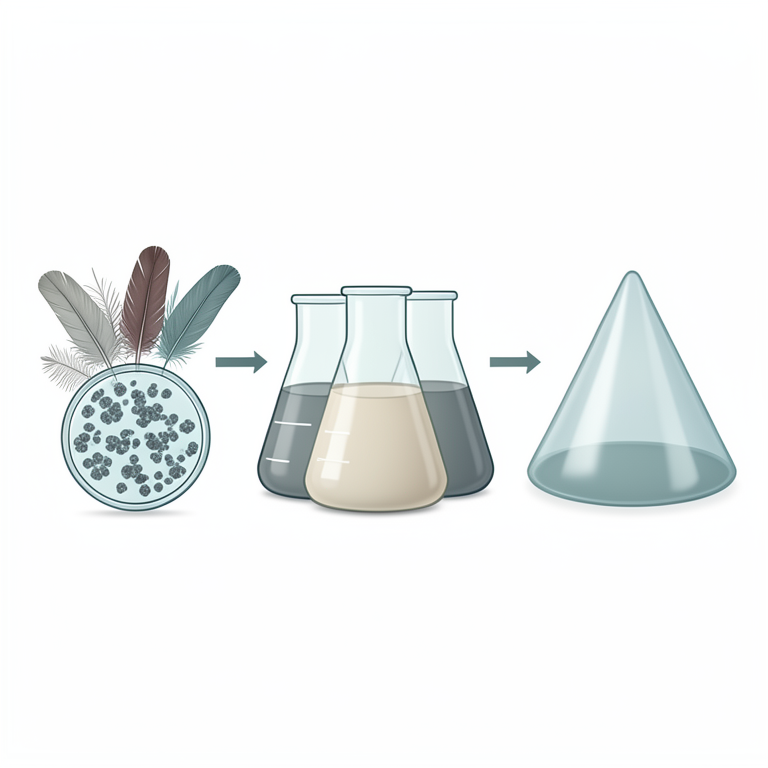
RSM Optimization Workflow
AI-generated conceptual illustration (Bacillus subtilis bacteria and chicken feathers in laboratory flasks). It explains the idea and does not show study data.
View source evidence ↗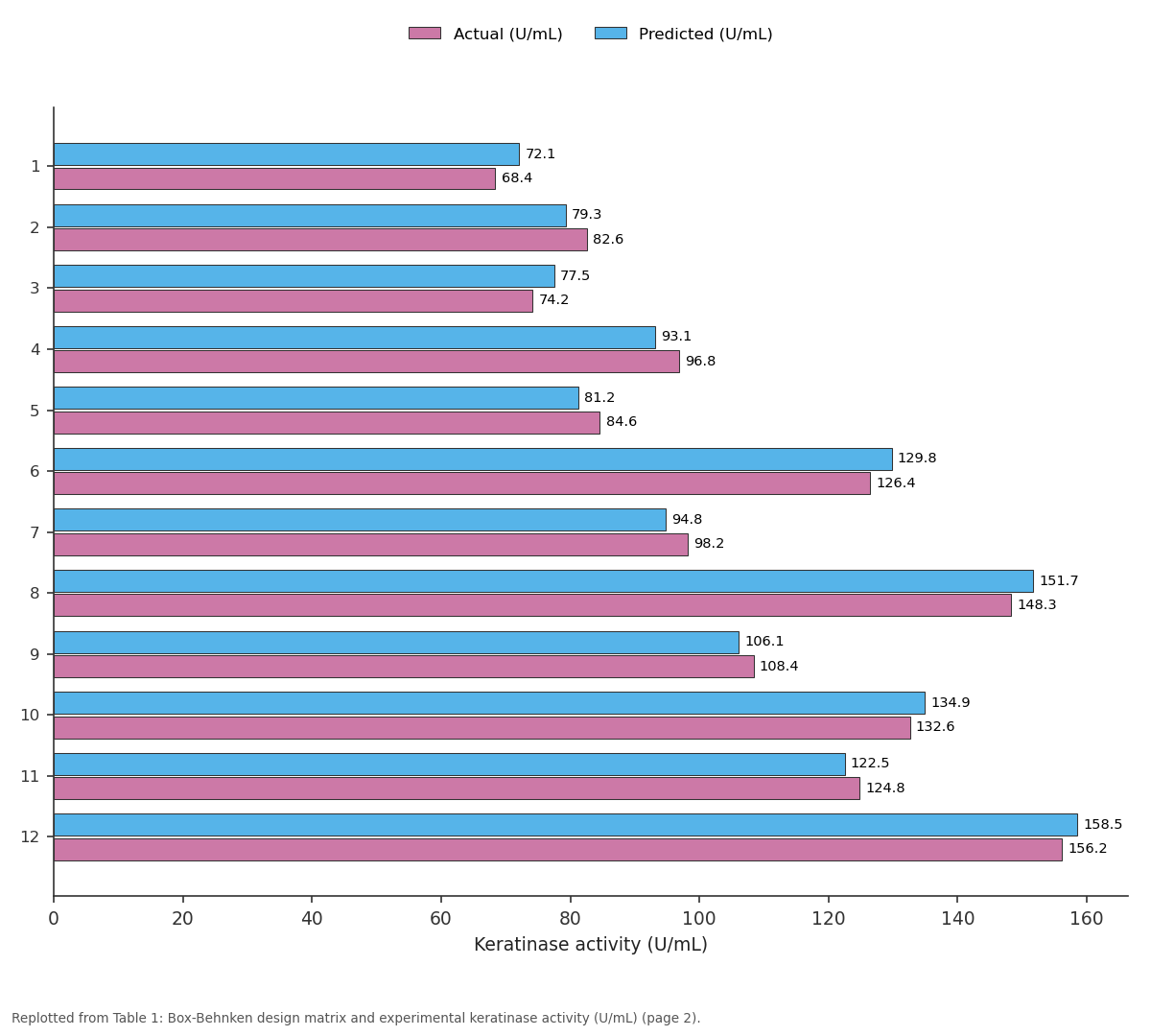
Actual (U/mL) and Predicted (U/mL): 1 vs 2 vs 3 vs 4 vs 5
Replotted from Table 1 (page 2) of the original paper. Every bar is the paper's own table value.
View source evidence ↗Figures & tables
From the original paper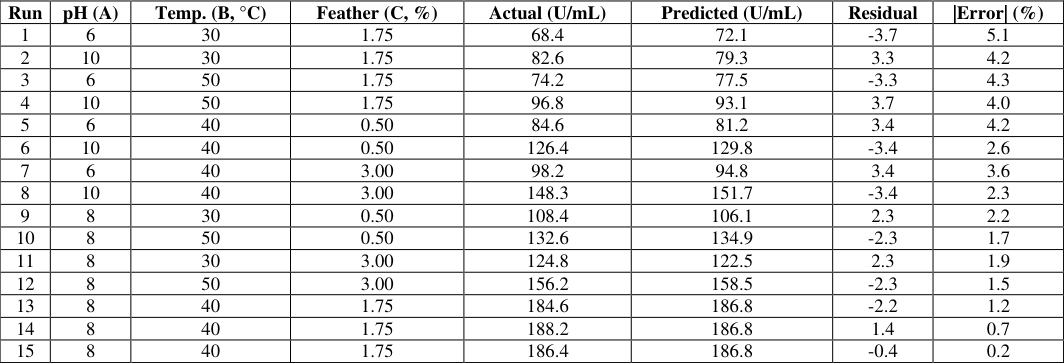 Table 1
 Table 2
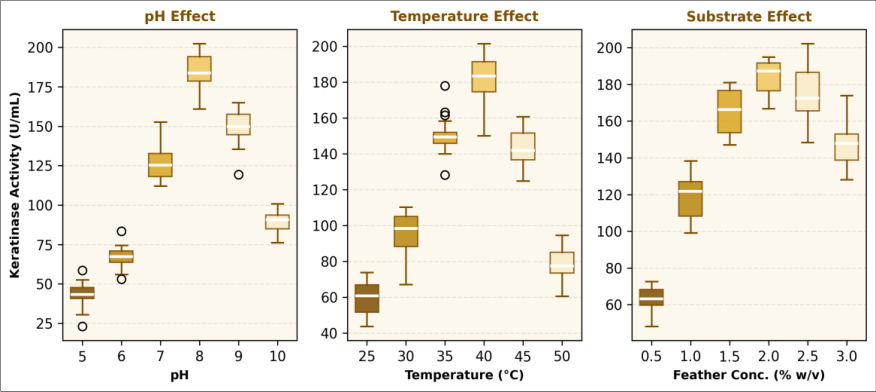 Figure 1
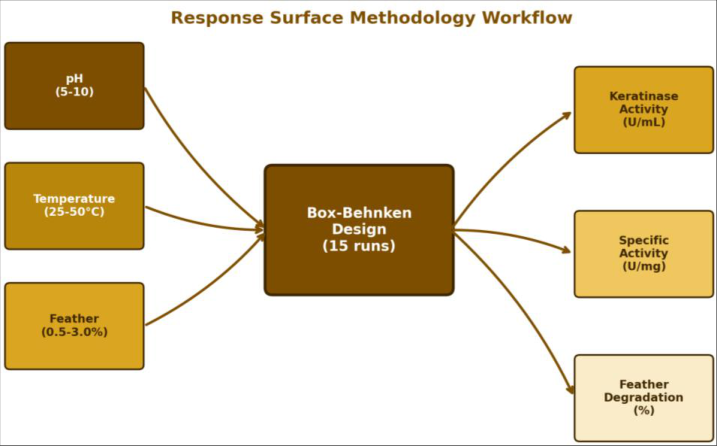 Figure 2
Introduction
In the world of industrial enzymology, keratinases occupy an unusual niche: they are among the few enzymes capable of degrading keratin, the fibrous structural protein that makes up feathers, hair, wool, hooves, and horns [1] . Keratin's resistance to common proteases trypsin, pepsin, papain stems from its dense network of disulfide bonds and tightly packed beta-sheet or alpha-helix secondary structures, which most proteolytic enzymes cannot penetrate [2] . Keratinases, produced mainly by Bacillus species, actinomycetes, and certain fungi, overcome this barrier through a combination of disulfide bond reduction (either enzymatic or via sulfite secretion) and proteolytic cleavage of the destabilized polypeptide chains [3,4] . The practical incentive for keratinase research is enormous. The global poultry industry generates roughly 8.5 billion kilograms of feather waste per year, most of which is either landfilled, incinerated, or converted to feather meal by energy-intensive hydrothermal processing at 140-150 °C [5] . Microbial keratinolysis offers a milder, more sustainable alternative that operates at 30-50 °C and atmospheric pressure, producing a protein hydrolysate that can serve as animal feed supplement, organic fertilizer, or a source of bioactive peptides [6,7] . Optimizing keratinase production is more complicated than for many other microbial enzymes because the substrate keratin is insoluble and particulate, meaning that mass transfer between the solid feather and the dissolved enzyme plays a role alongside the usual fermentation variables of pH, temperature, aeration, and nutrient composition [8] . Classical one-factor-at-a-time (OFAT) optimization is inefficient here because it cannot detect interactions: for example, the optimal pH may shift with temperature, or the optimal feather concentration may depend on the aeration rate [9] . Response surface methodology addresses this by fitting a polynomial model to a structured set of experiments that vary multiple factors simultaneously, allowing the researcher to visualize the response surface and locate the true optimum in the multidimensional space [10] . This research applied a Box-Behnken design to optimize keratinase production by Bacillus subtilis KS-17, an isolate recovered from poultry litter compost at a farm near Kuching, Sarawak, Malaysia. Three variables initial pH, temperature, and feather concentration were selected based on a preliminary screening that identified them as the most influential. All fermentation and analytical work was performed at the Department of Biological Chemistry, Rainforest Institute of Technology, Kuching, Sarawak, between August 2022 and May 2023 [11] .
Material and Methods
Material and Methods
Theoretical background
The Box-Behnken design is a class of rotatable second-order response surface design that requires three levels for each factor and uses a specific subset of the full factorial to reduce the number of experimental runs while still permitting estimation of all linear, quadratic, and two-way interaction terms [10,12] . For three factors, the design consists of 12 edge-midpoint runs plus three center-point replicates, totaling 15 runs. The response is modeled by a second-order polynomial: Y = β₀ + Σβᵢxᵢ + Σβᵢᵢxᵢ² + ΣΣβᵢⱼxᵢxⱼ, where Y is the predicted response (keratinase activity), xᵢ are the coded independent variables, and βᵢ, βᵢᵢ, βᵢⱼ are the regression coefficients estimated by least-squares fitting. Model adequacy is assessed by R², adjusted R², lack-of-fit test, and analysis of variance (ANOVA) [10] .
Material
Bacillus subtilis KS-17 was isolated from composted poultry litter collected at Sungai Apong Poultry Farm, Kuching (1.52°N, 110.38°E), Sarawak, Malaysia. The isolate was identified by 16S rRNA gene sequencing (99.4% similarity to B. subtilis strain 168, GenBank NR_102783). Chicken feathers were obtained fresh from a local wet market, washed three times with tap water, autoclaved at 121 °C for 15 min to sterilize without denaturing the keratin structure, and air-dried at 60 °C. Azokeratin (Sigma-Aldrich, Kuala Lumpur) served as the chromogenic substrate for keratinase assay. Peptone, yeast extract, K₂HPO₄, MgSO₄•7H₂O, NaCl, and other media components were from Merck (Darmstadt, Germany).
Methods
Methods
Fermentation conditions
Basal medium contained (g/L): K₂HPO₄ 0.3, KH₂PO₄ 0.4, NaCl 0.5, and chicken feather at the concentration specified by the design (0.5, 1.75, or 3.0% w/v) as the sole carbon and nitrogen source. The medium (50 mL in 250 mL flasks) was inoculated with 2% (v/v) seed culture (10⁸ CFU/mL) and incubated on a rotary shaker at 150 rpm for 72 hours at the temperature specified by the design. Initial pH was adjusted with 1 M NaOH or HCl before autoclaving. Culture supernatant was harvested by centrifugation (10,000 × g, 15 min, 4 °C) for enzyme assay.
Keratinase assay
Activity was measured using azokeratin as substrate [13] . A 1 mL aliquot of culture supernatant was mixed with 4 mL of 1% (w/v) azokeratin suspension in 50 mM glycine-NaOH buffer (pH 9.0) and incubated at 50 °C for 1 hour. The reaction was stopped with 4 mL of 10% (w/v) trichloroacetic acid. After centrifugation, absorbance of the supernatant was read at 440 nm. One unit (U) of keratinase was defined as the amount of enzyme that produced an increase of 0.01 in absorbance at 440 nm per minute.
Implementation details
The Box-Behnken design was generated using Design-Expert software version 13 (Stat-Ease, Minneapolis, MN, USA). Three factors were coded as: A = pH (6, 8, 10), B = temperature (30, 40, 50 °C), C = feather concentration (0.5, 1.75, 3.0% w/v). Fifteen runs were executed in randomized order over three independent batches. The ANOVA table, regression coefficients, 3D response surface plots, and optimization solutions were generated within Design-Expert. Model validation was performed by running three replicate flasks at the predicted optimum conditions and comparing the experimental mean to the predicted value. Feather degradation was evaluated by weighing residual feather material after 48 hours at the optimized conditions, with undegraded feather collected by filtration through a pre-weighed nylon mesh (100 μm), dried at 60 °C, and weighed. All work was performed at Rainforest Institute of Technology, Kuching, between August 2022 and May 2023. (F = 29.30), consistent with the known sensitivity of Bacillus keratinases to pH changes near their alkaline optima [4,8] .
Results
Results
Discussion
The optimized keratinase activity of 191.4 U/mL compares well with the 140-220 U/mL range reported for other Bacillus subtilis strains optimized by RSM. Pillai and Archana [8] obtained 178 U/mL for B. subtilis P13 using a central composite design, while Mazotto et al. [14] reported 215 U/mL for B. subtilis AMR using a Plackett-Burman/CCD sequential approach. Our single-step Box-Behnken design achieved a comparable result with only 15 runs, illustrating the efficiency of this design for three-factor problems [10,12] . The significant pH × temperature interaction (p = 0.008) has a practical explanation: at higher pH values (9-10), the enzyme is more active but also more susceptible to thermal inactivation, meaning that the optimal temperature shifts downward as pH rises. At pH 8, the enzyme tolerates 40 °C well, but at pH 10, the same temperature causes measurable activity loss over the 72-hour fermentation [3,4] . This interaction would have been invisible in a classical OFAT optimization, which underscores the value of the RSM approach.
The 87.3% feather degradation within 48 hours at the optimized conditions is a strong result for a nonsupplemented minimal medium where feathers are the sole carbon and nitrogen source. Brandelli et al. [6] reported 75-92% degradation for various Bacillus strains at comparable timeframes, with the variation depending mainly on feather pretreatment and agitation rate. Our feathers were autoclaved but not ground, making the degradation more representative of a real waste-processing scenario [7] . A practical limitation is that the Box-Behnken design examined only three variables. Other factors agitation speed, inoculum size, trace metal supplementation, and dissolved oxygen could also affect keratinase yields and would require additional RSM rounds or a screening step (such as Plackett-Burman) to evaluate [9,15] . The research also didn't purify the enzyme or determine its molecular weight or substrate specificity, which would be needed for industrial applications beyond bulk feather degradation.
Conclusion
Response surface methodology with a Box-Behnken design efficiently optimized keratinase production by Bacillus subtilis KS-17, identifying pH 8.2, 40 °C, and 2.1% chicken feather as the optimal conditions. The predicted maximum activity of 196.8 U/mL was experimentally confirmed at 191.4 ± 8.6 U/mL, representing a 97.3% match. The quadratic model (R² = 0.967) was statistically significant with a non-significant lack-of-fit, and ANOVA revealed a meaningful pH × temperature interaction that would not have been detected by conventional one-factor optimization. The optimized enzyme degraded 87.3% of intact chicken feathers within 48 hours, demonstrating the practical feasibility of using this strain for poultry waste bioconversion. For industrial scale-up, the next steps should include optimization of agitation and aeration in a bioreactor, enzyme purification and characterization, and economic analysis comparing the microbial process with conventional hydrothermal feather meal production.
Figures and tables from the paper
| Run | pH (A) | Temp. (B, °C) | Feather (C, %) | Actual (U/mL) | Predicted (U/mL) | Residual | |Error| (%) |
|---|---|---|---|---|---|---|---|
| 1 | 6 | 30 | 1.75 | 68.4 | 72.1 | -3.7 | 5.1 |
| 2 | 10 | 30 | 1.75 | 82.6 | 79.3 | 3.3 | 4.2 |
| 3 | 6 | 50 | 1.75 | 74.2 | 77.5 | -3.3 | 4.3 |
| 4 | 10 | 50 | 1.75 | 96.8 | 93.1 | 3.7 | 4.0 |
| 5 | 6 | 40 | 0.50 | 84.6 | 81.2 | 3.4 | 4.2 |
| 6 | 10 | 40 | 0.50 | 126.4 | 129.8 | -3.4 | 2.6 |
| 7 | 6 | 40 | 3.00 | 98.2 | 94.8 | 3.4 | 3.6 |
| 8 | 10 | 40 | 3.00 | 148.3 | 151.7 | -3.4 | 2.3 |
| 9 | 8 | 30 | 0.50 | 108.4 | 106.1 | 2.3 | 2.2 |
| 10 | 8 | 50 | 0.50 | 132.6 | 134.9 | -2.3 | 1.7 |
| 11 | 8 | 30 | 3.00 | 124.8 | 122.5 | 2.3 | 1.9 |
| 12 | 8 | 50 | 3.00 | 156.2 | 158.5 | -2.3 | 1.5 |
| 13 | 8 | 40 | 1.75 | 184.6 | 186.8 | -2.2 | 1.2 |
| 14 | 8 | 40 | 1.75 | 188.2 | 186.8 | 1.4 | 0.7 |
| 15 | 8 | 40 | 1.75 | 186.4 | 186.8 | -0.4 | 0.2 |
Table text extracted from the original PDF; superscript letters are shown inline. The original table image is below.
View original table image
| Source | Sum of Squares | df | Mean Square | F-value | p-value | Significance |
|---|---|---|---|---|---|---|
| Model | 24,168.4 | 9 | 2,685.4 | 16.28 | 0.003 | ** |
| A (pH) | 4,832.6 | 1 | 4,832.6 | 29.30 | 0.003 | ** |
| B (Temperature) | 3,648.2 | 1 | 3,648.2 | 22.12 | 0.005 | ** |
| C (Feather) | 1,284.6 | 1 | 1,284.6 | 7.79 | 0.038 | * |
| AB | 1,872.4 | 1 | 1,872.4 | 11.35 | 0.020 | * |
| Residual | 824.6 | 5 | 164.9 | |||
| Lack of Fit | 618.4 | 3 | 206.1 | 2.00 | 0.214 | NS |
| R² = 0.967 | Adj R² = 0.941 | Pred R² = 0.884 | C.V. = 3.84% |
Table text extracted from the original PDF; superscript letters are shown inline. The original table image is below.
View original table image
References
18 in the original paper- Gupta R, Ramnani P. Microbial keratinases and their prospective applications: an overview. Appl Microbiol Biotechnol. 2006;70(1):21-33.
- Bockle B, Galunsky B, Muller R. Characterization of a keratinolytic serine proteinase from Streptomyces pactum DSM 40530. Appl Environ Microbiol. 1995;61(10):3705-3710.
- Brandelli A. Bacterial keratinases: useful enzymes for bioprocessing agroindustrial wastes and beyond. Food Bioprocess Technol. 2008;1(2):105-116.
- Gupta R, Sharma R, Beg QK. Revisiting microbial keratinases: next generation proteases for sustainable biotechnology. Crit Rev Biotechnol. 2013;33(2):216228.
- Tesfaye T, Sithole B, Ramjugernath D, Chunilall V. Valorisation of chicken feathers: characterisation of chemical properties. Waste Manag. 2017;68:626-635.
- Brandelli A, Daroit DJ, Riffel A. Biochemical features of microbial keratinases and their production and applications. Appl Microbiol Biotechnol. 2010;85(6):1735-1750.
- Laba W, Rodziewicz A. Biodegradation of hard keratins by two Bacillus strains. Jundishapur J Microbiol. 2014;7(2):e8896.
- Pillai P, Archana G. Hide depilation and feather disintegration studies with keratinolytic serine protease from a novel Bacillus subtilis isolate. Appl Microbiol Biotechnol. 2008;78(4):643-650.
- Bezerra MA, Santelli RE, Oliveira EP, Villar LS, Escaleira LA. Response surface methodology (RSM) as a tool for optimization in analytical chemistry. Talanta. 2008;76(5):965-977.
- Myers RH, Montgomery DC, Anderson-Cook CM. Response surface methodology: process and product optimization using designed experiments. 4th ed. John Wiley & Sons; 2016. p. 1-856.
- Syed DG, Lee JC, Li WJ, Kim CJ, Agasar D. Production, characterization and application of keratinase from Streptomyces gulbargensis. Bioresour Technol. 2009;100(5):1868-1871.
- Ferreira SLC, Bruns RE, Ferreira HS, Matos GD, David JM, Brandao GC, et al. Box-Behnken design: an alternative for the optimization of analytical methods. Anal Chim Acta. 2007;597(2):179-186.
- Riffel A, Brandelli A. Keratinolytic bacteria isolated from feather waste. Braz J Microbiol. 2006;37(3):395399.
- Mazotto AM, Cedrola SML, Lins U, Rosado AS, Silva KT, Chaves JQ, et al. Keratinolytic activity of Bacillus subtilis AMR using human hair. Lett Appl Microbiol. 2010;50(1):89-96.
- Plackett RL, Burman JP. The design of optimum multifactorial experiments. Biometrika. 1946;33(4):305-325.
- Tiwary E, Gupta R. Medium optimization for a novel 58 kDa dimeric keratinase from Bacillus licheniformis ER-15. Biochem Eng J. 2010;51(1-2):38-45.
- Cai CG, Lou BG, Zheng XD. Keratinase production and keratin degradation by a mutant strain of Bacillus subtilis. J Zhejiang Univ Sci B. 2008;9(1):60-67.
- Daroit DJ, Correa APF, Brandelli A. Keratinolytic potential of a novel Bacillus sp. P45 isolated from the Amazon basin fish Piaractus mesopotamicus. Int Biodeterior Biodegrad. 2009;63(3):364-370.