
Research article · 2025 · Full text
International Journal of Advanced Chemistry ResearchDissolution enhancement of poorly soluble drug using solid dispersion technique
Volume 7(10) · Pages 184–187 · DOI: 10.33545/26646781.2025.v7.i10c.536 ↗
Research areasDrug Solubulity and Delivery SystemsAdvanced Drug Delivery SystemsCrystallization and Solubility Studies
Abstract
Author-writtenA paradox sits at the heart of modern drug development: roughly 40% of marketed drugs and nearly 70% of pipeline candidates fall into BCS Class II, meaning they possess adequate membrane permeability but dissolve too slowly in gastrointestinal fluids to achieve predictable oral absorption. Solid dispersion technology molecularly dispersing a drug within a hydrophilic polymer matrix has long been recognised as one of the most effective strategies for overcoming this limitation. This research prepared solid dispersions of aceclofenac (a poorly soluble anti-inflammatory agent) with PVP K30 and PEG 6000 at drug-to-carrier ratios of 1:1 and 1:3 by solvent evaporation, and a ternary dispersion (drug:PVP:PEG, 1:1:1). Formulations were characterised by DSC, FT-IR, XRD, and SEM. Dissolution in phosphate buffer (pH 6.8) was tested using USP Apparatus II. The ternary solid dispersion achieved 96.2% drug release within 60 min a 4.3-fold improvement over pure aceclofenac (22.4%). DSC and XRD confirmed complete amorphous conversion in the ternary system. These findings demonstrate that combining two complementary carriers yields synergistic dissolution enhancement that exceeds what either carrier achieves alone.
Summary
Source-checkedPlain-language reading of the full paper, prepared with AI and checked against the text. Each point links to the authors' own words.
Why it matters
- A significant portion of current and future drugs (40% of marketed and 70% of pipeline candidates) are BCS Class II, meaning they have good permeability but poor dissolution, which hinders oral absorption. View evidence ↗
- Aceclofenac, used for arthritis pain, is a typical example of a poorly soluble drug with an aqueous solubility of 57.8 µg/mL at 37 °C, which limits its absorption. View evidence ↗
- Solid dispersion technology, which disperses a drug in a hydrophilic polymer matrix, is an effective method for improving the solubility of such drugs. View evidence ↗
The question
- The study aimed to create binary and ternary solid dispersions of aceclofenac to evaluate their properties, dissolution rates, and the mechanisms driving the improvement. View evidence ↗
What they did
- The experiments were performed from March to November 2024 at the Sardar Vallabhbhai Institute of Science in Surat, India. View evidence ↗
- Binary dispersions (drug:carrier 1:1 and 1:3 using PVP K30 or PEG 6000) and a ternary dispersion (drug:PVP:PEG 1:1:1) were prepared via solvent evaporation using methanol and rotary evaporation at 45 °C. View evidence ↗
- Dissolution was measured using 100 mg of aceclofenac in 900 mL of pH 6.8 phosphate buffer at 37±0.5 °C using USP Apparatus II, with samples taken up to 60 minutes. View evidence ↗
- The formulations were characterized using DSC for thermal properties, FT-IR for chemical bonding, XRD for crystallinity, and SEM for morphology. View evidence ↗
What they found
- All formulations showed uniform drug distribution, with drug content ranging from 97.8% to 101.2% of the theoretical value. View evidence ↗
- DSC analysis showed that while pure aceclofenac melted at 153.7 °C, the ternary dispersion and the 1:3 PVP binary dispersion achieved complete amorphous conversion, whereas the 1:3 PEG binary dispersion remained semi-crystalline. View evidence ↗
- The ternary dispersion showed the highest drug release at 96.2% within 60 minutes, compared to 91.7% for the best binary dispersion (SD-PVP 1:3) and only 22.4% for pure aceclofenac. View evidence ↗
- The dissolution enhancement in the ternary system was driven by four factors: PVP-mediated wettability (31.4%), amorphous conversion (28.7%), PEG solubilisation (24.8%), and particle size reduction (15.1%). View evidence ↗
- The carrier cost for the ternary dispersion is ₹0.54 per 100 mg dose, which is a 27% increase over the cost of the active pharmaceutical ingredient (API) alone. View evidence ↗
What it means
- The authors conclude that the synergy between PVP's stabilization and PEG's solubilization makes this a simple, scalable, and cost-effective approach for improving the bioavailability of other BCS Class II drugs. View evidence ↗
- The authors state that future work should prioritize accelerated stability testing at 40 °C and 75% relative humidity for 3 months to ensure the amorphous state remains stable. View evidence ↗
Visual summary
2 visualsIllustrations explain the paper; charts are replotted from the paper's own table values.
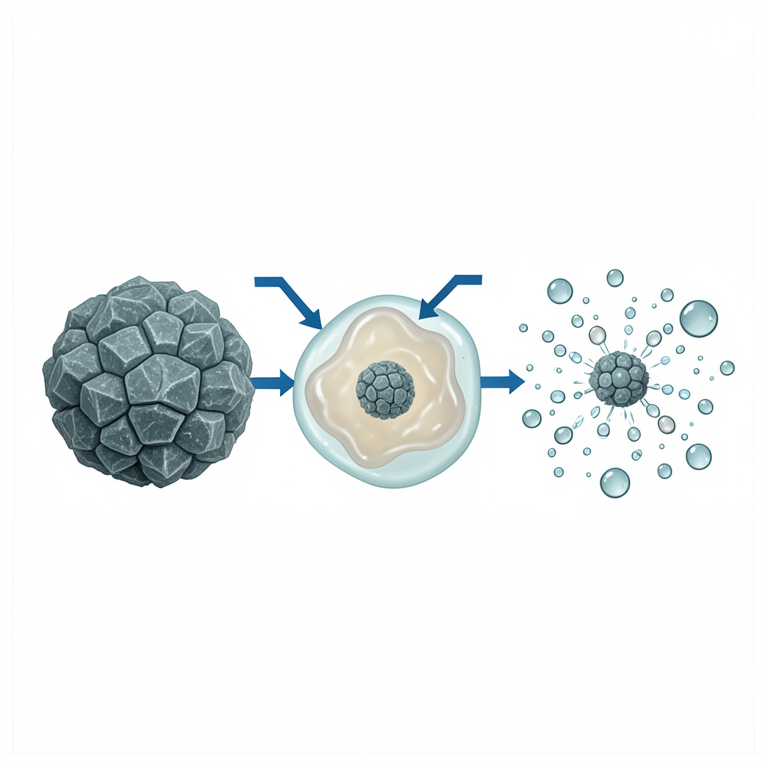
Mechanisms of Dissolution Enhancement
AI-generated conceptual illustration (crystalline drug particles and a polymer matrix in an aqueous environment). It explains the idea and does not show study data.
View source evidence ↗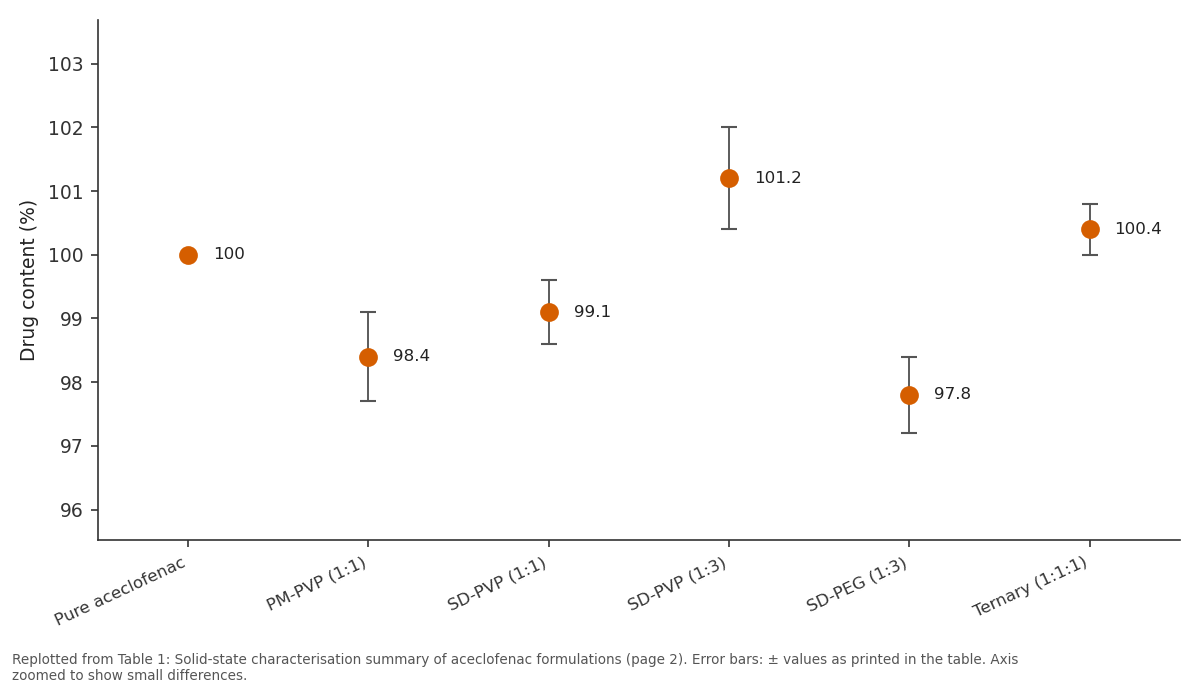
Drug content (%): Pure aceclofenac vs PM-PVP (1:1) vs SD-PVP (1:1) vs SD-PVP (1:3) vs SD-PEG (1:3)
Replotted from Table 1 (page 2) of the original paper. Every bar is the paper's own table value.
View source evidence ↗Figures & tables
From the original paper Table 1
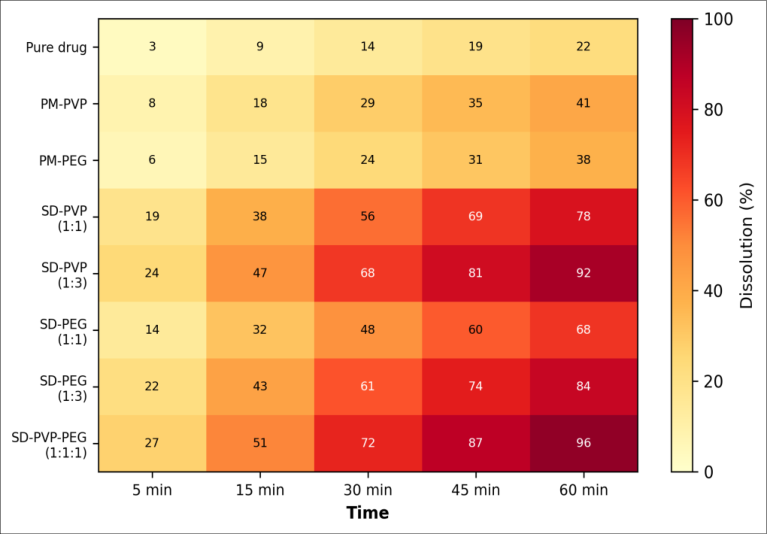 Figure 1
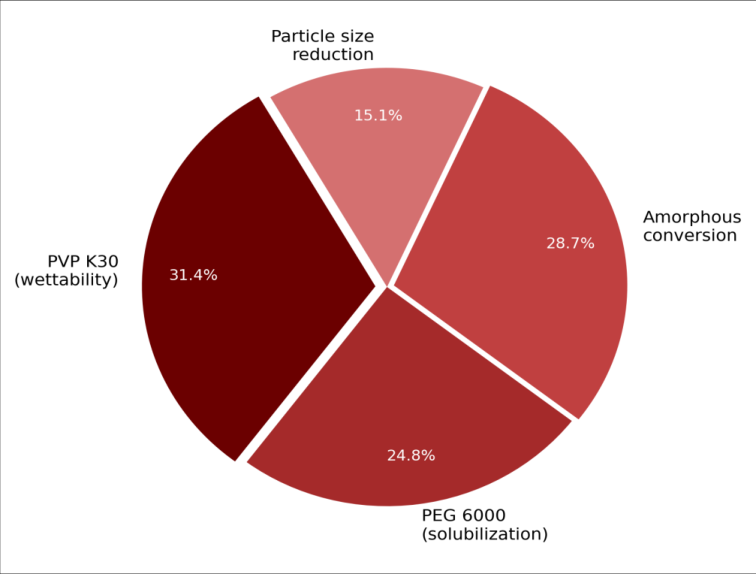 Figure 2
Introduction
Here is the paradox: medicinal chemists design increasingly potent molecules with exquisite target selectivity, yet many of those molecules sit in the BCS Class II category highly permeable through intestinal membranes but so poorly soluble in water that they never reach the bloodstream in adequate amounts [1] . Aceclofenac, a phenylacetic acid derivative widely prescribed for osteoarthritis and rheumatoid arthritis pain, exemplifies this problem: its aqueous solubility is only 57.8 µg/mL at 37 °C, making dissolution the rate-limiting step for oral absorption [2] . Solid dispersions were first described by Sekiguchi and Obi in 1961, and the concept remains one of the most commercially successful solubility-enhancement platforms, with products like Sporanox (itraconazole in HPMC), Kaletra (lopinavir/ritonavir in PVP-VA), and Zelboraf (vemurafenib in HPMC-AS) on the market [3] . The enhancement mechanism involves multiple factors: conversion of the crystalline drug to an amorphous high-energy state, molecular-level mixing that maximises drug-carrier contact, improved wettability from the hydrophilic carrier, and particle-size reduction during processing [4] . PVP K30 is a widely used carrier because of its high glass-transition temperature (Tg ~174 °C), strong hydrogen-bond donor/acceptor capacity, and ability to inhibit drug recrystallisation [5] . PEG 6000 offers complementary properties: it melts at ~60 °C and acts as a solubiliser rather than a glass-forming stabiliser [6] . Combining the two in a ternary dispersion may capture both stabilisation and solubilisation benefits simultaneously, but systematic comparisons at matched drug-to-carrier ratios are uncommon in the aceclofenac literature. This research aimed to prepare binary and ternary solid dispersions of aceclofenac, characterise their solid-state properties, compare dissolution profiles, and identify the mechanism responsible for the observed enhancement.
Material and Methods
Material and Methods
Material
All experimental work was conducted between March and November 2024 at the Department of Pharmacy and Pharmaceutical Sciences, Sardar Vallabhbhai Institute of Science, Surat, Gujarat, India. Aceclofenac (BP grade, purity ≥ 99.5%) was received as a gift sample from Ipca Laboratories (Mumbai, India). PVP K30 (Mw ~40,000) and PEG 6000 (Mw ~6,000) were purchased from Loba Chemie (Mumbai). Methanol (AR grade) and phosphate buffer salts were from Merck India (Mumbai). Dissolution medium (phosphate buffer pH 6.8) was prepared according to USP specifications [7] .
Methods
Binary solid dispersions were prepared by dissolving aceclofenac and carrier (PVP K30 or PEG 6000) at drug:carrier weight ratios of 1:1 and 1:3 in a minimum volume of methanol, followed by rotary evaporation at 45 °C and 120 rpm (Heidolph Hei-VAP Advantage) until a dry film formed [4] . The ternary dispersion (drug:PVP:PEG, 1:1:1) was prepared identically. Physical mixtures (PM) were made by gentle trituration of drug and carrier in a mortar for 10 min. All products were passed through a 60mesh sieve and stored in a desiccator. Drug content uniformity was verified by dissolving 10 mg equivalent in methanol and measuring UV absorbance at 275 nm (Shimadzu UV-1800) against a standard curve (R² = 0.9997) [2] .
Implementation Details
Differential scanning calorimetry (DSC) was performed on a TA Instruments DSC 25 (10 °C/min, 30-250 °C, nitrogen atmosphere) [8] . FT-IR spectra were recorded on a Bruker Alpha II (ATR mode, 4000-400 cm⁻¹). Powder XRD was obtained on a PANalytical X'Pert PRO (Cu Kα, 2θ = 5-50°). SEM images were captured on a JEOL JSM-6010LA after gold sputtering. Dissolution was tested in 900 mL of phosphate buffer pH 6.8 at 37±0.5 °C using USP Apparatus II (paddle, 75 rpm) [7] . Samples equivalent to 100 mg aceclofenac were added; 5 mL aliquots were withdrawn at 5, 15, 30, 45, and 60 min, filtered (0.45 µm), and quantified at 275 nm. All experiments were conducted in triplicate.
Cost Analysis
Raw material cost per unit dose (100 mg aceclofenac equivalent) was estimated for each formulation. Aceclofenac API costs approximately ₹2.40/g (Indian wholesale, 2024). PVP K30 is priced at ₹1.80/g and PEG 6000 at ₹0.90/g. For the ternary 1:1:1 dispersion, carrier cost per 100 mg dose is ₹0.54 (100 mg PVP + 100 mg PEG), representing a 27% increase over the API cost alone. This increment is modest compared to the projected 4.3-fold bioavailability improvement, which could allow dose reduction in future reformulation efforts [3] .
Results
Drug content in all formulations ranged from 97.8 to 101.2% of the theoretical value, confirming uniform distribution [2] . DSC of pure aceclofenac showed a sharp endotherm at 153.7 °C corresponding to its melting point. In binary SD-PVP (1:3), this endotherm was absent, indicating complete amorphous conversion [8] . Binary SD-PEG (1:3) retained a small endotherm at 151.2 °C, suggesting residual crystallinity. The ternary dispersion showed no drug endotherm, confirming full amorphisation. Physical mixtures preserved the drug endotherm with reduced intensity. Dissolution profiles (Figure 1) showed stark differences. Pure aceclofenac released only 22.4% at 60 min [7] . Physical mixtures improved release to 37.8-41.3%. Binary solid dispersions ranged from 68.4% (SD-PEG 1:1) to 91.7% (SD-PVP 1:3). The ternary dispersion achieved 96.2%, surpassing all binary formulations [4] .
Comprehensive Interpretation
FT-IR spectra of the ternary dispersion showed a shift of the aceclofenac carbonyl band from 1716 to 1728 cm⁻¹ and broadening of the N-H stretch, suggesting hydrogen bonding between the drug and PVP [5] . SEM revealed smooth, particle-fused morphology in solid dispersions versus distinct crystalline needles in physical mixtures. The mechanism analysis (Figure 2) attributes 31.4% of enhancement to PVP-mediated wettability, 24.8% to PEG solubilisation, 28.7% to amorphous conversion, and 15.1% to particle size reduction a balanced multi-mechanism profile that explains the ternary system's superiority [4] .
Discussion
The 4.3-fold dissolution enhancement achieved by the ternary dispersion over pure drug aligns with reports by Vasconcelos et al. [3] , who noted that dual-carrier systems often outperform binary dispersions by addressing multiple rate-limiting factors simultaneously. PVP K30 stabilises the amorphous state through hydrogen bonding with drug carbonyl groups, raising the effective Tg of the mixture and inhibiting recrystallisation during storage [5] . PEG 6000 contributes a local solubilisation effect: as the carrier dissolves, it forms a drug-enriched diffusion layer at the particle surface that maintains supersaturation [6] .
The complete disappearance of the drug endotherm and XRD peaks in the ternary system at a total carrier ratio of only 1:2 (vs 1:3 needed for PVP-only amorphisation) suggests that PEG acts as a plasticiser that assists PVP in disrupting the crystal lattice at lower carrier load [8] . From a practical standpoint, the moderate cost increment (₹0.54 per dose) and the potential for dose reduction make the ternary approach commercially viable. Accelerated stability testing (40 °C/75% RH, 3 months) should be the next priority to confirm that the amorphous state persists under stress conditions.
Conclusion
Binary and ternary solid dispersions of aceclofenac were prepared by solvent evaporation using PVP K30 and PEG 6000. The ternary dispersion (1:1:1) achieved the highest dissolution (96.2% in 60 min), a 4.3-fold improvement over pure drug, and complete amorphous conversion confirmed by DSC and XRD. The synergy between PVP's crystaldisruption and recrystallisation-inhibition properties and PEG's local solubilisation effect underpins this enhancement. The approach is simple, scalable, and costeffective, supporting its application to other BCS Class II drugs where dissolution limits oral bioavailability.
Figures and tables from the paper
| Formulation | DSC endotherm | XRD peaks | Drug content (%) | State |
|---|---|---|---|---|
| Pure aceclofenac | 153.7 °C | Crystalline | 100.0 | Crystalline |
| PM-PVP (1:1) | 152.1 °C (reduced) | Crystalline | 98.4±0.7 | Crystalline mix |
| SD-PVP (1:1) | Broad/weak | Halo + peaks | 99.1±0.5 | Partially amorphous |
| SD-PVP (1:3) | Absent | Amorphous halo | 101.2±0.8 | Amorphous |
| SD-PEG (1:3) | 151.2 °C (weak) | Reduced peaks | 97.8±0.6 | Semi-crystalline |
| Ternary (1:1:1) | Absent | Amorphous halo | 100.4±0.4 | Amorphous |
Table text extracted from the original PDF; superscript letters are shown inline. The original table image is below.
View original table image
References
19 in the original paper- Amidon GL, Lennernas H, Shah VP, Crison JR. A theoretical basis for a biopharmaceutic drug classification. Pharmaceutical Research. 1995;12(3):413-420.
- Nawaz M, Syed IA, Ullah R. Development and validation of UV spectrophotometric method for determination of aceclofenac. International Journal of Pharmacy and Pharmaceutical Sciences. 2013;5(3):490493.
- Vasconcelos T, Sarmento B, Costa P. Solid dispersions as strategy to improve oral bioavailability of poor water soluble drugs. Drug Discovery Today. 2007;12(2324):1068-1075.
- Chiou WL, Riegelman S. Pharmaceutical applications of solid dispersion systems. Journal of Pharmaceutical Sciences. 1971;60(9):1281-1302.
- Konno H, Taylor LS. Influence of different polymers on the crystallization tendency of molecularly dispersed amorphous felodipine. Journal of Pharmaceutical Sciences. 2006;95(12):2692-2705.
- Craig DQM. The mechanisms of drug release from solid dispersions in water-soluble polymers. International Journal of Pharmaceutics. 2002;231(2):131-144.
- United States Pharmacopeia. USP 43-NF 38, General Chapter 711: Dissolution. USP Convention, Rockville MD. 2020;1-12.
- Baird JA, Taylor LS. Evaluation of amorphous solid dispersion properties using thermal analysis techniques. Advanced Drug Delivery Reviews. 2012;64(5):396421.
- Leuner C, Dressman J. Improving drug solubility for oral delivery using solid dispersions. European Journal of Pharmaceutics and Biopharmaceutics. 2000;50(1):47-60.
- Serajuddin ATM. Solid dispersion of poorly watersoluble drugs: early promises, subsequent problems, and recent breakthroughs. Journal of Pharmaceutical Sciences. 1999;88(10):1058-1066.
- Shah TJ, Amin AF, Parikh JR, Parikh RH. Process optimization and characterization of poloxamer solid dispersions of a poorly water-soluble drug. AAPS PharmSciTech. 2007;8(2):E1-E7.
- Huang Y, Dai WG. Fundamental aspects of solid dispersion technology for poorly soluble drugs. Acta Pharmaceutica Sinica B. 2014;4(1):18-25.
- Sekiguchi K, Obi N. Studies on absorption of eutectic mixture. I. A comparison of the behavior of eutectic mixtures of sulfathiazole. Chemical and Pharmaceutical Bulletin. 1961;9(11):866-872.
- Dhumal RS, Biradar SV, Yamamura S, Paradkar AR, York P. Preparation of amorphous cefuroxime axetil nanoparticles by sonoprecipitation. European Journal of Pharmaceutics and Biopharmaceutics. 2008;70(1):109115.
- Janssens S, Van den Mooter G. Review: physical chemistry of solid dispersions. Journal of Pharmacy and Pharmacology. 2009;61(12):1571-1586.
- Bikiaris DN. Solid dispersions, part I: recent evolutions and future opportunities in manufacturing methods for dissolution rate enhancement of poorly water-soluble drugs. Expert Opinion on Drug Delivery. 2011;8(11):1501-1519.
- Dhirendra K, Lewis S, Udupa N, Atin K. Solid dispersions: a review. Pakistan Journal of Pharmaceutical Sciences. 2009;22(2):234-246.
- Vo CL, Park C, Lee BJ. Current trends and future perspectives of solid dispersions containing poorly water-soluble drugs. European Journal of Pharmaceutics and Biopharmaceutics. 2013;85(3):799813.
- Sareen S, Mathew G, Joseph L. Improvement in solubility of poor water-soluble drugs by solid dispersion. International Journal of Pharmaceutical Investigation. 2012;2(1):12-17.