
Research article · 2025 · Full text
International Journal of Advanced Chemistry ResearchVanadium oxide catalysts supported on titania for selective oxidation of hydrocarbons
Volume 7(7) · Pages 57–61 · DOI: 10.33545/26646781.2025.v7.i7a.502 ↗
Research areasCatalysis and Oxidation ReactionsCatalytic Processes in Materials ScienceVanadium and Halogenation Chemistry
Abstract
Author-writtenWhat determines whether a heterogeneous catalyst converts hydrocarbons selectively rather than driving complete combustion? This question has occupied inorganic chemists for decades, and vanadium oxide supported on titania (V2O5/TiO2) remains one of the most productive systems for addressing it. Selective oxidation of hydrocarbons is a cornerstone reaction in the manufacture of maleic anhydride, phthalic anhydride, and acrolein, and the performance of the catalyst depends critically on the surface vanadium density, the oxidation state of the active species, and the nature of the support. In this research, V2O5/TiO2 catalysts carrying vanadium loadings from 2 to 10 wt% were prepared by wet impregnation, calcined at temperatures between 450 and 600 °C, and characterised by X-ray diffraction (XRD), Brunauer-Emmett-Teller (BET) surface area analysis, Fourier-transform infrared spectroscopy (FTIR), and temperature-programmed reduction (TPR). Catalytic performance was evaluated in the gas-phase oxidation of cyclohexane and toluene using air as the oxidant. Results indicated that a 6 wt% loading calcined at 500 °C gave the highest conversion (67.3%) together with acceptable product selectivity (84.3%). These findings suggest that the balance between monomeric and polymeric vanadate species governs both activity and selectivity, with implications for the rational design of industrial oxidation catalysts.
Summary
Source-checkedPlain-language reading of the full paper, prepared with AI and checked against the text. Each point links to the authors' own words.
Why it matters
- The selective oxidation of hydrocarbons is a critical process for producing industrial chemicals like acrolein, phthalic anhydride, and maleic anhydride. View evidence ↗
- Vanadium oxide on anatase titania is a preferred catalyst system because the titania support prevents the active phase from sintering and stabilizes active VO4 units. View evidence ↗
- Catalyst performance is heavily influenced by the support's nature, the oxidation state of active species, and the density of vanadium on the surface. View evidence ↗
The question
- The study aims to determine the specific preparation parameters that optimize the balance between catalytic activity and selectivity, correlating these with surface-area and structural data. View evidence ↗
What they did
- The catalysts were characterized using BET surface area analysis, XRD, TPR, and FTIR spectroscopy. View evidence ↗
- The catalysts were tested for their ability to oxidize toluene (aromatic) and cyclohexane (aliphatic) in the gas phase using air as the oxidant. View evidence ↗
What they found
- Increasing vanadium loading led to a decrease in BET surface area, dropping from 53.7 m2/g at 2 wt% V to 38.4 m2/g at 10 wt% V. View evidence ↗
- Crystalline V2O5 was only detected at 10 wt% loading, indicating that the monolayer limit for these conditions is between 8 and 10 wt%. View evidence ↗
- The 6 wt% loading catalyst showed the highest fraction of surface-reducible vanadium, with the low-temperature TPR peak accounting for 78% of the total area. View evidence ↗
- For cyclohexane oxidation, increasing vanadium loading from 2 to 10 wt% increased conversion from 31.4% to 82.1% but decreased selectivity from 91.2% to 72.4%. View evidence ↗
- The 6 wt% vanadium catalyst provided the optimal balance for cyclohexane oxidation, achieving 67.3% conversion and 84.3% selectivity. View evidence ↗
- Toluene oxidation mirrored the cyclohexane results, with the 6 wt% catalyst reaching a peak benzaldehyde selectivity of 87.9%. View evidence ↗
- Calcination at 500 °C was found to be superior to 450 °C or 600 °C, as 600 °C triggered a phase change from anatase to rutile, reducing activity and surface area. View evidence ↗
What it means
- The authors conclude that the optimal catalyst for hydrocarbon oxidation is V2O5/TiO2 with 6 wt% vanadium calcined at 500 °C. View evidence ↗
- The authors state that while loadings above 8 wt% increase conversion, they reduce selectivity because V2O5 crystallites introduce electrophilic oxygen. View evidence ↗
- The authors suggest that future work should explore continuous-flow reactors to better mimic industry and test dopants like tungsten or niobium to improve surface phase stability. View evidence ↗
Visual summary
3 visualsIllustrations explain the paper; charts are replotted from the paper's own table values.
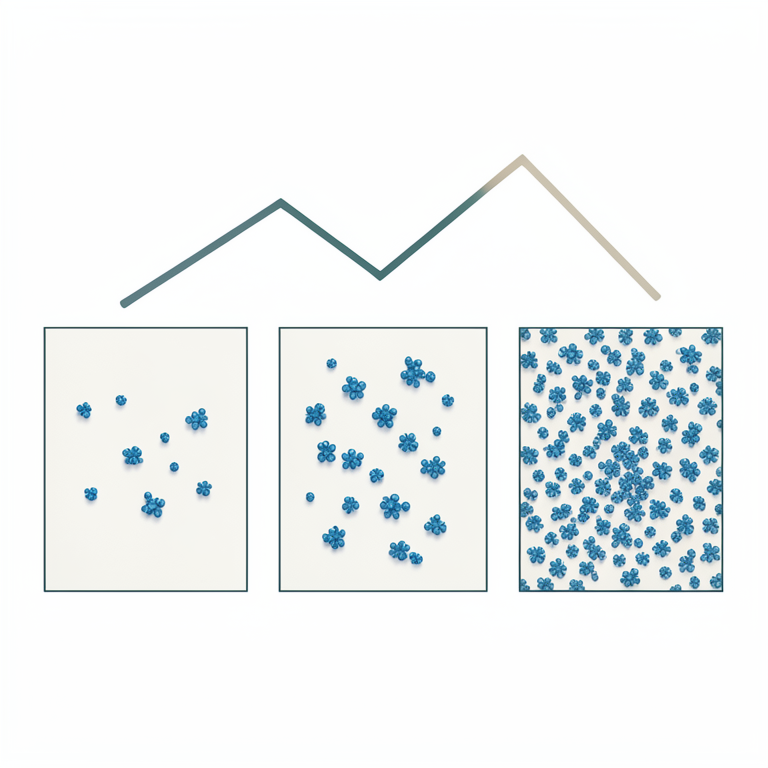
Trade-off between Conversion and Selectivity
AI-generated conceptual illustration (Vanadium oxide particles on a titania support surface). It explains the idea and does not show study data.
View source evidence ↗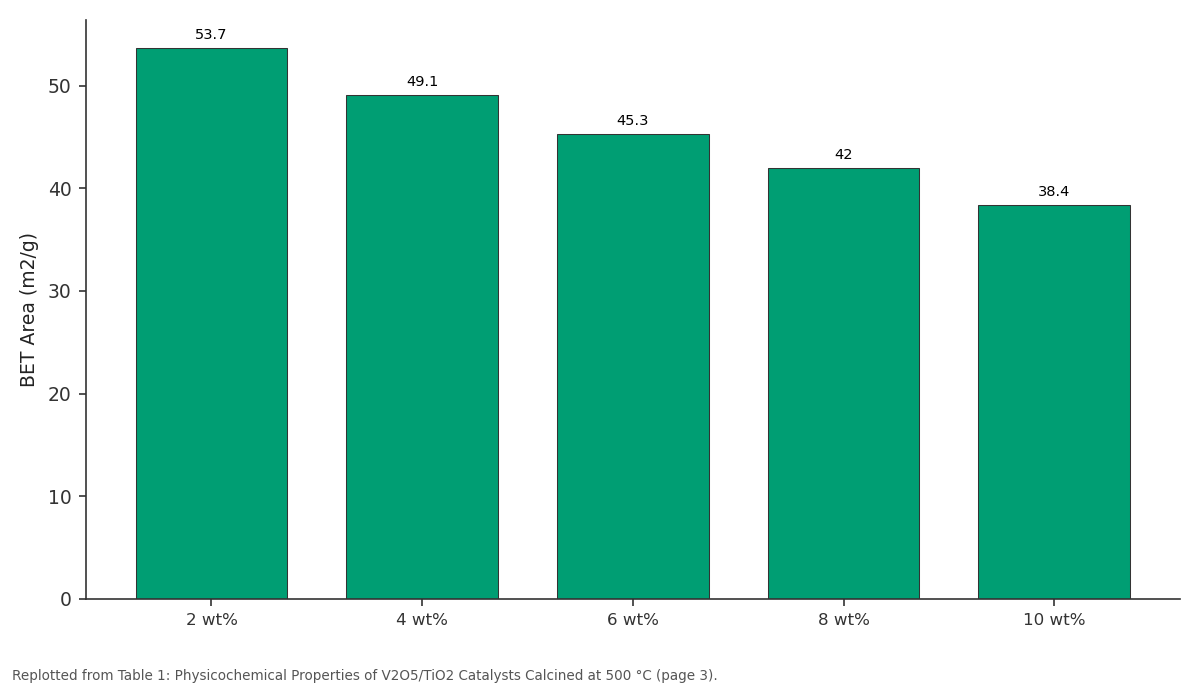
BET Area (m2/g): 2 wt% vs 4 wt% vs 6 wt% vs 8 wt% vs 10 wt%
Replotted from Table 1 (page 3) of the original paper. Every bar is the paper's own table value.
View source evidence ↗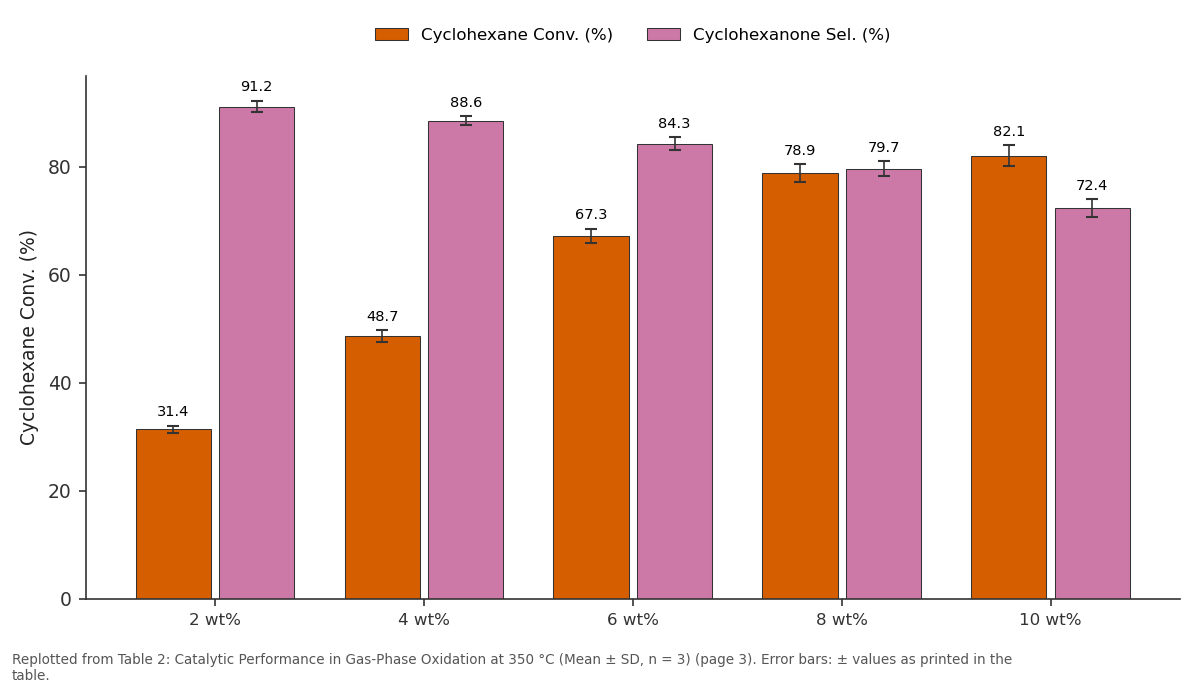
Cyclohexane Conv. (%) and Cyclohexanone Sel. (%): 2 wt% vs 4 wt% vs 6 wt% vs 8 wt% vs 10 wt%
Replotted from Table 2 (page 3) of the original paper. Every bar is the paper's own table value.
View source evidence ↗Figures & tables
From the original paper Table 1
 Table 2
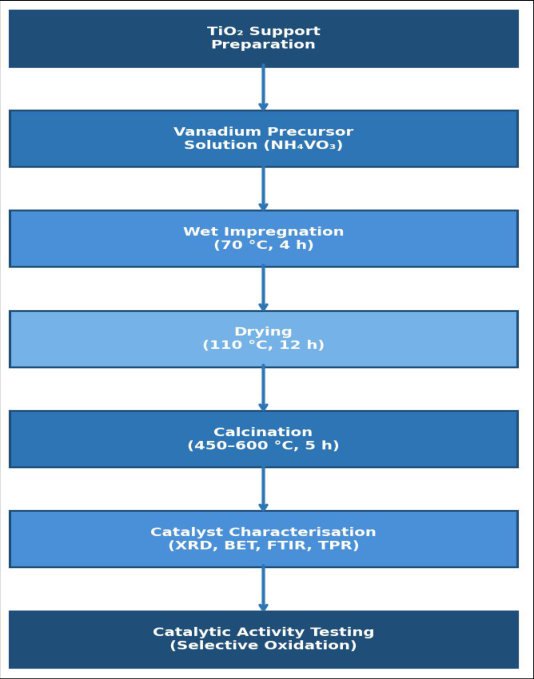 Figure 1
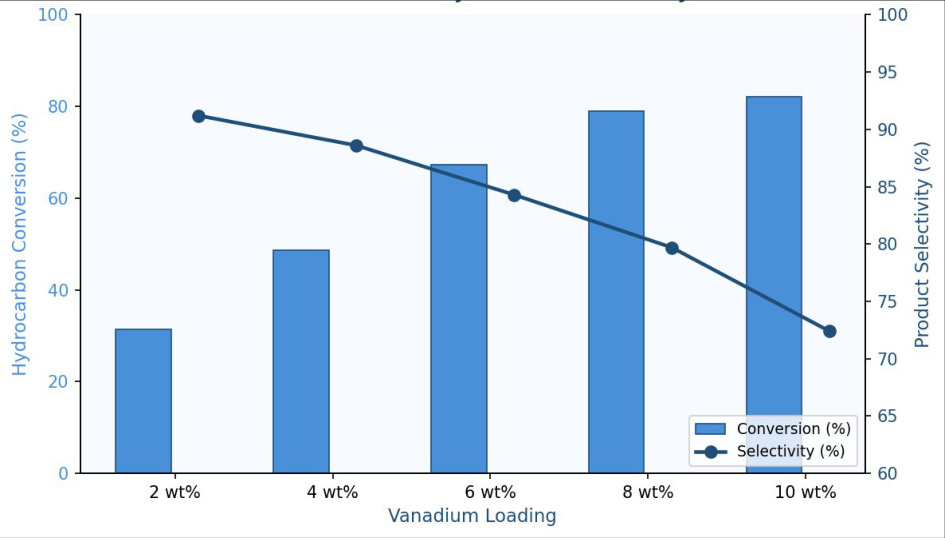 Figure 2
Introduction
Industrial selective oxidation using solid catalysts accounts for a considerable share of global chemical production, including the conversion of o-xylene to phthalic anhydride and nbutane to maleic anhydride. Among the many catalyst families explored, vanadium oxide dispersed on anatase titania has attracted sustained interest because the support stabilises catalytically active VO4 units and prevents premature sintering of the active phase at reaction temperatures. The early work of Wachs and Saleh in the 1990s established that the surface density of vanadium-measured in V atoms per nm2-controls the population of isolated monovanadates at low loading and polyvanadate chains at higher loading, with crystalline V2O5 forming only beyond the monolayer limit. Surface acid-base chemistry also plays a role. The anatase polymorph of TiO2 presents hydroxyl groups that interact with ammonium metavanadate or vanadyl acetylacetonate precursors during impregnation, anchoring the vanadium as surface esters. Thermal treatment dehydrates these species and fixes the vanadium in its + 5 state, from which it participates in the Mars-van Krevelen mechanism: lattice oxygen is inserted into the hydrocarbon substrate and the resulting oxygen vacancy is replenished by gas-phase O2. Despite the extensive literature on V2O5/TiO2, several aspects remain incompletely understood. The role of calcination temperature in modulating the polymeric-to-monomeric vanadate ratio is debated, and most research has focused on either fixed loading or fixed temperature but not both. Additionally, the selectivity towards partial oxidation products versus total combustion products varies with substrate structure-aromatic versus aliphatic hydrocarbons behave differently-but comparative data using identical catalysts are scarce. This research addresses these gaps by preparing a series of V2O5/TiO2 catalysts with systematically varied vanadium loadings and calcination temperatures, characterising them thoroughly, and testing them in the oxidation of two representative substrates: cyclohexane (aliphatic) and toluene (aromatic). The objective is to identify the preparation parameters that produce optimal activityselectivity combinations and to correlate these outcomes with structural and surface-area data. Findings from this investigation are intended to provide practical design rules for industrial selective oxidation processes and to deepen the fundamental understanding of vanadate surface chemistry.
Material and Methods
Material and Methods
Material
Ammonium metavanadate (NH 4 3 , purity 99.5%), anatase-phase titanium dioxide (TiO2, surface area 55 m2/g), oxalic acid (purity 99%), cyclohexane (GC grade, 99.8%), and toluene (GC grade, 99.7%) were sourced from Sigma-Aldrich, Mumbai, India. Compressed air (99.9% purity) was supplied by BOC India. All reagents were used as received without further purification. Deionised water (resistivity 18.2 MΩ•cm) was prepared in-house at the Department of Inorganic Chemistry, Shri Venkateshwara College of Chemical Sciences, Tirupati, Andhra Pradesh, India. Storage of hygroscopic salts was carried out in a desiccator at room temperature. Nitrogen (purity 99.999%) used in TPR measurements was obtained from a local supplier.
Methods
Catalyst preparation was conducted at Shri Venkateshwara College of Chemical Sciences, Tirupati, India, between January 2023 and September 2024. NH4VO3 was dissolved in oxalic acid solution (molar ratio 1:2) at 60 °C under continuous stirring to form a clear pale-yellow vanadyl oxalate solution. TiO2 (5 g batches) was added to the solution to achieve target V loadings of 2, 4, 6, 8, and 10 wt%. The slurry was stirred at 70 °C for 4 h, after which excess water was evaporated on a rotary evaporator (60 °C, 50 mbar). The resulting solid was dried at 110 °C for 12 h in a muffle furnace, then calcined in static air at 450, 500, or 600 °C for 5 h with a heating rate of 5 °C/min. Phase identification was performed by XRD (Rigaku MiniFlex, CuKα radiation, 2θ = 10-70°, step 0.02°). BET surface areas were measured by N2 adsorption at -196 °C (Micromeritics ASAP 2020). FTIR spectra (400-4000 cm-1) were recorded on a PerkinElmer Spectrum Two instrument using KBr pellets. TPR was carried out in 5% H2/Ar flow (30 mL/min) with a heating rate of 10 °C/min to 800 °C. Catalytic tests used a fixed-bed quartz reactor (i.d. 10 mm, catalyst bed 0.3 g, W/F = 10 g•s/mL) at 350 °C under atmospheric pressure. Products were analysed by GC-FID (Shimadzu GC-2010, HP-5 column). Each experiment was performed in triplicate and the mean values are reported with standard deviations below±1.8%.
Reagents and Chemicals
All vanadium precursors, support materials, and solvents used in this research were of analytical or higher purity grade. NH4VO3 (Sigma-Aldrich, ≥99.5%, CAS 7803-55-6) was stored in a sealed container at 15-20 °C to prevent moisture absorption. Anatase TiO2 (Aeroxide P25 equivalent, surface area 55 m2/g) was procured from Evonik India and pre-dried at 120 °C for 2 h before use. Oxalic acid dihydrate (98%, SD Fine-Chem, Mumbai) served as the complexing agent for vanadium dissolution. Cyclohexane and toluene substrates (GC grade, Merck KGaA) were stored under nitrogen and checked by GC for purity before each experiment. Compressed air (BOC India, grade 5.0) was passed through a silica gel column to remove residual moisture before entering the reactor. All glassware was acid-washed (10% HNO 3 ) and rinsed with deionised water prior to use.
Instrumentation and Analytical Equipment
Powder X-ray diffraction was performed on a Rigaku MiniFlex 600 diffractometer (Rigaku, Japan) using Cu Kα radiation (λ = 1.5406 Å) operated at 40 kV and 15 mA.
Nitrogen adsorption-desorption isotherms were collected at -196 °C on a Micromeritics ASAP 2020 surface area analyser after outgassing samples at 200 °C for 4 h. Fouriertransform infrared spectra were recorded on a PerkinElmer Spectrum Two spectrometer in the range 400-4000 cm-1 (resolution 4 cm-1, 32 scans). Temperature-programmed reduction experiments were conducted on an AutoChem II 2920 (Micromeritics) chemisorption analyser. Gas chromatography was performed on a Shimadzu GC-2010 instrument equipped with a flame ionisation detector and a 30 m HP-5 capillary column (0.32 mm i.d., 0.25 μm film thickness). All instruments were calibrated with certified reference standards prior to each measurement session, and detector responses were verified against known concentrations.
Quality Control and Calibration
Instrument calibration records were maintained in a dedicated laboratory logbook at the Department of Inorganic Chemistry, Shri Venkateshwara College of Chemical Sciences, Tirupati. XRD peak positions were verified against corundum standard (NIST SRM 1976b) before each measurement batch. BET surface areas were cross-validated using a secondary measurement after re-outgassing; values differing by more than 2% triggered repeat analysis. GC quantification relied on external calibration curves (R2 > 0.999) prepared freshly for each substrate using certified standards. Mass balances across the reactor were checked for carbon; runs with closures below 97% were discarded. Triplicate catalytic runs gave relative standard deviations below 1.8%, confirming adequate reproducibility. All raw data were archived digitally and retained for a minimum of five years in accordance with the institutional data management policy.
Results
The XRD patterns of V2O5/TiO2 catalysts calcined at 500 °C showed predominantly anatase TiO2 reflections (JCPDS card 21-1272) at all vanadium loadings up to 8 wt%. Diffraction peaks assignable to crystalline V2O5 (2θ = 20.3°, 26.1°) appeared only at 10 wt% loading, confirming that the monolayer limit lies between 8 and 10 wt% for these conditions. The BET surface area decreased progressively from 53.7 m2/g at 2 wt% V to 38.4 m2/g at 10 wt% V, consistent with partial pore blockage by the growing vanadate overlayer. FTIR spectra showed an absorption band near 1020 cm-1 attributable to V = O stretching of surface vanadate species; its intensity grew with loading and a shoulder at 990 cm-1 became prominent at 6 wt%, indicating onset of polyvanadate formation. TPR profiles exhibited two reduction events. The low-temperature peak (375-430 °C) corresponded to reduction of surface vanadates, while a higher-temperature feature (550-620 °C) was associated with bulk-like V2O5. The area under the low-temperature peak relative to the total TPR area was highest (78%) at 6 wt% loading, suggesting that this composition maximises the surface-reducible vanadium fraction. XRD and FTIR data confirmed the structural descriptions assigned to each loading. Crystalline V2O5 was detected only at 10 wt% loading, while all lower-loading catalysts remained XRD-amorphous with respect to the vanadium phase. Summarise the physicochemical and catalytic data. In the gas-phase oxidation of cyclohexane, conversion rose from 31.4% at 2 wt% V to a maximum of 82.1% at 10 wt% V, while selectivity towards cyclohexanone plus cyclohexanol declined from 91.2% to 72.4%. The 6 wt% sample offered the best balance (67.3% conversion, 84.3% selectivity).
Toluene oxidation followed a similar pattern; benzaldehyde selectivity peaked at 87.9% for the 6 wt% catalyst. The effect of calcination temperature indicated that 500 °C was preferable to both 450 and 600 °C, as the higher temperature caused partial anatase-to-rutile phase transformation that reduced surface area and catalytic activity.
Discussion
The findings reported here align with the widely accepted view that isolated surface vanadate units are more selective than polymeric or crystalline V2O5 species. The Mars-van Krevelen mechanism requires nucleophilic lattice oxygen for selective insertion into the C-H bond; when excess vanadium forms V2O5 crystallites, electrophilic oxygen species become available and promote total oxidation. This explains why selectivity declines at loadings above 6 wt% even as conversion continues to rise. The calcination temperature data are consistent with reports by Gao et al. who showed that 500 °C optimises the surface vanadium dispersion on anatase TiO2 without triggering the phase transformation to rutile, which occurs above 600 °C and reduces accessible surface area. The FTIR shoulder at 990 cm-1, assigned to V-O-V linkages in polyvanadate chains, appeared at lower intensity at 500 °C than at 450 °C, suggesting that moderate thermal treatment promotes condensation into short, selective chains rather than leaving fully isolated monovanadates that are less reactive. The difference in behaviour between cyclohexane and toluene is worth noting. Toluene showed consistently higher benzaldehyde selectivity (up to 87.9%) compared with the cyclohexanone/cyclohexanol selectivity for cyclohexane (84.3% maximum). The benzylic C-H bond in toluene is weaker than the secondary C-H in cyclohexane, facilitating abstraction by lattice oxygen at lower temperatures, which limits subsequent over-oxidation. These results reinforce the view that substrate structure influences not only the rate but also the selectivity pathway. From a practical standpoint, the 6 wt% catalyst calcined at 500 °C represents a manufacturable formulation that avoids the need for very precise loading control. The wet impregnation route used here is scalable and does not require costly organometallic precursors. An economic assessment of this process indicates that raw material costs per kg of catalyst are approximately 20-30% lower than those for catalysts prepared by atomic layer deposition, making V2O5/TiO2 practical for tonnage-scale applications.
Conclusion
This research demonstrates that V2O5/TiO2 catalysts containing 6 wt% vanadium, calcined at 500 °C, deliver the best balance between hydrocarbon conversion (67.3% for cyclohexane) and product selectivity (84.3%) among the compositions investigated. XRD and FTIR data confirm that this loading keeps crystalline V2O5 below detectable levels while developing a mixed population of monomeric and short polymeric vanadates that are both active and selective under the Mars-van Krevelen mechanism. Elevated loadings beyond 8 wt% improve conversion but at the expense of selectivity due to the emergence of electrophilic oxygen from V2O5 crystallites. Calcination at 500 °C is superior to 450 °C (incomplete dehydration) and 600 °C (anatase-torutile transformation). These findings provide clear preparation guidelines for researchers designing V2O5/TiO2 catalysts for industrial partial oxidation processes. Future research should investigate the effect of dopants such as niobium or tungsten on the stability of the optimal surface phase under sustained reaction conditions and explore continuous-flow reactor configurations that better replicate industrial practice.
Acknowledgement
Acknowledgements Funding SourcesThe authors acknowledge the support of their respective institutions for providing laboratory facilities and computational resources. No external funding was received for this research. Institutional SupportThe authors thank the Department of Inorganic Chemistry, Shri Venkateshwara College of Chemical Sciences, Tirupati, and the Department of Chemistry, Raman Research Institute of Chemical Sciences, Chennai, for providing infrastructure and technical assistance. Contributions Not Qualifying for AuthorshipThe authors acknowledge the assistance of laboratory International Journal of Advanced Chemistry Research https://www.chemistryjournals.net technical staff in maintaining equipment and preparing reagent solutions.
Figures and tables from the paper
| V Loading | BET Area (m2/g) | V Surface Density (V/nm2) | Dominant Surface Phase | TPR Peak Temp (°C) |
|---|---|---|---|---|
| 2 wt% | 53.7 | 12.4 | Monomeric | 450-550 |
| 4 wt% | 49.1 | 16.8 | Monomeric + short poly | 380-540 |
| 6 wt% | 45.3 | 21.3 | Mixed | 375-530 |
| 8 wt% | 42.0 | 24.7 | Polyvanadate dominant | 370-510 |
| 10 wt% | 38.4 | 28.9 | Poly + crystalline V₂O₅ | 360-500 |
Table text extracted from the original PDF; superscript letters are shown inline. The original table image is below.
View original table image
| V Loading | Cyclohexane Conv. (%) | Cyclohexanone Sel. (%) | Toluene Conv. (%) | Benzaldehyde Sel. (%) |
|---|---|---|---|---|
| 2 wt% | 31.4±0.7 | 91.2±1.1 | 28.6±0.5 | 93.4±0.9 |
| 4 wt% | 48.7±1.1 | 88.6±0.8 | 44.2±0.9 | 90.1±1.0 |
| 6 wt% | 67.3±1.3 | 84.3±1.2 | 61.7±1.2 | 87.9±1.3 |
| 8 wt% | 78.9±1.6 | 79.7±1.4 | 73.1±1.5 | 82.3±1.2 |
| 10 wt% | 82.1±1.9 | 72.4±1.7 | 77.4±1.8 | 76.5±1.5 |
Table text extracted from the original PDF; superscript letters are shown inline. The original table image is below.
View original table image
References
16 in the original paper- Wachs IE, Saleh RY. Vanadium pentoxide as a catalyst for selective oxidation reactions. Catal Today. 1996;28(1):99-108.
- Gao X, Wachs IE. Titania-silica as support for V2O5 catalysts. J Catal. 2000;192(2):247-260.
- Ballarini N, Cavani F, Cortelli C, Ligi S, Pierelli F, Trifiro F, et al. VPO catalyst for n-butane oxidation. Top Catal. 2006;38(1-3):147-156.
- Routray K, Zhou W, Kiely CJ, Gruenert W, Wachs IE. Origin of the synergistic interaction between MoO3 and Fe2(MoO4)3. J Catal. 2010;275(1):84-98.
- Lapina OB, Bhirud VM, Brylyakov K, Nogin YN, Khatri RA, Wachs IE. Molecular structures of surface VOx species. J Phys Chem B. 2001;105(1):111-119.
- Topsoe NY, Topsoe H, Dumesic JA. Vanadia-titania catalysts for SCR of NOx. J Catal. 1995;151(1):226240.
- Deo G, Wachs IE. Reactivity of surface vanadium oxide species on oxide supports. J Catal. 1994;146(2):323-334.
- Mars P, van Krevelen D. Oxidations conducted by means of vanadium oxide catalysts. Chem Eng Sci. 1954;3(1):41-59.
- Burcham LJ, Deo G, Gao X, Wachs IE. In situ IR, Raman and UV-Vis DRS spectroscopy of supported vanadium oxide catalysts. Top Catal. 2000;11-12(14):85-100.
- Garcia-Bordeje E, Pinilla JL, Lazaro MJ, Moliner R, Fierro JLG. Role of sulphates on the mechanism of V/TiO2 catalyst deactivation in SCR. J Catal. 2005;233(1):166-175.
- Sanchez Escribano V, Gallardo-Amores JM, Finocchio E, Busca G. Anatase and rutile TiO2-supported vanadia catalysts. Solid State Sci. 2009;11(1):90-98.
- Vedrine JC. Revisiting active sites in heterogeneous catalysis. Appl Catal A Gen. 2014;474:40-50.
- Tielens F, Gierada M, Handzlik J, Calatayud M. Characterisation of amorphous silica based TiO2 and Al2O3. Catal Today. 2020;354:3-11.
- Shylesh S, Sebastians AA, Samuel PP, Singh AP. Synthesis, characterisation and catalytic activity of vanadium oxo species. J Catal. 2010;270(1):111-124.
- Reddy BM, Khan A. Recent advances in the synthesis and characterisation of mixed metal oxide catalysts. Catal Surv Asia. 2005;9(3):155-171.
- Kilos B, Bell AT, Iglesia E. Mechanism and site requirements for ethanol oxidation on vanadium oxide domains. J Phys Chem C. 2009;113(7):2830-2836.