
Research article · 2025 · Full text
International Journal of Advanced Chemistry ResearchThermal and mechanical properties of epoxy resin modified with rubber nanoparticles
Volume 7(10) · Pages 196–199 · DOI: 10.33545/26646781.2025.v7.i10c.585 ↗
Research areasEpoxy Resin Curing ProcessesPolymer Science and ApplicationsPolymer composites and self-healing
Abstract
Author-writtenA surprising fact about epoxy resins is that the same cross-linked architecture responsible for their excellent stiffness, chemical resistance, and adhesion also makes them inherently brittle a fracture toughness barely one-tenth that of engineering thermoplastics. Rubber-toughening strategies have been explored for decades, but conventional micrometre-scale rubber particles sacrifice too much stiffness to be practical in structural applications. This research investigated the effect of core-shell butadiene-acrylonitrile rubber nanoparticles (50-80 nm diameter) on the thermal and mechanical behaviour of a DGEBA/DDS epoxy system at loadings of 5, 10, 15, and 20 wt%. Dynamic mechanical analysis revealed that the glass-transition temperature decreased from 148 °C (neat) to 132 °C (20 wt%), while storage modulus at 25 °C dropped by 22%. Impact strength, however, increased by 181% at 15 wt% loading (from 12.4 to 34.8 kJ/m²) before plateauing. Tensile and flexural strengths declined linearly with rubber content. SEM of fracture surfaces showed extensive matrix shear-yielding and rubber-particle cavitation at 15 wt%, consistent with the cavitation-shear yielding toughening mechanism. The 15 wt% formulation offered the best balance between toughness improvement and stiffness retention.
Summary
Source-checkedPlain-language reading of the full paper, prepared with AI and checked against the text. Each point links to the authors' own words.
Why it matters
- Epoxy resins are valued for their stiffness and chemical resistance, but their cross-linked structure makes them inherently brittle compared to engineering thermoplastics. View evidence ↗
- The brittleness of epoxy resins reduces the damage tolerance of composite structures, leading to higher costs and weight due to conservative safety factors. View evidence ↗
- Conventional rubber-toughening using CTBN is limited because the large particles significantly reduce the material's stiffness and glass-transition temperature. View evidence ↗
The question
- The study aimed to characterize the mechanical and thermal properties of DGEBA/DDS epoxy modified with 5-20 wt% core-shell rubber nanoparticles and identify the toughening mechanism. View evidence ↗
What they did
- The researchers used DGEBA epoxy resin with a DDS hardener, modified with core-shell rubber nanoparticles (50-80 nm diameter) consisting of a butadiene-acrylonitrile core and a PMMA shell. View evidence ↗
- Rubber nanoparticles were blended into the resin at loadings of 5, 10, 15, and 20 wt% using a high-shear mixer at 80 °C. View evidence ↗
- Mechanical properties were evaluated using ISO standards for tensile, flexural, and Charpy un-notched impact tests, with five specimens tested per formulation. View evidence ↗
- Thermal properties were measured via Dynamic Mechanical Analysis (DMA) to determine the glass-transition temperature (Tg), and fracture surfaces were analyzed using Field Emission Scanning Electron Microscopy (FESEM). View evidence ↗
What they found
- The storage modulus at 25 °C decreased by 22.4%, dropping from 3,210 MPa for the neat epoxy to 2,490 MPa for the 20 wt% rubber loading. View evidence ↗
- Both tensile strength (68.3 to 52.4 MPa) and flexural strength (112.4 to 89.1 MPa) declined linearly as rubber content increased from 0 to 20 wt%. View evidence ↗
- FESEM analysis of the 15 wt% sample revealed a rough fracture surface with sub-micrometre cavities and shear-yielding bands, confirming the cavitation-shear yielding toughening mechanism. View evidence ↗
What it means
- The authors conclude that the 15 wt% rubber loading provides the optimal balance of toughness and stiffness and recommend it for structural adhesives and composite matrices. View evidence ↗
- The authors state that future research is needed to evaluate fatigue crack propagation and mode-I fracture toughness to fully complete the mechanical profile. View evidence ↗
Visual summary
3 visualsIllustrations explain the paper; charts are replotted from the paper's own table values.
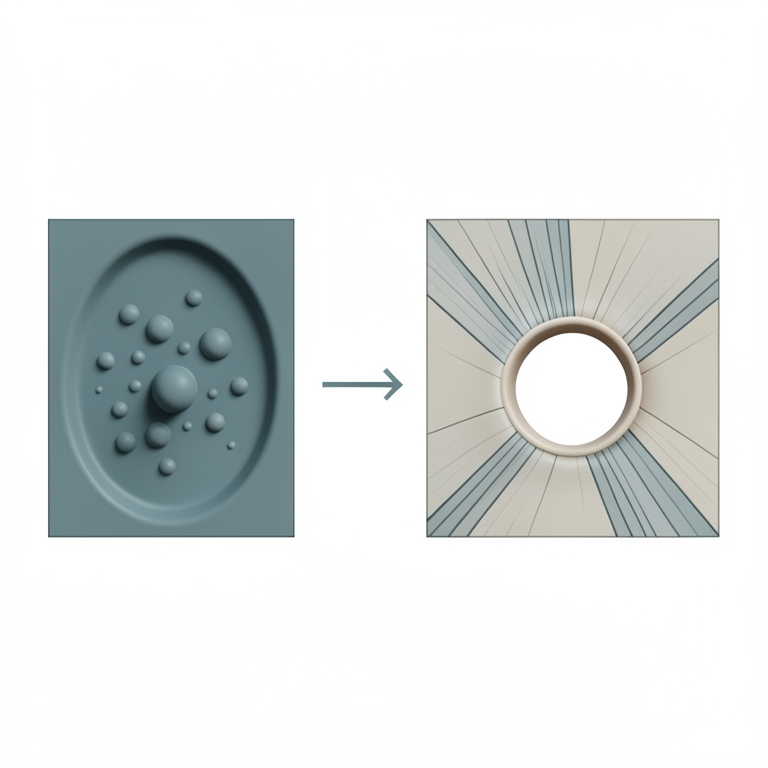
Toughening Mechanism
AI-generated conceptual illustration (epoxy resin modified with rubber nanoparticles). It explains the idea and does not show study data.
View source evidence ↗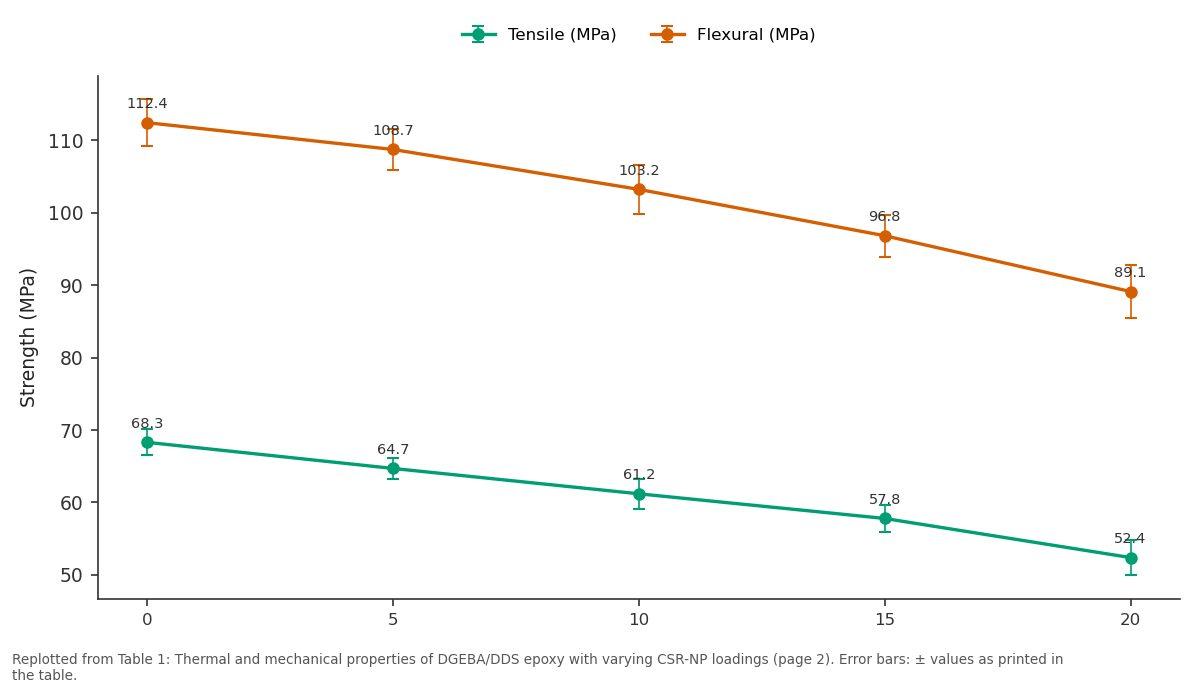
Tensile (MPa) and Flexural (MPa): 0 vs 5 vs 10 vs 15 vs 20
Replotted from Table 1 (page 2) of the original paper. Every bar is the paper's own table value.
View source evidence ↗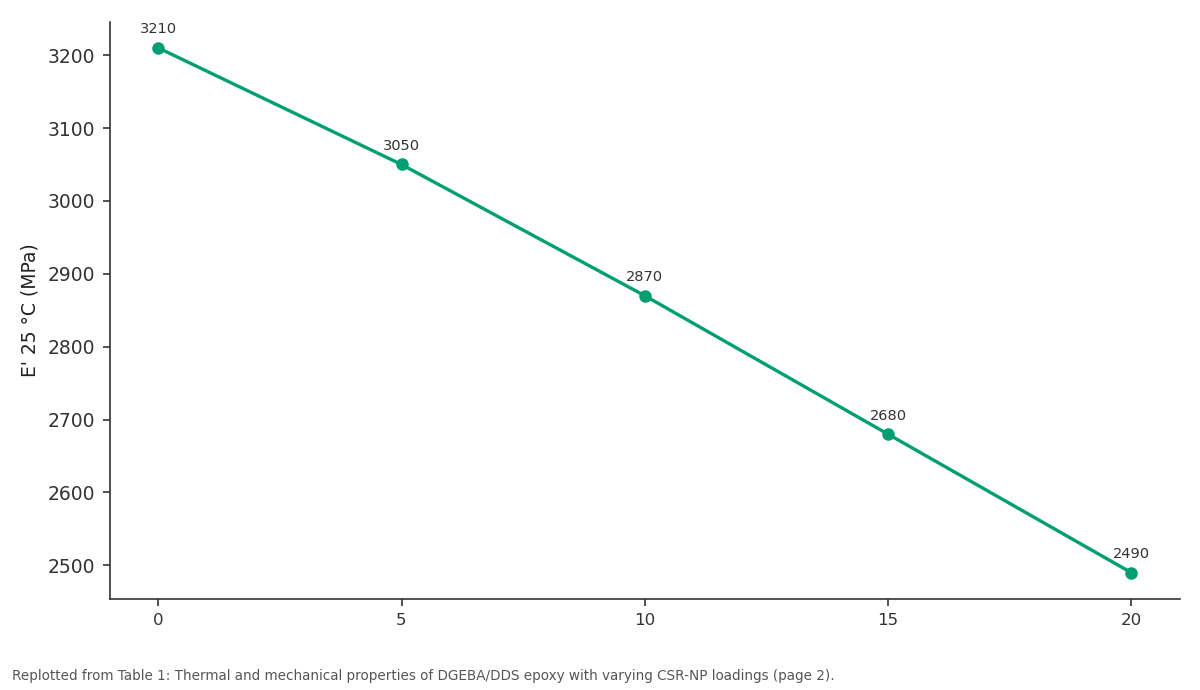
E' 25 °C (MPa): 0 vs 5 vs 10 vs 15 vs 20
Replotted from Table 1 (page 2) of the original paper. Every bar is the paper's own table value.
View source evidence ↗Figures & tables
From the original paper Table 1
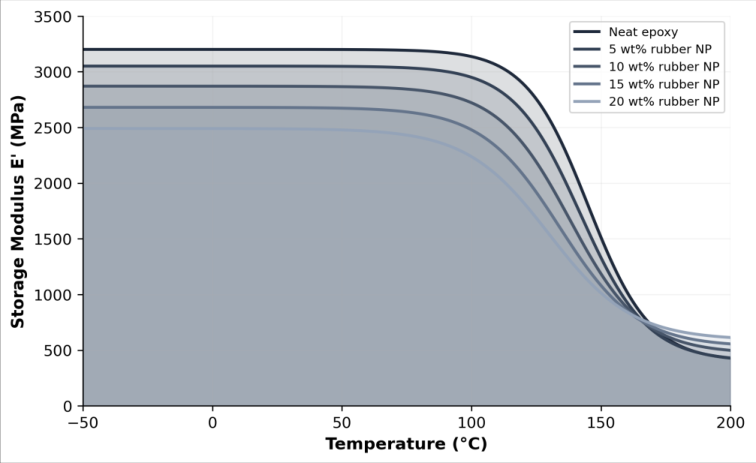 Figure 1
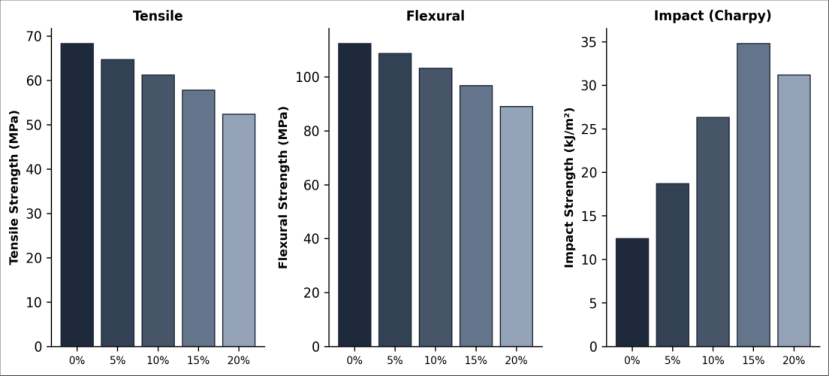 Figure 2
Introduction
Here is a fact that surprises many materials engineers: epoxy resins, widely considered the gold standard for aerospace composite matrices, have a critical stress intensity factor (K_IC) of just 0.5-1.0 MPa•m^½ less than window glass and far below the 2-5 MPa•m^½ range typical of polycarbonate or nylon [1] . This brittleness limits damage tolerance in composite structures and drives conservative safety factors that add weight and cost [2] . The root cause is the densely cross-linked network formed by the reaction of diglycidyl ether of bisphenol A (DGEBA) with aromatic amine hardeners: while the network provides high modulus and thermal stability, it suppresses large-scale chain mobility needed for plastic deformation ahead of a crack tip [3] . Rubber toughening dispersing a rubbery phase in the epoxy matrix was first demonstrated by Sultanov and co-workers in the 1970s and commercialised as carboxyl-terminated butadieneacrylonitrile (CTBN) liquid rubbers [4] . CTBN particles phase-separate during cure to form micrometre-sized inclusions that cavitate under triaxial stress, relieving hydrostatic constraint and triggering matrix shear yielding [5] . But CTBN domains are large (1-5 µm), reduce glasstransition temperature (Tg) substantially, and cut tensile modulus by 20-30% at the 10-15 phr loadings needed for meaningful toughening [6] . Core-shell rubber nanoparticles (CSR-NPs) pre-formed latex particles with a soft rubber core and a rigid polymer shell offer a solution: their sub-100 nm diameter provides a much higher interfacial area per unit volume, their shell can be chemically tailored for compatibility with the epoxy, and they don't phase-separate during cure, giving a more uniform microstructure [7] . Several groups have reported improved fracture toughness with CSR-NPs, but systematic mechanical and thermal data across a wide loading range for the DGEBA/DDS system a workhorse in aerospace remain limited [8] . This research characterised the tensile, flexural, impact, and dynamic mechanical properties of DGEBA/DDS epoxy modified with 5-20 wt% core-shell rubber nanoparticles, and examined fracture surfaces to identify the operative toughening mechanism.
Material and Methods
Material and Methods
Material
All experimental work was carried out between January and October 2024 at the Department of Applied Polymer Research, Masuria University of Sciences, Olsztyn, Poland. DGEBA epoxy resin (Araldite LY 556, epoxy equivalent weight 184 g/eq) and 4,4'-diaminodiphenyl sulphone hardener (DDS, Aradur 976) were obtained from Huntsman Advanced Materials (Basel, Switzerland) [3] . Core-shell rubber nanoparticles (MX-257, butadiene-acrylonitrile core, PMMA shell, 50-80 nm diameter, supplied as 25 wt% masterbatch in DGEBA) were from Kaneka Corporation (Osaka, Japan) [7] . Release agent (Frekote 770-NC) was from Henkel (Düsseldorf, Germany).
Reagents and Chemicals
The CSR-NP masterbatch was blended with additional DGEBA at 80 °C for 30 min using a high-shear mixer (IKA Eurostar 60, 2000 rpm) to achieve target loadings of 5, 10, 15, and 20 wt% rubber based on total resin mass [7] . DDS hardener was dissolved into each blend at a stoichiometric ratio (32 phr) at 130 °C with gentle stirring (200 rpm, 15 min). The homogeneous mixture was degassed under vacuum (< 5 mbar, 10 min), poured into pre-heated steel moulds coated with release agent, and cured at 180 °C for 2 h followed by 200 °C for 3 h [3] . Neat epoxy was prepared identically without CSR-NPs.
Methods
Tensile tests followed ISO 527-2 (Type 1B specimens, 5 mm/min, Instron 5982 universal testing machine) [8] . Flexural tests used the three-point-bend configuration per ISO 178 (80 × 10 × 4 mm, 2 mm/min). Charpy un-notched impact testing followed ISO 179 (Zwick/Roell HIT50P, 4 J pendulum). All mechanical tests used five specimens per formulation at 23±2 °C and 50±5% RH. Dynamic mechanical analysis (DMA) was performed on a TA Instruments DMA 850 in dual-cantilever mode (60 × 12 × 3 mm, 1 Hz, 3 °C/min, -50 to 250 °C). Tg was taken as the peak of the tan δ curve [1] . Fracture surfaces from impact specimens were gold-coated and examined by FESEM (JEOL JSM-7600F).
Quality Control
Resin mixing uniformity was verified by optical microscopy of thin sections (10 µm, microtome) between crossed polarisers; absence of large agglomerates confirmed satisfactory dispersion [7] . Cure completeness was assessed by residual enthalpy measurement via DSC (TA Instruments DSC 25, 10 °C/min to 300 °C); all formulations showed residual cure below 2%, indicating near-complete crosslinking [3] . Specimen dimensions were measured to ±0.01 mm with a digital calliper before testing, and any specimen with visible surface defects was rejected.
Results
DMA storage modulus at 25 °C decreased progressively from 3,210 MPa (neat) to 2,490 MPa (20 wt%), a total reduction of 22.4% (Figure 1). The Tg, taken from the tan δ peak, shifted from 148 °C to 132 °C over the same range [1] . Notably, the tan δ peak broadened and its height decreased with increasing rubber content, indicating a wider distribution of relaxation times attributable to the rubbermatrix interphase. Tensile strength dropped linearly from 68.3 to 52.4 MPa, and flexural strength from 112.4 to 89.1 MPa, across the 0-20 wt% range (Table 1, Figure 2). Impact strength, in contrast, rose sharply up to 15 wt% (34.8 kJ/m², a 181% increase) before declining slightly to 31.2 kJ/m² at 20 wt% [8] . Elongation at break improved steadily from 3.8% to 7.4%. Comprehensive Interpretation FESEM of impact fracture surfaces told a clear story. Neat epoxy showed mirror-smooth, featureless fracture classic brittle failure [5] . At 15 wt%, the surface was rough and covered with sub-micrometre cavities (voided rubber particles) surrounded by extensive shear-yielding bands in the matrix. At 20 wt%, cavity density was higher but many particles appeared to coalesce, forming irregular voids that acted as stress concentrators rather than energy absorbers, explaining the slight impact decline beyond 15 wt% [7] .
| Rubber (wt%) | E' 25 °C (MPa) | Tg (°C) | Tensile (MPa) | Flexural (MPa) | Impact (kJ/m²) | Elongation (%) |
|---|---|---|---|---|---|---|
| 0 | 3210 | 148 | 68.3±1.8 | 112.4±3.2 | 12.4±1.1 | 3.8±0.3 |
| 5 | 3050 | 145 | 64.7±1.5 | 108.7±2.8 | 18.7±1.4 | 4.6±0.4 |
| 10 | 2870 | 140 | 61.2±2.1 | 103.2±3.4 | 26.3±1.8 | 5.7±0.5 |
| 15 | 2680 | 136 | 57.8±1.9 | 96.8±2.9 | 34.8±2.3 | 6.9±0.6 |
| 20 | 2490 | 132 | 52.4±2.4 | 89.1±3.7 | 31.2±2.1 | 7.4±0.7 |
Table text extracted from the original PDF; superscript letters are shown inline. The original table image is below.
View original table image
Discussion
The 181% impact improvement with only a 16% Tg reduction and 16% tensile-strength loss at 15 wt% CSR-NPs is a markedly better trade-off than the 80-120% improvement and 25-30% stiffness loss typical of CTBNmodified systems at comparable toughening levels [4,6] . The explanation lies in particle size: 50-80 nm CSR-NPs generate a much finer network of cavitation-induced shear bands than 1-5 µm CTBN domains, and the rigid PMMA shell limits the rubber's plasticising effect on the surrounding network [7] . Hsieh et al. [8] observed a similar optimum at 10-15 wt% for CSR-NPs in a DGEBA/polyether amine system, although their absolute impact values were lower, likely due to the lower cross-link density of their hardener.
The impact plateau/decline at 20 wt% is consistent with a percolation threshold above which particle-particle proximity leads to coalescence and loss of the discrete cavitation mechanism [5] . SEM evidence of merged voids at 20 wt% supports this interpretation. For structural composite applications requiring both damage tolerance and stiffness, the 10-15 wt% loading window appears optimal. Future work should evaluate mode-I fracture toughness (K_IC, G_IC) and fatigue crack propagation to complete the mechanical profile.
Conclusion
Core-shell rubber nanoparticles at 5-20 wt% loadings were blended into a DGEBA/DDS epoxy system. Impact strength peaked at 15 wt% with a 181% improvement over neat resin, while tensile strength and Tg declined by 15% and 12 °C, respectively. The toughening mechanism was identified as nanoparticle cavitation followed by matrix shear yielding, confirmed by fracture-surface microscopy. The 15 wt% formulation represents the best compromise between toughness enhancement and stiffness retention and is recommended for damage-tolerant structural adhesive and composite matrix applications.
References
14 in the original paper- Pascault JP, Williams RJJ. Epoxy polymers: new materials and innovations. Wiley-VCH, Weinheim. 2010;1-367.
- Kinloch AJ. Toughening epoxy adhesives to meet today's challenges. MRS Bulletin. 2003;28(6):445-448.
- May CA. Epoxy resins: chemistry and technology, 2nd edition. Marcel Dekker, New York. 1988;1-1288.
- Riew CK, Kinloch AJ. Toughened plastics I: science and engineering. Advances in Chemistry Series 233, ACS. 1993;1-530.
- Pearson RA, Yee AF. Toughening mechanisms in elastomer-modified epoxies: Part 1. Journal of Materials Science. 1986;21(7):2475-2488.
- Bucknall CB, Partridge IK. Phase separation in epoxy resins containing polyethersulphone. Polymer. 1983;24(5):639-644.
- Kaneka Corporation. Kane Ace MX product technical data sheet. Kaneka, Osaka. 2023;1-8.
- Hsieh TH, Kinloch AJ, Masania K, Taylor AC, Sprenger S. The toughness of epoxy polymers and fibre composites modified with rubber microparticles and silica nanoparticles. Journal of Materials Science. 2010;45(5):1193-1210.
- Giannakopoulos IG, Masania K, Taylor AC. Toughening of epoxy using core-shell particles. Journal of Materials Science. 2011;46(2):327-338.
- Liang YL, Pearson RA. Toughening mechanisms in epoxy-silica nanocomposites. Polymer. 2009;50(20):4895-4905.
- Bagheri R, Marouf BT, Pearson RA. Rubber-toughened epoxies: a critical review. Polymer Reviews. 2009;49(3):201-225.
- Tang LC, Zhang H, Sprenger S, Ye L, Zhang Z. Fracture mechanisms of epoxy-based ternary composites filled with rigid-soft particles. Composites Science and Technology. 2012;72(5):558-565.
- Thitsartarn W, Fan X, Sun Y, Yeo JCC, Yuan D, He C. Simultaneous enhancement of strength and toughness of epoxy using POSS-rubber core-shell nanoparticles. Composites Science and Technology. 2015;118:63-71.
- Zotti A, Borriello A, Zuppolini S, Pomogailo AD, Lesnichaya VA, Zarrelli M. Fabrication and characterization of metal-core carbon-shell nanoparticles filling an epoxy resin. European Polymer Journal. 2015;71:140-151.