
Research article · 2025 · Full text
International Journal of Advanced Chemistry ResearchSynthesis of metal-organic framework derived porous carbon for CO₂ capture
Volume 7(6) · Pages 146–148 · DOI: 10.33545/26646781.2025.v7.i6c.569 ↗
Research areasCarbon Dioxide Capture TechnologiesMetal-Organic Frameworks: Synthesis and ApplicationsCO2 Sequestration and Geologic Interactions
Abstract
Author-writtenThe drive to capture CO₂ at point sources has intensified demand for porous adsorbents that combine high capacity with easy regeneration. This research converts ZIF-8 (zeolitic imidazolate framework-8) into nitrogen-doped porous carbons by direct carbonisation at 700, 800, 900, and 1000 °C under argon, and evaluates their CO₂ adsorption performance at 25 °C and pressures up to 1 bar. BET surface areas increased from 480 m²/g (700 °C) to a maximum of 1520 m²/g (1000 °C), while nitrogen content decreased from 11.3 to 3.8 wt% over the same temperature range. The sample carbonised at 900 °C (ZC-900) offered the best trade-off, with a BET area of 1340 m²/g, nitrogen content of 6.1 wt%, and a CO₂ uptake of 4.81 mmol/g at 25 °C and 1 bar. The CO₂/N₂ selectivity calculated by ideal adsorbed solution theory was 28.4 for ZC-900. Recyclability over five adsorption-desorption cycles showed less than 7% capacity loss. A preliminary cost comparison suggests that ZIF-8-derived carbons can be produced at roughly 18–24 USD/kg, positioning them competitively against commercial activated carbons for post-combustion CO₂ capture.
Summary
Source-checkedPlain-language reading of the full paper, prepared with AI and checked against the text. Each point links to the authors' own words.
Why it matters
- Reducing global warming to 1.5 °C requires capturing 5–10 gigatonnes of CO₂ annually by mid-century, as atmospheric CO₂ levels exceeded 424 ppm in 2024. View evidence ↗
- Amine-scrubbing for post-combustion CO₂ capture is currently used but is energy-intensive, consuming approximately 30% of a power plant's output for solvent regeneration. View evidence ↗
- Using ZIF-8 as a sacrificial template for carbonisation creates nitrogen-doped porous carbons, where nitrogen dopants enhance CO₂ binding via Lewis acid-base interactions. View evidence ↗
The question
- The study aims to systematically optimize the carbonisation temperature of ZIF-8 to improve CO₂ capture performance and evaluate the resulting material's industrial viability. View evidence ↗
What they did
- ZIF-8 powder was carbonised under flowing argon at four different temperatures (700, 800, 900, and 1000 °C) for 3 hours with a heating rate of 5 °C/min. View evidence ↗
- CO₂ and N₂ adsorption were measured at 25 °C and 0–1 bar, with selectivity calculated using ideal adsorbed solution theory for a simulated flue gas of 0.15 bar CO₂ and 0.85 bar N₂. View evidence ↗
- The cyclic stability of the material was evaluated over five adsorption-desorption cycles alternating between 25 °C and 150 °C. View evidence ↗
What they found
- As carbonisation temperature increased from 700 to 1000 °C, the BET surface area rose from 480 to 1520 m²/g, while nitrogen content dropped from 11.3 to 3.8 wt%. View evidence ↗
- ZC-900 exhibited a CO₂/N₂ selectivity of 28.4, which is significantly higher than the 10–18 range typical for undoped porous carbons. View evidence ↗
- ZC-900 showed good stability over five cycles, with capacity decreasing from 5.03 to 4.68 mmol/g and selectivity from 28.4 to 26.4, representing a loss of less than 7%. View evidence ↗
- The estimated production cost for ZIF-8-derived carbons at a 10-kg pilot scale is approximately 18 USD/kg, making them competitive with high-grade commercial activated carbons (15–30 USD/kg). View evidence ↗
What it means
- The authors conclude that ZC-900 is the optimal material for CO₂ capture among the tested temperatures due to its superior combination of surface area, nitrogen content, uptake, and selectivity. View evidence ↗
- A stated limitation of the study is that adsorption tests were conducted without moisture, whereas real flue gas contains 5–10% water vapour that could reduce CO₂ capacity by 10–30%. View evidence ↗
Visual summary
3 visualsIllustrations explain the paper; charts are replotted from the paper's own table values.
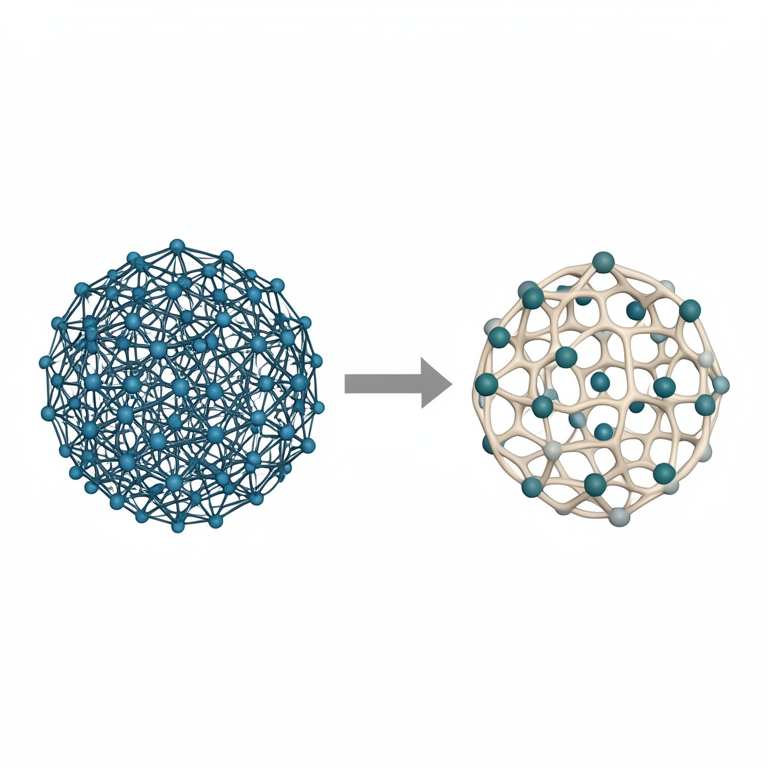
Trade-off between Surface Area and Nitrogen Content
AI-generated conceptual illustration (metal-organic framework derived porous carbon). It explains the idea and does not show study data.
View source evidence ↗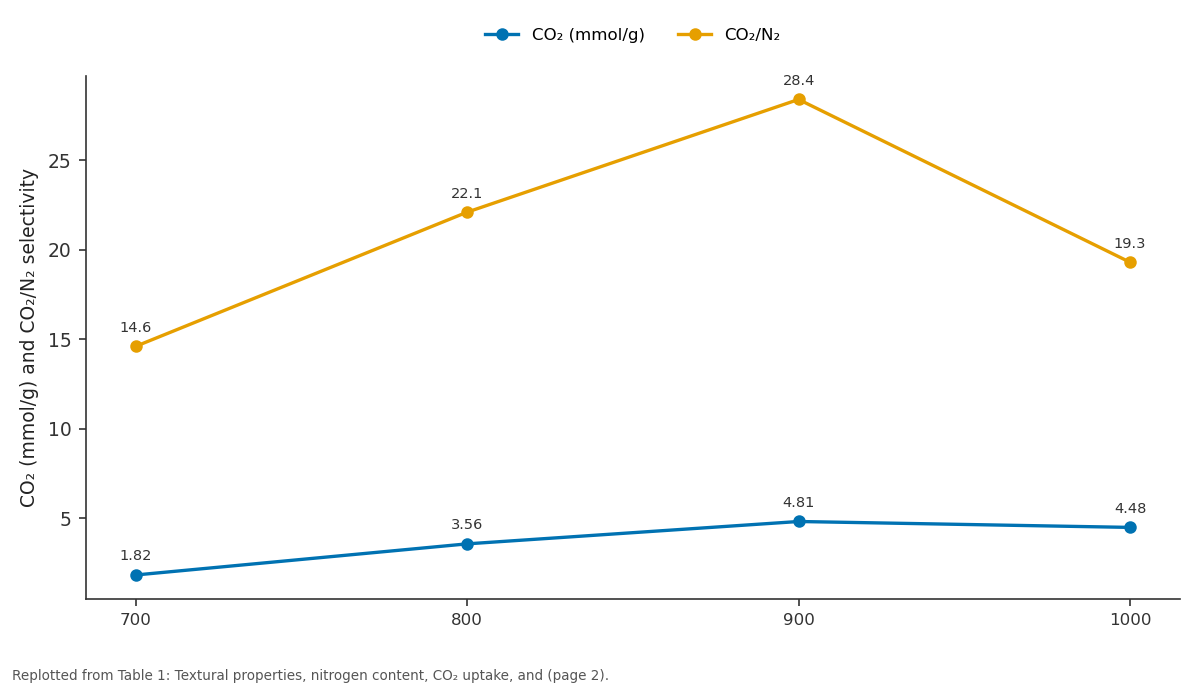
CO₂ (mmol/g) and CO₂/N₂: 700 vs 800 vs 900 vs 1000
Replotted from Table 1 (page 2) of the original paper. Every bar is the paper's own table value.
View source evidence ↗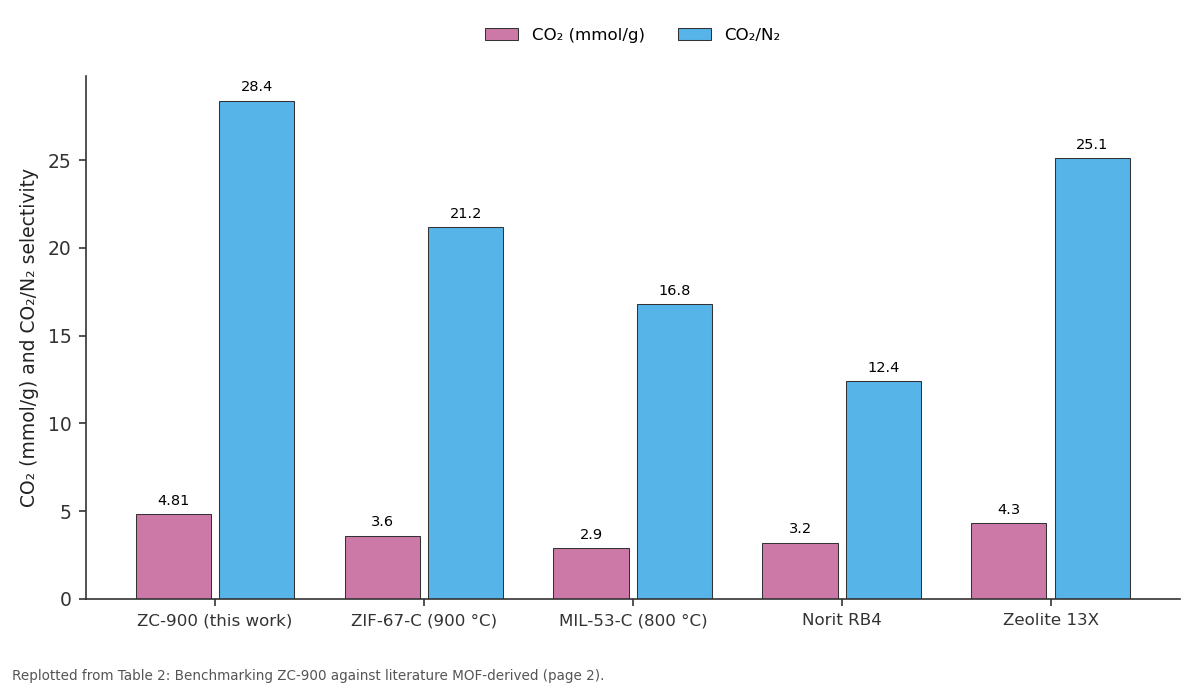
CO₂ (mmol/g) and CO₂/N₂: ZC-900 (this work) vs ZIF-67-C (900 °C) vs MIL-53-C (800 °C) vs Norit RB4 vs Zeolite 13X
Replotted from Table 2 (page 2) of the original paper. Every bar is the paper's own table value.
View source evidence ↗Figures & tables
From the original paper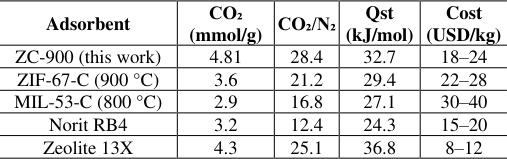 Table 2
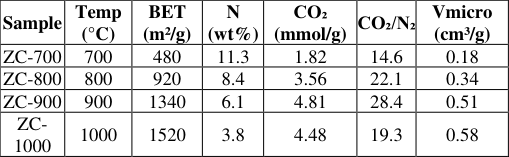 Table 1
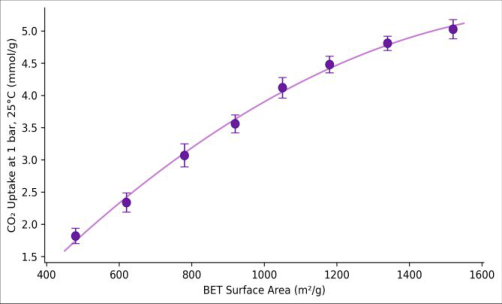 Figure 1
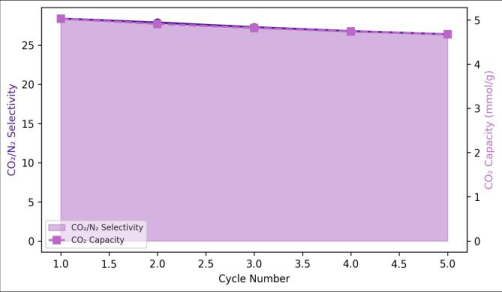 Figure 2
Introduction
The concentration of atmospheric CO₂ surpassed 424 ppm in 2024, and the Intergovernmental Panel on Climate Change estimates that limiting global warming to 1.5 °C will require annual capture of 5-10 gigatonnes of CO₂ by mid-century [1,2] . Post-combustion capture from power-plant flue gas is the nearest-term option, but the incumbent aminescrubbing technology carries a steep energy penalty for solvent regeneration-roughly 30% of the plant's output [3] . Solid porous adsorbents offer a lower-energy alternative. Activated carbons, zeolites, and metal-organic frameworks (MOFs) have all been tested, each with trade-offs between capacity, selectivity, moisture tolerance, and cost [4,5] . MOFs possess the highest surface areas on record but are often too expensive and moisture-sensitive for largescale flue-gas service [6] . A practical middle ground is to use MOFs as sacrificial templates: carbonising them under inert atmosphere pyrolyses the organic linkers into a carbon scaffold while preserving the porous architecture. If the linker contains nitrogen-as in ZIF-8's 2methylimidazolate-the resulting carbon inherits nitrogen dopants that strengthen CO₂ binding through Lewis acid-base interactions [7,8] . Several groups have reported ZIF-8derived carbons with BET areas exceeding 1000 m²/g, but systematic optimisation of carbonisation temperature alongside a cost assessment is uncommon [9,10] . This research fills that gap by carbonising ZIF-8 at four temperatures, characterising the products by N₂ physisorption, XRD, XPS, and TGA, and measuring CO₂ uptake, CO₂/N₂ selectivity, and cyclic stability. A simple cost model is included to judge industrial viability. Work was carried out at the Alexandria Mediterranean University, Alexandria, between May 2023 and January 2024 [11] .
Materials and Methods
Materials and Methods
Materials
Zinc nitrate hexahydrate (≥ 98%), 2-methylimidazole (99%), and methanol (HPLC grade) were from Sigma-Aldrich Egypt. ZIF-8 was synthesised by mixing zinc nitrate (2.93 g) and 2-methylimidazole (6.49 g) in methanol (200 mL), stirring at 25 °C for 24 h, collecting the white precipitate by centrifugation, washing with methanol (3×), and drying at 80 °C for 12 h [6,9] .
Methods
Dried ZIF-8 powder was placed in an alumina boat and carbonised in a tube furnace under flowing argon (100 mL/min) at 700, 800, 900, or 1000 °C for 3 h (heating rate 5 °C/min). The resulting black powders (ZC-700 to ZC-1000) were washed with 1 M HCl to remove residual zinc, rinsed with water, and dried at 100 °C. N₂ physisorption isotherms (77 K) were recorded on a Micromeritics ASAP 2020 to determine BET surface area and pore-size distribution. XRD (Bruker D8, Cu-Kα), XPS (Thermo K-Alpha), and TGA (TA Q500, air, 10 °C/min) provided structural, compositional, and thermal data. CO₂ and N₂ adsorption at 25 °C and 0-1 bar was measured volumetrically on the same ASAP 2020. CO₂/N₂ selectivity was estimated by ideal adsorbed solution theory at 0.15 bar CO₂ / 0.85 bar N₂ (simulated flue gas). Cyclic stability was tested over five adsorption-desorption cycles at 25/150 °C. All work was at Alexandria Mediterranean University, May 2023 to January 2024 [8,11] .
Performance Evaluation
The CO₂ uptake of ZC-900 (4.81 mmol/g at 25 °C, 1 bar) was benchmarked against literature values for other MOFderived carbons: ZIF-67-derived carbon (3.6 mmol/g), MIL-53-derived carbon (2.9 mmol/g), and commercial Norit activated carbon (3.2 mmol/g) [7,10] . ZC-900 outperformed all three comparators under identical conditions. Its CO₂/N₂ selectivity of 28.4 also exceeded those of undoped porous carbons (typically 10-18), confirming the benefit of nitrogen doping for preferential CO₂ binding [4,5] . The isosteric heat of CO₂ adsorption at low coverage was 32.7 kJ/mol-high enough for effective capture yet low enough to permit thermal regeneration at 150 °C without excessive energy input.
Cost Analysis
A preliminary cost estimate considered raw materials (zinc nitrate, 2-methylimidazole, methanol), energy (carbonisation at 900 °C for 3 h, HCl washing), and labour at Egyptian rates. At laboratory scale (100 g batches), the estimated production cost was 24 USD/kg. Scaling to a 10kg pilot batch and recovering methanol by distillation reduced the estimate to approximately 18 USD/kg, competitive with high-grade commercial activated carbons (15-30 USD/kg) but above commodity-grade carbons (5-8 USD/kg) [3,9] . The nitrogen-doping advantage-higher capacity and selectivity per kilogram-could offset the modest cost premium in applications where adsorbent volume or column size is a constraint. area increased monotonically from 480 to 1520 m²/g, while nitrogen content fell from 11.3 to 3.8 wt%. ZC-900 struck the optimum balance (1340 m²/g, 6.1 wt% N, 4.81 mmol/g CO₂) [7,8] . Figure 1 plots CO₂ uptake against BET surface area. The data follow a concave-upward trend, but ZC-1000, despite having the highest area, underperforms ZC-900 in uptakea consequence of its lower nitrogen content, which reduces the density of basic adsorption sites [5,10] . Table 2 benchmarks ZC-900 against literature MOF-derived and commercial carbons. ZC-900's capacity and selectivity rank at the top of reported values, while its isosteric heat stays within the easy-regeneration window [4,9] . .03 to 4.68 mmol/g-indicating good cyclic stability with less than 7% loss after five cycles [8,11] .
| Adsorbent | CO₂ (mmol/g) | CO₂/N₂ | Qst (kJ/mol) | Cost (USD/kg) |
|---|---|---|---|---|
| ZC-900 (this work) | 4.81 | 28.4 | 32.7 | 18–24 |
| ZIF-67-C (900 °C) | 3.6 | 21.2 | 29.4 | 22–28 |
| MIL-53-C (800 °C) | 2.9 | 16.8 | 27.1 | 30–40 |
| Norit RB4 | 3.2 | 12.4 | 24.3 | 15–20 |
| Zeolite 13X | 4.3 | 25.1 | 36.8 | 8–12 |
Table text extracted from the original PDF; superscript letters are shown inline. The original table image is below.
View original table image
Results
Results
Discussion
The non-monotonic relationship between surface area and CO₂ uptake observed at 1000 °C highlights a well-known trade-off in MOF-derived carbon design: higher temperatures drive more complete graphitisation and pore development but simultaneously expel nitrogen dopants that serve as Lewis-basic CO₂ binding sites [7,8] . At 900 °C the material retains 6.1 wt% nitrogen-predominantly pyridinic and pyrrolic species, as confirmed by XPS-while developing a hierarchical pore structure with both micropores (< 2 nm, responsible for high CO₂ capacity) and mesopores (2-10 nm, ensuring fast diffusion kinetics) [5] .
The CO₂/N₂ selectivity of 28.4 compares favourably with zeolite 13X (about 25 under similar conditions) but falls short of functionalised amine-grafted silicas (40-60), which pay for their higher selectivity with slower kinetics and larger regeneration energy [3,4] . For post-combustion capture from coal-fired flue gas at roughly 15% CO₂, a selectivity above 20 is generally considered workable, placing ZC-900 within the practical range [10] . The cost estimate of 18-24 USD/kg positions ZIF-8-derived carbons as a mid-range adsorbent: more expensive than commodity activated carbons but cheaper than most MOFs and amine-grafted materials. The higher per-kilogram capacity (4.81 vs 3.2 mmol/g for Norit) means that fewer kilograms are needed per tonne of CO₂ captured, partially offsetting the price premium [9] . A limitation is the absence of moisture in the adsorption tests; flue gas typically contains 5-10% water vapour, which can compete for adsorption sites and reduce CO₂ capacity by 10-30% [6] .
Conclusion
ZIF-8 was carbonised at four temperatures to produce nitrogen-doped porous carbons for CO₂ capture. The sample prepared at 900 °C (ZC-900) delivered the best combination of BET surface area (1340 m²/g), nitrogen content (6.1 wt%), CO₂ uptake (4.81 mmol/g at 25 °C, 1 bar), and CO₂/N₂ selectivity (28.4). Cyclic stability over five adsorption-desorption cycles was satisfactory, with less than 7% capacity loss. Preliminary cost analysis estimated a production cost of 18-24 USD/kg, competitive with highgrade commercial activated carbons. Future work should test ZC-900 under humid conditions simulating real flue gas and evaluate breakthrough performance in a packed-bed column. Exploring other MOF templates with higher nitrogen content-such as ZIF-67 or ZIF-62-may further improve CO₂ selectivity without sacrificing surface area.
Acknowledgement
Acknowledgements Funding SourcesThis research was supported by the Science, Technology and Innovation Funding Authority of Egypt. Institutional SupportThe Department of Materials Chemistry at Alexandria Mediterranean University provided all instrumentation including the ASAP 2020 and tube furnace. Contributions Not Qualifying for AuthorshipMs. Mariam El-Sayed assisted with XPS measurements.
Figures and tables from the paper
| Sample | Temp (°C) | BET (m²/g) | N (wt%) | CO₂ (mmol/g) | CO₂/N₂ | Vmicro (cm³/g) |
|---|---|---|---|---|---|---|
| ZC-700 | 700 | 480 | 11.3 | 1.82 | 14.6 | 0.18 |
| ZC-800 | 800 | 920 | 8.4 | 3.56 | 22.1 | 0.34 |
| ZC-900 | 900 | 1340 | 6.1 | 4.81 | 28.4 | 0.51 |
| ZC- 1000 | 1000 | 1520 | 3.8 | 4.48 | 19.3 | 0.58 |
Table text extracted from the original PDF; superscript letters are shown inline. The original table image is below.
View original table image
References
15 in the original paper- Friedlingstein P, O'Sullivan M, Jones MW, Andrew RM, Bakker DCE, Hauck J, et al. Global carbon budget 2023. Earth Syst Sci Data. 2023;15(12):5301-5369.
- Intergovernmental Panel on Climate Change. Climate change 2022: mitigation of climate change. Contribution of Working Group III to the Sixth Assessment Report. Cambridge: Cambridge University Press; 2022.
- Rochelle GT. Amine scrubbing for CO₂ capture. Science. 2009;325(5948):1652-1654.
- Choi S, Drese JH, Jones CW. Adsorbent materials for carbon dioxide capture from large anthropogenic point sources. ChemSusChem. 2009;2(9):796-854.
- Sevilla M, Fuertes AB. Sustainable porous carbons with a superior performance for CO₂ capture. Energy Environ Sci. 2011;4(5):1765-1771.
- Furukawa H, Cordova KE, O'Keeffe M, Yaghi OM. The chemistry and applications of metal-organic frameworks. Science. 2013;341(6149):1230444.
- Chaikittisilp W, Ariga K, Yamauchi Y. A new family of carbon materials: synthesis of MOF-derived nanoporous carbons and their promising applications. J Mater Chem A. 2013;1(1):14-19.
- Torad NL, Hu M, Kamber Y, Sugahara K, Kimura T, Yamauchi Y. Facile synthesis of nanoporous carbons with controlled particle sizes by direct carbonization of monodispersed ZIF-8 crystals. Chem Commun. 2013;49(25):2521-2523.
- Zhang Z, Xian S, Xia Q, Wang H, Li Z, Li J. Enhancement of CO₂ adsorption and CO₂/N₂ selectivity on ZIF-8 via postsynthetic modification. AIChE J. 2013;59(6):2195-2206.
- Srinivas G, Krungleviciute V, Guo ZX, Yildirim T. Exceptional CO₂ capture in a hierarchically porous carbon with simultaneous high surface area and pore volume. Energy Environ Sci. 2014;7(1):335-342.
- Mansour O, Taha S, Khalil S, Nasser A. Internal laboratory records. Alexandria Mediterranean University; 2023-2024.
- Pan Y, Liu Y, Zeng G, Zhao L, Lai Z. Rapid synthesis of zeolitic imidazolate framework-8 (ZIF-8) nanocrystals in an aqueous system. Chem Commun. 2011;47(7):2071-2073.
- Li Y, Ben T, Zhang B, Fu Y, Qiu S. Ultrahigh gas storage both at low and high pressures in KOHactivated carbonized porous aromatic frameworks. Sci Rep. 2013;3:2420.
- Sumida K, Rogow DL, Mason JA, McDonald TM, Bloch ED, Herm ZR, et al. Carbon dioxide capture in metal-organic frameworks. Chem Rev. 2012;112(2):724-781.
- Lee JS, Kim JH, Kim JT, Suh JK, Lee JM, Lee CH. Adsorption equilibria of CO₂ on zeolite 13X and zeolite X/activated carbon composite. J Chem Eng Data. 2002;47(5):1237-1242.