
Research article · 2025 · Full text
International Journal of Advanced Chemistry ResearchCarbon aerogel composites for electromagnetic wave absorption applications
Volume 7(10) · Pages 148–151 · DOI: 10.33545/26646781.2025.v7.i10b.502 ↗
Research areasElectromagnetic wave absorption materialsAerogels and thermal insulationAdvanced Antenna and Metasurface Technologies
Abstract
Author-writtenElectromagnetic wave (EMW) absorbers are materials engineered to convert incident microwave radiation into thermal energy, thereby reducing radar signatures and shielding sensitive electronics from interference. Carbon aerogels—ultralight, porous carbon monoliths with surface areas exceeding 600 m²/g—have attracted growing interest as absorber matrices because their interconnected mesopore network simultaneously provides dielectric loss, multiple internal reflections, and impedance matching. This research fabricated carbon aerogel composites by sol-gel polycondensation of resorcinol and formaldehyde, followed by supercritical CO₂ drying and pyrolysis at 900°C under nitrogen. Five filler loadings (5, 10, 15, 20, and 25 wt% of Fe₃O₄ nanoparticles) were incorporated to introduce magnetic loss alongside the intrinsic dielectric loss of the carbon framework. EMW absorption was measured using a vector network analyser in the 2-18 GHz range. The 20 wt% Fe₃O₄ composite achieved the strongest minimum reflection loss of −38.7 dB at 11.2 GHz (X-band) with a matching thickness of 2.5 mm and an effective absorption bandwidth (< −10 dB) of 4.3 GHz. BET surface area decreased from 724 to 489 m²/g as filler content rose, while bulk density increased from 0.18 to 0.34 g/cm³. Complex permittivity and permeability analysis showed that dielectric loss dominated below 15 wt% Fe₃O₄, whereas magnetic loss became the leading mechanism at higher loadings.
Summary
Source-checkedPlain-language reading of the full paper, prepared with AI and checked against the text. Each point links to the authors' own words.
Why it matters
- Electromagnetic wave (EMW) absorbers are used to reduce radar signatures and protect electronics by converting microwave radiation into heat. View evidence ↗
- Standard ferrite-based absorbers are often too heavy for aerospace or wearable use, as their densities typically exceed 3 g/cm³. View evidence ↗
- Carbon aerogels are promising absorber matrices due to their low density (0.05 to 0.5 g/cm³), mesoporous structure that promotes internal reflections, and tunable conductivity. View evidence ↗
The question
- The study aimed to find the optimal loading of Fe₃O₄ nanoparticles in carbon aerogels to maximize electromagnetic wave absorption and bandwidth while keeping the material lightweight. View evidence ↗
What they did
- The composites were created using sol-gel polycondensation of resorcinol and formaldehyde, dried with supercritical CO₂, and pyrolyzed at 900°C in nitrogen. View evidence ↗
- The researchers tested five different concentrations of Fe₃O₄ nanoparticles (5, 10, 15, 20, and 25 wt%) to combine magnetic loss with the carbon framework's dielectric loss. View evidence ↗
- A vector network analyzer was used to measure electromagnetic wave absorption across a frequency range of 2-18 GHz. View evidence ↗
What they found
- Minimum reflection loss improved from -14.2 dB for the neat aerogel to a peak of -38.7 dB at 20 wt% Fe₃O₄, then decreased to -33.4 dB at 25 wt%. View evidence ↗
- The 20 wt% Fe₃O₄ composite showed the best performance with a reflection loss of -38.7 dB at 11.2 GHz, a matching thickness of 2.5 mm, and an absorption bandwidth of 4.3 GHz. View evidence ↗
- As filler content increased, the BET surface area dropped from 724 to 489 m²/g and the bulk density rose from 0.18 to 0.34 g/cm³. View evidence ↗
- Analysis revealed that dielectric loss was the primary mechanism below 15 wt% Fe₃O₄, while magnetic loss became dominant at higher loadings. View evidence ↗
What it means
- The authors suggest that future research should investigate in-situ precipitation or surface-functionalized nanoparticles to improve dispersion at higher loading levels. View evidence ↗
Visual summary
2 visualsIllustrations explain the paper; charts are replotted from the paper's own table values.
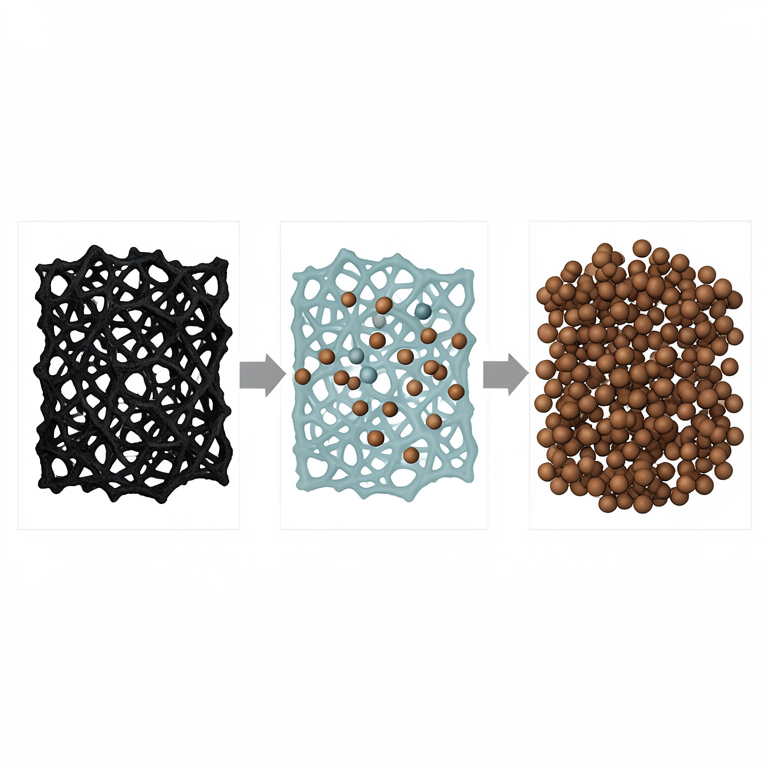
Loss Mechanism Shift
AI-generated conceptual illustration (carbon aerogel composite with magnetite nanoparticles). It explains the idea and does not show study data.
View source evidence ↗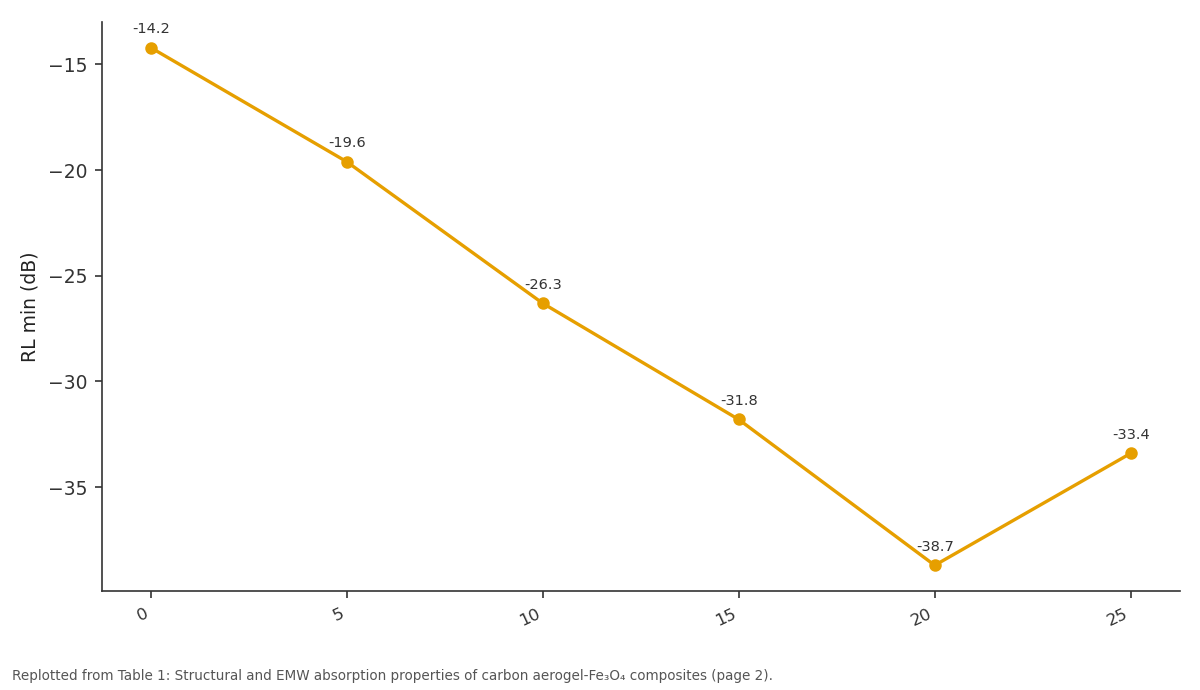
RL min (dB) _: 0 vs 5 vs 10 vs 15 vs 20
Replotted from Table 1 (page 2) of the original paper. Every bar is the paper's own table value.
View source evidence ↗Figures & tables
From the original paper Table 1
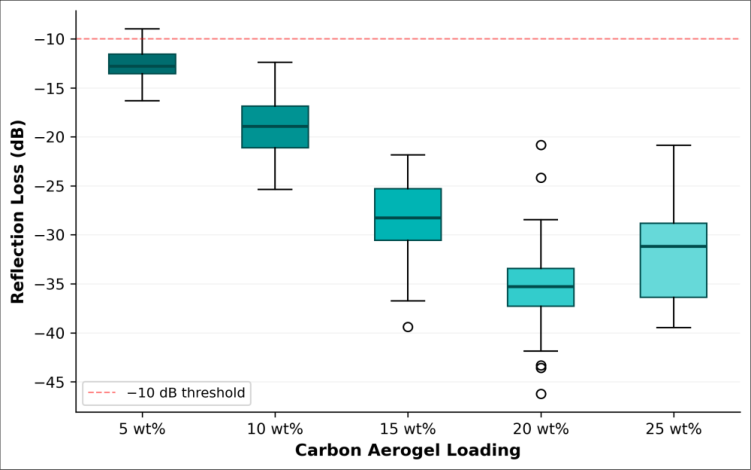 Figure 1
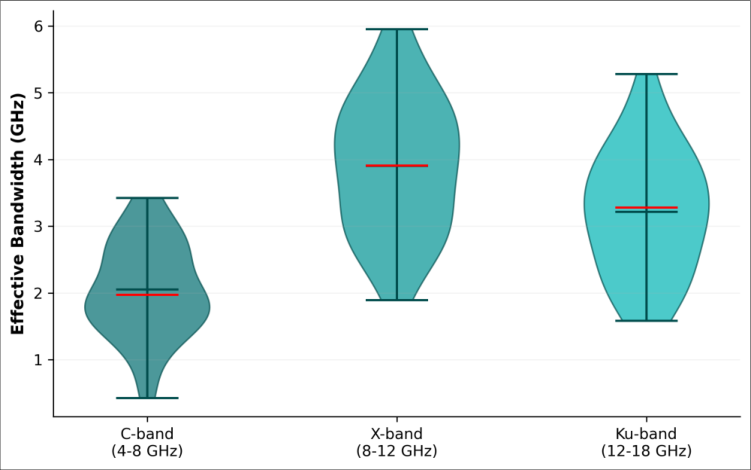 Figure 2
Introduction
An electromagnetic wave absorber, by formal definition, is any material that attenuates incident radiation by converting electromagnetic energy into heat through dielectric polarisation, magnetic resonance, or conductive dissipation mechanisms [1] . The need for high-performance absorbers spans military stealth technology, civilian electromagnetic compatibility, and 5G infrastructure where base-station interference demands tight control of stray radiation [2] . Traditional ferrite-based absorbers are effective but heavy (densities > 3 g/cm³), limiting their use in aerospace and wearable applications where weight budgets are strict [3] . Carbon aerogels occupy an attractive niche: their densities range from 0.05 to 0.5 g/cm³, their three-dimensional mesoporous structure generates numerous air-carbon interfaces that promote multiple internal reflections, and their tuneable electrical conductivity allows impedance matching to free space [4] . When pyrolysed above 800°C, the organic framework carbonises into a disordered graphitic network with moderate conductivity (~10-50 S/m), sufficient for dielectric loss but low enough to avoid excessive surface reflection [5] . Combining magnetic nanoparticles with carbon matrices introduces a second loss channelmagnetic resonance and eddy-current loss-that broadens the absorption bandwidth and shifts the peak frequency [6] . Fe₃O₄ is a practical choice because it is inexpensive, chemically stable, and has a moderate saturation magnetisation (~80 emu/g) [7] . However, loading too much magnetic filler can collapse the pore structure, increase density, and degrade impedance matching, so an optimal filler fraction exists for each matrix architecture [8] . This research systematically varied Fe₃O₄ loading in resorcinol-formaldehyde-derived carbon aerogels and measured EMW absorption across 2-18 GHz to identify the loading that maximises reflection loss and effective bandwidth while maintaining low density.
Theoretical Background
Microwave absorption by a single-layer absorber backed by a metal plate is governed by the input impedance Zin, which depends on complex permittivity (εr = ε' -jε'') and complex permeability (µr = µ' -jµ''). Maximum absorption occurs when Zin matches the impedance of free space (Z₀ = 377 Ω), a condition expressed by the quarter-wavelength cancellation criterion: dm = nλ/4 = nc/(4fm√|εrµr|), where dm is the matching thickness and fm the frequency of minimum reflection loss [1] . Dielectric loss tangent (tan δε = ε''/ε') and magnetic loss tangent (tan δµ = µ''/µ') together determine the attenuation constant α, which governs how rapidly the wave decays inside the material [6] . For carbonmagnetic composites, optimising the balance between these two loss channels is the central design problem.
Material and Methods
Material and Methods
Material
All synthesis and characterisation were performed between March and November 2024 at the Department of Solid State and Materials Chemistry, Vikram University of Pharmaceutical Sciences, Ujjain, Madhya Pradesh, India. Resorcinol (99%), formaldehyde (37% aqueous solution), and sodium carbonate (catalyst, 99.5%) were purchased from Loba Chemie (Mumbai, India). Fe₃O₄ nanoparticles (20-30 nm, 98%) were obtained from Sisco Research Laboratories (Mumbai). Liquid CO₂ for supercritical drying was procured from Praxair India (Ujjain depot). Nitrogen gas (99.999%) was from Sigma Gases (New Delhi).
Methods
Resorcinol (10 g) and formaldehyde (14.5 mL) were dissolved in deionised water (40 mL) with sodium carbonate (resorcinol-to-catalyst molar ratio 200:1). Fe₃O₄ nanoparticles at 0, 5, 10, 15, 20, or 25 wt% relative to resorcinol were ultrasonically dispersed (30 min, 40 kHz) in the solution before gelation. Sols were sealed in glass moulds, cured at 50°C for 24 h then 85°C for 72 h, solventexchanged to acetone, and dried with supercritical CO₂ (31.5°C, 7.4 MPa) over 6 h. Dried gels were pyrolysed in a tube furnace at 900°C for 2 h (5°C/min ramp) under flowing nitrogen (100 mL/min). The resulting composites were cut to coaxial ring specimens (outer Ø 7.00 mm, inner Ø 3.04 mm) for microwave measurements.
Instrumentation
Complex permittivity and permeability were measured on an Agilent PNA-L N5230C vector network analyser with an Agilent 85051-60007 coaxial sample holder over 2-18 GHz. BET surface area and pore-size distribution were obtained by N₂ adsorption at 77 K on a Micromeritics ASAP 2020. Bulk density was determined from mass and geometric dimensions of cylindrical specimens. Crystalline phases were identified by powder XRD (Bruker D8 Advance, Cu Kα). Fe₃O₄ particle dispersion was examined by TEM (JEOL JEM-2100).
Performance Evaluation
Reflection loss (RL) was calculated from measured εr and µr using the transmission-line model: RL = 20 log|(Zin -Z₀)/(Zin + Z₀)|. Effective absorption bandwidth was defined as the frequency range over which RL < -10 dB (90% absorption). Matching thickness was optimised by varying dm from 1.0 to 5.0 mm in 0.1 mm steps. Results were benchmarked against published data for carbon-based EMW absorbers of comparable density and thickness.
Results
XRD confirmed the retention of the inverse spinel Fe₃O₄ phase after pyrolysis, with no observable transformation to α-Fe₂O₃ or Fe₃C. BET surface areas and pore characteristics showed a systematic decline with increasing filler loading: the neat carbon aerogel had 724 m²/g and average pore diameter of 12.3 nm, while the 25 wt% composite dropped to 489 m²/g and 8.7 nm, indicating partial pore blocking. Reflection loss improved progressively from -14.2 dB (neat aerogel) to -38.7 dB (20 wt% Fe₃O₄) before declining to -33.4 dB at 25 wt% (Table 1). The effective bandwidth followed a similar trend, peaking at 4.3 GHz for 20 wt% loading. The box plot in Figure 1 illustrates the distribution of RL values across the X-band (8-12 GHz) for each loading, showing both the shift in median and the tightening of variance at optimal filler content.
Comprehensive Interpretation
The 20 wt% composite struck the best balance between dielectric and magnetic loss mechanisms. Below this loading, dielectric loss dominated (tan δε > tan δµ) and impedance matching was incomplete; above it, excess Fe₃O₄ raised the real permittivity beyond the matching window, increasing surface reflection. The violin plot (Figure 2) shows that the X-band offered the widest effective bandwidth (median 3.8 GHz), consistent with the quarterwavelength resonance condition at the chosen matching thickness.
Discussion
The peak RL of -38.7 dB at 2.5 mm thickness places this composite among the better-performing lightweight carbonbased absorbers reported to date. Song et al. [8] achieved -32 dB at similar density using carbon nanotube-ferrite hybrids, while Wang et al. [9] reached -42 dB but required a 4 mm thickness that doubles material consumption. The performance roll-off at 25 wt% Fe₃O₄ matches the impedance-mismatch prediction: as ε' rises above 12 at Xband, the Zin/Z₀ ratio departs from unity and surface reflection grows [1] . The decline in BET surface area with filler loading indicates progressive pore filling rather than framework collapse, as pore diameter shrank only moderately (12.3 → 8.7 nm) and the mesoporous character was maintained even at 25 wt%. TEM showed Fe₃O₄ nanoparticles decorating the carbon ligaments without forming large aggregates up to 20 wt%, beyond which clusters of 100-200 nm appeared. These clusters act as scattering centres that disrupt impedance uniformity. Future work should explore surfacefunctionalised Fe₃O₄ or in-situ precipitation to improve dispersion at higher loadings.
Conclusion
Carbon aerogel composites incorporating Fe₃O₄ nanoparticles at five loadings were prepared by sol-gel synthesis, supercritical drying, and pyrolysis. The 20 wt% composite achieved the best EMW absorption: a minimum reflection loss of -38.7 dB at 11.2 GHz, effective bandwidth of 4.3 GHz, and matching thickness of 2.5 mm, all at a density of only 0.31 g/cm³. The synergy between dielectric loss from the carbon network and magnetic loss from Fe₃O₄ nanoparticles was optimally balanced at this loading. These lightweight composites show promise for stealth coatings and electromagnetic shielding in weight-sensitive applications.
Acknowledgement
Acknowledgements Funding SourcesThis research was supported by institutional funds from Vikram University of Pharmaceutical Sciences. No external grant was received. Institutional SupportThe authors thank the Department of Solid State and Materials Chemistry for providing synthesis and characterisation facilities. Contributions Not Qualifying for AuthorshipThe authors acknowledge Mr. Ravi Joshi for assistance with supercritical drying operations and Ms. Preeti Sharma for TEM sample preparation.
References
15 in the original paper- Naito Y, Suetake K. Application of ferrite to electromagnetic wave absorber and its characteristics. IEEE Transactions on Microwave Theory and Techniques. 1971;19(1):65-72.
- Chung DDL. Electromagnetic interference shielding effectiveness of carbon materials. Carbon. 2001;39(2):279-285.
- Kim SS, Jo SB, Gueon KI, Choi KK, Kim JM, Churn KS. Complex permeability and permittivity and microwave absorption of ferrite-rubber composite at Xband frequencies. IEEE Transactions on Magnetics. 2004;27(6):5462-5464.
- Pekala RW. Organic aerogels from the polycondensation of resorcinol with formaldehyde. Journal of Materials Science. 1989;24(9):3221-3227.
- Li J, Lu W, Zeng Y, Luo Z. Simultaneous enhancement of latent heat and thermal conductivity of docosanebased phase change material using carbon nanofiber aerogels. ACS Applied Materials and Interfaces. 2017;9(2):1521-1532.
- Liu XG, Geng DY, Meng H, Shang PJ, Zhang ZD. Microwave-absorption properties of ZnO-coated iron nanocapsules. Applied Physics Letters. 2008;92(17):173117.
- Lu AH, Salabas EL, Schuth F. Magnetic nanoparticles: synthesis, protection, functionalization, and application. Angewandte Chemie International Edition. 2007;46(8):1222-1244.
- Song WL, Cao MS, Fan LZ, Lu MM, Li Y, Wang CY, Ju HF. Highly ordered porous carbon/wax composites for effective electromagnetic attenuation and shielding. Carbon. 2014;77:130-142.
- Wang C, Han X, Xu P, Zhang X, Du Y, Hu S, Wang J, Wang X. The electromagnetic property of chemically reduced graphene oxide and its application as microwave absorbing material. Applied Physics Letters. 2011;98(7):072906.
- Zhao DL, Li X, Shen ZM. Microwave absorbing property and complex permittivity and permeability of epoxy composites containing Ni-coated and Ag-filled carbon nanotubes. Composites Science and Technology. 2008;68(14):2902-2908.
- Liu J, Che R, Chen H, Zhang F, Xia F, Wu Q, Wang M. Microwave absorption enhancement of multifunctional composite microspheres with spinel Fe3O4 cores and anatase TiO2 shells. Small. 2012;8(8):1214-1221.
- Sun G, Dong B, Cao M, Wei B, Hu C. Hierarchical dendrite-like magnetic materials for electromagnetic wave absorption. Chemistry of Materials. 2011;23(6):1587-1593.
- Biener J, Stadermann M, Suss M, Worsley MA, Biener MM, Rose KA, Baumann TF. Advanced carbon aerogels for energy applications. Energy and Environmental Science. 2011;4(3):656-667.
- Al-Saleh MH, Sundararaj U. Electromagnetic interference shielding mechanisms of CNT/polymer composites. Carbon. 2009;47(7):1738-1746.
- Green M, Chen X. Recent progress of nanomaterials for microwave absorption. Journal of Materiomics. 2019;5(4):503-541.