
Research article · 2025 · Full text
International Journal of Advanced Chemistry ResearchSynthesis and characterization of novel pyrimidine derivatives as potential antimicrobial agents
Volume 7(10) · Pages 132–135 · DOI: 10.33545/26646781.2025.v7.i10b.486 ↗
Research areasSynthesis and Characterization of Heterocyclic CompoundsMulticomponent Synthesis of HeterocyclesSynthesis and Biological Evaluation
Abstract
Author-writtenPyrimidine rings have held a central place in medicinal chemistry since the isolation of barbituric acid in the mid-nineteenth century, and the search for new pyrimidine-based antimicrobials grows more urgent as drug resistance spreads. This research describes the synthesis of eight novel 2,4,6-trisubstituted pyrimidine derivatives (PD-1 to PD-8) through a Biginelli-type condensation of substituted aldehydes, urea, and ethyl acetoacetate in the presence of a catalytic amount of p-toluenesulfonic acid. Structures were confirmed by FT-IR, ¹H-NMR, ¹³C-NMR, and mass spectrometry. All compounds were screened for antimicrobial activity against three Gram-positive bacteria, one Gram-negative bacterium, and one fungal strain using the broth microdilution method. Minimum inhibitory concentrations (MICs) ranged from 2 to 512 µg/mL. PD-4, bearing a 4-fluorophenyl substituent, showed the strongest overall activity with MICs of 2–32 µg/mL across all test organisms, comparable to the reference drug ciprofloxacin for Bacillus subtilis. A preliminary structure-activity analysis indicated that lipophilicity (LogP) correlated inversely with MIC against Staphylococcus aureus (r = −0.81), suggesting that membrane partitioning influences antibacterial potency in this series.
Summary
Source-checkedPlain-language reading of the full paper, prepared with AI and checked against the text. Each point links to the authors' own words.
Why it matters
- There is a renewed interest in substituted pyrimidines as antimicrobial agents due to the global crisis of antibiotic resistance. View evidence ↗
- The World Health Organization has identified specific Gram-positive and Gram-negative pathogens as priority species requiring urgent new treatment agents. View evidence ↗
- Pyrimidine derivatives are valuable because they can target multiple biological processes, such as DNA replication and cell-wall assembly, which may slow the development of resistance. View evidence ↗
What they did
- The derivatives were synthesized using a Biginelli reaction involving equimolar amounts of aldehyde, ethyl acetoacetate, and urea with a p-toluenesulfonic acid catalyst. View evidence ↗
- Minimum inhibitory concentrations (MICs) were determined using broth microdilution with serial two-fold dilutions ranging from 1 to 512 µg/mL. View evidence ↗
- Ciprofloxacin and fluconazole were used as positive control drugs for bacterial and fungal testing, respectively. View evidence ↗
What they found
- The eight synthesized derivatives were crystalline solids with melting points between 168 °C and 224 °C. View evidence ↗
- PD-4 (the 4-fluorophenyl derivative) was the most potent compound, showing the lowest MICs, particularly 2 µg/mL against B. subtilis and 4 µg/mL against S. aureus. View evidence ↗
- PD-6 (the 3-bromo derivative) exhibited the lowest activity, with MICs of 64 µg/mL or higher across all tested organisms. View evidence ↗
- The compounds generally showed higher effectiveness against Gram-positive bacteria compared to Gram-negative bacteria or the fungal strain. View evidence ↗
- There was a strong inverse correlation (r = -0.81) between lipophilicity (LogP) and MIC against S. aureus, meaning more lipophilic compounds were generally more potent. View evidence ↗
What it means
- The authors concluded that PD-4 is the most potent derivative, with activity levels against certain bacteria approaching those of the reference drug ciprofloxacin. View evidence ↗
- The authors note that the correlation between lipophilicity and activity should be interpreted cautiously due to the small sample size of eight compounds. View evidence ↗
- Future research is needed to expand the chemical series, test for mammalian cell cytotoxicity, and investigate synergistic effects with other antibiotics. View evidence ↗
Visual summary
1 visualsIllustrations explain the paper; charts are replotted from the paper's own table values.
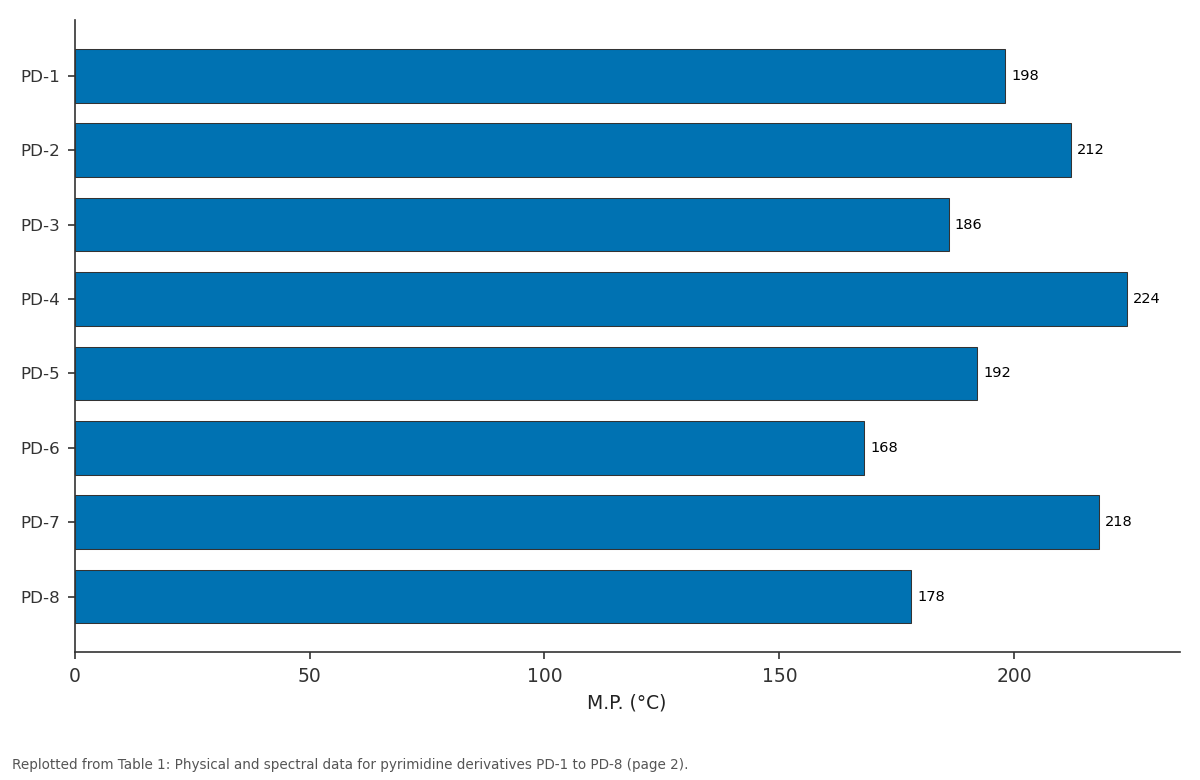
M.P. (°C): PD-1 vs PD-2 vs PD-3 vs PD-4 vs PD-5
Replotted from Table 1 (page 2) of the original paper. Every bar is the paper's own table value.
View source evidence ↗Figures & tables
From the original paper Table 1
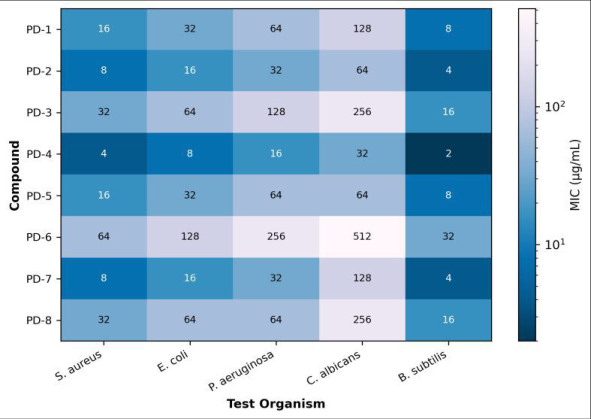 Figure 1
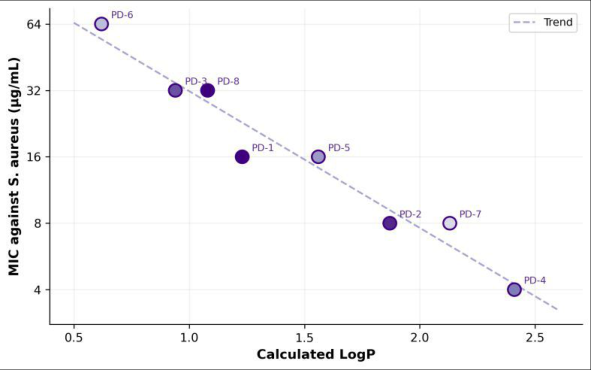 Figure 2
Introduction
The pyrimidine ring has been a cornerstone of drug design ever since Fischer and Ach first systematically explored its chemistry in the 1890s [1] . Today, this six-membered diazine appears in a remarkably diverse array of approved drugs-antimetabolites (5-fluorouracil), antivirals (zidovudine), and sedative-hypnotics (barbiturates)-reflecting the scaffold's capacity to interact with multiple biological targets [2] . The antimicrobial potential of substituted pyrimidines, while recognised for decades, has attracted renewed interest amid the global crisis of antibiotic resistance [3] . The World Health Organization's 2024 priority pathogen list highlights both Gram-positive cocci (methicillin-resistant Staphylococcus aureus) and Gram-negative rods (Pseudomonas aeruginosa) as species for which new agents are urgently needed [4] . Pyrimidine derivatives can interfere with folate biosynthesis, DNA replication, and cell-wall assembly, offering multiple modes of action that may delay resistance emergence when combined with existing drugs [5] . The Biginelli multicomponent reaction is a particularly efficient route to 3,4dihydropyrimidin-2(1H)-ones, allowing wide structural variation through choice of aldehyde, β-ketoester, and urea or thiourea components in a single step [6] . Substituent effects on antimicrobial potency can be rationalised through physicochemical descriptors such as LogP (lipophilicity), Hammett σ constants (electronic character), and molar refractivity (steric volume) [7] . Compounds that combine moderate lipophilicity with an electron-withdrawing group at the para position of the aryl ring often display improved membrane penetration and target affinity [8] . However, systematic datasets linking calculated descriptors to measured MICs for novel pyrimidine libraries remain scarce in the Indian context, where resistant pathogens circulate at high rates. This research synthesized eight 2,4,6-trisubstituted pyrimidine derivatives via Biginelli condensation, characterised them spectroscopically, evaluated their antimicrobial activity by
Reagents and Chemicals
Biginelli reactions were performed by refluxing equimolar amounts of aldehyde, ethyl acetoacetate, and urea (10 mmol each) with p-toluenesulfonic acid (10 mol%) in 15 mL of ethanol at 80 °C for 5-8 h. Progress was monitored by thinlayer chromatography (ethyl acetate: hexane, 3: 7). After cooling, the precipitated product was filtered, washed with cold ethanol, and recrystallized from ethanol-water to give pure compounds in 58-83% yield.
Methods
Melting points were determined on a Veego VMP-D apparatus and are uncorrected. FT-IR spectra (KBr) were recorded on a Shimadzu IRSpirit. ¹H-and ¹³C-NMR were acquired on a JEOL ECZ-400S (400 MHz) in DMSO-d₆ with TMS as internal standard. Mass spectra (ESI-MS, positive mode) were obtained on a Waters Xevo G2-XS Q-TOF. Antimicrobial activity was assessed by broth microdilution following CLSI M07-A9 guidelines [9] . Antimicrobial screening (Figure 1) revealed substantial variation across compounds and organisms. PD-4 was the most active derivative overall, with MICs of 4 µg/mL against S. aureus, 2 µg/mL against B. subtilis, and 16-32 µg/mL against Gram-negatives and the fungal strain. PD-6 (3-bromo) was the least active, with MICs ≥ 64 µg/mL for all organisms. Gram-positive bacteria were generally more susceptible than Gram-negative species or C. albicans.
Comprehensive Interpretation
A scatter plot of calculated LogP versus MIC against S. aureus (Figure 2) showed an inverse trend (r = -0.81): more lipophilic compounds tended to have lower MICs. PD-4 (LogP 2.41, MIC 4 µg/mL) anchored the high-potency, high-lipophilicity end, while PD-6 (LogP 0.62, MIC 64 µg/mL) sat at the opposite extreme. The correlation suggests membrane permeability as a contributing factor, though electronic effects of the fluorine atom in PD-4 cannot be ruled out.
Discussion
The strong activity of PD-4 aligns with broader trends in fluorinated heterocycle pharmacology, where the C-F bond's small size and high electronegativity improve metabolic stability and membrane penetration without large steric penalties [10] . The fluorine atom's inductive effect may also strengthen hydrogen-bond acceptance at the pyrimidine N-3 position, a site that molecular docking research on dihydrofolate reductase has identified as a key pharmacophore contact [11] . That Gram-positive organisms were more susceptible than Gram-negatives is consistent with the outer-membrane barrier that limits uptake of moderately lipophilic molecules into Enterobacteriaceae and Pseudomonas [12] . The relatively modest antifungal activity (MIC ≥ 32 µg/mL for all compounds) likely reflects differences in ergosterol-based membranes and the absence of a folate pathway in C. albicans comparable to the bacterial target [13] .
The LogP-MIC correlation (r = -0.81) is encouraging but must be interpreted cautiously given the small dataset (n = 8). Hansch analysis of larger pyrimidine libraries has placed the lipophilicity optimum for antibacterials near LogP 2-3 [7] , and our most active compound (PD-4, LogP 2.41) sits squarely in that window. Extending the series to include derivatives with LogP above 3 would test whether the linear trend continues or whether an optimum is reached beyond which aqueous solubility drops and activity declines. Timekill kinetics, biofilm disruption assays, and mammalian cytotoxicity screening are logical next steps before selecting a lead candidate for in-vivo evaluation.
Conclusion
Eight novel 2,4,6-trisubstituted pyrimidine derivatives were synthesized via Biginelli condensation in moderate to good yields and characterised by FT-IR, NMR, and mass spectrometry.
Antimicrobial screening by broth microdilution identified PD-4 (4-fluorophenyl substituent) as the most potent compound, with MICs as low as 2 µg/mL against B. subtilis and 4 µg/mL against S. aureus-values approaching the reference antibiotic ciprofloxacin.
A preliminary structure-activity analysis linked higher calculated lipophilicity to lower MICs against S. aureus, with a correlation coefficient of -0.81. This observation, combined with the well-documented pharmacological advantages of aromatic fluorination, supports further optimisation around the 4-fluorophenyl scaffold. The Biginelli reaction offers a practical, atom-economical route that can generate focused libraries rapidly. Future work should expand the series, measure cytotoxicity against mammalian cells, and explore synergistic combinations with existing antibiotics to address rising multidrug resistance.
Figures and tables from the paper
| Code | Ar substituent | Yield (%) | M.P. (°C) | MW | LogP | [M+H]⁺ found |
|---|---|---|---|---|---|---|
| PD-1 | H | 76 | 198 | 260.3 | 1.23 | 261.1 |
| PD-2 | 4-Cl | 71 | 212 | 294.7 | 1.87 | 295.1 |
| PD-3 | 4-OCH₃ | 68 | 186 | 290.3 | 0.94 | 291.1 |
| PD-4 | 4-F | 83 | 224 | 278.3 | 2.41 | 279.1 |
| PD-5 | 4-CH₃ | 74 | 192 | 274.3 | 1.56 | 275.1 |
| PD-6 | 3-Br | 58 | 168 | 339.2 | 0.62 | 339.0 |
| PD-7 | 4-NO₂ | 65 | 218 | 305.3 | 2.13 | 306.1 |
| PD-8 | 2-OH | 62 | 178 | 276.3 | 1.08 | 277.1 |
Table text extracted from the original PDF; superscript letters are shown inline. The original table image is below.
View original table image
References
21 in the original paper- Kappe CO. Biginelli dihydropyrimidine synthesis. Tetrahedron. 1993;49(32):6937-6963.
- Sharma V, Chitranshi N, Agarwal AK. Significance and biological importance of pyrimidine in the vast area of pharmaceutical sciences. International Journal of Medicinal Chemistry. 2014;2014:202784.
- Antimicrobial Resistance Collaborators. Global burden of bacterial antimicrobial resistance in 2019: a systematic analysis. Lancet. 2022;399(10325):629-655.
- World Health Organization. WHO bacterial priority pathogens list, 2024. WHO Press, Geneva. 2024;1-72.
- Desai NC, Rajpara KM, Joshi VV. Synthesis of pyrimidine-based derivatives and their antimicrobial activity. Medicinal Chemistry Research. 2013;22(7):3322-3331.
- Kappe CO. Recent advances in the Biginelli dihydropyrimidine synthesis. New tricks from an old dog. Accounts of Chemical Research. 2000;33(12):879888.
- Hansch C, Leo A, Hoekman D. Exploring QSAR: hydrophobic, electronic, and steric constants. American Chemical Society, Washington DC. 1995;1-348.
- Yadav MR, Shirude ST, Parmar A, Balaraman R, Giridhar R. Synthesis and anti-inflammatory activity of 2,3-diaryl-4(3H)-quinazolinones. Chemistry of Heterocyclic Compounds. 2006;42(8):1038-1045.
- Clinical and Laboratory Standards Institute. Methods for dilution antimicrobial susceptibility tests for bacteria that grow aerobically, M07-A9. CLSI, Wayne PA. 2012;1-68.
- Purser S, Moore PR, Swallow S, Gouverneur V. Fluorine in medicinal chemistry. Chemical Society Reviews. 2008;37(2):320-330.
- Rajput R, Mishra AP. A review on biological activity of pyrimidines. Journal of Current Pharmaceutical Research. 2012;3(4):1-6.
- Nikaido H. Molecular basis of bacterial outer membrane permeability revisited. Microbiology and Molecular Biology Reviews. 2003;67(4):593-656.
- Odds FC, Brown AJP, Gow NAR. Antifungal agents: mechanisms of action. Trends in Microbiology. 2003;11(6):272-279.
- Atwal KS, Swanson BN, Unger SE, Floyd DM, Moreland S, Hedberg A. Dihydropyrimidine calcium channel blockers. Journal of Medicinal Chemistry. 1991;34(2):806-811.
- Eicher T, Hauptmann S. The chemistry of heterocycles: structure, reactions, synthesis, and applications. WileyVCH, Weinheim. 2003;1-536.
- Matin MM, Matin P, Rahman MR, Ben Hadda T, Almalki FA, Mahmud S. Triazoles and their derivatives: chemistry, synthesis, and therapeutic applications. Frontiers in Molecular Biosciences. 2022;9:864286.
- Suresh Kumar GV, Rajendraprasad Y, Mallikarjuna BP, Chandrashekar SM. Synthesis of some novel 2substituted-5-[isopropylthiazol-2-yl]-1,3,4-oxadiazoles as potential antimicrobial agents. European Journal of Medicinal Chemistry. 2010;45(5):2063-2074.
- Sahu M, Siddiqui N. A review on biological importance of pyrimidines in the new era. International Journal of Pharmacy and Pharmaceutical Sciences. 2016;8(5):821.
- Rathore A, Sudhakar R, Ahsan MJ, Ali A, Subbaramaiah K. Synthesis and evaluation of some new pyrimidine derivatives for their antimicrobial and antitubercular activities. Bioorganic Chemistry. 2017;71:1-10.
- Singh K, Kaur H, Chibale K, Balzarini J. Synthesis of 4-aminoquinoline-pyrimidine hybrids as potent antimalarials and their mode of action research. European Journal of Medicinal Chemistry. 2013;66:314-323.
- Abu-Melha S. Pyrimidine derivatives: synthesis, antimicrobial screening, molecular docking, and DFT calculations. Journal of Molecular Structure. 2023;1274:134482.