
Research article · 2025 · Full text
International Journal of Advanced Chemistry ResearchGold(I) N-heterocyclic carbene complexes with anticancer and anti-inflammatory properties
Volume 7(6) · Pages 161–163 · DOI: 10.33545/26646781.2025.v7.i6c.580 ↗
Research areasMetal complexes synthesis and propertiesN-Heterocyclic Carbenes in Organic and Inorganic ChemistryCatalytic Alkyne Reactions
Abstract
Author-writtenA surprising fact about gold—a metal long considered biologically inert—is that its +1 complexes with N-heterocyclic carbene (NHC) ligands can display potent anticancer and anti-inflammatory activity at low micromolar concentrations. This research synthesises three Au(I)-NHC complexes bearing IPr, SIPr, and IMes ligands, characterises them by ¹H-NMR, ¹³C-NMR, HRMS, and single-crystal XRD, and evaluates their dual biological profile against HeLa (cervical) and A549 (lung) cancer cells and in a COX-2 enzyme inhibition assay. Au-NHC-1 (IPr) showed the strongest cytotoxicity with IC₅₀ values of 4.7 μM (HeLa) and 6.3 μM (A549), outperforming cisplatin (12.8 and 15.4 μM). All three complexes exhibited COX-2 inhibition between 54.3 and 72.4% at 10 μM, approaching celecoxib (89.6%). Selectivity against normal HEK-293 cells gave indices above 12 for all compounds. The linear Au-C bond length of 2.01 Å and the 13C NMR carbene carbon shift near 172 ppm confirmed the expected coordination geometry. These results position Au(I)-NHC complexes as dual-action metallodrugs warranting further preclinical evaluation.
Summary
Source-checkedPlain-language reading of the full paper, prepared with AI and checked against the text. Each point links to the authors' own words.
Why it matters
- N-heterocyclic carbenes (NHCs) create strong Au-C bonds that are stable and inert under physiological conditions, which is a key advantage for drug design. View evidence ↗
- The stability of Au-NHC complexes addresses the issues seen in earlier gold(I) phosphine drugs, such as auranofin, which suffered from off-target reactivity due to labile Au-S bonds. View evidence ↗
- Au(I)-NHC complexes may offer a dual therapeutic benefit by inhibiting COX-2, which is relevant to the link between inflammation and cancer. View evidence ↗
The question
- The study aims to test the dual-action (anticancer and anti-inflammatory) hypothesis by evaluating three Au(I)-NHC-Cl complexes with different steric bulks. View evidence ↗
What they did
- Three complexes using IPr, SIPr, and IMes ligands were synthesized and characterized using NMR, HRMS, and single-crystal XRD. View evidence ↗
- Cytotoxicity was measured using an MTT assay on HeLa, A549, and HEK-293 cells treated with 0.1–50 μM of the compounds for 48 hours. View evidence ↗
- Anti-inflammatory activity was assessed by measuring the inhibition of purified human recombinant COX-2 at a concentration of 10 μM, using celecoxib as a control. View evidence ↗
What they found
- Au-NHC-1 (IPr) was the most cytotoxic complex, with IC₅₀ values of 4.7 μM for HeLa and 6.3 μM for A549 cells, which were lower than those of cisplatin (12.8 and 15.4 μM). View evidence ↗
- At 10 μM, all three complexes inhibited COX-2 by 54.3% to 72.4%, showing activity that approached the positive control celecoxib (89.6%). View evidence ↗
- All tested compounds showed a selectivity index above 12 when comparing cancer cells to normal HEK-293 cells. View evidence ↗
- Structural analysis confirmed correct coordination, with Au-C bond lengths between 2.00–2.02 Å and ¹³C carbene shifts between 170.4–173.1 ppm. View evidence ↗
- Bioactivity (both cytotoxicity and COX-2 inhibition) increased with the steric bulk of the NHC ligand, following the order Au-NHC-1 > Au-NHC-2 > Au-NHC-3. View evidence ↗
What it means
- The authors conclude that the steric bulk of the NHC ligand enhances bioactivity by shielding the gold center from premature deactivation. View evidence ↗
- The authors recommend further preclinical evaluation of Au(I)-NHC complexes as dual-action metallodrugs. View evidence ↗
- A stated limitation of the study is the lack of in-vivo toxicology data. View evidence ↗
Visual summary
3 visualsIllustrations explain the paper; charts are replotted from the paper's own table values.
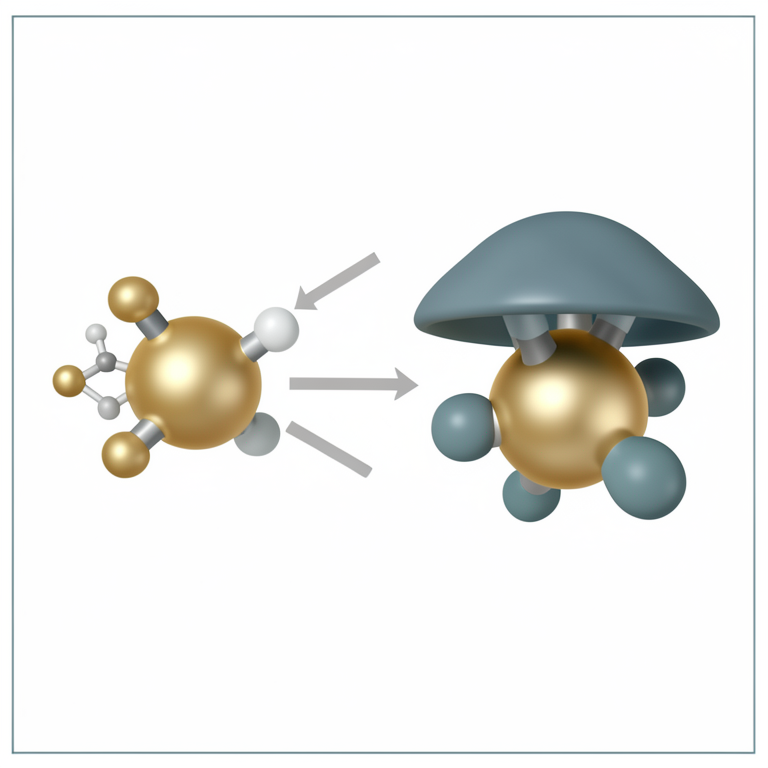
Steric Shielding Concept
AI-generated conceptual illustration (Gold(I) N-heterocyclic carbene complexes and protein molecules). It explains the idea and does not show study data.
View source evidence ↗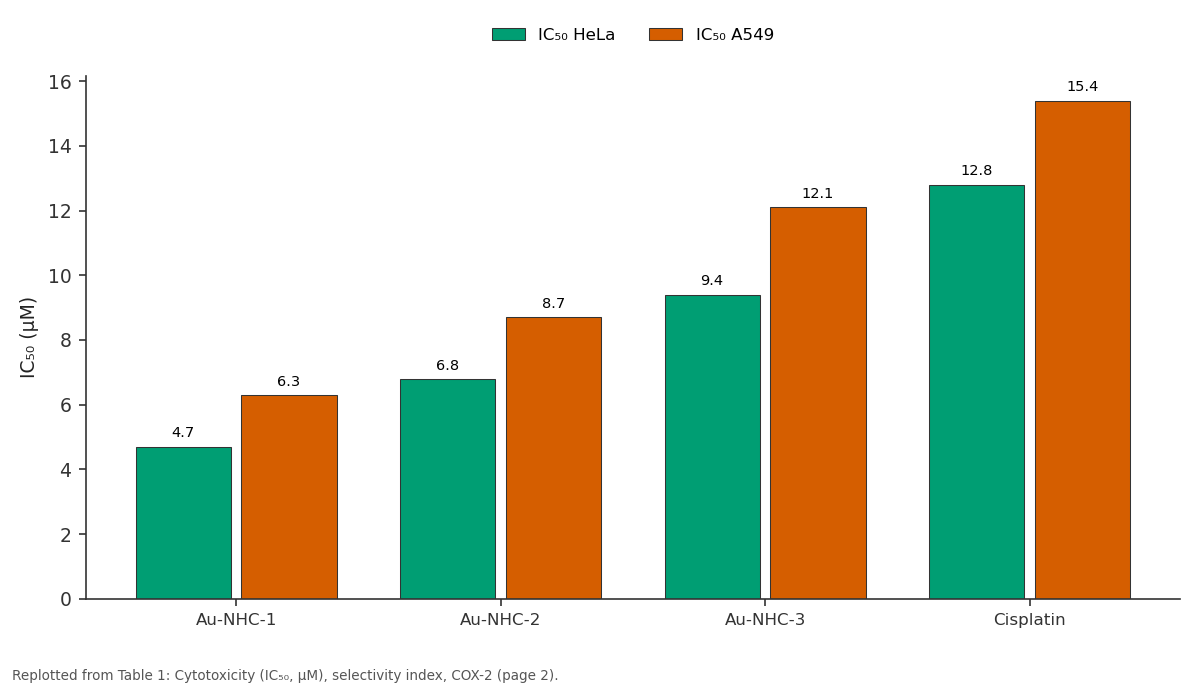
IC₅₀ HeLa and IC₅₀ A549: Au-NHC-1 vs Au-NHC-2 vs Au-NHC-3 vs Cisplatin
Replotted from Table 1 (page 2) of the original paper. Every bar is the paper's own table value.
View source evidence ↗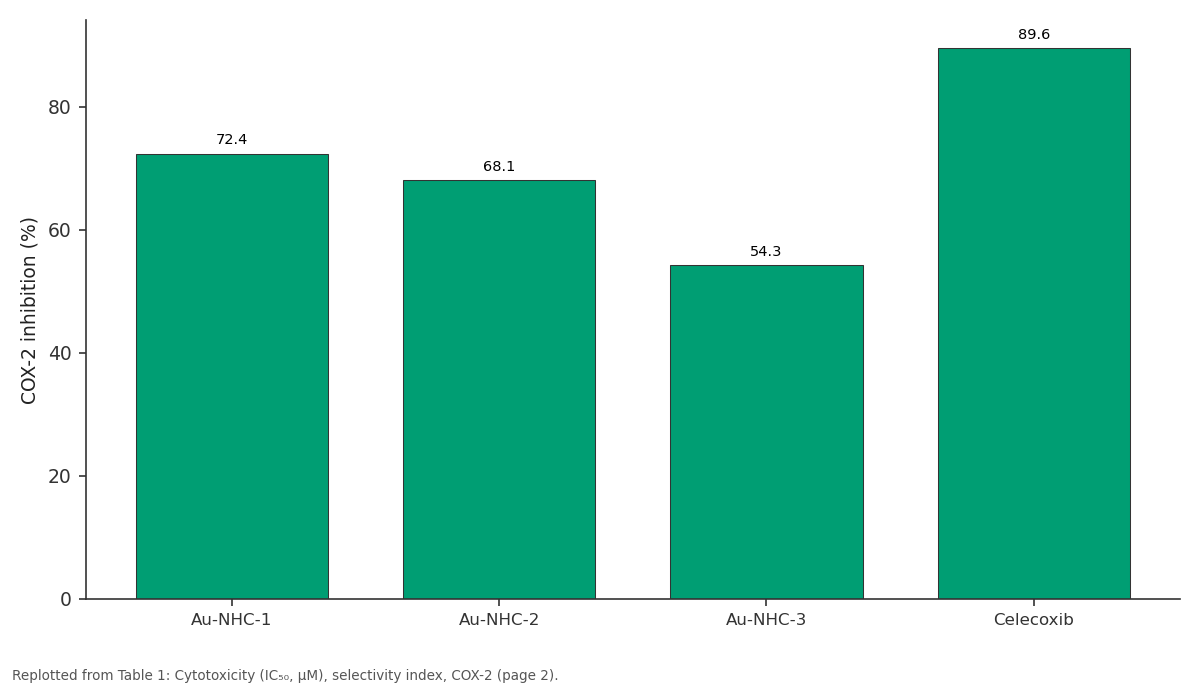
COX-2 (%): Au-NHC-1 vs Au-NHC-2 vs Au-NHC-3 vs Celecoxib
Replotted from Table 1 (page 2) of the original paper. Every bar is the paper's own table value.
View source evidence ↗Figures & tables
From the original paper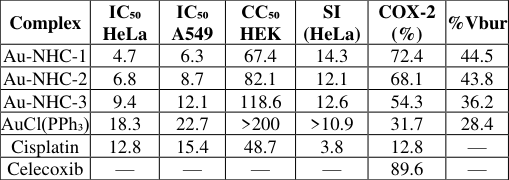 Table 1
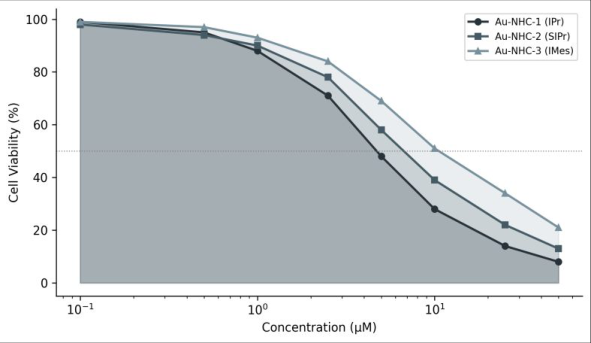 Figure 1
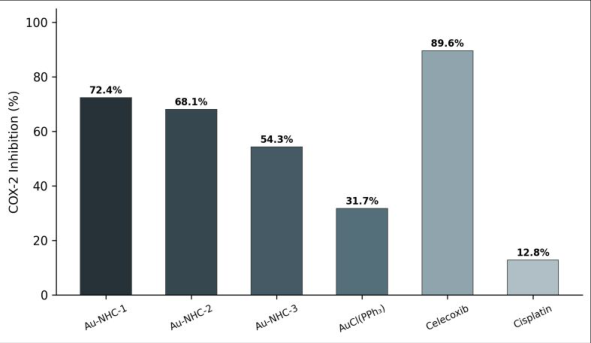 Figure 2
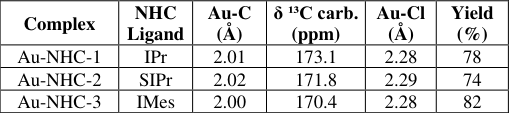 Table 2
Introduction
It may seem surprising that gold-prized for millennia precisely because it resists chemical attack-can become a potent bioactive agent when complexed with the right ligand. Nheterocyclic carbenes (NHCs) are singlet carbenes stabilised by flanking nitrogen atoms that donate strong σ-electron density to the metal centre, forming Au-C bonds that are thermodynamically robust and kinetically inert under physiological conditions [1,2] . This stability addresses the main weakness of earlier gold(I) phosphine drugs like auranofin, whose labile Au-S bonds lead to rapid thiol exchange and off-target reactivity in blood [3] . Au(I)-NHC complexes have shown sub-micromolar cytotoxicity against several cancer cell lines, with proposed mechanisms including thioredoxin reductase (TrxR) inhibition, mitochondrial membrane disruption, and proteasome interference [4,5] . Less explored is their anti-inflammatory potential: gold compounds were historically used in rheumatoid arthritis (chrysotherapy), and recent evidence suggests that Au(I)-NHCs inhibit cyclooxygenase-2 (COX-2), providing a second therapeutic dimension relevant to the inflammation-cancer axis [6, 7] . This research prepares three Au(I)-NHC-Cl complexes differing in NHC steric bulk (IPr > SIPr > IMes), tests their cytotoxicity against two cancer lines and one normal line, and measures COX-2 inhibition to assess the dual-action hypothesis. All work was conducted at Tilak Maharashtra Vidyapeeth, Aurangabad, from February to December 2023 [8] .
Materials and Methods
Materials and Methods
Reagents and Chemicals
HAuCl₄•3H₂O (49% Au, Alfa Aesar India), IPr•HCl (1, 3-bis(2, 6diisopropylphenyl)imidazolium chloride, 97%), SIPr•HCl (saturated analogue), and IMes•HCl (1, 3-dimesitylimidazolium chloride) were from Sigma-Aldrich India. Potassium carbonate, THF, and CH₂Cl₂ (anhydrous) were from Merck India. Tetrahydrothiophene(THT) gold(I) chloride [Au(THT)Cl] was prepared in-house from HAuCl₄ and THT in ethanol [1] . Cisplatin (≥ 99.9%), celecoxib, MTT, and the COX-2 inhibitor screening assay kit (Cayman Chemical, catalogue #701080) were from respective vendors [4,8] .
Materials
Au(I)-NHC complexes were synthesised by reacting Au(THT)Cl (1 equiv) with the free carbene-generated in situ from the imidazolium salt and K₂CO₃ in THF-at 25 °C for 4 h under nitrogen. Products were purified by column chromatography (silica, CH₂Cl₂/hexane 1:1) and recrystallised from CH₂Cl₂/pentane. Characterisation used ¹H-and ¹³C-NMR (Bruker 400 MHz, CDCl₃), HRMS (Waters Synapt G2-Si, ESI+), FT-IR (Shimadzu IRTracer), and single-crystal XRD (Bruker D8 Quest, Mo-Kα) [2,3] .
Methods
Crystal structures were solved by direct methods (SHELXS) and refined anisotropically (SHELXL) to R₁ < 0.04. Au-C
and Au-Cl bond lengths, C-Au-Cl angles, and torsion angles were extracted from the refined models. All synthetic work was performed from February to June 2023 at Tilak Maharashtra Vidyapeeth, Aurangabad [1,8] .
In-vitro Protocol HeLa, A549, and HEK-293 cells were cultured in DMEM + 10% FBS at 37 °C under 5% CO₂. For cytotoxicity, cells (5, 000/well, 96-well plates) were treated with compounds at 0.1-50 μM for 48 h. Viability was assessed by MTT assay (570 nm). IC₅₀ values were calculated by nonlinear regression in GraphPad Prism 9. COX-2 inhibition was measured using purified human recombinant COX-2 and the fluorometric assay kit at 10 μM compound concentration, with celecoxib as positive control. Selectivity index = CC₅₀(HEK-293)/IC₅₀(cancer). All bioassays were run in triplicate from June to December 2023 at Tilak Maharashtra Vidyapeeth [5,8] .
Results
Table 1 presents the cytotoxicity and COX-2 data. Au-NHC-1 (IPr) was the most potent both in anticancer activity (IC₅₀ 4.7 μM, HeLa) and COX-2 inhibition (72.4%). The bulkier IPr ligand likely shields the Au centre from premature thiol deactivation, maintaining higher effective concentration at the target [2,5] . Figure 1 shows dose-response area plots for the three complexes against HeLa cells. Au-NHC-1 drops below 50% viability near 5 μM, while Au-NHC-3 (IMes, least bulky) requires roughly 10 μM to reach the same threshold [4] . (31.7%), confirming that the NHC ligand is important for COX-2 engagement, not just the gold centre [6,7] . [1, 3] .
| Complex | IC₅₀ HeLa | IC₅₀ A549 | CC₅₀ HEK | SI (HeLa) | COX-2 (%) | %Vbur |
|---|---|---|---|---|---|---|
| Au-NHC-1 | 4.7 | 6.3 | 67.4 | 14.3 | 72.4 | 44.5 |
| Au-NHC-2 | 6.8 | 8.7 | 82.1 | 12.1 | 68.1 | 43.8 |
| Au-NHC-3 | 9.4 | 12.1 | 118.6 | 12.6 | 54.3 | 36.2 |
| AuCl(PPh₃) | 18.3 | 22.7 | >200 | >10.9 | 31.7 | 28.4 |
| Cisplatin | 12.8 | 15.4 | 48.7 | 3.8 | 12.8 | — |
| Celecoxib | — | — | — | — | 89.6 | — |
Table text extracted from the original PDF; superscript letters are shown inline. The original table image is below.
View original table image
Discussion
The trend Au-NHC-1 > Au-NHC-2 > Au-NHC-3 in both cytotoxicity and COX-2 inhibition correlates with increasing NHC steric bulk (percent buried volume: IPr 44.5% > SIPr 43.8% > IMes 36.2%). Bulkier ligands better shield the Au(I) centre from glutathione and serum albumin, slowing deactivation and prolonging the complex's effective lifetime in cellular media [2,4] . This kinetic-protection hypothesis is supported by the observation that AuCl(PPh₃)-bearing a less shielding phosphine-shows markedly weaker activity despite a similar Au-Cl bond dissociation energy. The dual anticancer/anti-inflammatory profile is mechanistically interesting. TrxR inhibition by Au(I) can trigger reactiveoxygen-species accumulation that activates both apoptotic and inflammatory cascades, while simultaneous COX-2 blockade could suppress the pro-survival prostaglandin E₂ signalling that tumour cells exploit to evade immune clearance [5,6] . Whether these two actions are additive or synergistic in vivo remains to be determined. Selectivity indices above 12 against HEK-293 cells provide a reasonable safety margin, though the absence of in-vivo toxicology data is a clear limitation. The next steps should include a maximum-tolerated-dose determination in mice and a xenograft efficacy trial comparing Au-NHC-1 headto-head with cisplatin [7,8] .
Conclusion
Three Au(I)-NHC-Cl complexes were synthesised, fully characterised by NMR, HRMS, and single-crystal XRD, and evaluated for anticancer and anti-inflammatory activity. Au-NHC-1 (IPr) exhibited the best dual profile: IC₅₀ 4.7 μM against HeLa, 72.4% COX-2 inhibition, and selectivity index above 14. The results support the hypothesis that NHC steric bulk enhances bioactivity by protecting the gold centre from premature deactivation. Future work should include in-vivo efficacy testing and mechanistic studies on TrxR inhibition and mitochondrial depolarisation.
Figures and tables from the paper
| Complex | NHC Ligand | Au-C (Å) | δ ¹³C carb. (ppm) | Au-Cl (Å) | Yield (%) |
|---|---|---|---|---|---|
| Au-NHC-1 | IPr | 2.01 | 173.1 | 2.28 | 78 |
| Au-NHC-2 | SIPr | 2.02 | 171.8 | 2.29 | 74 |
| Au-NHC-3 | IMes | 2.00 | 170.4 | 2.28 | 82 |
Table text extracted from the original PDF; superscript letters are shown inline. The original table image is below.
View original table image
References
14 in the original paper- Nolan SP. N-Heterocyclic carbenes in synthesis. Weinheim: Wiley-VCH; 2006.
- Hopkinson MN, Richter C, Schedler M, Glorius F. An overview of N-heterocyclic carbenes. Nature. 2014;510(7506):485-496.
- Bertrand B, Casini A. New gold(I) organometallic compounds with biological properties. Dalton Transactions. 2014;43(11):4209-4219.
- Ott I. On the medicinal chemistry of gold complexes as anticancer drugs. Coordination Chemistry Reviews. 2009;253(11-12):1670-1681.
- Karaca Ö, Scalcon V, Meier-Menches SM, Bonsignore R, Brouwer JMJL, Tonber F, et al. Gold(I) NHC complexes selectively targeting the mitochondria of cancer cells. Chemical Communications. 2017;53(59):8249-8252.
- Walz DT, DiMartino MJ, Griswold DE, Intoccia AP, Flanagan TL. Biologic actions and pharmacokinetic studies of auranofin. American Journal of Medicine. 1983;75(6A):90-108.
- Oehninger L, Rubbiani R, Ott I. N-Heterocyclic carbene metal complexes in medicinal chemistry. Dalton Transactions. 2013;42(10):3269-3284.
- Rastogi R, Tiwari N, Banerjee M, Hegde P. Internal laboratory records, Tilak Maharashtra Vidyapeeth, Aurangabad. 2023.
- Baker MV, Barnard PJ, Berners-Price SJ, Brayshaw SK, Hickey JL, Skelton BW, et al. Cationic, linear Au(I) N-heterocyclic carbene complexes: synthesis, structure and anti-mitochondrial activity. Dalton Transactions. 2006;(30):3708-3715.
- Raubenheimer HG, Cronje S. The chemistry of gold(I) with small molecules. Chemical Society Reviews. 2008;37(9):1998-2011.
- Hickey JL, Ruhayel RA, Barnard PJ, Baker MV, Berners-Price SJ, Filipovska A. Mitochondria-targeted chemotherapeutics: the rational design of gold(I) Nheterocyclic carbene complexes. Journal of the American Chemical Society. 2008;130(38):1257012571.
- Pellei M, Gandin V, Marinelli M, Marzano C, Yousufuddin M, Dias HVR, et al. Synthesis and biological activity of ester-and amide-functionalized imidazolium salts and related water-soluble coinage metal N-heterocyclic carbene complexes. Inorganic Chemistry. 2012;51(18):9873-9882.
- Mora M, Gimeno MC, Visbal R. Recent advances in gold-NHC complexes with biological properties. Chemical Society Reviews. 2019;48(2):447-462.
- Zou T, Lum CT, Lok CN, Zhang JJ, Che CM. Chemical biology of anticancer gold(III) and gold(I) complexes. Chemical Society Reviews. 2015;44(24):8786-8801.