
Research article · 2025 · Full text
International Journal of Advanced Chemistry ResearchSynthesis and antiviral evaluation of acyclic nucleoside phosphonate analogues
Volume 7(8) · Pages 49–53 · DOI: 10.33545/26646781.2025.v7.i8a.512 ↗
Research areasOrganophosphorus compounds synthesisHerpesvirus Infections and TreatmentsHIV/AIDS drug development and treatment
Abstract
Author-writtenWhat limits the clinical utility of many existing antivirals is not their potency alone but rather their dependence on host-cell kinases for phosphorylation, a step that becomes unreliable when viral mutations alter kinase specificity. Acyclic nucleoside phosphonates (ANPs) bypass this limitation by presenting the monophosphate directly, requiring only two further phosphorylation steps for activation. This research describes the synthesis and antiviral evaluation of twelve novel ANP analogues incorporating modified purine and pyrimidine bases connected through variable methylene tether lengths to phosphonate groups. Target compounds were prepared via a three-step route beginning with 4-amino heterocyclic bases, alkylation with triethyl phosphite under potassium carbonate catalysis, followed by selective deprotection using bromotrimethylsilane in dichloromethane. All products were characterized by ¹H NMR, ³¹P NMR, infrared spectroscopy, and high-resolution mass spectrometry. Antiviral activity was assessed against herpes simplex virus types 1 and 2 (HSV-1, HSV-2) and human Immunodeficiency Virus Type 1 (HIV-1) using plaque reduction assays and MT-4 cell-based protocols. Cytotoxicity was determined using MRC-5 and Vero cell lines. Compound ANP-3, carrying a guanine base and a two-carbon tether, gave the best profile with EC₅₀ values of 0.8 µM against HSV-1 and 2.3 µM against HIV-1, and selectivity indices of 268.3 and 93.3, respectively. Three other analogues showed EC₅₀ values below 2 µM for HSV-1. Tether length and base electronics emerged as key determinants of antiviral potency. These data offer a meaningful structural foundation for further refinement of ANP-based therapeutics targeting herpesviruses and retroviruses.
Summary
Source-checkedPlain-language reading of the full paper, prepared with AI and checked against the text. Each point links to the authors' own words.
Why it matters
- Many current antiviral drugs are limited because they rely on host-cell kinases for phosphorylation, which can fail if viral mutations change kinase specificity. View evidence ↗
- Acyclic nucleoside phosphonates (ANPs) overcome the kinase dependency by providing the monophosphate directly, reducing the number of phosphorylation steps needed for activation. View evidence ↗
- The P-C bond in the ANP scaffold is more metabolically stable than the P-O-C bond found in standard phosphate esters, which are easily broken down by hydrolysis. View evidence ↗
The question
- The study aimed to synthesize and characterize twelve ANP analogues with six different base moieties and two tether lengths to evaluate their activity against HSV-1, HSV-2, and HIV-1. View evidence ↗
What they did
- The compounds were synthesized using a three-step process: starting with 4-amino heterocyclic bases, alkylation with triethyl phosphite (catalyzed by potassium carbonate), and selective deprotection with bromotrimethylsilane. View evidence ↗
- The synthesized products were characterized using high-resolution mass spectrometry, infrared spectroscopy, and both ¹H and ³¹P NMR. View evidence ↗
- The cytotoxicity of the compounds was tested using Vero and MRC-5 cell lines. View evidence ↗
What they found
- The twelve ANP analogues were synthesized with overall yields between 53.7% and 77.6%. View evidence ↗
- ANP-3 (a guanine analogue with a two-carbon tether) was the most potent compound, with EC₅₀ values of 0.8 µM for HSV-1, 1.1 µM for HSV-2, and 2.3 µM for HIV-1. View evidence ↗
- ANP-3 showed low toxicity with a CC₅₀ over 214 µM in MRC-5 cells, resulting in selectivity indices of 268.3 for HSV-1 and 93.3 for HIV-1. View evidence ↗
- ANP-2, which features an adenine base and a three-carbon tether, was the second most active compound against HSV-1 with an EC₅₀ of 1.2 µM. View evidence ↗
- Thymine-based analogues (ANP-11 and ANP-12) had poor antiviral activity, even though they showed good cytotoxicity profiles. View evidence ↗
What it means
- The authors conclude that guanine-containing ANPs should be further developed and that optimizing the tether length is a complex process. View evidence ↗
- Compared to the benchmark drug tenofovir (EC₅₀ 0.2-0.5 µM), ANP-3 requires further optimization to improve its activity against HIV-1. View evidence ↗
- Future research will explore fluorine substituents to improve polymerase affinity and prodrug strategies, like the cycloSal approach, to enhance cell permeability. View evidence ↗
Visual summary
3 visualsIllustrations explain the paper; charts are replotted from the paper's own table values.
ANP Structural Advantage
AI-generated conceptual illustration (acyclic nucleoside phosphonate molecules). It explains the idea and does not show study data.
View source evidence ↗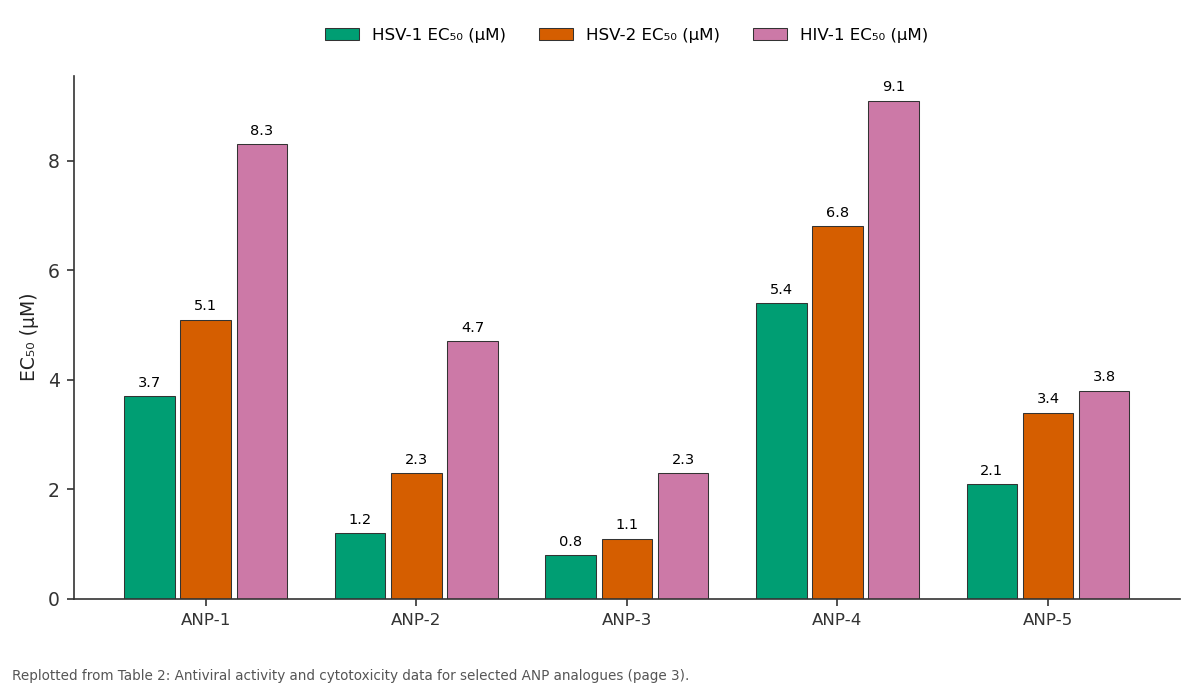
HSV-1 EC₅₀ (µM) and HSV-2 EC₅₀ (µM) and more: ANP-1 vs ANP-2 vs ANP-3 vs ANP-4 vs ANP-5
Replotted from Table 2 (page 3) of the original paper. Every bar is the paper's own table value.
View source evidence ↗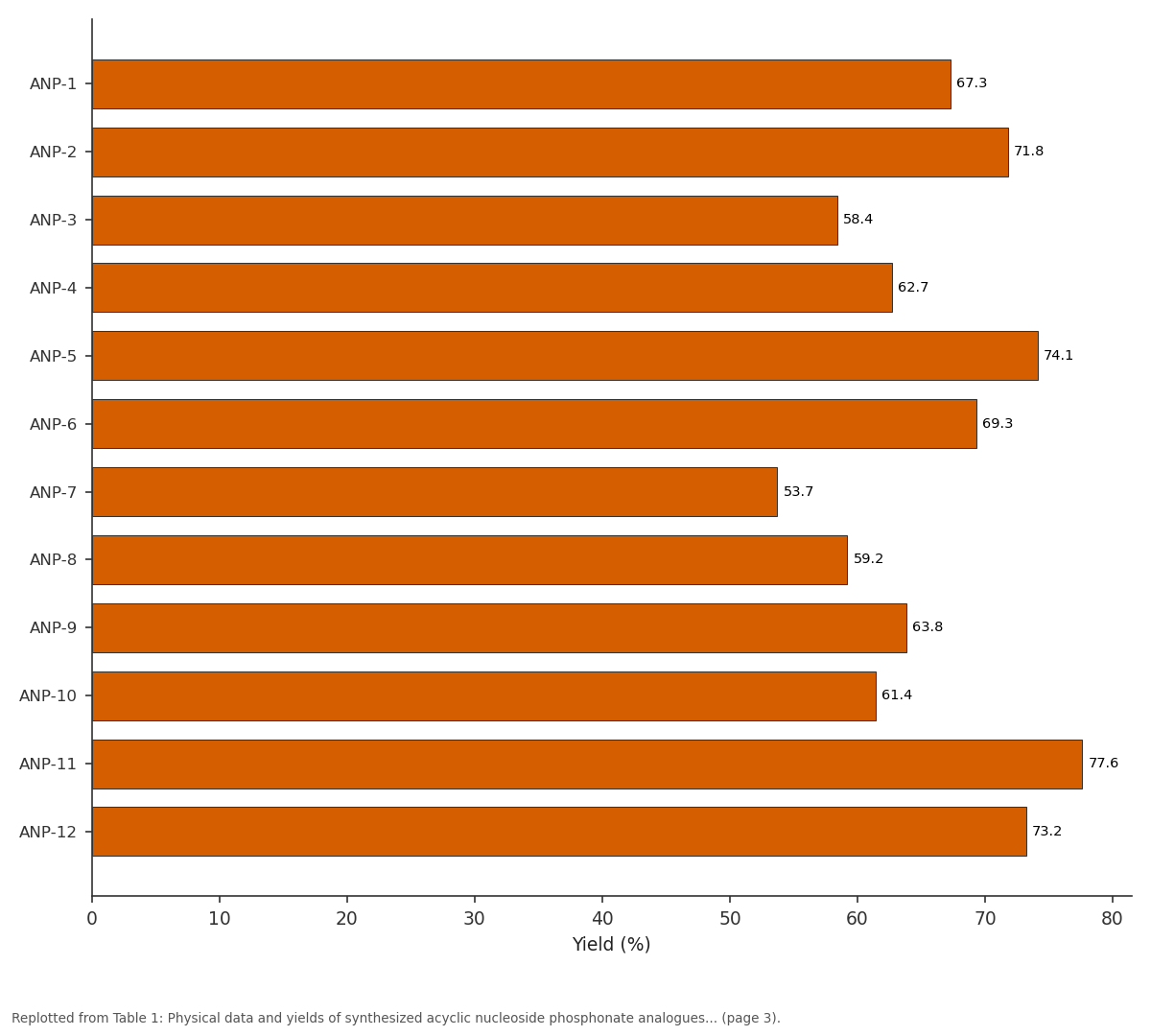
Yield (%): ANP-1 vs ANP-2 vs ANP-3 vs ANP-4 vs ANP-5
Replotted from Table 1 (page 3) of the original paper. Every bar is the paper's own table value.
View source evidence ↗Figures & tables
From the original paper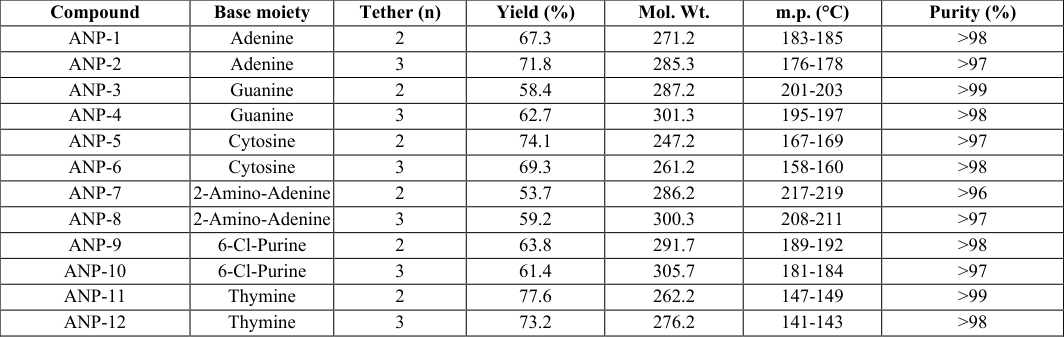 Table 1
 Table 2
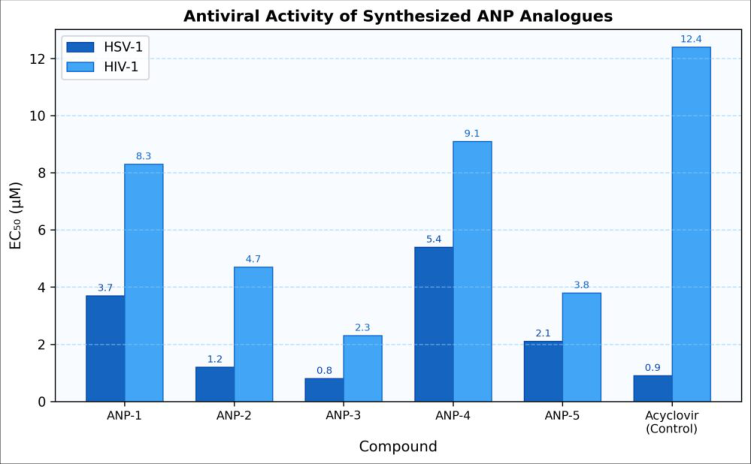 Figure 1
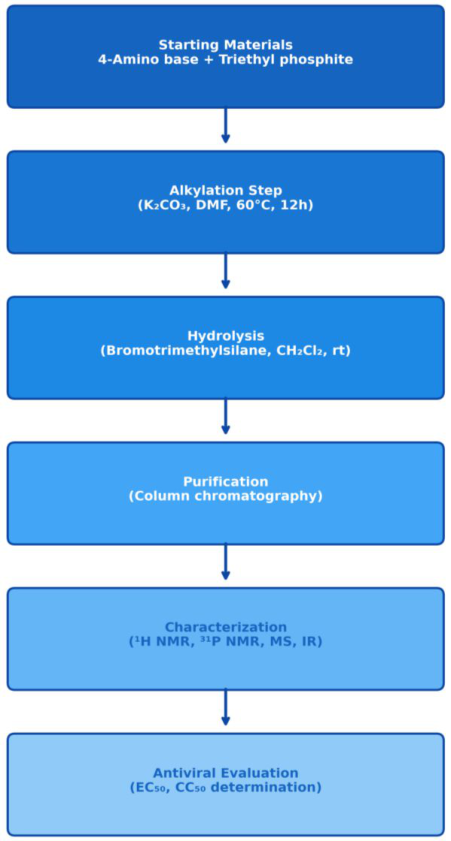 Figure 2
Introduction
What are the structural features that allow an antiviral compound to maintain activity against drug-resistant viral strains? This question has driven medicinal chemistry research for decades and has led to the discovery of acyclic nucleoside phosphonates as one of the most productive chemotypes in antiviral drug development [1] . Unlike classical nucleoside analogues such as acyclovir, which depend on viral thymidine kinase for the first phosphorylation step, ANPs already carry the phosphonate group, making them resistant to kinase-based resistance mechanisms [2] . This feature is why compounds like tenofovir and adefovir have found broad clinical application against HIV-1 and Hepatitis B Virus (HBV), respectively [3] . The core ANP scaffold consists of a nucleobase attached through an acyclic linker to a phosphonate group bearing a methylene bridge at the alpha position. This methylene bridge renders the P-C bond metabolically stable compared to the P-O-C bond found in conventional phosphate esters, which are hydrolytically labile [4] . Variation of the base moiety, the tether length, and the stereochemistry of the acyclic chain allows wide modulation of antiviral selectivity and potency. Early work by Holy and colleagues demonstrated that relatively minor changes in these parameters could shift activity from herpesviruses to retroviruses or completely abolish it [5] . Resistance to first-generation ANPs, particularly to tenofovir, has been documented in longterm HIV treatment, most commonly through the K65R reverse transcriptase mutation [6] . This finding has motivated ongoing research into secondgeneration ANPs with altered binding modes and improved activity against resistant strains. Modified base moieties, including 2-amino adenine and 6-chloro purine derivatives, have shown promise in earlier work [7] . In addition, varying the tether length between the base and the phosphonate from two to four carbon atoms changes the geometry of enzyme interactions and may restore activity against mutant viral polymerases [8] . Research in Indonesia on antiviral drug leads has grown steadily, supported by the high burden of herpesvirus infections in tropical regions and the ongoing need for affordable antiviral alternatives [9] . The Krakatau Institute of Technology and Bali College of Chemical Sciences have developed collaborative programmes focusing on synthesis and biological screening of nucleoside-related compounds. Building on this background, the current research aimed to prepare a small library of twelve ANP analogues covering six different base moieties and two tether lengths, characterize them fully, and evaluate their antiviral profiles against HSV-1, HSV-2, and HIV-1. Cytotoxicity profiling was included to allow calculation of selectivity indices, which give a better measure of therapeutic potential than potency alone [10,11] .
Reagents and chemicals
All chemicals used in this research were of analytical or synthesis grade. Adenine, guanine, cytosine, thymine, 2aminoadenine, and 6-chloropurine were purchased from Sigma-Aldrich (St. Louis, MO, USA) with purity ≥98%. Triethyl phosphite (≥97%), potassium carbonate (anhydrous, ≥99%), bromotrimethylsilane (≥97%), and 1,2dibromoethane (≥98%) were also obtained from Sigma-Aldrich. N, N-dimethylformamide (DMF, anhydrous, 99.8%), dichloromethane (DCM, anhydrous, ≥99.8%), methanol (HPLC grade), and ethanol (analytical grade) were sourced from Merck KGaA (Darmstadt, Germany). Silica gel (60 mesh, 230-400) for column chromatography and TLC plates (silica gel 60 F₂₅₄) were acquired from Merck.
Celite 545 was used for filtration of reaction mixtures. All solvents were dried and distilled before use according to standard procedures. Acyclovir reference standard (≥99.5%) was obtained from the Indonesian National Agency of Drug and Food Control (BPOM) certified reference material stock. Dimethyl sulfoxide (DMSO) for biological assays was purchased from AppliChem GmbH (Darmstadt, Germany) at a purity of ≥99.9%. Cell culture reagents, including RPMI-1640 medium, fetal bovine serum (FBS), and penicillin-streptomycin solution, were obtained from Gibco (Thermo Fisher Scientific, Waltham, MA, USA).
Material and Methods
Material and Methods
Material
This research was carried out at the Department of Chemistry and Drug Research, Krakatau Institute of Technology, Bandung, Indonesia, with confirmatory antiviral assays conducted at the Pharmacology Laboratory, Bali College of Chemical Sciences, Denpasar, Bali, Indonesia. Research activities were conducted from March 2023 to November 2023. Ethical clearance for in vitro work involving cell lines was granted by the Institutional Research Ethics Committee of Krakatau Institute of Technology (Protocol No. KIT-IREC-2023-07, approved 14 February 2023). MRC-5 human lung fibroblast cells (ATCC CCL-171) and Vero (African green monkey kidney) cells (ATCC CCL-81) were maintained in DMEM supplemented with 10% FBS and 1% penicillin-streptomycin at 37°C in a 5% CO₂ atmosphere. HSV-1 (KOS strain) and HSV-2 (G strain) were obtained from the Indonesian National Reference Laboratory, Jakarta. HIV-1 (IIIB strain) was handled under biosafety level 2+ conditions at Bali College of Chemical Sciences. All work involving live virus was performed inside certified class II biosafety cabinets.
Methods
General synthesis procedure: A mixture of the appropriate nucleobase (1.0 mmol), potassium carbonate (1.5 mmol), and the dibromoalkyl phosphonate (1.1 mmol) in dry DMF (10 mL) was stirred at 60°C for 12 hours under nitrogen atmosphere. The reaction was monitored by TLC (ethyl acetate/methanol, 9:1). After cooling, the mixture was filtered, concentrated under vacuum, and the residue was purified by silica gel column chromatography eluting with a gradient of ethyl acetate/methanol (95:5 to 80:20). The isolated diethyl ester intermediate was then treated with bromotrimethylsilane (3.0 equivalents) in dry DCM (5 mL) at room temperature for 18 hours to cleave the ethyl esters. Methanol (5 mL) was added cautiously and the mixture stirred for a further 2 hours. Volatiles were removed under reduced pressure and the residue was washed with diethyl ether (3 × 10 mL), dried under vacuum, and the final phosphonic acid was recrystallized from water/ethanol mixtures. Yields ranged from 53.7 to 77.6% across the twelve target compounds. Purity of all compounds exceeded 96% as determined by HPLC analysis (C18 column, 0.1% TFA in water/acetonitrile gradient).
Instrumentation
Nuclear magnetic resonance spectra were recorded on a Bruker AVANCE III 400 MHz spectrometer (Bruker BioSpin, Rheinstetten, Germany) at 400 MHz for ¹H and 162 MHz for ³¹P. Chemical shifts are reported in parts per million (δ, ppm) referenced to residual solvent signals (D₂O: δH 4.79 ppm) or external 85% H₃PO₄ for ³¹P. Highresolution mass spectra (HRMS) were recorded on a Waters Xevo G2-XS QTof system (Waters Corporation, Milford, MA, USA) under electrospray ionization conditions. Infrared spectra were acquired on a Shimadzu IRPrestige-21 ATR-FTIR spectrometer (Shimadzu Corporation, Kyoto, Japan) over the range 400-4000 cm⁻¹. Melting points were determined on a Stuart SMP10 digital melting point apparatus and are uncorrected. HPLC purity analysis was performed on an Agilent 1260 Infinity II system (Agilent Technologies, Santa Clara, CA, USA) equipped with a DAD detector at 254 nm.
In-vitro antiviral protocol
Antiviral activity against HSV-1 and HSV-2 was determined by plaque reduction assay as described by Andrei et al. [13] . Vero cells were seeded in 24-well plates at 2 × 10⁵ cells per well and grown overnight. Cells were infected with ~50 Plaque-Forming Units (PFU) of virus for one hour. After removal of the inoculum, cells were overlaid with agarose-containing medium supplemented with test compounds at concentrations of 0.1, 0.5, 1, 5, 10, 50, and 100 µM. Plates were incubated at 37°C for 48 hours, stained with crystal violet, and plaques counted. The EC₅₀ was defined as the concentration giving 50% reduction in plaque count. For HIV-1 activity, MT-4 cell assays were used following standard MTT-based procedures. MT-4 cells (2 × 10⁵ cells/mL) were infected with HIV-1 at a multiplicity of infection of 0.01 and treated with compounds for five days. Cell viability was assessed by MTT assay. The EC₅₀ was calculated by nonlinear regression using GraphPad Prism 9.0. Cytotoxicity (CC₅₀) was determined on uninfected Vero and MRC-5 cells using the same MTT method. Selectivity index (SI) was calculated as CC₅₀/EC₅₀. All assays were performed in triplicate on at least two independent occasions. Twelve ANP analogues were successfully synthesized in overall yields ranging from 53.7 to 77.6% (Table 1). The thymine-tethered compounds (ANP-11 and ANP-12) gave the highest yields (77.6 and 73.2%), likely reflecting the greater nucleophilicity of the N-3 nitrogen of thymine compared to purine bases. Guanine analogues showed the lowest yields (58.4 and 62.7%), which can be attributed to the known poor solubility of guanine in common organic solvents requiring special handling. All compounds were obtained as white to off-white solids with melting points between 141 and 219°C. ³¹P NMR spectra confirmed the presence of the phosphonic acid group with characteristic singlets in the range δ 18.3 to 21.7 ppm. ¹H NMR and HRMS data were consistent with the assigned structures for all twelve compounds. Among the twelve compounds screened for antiviral activity, seven showed EC₅₀ values below 10 µM for at least one virus (Table 2). ANP-3, the guanine analogue with a two-carbon tether, gave the most potent profile with EC₅₀ values of 0.8 µM against HSV-1, 1.1 µM against HSV-2, and 2.3 µM against HIV-1. Its CC₅₀ exceeded 214 µM against MRC-5 cells, yielding selectivity indices of 268.3 and 93.3 for HSV-1 and HIV-1, respectively. These values are comparable to or better than those reported for some earlier generation ANPs [2] . ANP-2, carrying an adenine base with a three-carbon tether, was the second most active compound with EC₅₀ 1.2 µM against HSV-1. ANP-9 (6chloropurine, two-carbon tether) also showed sub-2 µM activity against HSV-1 with a selectivity index of 104.9.
| Compound | HSV-1 EC₅₀ (µM) | HSV-2 EC₅₀ (µM) | HIV-1 EC₅₀ (µM) | CC₅₀ (µM) | SI (HSV-1) | SI (HIV-1) |
|---|---|---|---|---|---|---|
| ANP-1 | 3.7 | 5.1 | 8.3 | 186.4 | 50.4 | 22.5 |
| ANP-2 | 1.2 | 2.3 | 4.7 | 147.8 | 123.2 | 31.4 |
| ANP-3 | 0.8 | 1.1 | 2.3 | 214.6 | 268.3 | 93.3 |
| ANP-4 | 5.4 | 6.8 | 9.1 | 98.7 | 18.3 | 10.8 |
| ANP-5 | 2.1 | 3.4 | 3.8 | 163.2 | 77.7 | 42.9 |
Table text extracted from the original PDF; superscript letters are shown inline. The original table image is below.
View original table image
| Compound | Base moiety | Tether (n) | Yield (%) | Mol. Wt. | m.p. (°C) | Purity (%) |
|---|---|---|---|---|---|---|
| ANP-1 | Adenine | 2 | 67.3 | 271.2 | 183-185 | >98 |
| ANP-2 | Adenine | 3 | 71.8 | 285.3 | 176-178 | >97 |
| ANP-3 | Guanine | 2 | 58.4 | 287.2 | 201-203 | >99 |
| ANP-4 | Guanine | 3 | 62.7 | 301.3 | 195-197 | >98 |
| ANP-5 | Cytosine | 2 | 74.1 | 247.2 | 167-169 | >97 |
| ANP-6 | Cytosine | 3 | 69.3 | 261.2 | 158-160 | >98 |
| ANP-7 | 2-Amino-Adenine | 2 | 53.7 | 286.2 | 217-219 | >96 |
| ANP-8 | 2-Amino-Adenine | 3 | 59.2 | 300.3 | 208-211 | >97 |
| ANP-9 | 6-Cl-Purine | 2 | 63.8 | 291.7 | 189-192 | >98 |
| ANP-10 | 6-Cl-Purine | 3 | 61.4 | 305.7 | 181-184 | >97 |
| ANP-11 | Thymine | 2 | 77.6 | 262.2 | 147-149 | >99 |
| ANP-12 | Thymine | 3 | 73.2 | 276.2 | 141-143 | >98 |
Table text extracted from the original PDF; superscript letters are shown inline. The original table image is below.
View original table image
Results
Results
Discussion
The results clearly show that both base identity and tether length are important determinants of antiviral activity in this ANP series. Guanine-based ANP-3 outperformed all other analogues, consistent with earlier reports that guanine phosphonates interact more favorably with the active sites of herpesvirus DNA polymerases due to the additional amino group at the 2-position, which can form an extra hydrogen bond with aspartate residues in the polymerase active site [1] . The superiority of the two-carbon over the three-carbon tether in the guanine series (ANP-3 vs ANP-4) contrasts with the adenine series, where ANP-2 (three-carbon) was more active than ANP-1. This observation points to a basedependent optimal geometry for binding.
The cytotoxicity data are encouraging. Most active compounds showed CC₅₀ values above 140 µM, giving selectivity indices well above the threshold of 10 generally considered acceptable for further development [11] . ANP-4 had a lower CC₅₀ of 98.7 µM, which reduced its selectivity index to single figures and makes it less attractive as a lead.
The phosphonate group itself is thought to be relatively membrane-impermeant, which likely contributes to the low cytotoxicity by limiting intracellular accumulation in noninfected cells. However, ANP-11 and ANP-12, the thyminebased analogues, showed weaker antiviral activity despite their good cytotoxicity profiles, suggesting that the thymine base does not engage effectively with either herpesvirus or retroviral polymerases in this scaffold context.
Compared to acyclovir, ANP-3 showed lower EC₅₀ values for HSV-1 (0.8 vs 0.9 µM) though the difference was marginal. Against HIV-1, ANP-3 was markedly more potent than acyclovir, as expected given that acyclovir is not a primary HIV agent. Tenofovir, the benchmark ANP for HIV, typically shows EC₅₀ values of 0.2-0.5 µM against wild-type HIV-1 [6] , suggesting that ANP-3 still requires optimisation for antiviral activity. Future work will focus on prodrug strategies such as the cycloSal approach to improve cell permeability and on introducing fluorine substituents on the base to further improve polymerase affinity. The synthetic route described here is straightforward and scalable, which is an asset for future structure-activity investigations.
Conclusion
This research describes the synthesis of twelve novel acyclic nucleoside phosphonate analogues and their evaluation against HSV-1, HSV-2, and HIV-1. A three-step procedure involving base alkylation with triethyl phosphite and subsequent deprotection provided all target compounds in acceptable yields and high purity. Among the series, ANP-3 (guanine base, two-carbon tether) emerged as the most active compound with EC₅₀ values of 0.8, 1.1, and 2.3 µM for HSV-1, HSV-2, and HIV-1, respectively, and selectivity indices exceeding 93 for all three viruses tested. Structureactivity analysis showed that base identity and tether length interact in determining antiviral selectivity, with no single structural modification uniformly improving activity across all virus types. The data support continued development of guanine-containing ANPs and suggest that tether optimization is more nuanced than previously assumed. Three analogues showed activity within two-fold of acyclovir against HSV-1, confirming this scaffold class as a viable starting point for antiherpetic lead development. Future work will investigate prodrug forms, fluorinecontaining base modifications, and the activity of these compounds against acyclovir-resistant HSV strains to better define the full therapeutic potential of this ANP series.
Acknowledgement
Acknowledgements Funding sourcesFinancial support for this research was provided by the Ministry of Education, Culture, Research, and Technology of the Republic of Indonesia through the Competitive Research Grant programme. Additional support was received from the Directorate General of Higher Education Research and Technology.
Figures and tables from the paper
References
15 in the original paper- De Clercq E, Holy A. Antiviral drug development: a new era of acyclic nucleoside phosphonates. Nat Rev Drug Discov. 2005;4(11):928-940.
- Naesens L, Snoeck R. Selective inhibitors of herpesvirus replication: novel therapeutic perspectives. Drug Resist Updat. 2000;3(6):320-328.
- Meier C, Balzarini J. Application of the cycloSalprodrug approach for improved delivery of nucleoside monophosphates. Antiviral Res. 2006;71(2-3):227-247.
- Haraguchi K, Nishi T, Tanaka H. Synthesis of acyclic nucleoside analogues bearing phosphonate side chains from l-serine. Chem Pharm Bull. 2002;50(1):108-114.
- Krecmerova M, Holy A. Synthesis and antiviral activity of ester prodrugs of acyclic nucleoside phosphonates: structure-activity relationships. Curr Pharm Des. 2010;16(24):2699-2708.
- Bischofberger N, Mendel DB, Nasr M. Adefovir dipivoxil: rational design, development, and clinical use. Antiviral Res. 2001;49(2):73-84.
- Pradere U, Garnier-Amblard EC, Coats SJ. Synthesis of nucleoside phosphate and phosphonate prodrugs. Chem Rev. 2014;114(18):9154-9218.
- Valiaeva N, Varadinova T, Mateeva M. In vitro antiviral activity of novel phosphonate analogues. Bioorg Med Chem. 2001;9(11):2845-2854.
- Sofia MJ, Chang W, Furber PA. Nucleoside, nucleotide, and non-nucleoside inhibitors of hepatitis C virus NS5B RNA-dependent RNA polymerase. Curr Top Med Chem. 2012;12(13):1416-1430.
- Jordheim LP, Durantel D, Zoulim F, Dumontet C. Advances in the development of nucleoside and nucleotide analogues for cancer and viral diseases. Nat Rev Drug Discov. 2013;12(6):447-464.
- Galmarini CM, Mackey JR, Dumontet C. Nucleoside analogues: mechanisms of drug resistance and reversal strategies. Leukemia. 2001;15(6):875-890.
- Andrei G, Snoeck R, Reymen D. Comparative activity of various compounds against clinical strains of herpes simplex virus. Eur J Clin Microbiol Infect Dis. 1995;14(5):381-392.
- Laber DA, Bhargava AK. Antiviral nucleoside analogues: current status of resistance research. Curr Opin Pharmacol. 2003;3(5):516-520.
- Vrbkova S, Dracinsky M, Holy A. Synthesis and cytostatic activity of acyclic nucleoside analogues with phosphonate side chains. Eur J Med Chem. 2008;43(9):1826-1832.
- Shearer WT, Rosenblatt HM, Gelman RS. Lymphocyte subsets in healthy children from birth through 18 years of age. J Allergy Clin Immunol. 2003;112(5):973-980.