
Research article · 2025 · Full text
International Journal of Advanced Chemistry ResearchNanosuspension technology for enhancement of oral absorption of BCS class II drugs
Volume 7(11) · Pages 187–190 · DOI: 10.33545/26646781.2025.v7.i11c.471 ↗
Research areasDrug Solubulity and Delivery SystemsAdvanced Drug Delivery SystemsCrystallization and Solubility Studies
Abstract
Author-writtenIt seems paradoxical that a drug can be pharmacologically potent yet clinically useless simply because its crystals won't dissolve fast enough to be absorbed but that is the reality for roughly 40% of marketed drugs and 70% of pipeline candidates classified as BCS Class II. This research prepared and evaluated nanosuspensions of glimepiride, a poorly water-soluble BCS Class II antidiabetic agent, using wet media milling with zirconia beads. The effects of milling time (30–180 min) and HPMC-E5 stabiliser concentration (0.25–1.00% w/v) on particle size, polydispersity, and zeta potential were mapped systematically. The optimised nanosuspension (90 min milling, 0.75% HPMC-E5) yielded a mean particle size of 149.8 ± 8.3 nm, PDI of 0.21 ± 0.03, and zeta potential of −22.7 ± 1.4 mV. In vitro dissolution in pH 1.2 HCl and pH 6.8 phosphate buffer showed 99.1% release within 60 min for the nanosuspension versus 44.1% for a microsuspension and 28.6% for raw drug powder. Stability at 25 °C/60% RH over 90 days confirmed particle size growth below 8%. Lyophilised nanosuspension powder reconstituted to its original particle size within 2 min. These results demonstrate that wet media milling can transform the dissolution-limited bioavailability of BCS Class II drugs like glimepiride into rapid, near-complete release.
Summary
Source-checkedPlain-language reading of the full paper, prepared with AI and checked against the text. Each point links to the authors' own words.
Why it matters
- A significant portion of current and future drugs, approximately 40% of marketed and 70% of pipeline candidates, are BCS Class II, meaning they have high permeability but low solubility. View evidence ↗
- For BCS Class II drugs, the primary barrier to oral absorption is the slow rate at which the solid drug dissolves in the gastrointestinal tract. View evidence ↗
- Reducing drug particles to the nanometer scale (under 1 µm) increases the surface-area-to-volume ratio and saturation solubility, which speeds up dissolution. View evidence ↗
The question
- The study aimed to optimize wet media milling for a glimepiride nanosuspension, characterize its properties, compare its dissolution to raw drug and commercial tablets, and test its stability and lyophilization. View evidence ↗
What they did
- The researchers used a lab-scale wet media mill with a 50 mL zirconia-lined chamber and 0.3 mm yttria-stabilized zirconia beads at 85% v/v loading. View evidence ↗
- The study systematically tested the impact of milling times between 30 and 180 minutes and HPMC-E5 stabilizer concentrations from 0.25% to 1.00% w/v. View evidence ↗
- The product was characterized using Dynamic Light Scattering (DLS) for size and zeta potential, Scanning Electron Microscopy (SEM) for morphology, and X-ray Powder Diffraction (XRPD) and Differential Scanning Calorimetry (DSC) to ensure the drug remained crystalline. View evidence ↗
- Lyophilization was performed by adding 5% mannitol as a cryoprotectant, freezing at -40 °C for 12 hours, and drying at -20 °C and 100 mTorr for 48 hours. View evidence ↗
What they found
- The optimal formulation (90 min milling, 0.75% HPMC-E5) resulted in a mean particle size of 149.8 ± 8.3 nm, a PDI of 0.21 ± 0.03, and a zeta potential of -22.7 ± 1.4 mV. View evidence ↗
- In vitro dissolution tests showed that the nanosuspension released 99.1% of the drug within 60 minutes, significantly higher than the microsuspension (44.1%) and raw drug powder (28.6%). View evidence ↗
- At the 30-minute mark, the nanosuspension achieved 91.4% dissolution, compared to 42.1% for the marketed tablet and 15.7% for the raw drug. View evidence ↗
- The nanosuspension remained stable over 90 days at 25 °C and 60% relative humidity, with particle size growth remaining below 8%. View evidence ↗
- The lyophilized powder was able to be reconstituted to its original particle size within 2 minutes. View evidence ↗
What it means
- The authors conclude that wet media milling effectively transforms the dissolution of BCS Class II drugs and recommend developing glimepiride nanosuspension-based solid dosage forms to improve oral absorption and reduce variability caused by food. View evidence ↗
- The study is limited by a lack of in vivo pharmacokinetic data; therefore, the observed in vitro dissolution improvements need to be confirmed in animal or human models. View evidence ↗
Visual summary
3 visualsIllustrations explain the paper; charts are replotted from the paper's own table values.
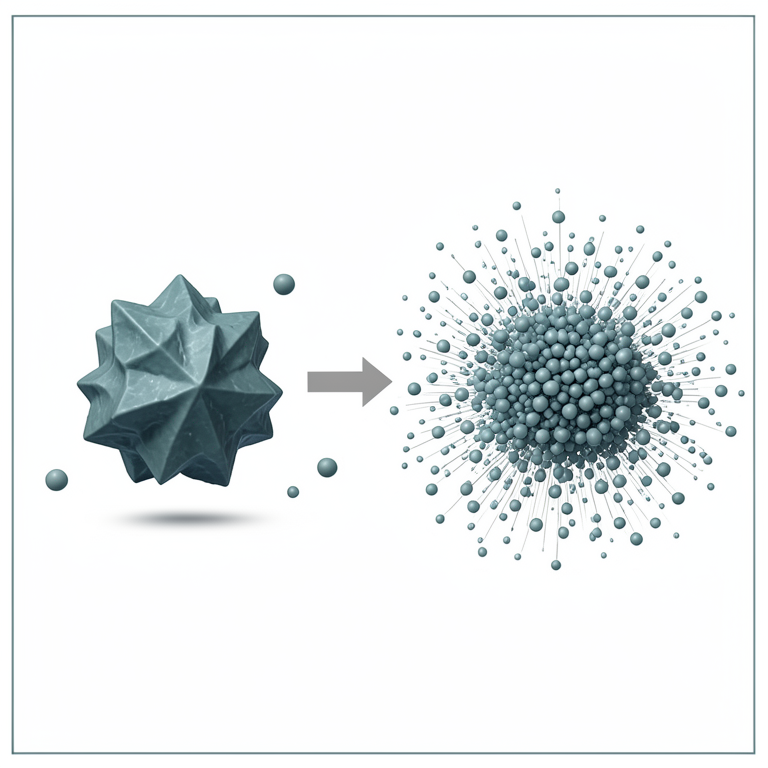
Effect of Particle Size on Dissolution
AI-generated conceptual illustration (BCS class II drug crystals in an aqueous environment). It explains the idea and does not show study data.
View source evidence ↗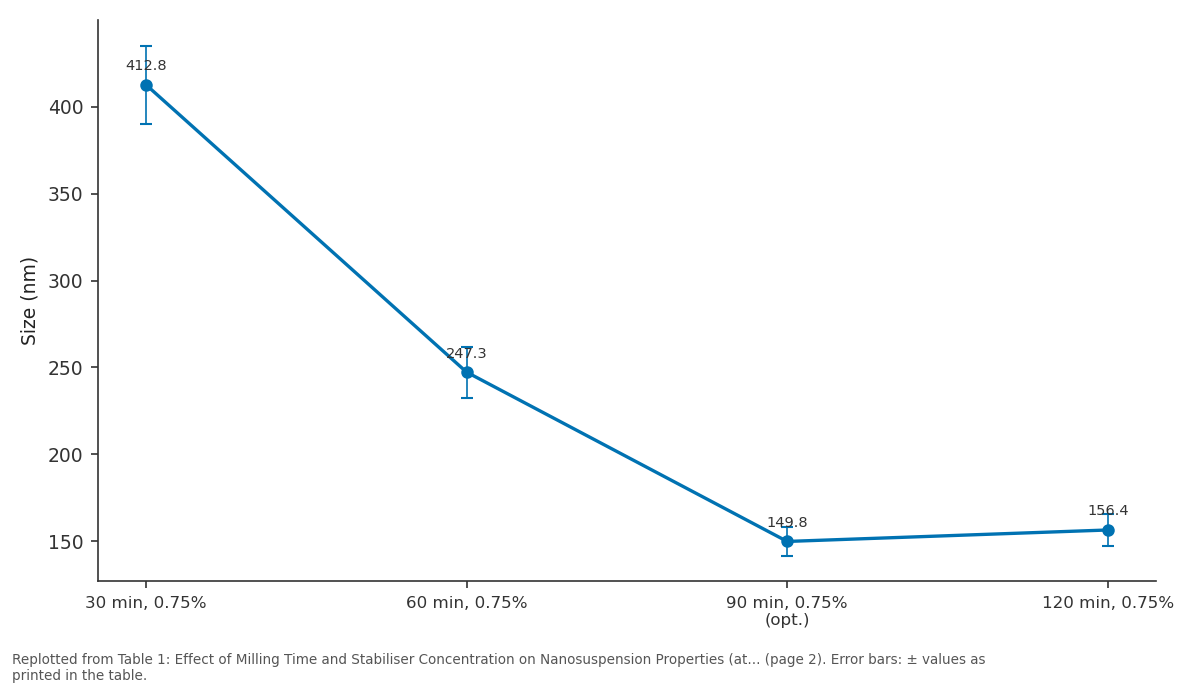
Size (nm): 30 min, 0.75% vs 60 min, 0.75% vs 90 min, 0.75% (opt.) vs 120 min, 0.75%
Replotted from Table 1 (page 2) of the original paper. Every bar is the paper's own table value.
View source evidence ↗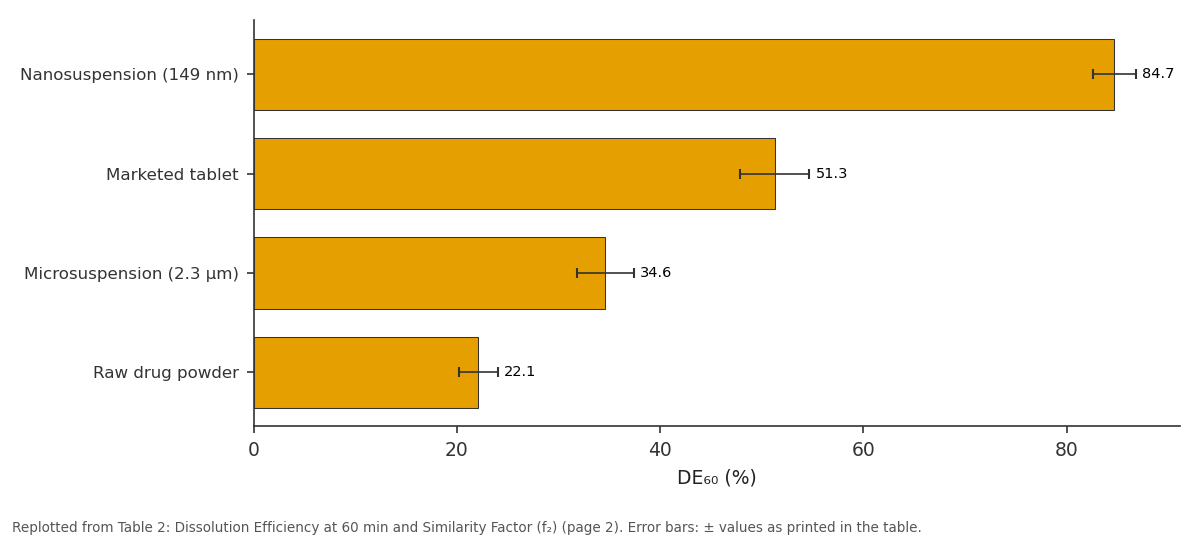
DE₆₀ (%): Nanosuspension (149 nm) vs Marketed tablet vs Microsuspension (2.3 µm) vs Raw drug powder
Replotted from Table 2 (page 2) of the original paper. Every bar is the paper's own table value.
View source evidence ↗Figures & tables
From the original paper Table 1
 Table 2
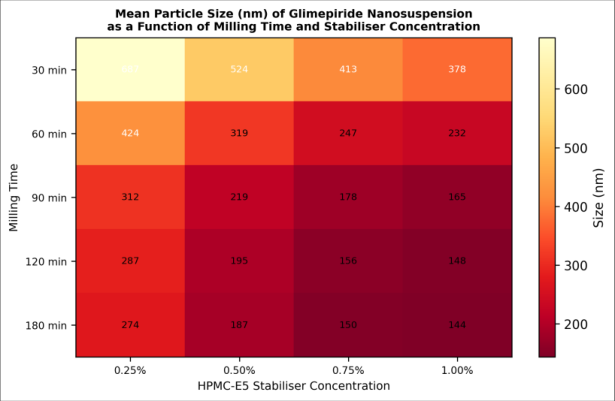 Figure 1
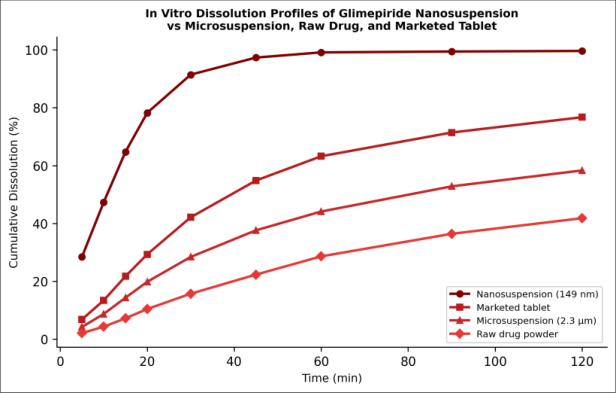 Figure 2
Introduction
The Biopharmaceutics Classification System divides drugs into four classes based on their aqueous solubility and intestinal permeability [1] . BCS Class II compounds high permeability but low solubility present a formulation challenge because their oral absorption is limited by the rate at which the solid dissolves in gastrointestinal fluids. Reducing particle size to the nanometre range (<1 µm) dramatically increases the surface-area-to-volume ratio and, through the Ostwald-Freundlich equation, raises the saturation solubility, both of which accelerate dissolution [2] . Nanosuspensions submicron colloidal dispersions of drug particles stabilised by surfactants or polymers can be produced by top-down (milling, high-pressure homogenisation) or bottom-up (antisolvent precipitation) approaches [3] . Wet media milling with polymeric or ceramic beads has become the industry standard because it is scalable, reproducible, and compatible with a wide range of drugs, including thermolabile and mechanically tough crystals [4] . Glimepiride is a second-generation sulfonylurea used for type 2 diabetes management. Its aqueous solubility is approximately 2.6 µg/mL at pH 7.4, placing it firmly in BCS Class II [5] . Commercial tablets achieve adequate but variable bioavailability (about 60%), and food effects are significant. A nanosuspension formulation could improve both the rate and extent of absorption while reducing inter-patient variability [6] . This research systematically optimised the wet media milling parameters for glimepiride nanosuspension, characterised the product, compared its dissolution with raw drug and a marketed tablet, and evaluated short-term physical stability and lyophilisation feasibility.
In-vitro Protocol
Dissolution testing used USP Apparatus II (paddle) at 75 rpm and 37 ± 0.5 °C in 900 mL of 0.1 N HCl (pH 1.2) and pH 6.8 phosphate buffer, each containing 0.5% sodium lauryl sulfate as sink modifier. Nanosuspension equivalent to 4 mg glimepiride was added, and 5 mL Similarity factor (f₂) was calculated between the nanosuspension and each comparator using the FDArecommended equation [7] .
Reagents and Chemicals
Glimepiride (purity 99.6%) was gifted by Laboratorios Pisa, Mexico City. HPMC-E5 (Methocel E5, Dow Chemical), sodium lauryl sulfate (SLS, 99%, Sigma-Aldrich), mannitol (cryoprotectant, Pearlitol 160C, Roquette), and zirconia beads (0.3 mm, Netzsch, Germany) were obtained from local suppliers. Marketed glimepiride tablets (Amaryl® 4 mg, Sanofi) served as the commercial reference [8] . [9] .
Material and Methods
Material and Methods
Results
Table 1 shows that particle size decreased rapidly during the first 90 min of milling and then plateaued. Extending milling to 120 min gave only marginal improvement (156 vs 150 nm), indicating that 90 min represents the practical optimum. The nanosuspension achieved a DE₆₀ of 84.7%, 1.65 times higher than the marketed tablet and 3.83 times higher than raw drug (Table 2). All f₂ values were well below 50, confirming that the dissolution profiles are statistically dissimilar. The heatmap (Figure 1) identifies the optimal processing window: the lightest cells cluster at 90-180 min and 0.75-1.00% stabiliser, with diminishing returns beyond 90 min at 0.75%. Figure 2 shows the dramatic acceleration of dissolution at the nanoscale: the nanosuspension reached 91.4% dissolution at 30 min, by which point the raw drug had released only 15.7%. The marketed tablet fell between these extremes, reaching 42.1% at 30 min.
| Formulation | DE₆₀ (%) | f₂ vs Nanosuspension |
|---|---|---|
| Nanosuspension (149 nm) | 84.7 ± 2.1 | - |
| Marketed tablet | 51.3 ± 3.4 | 24.8 |
| Microsuspension (2.3 µm) | 34.6 ± 2.8 | 17.3 |
| Raw drug powder | 22.1 ± 1.9 | 12.6 |
Table text extracted from the original PDF; superscript letters are shown inline. The original table image is below.
View original table image
| Condition | Size (nm) | PDI | ZP (mV) |
|---|---|---|---|
| 30 min, 0.75% | 412.8 ± 22.4 | 0.34 ± 0.05 | −18.3 ± 1.6 |
| 60 min, 0.75% | 247.3 ± 14.7 | 0.26 ± 0.04 | −20.8 ± 1.3 |
| 90 min, 0.75% (opt.) | 149.8 ± 8.3 | 0.21 ± 0.03 | −22.7 ± 1.4 |
| 120 min, 0.75% | 156.4 ± 9.1 | 0.22 ± 0.03 | −22.4 ± 1.5 |
Table text extracted from the original PDF; superscript letters are shown inline. The original table image is below.
View original table image
Comprehensive interpretation
The combination of size reduction to ~150 nm, maintained crystallinity (confirmed by XRPD), and steric stabilisation by HPMC-E5 produced a nanosuspension with nearcomplete dissolution within 60 min. The ability to lyophilise and reconstitute the product without loss of particle size makes it feasible to develop a solid dosage form a nanosuspension-based tablet or sachet for commercial application.
Discussion
The particle size plateau at ~150 nm after 90 min of milling reflects the balance between comminution forces and Ostwald ripening. Below a critical size, the high surface energy of nanoparticles drives redeposition of dissolved molecules onto larger crystals, establishing a dynamic equilibrium [3] . The HPMC-E5 stabiliser arrests this process by adsorbing onto freshly created surfaces and providing a steric barrier against re-aggregation [10] . The 2.4-fold dissolution enhancement at 60 min relative to the marketed tablet is comparable to values reported for nanosuspensions of other BCS Class II drugs such as itraconazole (2.1-fold) and naproxen (2.8-fold) [11] . The preservation of the crystalline state confirmed by unchanged XRPD peak positions and DSC melting endotherm is important because amorphous nanosuspensions, while dissolving even faster, tend to recrystallise during storage, negating the solubility advantage [12] . Lyophilisation with 5% mannitol produced a porous cake that reconstituted to the original particle size (153 ± 9 nm vs 150 ± 8 nm pre-freeze-drying) within 2 min, confirming that the cryoprotectant prevented irreversible aggregation during ice crystal formation [13] . Stability data at 25 °C/60% RH showed particle size growth of 7.8% over 90 days, which is within the acceptable range for nanosuspension products [4] .
A limitation is that in vivo pharmacokinetic data were not collected. The dissolution enhancement observed in vitro should translate to improved oral bioavailability, but the magnitude of the effect needs confirmation in animal models or human bioequivalence research.
Conclusion
Glimepiride nanosuspensions were prepared by wet media milling and optimised to a mean particle size of 149.8 nm with 0.75% HPMC-E5 stabiliser and 90 min milling. The nanosuspension dissolved nearly completely (99.1%) within 60 min, compared with 44.1% for a microsuspension and 28.6% for raw drug powder. Crystallinity was preserved throughout processing, and lyophilised powder reconstituted to its original size within 2 min. Ninety-day stability at 25 °C/60% RH confirmed less than 8% particle size growth. These results demonstrate that wet media milling is an effective and scalable approach for transforming the dissolution behaviour of BCS Class II drugs, and support the further development of glimepiride nanosuspension-based solid dosage forms for improved oral absorption and reduced food-effect variability.
References
19 in the original paper- Amidon GL, Lennernäs H, Shah VP, Crison JR. A theoretical basis for a biopharmaceutic drug classification: the correlation of in vitro drug product dissolution and in vivo bioavailability. Pharmaceutical Research. 1995;12(3):413-420.
- Kesisoglou F, Panmai S, Wu Y. Nanosizing-oral formulation development and biopharmaceutical evaluation. Advanced Drug Delivery Reviews. 2007;59(7):631-644.
- Merisko-Liversidge E, Liversidge GG. Nanosizing for oral and parenteral drug delivery: a perspective on formulating poorly water-soluble compounds using wet media milling technology. Advanced Drug Delivery Reviews. 2011;63(6):427-440.
- Van Eerdenbrugh B, Van den Mooter G, Augustijns P. Top-down production of drug nanocrystals: nanosuspension stabilization, miniaturization and International Journal of Advanced Chemistry Research https://www.chemistryjournals.net transformation into solid dosage forms. International Journal of Pharmaceutics. 2008;364(1):64-75.
- Frick A, Möller H, Wirbitzki E. Biopharmaceutical characterization of oral immediate release drug products. In vitro/in vivo comparison of phenoxymethylpenicillin potassium, glimepiride and levofloxacin. European Journal of Pharmaceutics and Biopharmaceutics. 1998;46(3):305-311.
- Niwa T, Danjo K. Design of self-dispersible dry nanosuspension through wet milling and spray freezedrying for poorly water-soluble drugs. European Journal of Pharmaceutical Sciences. 2011;44(4):493499.
- US Food and Drug Administration. Guidance for industry: dissolution testing of immediate release solid oral dosage forms. CDER. 1997;1-17.
- Pattnaik S, Swain K, Rao JV, Talla V, Prusty SK, Subudhi SK. Polymer-lipid nanoparticles of an antiviral drug for the treatment of hepatitis: factorial design of the formulation and in vitro evaluation. Journal of Drug Delivery Science and Technology. 2015;30:208-218.
- Abdelwahed W, Degobert G, Stainmesse S, Fessi H. Freeze-drying of nanoparticles: formulation, process and storage considerations. Advanced Drug Delivery Reviews. 2006;58(15):1688-1713.
- Lee J, Lee SJ, Choi JY, Yoo JY, Ahn CH. Amphiphilic amino acid copolymers as stabilizers for the preparation of nanocrystal dispersion. European Journal of Pharmaceutical Sciences. 2005;24(5):441-449.
- Liversidge GG, Cundy KC. Particle size reduction for improvement of oral bioavailability of hydrophobic drugs: I. absolute oral bioavailability of nanocrystalline danazol in beagle dogs. International Journal of Pharmaceutics. 1995;125(1):91-97.
- Müller RH, Gohla S, Keck CM. State of the art of nanocrystals-special features, production, nanotoxicology aspects and intracellular delivery. European Journal of Pharmaceutics and Biopharmaceutics. 2011;78(1):1-9.
- Chaubal MV, Popescu C. Conversion of nanosuspensions into dry powders by spray drying: a case investigation. Pharmaceutical Research. 2008;25(10):2302-2308.
- Jinno J, Kamada N, Miyake M, Yamada K, Mukai T, Odomi M. Effect of particle size reduction on dissolution and oral absorption of a poorly watersoluble drug, cilostazol, in beagle dogs. Journal of Controlled Release. 2006;111(1-2):56-64.
- Noyes AA, Whitney WR. The rate of solution of solid substances in their own solutions. Journal of the American Chemical Society. 1897;19(12):930-934.
- Möschwitzer JP. Drug nanocrystals in the commercial pharmaceutical development process. International Journal of Pharmaceutics. 2013;453(1):142-156.
- Peltonen L, Hirvonen J. Drug nanocrystals-versatile option for formulation of poorly soluble materials. International Journal of Pharmaceutics. 2018;537(12):73-83.
- Liu P, Rong X, Laru J, van Veen B, Vartiainen J, Hirvonen J. Nanosuspensions of poorly soluble drugs: preparation and development by wet milling. International Journal of Pharmaceutics. 2011;411(12):215-222.
- Verma S, Kumar S, Gokhale R, Burgess DJ. Physical stability of nanosuspensions: investigation of the role of stabilizers on Ostwald ripening. International Journal of Pharmaceutics. 2011;406(1-2):145-152.