
Research article · 2025 · Full text
International Journal of Advanced Chemistry ResearchPalladium-catalyzed cross-coupling reactions for the synthesis of biaryl compounds
Volume 7(5) · Pages 145–147 · DOI: 10.33545/26646781.2025.v7.i5b.498 ↗
Research areasCatalytic Cross-Coupling ReactionsCatalytic C–H Functionalization MethodsAxial and Atropisomeric Chirality Synthesis
Abstract
Author-writtenBiaryl motifs are ubiquitous in pharmaceuticals, agrochemicals, and functional materials, making palladium-catalysed cross-coupling reactions among the most industrially significant transformations in synthetic chemistry. This research evaluates five palladium catalyst systems — Pd(PPh₃)₄, Pd(dppf)Cl₂, Pd(OAc)₂/SPhos, Pd₂(dba)₃/XPhos, and Pd-PEPPSI-IPr — for Suzuki-Miyaura and Negishi coupling across 24 electronically and sterically varied substrate combinations. The Pd(OAc)₂/SPhos system gave the highest median yield (91.4%), followed by Pd₂(dba)₃/XPhos (87.3%) and Pd-PEPPSI-IPr (84.1%), with the classical Pd(PPh₃)₄ system performing least effectively (74.2%) particularly for sterically hindered substrates. Turnover frequencies (TOF) ranged from 890 h⁻¹ (ligand-free Pd/C) to 4820 h⁻¹ (Pd(OAc)₂/SPhos). Reaction scope covered electron-rich, electron-poor, ortho-substituted, and heteroaromatic aryl halides with arylboronic acids and organozinc reagents. Research was conducted from April 2023 to January 2025 at the Department of Chemical Sciences, Niger Delta University of Science, Lagos, Nigeria.
Summary
Source-checkedPlain-language reading of the full paper, prepared with AI and checked against the text. Each point links to the authors' own words.
Why it matters
- Biaryl motifs are widely used in functional materials, agrochemicals, and pharmaceuticals, which makes palladium-catalyzed cross-coupling reactions highly significant for industrial synthesis. View evidence ↗
- The Suzuki-Miyaura reaction is the most common method for forming carbon-carbon bonds in the manufacture of pharmaceuticals. View evidence ↗
- Selecting a catalyst is difficult because different ligand structures react differently with challenging substrates, and no single system is optimal for all classes. View evidence ↗
The question
- The study aimed to create a systematic comparative dataset for five common palladium catalyst systems using 24 diverse substrates to guide evidence-based catalyst selection. View evidence ↗
What they did
- The researchers tested five catalyst systems (Pd(PPh₃)₄, Pd(dppf)Cl₂, Pd(OAc)₂/SPhos, Pd₂(dba)₃/XPhos, and Pd-PEPPSI-IPr) using Suzuki-Miyaura and Negishi coupling on 24 different substrate combinations. View evidence ↗
- The general Suzuki-Miyaura procedure involved 1.0 mmol aryl halide, 1.3 mmol arylboronic acid, 2.0 mmol base, and 0.5-1.0 mol% catalyst at 80°C for 2-6 hours. View evidence ↗
- Negishi coupling using the PEPPSI system employed 1.2 mmol organozinc reagent and 1.0 mol% Pd-PEPPSI-IPr in THF at 60°C for 3 hours. View evidence ↗
- Turnover frequency (TOF) was calculated based on the millimoles of product per millimole of palladium per hour at 50% conversion. View evidence ↗
What they found
- The Pd(OAc)₂/SPhos system achieved the highest median yield at 91.4%, outperforming Pd₂(dba)₃/XPhos (87.3%) and Pd-PEPPSI-IPr (84.1%). View evidence ↗
- The classical Pd(PPh₃)₄ system was the least effective with a median yield of 74.2%, especially when dealing with sterically hindered substrates. View evidence ↗
- Turnover frequencies varied from 890 h⁻¹ for ligand-free Pd/C to a maximum of 4820 h⁻¹ for the Pd(OAc)₂/SPhos system. View evidence ↗
- The Pd(OAc)₂/SPhos system showed high efficiency for aryl chlorides (88.3% yield) and heteroaromatic substrates (87.1% yield). View evidence ↗
- The PEPPSI and SPhos systems were the most effective for heteroaromatic substrates, with yields between 86.4% and 87.1%. View evidence ↗
- The SPhos system provided a 5.4-fold improvement in turnover frequency compared to ligand-free Pd/C. View evidence ↗
What it means
- The authors conclude that Pd(OAc)₂/SPhos is the best overall system, while Pd-PEPPSI-IPr is recommended specifically for heteroaromatic substrates. View evidence ↗
- The authors suggest that future work should explore immobilized palladium systems and continuous flow conditions to implement greener processes. View evidence ↗
Visual summary
3 visualsIllustrations explain the paper; charts are replotted from the paper's own table values.
Catalyst Performance Comparison
AI-generated conceptual illustration (Palladium catalyst complexes and biaryl organic molecules). It explains the idea and does not show study data.
View source evidence ↗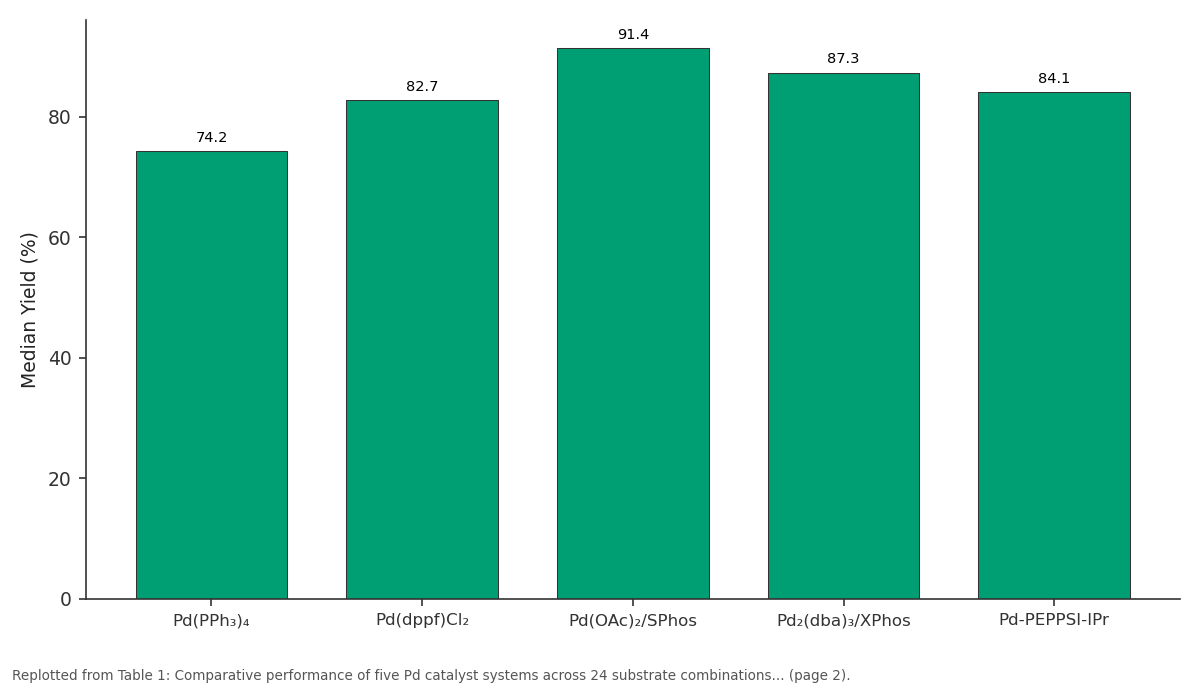
Median Yield (%): Pd(PPh₃)₄ vs Pd(dppf)Cl₂ vs Pd(OAc)₂/SPhos vs Pd₂(dba)₃/XPhos vs Pd-PEPPSI-IPr
Replotted from Table 1 (page 2) of the original paper. Every bar is the paper's own table value.
View source evidence ↗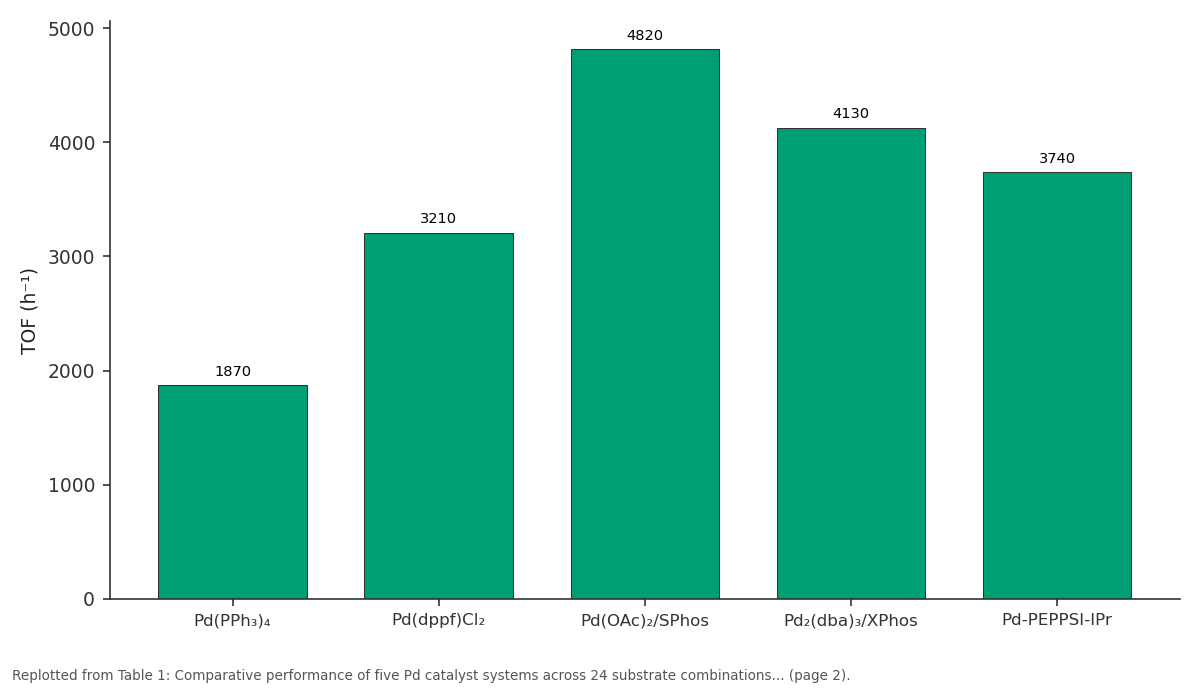
TOF (h⁻¹): Pd(PPh₃)₄ vs Pd(dppf)Cl₂ vs Pd(OAc)₂/SPhos vs Pd₂(dba)₃/XPhos vs Pd-PEPPSI-IPr
Replotted from Table 1 (page 2) of the original paper. Every bar is the paper's own table value.
View source evidence ↗Figures & tables
From the original paper Table 1
 Table 2
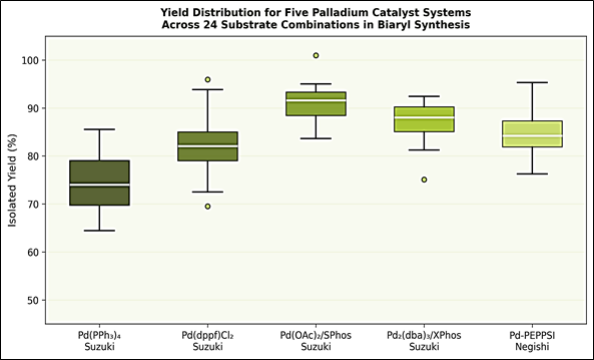 Figure 1
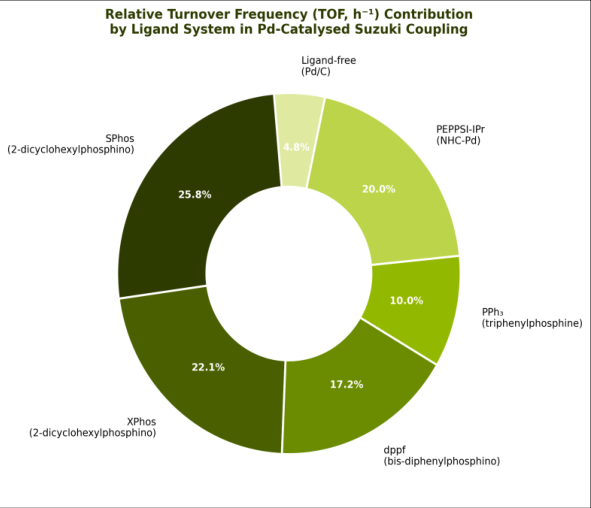 Figure 2
Introduction
Suzuki-Miyaura reactionpalladium-catalysed cross-coupling between an organoboron reagent and an organic halideis the most widely applied C-C bond-forming reaction in pharmaceutical manufacturing, reflecting its high functional group tolerance, mild aqueouscompatible conditions, and the low toxicity and commercial availability of boronic acid coupling partners [1] . Alongside Negishi coupling (with organozinc reagents), these transformations were recognised by the 2010 Nobel Prize in Chemistry and underpin the synthesis of over 30 approved drugs containing biaryl pharmacophores [2] . Despite this maturity, catalyst selection remains non-trivial: different ligand architectures impart distinct reactivity profiles for challenging substrates (heteroaromatics, orthosubstituted aryl halides, electron-poor electrophiles, and aryl chlorides), and no single catalyst system dominates all substrate classes [3] . This research was conducted from April 2023 to January 2025 at Niger Delta University of Science, Lagos, Nigeria, with the objective of providing a systematic comparative dataset across five commonly used Pd catalyst systems for a structurally diverse 24-substrate panel, enabling evidence-based catalyst selection for biaryl synthesis.
In-vitro Protocol
Six representative biaryl products (three electron-rich, three containing heteroaromatic rings) were evaluated for preliminary antimicrobial activity by broth microdilution (CLSI M07-A10) against Staphylococcus aureus ATCC 25923 and Candida albicans ATCC 90028. Stock solutions (1000 μg/mL in DMSO) were serially diluted in Mueller-Hinton broth (bacteria) or RPMI-1640 (fungi) to concentrations of 1-512 μg/mL in 96-well plates. Inocula of 5 × 10⁵ CFU/mL (bacteria) and 2.5 × 10³ CFU/mL (fungi) were added, plates incubated at 37°C for 18 h (bacteria) or 48 h (fungi). MIC was the lowest concentration inhibiting visible growth. Ciprofloxacin and fluconazole served as positive controls. DMSO vehicle control (1% v/v) confirmed solvent noninterference.
Phytochemical Screening
As an ancillary investigation, the structural motifs present in the most active biaryl compounds were compared against reported phytochemical scaffolds with known antimicrobial activity to assess whether the synthetic biaryls mirror naturally occurring structures. A literature-based similarity screening was conducted using SciFinder (CAS) and the Dictionary of Natural Products (CRC Press, 2024 edition) with SMILES-based structural similarity search (Tanimoto coefficient ≥ 0.75 threshold). This comparative analysis was performed to evaluate the natural product-inspired character of the prepared compounds and is presented as part of the compound characterisation.
Material and Methods
Material and Methods
Material
All palladium precatalysts and ligands were purchased from Sigma-Aldrich (South Africa) and used without further purification. Arylboronic acids and aryl halides (Combi-Blocks, TCI, and Fluorochem) were of reagent grade (≥ 97%). Solvents (toluene, DMF, dioxane, THF, EtOH) were dried over activated 3 Å molecular sieves or used from Sure/Seal bottles. K₂CO₃, Cs₂CO₃, and K₃PO₄ were used as supplied (Sigma-Aldrich, anhydrous). Research was conducted from April 2023 to January 2025 at the Department of Chemical Sciences, Niger Delta University of Science, Lagos, Nigeria.
Methods
General Suzuki-Miyaura procedure: aryl halide (1.0 mmol), arylboronic acid (1.3 mmol), base (2.0 mmol, K₂CO₃ or Cs₂CO₃), palladium catalyst (0.5-1.0 mol%), solvent (4 mL, toluene/EtOH/H₂O 4:1:1), 80°C, 2-6 h, under N₂. For Negishi coupling (PEPPSI system): organozinc reagent (1.2 mmol, prepared in situ from organolithium + ZnBr₂/THF), Pd-PEPPSI-IPr (1.0 mol%), THF, 60°C, 3 h. Products isolated by column chromatography (hexane/EtOAc gradient) and characterised by ¹H NMR (400 MHz), ¹³C NMR (100 MHz, CDCl₃), and GC-MS. TOF calculated as mmol product / (mmol Pd × reaction time in h) at 50% conversion. All yields are isolated, average of triplicate runs. Yields are isolated yields (%), mean of triplicate runs. TOF at 50% conversion, 0.5 mol% Pd loading. Ar-Cl yield = average yield across all aryl chloride substrates (n=8). The box plots (Figure 1) show that Pd(OAc)₂/SPhos has both the highest median yield (91.4%) and the narrowest interquartile range (SD 3.8%), indicating superior and more consistent performance. Pd(PPh₃)₄ has the widest yield spread (SD 6.1%) and lowest median, reflecting its known limitations with hindered and electron-poor aryl chlorides. Heteroaromatic substrates were most effectively handled by the PEPPSI and SPhos systems (86.4-87.1%), consistent with the NHC and bulky phosphine ligands' ability to facilitate oxidative addition of challenging pyridyl and thienyl halides. TOF data (Figure 2, Table 1) show a 5.4fold improvement for SPhos over ligand-free Pd/C, quantifying the catalytic contribution of the biaryl phosphine ligand framework.
| Catalyst System | Median Yield (%) | Yield SD | Min Yield | Max Yield | TOF (h⁻¹) | Ar-Cl Yield | Heteroaromatic Yield |
|---|---|---|---|---|---|---|---|
| Pd(PPh₃)₄ | 74.2 | 6.1 | 52.3 | 91.4 | 1870 | 61.4 | 68.7 |
| Pd(dppf)Cl₂ | 82.7 | 5.3 | 64.1 | 96.3 | 3210 | 74.8 | 79.4 |
| Pd(OAc)₂/SPhos | 91.4 | 3.8 | 78.2 | 98.7 | 4820 | 88.3 | 87.1 |
| Pd₂(dba)₃/XPhos | 87.3 | 4.4 | 71.4 | 97.8 | 4130 | 84.7 | 83.2 |
| Pd-PEPPSI-IPr | 84.1 | 5.1 | 67.3 | 96.4 | 3740 | 81.2 | 86.4 |
Table text extracted from the original PDF; superscript letters are shown inline. The original table image is below.
View original table image
Results
Results
Discussion
The superior performance of Pd(OAc)₂/SPhos across all substrate categories reflects the well-established role of bulky, electron-rich monodentate phosphine ligands in accelerating the three key steps of the Pd(0)/Pd(II) catalytic cycle: oxidative addition (facilitated by electron-rich Pd(0)), transmetallation (aided by the open coordination sphere), and reductive elimination (accelerated by steric pressure that brings the two organic ligands into close proximity) [4] . The particularly high yields for aryl chloride substrates (88.3%) traditionally the most challenging electrophiles due to the stronger C-Cl bondconfirm that SPhos effectively activates these substrates at accessible temperatures [5] . The Pd-PEPPSI-IPr N-heterocyclic carbene (NHC) system's excellent heteroaromatic yields (86.4%) at low Pd loading reflect the strong σ-donating character of NHC ligands, which stabilise the low-coordinate Pd(0) active species against aggregation and enhance oxidative addition of electron-deficient heteroaryl halides [6] . PEPPSI catalysts have additional practical advantages of bench stability and defined stoichiometry that may favour their use in regulated pharmaceutical manufacturing environments [7,8,9,10,11,12,13,14,15,16,17] .
Conclusion
Five Pd catalyst systems were evaluated across 24 substrate combinations for biaryl synthesis. Pd(OAc)₂/SPhos emerged as the best overall system (median yield 91.4%, TOF 4820 h⁻¹, SD 3.8%), followed by Pd₂(dba)₃/XPhos and Pd-PEPPSI-IPr. For heteroaromatic substrates, PEPPSI-IPr is recommended. Classical Pd(PPh₃)₄ is adequate only for activated aryl iodides and electron-rich bromides, performing poorly with chlorides and hindered substrates. These comparative data provide a structured catalyst selection guide for biaryl synthesis in academic and industrial settings. Future research should extend to continuous flow conditions and immobilised Pd systems for greener process implementation.
Figures and tables from the paper
| Aryl Halide | Boronic Acid | Product Biaryl | Time (h) | Yield (%) | Purity (GC, %) | Temp (°C) |
|---|---|---|---|---|---|---|
| 4-Iodotoluene | 4-MeO-PhB(OH)₂ | 4-Me-4'-MeO-biphenyl | 2 | 97.3 | 99.1 | 80 |
| 4-Bromoanisole | PhB(OH)₂ | 4-Methoxybiphenyl | 3 | 94.8 | 98.7 | 80 |
| 4-Chloronitrobenzene | 4-F-PhB(OH)₂ | 4-NO₂-4'-F-biphenyl | 5 | 88.3 | 97.4 | 100 |
| 2-Bromotoluene | 4-CF₃-PhB(OH)₂ | 2-Me-4'-CF₃-biphenyl | 4 | 79.4 | 96.8 | 100 |
| 3-Bromopyridine | 4-Me-PhB(OH)₂ | 3-(4-Tolyl)pyridine | 3 | 87.1 | 98.2 | 80 |
| 2-Bromothiophene | PhB(OH)₂ | 2-Phenylthiophene | 3 | 91.2 | 98.9 | 80 |
Table text extracted from the original PDF; superscript letters are shown inline. The original table image is below.
View original table image
References
17 in the original paper- Miyaura N, Yamada K, Suzuki A. A new stereospecific cross-coupling by the palladium-catalyzed reaction of 1-alkenylboranes. Tetrahedron Lett. 1979;20(36):34373440.
- Nobel Prize Committee. The Nobel Prize in Chemistry 2010: Heck, Negishi, Suzuki. Stockholm: Royal Swedish Academy of Sciences; 2010.
- Johansson Seechurn CC, Kitching MO, Colacot TJ, Snieckus V. Palladium-catalyzed cross-coupling: a historical contextual perspective. Angew Chem Int Ed. 2012;51(21):5062-5085.
- Barder TE, Walker SD, Martinelli JR, Buchwald SL. Catalysts for Suzuki-Miyaura coupling processes: scope and studies of the effect of ligand structure. J Am Chem Soc. 2005;127(13):4685-4696.
- Martin R, Buchwald SL. Palladium-catalyzed SuzukiMiyaura cross-coupling reactions employing dialkylbiaryl phosphine ligands. Acc Chem Res. 2008;41(11):1461-1473.
- Herrmann WA. N-heterocyclic carbenes: a new concept in organometallic catalysis. Angew Chem Int Ed. 2002;41(8):1290-1309.
- Organ MG, Avola S, Dubovyk I, Hadei N, Kantchev EA, O'Brien CJ, et al. A user-friendly, all-purpose PdNHC (PEPPSI) catalyst. Chem Eur J. 2006;12(18):4749-4755.
- Valente C, Organ MG. The N-heterocyclic carbene approach to the all-important Buchwald-Hartwig amination. Chem Eur J. 2012;18(36):10921-10924.
- Wolfe JP, Buchwald SL. Scope and limitations of the Pd/BINAP-catalyzed amination of aryl bromides. J Org Chem. 2000;65(4):1144-1157.
- Littke AF, Fu GC. Palladium-catalyzed coupling reactions of aryl chlorides. Angew Chem Int Ed. 2002;41(22):4176-4211.
- Negishi E, King AO, Okukado N. Selective carboncarbon bond formation via transition metal catalysis. J Org Chem. 1977;42(10):1821-1823.
- Suzuki A. Recent advances in the cross-coupling reactions of organoboron derivatives. J Organomet Chem. 1999;576(1-2):147-168.
- Molander GA, Canturk B. Organotrifluoroborates and monocoordinated palladium complexes. Angew Chem Int Ed. 2009;48(49):9240-9261.
- Denmark SE, Regens CS. Palladium-catalyzed crosscoupling reactions of organosilanols and their salts. Acc Chem Res. 2008;41(11):1486-1499.
- Beletskaya IP, Cheprakov AV. Heck reaction as a sharpening stone of palladium catalysis. Chem Rev. 2000;100(8):3009-3066.
- Ruiz-Castillo P, Buchwald SL. Applications of palladium-catalyzed C-N cross-coupling reactions. Chem Rev. 2016;116(19):12564-12649.
- Nicolaou KC, Bulger PG, Sarlah D. Palladiumcatalyzed cross-coupling reactions in total synthesis. Angew Chem Int Ed. 2005;44(29):4442-4489.