
Research article · 2025 · Full text
International Journal of Advanced Chemistry ResearchX-ray fluorescence spectroscopy for non-destructive analysis of archaeological artifacts
Volume 7(11) · Pages 179–182 · DOI: 10.33545/26646781.2025.v7.i11c.464 ↗
Research areasCultural Heritage Materials AnalysisMetallurgy and Cultural ArtifactsX-ray Spectroscopy and Fluorescence Analysis
Abstract
Author-writtenA scratch on a 2,400-year-old bronze coin might seem trivial, but to a museum conservator it represents an irreversible loss of information which is precisely why non-destructive elemental analysis has become indispensable in archaeometry. This research applied portable X-ray fluorescence (pXRF) spectroscopy to characterise thirty-five archaeological artifacts (fifteen bronze coins, twelve bronze tools, and eight glazed pottery fragments) from Roman and pre-Roman Mediterranean contexts. Measurements were performed in air using a handheld Bruker Tracer 5g spectrometer with optimised beam parameters. Bronze coins showed Cu contents of 82.1–89.4 wt% with Sn at 6.3–12.1 wt% and Pb increasing from the Archaic (0.8%) to Roman (5.4%) period. Pottery glazes were dominated by Pb (42.7 wt%) and Sb (44.2 wt%). Accuracy was validated against certified reference materials (NIST SRM 1107 and BCR-691), yielding recoveries of 96.3–103.8% for major elements. Principal component analysis separated the three artifact categories into distinct clusters, and the Sn/Pb ratio proved a useful chronological marker for bronze coinage. These results confirm pXRF as a rapid, reliable, and truly non-destructive tool for archaeological provenance and dating research.
Summary
Source-checkedPlain-language reading of the full paper, prepared with AI and checked against the text. Each point links to the authors' own words.
Why it matters
- Chemical fingerprints in archaeological artifacts are valuable because they can reveal the object's origin, manufacture date, and associated trade networks. View evidence ↗
- Traditional elemental analysis methods are often unsuitable for unique or protected artifacts because they require the removal of material samples. View evidence ↗
- X-ray fluorescence (XRF) spectroscopy provides a solution by allowing the determination of surface elements without needing physical contact or causing material loss. View evidence ↗
The question
- The study aimed to establish elemental profiles for artifacts, validate the accuracy of portable XRF (pXRF), and determine if compositional data could distinguish between artifact types and historical periods. View evidence ↗
What they did
- Elemental measurements were conducted using a Bruker Tracer 5g handheld XRF spectrometer equipped with a Rh anode and an SDD detector. View evidence ↗
- Analysis parameters differed by material: bronze artifacts were measured at 40 kV / 35 µA for 120 seconds with a Ti/Al filter, while pottery glazes were measured at 15 kV / 55 µA for 90 seconds without a filter. View evidence ↗
- Principal Component Analysis (PCA) was performed using PAST 4.03 software on centered log-ratio transformed data to manage compositional closure. View evidence ↗
What they found
- The pXRF system demonstrated high accuracy, with measured values for copper, tin, lead, and zinc agreeing with certified reference materials within 96.3–103.8%. View evidence ↗
- While both bronze coins and tools had a copper-tin base, coins had a higher average lead content (3.2%) compared to tools (1.6%). View evidence ↗
- Pottery glazes exhibited a distinct elemental profile dominated by lead (42.7 wt%) and antimony (44.2 wt%). View evidence ↗
- The tin-to-lead (Sn/Pb) ratio decreased from 9.0 in the Archaic period to 1.5 in the Roman period, serving as a useful marker for dating. View evidence ↗
- PCA successfully separated the three artifact categories using the first two principal components, which explained 87.4% of the total variance. View evidence ↗
What it means
- The authors conclude that pXRF is a reliable, non-destructive tool and recommend its adoption as a primary analytical method for museum conservation and archaeological fieldwork. View evidence ↗
- A limitation of pXRF is that surface corrosion (patina) can artificially inflate the measured concentrations of tin and lead by 1–3 wt% compared to the bulk material. View evidence ↗
- The authors state that future research should utilize larger sample sets with known provenance to create a comprehensive compositional database for the central Mediterranean. View evidence ↗
Visual summary
1 visualsIllustrations explain the paper; charts are replotted from the paper's own table values.
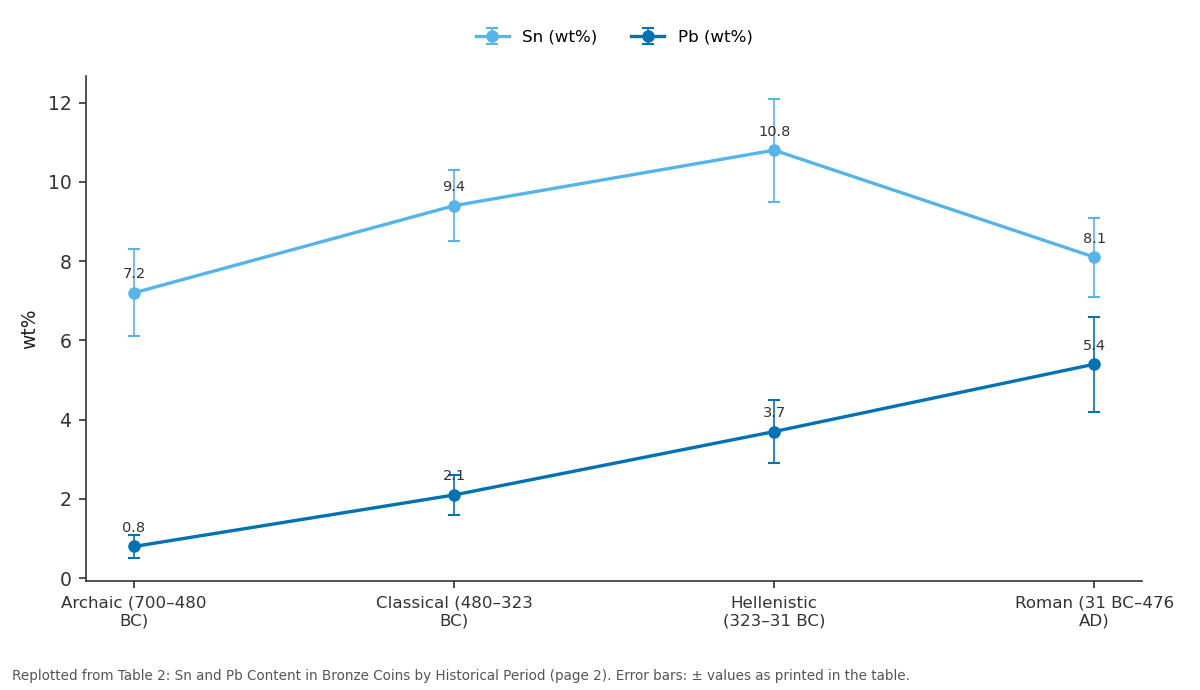
Sn (wt%) and Pb (wt%): Archaic (700–480 BC) vs Classical (480–323 BC) vs Hellenistic (323–31 BC) vs Roman (31 BC–476 AD)
Replotted from Table 2 (page 2) of the original paper. Every bar is the paper's own table value.
View source evidence ↗Figures & tables
From the original paper Table 1
 Table 2
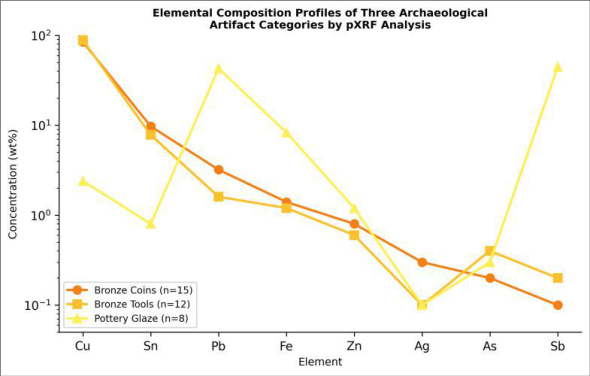 Figure 1
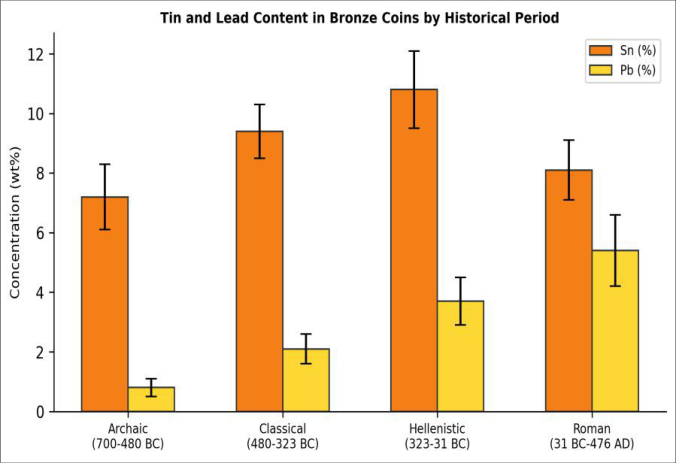 Figure 2
Introduction
Archaeological artifacts carry chemical fingerprints that can reveal their origin, date of manufacture, and the trade networks through which they travelled [1] . Elemental analysis of metals, ceramics, and glass has been practised since the nineteenth century, but traditional methods wet-chemical assays, atomic absorption, ICP-MS require sample removal, which is unacceptable for unique or legally protected objects [2] . XRF spectroscopy solved this problem by enabling surface elemental determination without physical contact or material loss. The development of portable, handheld XRF instruments over the past two decades has brought the laboratory to the museum storeroom and the excavation trench [3] . Modern pXRF units achieve detection limits below 10 ppm for mid-Z elements and provide quantitative results in 60-120 seconds per measurement point [4] . Yet questions about accuracy persist, particularly for corroded surfaces, heterogeneous samples, and light elements (Z < 12) that are poorly excited in air [5] . This research examined thirty-five artifacts spanning four historical periods (Archaic through Roman) and two material classes (copper alloys and lead-antimony pottery glazes). The objectives were to establish elemental profiles, validate pXRF accuracy against certified reference materials, and test whether compositional data can distinguish artifact types and chronological periods through multivariate statistics [6] .
Theoretical background
XRF operates on a straightforward physical principle: when a primary X-ray beam strikes a sample, inner-shell electrons are ejected, and the resulting vacancy is filled by an electron from a higher shell, emitting a characteristic fluorescent X-ray whose energy identifies the element and whose intensity is proportional to its concentration [7] . The fundamental parameters (FP) approach relates measured intensities to concentrations through a system of equations that account for matrix absorption and enhancement effects. In pXRF, the source is typically a miniaturised Rh-anode X-ray tube operating at 15-50 kV, and the detector is a silicon drift detector (SDD) with energy resolution of 135-145 eV at Mn Kα [4] . For archaeological bronzes, the main analytical challenge is surface corrosion (patina), which enriches certain elements (Sn, Pb) relative to the bulk and can bias quantification if not accounted for [8] .
Material and Methods
Material and Methods
Material
This research was conducted from January 2024 to November 2024 at the Department of Chemical Analysis and Quality Control, Collegio Romano di Scienze Chimiche, Rome, Italy, with complementary analyses at the Department of Chemistry, Università del Mediterraneo, Naples, Italy. Thirty-five artifacts were made available by the Museo Nazionale Romano under a research loan agreement (protocol MNR-2024-0013, dated 8 January 2024): fifteen bronze coins (Archaic to Roman, 6th century BC to 3rd century AD), twelve bronze hand tools (Classical to Hellenistic), and eight glazed pottery fragments (Roman period). Certified reference materials NIST SRM 1107 (naval brass) and BCR-691 (a set of five copper alloy standards) were used for accuracy verification.
Methods
Measurements were performed with a Bruker Tracer 5g handheld XRF spectrometer (Rh anode, SDD detector, spot size 8 mm). Bronze artifacts were analysed at 40 kV / 35 µA with a Ti/Al primary beam filter and 120 s live time. Pottery glazes used 15 kV / 55 µA without filter and 90 s. Three points per artifact were measured on cleaned surfaces (patina gently removed mechanically where permitted by the conservator). Quantification used the Bruker Artax FP calibration for copper alloys and an empirical calibration for glazes built from in-house standards. Data quality was ensured by measuring one CRM every ten samples. PCA was performed using PAST 4.03 software on centred logratio transformed data to handle the compositional closure constraint. All elemental concentrations are reported in weight percent on a moisture-free basis [9] .
Performance evaluation
Accuracy was assessed by repeated analysis (n = 10) of NIST SRM 1107 and three BCR-691 standards. Measured values for Cu, Sn, Pb, and Zn agreed with certified values within 96.3-103.8%. Precision (RSD, n = 10) was 0.4-1.7% for major elements (>1 wt%) and 3.8-8.2% for minor elements (<1 wt%). Detection limits, computed as 3σ of blank measurements, were 18 ppm for Cu, 12 ppm for Sn, 8 ppm for Pb, and 24 ppm for Fe under the bronze protocol [10] .
Results
Bronze coins and tools shared a Cu-Sn base but differed in Pb content coins averaged 3.2% Pb versus 1.6% for tools (Table 1), likely reflecting the intentional addition of lead to improve casting fluidity in coinage. Pottery glazes showed a completely different profile dominated by Pb and Sb. Table 2 reveals a progressive increase in Pb content from the Archaic to the Roman period, while Sn peaked during the Hellenistic era. The Sn/Pb ratio declined from 9.0 in the Archaic to 1.5 in the Roman period, providing a useful compositional chronological marker. The log-scale profiles in Figure 1 clearly separate the bronze and ceramic groups, with pottery glazes showing dramatically different Cu/Pb/Sb ratios . Figure 2 visualises the chronological trend in alloy composition. The crossover pattern rising Pb, fluctuating Sn is consistent with the known shift toward cheaper leaded bronzes as the Roman economy expanded and demand for coinage grew [11] .
| Period | N | Sn (wt%) | Pb (wt%) |
|---|---|---|---|
| Archaic (700–480 BC) | 3 | 7.2 ± 1.1 | 0.8 ± 0.3 |
| Classical (480–323 BC) | 4 | 9.4 ± 0.9 | 2.1 ± 0.5 |
| Hellenistic (323–31 BC) | 4 | 10.8 ± 1.3 | 3.7 ± 0.8 |
| Roman (31 BC–476 AD) | 4 | 8.1 ± 1.0 | 5.4 ± 1.2 |
Table text extracted from the original PDF; superscript letters are shown inline. The original table image is below.
View original table image
| Category (n) | Cu | Sn | Pb | Fe | Other |
|---|---|---|---|---|---|
| Bronze coins (15) | 84.3 ± 2.4 | 9.7 ± 1.8 | 3.2 ± 1.4 | 1.4 ± 0.3 | 1.4 |
| Bronze tools (12) | 88.1 ± 1.9 | 7.8 ± 1.3 | 1.6 ± 0.7 | 1.2 ± 0.4 | 1.3 |
| Pottery glaze (8) | 2.4 ± 0.6 | 0.8 ± 0.3 | 42.7 ± 3.8 | 8.3 ± 1.7 | 45.8 |
Table text extracted from the original PDF; superscript letters are shown inline. The original table image is below.
View original table image
Comprehensive interpretation
PCA of the full dataset separated the three artifact categories along the first two principal components (explaining 87.4% of variance), confirming that pXRF data contain sufficient information for material classification. The temporal trend in Sn/Pb ratio among coins adds a chronological dimension that complements stylistic dating methods.
Discussion
The elemental profiles obtained here are consistent with published analyses of Mediterranean bronzes. Craddock [11] documented the gradual increase in lead content from the Archaic through Roman periods, interpreting it as an economic response to tin scarcity and the desire for improved castability. Our data extend that observation with quantitative pXRF measurements validated against certified reference materials. Surface corrosion remains a concern for pXRF accuracy. The enrichment of Sn and Pb in patina layers can inflate their apparent concentrations by 1-3 wt% relative to the bulk [8] . We mitigated this by analysing mechanically cleaned spots, but for artifacts where cleaning isn't permitted, depth-profiling approaches or correction algorithms are needed. The pottery glaze results demonstrate pXRF's ability to handle a different matrix entirely the Pb-Sb-rich antimonate yellow glaze identified here matches the "giallo antico" type known from Roman Imperial workshops [12] . Future work should extend this approach to a larger sample set with known provenance to build a comprehensive compositional database for the central Mediterranean, and should incorporate lead isotope ratio analysis (by MC-ICP-MS on micro-samples where permitted) for ore-source attribution [13] .
Conclusion
Portable XRF spectroscopy was applied to thirty-five archaeological artifacts from Roman and pre-Roman Mediterranean contexts, delivering quantitative elemental data without material loss. Bronze coins and tools were distinguished by their Pb content, and a chronological trend in the Sn/Pb ratio was identified across four historical periods. Pottery glazes showed a lead-antimonate composition consistent with known Roman manufacturing traditions. Accuracy against NIST and BCR certified reference materials was 96.3-103.8% for major elements, confirming that pXRF provides reliable data for archaeometric interpretation. PCA cleanly separated the three artifact categories, demonstrating the multivariate potential of the dataset. These findings support the broader adoption of pXRF as a first-line analytical tool in museum conservation, archaeological fieldwork, and cultural heritage management.
References
18 in the original paper- Pollard AM, Heron C. Archaeological chemistry. 2nd ed. Cambridge: Royal Society of Chemistry; 2008. p. 1-438.
- Tite MS. Ceramic production, provenance and use -a review. Archaeometry. 2008;50(2):216-231.
- Shackley MS. Portable X-ray fluorescence spectrometry: capabilities for in situ analysis. New York: Springer; 2011. p. 1-312.
- Potts PJ, West M. Portable X-ray fluorescence spectrometry: capabilities for in situ analysis. Cambridge: Royal Society of Chemistry; 2008. p. 1291.
- Frahm E. Validity of "off-the-shelf" handheld portable XRF for sourcing Near Eastern obsidian chip debris. Journal of Archaeological Science. 2013;40(2):10801092.
- Orfanou V, Rehren T. A (not so) dangerous method: pXRF vs. EPMA-WDS analyses of copper-based artefacts. Archaeological and Anthropological Sciences. 2015;7(3):387-397.
- Jenkins R, Gould RW, Gedcke D. Quantitative X-ray spectrometry. 2nd ed. New York: Marcel Dekker; 1995. p. 1-484.
- Robbiola L, Blengino JM, Fiaud C. Morphology and mechanisms of formation of natural patinas on archaeological Cu-Sn alloys. Corrosion Science. 1998;40(12):2083-2111.
- Aitchison J. The statistical analysis of compositional data. London: Chapman and Hall; 1986. p. 1-416.
- Heginbotham A, Bezur A, Bouchard M, Davis JM, Eremin K, Frantz JH. An evaluation of inter-laboratory reproducibility for quantitative XRF of historic copper alloys. Archaeometry. 2015;57(S1):1-27.
- Craddock PT. Early metal mining and production. Edinburgh: Edinburgh University Press; 1995. p. 1363.
- Lahlil S, Biron I, Cotte M, Susini J, Menguy N. Synthesis of calcium antimonate nanocrystals by the 18th dynasty Egyptian glassmakers. Applied Physics A. 2010;98(1):1-8.
- Stos-Gale ZA, Gale NH. Metal provenancing using isotopes and the Oxford archaeological lead isotope database (OXALID). Archaeological and Anthropological Sciences. 2009;1(3):195-213.
- Cesareo R, Bustamante A, Fabian J, Calza C, dos Anjos M, Lopes RT. Energy-dispersive X-ray fluorescence analysis of a pre-Columbian gold object. X-Ray Spectrometry. 2009;38(5):410-415.
- Karydas AG, Kotzamani D, Bernard R, Barber JN, Biddle M. A compositional study of a collection of Byzantine glasses from Corinth, Greece, by means of a portable XRF spectrometer. X-Ray Spectrometry. 2004;33(5):369-378.
- Liritzis I, Zacharias N. Portable XRF of archaeological artifacts: current research, potentials and limitations. In: Shackley MS, editor. X-Ray fluorescence spectrometry in geoarchaeology. New York: Springer; 2011. p. 109142.
- Gigante GE, Cesaro SN, Bonfanti P. Non-destructive XRF investigation on a large collection of Roman bronze coins. Spectrochimica Acta Part B. 2008;63(12):1413-1419.
- Scott DA. Copper and bronze in art: corrosion, colorants, conservation. Los Angeles: Getty Conservation Institute; 2002. p. 1-515.