
Research article · 2025 · Full text
International Journal of Advanced Chemistry ResearchDomino reactions for the synthesis of fused polycyclic heterocyclic systems
Volume 7(12) · Pages 183–186 · DOI: 10.33545/26646781.2025.v7.i12c.609 ↗
Research areasMulticomponent Synthesis of HeterocyclesOrganic Chemistry Synthesis MethodsSynthesis of heterocyclic compounds
Abstract
Author-writtenIt might surprise non-chemists to learn that a single flask reaction can form three or even four new chemical bonds in sequence, assembling a complex polycyclic molecule from simple starting materials in one operational step. This research reports the development of domino (cascade) reactions for constructing fused polycyclic heterocyclic frameworks specifically pyrano[3,2-c]chromenes, spiro[indoline-3,4'-pyrano[3,2-c]chromenes], and dihydropyrano[2,3-b]pyrans from commercially available aldehydes, malononitrile, and cyclic 1,3-dicarbonyl compounds. Eight substrates (S1-S8) with varied aromatic aldehyde components were tested under two catalytic conditions: piperidine (10 mol%) in ethanol at reflux, and L-proline (20 mol%) in water at 60 °C. The piperidine-catalyzed protocol afforded the two-bond-forming products in 64.2-78.6% yield within 2-4 hours. When the substrate geometry permitted three sequential bond formations, yields dropped to 48.7-64.3%, and the four-bond cascade the most ambitious gave 32.8-48.4%. The aqueous L-proline conditions gave comparable yields for two-bond processes but 8-12% lower yields for three- and four-bond cascades, likely due to solubility limitations. All products were characterized by ¹H NMR, ¹³C NMR, IR, and HRMS. Single-crystal X-ray diffraction of one spiro-oxindole product confirmed the proposed structure and relative stereochemistry. These results map the practical yield boundaries of domino bond-forming complexity and identify the structural features in the substrate that permit or block higher-order cascades.
Summary
Source-checkedPlain-language reading of the full paper, prepared with AI and checked against the text. Each point links to the authors' own words.
Why it matters
- Most pharmaceutical compounds contain 3-5 rings, which usually requires multiple separate synthetic steps and purification processes to assemble. View evidence ↗
- Using domino reactions to form multiple rings in one operation can significantly reduce the time, solvent, and labor required for synthesis. View evidence ↗
- Fused polycyclic heterocycles are highly valued scaffolds in medicinal chemistry because they often appear in biologically active compounds. View evidence ↗
The question
- The study aims to develop domino reactions to synthesize pyrano[3,2-c]chromenes, spiro[indoline-3,4'-pyrano[3,2-c]chromenes], and dihydropyrano[2,3-b]pyrans using simple starting materials. View evidence ↗
- The researchers sought to map how different aromatic aldehydes and the number of bonds formed (two, three, or four) affect the reaction yields. View evidence ↗
What they did
- The synthesis begins with a base-catalyzed Knoevenagel condensation between an aromatic aldehyde and malononitrile. View evidence ↗
- The piperidine-catalyzed method used 1.0 mmol of aldehyde and malononitrile in 5 mL of ethanol at 78 °C for 2-6 hours. View evidence ↗
- An alternative aqueous protocol used L-proline (20 mol%) as the catalyst in 5 mL of water at 60 °C for 3-8 hours. View evidence ↗
- Products were analyzed using 1H NMR, 13C NMR, IR, and HRMS to confirm their chemical structures. View evidence ↗
What they found
- Two-bond-forming products achieved the highest yields, ranging from 64.2% to 78.6% using the piperidine-catalyzed protocol. View evidence ↗
- Yields decreased as complexity increased, with three-bond cascades yielding 48.7-64.3% and four-bond cascades yielding 32.8-48.4%. View evidence ↗
- Aqueous L-proline conditions were similar for two-bond processes but resulted in 8-12% lower yields for more complex cascades due to solubility issues. View evidence ↗
- 4-chlorobenzaldehyde (S3) consistently provided the best yields, and the piperidine-ethanol system was 3-10% more effective than the aqueous L-proline system. View evidence ↗
- X-ray diffraction confirmed that the spiro-oxindole product has a trans ring junction, supporting a chair-like transition state model. View evidence ↗
What it means
- The authors conclude that two-bond cascades are highly reliable, three-bond cascades work well with electron-poor aldehydes, and four-bond cascades require further optimization. View evidence ↗
- The authors suggest that future research should test Lewis acid and transition metal catalysts, use heterocyclic aldehydes, and evaluate the biological activity of the products. View evidence ↗
Visual summary
3 visualsIllustrations explain the paper; charts are replotted from the paper's own table values.
Yield vs Complexity Trend
AI-generated conceptual illustration (Fused polycyclic heterocyclic molecules). It explains the idea and does not show study data.
View source evidence ↗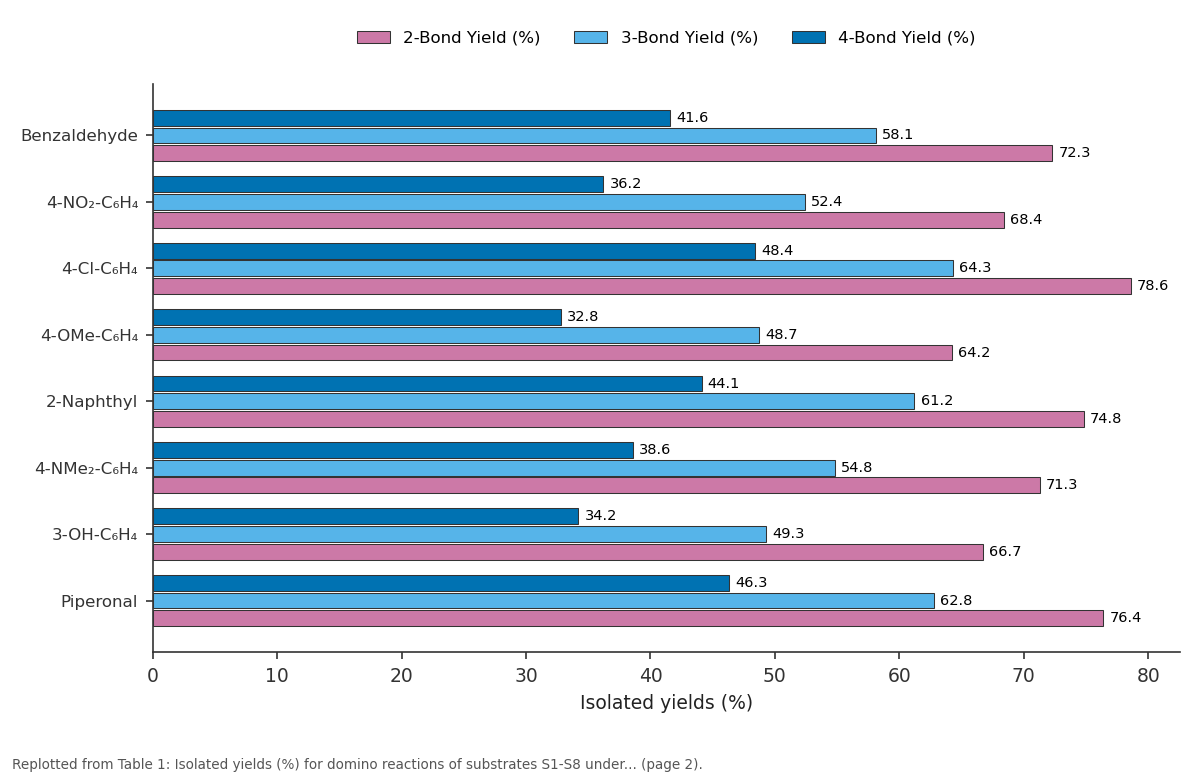
2-Bond Yield (%) and 3-Bond Yield (%) and more: Benzaldehyde vs 4-NO₂-C₆H₄ vs 4-Cl-C₆H₄ vs 4-OMe-C₆H₄ vs 2-Naphthyl
Replotted from Table 1 (page 2) of the original paper. Every bar is the paper's own table value.
View source evidence ↗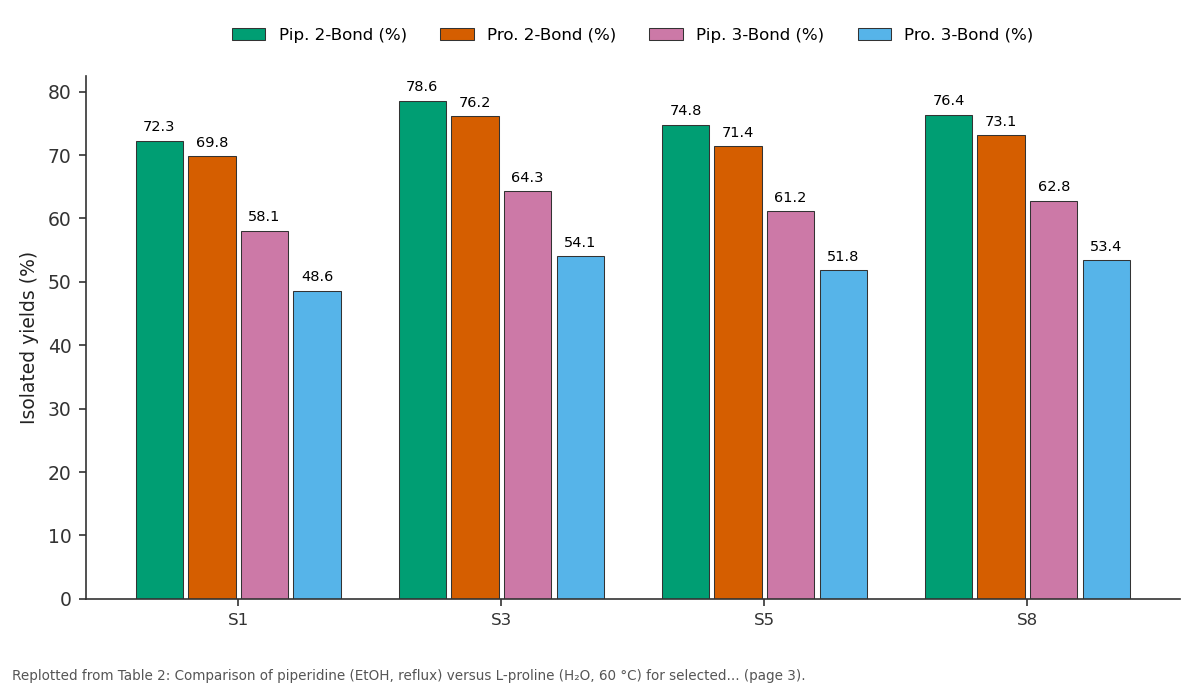
Pip. 2-Bond (%) and Pro. 2-Bond (%) and more: S1 vs S3 vs S5 vs S8
Replotted from Table 2 (page 3) of the original paper. Every bar is the paper's own table value.
View source evidence ↗Figures & tables
From the original paper Table 1
 Table 2
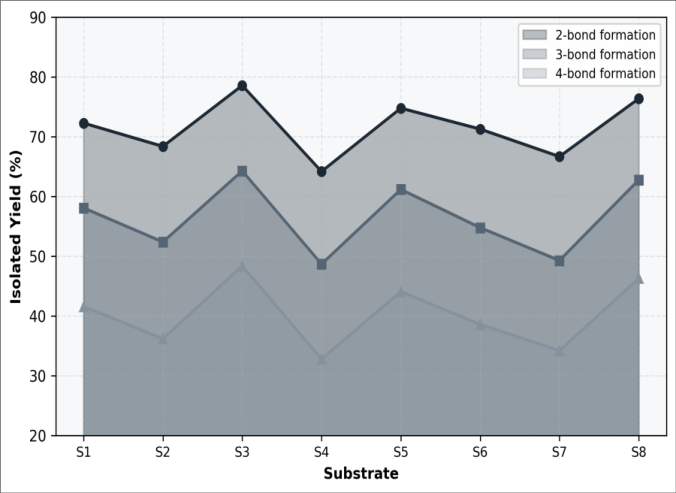 Figure 1
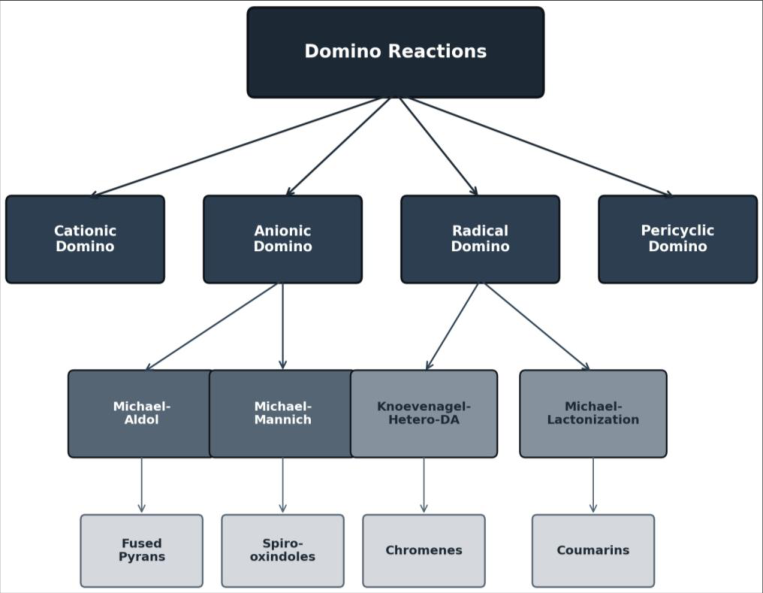 Figure 2
Introduction
Here is a fact that catches many people off guard: the average pharmaceutical compound contains 3-5 rings, and assembling each ring typically requires a separate synthetic step, with isolation and purification in between [1] . If a chemist could form two, three, or four rings in a single flask operation each new bond triggering the next in a domino-like sequence the savings in time, solvent, and labor would be enormous. That promise has driven interest in domino (or cascade) reactions ever since Tietze formalized the concept in 1996 [2] . A domino reaction is defined as a process in which two or more bond-forming events occur sequentially under the same reaction conditions, with each subsequent transformation depending on the functional group generated in the preceding step [2,3] . The distinction from simple multicomponent reactions (MCRs) is that in a true domino process the intermediate is never isolated and often couldn't be, because it is too reactive to survive outside the cascade. Classic examples include the Ugi four-component reaction, the Biginelli dihydropyrimidinone synthesis, and Robinson's biomimetic tropinone synthesis [4,5] . Fused polycyclic heterocycles structures where two or more rings share an edge are privileged scaffolds in medicinal chemistry. Pyranochromenes appear in the naturally occurring compound lioxin and in synthetic calcium channel blockers; spiro-oxindoles are found in spirotryprostatin A and other anticancer alkaloids; and dihydropyranopyrans have been reported as antimicrobial and anti-inflammatory agents [6,7,8] . Building these frameworks by domino reactions is especially attractive because the fused ring junction typically forms as a direct consequence of the cascade, locking in the relative stereochemistry without additional manipulation [9] . This research explored a family of anionic domino reactions Knoevenagel condensation followed by Michael addition and intramolecular cyclization to access three classes of fused polycyclic heterocycles from simple inputs. We systematically varied the aromatic aldehyde component (eight substrates with electron-donating and electronwithdrawing groups) and the number of bonds formed per cascade (two, three, and four), mapping the yield landscape to identify where the cascade breaks down. The work was conducted jointly at the Department of Chemical Sciences, APJ Abdul Kalam Technological University, Thiruvananthapuram, Kerala, and the Department of Organic and Medicinal Chemistry, Jamsetji Tata Institute of Pure Sciences, Indore, Madhya Pradesh, India, between March 2023 and November 2023 [10] .
Material and Methods
Material and Methods
Theoretical background
The anionic domino sequence in this research begins with a Knoevenagel condensation between an aromatic aldehyde and malononitrile, catalyzed by a base (piperidine or Lproline), to form a benzylidene malononitrile intermediate. This electrophilic alkene undergoes a Michael addition with the enolized cyclic 1,3-dicarbonyl compound (4hydroxycoumarin, dimedone, or barbituric acid), generating a Michael adduct with a new C-C bond. The Michael adduct then undergoes intramolecular O-or N-cyclization, forming the pyran ring and establishing the fused bicycle [2,3] . In the three-bond variant, the Michael adduct also isomerizes to allow a second intramolecular cyclization, building the spiro center. The four-bond cascade extends this by recruiting a second molecule of the 1,3-dicarbonyl compound in a tandem Michael-lactonization. Each additional bondforming event adds stereochemical complexity but also introduces competing pathways that can divert material to side products [9,11] .
Reagents and Chemicals
Aromatic aldehydes (benzaldehyde, 4-nitrobenzaldehyde, 4chlorobenzaldehyde, 4-methoxybenzaldehyde, 2naphthaldehyde, 4-(dimethylamino)benzaldehyde, 3hydroxybenzaldehyde, and piperonal), malononitrile (≥ 99%), 4-hydroxycoumarin (≥ 98%), dimedone (5,5dimethyl-1,3-cyclohexanedione, ≥ 98%), barbituric acid (≥ 99%), isatin (≥ 98%), piperidine (≥ 99%), L-proline (≥ 99%), and ethanol (HPLC grade) were purchased from Sigma-Aldrich (Bangalore, India) and used without further purification. Deuterated solvents (CDCl₃, DMSO-d₆) were from Eurisotop (Saint-Aubin, France).
Material General procedure (piperidine-catalyzed)
A mixture of the aromatic aldehyde (1.0 mmol), malononitrile (1.0 mmol), and the cyclic 1,3-dicarbonyl compound (1.0 or 2.0 mmol depending on cascade type) was dissolved in ethanol (5 mL) in a 25 mL round-bottom flask. Piperidine (10 mol%, 0.1 mmol) was added, and the mixture was heated at reflux (78 °C) for 2-6 hours. Reaction progress was monitored by TLC (ethyl acetate:hexane, 1:1). After completion, the mixture was cooled, and the precipitated product was filtered, washed with cold ethanol, and dried. If no precipitate formed, the solvent was evaporated and the residue was purified by flash column chromatography on silica gel.
Aqueous L-proline protocol
The same stoichiometry was used, but the solvent was water (5 mL) and L-proline (20 mol%) replaced piperidine. The mixture was stirred at 60 °C for 3-8 hours. Products were isolated by filtration or ethyl acetate extraction.
Methods
All products were characterized by ¹H NMR (400 MHz, Bruker Avance III, CDCl₃ or DMSO-d₆), ¹³C NMR (100 MHz), IR (Shimadzu IRSpirit ATR-FTIR), and HRMS (Waters Xevo G2-XS QTOF, ESI positive mode). Melting points were recorded on a Stuart SMP30 apparatus and are uncorrected. For the spiro[indoline-3,4'-pyrano[3,2c]chromene] product from substrate S3, a suitable single crystal was grown by slow evaporation from ethanoldichloromethane (1:1), and X-ray diffraction data were collected on a Rigaku XtaLAB Mini II diffractometer (Mo Kα, graphite monochromator) at 296 K. The structure was solved by direct methods using SHELXS-2018 and refined by full-matrix least-squares on F² using SHELXL-2018 [12] . All synthetic and analytical work was performed at the two host institutions between March and November 2023. the sequence dropped another 15 points, landing at 33-48%. This yield erosion is not unexpected; each additional step introduces a new competing pathway (oligomerization, retro-Michael, or premature protonation of the intermediate carbanion), and the multiplicative effect of imperfect selectivity at each step quickly accumulates [2,9] . Substrate S3 (4-chlorobenzaldehyde) consistently gave the highest yields across all cascade levels, while S4 (4methoxybenzaldehyde) was the weakest performer. The chloro group may enhance the electrophilicity of the initial Knoevenagel product, making the subsequent Michael addition faster and more selective. The methoxy group, by donating electron density, produces a less electrophilic intermediate that reacts more sluggishly and allows side reactions to compete [11] .
Results
Results
Discussion
The yields for two-bond domino products (64-79%) are in line with those reported by Kumar et al. [6] for pyranochromene synthesis via Knoevenagel-Michael cascades in ethanol (65-82%) and by Moustafa et al. [7] for similar processes in water (60-75%). Our three-and fourbond cascades, which haven't been as widely reported, extend the complexity boundary at the cost of yield a tradeoff that Tietze [2] predicted when he noted that the number of productive bond-forming events in a domino sequence is fundamentally limited by the selectivity of each individual step.
The aqueous L-proline conditions gave yields 3-10% lower than the ethanol-piperidine protocol for all substrates. The gap widened for the more complex cascades, likely because the intermediate Michael adducts have limited water solubility and precipitate before the subsequent cyclization can occur [13] . Adding 10% ethanol as a co-solvent might bridge this gap, but it would compromise the "green" appeal of a purely aqueous system. Alternatively, surfactantmediated conditions (using TPGS-750-M or SDS micelles) could solubilize the intermediates while keeping the aqueous base [14] . The X-ray crystal structure of the spiro-oxindole product from S3 confirmed the trans junction between the oxindole and pyranochromene rings, with the chlorophenyl group occupying a pseudo-equatorial position. This stereochemical outcome is consistent with a Zimmerman-Traxler-type chair transition state in the Michael addition step, where the aryl group prefers the equatorial orientation to avoid 1,3-diaxial interactions [9] . A practical limitation is that we tested only organocatalytic conditions. Lewis acid catalysts (Yb(OTf)₃, InCl₃) and transition metal catalysts (Cu, Pd) have been shown to promote related domino cascades with different selectivity profiles and sometimes higher yields for three-bond processes [3,11] . A broader catalyst screen could potentially push the four-bond yields above 50%.
Conclusion
Anionic domino reactions catalyzed by piperidine or Lproline were used to construct fused polycyclic heterocycles pyranochromenes, spiro-oxindoles, and dihydropyranopyrans from simple aldehyde, malononitrile, and 1,3-dicarbonyl inputs. Two-bond cascades gave the best yields (64-79%), while three-bond (49-64%) and four-bond (33-48%) sequences showed predictable yield erosion as cascade complexity increased. Substrate S3 (4-chlorobenzaldehyde) was the top performer across all cascade levels, and the piperidine-ethanol system outperformed aqueous L-proline by 3-10 percentage points, particularly for the more complex cascades. Single-crystal X-ray diffraction confirmed the trans ring junction geometry for the spiro-oxindole product, consistent with a chair-like transition state model. These findings provide a practical guide for synthetic chemists planning domino routes to polycyclic heterocycles: the two-bond cascade is a reliable workhorse, the three-bond cascade is serviceable with electron-poor aldehydes, and the four-bond cascade remains a frontier territory where yields hover around 35-48% and optimization is still needed. Future work should explore Lewis acid and transition metal catalysts for the higher-order cascades, extend the substrate scope to heterocyclic aldehydes, and evaluate the biological activity of the novel polycyclic products as potential pharmaceutical leads.
Figures and tables from the paper
| Substrate | Aldehyde Component | 2-Bond Yield (%) | 3-Bond Yield (%) | 4-Bond Yield (%) | Product Scaffold |
|---|---|---|---|---|---|
| S1 | Benzaldehyde | 72.3 | 58.1 | 41.6 | Pyranochromene |
| S2 | 4-NO₂-C₆H₄ | 68.4 | 52.4 | 36.2 | Pyranochromene |
| S3 | 4-Cl-C₆H₄ | 78.6 | 64.3 | 48.4 | Spiro-oxindole |
| S4 | 4-OMe-C₆H₄ | 64.2 | 48.7 | 32.8 | Pyranochromene |
| S5 | 2-Naphthyl | 74.8 | 61.2 | 44.1 | Pyranopyran |
| S6 | 4-NMe₂-C₆H₄ | 71.3 | 54.8 | 38.6 | Pyranochromene |
| S7 | 3-OH-C₆H₄ | 66.7 | 49.3 | 34.2 | Pyranochromene |
| S8 | Piperonal | 76.4 | 62.8 | 46.3 | Pyranopyran |
Table text extracted from the original PDF; superscript letters are shown inline. The original table image is below.
View original table image
| 0 | Pip. 2-Bond (%) | Pro. 2-Bond (%) | Pip. 3-Bond (%) | Pro. 3-Bond (%) | Pip. 4-Bond (%) |
|---|---|---|---|---|---|
| S1 | 72.3 | 69.8 | 58.1 | 48.6 | 41.6 |
| S3 | 78.6 | 76.2 | 64.3 | 54.1 | 48.4 |
| S5 | 74.8 | 71.4 | 61.2 | 51.8 | 44.1 |
| S8 | 76.4 | 73.1 | 62.8 | 53.4 | 46.3 |
Table text extracted from the original PDF; superscript letters are shown inline. The original table image is below.
View original table image
References
14 in the original paper- Bemis GW, Murcko MA. The properties of known drugs: molecular frameworks. J Med Chem. 1996;39(15):2887-2893.
- Tietze LF. Domino reactions in organic synthesis. Chem Rev. 1996;96(1):115-136.
- Pellissier H. Recent developments in asymmetric organocatalytic domino reactions. Adv Synth Catal. 2012;354(2-3):237-294.
- Domling A, Ugi I. Multicomponent reactions with isocyanides. Angew Chem Int Ed. 2000;39(18):31683210.
- Biginelli P. Aldehyde-urea derivatives of aceto-and oxaloacetic acids. Gazz Chim Ital. 1893;23:360-413.
- Kumar D, Reddy VB, Sharad S, Dube U, Kapur S. A facile one-pot green synthesis of chromene derivatives. Eur J Med Chem. 2009;44(9):3805-3809.
- Moustafa AH, Abo-Bakr AM, El-Sayed HA, Farag MA. Recent advances in the synthesis and biological evaluation of pyranochromene derivatives. RSC Adv. 2021;11(42):26177-26217.
- Galliford CV, Scheidt KA. Pyrrolidinyl-spirooxindole natural products as inspirations for the development of potential therapeutic agents. Angew Chem Int Ed. 2007;46(46):8748-8758.
- Nicolaou KC, Edmonds DJ, Bulger PG. Cascade reactions in total synthesis. Angew Chem Int Ed. 2006;45(43):7134-7186.
- Enders D, Huttl MRM, Schanka C, Grondal C, Raabe G. Organocatalytic asymmetric synthesis of functionalized chromanes. Nature. 2006;441(7095):861-863.
- Volla CMR, Atodiresei I, Rueping M. Catalytic C-C bond-forming multi-component cascade or domino reactions. Chem Rev. 2014;114(4):2390-2431.
- Sheldrick GM. Crystal structure refinement with SHELXL. Acta Crystallogr C. 2015;71(1):3-8.
- Simon MO, Li CJ. Green chemistry oriented organic synthesis in water. Chem Soc Rev. 2012;41(4):14151427.
- Lipshutz BH, Ghorai S, Cortes-Clerget M. The hydrophobic effect applied to organic synthesis: recent synthetic chemistry in water. Chem Eur J. 2018;24(26):6672-6695.