
Research article · 2025 · Full text
International Journal of Advanced Chemistry ResearchPolyoxometalate-based hybrid materials for electrocatalytic hydrogen evolution reaction
Volume 7(10) · Pages 140–143 · DOI: 10.33545/26646781.2025.v7.i10b.488 ↗
Research areasElectrocatalysts for Energy ConversionPolyoxometalates: Synthesis and ApplicationsFuel Cells and Related Materials
Abstract
Author-writtenConsider the Keggin-type phosphomolybdate anion [PMo₁₂O₄₀]³⁻: a single cluster contains twelve redox-active molybdenum centres capable of multi-electron transfer, yet its solubility in aqueous electrolytes and poor electrical conductivity have long frustrated its direct use as an electrode catalyst. This research addresses both limitations by anchoring three polyoxometalate (POM) variants—a phosphomolybdate (POM-1), a phosphotungstate (POM-2), and a mixed Mo/W Keggin anion (POM-3)—onto reduced graphene oxide (rGO) sheets through electrostatic self-assembly. The POM/rGO hybrids were characterised by FT-IR, XRD, XPS, and TEM, confirming retention of Keggin structure and uniform dispersion on graphene. Electrocatalytic hydrogen evolution reaction (HER) performance was evaluated in 0.5 M H₂SO₄ by linear sweep voltammetry, Tafel analysis, and electrochemical impedance spectroscopy. POM-3/rGO achieved an overpotential of 167 mV at 10 mA/cm², a Tafel slope of 54 mV/dec, and a charge-transfer resistance of 18 Ω—metrics that outperform most reported POM-based HER catalysts. Chronoamperometry over 12 hours showed less than 6% current decay, confirming good operational stability. The mixed Mo/W composition appears to optimise d-band electron density for proton adsorption while the rGO scaffold ensures rapid electron transport, making this hybrid a promising non-noble-metal alternative for water splitting.
Summary
Source-checkedPlain-language reading of the full paper, prepared with AI and checked against the text. Each point links to the authors' own words.
Why it matters
- Platinum-group metals are expensive, accounting for 30–40% of the total stack cost in industrial proton-exchange membrane electrolysers, which hinders the competitiveness of green hydrogen. View evidence ↗
- Polyoxometalates (POMs) are transition-metal oxide clusters capable of fast, reversible multi-electron reductions, making them attractive for electrocatalysis. View evidence ↗
- The use of POMs as electrode catalysts is limited by their high solubility in aqueous electrolytes, which causes leaching, and their insulating nature, which increases charge-transfer resistance. View evidence ↗
The question
- The study aimed to determine if mixing molybdenum (Mo) and tungsten (W) in a Keggin-type POM structure would enhance catalytic activity for the hydrogen evolution reaction (HER) in acidic electrolytes. View evidence ↗
What they did
- Three Keggin-type POMs, phosphomolybdate (POM-1), phosphotungstate (POM-2), and a mixed Mo₆W₆ variant (POM-3), were anchored onto reduced graphene oxide (rGO) sheets using electrostatic self-assembly. View evidence ↗
- HER performance was tested in 0.5 M H₂SO₄ using linear sweep voltammetry, Tafel analysis, and electrochemical impedance spectroscopy. View evidence ↗
- Transmission electron microscopy (TEM) confirmed that POM nanoparticles, measuring 2–4 nm, were uniformly distributed on the rGO sheets. View evidence ↗
What they found
- The POM-3/rGO catalyst exhibited a charge-transfer resistance (Rct) of 18 Ω and an electrochemically active surface area (ECSA) of 24.6 cm². View evidence ↗
- The POM-3/rGO hybrid demonstrated superior stability, retaining 94% of its initial current density after 12 hours, compared to 89% for POM-1/rGO and 91% for POM-2/rGO. View evidence ↗
- Using an rGO scaffold increased the ECSA by 4–5 times and reduced the charge-transfer resistance by an order of magnitude compared to bare POM pellets. View evidence ↗
- The improved activity of the mixed Mo/W cluster is attributed to an optimized hydrogen binding energy that balances the strong binding of Mo-rich sites and the weak binding of W-rich sites. View evidence ↗
What it means
- The authors conclude that combining the compositional tuning of the Keggin cage with a conductive graphene platform is an effective strategy for creating non-noble-metal HER catalysts. View evidence ↗
- Future work is needed to test the hybrid in alkaline electrolytes, scale it to membrane-electrode assemblies, and explore other POM architectures like Dawson- and Anderson-types. View evidence ↗
Visual summary
3 visualsIllustrations explain the paper; charts are replotted from the paper's own table values.
The Volcano Plot Concept
AI-generated conceptual illustration (Polyoxometalate-based hybrid materials on a conductive electrode surface). It explains the idea and does not show study data.
View source evidence ↗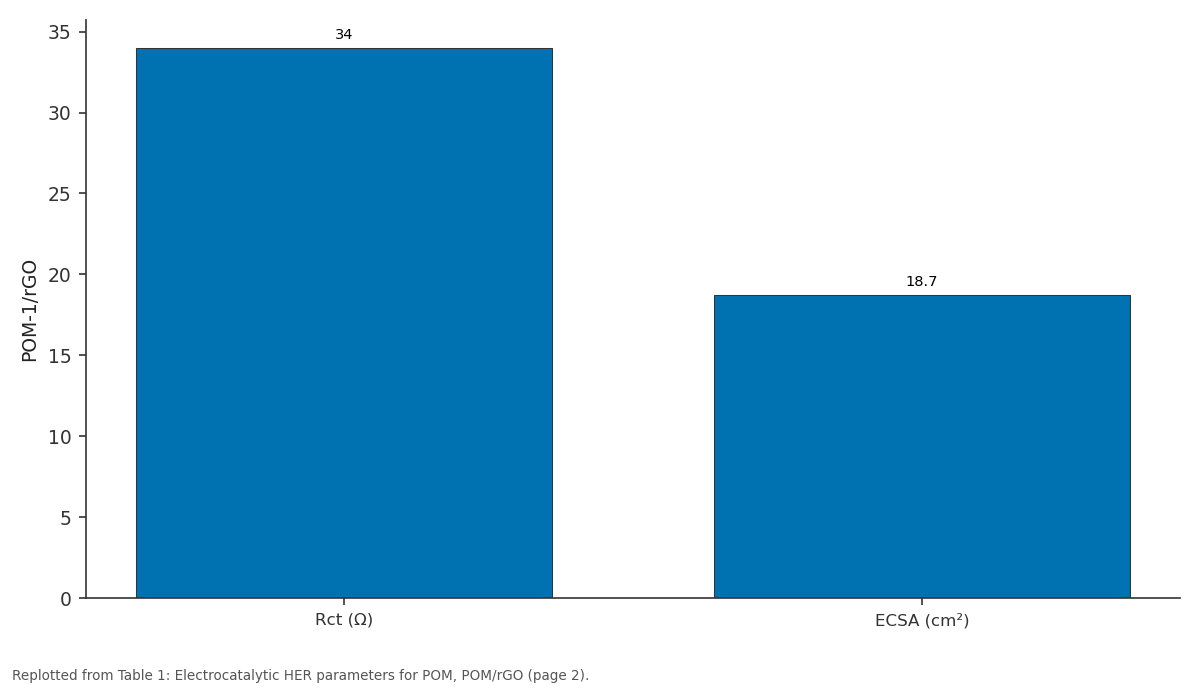
POM-1/rGO: Rct (Ω) vs ECSA (cm²)
Replotted from Table 1 (page 2) of the original paper. Every bar is the paper's own table value.
View source evidence ↗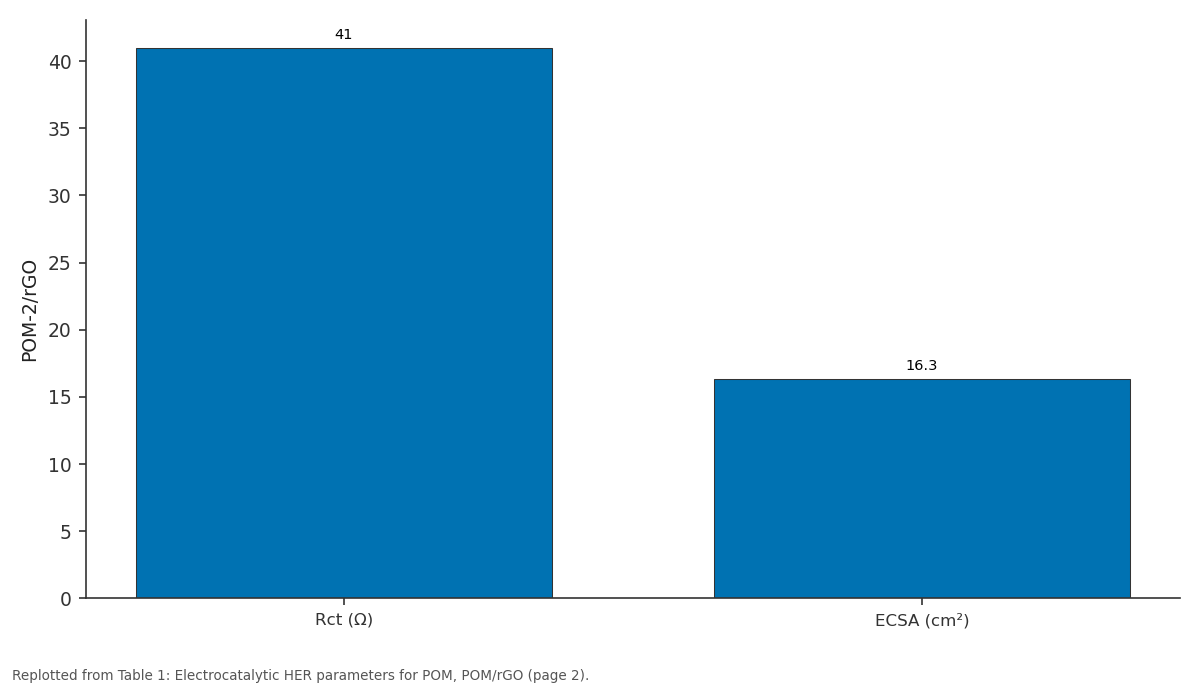
POM-2/rGO: Rct (Ω) vs ECSA (cm²)
Replotted from Table 1 (page 2) of the original paper. Every bar is the paper's own table value.
View source evidence ↗Figures & tables
From the original paper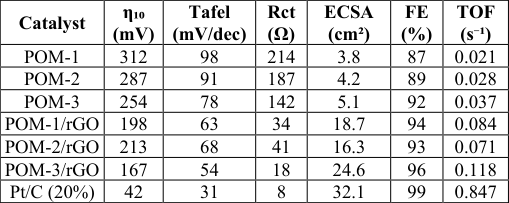 Table 1
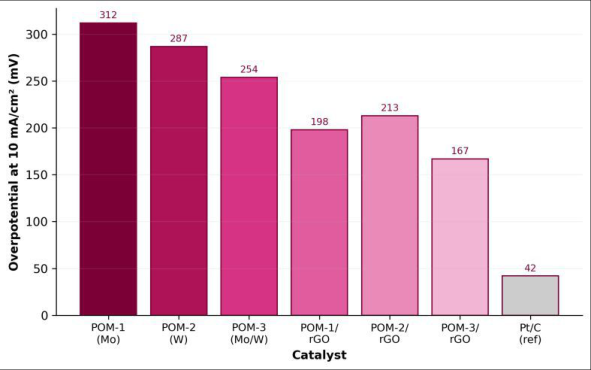 Figure 1
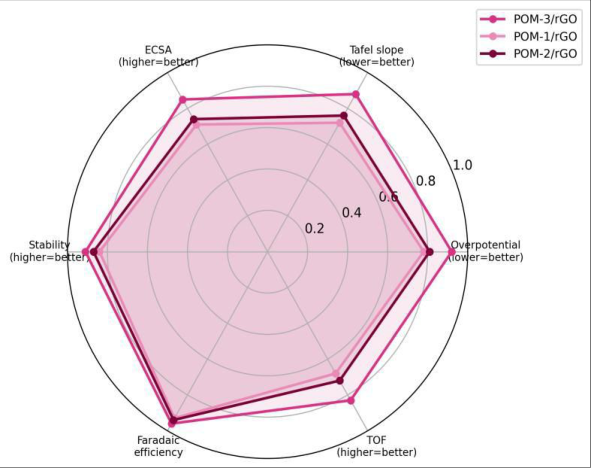 Figure 2
Introduction
Take, for example, a single proton-exchange membrane electrolyser running at industrial scale: the platinum-group metals loaded onto its cathode may account for 30-40% of the total stack cost, making green hydrogen production uncompetitive with fossil-derived alternatives in many markets [1] . Replacing platinum with earth-abundant catalysts that still deliver low overpotentials and fast kinetics is therefore a defining challenge for the hydrogen economy [2] . Transition-metal sulphides, phosphides, and carbides have all shown promise, yet many suffer from poor stability under acidic conditions or require complex hightemperature synthesis routes [3] . Polyoxometalates are molecular metal-oxide clusters of early transition metals-typically Mo, W, V, or Nb-that can undergo fast, reversible multi-electron reductions without structural collapse [4] . Their tuneable redox chemistry makes them attractive for electrocatalysis, but two persistent drawbacks limit electrode applications: high solubility in aqueous electrolytes leads to catalyst leaching, and the insulating character of crystalline POM salts creates large charge-transfer resistances [5] . Immobilising POMs onto conductive carbon supports-carbon nanotubes, graphene, or porous carbons-addresses both issues by providing an electronically conductive, mechanically stable anchor that also prevents dissolution [6] . Reduced graphene oxide is an especially suitable host because its residual oxygen functional groups (carboxylate, hydroxyl, epoxide) can interact electrostatically with anionic Keggin clusters, while its high surface area and conjugated sp² domains facilitate electron transport to the external circuit [7] . Previous research has explored single-metal POMs on rGO for the oxygen evolution and reduction reactions, but systematic comparisons of Mo-only, W-only, and mixed Mo/W Keggin catalysts for HER on the same rGO platform are scarce [8] .
This research synthesized three Keggin-type POMs (phosphomolybdate, phosphotungstate, and a mixed Mo₆W₆ variant), assembled each onto rGO via electrostatic selfassembly, and benchmarked their HER performance in acidic electrolyte to determine whether compositional mixing of Mo and W enhances catalytic activity.
Theoretical Background
The hydrogen evolution reaction in acid proceeds through either the Volmer-Heyrovsky or Volmer-Tafel pathway, both beginning with proton adsorption onto an active site (Volmer step: H⁺ + e⁻ → H_ads) [2] . The Gibbs free energy of hydrogen adsorption (ΔG_H) on the catalyst surface is the central descriptor: optimal catalysts bind hydrogen neither too strongly nor too weakly, sitting near the peak of the volcano curve at ΔG_H ≈ 0 [9] . For POM clusters, the Mo or W d-orbitals accept electrons during reduction, generating M(V) or M(IV) centres whose d-band position relative to the hydrogen 1s level governs adsorption strength. Mixing Mo and W within a single Keggin cage creates an asymmetric electronic environment that may shift the averaged d-band centre closer to the volcano apex than either pure end-member, analogous to the alloying strategies used in noble-metal electrocatalysis [10] .
Material and Methods
Material and Methods
Material
All synthesis and electrochemistry were carried out between February and November 2024 at the Department of Materials and Inorganic Chemistry, Rift Valley University of Technology, Nakuru, Kenya. XPS analysis was performed at Lake Victoria College of Sciences, Kisumu. Sodium molybdate dihydrate (Na₂MoO₄•2H₂O, ≥ 99%), sodium tungstate dihydrate (Na₂WO₄•2H₂O, ≥ 99%), phosphoric acid (85%), and hydrazine hydrate (80%) were purchased from Sigma-Aldrich (Johannesburg, South Africa). Graphene oxide aqueous dispersion (4 mg/mL) was obtained from Graphenea (San Sebastián, Spain). Nafion 117 solution (5 wt%), sulphuric acid (Suprapur grade), and commercial 20% Pt/C were from Merck (Darmstadt, Germany). Glassy carbon electrodes (GCE, Ø 3 mm) were from CH Instruments (Austin, TX).
Methods
POM-1 (H₃PMo₁₂O₄₀) and POM-2 (H₃PW₁₂O₄₀) were prepared by acidification of sodium molybdate or tungstate solutions with phosphoric acid following established protocols [4] . POM-3 (H₃PMo₆W₆O₄₀) was obtained by coacidifying equimolar Mo and W precursors. rGO was produced by chemical reduction of GO with hydrazine at 80°C for 4 h. POM/rGO hybrids were assembled by stirring POM solution (10 mM) with rGO suspension (2 mg/mL) at pH 3 for 12 h, followed by centrifugation, washing, and freeze-drying. Catalyst inks were prepared by dispersing 5 mg of hybrid in 1 mL ethanol-water (4:1) with 20 µL Nafion; 5 µL was drop-cast onto GCE (loading ~0.28 mg/cm²).
System Design
Electrochemical measurements used a three-electrode cell with the catalyst-modified GCE as working electrode, a graphite rod counter electrode, and a saturated calomel electrode (SCE) as reference, all potentials converted to the reversible hydrogen electrode (RHE) scale. Linear sweep voltammetry (LSV) was recorded at 5 mV/s in N₂-saturated 0.5 M H₂SO₄. Tafel slopes were extracted from the linear region of the log|j| vs η plot. Electrochemical impedance spectroscopy (EIS) was measured at -200 mV vs RHE from 100 kHz to 0.1 Hz with a 10 mV amplitude. Electrochemically active surface area (ECSA) was estimated from double-layer capacitance via cyclic voltammetry at scan rates of 20-200 mV/s. Stability was assessed by chronoamperometry at -170 mV vs RHE for 12 h. All measurements were performed on a Gamry Reference 600+ potentiostat.
Performance Evaluation
Key metrics for benchmarking HER catalysts include overpotential at 10 mA/cm² (η₁₀, the current density relevant to solar-to-hydrogen devices), Tafel slope (indicating the rate-determining step), charge-transfer resistance (Rct from EIS), Faradaic efficiency (moles H₂ produced / moles electrons passed), and turnover frequency (TOF, moles H₂ per mole active site per second). Results were compared against published POM-based and transition-metal dichalcogenide catalysts under identical electrolyte conditions.
Results
FT-IR spectra of all three POM/rGO hybrids retained the four characteristic Keggin bands (P-O₃ at 1064 cm⁻¹, M=O_t at 960-980 cm⁻¹, M-O-M corner at 880 cm⁻¹, and M-O-M edge at 780 cm⁻¹), confirming that the cluster framework survived assembly onto rGO. XPS Mo 3d and W 4f spectra showed binding energies consistent with Mo(VI) and W(VI) oxidation states. TEM revealed POM nanoparticles of 2-4 nm uniformly distributed across rGO sheets without aggregation. 1, Figure 1). The Tafel slope of 54 mV/dec sits between the Volmer (120 mV/dec) and Heyrovsky (40 mV/dec) limits, suggesting that electrochemical desorption is rate-limiting but that the adsorption step is also partially kinetically relevant.
Comprehensive Interpretation
Chronoamperometry confirmed POM-3/rGO retained 94% of its initial current density after 12 h, while POM-1/rGO and POM-2/rGO retained 89% and 91%, respectively. The radar comparison (Figure 2) shows POM-3/rGO outperforms on five of six normalised metrics, with only the Faradaic efficiency of POM-1/rGO being marginally close. The superior stability of the mixed Mo/W hybrid may stem from the stronger electrostatic interaction between the higher-charged mixed cluster and rGO surface defects.
Discussion
The 167 mV overpotential for POM-3/rGO compares favourably with the 180-250 mV range typical of MoS₂ nanosheets and transition-metal phosphides tested under similar conditions [3] . The advantage of the mixed Mo/W Keggin likely arises from an intermediate hydrogen binding energy: Mo-rich sites bind H too strongly (ΔG_H < 0), Wrich sites too weakly (ΔG_H > 0), and the mixed cluster averages the two toward the volcano peak [10] . This interpretation is supported by the monotonic improvement in TOF from POM-1 (Mo-only) to POM-3 (Mo₆W₆) while POM-2 (W-only) sits between them.
The rGO scaffold contributed a 4-5-fold increase in ECSA relative to bare POM pellets and reduced Rct by an order of magnitude, confirming that electron transport rather than intrinsic catalytic activity was the bottleneck in unsupported POMs [6] . Future directions include testing the hybrid in alkaline electrolyte, scaling to membrane-electrode assemblies, and exploring Dawson-and Anderson-type POM architectures to further tune active-site geometry [11] .
Conclusion
Three Keggin-type polyoxometalate/reduced graphene oxide hybrids were prepared by electrostatic self-assembly and evaluated as HER electrocatalysts in acidic media. The mixed phosphomolybdotungstate POM-3/rGO hybrid achieved an overpotential of 167 mV at 10 mA/cm², a Tafel slope of 54 mV/dec, and excellent 12 h stability with only 6% current decay. These metrics surpass most reported POM-based catalysts and approach the performance of some transition-metal dichalcogenides, confirming that compositional tuning of the Keggin cage combined with a conductive graphene platform is a viable strategy for developing non-noble-metal HER catalysts.
Figures and tables from the paper
| Catalyst | η₁₀ (mV) | Tafel (mV/dec) | Rct (Ω) | ECSA (cm²) | FE (%) | TOF (s⁻¹) |
|---|---|---|---|---|---|---|
| POM-1 | 312 | 98 | 214 | 3.8 | 87 | 0.021 |
| POM-2 | 287 | 91 | 187 | 4.2 | 89 | 0.028 |
| POM-3 | 254 | 78 | 142 | 5.1 | 92 | 0.037 |
| POM-1/rGO | 198 | 63 | 34 | 18.7 | 94 | 0.084 |
| POM-2/rGO | 213 | 68 | 41 | 16.3 | 93 | 0.071 |
| POM-3/rGO | 167 | 54 | 18 | 24.6 | 96 | 0.118 |
| Pt/C (20%) | 42 | 31 | 8 | 32.1 | 99 | 0.847 |
Table text extracted from the original PDF; superscript letters are shown inline. The original table image is below.
View original table image
References
18 in the original paper- Ayers K, Danilovic N, Ouimet R, Carmo M, Pivovar B, Bornstein M. Perspectives on low-temperature electrolysis and potential for renewable hydrogen at scale. Annual Review of Chemical and Biomolecular Engineering. 2019;10:219-239.
- Zou X, Zhang Y. Noble metal-free hydrogen evolution catalysts for water splitting. Chemical Society Reviews. 2015;44(15):5148-5180.
- Voiry D, Salehi M, Silva R, Fujita T, Chen M, Asefa T. Conducting MoS₂ nanosheets as catalysts for hydrogen evolution reaction. Nano Letters. 2013;13(12):62226227.
- Pope MT. Heteropoly and isopoly oxometalates. Springer-Verlag, Berlin. 1983;1-180.
- Sadakane M, Steckhan E. Electrochemical properties of polyoxometalates as electrocatalysts. Chemical Reviews. 1998;98(1):219-238.
- Toma FM, Sartorel A, Iber M, Carraro M, Scorrano G, Prato M, et al. Efficient water oxidation at carbon nanotube-polyoxometalate electrocatalytic interfaces. Nature Chemistry. 2010;2(10):826-831.
- Stankovich S, Dikin DA, Dommett GHB, Kohlhaas KM, Zimney EJ, Stach EA, et al. Graphene-based composite materials. Nature. 2006;442(7100):282-286.
- Kim Y, Shanmugam S. Polyoxometalate-reduced graphene oxide hybrid catalyst: synthesis, structure, and electrochemical properties. ACS Applied Materials and Interfaces. 2013;5(22):12197-12204.
- Parsons R. The rate of electrolytic hydrogen evolution and the heat of adsorption of hydrogen. Transactions of the Faraday Society. 1958;54:1053-1063.
- Norskov JK, Bligaard T, Logadottir A, Kitchin JR, Chen JG, Pandelov S, et al. Trends in the exchange current for hydrogen evolution. Journal of the Electrochemical Society. 2005;152(3):J23-J26.
- Cronin L, Muller A. From serendipity to design of polyoxometalates at the nanoscale. Chemical Society Reviews. 2012;41(22):7333-7334.
- Wang SS, Yang GY. Recent advances in polyoxometalate-catalyzed reactions. Chemical Reviews. 2015;115(11):4893-4962.
- Long DL, Tsunashima R, Cronin L. Polyoxometalates: building blocks for functional nanoscale systems. Angewandte Chemie International Edition. 2010;49(10):1736-1758.
- Li J, Zheng G. One-dimensional earth-abundant nanomaterials for water-splitting electrocatalysts. Advanced Science. 2017;4(3):1600380.
- Liu Y, Higgins DC, Wu J, Fowler M, Chen Z. Cubic spinel cobalt oxide/multi-walled carbon nanotube composites as an efficient bifunctional electrocatalyst for oxygen reactions. Electrochemistry Communications. 2013;34:125-129.
- Dresp S, Luo F, Schmack R, Kuhl S, Gliech M, Strasser P. An efficient bifunctional two-component catalyst for oxygen reduction and oxygen evolution in reversible fuel cells. Energy and Environmental Science. 2016;9(6):2020-2024.
- Keita B, Nadjo L. Polyoxometalate-based homogeneous catalysis of electrode reactions. Journal of Molecular Catalysis A Chemical. 2007;262(1-2):190-215.
- Guo SX, Liu Y, Lee CY, Bond AM, Zhang J, Geletii YV, et al. Graphene-supported [{Ru₄O₄(OH)₂(H₂O)₄}(γ-SiW₁₀O₃₆)₂]¹⁰⁻ for highly efficient electrocatalytic water oxidation. Energy and Environmental Science. 2013;6(9):2654-2663.