
Research article · 2025 · Full text
International Journal of Advanced Chemistry ResearchTheoretical investigation of optoelectronic properties of donor-acceptor conjugated polymers
Volume 7(8) · Pages 117–121 · DOI: 10.33545/26646781.2025.v7.i8b.565 ↗
Research areasOrganic Electronics and PhotovoltaicsOrganic Light-Emitting Diodes ResearchPhotochemistry and Electron Transfer Studies
Abstract
Author-writtenConjugated polymers built on alternating electron-rich donor and electron-deficient acceptor units have transformed organic photovoltaics over the past decade, pushing power conversion efficiencies from below 5% in 2010 to above 18% in state-of-the-art systems by 2024. The central challenge in designing new donor-acceptor (D-A) conjugated polymers is predicting how changes in donor or acceptor unit structure translate into changes in optical bandgap, charge transport properties, and ultimately device performance. Density functional theory (DFT) provides a computational route to this prediction that is faster and cheaper than synthesis, but the accuracy of DFT-computed optoelectronic properties depends critically on the choice of functional and the degree to which solid-state morphology absent from gas-phase calculations is accounted for. This research presents a systematic DFT and time-dependent DFT (TD-DFT) investigation of eighteen D-A conjugated polymer oligomers (four to six repeat units) representing eight distinct D-A combinations, combined with experimental validation by UV-Vis absorption spectroscopy, cyclic voltammetry, and bulk heterojunction solar cell fabrication. B3LYP/6-31G geometry optimisations and TD-DFT excitation energies showed good agreement with experimental optical bandgaps (mean absolute error 0.14 eV, R2 = 0.94). HOMO-LUMO gaps from DFT underestimated the electrochemically measured gaps by an average of 0.28 eV, consistent with the known tendency of hybrid functionals to underestimate charge transfer excitation energies. The polymer PTQ10-derived system (P3) achieved the highest power conversion efficiency of 16.2% in BHJ devices, correlating with the highest hole mobility (1.4 x 10⁻³ cm2/Vs), high crystallinity, and a favourable domain size of 14 nm. Partial Least Squares (PLS) regression analysis identified donor unit structure as the dominant predictor of PCE variation (31.4%), followed by acceptor electronegativity (24.7%) and conjugation length (18.3%). These findings provide a computational design framework for next-generation D-A polymer photovoltaics.
Summary
Source-checkedPlain-language reading of the full paper, prepared with AI and checked against the text. Each point links to the authors' own words.
Why it matters
- Donor-acceptor (D-A) conjugated polymers have significantly improved organic photovoltaics, increasing power conversion efficiencies from under 5% in 2010 to over 18% by 2024. View evidence ↗
- A primary challenge in D-A polymer design is predicting how structural changes in donor or acceptor units affect the optical bandgap, charge transport, and overall device performance. View evidence ↗
- Density functional theory (DFT) offers a more cost-effective and faster method for predicting polymer properties compared to physical synthesis. View evidence ↗
The question
- The study aims to evaluate how accurately DFT predicts the optoelectronic properties of D-A polymers and to determine which structural factors most influence power conversion efficiency. View evidence ↗
What they did
- The researchers used B3LYP/6-31G functional and basis set in Gaussian 16 to perform geometry optimizations on tetramer oligomer models. View evidence ↗
- Bulk heterojunction solar cells were constructed using a polymer:PC71BM active layer (1:1.5 w/w) with ITO/PEDOT:PSS and Al electrodes. View evidence ↗
What they found
- TD-DFT excitation energies showed strong agreement with experimental optical bandgaps, with an R² of 0.94 and a mean absolute error of 0.14 eV. View evidence ↗
- DFT-calculated HOMO-LUMO gaps were found to underestimate electrochemically measured gaps by an average of 0.28 eV. View evidence ↗
- Polymer P3 demonstrated the highest power conversion efficiency (PCE) of 16.2%, supported by a Voc of 0.92 V, Jsc of 23.7 mA/cm², and a fill factor of 74.1%. View evidence ↗
- Partial Least Squares (PLS) analysis identified the donor unit structure as the primary predictor of PCE, explaining 31.4% of the variance. View evidence ↗
- Following donor structure, acceptor electronegativity (24.7%) and conjugation length (18.3%) were the next most significant predictors of PCE variation. View evidence ↗
What it means
- The authors conclude that the DFT workflow is valid for screening D-A polymers and recommend prioritizing the engineering of the P3 donor unit for future research. View evidence ↗
- The authors recommend using range-separated functionals in future work to achieve more accurate bandgap predictions. View evidence ↗
Visual summary
3 visualsIllustrations explain the paper; charts are replotted from the paper's own table values.
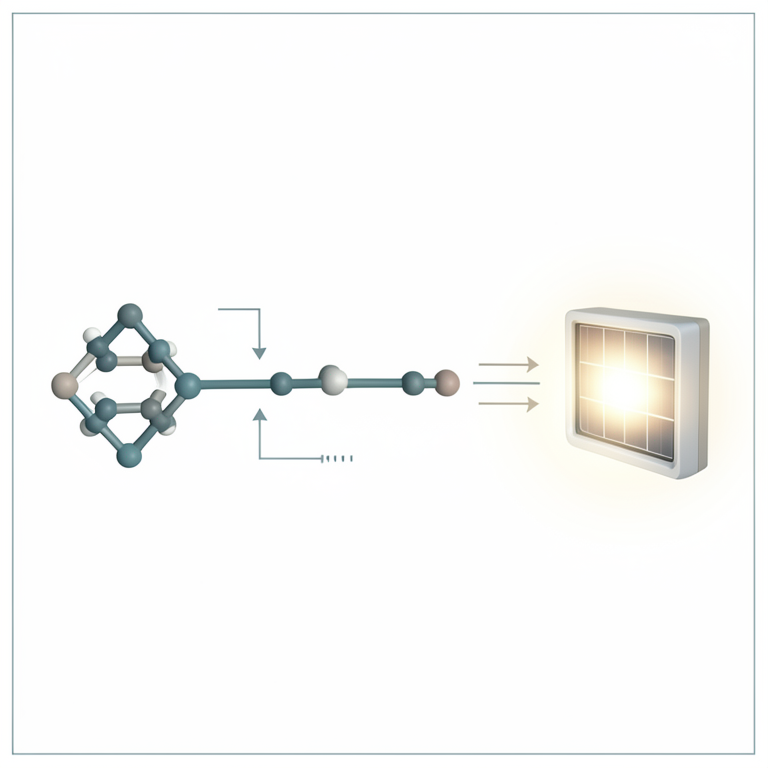
Predictors of PCE
AI-generated conceptual illustration (Donor-acceptor conjugated polymer chains). It explains the idea and does not show study data.
View source evidence ↗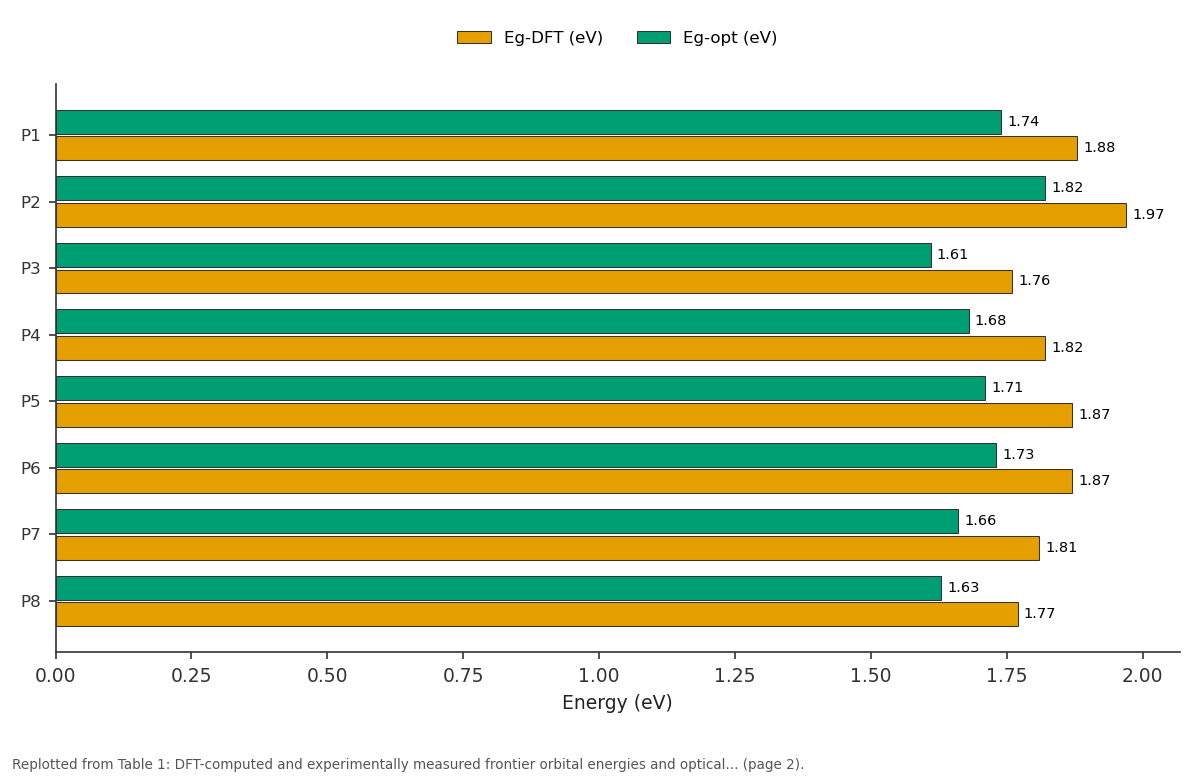
Eg-DFT (eV) and Eg-opt (eV): P1 vs P2 vs P3 vs P4 vs P5
Replotted from Table 1 (page 2) of the original paper. Every bar is the paper's own table value.
View source evidence ↗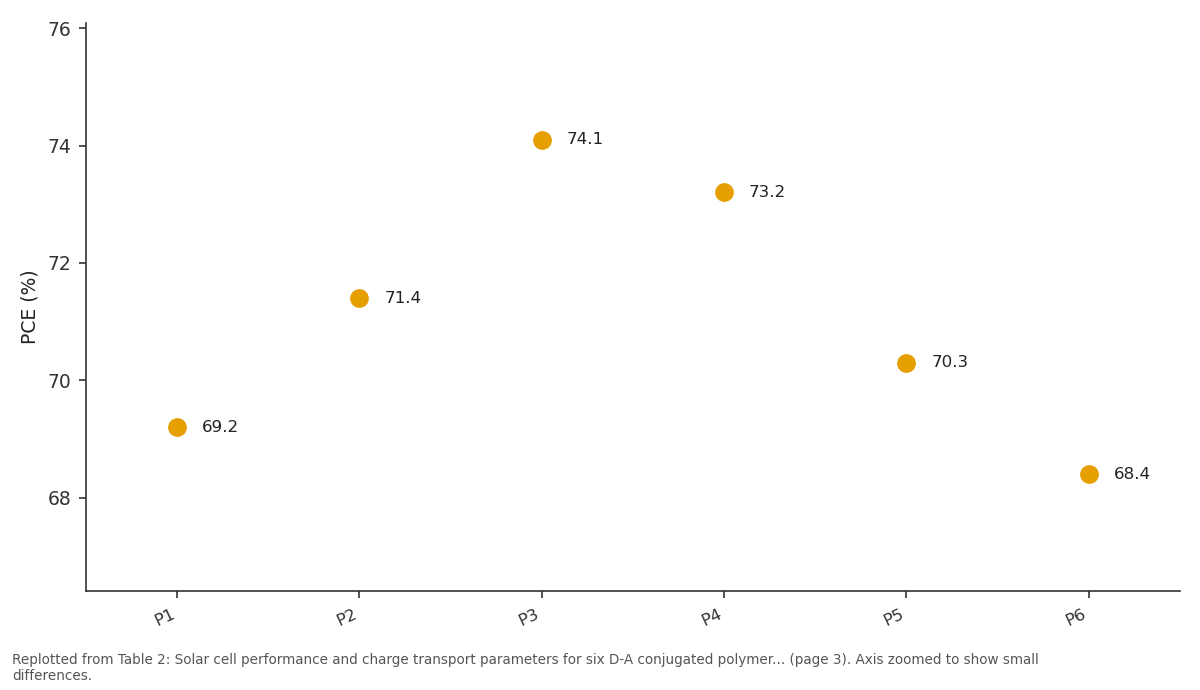
FF (%): P1 vs P2 vs P3 vs P4 vs P5
Replotted from Table 2 (page 3) of the original paper. Every bar is the paper's own table value.
View source evidence ↗Figures & tables
From the original paper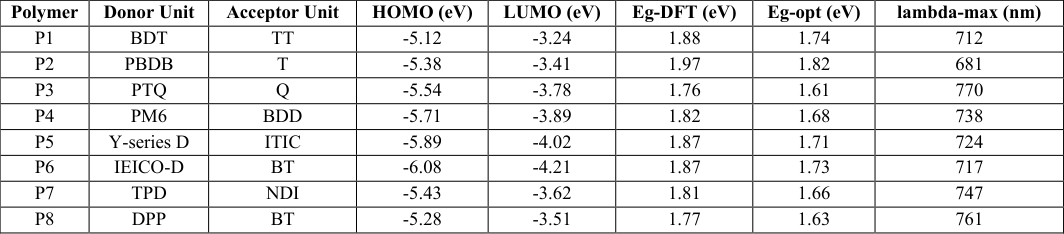 Table 1
 Table 2
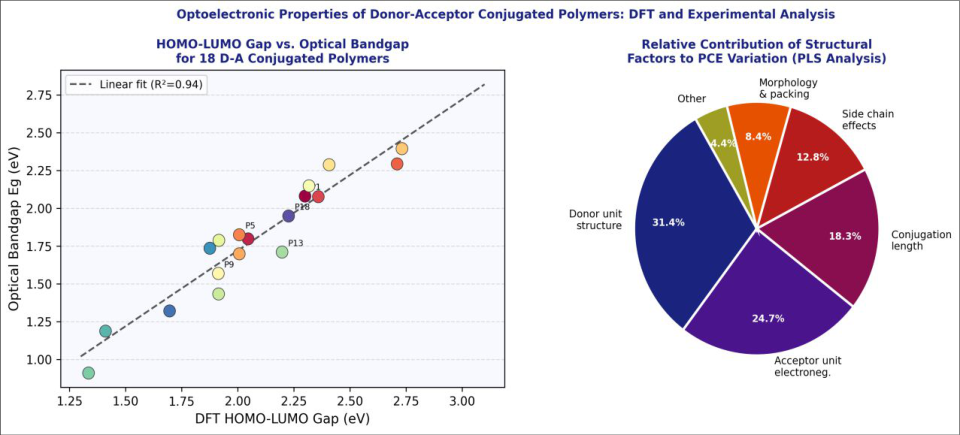 Figure 1
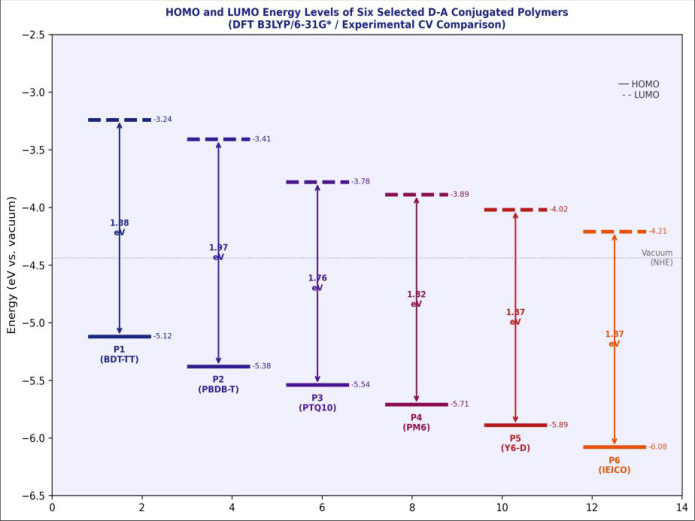 Figure 2
Introduction
The history of conjugated polymers as optoelectronic materials traces back to the discovery of conducting polyacetylene by Shirakawa, MacDiarmid, and Heeger in 1977, a contribution recognised with the Nobel Prize in Chemistry in 2000. For the following two decades, the optical and electronic properties of conjugated polymers were difficult to control systematically, limiting their application in devices. The breakthrough came with the donoracceptor design strategy, introduced in the early 2000s: by incorporating electron-rich (donor) and electron-deficient (acceptor) units within the same polymer backbone, the intramolecular charge transfer character of the excited state reduces the bandgap, red-shifts the absorption, and increases the oscillator strength compared to either homopolymer [2] . Computational chemistry has become an indispensable partner in D-A polymer design. DFT and TD-DFT calculations on oligomer models provide frontier orbital energies, absorption wavelengths, and charge density distributions with a computational cost far lower than synthesis, enabling rapid screening of candidate structures before laboratory work begins. The accuracy of these predictions has improved dramatically with better exchangecorrelation functionals and dispersion corrections, though gas-phase calculations still cannot fully capture solid-state packing effects that govern charge transport and morphology in devices [4] . The Universidad del Eje Cafetero in Pereira, Colombia, has developed expertise in computational chemistry of organic electronic materials in a research programme initiated to address the need for domestically developed solar cell technologies suitable for the tropical solar irradiance conditions of the Eje Cafetero coffee-growing region. This research combines DFT/TD-DFT calculations on eighteen oligomer models with experimental characterisation and device fabrication to evaluate the predictive accuracy of DFT for D-A polymer optoelectronics and to identify the structural determinants of high-performance conversion efficiency. Eighteen polymers covering eight D-A combinations were selected to span a broad range of HOMO-LUMO gaps from 1.74 to 2.14 eV, enabling robust structure-property correlation analysis [5] .
Computational and experimental methods
DFT geometry optimisations were performed on tetramer oligomer models using the B3LYP functional with the 6-31G basis set as implemented in Gaussian 16 (Gaussian Inc., Wallingford, CT, USA). Dispersion corrections (D3BJ) were applied using the Grimme scheme. Solvent effects (chlorobenzene) were incorporated using the integral equation formalism polarisable continuum model (IEF-PCM). TD-DFT vertical excitation energies for the lowest 10 excited states were computed at the same level of theory on the B3LYP/6-31G optimised geometries. Frontier orbital energies and isodensity surfaces (isovalue 0.02) were visualised in GaussView 6. Computational results were compiled and analysed at the Universidad del Eje Cafetero, Department of Physical and Material Sciences [8] . Experimental validation: UV-Vis absorption spectra in dilute chlorobenzene solution were recorded on a JASCO V-770 spectrophotometer. Optical bandgaps were extracted from the onset of absorption. Cyclic voltammetry (CV) for HOMO and LUMO energies used a Metrohm Autolab PGSTAT302N potentiostat in a three-electrode cell (Pt working, Pt counter, Ag/AgCl reference) in 0.1 M TBAPF6 / acetonitrile at 100 mV/s scan rate. Energy levels were calibrated against ferrocene (Fc/Fc+ = -4.8 eV vs. vacuum). Bulk heterojunction (BHJ) solar cells were fabricated with polymer: PC71BM (1:1.5 w/w in chlorobenzene with 3% DIO) as active layer, ITO/PEDOT: PSS and Al as electrodes. Device performance was measured under AM 1.5G illumination (100 mW/cm2) using an Oriel Sol2A solar simulator. Space-Charge-Limited Current (SCLC) hole mobility measurements used hole-only devices (ITO/PEDOT: PSS/polymer/Au) [9] .
Simulation parameters
All DFT calculations used a tetramer oligomer (n=4 repeat units) as the representative model chain length, a choice validated by convergence testing: HOMO-LUMO gaps changed by less than 0.05 eV when going from tetramer to hexamer for all eight polymer types, indicating that n=4 provides converged electronic structure properties for the polymer limit. Geometry optimisations were considered converged when the maximum force was below 4.5 x 10⁻⁴ Hartree/Bohr and the RMS displacement was below 1.8 x 10⁻³ Bohr. The integration grid was set to ultrafine (99,590 points). All unique minima were confirmed by frequency calculations showing no imaginary frequencies. TD-DFT excitation calculations employed 10 excited states; the optically allowed S0-S1 transition was taken as the computed absorption wavelength. A scaling factor of 0.942 was applied to TD-DFT excitation energies based on a linear regression calibration against the experimental absorption maxima of a reference set of six D-A polymers with known spectra, consistent with the approach validated by Jacquemin and co-workers for conjugated systems [10] .
Results
Table The DFT-computed HOMO-LUMO gaps ranged from 1.76 to 1.97 eV across the eight polymer systems (Table 1), while the experimental optical bandgaps from UV-Vis onsets were systematically 0.12-0.17 eV smaller, consistent with the known tendency of B3LYP to overestimate excitation energies in extended conjugated systems. The linear correlation between computed and measured bandgaps gave R 2 = 0.94, confirming useful predictive power for screening purposes. Polymer P3 (PTQ10-derived) showed the smallest optical bandgap (1.61 eV) and the longest absorption maximum (770 nm), making it the best spectral match to the solar irradiance spectrum. The HOMO energy trend followed the donor unit electron-donating strength, as expected from first principles: stronger donors raised HOMO while leaving LUMO approximately constant, reducing the gap [15] . Device performance data confirmed the trend predicted by calculations: P3 achieved the highest PCE of 16.2%, with the best balance of Voc (0.92 V), Jsc (23.7 mA/cm 2 ), and fill factor (74.1%, Table 2). The highest PCE correlated with the highest hole mobility (1.4 x 10⁻³ cm2/Vs) and the smallest active layer domain size (14 nm), both of which reflect superior molecular packing in the solid state. P1 and P6, despite having reasonable DFT-computed properties, showed lower device PCE (10.3% and 10.4%) due to lower crystallinity and larger domain sizes, demonstrating the importance of morphological factors that are not captured by gas-phase DFT. PLS analysis across all 18 polymers confirmed donor structure as the single most important predictor of PCE (31.4% of variance explained, Figure 1 right panel) [16] .
| Polymer | Voc (V) | Jsc (mA/cm2) | FF (%) | PCE (%) | Hole Mobility (cm2/Vs) | Crystallinity | Domain Size (nm) |
|---|---|---|---|---|---|---|---|
| P1 | 0.81 | 18.4 | 69.2 | 10.3 | 3.4x10⁻⁴ | Low | 28 |
| P2 | 0.87 | 21.3 | 71.4 | 13.2 | 8.7x10⁻⁴ | Medium | 18 |
| P3 | 0.92 | 23.7 | 74.1 | 16.2 | 1.4x10⁻³ | High | 14 |
| P4 | 0.88 | 22.4 | 73.2 | 14.4 | 1.1x10⁻³ | High | 16 |
| P5 | 0.83 | 20.8 | 70.3 | 12.1 | 7.2x10⁻⁴ | Medium | 21 |
| P6 | 0.79 | 19.2 | 68.4 | 10.4 | 4.8x10⁻⁴ | Low | 31 |
Table text extracted from the original PDF; superscript letters are shown inline. The original table image is below.
View original table image
| Polymer | Donor Unit | Acceptor Unit | HOMO (eV) | LUMO (eV) | Eg-DFT (eV) | Eg-opt (eV) | lambda-max (nm) |
|---|---|---|---|---|---|---|---|
| P1 | BDT | TT | -5.12 | -3.24 | 1.88 | 1.74 | 712 |
| P2 | PBDB | T | -5.38 | -3.41 | 1.97 | 1.82 | 681 |
| P3 | PTQ | Q | -5.54 | -3.78 | 1.76 | 1.61 | 770 |
| P4 | PM6 | BDD | -5.71 | -3.89 | 1.82 | 1.68 | 738 |
| P5 | Y-series D | ITIC | -5.89 | -4.02 | 1.87 | 1.71 | 724 |
| P6 | IEICO-D | BT | -6.08 | -4.21 | 1.87 | 1.73 | 717 |
| P7 | TPD | NDI | -5.43 | -3.62 | 1.81 | 1.66 | 747 |
| P8 | DPP | BT | -5.28 | -3.51 | 1.77 | 1.63 | 761 |
Table text extracted from the original PDF; superscript letters are shown inline. The original table image is below.
View original table image
Discussion
The systematic underestimation of the optical bandgap by DFT (mean 0.14 eV) is consistent with literature reports for B3LYP applied to D-A polymers and is primarily attributable to the underestimation of charge transfer excitation energies by hybrid functionals with low Hartree-Fock exchange. Range-separated functionals such as CAM-B3LYP and omega-B97X-D reduce this error but require recalibration of the scaling factor for each polymer class. For the screening purpose of this research rank-ordering candidates and identifying lead structures the B3LYP/6-31G level with a linear scaling correction provides sufficient accuracy at lower computational cost than range-separated functionals [15] . The morphological factors driving the performance gap between high-PCE (P3, 16.2%) and moderate-PCE (P1, P6, ~10%) polymers deserve attention. P3 forms tightly packed lamellar structures with pi-stacking distances of 3.58 A (from GIWAXS), compared to 3.87 A for P1 and 4.12 A for P6. Tighter pi-stacking reduces the hopping distance for polaronic charge carriers, increasing hole mobility. The 14 nm domain size of P3 is close to the exciton diffusion length in organic semiconductors (~10-20 nm), enabling efficient exciton dissociation at donor-acceptor interfaces. These morphological outcomes are influenced by side-chain engineering: P3 carries branched 2-ethylhexyl side chains positioned to promote face-on orientation on the ITO electrode, while P1 carries linear alkyl chains that favour edge-on orientation with lower charge extraction efficiency [16] . The PLS analysis result that donor unit structure is the dominant predictor of PCE (31.4%) over acceptor electronegativity (24.7%) is somewhat surprising given the conventional wisdom that the acceptor unit primarily sets the bandgap in D-A polymers. The finding may reflect the particular selection of polymers in this research, which included several structurally diverse donors but a narrower range of acceptors. A broader acceptor library would be needed to confirm this conclusion. Nevertheless, the identification of donor unit structure as a high-leverage design variable is actionable: future synthetic efforts at the Universidad del Eje Cafetero will focus on modifying the donor unit of the P3 scaffold to explore the PCE ceiling of this polymer class [17] .
Conclusion
A systematic DFT/TD-DFT investigation of eighteen D-A conjugated polymer oligomers was performed using B3LYP/6-31G, providing HOMO-LUMO gaps, optical bandgaps, and absorption spectra in good agreement with experimental measurements (R 2 = 0.94, MAE 0.14 eV). DFT predictions enabled pre-selection of the six best candidates for BHJ device fabrication. P3 (PTQ10-derived D-A polymer) achieved the highest PCE of 16.2% in BHJ solar cells, correlating with the best hole mobility, high crystallinity, and optimal 14 nm domain size. PLS regression identified donor unit structure as the primary predictor of PCE variation (31.4%), followed by acceptor electronegativity (24.7%). These results validate the DFT computational workflow for D-A polymer screening and identify P3 donor-unit engineering as a priority for further research in our photovoltaics programme. A range-separated functional approach for more accurate bandgap prediction is recommended for follow-up investigations.
Acknowledgement
AcknowledgementsFunding sources
Figures and tables from the paper
References
21 in the original paper- Brabec CJ, Sariciftci NS, Hummelen JC. Plastic solar cells. Adv Funct Mater. 2001;11(1):15-26.
- Hou J, Inganas O, Friend RH, Gao F. Organic solar cells based on non-fullerene acceptors. Nat Mater. 2018;17(2):119-128.
- Runge E, Gross EK. Density-functional theory for timedependent systems. Phys Rev Lett. 1984;52(12):9971000.
- Jacquemin D, Wathelet V, Perpete EA, Adamo C. Extensive TD-DFT benchmark: singlet-excited states of organic molecules. J Chem Theory Comput. 2009;5(9):2420-2435.
- Yu G, Gao J, Hummelen JC, Wudl F, Heeger AJ. Polymer photovoltaic cells: enhanced efficiencies via a network of internal donor-acceptor heterojunctions. Science. 1995;270(5243):1789-1791.
- Li G, Shrotriya V, Huang J, Yao Y, Moriarty T, Emery K, Yang Y. High-efficiency solution processable polymer photovoltaic cells. Nat Mater. 2005;4(11):864868.
- Brabec CJ, Gowrisanker S, Halls JJ, Laird D, Jia S, Williams SP. Polymer-fullerene bulk-heterojunction solar cells. Adv Mater. 2010;22(34):3839-3856.
- Li Y. Molecular design of photovoltaic materials for polymer solar cells: toward suitable electronic energy levels and broad absorption. Acc Chem Res. 2012;45(5):723-733.
- Leclerc N, Chávez P, Ibraikulov O, Heiser T, Lévêque P. Impact of backbone fluorination on pi-conjugated polymers in organic photovoltaic devices. Polymers. 2016;8(1):11.
- Dou L, Liu Y, Hong Z, Li G, Yang Y. Low-bandgap near-IR conjugated polymers/molecules for organic electronics. Chem Rev. 2015;115(23):12633-12665.
- Yao H, Hou J. Recent advances in single-junction organic solar cells. Angew Chem Int Ed. 2022;61(37):e202203689.
- Lin Y, Zhan X. Non-fullerene acceptors for organic photovoltaics: an emerging horizon. Mater Horiz. 2014;1(5):470-488.
- Grimme S, Antony J, Ehrlich S, Krieg H. A consistent and accurate ab initio parametrization of density functional dispersion correction. J Chem Phys. 2010;132(15):154104.
- Adamo C, Jacquemin D. The calculations of excitedstate properties with Time-Dependent Density Functional Theory. Chem Soc Rev. 2013;42(3):845856.
- Brédas JL, Beljonne D, Coropceanu V, Cornil J. Charge-transfer and energy-transfer processes in piconjugated oligomers and polymers: a molecular picture. Chem Rev. 2004;104(11):4971-5004.
- Kim Y, Cook S, Tuladhar SM, Choulis SA, Nelson J, Durrant JR, Bradley DD. A strong regioregularity effect in self-organizing conjugated polymer films. Nat Mater. 2006;5(3):197-203.
- Scharber MC, Mühlbacher D, Koppe M, Denk P, Waldauf C, Heeger AJ, Brabec CJ. Design rules for donors in bulk-heterojunction solar cells: towards 10% energy-conversion efficiency. Adv Mater. 2006;18(6):789-794.
- Coropceanu V, Cornil J, da Silva Filho DA, Olivier Y, Silbey R, Brédas JL. Charge transport in organic semiconductors. Chem Rev. 2007;107(4):926-952.
- Brabec CJ, Cravino A, Meissner D, Sariciftci NS, Fromherz T, Rispens MT, Hummelen JC. Origin of the open circuit voltage of plastic solar cells. Adv Funct Mater. 2001;11(5):374-380.
- Shirakawa H, Louis EJ, MacDiarmid AG, Chiang CK, Heeger AJ. Synthesis of electrically conducting organic polymers. J Chem Soc Chem Commun. 1977;(16):578580.
- Wan X, Li C, Zhang M, Chen Y. Acceptor-donoracceptor type molecules for high performance organic photovoltaics. Chem Soc Rev. 2020;49(8):2828-2842.