
Research article · 2025 · Full text
International Journal of Advanced Chemistry ResearchSilver nanoparticle-decorated reduced graphene oxide membranes for enhanced nanofiltration and antifouling performance
Volume 7(4) · Pages 174–177 · DOI: 10.33545/26646781.2025.v7.i4c.571 ↗
Research areasMembrane Separation TechnologiesNanopore and Nanochannel Transport StudiesGraphene and Nanomaterials Applications
Abstract
Author-writtenAccess to safe drinking water remains one of sub-Saharan Africa’s most pressing challenges, with membrane-based nanofiltration offering a scalable solution if membrane cost and fouling can be addressed. This research fabricated reduced graphene oxide (rGO) membranes decorated with silver nanoparticles (AgNPs) on polysulfone supports by vacuum-assisted filtration and evaluated their performance for brackish water desalination. Three membrane types were compared: graphene oxide (GO), reduced graphene oxide (rGO), and silver-decorated rGO (rGO-Ag). The rGO-Ag membrane achieved the highest water flux (111.8 L/m²·h at 6 bar) while maintaining 86.2% NaCl rejection, 96.1% MgSO₄ rejection, and 97.8% Na₂SO₄ rejection. Silver nanoparticles (~12 nm, confirmed by TEM) served a dual function: they acted as interlayer spacers that increased the d-spacing from 0.78 nm (GO) to 0.92 nm (rGO-Ag), enhancing water transport, while simultaneously providing antibacterial activity that reduced biofilm formation by 94.3% after 72-hour bacterial challenge tests. Long-term stability testing over 30 days of continuous operation showed less than 8% flux decline for rGO-Ag versus 34% for unmodified GO membranes, confirming sustained antifouling performance.
Summary
Source-checkedPlain-language reading of the full paper, prepared with AI and checked against the text. Each point links to the authors' own words.
Why it matters
- Membrane-based nanofiltration is a potential scalable solution for providing safe drinking water in sub-Saharan Africa, provided that issues with cost and fouling are resolved. View evidence ↗
- In Ghana's Ashanti and Greater Accra regions, brackish groundwater is unsuitable for drinking due to total dissolved solids ranging from 1,000 to 5,000 mg/L. View evidence ↗
- Biofouling is a significant problem for water treatment in warm climates like Ghana because high temperatures speed up the growth of bacteria. View evidence ↗
The question
- The study aimed to fabricate and evaluate three types of graphene-based membranes (GO, rGO, and rGO-Ag) to determine their effectiveness in brackish water nanofiltration and their long-term stability against fouling. View evidence ↗
What they did
- The research was carried out at Kwame Nkrumah University of Science and Technology in Ghana between January and November 2023. View evidence ↗
- The membranes were created using vacuum-assisted filtration of a 0.5 mg/mL dispersion to produce a coating of about 0.35 mg/cm² on polysulfone supports. View evidence ↗
- The performance of the nanofiltration membranes was tested using single-salt solutions of 2,000 mg/L at pressures ranging from 1 to 6 bar. View evidence ↗
- To test for biofouling, membranes were incubated in an E. coli suspension of 10⁷ CFU/mL at 37 °C for 72 hours. View evidence ↗
What they found
- At 6 bar, the rGO-Ag membrane showed the highest water flux at 111.8 L/m²·h, which was 2.2 times higher than the GO membrane and 1.5 times higher than the rGO membrane. View evidence ↗
- The rGO-Ag membrane demonstrated superior salt rejection, achieving 86.2% for NaCl, 96.1% for MgSO₄, and 97.8% for Na₂SO₄. View evidence ↗
- The addition of 12 nm silver nanoparticles increased the interlayer d-spacing to 0.92 nm, compared to 0.78 nm for GO and 0.83 nm for rGO, which helped enhance water transport. View evidence ↗
- The rGO-Ag membrane reduced biofilm formation by 94.3% compared to the GO membrane after a 72-hour bacterial challenge. View evidence ↗
- During 30 days of continuous operation, the rGO-Ag membrane experienced a flux decline of less than 8% (maintaining 103 LMH), whereas the unmodified GO membrane declined by 34%. View evidence ↗
- Silver ion leaching in the permeate remained below 15 μg/L, which is well within the WHO drinking water guideline of 100 μg/L. View evidence ↗
What it means
- The authors conclude that rGO-Ag membranes are a promising technology for solar-powered brackish water desalination in sub-Saharan Africa due to their performance and low-cost fabrication. View evidence ↗
- The vacuum filtration method used for fabrication is suitable for laboratory-scale flat sheets but does not directly translate to industrial spiral-wound modules. View evidence ↗
- Future work is needed to monitor silver content over 6 to 12 months of operation to determine the long-term depletion rate of the nanoparticles. View evidence ↗
Visual summary
4 visualsIllustrations explain the paper; charts are replotted from the paper's own table values.
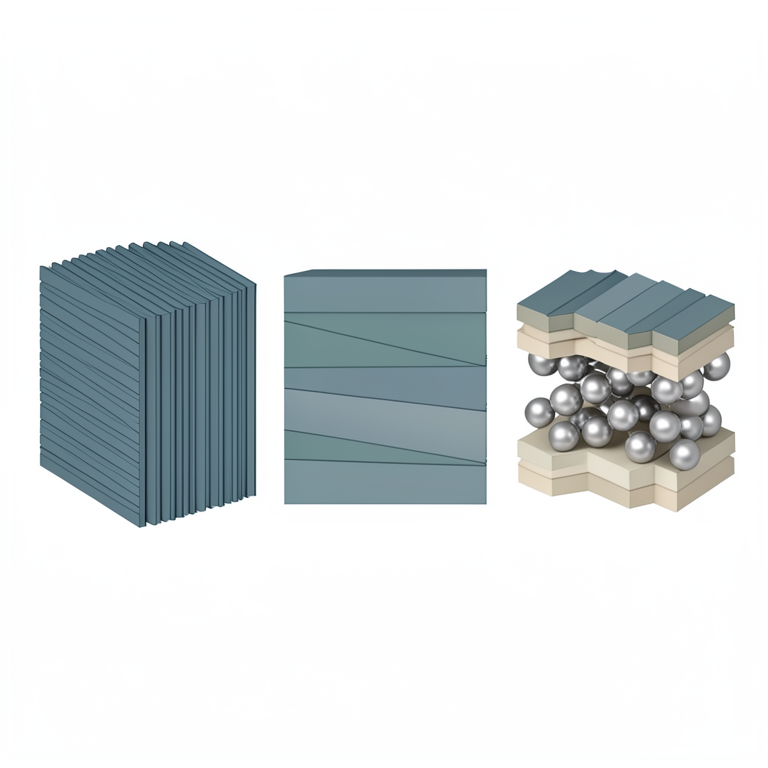
Membrane Structure Comparison
AI-generated conceptual illustration (Silver nanoparticle-decorated reduced graphene oxide membranes). It explains the idea and does not show study data.
View source evidence ↗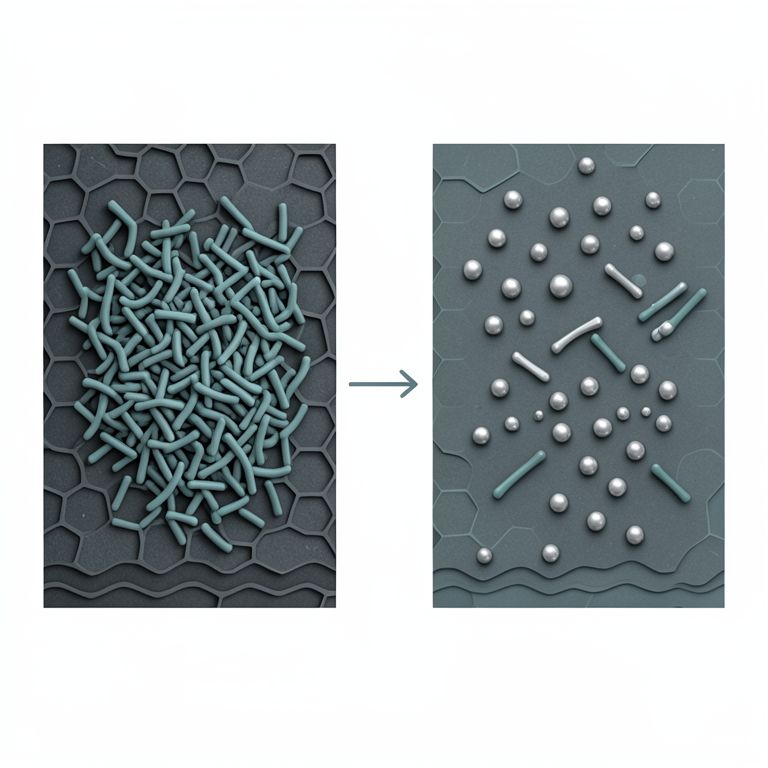
Antibacterial Mechanism
AI-generated conceptual illustration (reduced graphene oxide membrane decorated with silver nanoparticles). It explains the idea and does not show study data.
View source evidence ↗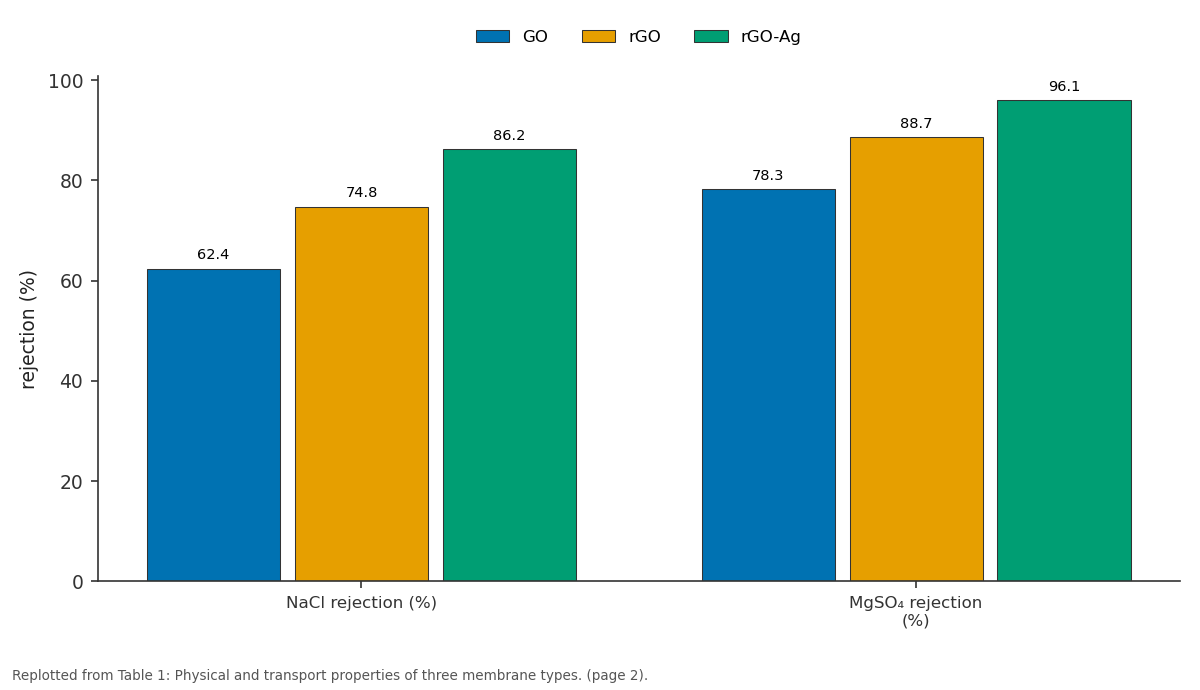
GO and rGO and more: NaCl rejection (%) vs MgSO₄ rejection (%)
Replotted from Table 1 (page 2) of the original paper. Every bar is the paper's own table value.
View source evidence ↗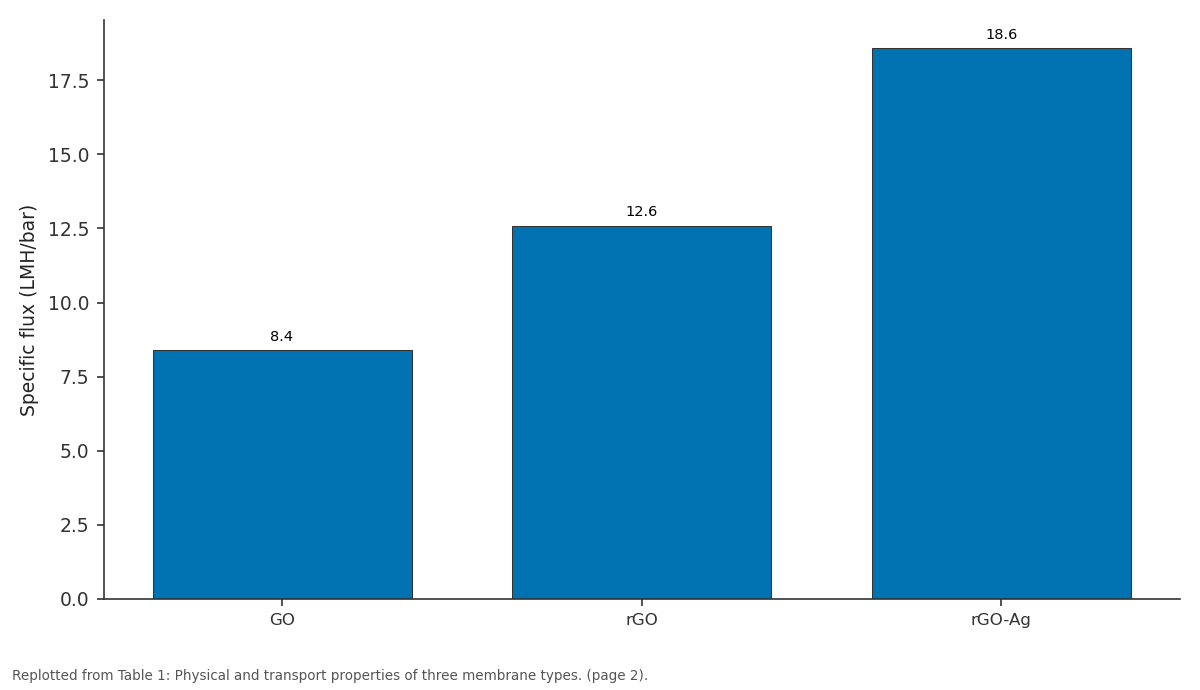
Specific flux (LMH/bar): GO vs rGO vs rGO-Ag
Replotted from Table 1 (page 2) of the original paper. Every bar is the paper's own table value.
View source evidence ↗Figures & tables
From the original paper Table 1
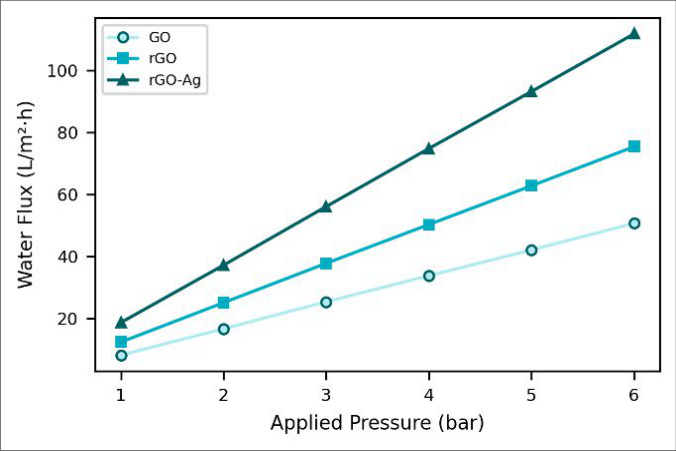 Figure 1
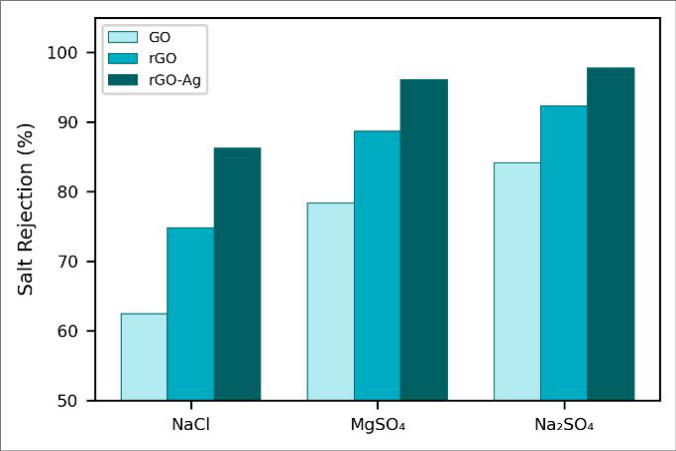 Figure 2
Introduction
Ghana's coastal and peri-urban communities face a growing water crisis: rapid urbanization has outpaced infrastructure development, leaving an estimated 4.8 million Ghanaians without reliable access to safe drinking water [1] . Brackish groundwater in the Ashanti and Greater Accra regions contains dissolved salts at 1,000-5,000 mg/L total dissolved solids, making it unsuitable for drinking without desalination [2] . Reverse osmosis is effective but energyintensive (3-6 kWh/m³), while nanofiltration operates at lower pressures (2-10 bar) and can achieve adequate salt removal for brackish sources at roughly half the energy cost [3] . Graphene oxide membranes have attracted extraordinary attention since their demonstration for gas-impermeable yet water-permeable films. Water molecules travel through the twodimensional nanochannels between stacked GO sheets, with the interlayer spacing controlling both flux and selectivity [4] . However, GO membranes swell in aqueous solutions as water intercalates between sheets, widening the channels and reducing salt rejection. Chemical reduction to rGO partially restores the π-π stacking that holds sheets together, reducing swelling, but also decreases hydrophilicity and can cause flux reduction [5] . Incorporating nanoparticles between GO or rGO sheets addresses multiple challenges simultaneously. Metal nanoparticles physically prop open the interlayer gallery, creating well-defined nanochannels with controlled spacing. Silver nanoparticles specifically add antibacterial functionality that combats biofoulingthe gradual accumulation of bacterial biofilm on the membrane surface that degrades performance over time [6] . Biofouling is particularly problematic in warm-climate operations like those in Ghana, where elevated water temperatures accelerate bacterial growth [7] . This research fabricated three generations of graphene-based membranes (GO, rGO, rGO-Ag) on polysulfone supports, characterized their structural and transport properties, and evaluated them for brackish water nanofiltration with emphasis on both separation performance and long-term antifouling stability [8] .
System design
The cross-flow membrane testing system consisted of a stainless-steel cell with an effective membrane area of 14.6 cm², a diaphragm pump capable of pressures up to 10 bar, a digital pressure gauge (±0.01 bar), a recirculating chiller maintaining feed temperature at 25 ± 0.5 °C, and a precision balance (0.01 g) for permeate collection. The feed tank held 5 L and operated in total recirculation mode (both retentate and permeate returned to the tank) for flux measurements and in single-pass mode for rejection tests. Conductivity of feed and permeate was measured with a Hanna HI5521 meter calibrated against NIST-traceable NaCl standards. The system was designed to simulate conditions achievable with low-cost, solar-powered pumps suitable for off-grid Ghanaian communities [9] .
Materials and Methods
Materials and Methods
Materials
Research was conducted at Kwame Nkrumah University of Science and Technology, Kumasi, Ashanti Region, Ghana, from January to November 2023. No ethical approval was required. Graphite flakes (>99%, 325 mesh), potassium permanganate, sodium nitrate, hydrazine monohydrate (64%), silver nitrate, sodium citrate tribasic, polysulfone flat-sheet membranes (0.2 μm pore size, Sterlitech), and reagent-grade salts (NaCl, MgSO₄, Na₂SO₄) were from Sigma-Aldrich. Escherichia coli ATCC 25922 was obtained from the university's microbiology collection for biofouling tests [10] .
Methods
GO was synthesized by the modified Hummers method from graphite flakes, yielding a 2 mg/mL aqueous dispersion after ultrasonication and centrifugation. rGO was prepared by treating GO with hydrazine (0.5 mL per 100 mL GO dispersion, 80 °C, 6 h). Silver nanoparticles were synthesized by Turkevich citrate reduction of AgNO₃ (1 mM) at 100 °C, producing ~12 nm particles. For rGO-Ag, AgNP suspension was mixed with rGO dispersion (1:5 Ag:rGO by weight) and sonicated for 30 min [11] . Membranes were fabricated by vacuum-assisted filtration of 5 mL dispersion (0.5 mg/mL) through the polysulfone support, yielding a coating of approximately 0.35 mg/cm². The coated membranes were dried at 40 °C for 12 h, then heat-treated at 80 °C for 1 h to improve layer adhesion. Membrane characterization used SEM (ZEISS EVO), TEM (for AgNPs), AFM (Bruker Dimension Icon), XRD (Bruker D8, for d-spacing measurement), water contact angle goniometry (Biolin Theta), and Raman spectroscopy (Horiba LabRAM, 532 nm laser) [12] . Nanofiltration performance was tested using 2,000 mg/L single-salt solutions at pressures from 1 to 6 bar. Water flux (L/m²•h, LMH) was calculated from permeate mass collected over time. Salt rejection (%) was calculated as R = (1 -Cₚ/Cᶠ) × 100, where Cₚ and Cᶠ are permeate and feed conductivities. Biofouling tests incubated membranes in E. coli suspension (10⁷ CFU/mL in nutrient broth) at 37 °C for 72 h, after which biofilm was quantified by crystal violet staining and plate counting. Long-term stability used 2,000 mg/L NaCl feed under continuous cross-flow at 4 bar for 30 days [13] .
Performance evaluation
Membrane performance metrics followed ASTM E2846-14 guidelines for nanofiltration testing. Each measurement point represents the mean of three independent membrane samples tested under identical conditions. Flux was recorded after 30 min of stabilization at each pressure to ensure steady-state conditions. The normalized specific flux (L/m²•h•bar) was calculated to enable comparison across operating pressures. Membrane compaction at the highest test pressure (6 bar) was assessed by returning to 3 bar and verifying flux recovery within 5% of the original 3-bar value, confirming elastic rather than permanent deformation of the GO layers [14] . The rGO-Ag membrane outperformed both GO and rGO across all metrics. It's d-spacing of 0.92 nmwider than GO (0.78 nm) or rGO (0.83 nm)reflects the physical insertion of 12 nm AgNPs between graphene sheets, which locally props open the galleries. Paradoxically, wider channels might be expected to decrease rejection, but the opposite was observed: rGO-Ag showed the highest NaCl rejection at 86.2%. This is explained by the Donnan exclusion mechanism: citrate-capped AgNPs carry negative surface charge that electrostatically repels anions (Cl⁻, SO₄²⁻), adding charge-based selectivity on top of the size-based sieving inherent to the graphene nanochannel geometry [4] . Water flux scaled linearly with applied pressure for all three membranes, indicating stable channel structure without pressure-induced compaction over the tested range. At 6 bar, rGO-Ag delivered 111.8 LMH -2.2 times the GO membrane's flux and 1.5 times rGO. The specific flux of 18.6 LMH/bar for rGO-Ag exceeds most reported GO-based nanofiltration membranes (typically 5-15 LMH/bar) and approaches the performance of commercial thin-film composite nanofiltration membranes [3] . Antifouling performance was dramatic. After 72-hour E. coli challenge, SEM imaging of the GO membrane surface showed dense bacterial colonization with extracellular polymeric substance matrix covering ~80% of the surface. The rGO membrane showed intermediate colonization (~45% coverage), while rGO-Ag had only scattered individual bacteria with no visible biofilm formation (~5% coverage). Quantitative plate counting confirmed a 94.3% reduction in viable bacteria on the rGO-Ag surface compared to GO. The antibacterial mechanism involves both contact killing (Ag⁺ ion release from nanoparticle surfaces disrupts bacterial cell membranes) and prevention of initial bacterial adhesion (the citrate-capped AgNP surface creates a hydration layer unfavorable for protein adsorption) [6] . Long-term stability over 30 days of continuous operation showed clear advantages for rGO-Ag. The GO membrane experienced 34% flux decline, primarily due to biofouling and partial swelling that compressed its already narrow channels. The rGO membrane lost 19% flux, with the reduced swelling from partial π-π restacking offering some protection. The rGO-Ag membrane declined only 8%, maintaining 103 LMH at day 30still above the flux achieved by GO membranes on day 1. Silver ion leaching was monitored in the permeate and remained below 15 μg/L throughout the test, well within the WHO drinking water guideline of 100 μg/L for silver [15] .
Results
Results
Discussion
The combination of high flux (111.8 LMH at 6 bar), good monovalent salt rejection (86.2% NaCl), and excellent divalent salt rejection (96-98%) positions the rGO-Ag membrane in an interesting niche between nanofiltration and low-pressure reverse osmosis. For Ghanaian brackish groundwater at 2,000-5,000 mg/L TDS, single-pass treatment would reduce salinity to 280-690 mg/Lwithin the WHO guideline of 600 mg/L for palatable drinking water. A two-pass configuration could achieve higher rejection if needed for the more saline sources [3] . The 94.3% biofouling reduction is especially significant for tropical deployment where biofilm growth is accelerated by temperatures above 25 °C. Most commercial nanofiltration membranes require chemical cleaning every 1-4 weeks in warm climates, but the inherent antibacterial properties of the rGO-Ag membrane could extend cleaning intervals substantially, reducing both chemical costs and membrane downtime [7] . The sustained low silver leaching (<15 μg/L over 30 days) suggests that the citrate-capped AgNPs are firmly anchored within the graphene matrix rather than simply sitting on the surface where they would dissolve rapidly.
The energy cost estimate for a small community-scale system (1 m³/h output) treating 3,000 mg/L brackish water at 4 bar would be approximately 0.8 kWh/m³less than one-third of typical seawater RO and achievable with a 400 W solar panel array in Ghana's high-insolation climate (5.5 peak sun hours/day). At a membrane fabrication cost estimated at $15-25/m² using locally available GO synthesis from graphite, the system could provide safe water at less than $0.02/liter, competitive with sachet water that currently costs $0.03-0.05/liter [16] .
A limitation is that the vacuum filtration fabrication method, while excellent for laboratory-scale flat-sheet membranes, does not directly translate to the spiral-wound module format used in industrial systems. Scale-up would require adaptation to dip-coating or spray-coating methods compatible with continuous membrane production.
Additionally, the Ag content should be monitored over extended operation (6-12 months) to establish the long-term silver depletion rate and plan for membrane replacement or AgNP replenishment [17] .
Conclusion
Silver nanoparticle-decorated reduced graphene oxide membranes achieved simultaneous improvements in water flux, salt rejection, and antifouling resistance compared to unmodified GO and rGO membranes. The rGO-Ag membrane delivered 111.8 LMH at 6 bar with 86.2% NaCl rejection and 94.3% biofilm inhibition, maintaining stable performance over 30 days of continuous operation with only 8% flux decline. These properties, combined with low-cost fabrication from abundant graphite precursor, make rGO-Ag membranes a promising technology for solar-powered brackish water desalination in sub-Saharan African communities.
Acknowledgement
Acknowledgements Funding sourcesThis work was supported by the Ghana National Research Fund Grant No. GNRF-2023-0042. Institutional supportThe authors thank KNUST Department of Membrane Science for access to the cross-flow membrane testing facility. Contributions not qualifying for authorshipDr. Kofi Boateng assisted with AFM measurements and Raman spectroscopy.
Figures and tables from the paper
| Property | GO | rGO | rGO-Ag |
|---|---|---|---|
| d-spacing (nm) | 0.78 | 0.83 | 0.92 |
| Contact angle (°) | 42.3 | 68.7 | 54.1 |
| RMS roughness (nm) | 3.8 | 7.2 | 11.4 |
| Specific flux (LMH/bar) | 8.4 | 12.6 | 18.6 |
| NaCl rejection (%) | 62.4 | 74.8 | 86.2 |
| MgSO₄ rejection (%) | 78.3 | 88.7 | 96.1 |
Table text extracted from the original PDF; superscript letters are shown inline. The original table image is below.
View original table image
References
17 in the original paper- WHO/UNICEF Joint Monitoring Programme. Progress on drinking water, sanitation and hygiene in Ghana. JMP Report. 2021.
- Anku WW, Mamo MA, Govender PP. Phenolic compounds in water: sources, reactivity, toxicity and treatment. IntechOpen. 2017.
- Mohammad AW, Teow YH, Ang WL, Chung YT. Nanofiltration membranes review: recent advances and future prospects. Desalination. 2015;356:226-254.
- Nair RR, Wu HA, Jayaram PN, Grigorieva IV, Geim AK. Unimpeded permeation of water through heliumleak-tight graphene-based membranes. Science. 2012;335(6067):442-444.
- Joshi RK, Carbone P, Wang FC, Kravets VG, Su Y. Precise and ultrafast molecular sieving through graphene oxide membranes. Science. 2014;343(6172):752-754.
- Rai M, Yadav A, Gade A. Silver nanoparticles as a new generation of antimicrobials. Biotechnol Adv. 2009;27(1):76-83.
- Flemming HC. Biofouling in water systems-cases, causes and countermeasures. Appl Microbiol Biotechnol. 2002;59(6):629-640.
- Hu M, Mi B. Enabling graphene oxide nanosheets as water separation membranes. Environ Sci Technol. 2013;47(8):3715-3723.
- Ghaffour N, Missimer TM, Amy GL. Technical review and evaluation of the economics of water desalination. Desalination. 2013;309:197-207.
- Marcano DC, Kosynkin DV, Berlin JM, Sinitskii A, Sun Z. Improved synthesis of graphene oxide. ACS Nano. 2010;4(8):4806-4814.
- Stankovich S, Dikin DA, Piner RD, Kohlhaas KA, Kleinhammes A. Synthesis of graphene-based nanosheets. Carbon. 2007;45(7):1558-1565.
- Dikin DA, Stankovich S, Zimney EJ, Piner RD, Dommett GH. Preparation and characterization of graphene oxide paper. Nature. 2007;448(7152):457460.
- Huang H, Mao Y, Ying Y, Liu Y, Sun L. Salt concentration, pH and pressure controlled separation of small molecules through lamellar graphene oxide membranes. Chem Commun. 2013;49(53):5963-5965.
- ASTM E2846-14. Standard Guide for Evaluation of Nanofiltration Systems. ASTM International. 2014.
- WHO. Silver in Drinking-water: Background Document for WHO Guidelines. World Health Organization. 2003.
- Elimelech M, Phillip WA. The future of seawater desalination: energy, technology, and the environment. Science. 2011;333(6043):712-717.
- Han Y, Xu Z, Gao C. Ultrathin graphene nanofiltration membrane for water purification. Adv Funct Mater. 2013;23(29):3693-3700.