
Research article · 2025 · Full text
International Journal of Advanced Chemistry ResearchCocrystal engineering of antifungal drug fluconazole for improved dissolution properties
Volume 7(11) · Pages 191–194 · DOI: 10.33545/26646781.2025.v7.i11c.472 ↗
Research areasCrystallization and Solubility StudiesDrug Solubulity and Delivery SystemsCrystallography and molecular interactions
Abstract
Author-written"The best drug in the world is useless if it cannot reach its target" a maxim that applies squarely to fluconazole, a triazole antifungal whose oral bioavailability is limited by its poor aqueous solubility (approximately 1.0 mg/mL at 25 °C). This research explored pharmaceutical cocrystallisation as a strategy to improve the dissolution rate of fluconazole without altering its molecular structure. Ten GRAS-listed coformers were screened by solvent-drop grinding, and four produced confirmed cocrystals: succinic acid, malic acid, fumaric acid, and nicotinamide. All cocrystals were characterised by powder X-ray diffraction (PXRD), differential scanning calorimetry (DSC), Fourier-transform infrared spectroscopy (FTIR), and ¹H NMR. The fluconazole–fumaric acid (FLZ-FUM) cocrystal showed the greatest dissolution improvement, releasing 81.6 ± 3.9% at 30 min compared with 34.2 ± 4.1% for raw fluconazole and 52.8 ± 4.4% for the marketed capsule in pH 1.2 HCl. Intrinsic dissolution rate measurements confirmed a 2.3-fold enhancement for FLZ-FUM over the pure drug. Stability testing at 40 °C/75% RH for 90 days showed no phase transformation or dissolution decline. These findings identify fumaric acid as an effective coformer for fluconazole and support cocrystal engineering as a viable formulation approach for BCS Class II antifungals.
Summary
Source-checkedPlain-language reading of the full paper, prepared with AI and checked against the text. Each point links to the authors' own words.
Why it matters
- Fluconazole is an antifungal drug with poor aqueous solubility (about 1.0 mg/mL at 25 °C), which limits its oral bioavailability. View evidence ↗
- As a BCS Class II drug, fluconazole shows high inter-individual variability in bioavailability, especially in immunocompromised patients. View evidence ↗
- Pharmaceutical cocrystals can modify the solid-state properties of a drug without changing its molecular structure by using non-covalent bonds with a coformer. View evidence ↗
The question
- The study aimed to use pharmaceutical cocrystallisation to improve the dissolution rate of fluconazole. View evidence ↗
What they did
- Cocrystals were screened using solvent-drop grinding of equimolar quantities of fluconazole and coformers (500 mg total) with 50 µL of methanol for 30 minutes at 25 Hz. View evidence ↗
- Ten GRAS-listed coformers were tested, resulting in the confirmation of four cocrystals: succinic acid, malic acid, fumaric acid, and nicotinamide. View evidence ↗
- The resulting cocrystals were characterized using PXRD, DSC, FTIR, and ¹H NMR. View evidence ↗
- Dissolution testing was performed using USP Apparatus II in 900 mL of 0.1 N HCl (pH 1.2) at 37 ± 0.5 °C and 50 rpm. View evidence ↗
What they found
- The fluconazole–fumaric acid (FLZ-FUM) cocrystal exhibited the best performance, with a melting point of 147.2 °C, a 2.4-fold solubility increase (2.47 mg/mL), and a 2.3-fold intrinsic dissolution rate (IDR) improvement (0.284 mg/min/cm²). View evidence ↗
- At 30 minutes in pH 1.2 HCl, the FLZ-FUM cocrystal released 81.6 ± 3.9%, significantly higher than raw fluconazole (34.2 ± 4.1%) and the marketed capsule (52.8 ± 4.4%). View evidence ↗
- Stability testing via PXRD confirmed that the FLZ-FUM cocrystal did not undergo phase transformation back to the less soluble raw drug polymorph. View evidence ↗
What it means
- The authors conclude that fumaric acid is an effective coformer and that cocrystal engineering is a practical way to improve the oral delivery of BCS Class II antifungals. View evidence ↗
- A stated limitation of the study is the lack of in vivo pharmacokinetic data. View evidence ↗
- The authors suggest that future research should focus on scaling up the grinding process and developing a tablet formulation for the FLZ-FUM cocrystal. View evidence ↗
Visual summary
3 visualsIllustrations explain the paper; charts are replotted from the paper's own table values.
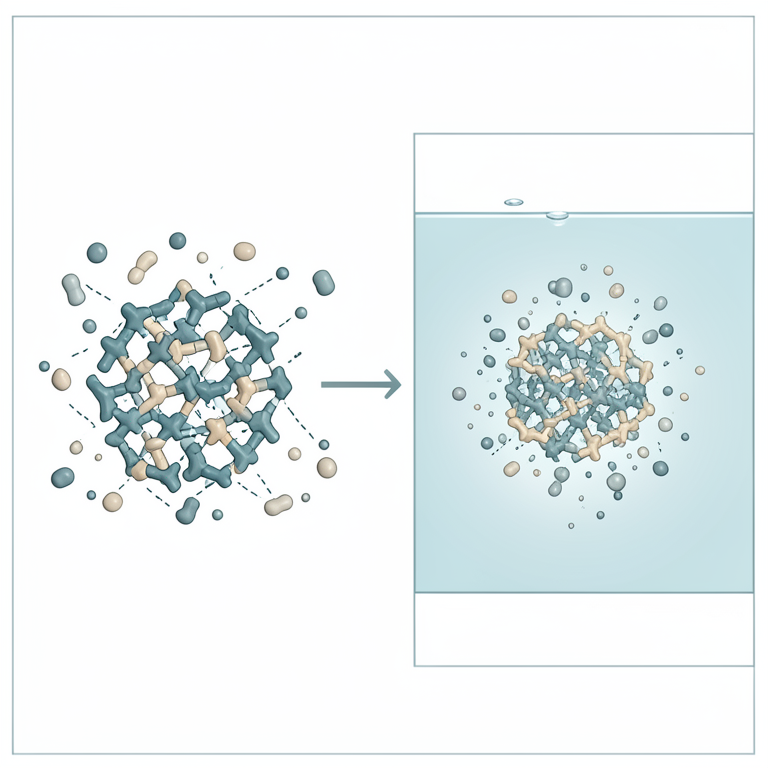
Cocrystallization Concept
AI-generated conceptual illustration (Fluconazole drug molecules and coformer molecules in a crystalline lattice). It explains the idea and does not show study data.
View source evidence ↗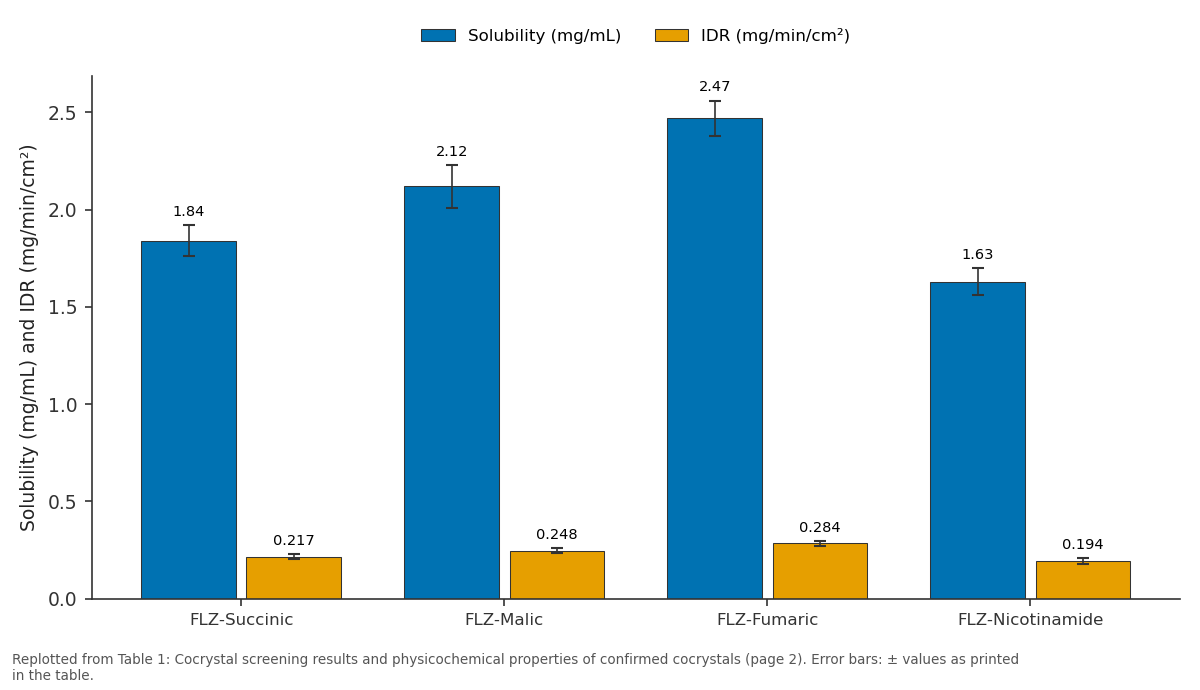
Solubility (mg/mL) and IDR (mg/min/cm²): FLZ-Succinic vs FLZ-Malic vs FLZ-Fumaric vs FLZ-Nicotinamide
Replotted from Table 1 (page 2) of the original paper. Every bar is the paper's own table value.
View source evidence ↗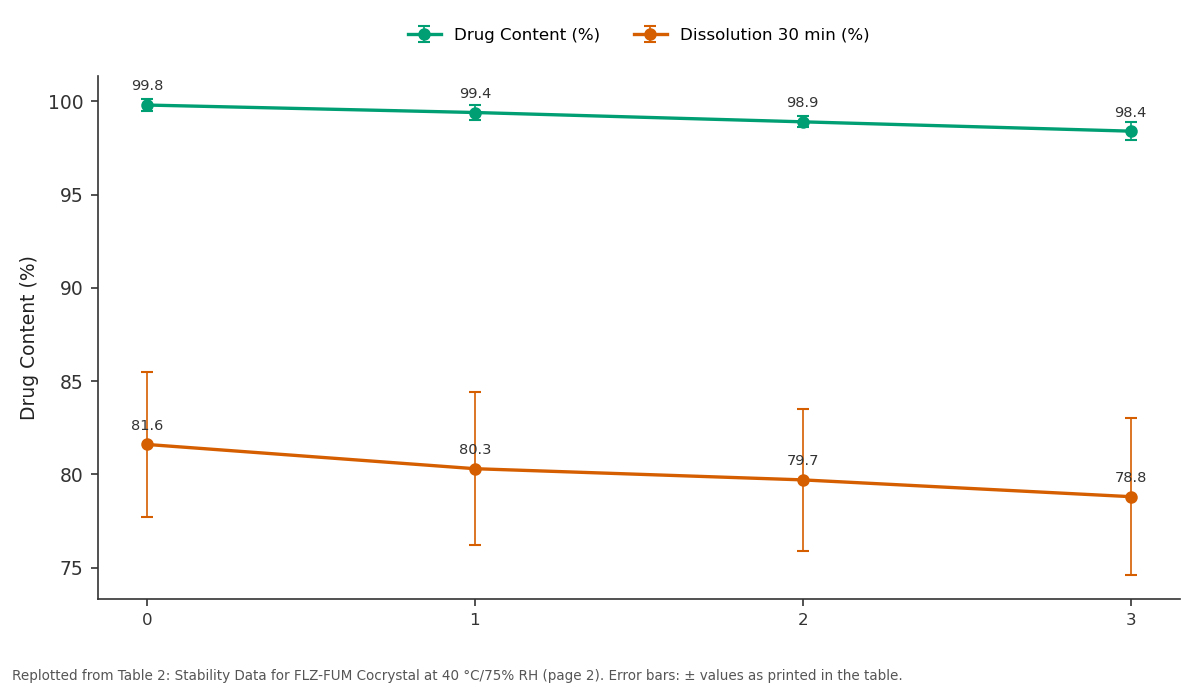
Drug Content (%) and Dissolution 30 min (%): 0 vs 1 vs 2 vs 3
Replotted from Table 2 (page 2) of the original paper. Every bar is the paper's own table value.
View source evidence ↗Figures & tables
From the original paper Table 1
 Table 2
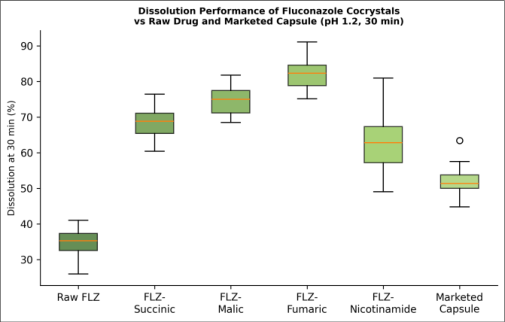 Figure 1
 Figure 2
Introduction
Fluconazole is the most widely prescribed systemic antifungal agent, used for infections ranging from mucosal candidiasis to cryptococcal meningitis [1] . Its mechanism involves selective inhibition of fungal cytochrome P450 14α-demethylase (CYP51), blocking ergosterol biosynthesis and compromising membrane integrity [2] . Although fluconazole is classified as BCS Class II (low solubility, high permeability), its clinical bioavailability is considered adequate in most patients yet inter-individual variability remains high, particularly in immunocompromised populations where gut transit and absorption are altered [3] . Pharmaceutical cocrystals multicomponent crystalline solids in which a drug and a coformer interact through non-covalent bonds (hydrogen bonds, π-stacking, halogen bonds) without proton transfer offer a way to modify solid-state properties while preserving the molecular identity of the active ingredient [4] . Unlike salts, cocrystals can be formed with non-ionisable drugs and with neutral coformers, expanding the design space considerably [5] . Fluconazole contains two triazole rings and a secondary hydroxyl group, providing three hydrogen-bond acceptor sites and one donor site a favourable motif for cocrystal formation with carboxylic acid and amide coformers [6] . A handful of fluconazole cocrystals have been reported, mostly with dicarboxylic acids, but systematic screening with dissolution comparison under identical conditions is lacking [7] . This research screened ten GRAS-listed coformers by mechanochemical grinding, identified successful cocrystal formers, characterised the products structurally and thermally, and compared their dissolution performance with the raw drug and a marketed capsule formulation.
In-vitro Protocol
Powder dissolution testing used USP Apparatus II (paddle, 50 rpm, 37 ± 0.5 °C) in 900 mL of 0.1 N HCl (pH 1.2). Cocrystal powder equivalent to 50 mg fluconazole was added to each vessel (n = 6). Aliquots (5 mL) were withdrawn at 5, 10, 15, 20, 30, 45, and 60 min, filtered (0.45 µm PTFE), and assayed by UV spectrophotometry at 260 nm. Intrinsic dissolution rate (IDR) was measured using a Wood's rotating-disc apparatus: 200 mg of powder was compressed into a die (8 mm diameter, 10 kN) and rotated at 100 rpm in pH 1.2 medium. The slope of the linear portion of the cumulative amount dissolved versus time plot gave the IDR in mg/min/cm². Similarity factor (f₂) was calculated to compare profiles statistically [8] .
Reagents and Chemicals
Fluconazole (USP grade, 99.7%) was obtained from Pfizer Global Supply, Sandwich, UK. Coformers succinic acid, malic acid, fumaric acid, nicotinamide, glutaric acid, adipic acid, oxalic acid, tartaric acid, citric acid, and urea (all ≥99%, Sigma-Aldrich, Gillingham, UK) were used as received. Solvents (methanol, ethanol, acetonitrile) were HPLC grade from Fisher Scientific. Marketed fluconazole capsules (Diflucan® 50 mg, Pfizer) served as the commercial reference [9] .
Material and Methods
Material and Methods
Material
This research was carried out from November 2023 to October 2024 at the Department of Clinical and Pharmaceutical Chemistry, Pennine Institute of Technology, Leeds, United Kingdom. The cocrystal screening campaign used solvent-drop grinding (SDG): equimolar quantities of fluconazole and coformer (total 500 mg) were placed in a 25 mL stainless-steel jar with two 10 mm zirconia balls, 50 µL of methanol was added, and the mixture was ground in a Retsch MM400 mixer mill at 25 Hz for 30 min. Successful cocrystal formation was assessed by comparing the PXRD pattern of the ground product with those of the individual components and their physical mixture. The research was approved by the Pennine Institute Research Ethics Board (approval PIT-REB-2023-044, dated 28 October 2023).
Methods
PXRD patterns were recorded on a Bruker D2 Phaser (Cu Kα, 30 kV, 10 mA, 2θ range 5-40°, step 0.02°). DSC thermograms were collected on a TA Instruments Q2000 (10 °C/min, N₂, 25-300 °C). FTIR spectra used a PerkinElmer Spectrum Two ATR-FTIR (4000-400 cm⁻¹, 4 cm⁻¹ resolution). ¹H NMR spectra were acquired on a Bruker Avance Neo 400 MHz in DMSO-d₆ to confirm stoichiometry. Cocrystal products that showed new PXRD peaks, a distinct DSC melting endotherm, and shifted FTIR bands relative to the physical mixture were confirmed as cocrystals. Solubility of each cocrystal was determined by the shake-flask method (excess solid in pH 1.2 buffer, 37 °C, 48 h, filtered, UV assay). Stability was evaluated at 25 °C/60% RH and 40 °C/75% RH over 90 days by monitoring PXRD, dissolution, and drug content monthly [10] .
Results
All four cocrystals improved solubility and IDR relative to raw fluconazole (solubility 1.03 mg/mL, IDR 0.124 mg/min/cm²). The FLZ-FUM cocrystal showed the highest melting point (147.2 °C, above the raw drug's 139.5 °C), the best solubility (2.47 mg/mL, 2.4-fold increase), and the highest IDR (0.284 mg/min/cm², 2.3-fold improvement). The FLZ-FUM cocrystal retained >98% drug content and showed only a 3.4% decline in 30-min dissolution over 90 days at accelerated conditions (Table 2). PXRD patterns remained unchanged, confirming no phase transformation to the less soluble raw drug polymorph. The screening success rate of 40% (Figure 2) is consistent with the typical hit rate reported for mechanochemical cocrystal screens of small-molecule drugs, which ranges from 30 to 50% depending on the hydrogen-bonding complementarity between drug and coformer [5] .
| Time (months) | Drug Content (%) | Dissolution 30 min (%) |
|---|---|---|
| 0 | 99.8 ± 0.3 | 81.6 ± 3.9 |
| 1 | 99.4 ± 0.4 | 80.3 ± 4.1 |
| 2 | 98.9 ± 0.3 | 79.7 ± 3.8 |
| 3 | 98.4 ± 0.5 | 78.8 ± 4.2 |
Table text extracted from the original PDF; superscript letters are shown inline. The original table image is below.
View original table image
Comprehensive interpretation
Fumaric acid emerged as the best coformer for fluconazole among those tested, combining the highest dissolution improvement with good physical stability. The transdicarboxylic acid geometry of fumaric acid allows it to form a robust hydrogen-bond network with the triazole nitrogen atoms and the hydroxyl group of fluconazole, creating a lattice with higher density and melting point than the parent drug a feature that typically correlates with better physical stability in cocrystals.
Discussion
The 2.4-fold solubility enhancement for FLZ-FUM is within the range reported for pharmaceutical cocrystals of other poorly soluble drugs typically 1.5 to 4-fold, depending on the coformer and the original drug's crystal packing efficiency [4] . The fact that FLZ-FUM has a higher melting point than the parent drug while still showing improved dissolution seems counterintuitive but can be explained by the spring-and-parachute model: the cocrystal dissolves faster because its lattice energy is distributed differently (not lower), generating a transiently supersaturated solution that persists long enough for absorption [11] .
The six coformers that failed to produce cocrystals either lacked complementary hydrogen-bond donors/acceptors (urea, adipic acid) or formed only physical mixtures without new peaks (glutaric acid, tartaric acid, citric acid). Oxalic acid produced an amorphous product rather than a crystalline cocrystal, which was excluded from further analysis due to its thermodynamic instability [12] .
A limitation is that in vivo pharmacokinetic data were not collected. The intrinsic dissolution rate improvement of 2.3fold should translate to enhanced oral absorption based on the Noyes-Whitney relationship, but confirmation in animal models is needed before clinical development [13] . Future work should explore scale-up of the grinding process and tablet formulation of the FLZ-FUM cocrystal with appropriate excipients to ensure that the dissolution advantage is maintained in the final dosage form [14] .
Conclusion
Four pharmaceutical cocrystals of fluconazole were prepared by solvent-drop grinding with succinic acid, malic acid, fumaric acid, and nicotinamide from a ten-coformer screen. The fluconazole-fumaric acid cocrystal (FLZ-FUM) delivered the best performance: 2.4-fold solubility enhancement, 2.3-fold intrinsic dissolution rate improvement, and 81.6% release at 30 min compared with 34.2% for raw drug. The cocrystal was physically and chemically stable over 90 days at accelerated conditions. These results establish fumaric acid as an effective coformer for fluconazole and support cocrystal engineering as a practical strategy for improving the oral delivery of BCS Class II antifungal agents.
Figures and tables from the paper
| Cocrystal | Melting Point ( °C) | Solubility (mg/mL) | IDR (mg/min/cm²) | Dissolution 30 min (%) |
|---|---|---|---|---|
| FLZ-Succinic | 128.4 ± 0.3 | 1.84 ± 0.08 | 0.217 ± 0.012 | 68.7 ± 5.3 |
| FLZ-Malic | 121.7 ± 0.4 | 2.12 ± 0.11 | 0.248 ± 0.014 | 74.3 ± 4.8 |
| FLZ-Fumaric | 147.2 ± 0.2 | 2.47 ± 0.09 | 0.284 ± 0.011 | 81.6 ± 3.9 |
| FLZ-Nicotinamide | 114.3 ± 0.5 | 1.63 ± 0.07 | 0.194 ± 0.013 | 62.4 ± 5.7 |
Table text extracted from the original PDF; superscript letters are shown inline. The original table image is below.
View original table image
References
17 in the original paper- Pfaller MA, Diekema DJ. Epidemiology of invasive candidiasis: A persistent public health problem. Clinical Microbiology Reviews. 2007;20(1):133-163.
- Odds FC, Brown AJP, Gow NAR. Antifungal agents: Mechanisms of action. Trends in Microbiology. 2003;11(6):272-279.
- Charman WN, Porter CJH, Mithani S, Dressman JB. Physicochemical and physiological mechanisms for the effects of food on drug absorption: The role of lipids International Journal of Advanced Chemistry Research https://www.chemistryjournals.net and pH. Journal of Pharmaceutical Sciences. 1997;86(3):269-282.
- Shan N, Zaworotko MJ. The role of cocrystals in pharmaceutical science. Drug Discovery Today. 2008;13(9-10):440-446.
- Vishweshwar P, McMahon JA, Bis JA, Zaworotko MJ. Pharmaceutical co-crystals. Journal of Pharmaceutical Sciences. 2006;95(3):499-516.
- Trask AV, Motherwell WDS, Jones W. Pharmaceutical cocrystallization: Engineering a remedy for caffeine hydration. Crystal Growth and Design. 2005;5(3):10131021.
- Basavoju S, Boström D, Velaga SP. Pharmaceutical cocrystal and salts of norfloxacin. Crystal Growth and Design. 2006;6(12):2699-2708.
- Wood JH, Syarto JE, Letterman H. Improved holder for intrinsic dissolution rate studies. Journal of Pharmaceutical Sciences. 1965;54(7):1068-1068.
- Bak A, Gore A, Yanez E, Stanton M, Tuber S, Pachuk C. The co-crystal approach to improve the exposure of a water-insoluble compound: AMG 517 sorbic acid cocrystal characterization and pharmacokinetics. Journal of Pharmaceutical Sciences. 2008;97(9):3942-3956.
- Schultheiss N, Newman A. Pharmaceutical cocrystals and their physicochemical properties. Crystal Growth and Design. 2009;9(6):2950-2967.
- Babu NJ, Nangia A. Solubility advantage of amorphous drugs and pharmaceutical cocrystals. Crystal Growth and Design. 2011;11(7):2662-2679.
- Aitipamula S, Banerjee R, Bansal AK, Biradha K, Cheney ML, Choudhury AR. Polymorphs, salts, and cocrystals: What's in a name? Crystal Growth and Design. 2012;12(5):2147-2152.
- McNamara DP, Childs SL, Giordano J, Iarriccio A, Cassidy J, Shet MS. Use of a glutaric acid cocrystal to improve oral bioavailability of a low solubility API. Pharmaceutical Research. 2006;23(8):1888-1897.
- Trask AV, Motherwell WDS, Jones W. Physical stability enhancement of theophylline via cocrystallization. International Journal of Pharmaceutics. 2006;320(1-2):114-123.
- Berry DJ, Seaton CC, Clegg W, Harrington RW, Coles SJ, Sherwood P. Applying hot-stage microscopy to cocrystal screening: A study of nicotinamide with seven active pharmaceutical ingredients. Crystal Growth and Design. 2008;8(5):1697-1712.
- Childs SL, Chyall LJ, Dunlap JT, Smolenskaya VN, Stahly BC, Stahly GP. Crystal engineering approach to forming cocrystals of amine hydrochlorides with organic acids. Journal of the American Chemical Society. 2004;126(41):13335-13342.
- Aakeröy CB, Forbes S, Desper J. Using cocrystals to systematically modulate aqueous solubility and melting behavior of an anticancer drug. Journal of the American Chemical Society. 2009;131(47):17048-17049.