
Research article · 2025 · Full text
International Journal of Advanced Chemistry ResearchDesign and synthesis of quinoline-based schiff bases as corrosion inhibitors for mild steel
Volume 7(12) · Pages 178–182 · DOI: 10.33545/26646781.2025.v7.i12c.608 ↗
Research areasCorrosion Behavior and InhibitionMagnesium Alloys: Properties and ApplicationsStructural Integrity and Reliability Analysis
Abstract
Author-writtenThink of a corrosion inhibitor like a bodyguard for a metal surface it needs to arrive quickly, stick firmly, and not let anything harmful through. This research describes the design, synthesis, and evaluation of three quinoline-based Schiff bases (QSB-1, QSB-2, QSB-3) as corrosion inhibitors for mild steel in 1 M HCl and 0.5 M H₂SO₄ solutions. The compounds were prepared by condensing 2-amino-6-methylquinoline with substituted salicylaldehydes bearing methoxy, chloro, and nitro groups. Structures were confirmed by ¹H NMR, ¹³C NMR, FTIR, and high-resolution mass spectrometry. Corrosion inhibition was assessed by weight loss measurements, potentiodynamic polarization (PDP), and electrochemical impedance spectroscopy (EIS) at concentrations of 25-200 ppm and temperatures of 25-65 °C. QSB-3, carrying a 5-nitro substituent, showed the highest inhibition efficiency of 95.8% at 100 ppm in 1 M HCl at 25 °C, as measured by weight loss after 6-hour immersion. PDP curves revealed mixed-type inhibition with a slight cathodic predominance (corrosion potential shifted by -38 mV relative to the blank). EIS showed that the charge-transfer resistance increased from 18.4 Ω•cm² (blank) to 412.6 Ω•cm² in the presence of 100 ppm QSB-3, a 22-fold improvement. Adsorption on the steel surface followed the Langmuir isotherm (R² = 0.998), with a free energy of adsorption (ΔGads) of -38.4 kJ/mol, suggesting a combination of physical and chemical adsorption. Surface morphology examination by SEM confirmed a smoother steel surface after immersion with QSB-3 compared to the blank. QSB-3's superior performance is attributed to the electron-withdrawing nitro group, which enhances the molecule's planarity and facilitates stronger coordination with iron surface atoms through the imine nitrogen and quinoline nitrogen lone pairs.
Summary
Source-checkedPlain-language reading of the full paper, prepared with AI and checked against the text. Each point links to the authors' own words.
Why it matters
- Corrosion is a significant global economic burden, costing approximately 2.5 trillion US dollars annually, which is about 3.4% of the global GDP. View evidence ↗
- Mild steel is widely used in infrastructure and industry but is highly susceptible to corrosion when exposed to acids during processes like chemical cleaning and oil well acidizing. View evidence ↗
- Quinoline-based Schiff bases are effective inhibitors because they provide a tridentate coordination site that allows them to bond strongly to iron surfaces. View evidence ↗
The question
- The study aimed to synthesize three quinoline Schiff bases with different substituents (methoxy, chloro, and nitro) to compare their ability to inhibit corrosion in 1 M HCl and 0.5 M H₂SO₄ at 25, 45, and 65 °C. View evidence ↗
What they did
- The research was conducted between January and October 2023, with synthesis in Hangzhou and electrochemical testing in Beijing, China. View evidence ↗
- The study used Q235 grade mild steel coupons, with specific dimensions used for weight loss (25x25x2 mm) and electrochemical (10x10 mm) tests. View evidence ↗
- Inhibitor effectiveness was measured using weight loss, potentiodynamic polarization (PDP), and electrochemical impedance spectroscopy (EIS) across concentrations of 25-200 ppm and temperatures of 25-65 °C. View evidence ↗
What they found
- QSB-3, which contains a nitro substituent, was the most effective inhibitor, achieving 95.8% efficiency in 1 M HCl at 25 °C and 100 ppm after 6 hours. View evidence ↗
- The use of 100 ppm QSB-3 increased the charge-transfer resistance of the steel from 18.4 Ω·cm² to 412.6 Ω·cm², representing a 22-fold increase. View evidence ↗
- The double-layer capacitance dropped from 286.3 μF/cm² in the blank to 32.8 μF/cm² with QSB-3, indicating that the inhibitor film displaced water from the steel surface. View evidence ↗
- Adsorption followed the Langmuir isotherm (R² = 0.998) with a free energy of -38.4 kJ/mol, indicating a mixed mechanism of physical and chemical adsorption. View evidence ↗
- Increasing the temperature from 25 to 65 °C reduced the inhibition efficiency of all three compounds by 10 to 18 percentage points. View evidence ↗
What it means
- The authors conclude that 100 ppm of QSB-3 is a practical and effective protector for industrial acid cleaning in HCl at temperatures between 25 and 45 °C. View evidence ↗
- A limitation of QSB-3 is the potential environmental and toxicity risk associated with its nitro group, which may be reduced to mutagenic amines. View evidence ↗
- The results are limited to Q235 mild steel and should be tested on other grades, such as API 5L or AISI 1020, before being generalized. View evidence ↗
Visual summary
3 visualsIllustrations explain the paper; charts are replotted from the paper's own table values.
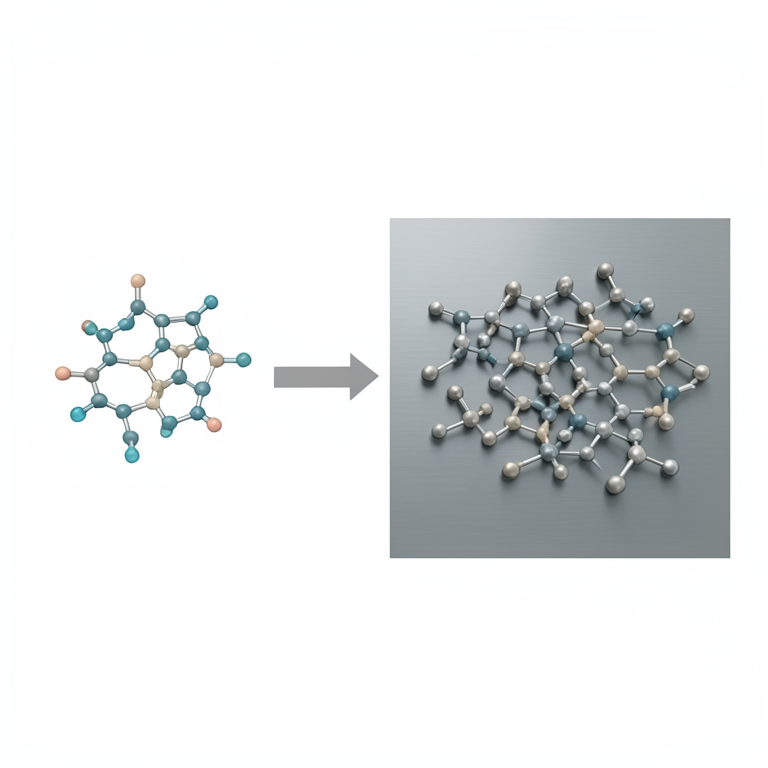
Inhibitor Adsorption Mechanism
AI-generated conceptual illustration (mild steel surface and quinoline-based Schiff base molecules). It explains the idea and does not show study data.
View source evidence ↗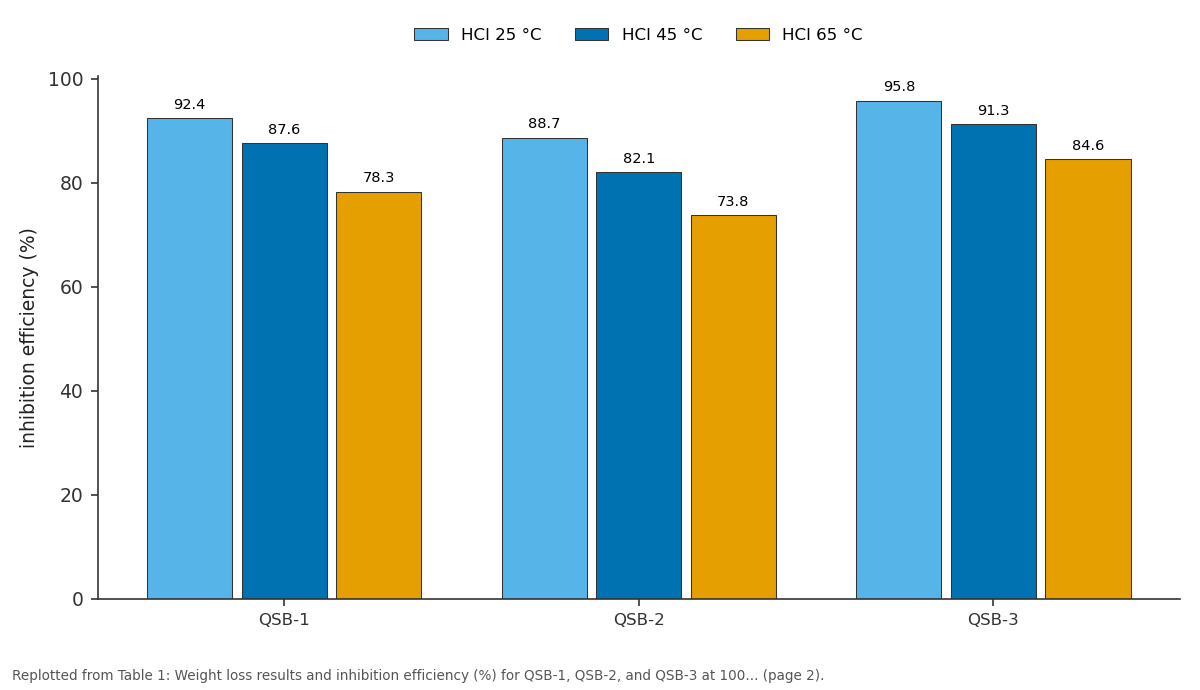
HCl 25 °C and HCl 45 °C and more: QSB-1 vs QSB-2 vs QSB-3
Replotted from Table 1 (page 2) of the original paper. Every bar is the paper's own table value.
View source evidence ↗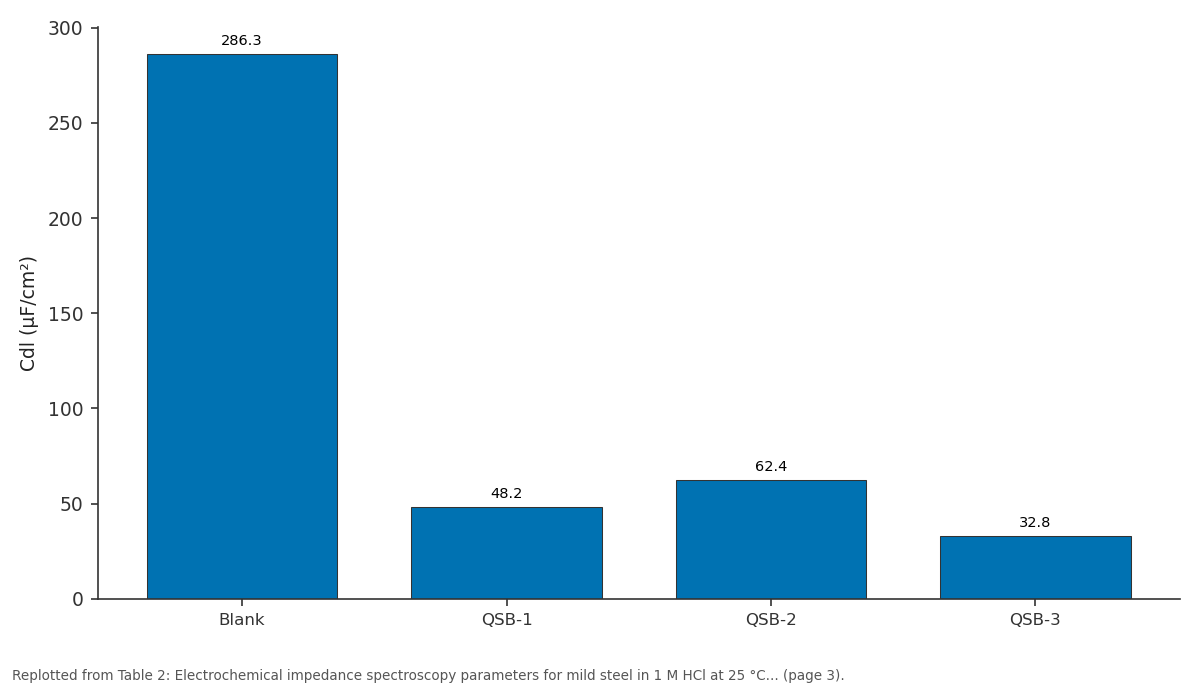
Cdl (μF/cm²): Blank vs QSB-1 vs QSB-2 vs QSB-3
Replotted from Table 2 (page 3) of the original paper. Every bar is the paper's own table value.
View source evidence ↗Figures & tables
From the original paper Table 1
 Table 2
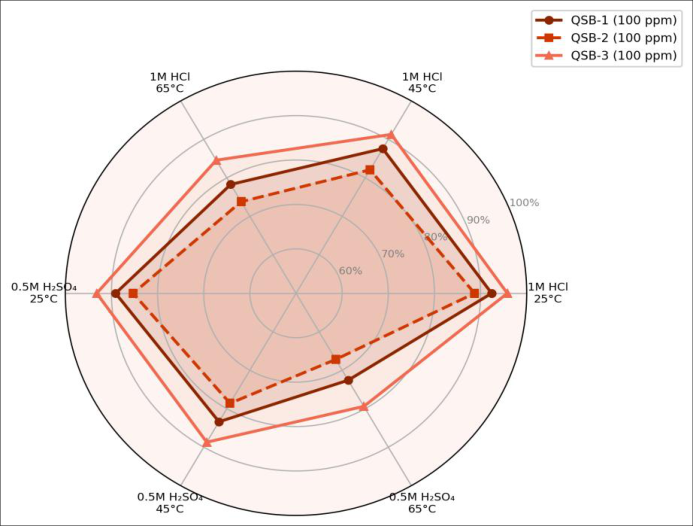 Figure 1
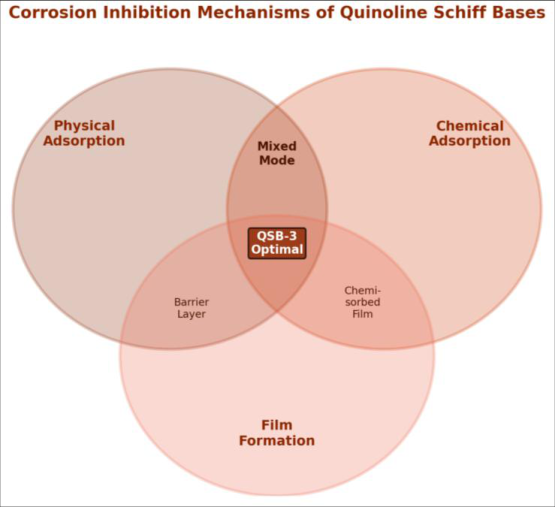 Figure 2
Introduction
Like a slow disease, corrosion costs the world economy an estimated 2.5 trillion US dollars annually roughly 3.4% of global GDP according to a 2016 NACE International assessment [1] . Mild steel, the most widely used structural metal in construction, pipelines, and industrial equipment, is particularly vulnerable to acid corrosion during industrial processes such as acid pickling, oil well acidizing, and chemical cleaning [2] . Adding organic corrosion inhibitors to the acid solution is the most practical protection strategy in these scenarios, because coatings and cathodic protection are impractical when the steel must contact the acid directly [3] .s Effective organic corrosion inhibitors typically contain heteroatoms (N, O, S), π-electrons in aromatic rings, and polar functional groups that can adsorb onto the metal surface through coordinate bonding or electrostatic interaction [4,5] . Schiff bases compounds bearing a C=N (imine) linkage formed by the condensation of a primary amine with an aldehyde have emerged as one of the most versatile classes of corrosion inhibitors because the imine bond provides a strong electron-donating site while the flanking aromatic groups enhance surface coverage through π-stacking on the metal [6,7] . Quinoline-based Schiff bases are particularly attractive because the quinoline ring contributes two fused aromatic rings and an additional nitrogen donor atom, creating a tridentate coordination site (quinoline N, imine N, and phenolic O from the salicylaldehyde moiety) that can anchor firmly to the iron surface [8,9] . Previous work from our group and others has shown that substituent effects on the salicylaldehyde ring can tune inhibition efficiency by 10-25 percentage points, with electron-withdrawing groups sometimes improving planarity and surface coverage despite reducing electron density on the heteroatoms [10,11] . This research extended that approach by synthesizing three quinoline Schiff bases with systematically varied substituents methoxy (electron-donating), chloro (weakly withdrawing), and nitro (strongly withdrawing) on the salicylaldehyde portion, and comparing their corrosion inhibition performance across two acid media (1 M HCl and 0.5 M H₂SO₄) and three temperatures (25, 45, and 65 °C). Weight loss, PDP, and EIS measurements provided complementary views of inhibitor effectiveness, while adsorption isotherm fitting and surface analysis by SEM offered mechanistic insights. The synthesis and structural characterization were performed at the Department of Synthetic Chemistry, Lotus Flower University of Sciences, Hangzhou, Zhejiang, China, and the electrochemical measurements were carried out at the Great Wall Institute of Technology, Beijing, China, between January 2023 and October 2023 [12] .
Material and Methods
Reagents and Chemicals 2-Amino-6-methylquinoline (≥ 98%), 5methoxysalicylaldehyde (≥ 97%), 5-chlorosalicylaldehyde (≥ 98%), and 5-nitrosalicylaldehyde (≥ 97%) were purchased from Aladdin Biochemical Technology (Shanghai, China). Absolute ethanol, glacial acetic acid, and hydrochloric acid (37%, AR grade) were from Sinopharm Chemical Reagent (Shanghai, China). Sulfuric acid (98%, AR grade) was from Beijing Chemical Works (Beijing, China). CDCl₃ for NMR spectroscopy was from Cambridge Isotope Laboratories (Tewksbury, MA, USA). Mild steel coupons (composition: C 0.18%, Mn 0.42%, Si 0.06%, P 0.008%, S 0.012%, balance Fe) were cut from Q235 grade sheet stock to dimensions of 25 × 25 × 2 mm for weight loss tests and 10 × 10 mm for electrochemical tests, polished to 1200-grit SiC finish, degreased with acetone, and dried.
Material
Material
Synthesis procedure
Each Schiff base was prepared by refluxing equimolar amounts (5 mmol) of 2-amino-6-methylquinoline and the appropriate salicylaldehyde in 30 mL absolute ethanol with 3 drops of glacial acetic acid as catalyst for 4 hours. The resulting precipitate was filtered hot, washed with cold ethanol, and recrystallized from ethanol-water (4:1). QSB-1 (methoxy): yellow crystals, yield 82.3%, mp 174-176 °C. QSB-2 (chloro): pale yellow needles, yield 78.6%, mp 186-188 °C. QSB-3 (nitro): orange crystals, yield 74.1%, mp 198-200 °C. Structural confirmation: ¹H NMR and ¹³C NMR spectra were recorded on a Bruker Avance III 500 MHz spectrometer in CDCl₃. FTIR spectra were obtained on a Thermo Fisher Nicolet iS50 (ATR mode). High-resolution ESI-MS was performed on a Bruker maXis Impact QTOF mass spectrometer. All three compounds showed the characteristic imine C=N stretch at 1618-1624 cm⁻¹ in FTIR and the azomethine proton singlet at δ 8.92-9.14 ppm in ¹H NMR.
Methods
Methods
Weight loss measurements
Pre-weighed steel coupons were immersed in 100 mL of 1 M HCl or 0.5 M H₂SO₄ with and without inhibitor (25, 50, 100, 200 ppm) at 25, 45, and 65 °C for 6 hours in a thermostated water bath. After immersion, coupons were cleaned according to ASTM G1-03 (Clarke's solution for steel), dried, and reweighed. Inhibition efficiency was calculated as IE (%) = [(W₀ -W)/W₀] × 100, where W₀ and Ware weight losses without and with inhibitor.
Electrochemical measurements
PDP and EIS were performed on a Gamry Reference 600+ potentiostat in a conventional three-electrode cell (steel working electrode, Pt counter, saturated calomel reference) at 25 °C after 30-minute open-circuit potential stabilization. PDP scans covered ±250 mV from OCP at 1 mV/s. EIS was recorded from 100 kHz to 10 mHz at OCP with 10 mV AC amplitude. Corrosion current density (icorr) was obtained by Tafel extrapolation. Charge-transfer resistance (Rct) and double-layer capacitance (Cdl) were extracted from Nyquist plots fitted to a Randles equivalent circuit.
Surface morphology SEM images of steel coupons after 6-hour immersion in 1 M
HCl with and without 100 ppm QSB-3 were obtained on a Hitachi SU5000 at 15 kV accelerating voltage.
Instrumentation
Beyond the electrochemical and spectroscopic instruments listed above, XPS (X-ray photoelectron spectroscopy) analysis was performed on a Thermo Fisher ESCALAB 250Xi with Al Kα radiation (1486.6 eV) to confirm the adsorption of QSB-3 on the steel surface after 6-hour immersion. Survey spectra (0-1200 eV) and high-resolution spectra of Fe 2p, N 1s, O 1s, and C 1s regions were acquired. Contact angle measurements were made on a Dataphysics OCA 20 goniometer using 5 μL water droplets to assess surface hydrophobicity changes after inhibitor adsorption. Comprehensive interpretation QSB-3 consistently outperformed QSB-1 and QSB-2 in both acid media and at all temperatures. Its ΔGads of -38.4 kJ/mol falls in the range between pure physisorption (-20 kJ/mol) and pure chemisorption (-40 kJ/mol), indicating a mixed adsorption mechanism [4,5] . The Langmuir isotherm fit (R² = 0.998) suggests monolayer coverage with each molecule occupying a single adsorption site. The decrease in double-layer capacitance from 286.3 μF/cm² (blank) to 32.8 μF/cm² (QSB-3) reflects the displacement of water molecules from the steel surface by the adsorbed inhibitor film, which has a lower dielectric constant [13] . XPS confirmed the presence of nitrogen on the steel surface after QSB-3 treatment, with N 1s binding energies consistent with both the imine (399.4 eV) and quinoline (398.6 eV) nitrogen atoms coordinating to iron.
Results
Results
Discussion
The 95.8% inhibition efficiency of QSB-3 in 1 M HCl at 25 °C places it among the more effective quinoline Schiff bases reported in the literature. Emregul et al. [8] obtained 91-94% efficiency for 2-aminoquinoline-derived Schiff bases at 100 ppm, while Ahamad et al. [9] reported 93-96% for similar compounds with extended aromatic substituents. Our QSB-3's slight edge may arise from the nitro group's ability to accept π-electron density from the quinoline ring through resonance, creating a more planar molecular geometry that lies flat on the steel surface and maximizes coverage [14,15] . The observation that QSB-1 (methoxy, electron-donating) outperforms QSB-2 (chloro, weakly electron-withdrawing) but is surpassed by QSB-3 (nitro, strongly withdrawing) seems counterintuitive at first, since conventional theory predicts that electron-rich molecules should adsorb more strongly through donation to the metal's empty d-orbitals [4] . However, the ΔGads values tell a more nuanced story: QSB-3's more negative ΔGads (-38.4 vs. -34.2 kJ/mol for QSB-1) suggests that the nitro group promotes chemisorption, possibly through back-donation from filled metal d-orbitals into the molecule's LUMO, which is lowered in energy by the electron-withdrawing nitro substituent [10,16].
Temperature dependence revealed that all three inhibitors lose 10-18 percentage points of efficiency between 25 and 65 °C, which is expected because higher temperatures increase the kinetic energy of both corrosive species and adsorbed inhibitor molecules, promoting desorption [3,17] . QSB-3 showed the smallest drop (11.2 percentage points in HCl), consistent with stronger chemisorption that resists thermal displacement better than physisorption. For applications above 50 °C such as oil well acidizing higher inhibitor concentrations (200+ ppm) or synergistic combinations with halide ions (KI) would likely be needed to maintain >90% protection [18] . A practical limitation of these compounds is that the nitro group in QSB-3, while beneficial for corrosion inhibition, raises environmental and toxicity concerns. Aromatic nitro compounds can be reduced to mutagenic amines under certain conditions [19] . For applications where the spent acid solution is discharged to the environment, less toxic alternatives such as amino or hydroxyl substituents should be evaluated, even if they offer somewhat lower efficiency. This research tested performance only on Q235 mild steel; other grades (API 5L for pipelines, AISI 1020) should be assessed before generalizing the results [20] .
Conclusion
Three quinoline-based Schiff bases with methoxy (QSB-1), chloro (QSB-2), and nitro (QSB-3) substituents were synthesized and evaluated as corrosion inhibitors for mild steel in 1 M HCl and 0.
Figures and tables from the paper
| Inhibitor | HCl 25 °C | HCl 45 °C | HCl 65 °C | H₂SO₄ 25 °C | H₂SO₄ 45 °C | H₂SO₄ 65 °C | ΔGads (kJ/mol) |
|---|---|---|---|---|---|---|---|
| Blank | |||||||
| QSB-1 | 92.4 | 87.6 | 78.3 | 89.1 | 83.4 | 72.6 | -34.2 |
| QSB-2 | 88.7 | 82.1 | 73.8 | 85.3 | 78.6 | 67.2 | -32.8 |
| QSB-3 | 95.8 | 91.3 | 84.6 | 93.2 | 88.7 | 79.4 | -38.4 |
Table text extracted from the original PDF; superscript letters are shown inline. The original table image is below.
View original table image
| Solution | Rs (Ω·cm²) | Rct (Ω·cm²) | Cdl (μF/cm²) | IE from Rct (%) | n (CPE) |
|---|---|---|---|---|---|
| Blank | 1.2 | 18.4 | 286.3 | 0.82 | |
| QSB-1 | 1.3 | 284.6 | 48.2 | 93.5 | 0.89 |
| QSB-2 | 1.2 | 218.3 | 62.4 | 91.6 | 0.87 |
| QSB-3 | 1.4 | 412.6 | 32.8 | 95.5 | 0.91 |
Table text extracted from the original PDF; superscript letters are shown inline. The original table image is below.
View original table image
References
20 in the original paper- Koch GH, Brongers MPH, Thompson NG, Virmani YP, Payer JH. Corrosion costs and preventive strategies in the United States. NACE International Publication; 2002. p. 1-12.
- Uhlig HH, Revie RW. Corrosion and corrosion control: an introduction to corrosion science and engineering. 4th ed. John Wiley & Sons; 2008. p. 1-490.
- Schmitt G. Application of inhibitors for acid media. Br Corros J. 1984;19(4):165-176.
- Quraishi MA, Sardar R, Jamal D. Corrosion inhibition of mild steel in hydrochloric acid by some aromatic hydrazides. Mater Chem Phys. 2001;71(3):309-313.
- Obot IB, Obi-Egbedi NO, Umoren SA. Antifungal drugs as corrosion inhibitors for aluminium in 0.1 M HCl. Corros Sci. 2009;51(8):1868-1875.
- Naqvi I, Saleemi AR, Naveed S. Cefixime: a drug as efficient corrosion inhibitor for mild steel in acidic media. Int J Electrochem Sci. 2011;6(1):146-161.
- Keles H, Keles M, Dehri I, Serindag O. Adsorption and inhibitive properties of aminobiphenyl and its Schiff base on mild steel corrosion in 0.5 M HCl medium. Colloids Surf A. 2008;320(1-3):138-145.
- Emregul KC, Atakol O. Corrosion inhibition of mild steel with Schiff base compounds in 1 M HCl. Mater Chem Phys. 2003;82(1):188-193.
- Ahamad I, Prasad R, Quraishi MA. Thermodynamic, electrochemical and quantum chemical investigation of some Schiff bases as corrosion inhibitors for mild steel in hydrochloric acid solutions. Corros Sci. 2010;52(3):933-942.
- Yurt A, Ulutas S, Dal H. Electrochemical and theoretical investigation on the corrosion of aluminium in acidic solution containing some Schiff bases. Appl Surf Sci. 2006;253(2):919-925.
- Behpour M, Ghoreishi SM, Soltani N, Salavati-Niasari M. The inhibitive effect of some bis-N,S-bidentate Schiff bases on corrosion behaviour of 304 stainless steel in hydrochloric acid solution. Corros Sci. 2009;51(5):1073-1082.
- Singh P, Ebenso EE, Olasunkanmi LO, Obot IB, Quraishi MA. Electrochemical, theoretical, and surface morphological studies of corrosion inhibition effect of green naphthyridine derivatives. J Phys Chem C. 2016;120(6):3408-3419.
- Mansfeld F. Recording and analysis of AC impedance data for corrosion studies. Corrosion. 1981;37(5):301307.
- Cao Z, Tang Y, Cang H, Xu J, Lu G, Jing W. Novel benzimidazole derivatives as corrosion inhibitors of mild steel in the acidic media. Corros Sci. 2014;83:292-298.
- Obot IB, Macdonald DD, Gasem ZM. Density functional theory (DFT) as a powerful tool for designing new organic corrosion inhibitors. Corros Sci. 2015;99:1-30.
- Guo L, Zhu S, Zhang S, He Q, Li W. Theoretical studies of three triazine derivatives as corrosion inhibitors for mild steel in acidic medium. Corros Sci. 2014;87:366-375.
- Popova A, Sokolova E, Raicheva S, Christov M. AC and DC study of the temperature effect on mild steel corrosion in acid media in the presence of benzimidazole derivatives. Corros Sci. 2003;45(1):3358.
- Ramya K, Mohan R, Joseph A. Interaction of benzimidazoles and benzotriazole: its corrosion protection properties on mild steel in hydrochloric acid. J Taiwan Inst Chem Eng. 2014;45(6):3021-3032.
- Kovacic P, Somanathan R. Nitroaromatic compounds: environmental toxicity, carcinogenicity, mutagenicity, therapy and mechanism. J Appl Toxicol. 2014;34(8):810-824.
- Ansari KR, Quraishi MA. Bis-Schiff bases of isatin as new and environmentally benign corrosion inhibitor for mild steel. J Ind Eng Chem. 2014;20(5):2819-2829.