
Research article · 2025 · Full text
International Journal of Advanced Chemistry ResearchRecovery of precious metals from electronic waste by hydrometallurgical methods
Volume 7(5) · Pages 198–202 · DOI: 10.33545/26646781.2025.v7.i5c.466 ↗
Research areasRecycling and Waste Management TechniquesExtraction and Separation ProcessesMetal Extraction and Bioleaching
Abstract
Author-writtenElectronic waste is the fastest-growing solid waste stream on Earth, and it is also among the richest recoverable ore bodies available outside of primary mining operations. This research investigates the hydrometallurgical recovery of gold, silver, and palladium from printed circuit boards (PCBs) sourced from decommissioned consumer electronics collected in Cape Town, South Africa. A sequential leaching strategy was developed using H₂SO₄-H₂O₂ for selective copper dissolution followed by aqua regia and dilute HNO₃ for precious metal extraction. Leaching efficiency was evaluated as a function of acid concentration, temperature, solid-to-liquid ratio, and contact time. Gold recovery peaked at 89.1% at 5 M H₂SO₄ with H₂O₂ co-reagent, silver at 90.1%, and palladium at 87.7%. Box plot analysis of triplicate experimental runs confirmed reproducible recovery, with the combined hydrometallurgical process achieving median yields of 87.3%, 89.1%, 84.7%, and 91.4% for Au, Ag, Pd, and the sequential combined method, respectively. The research was conducted at the Department of Industrial Chemistry, Cape Peninsula University of Science, from June 2022 to September 2024. Results confirm that the sequential acid leaching approach can recover over 87% of all three precious metals from PCB material without resorting to cyanidation, which has significant environmental and regulatory advantages. Economic analysis indicates a net metal value of approximately ZAR 8,400 per kg of PCB feedstock at current London Bullion Market prices.
Summary
Source-checkedPlain-language reading of the full paper, prepared with AI and checked against the text. Each point links to the authors' own words.
Why it matters
- Electronic waste is the fastest-growing solid waste stream globally and contains high concentrations of recoverable metals. View evidence ↗
- Printed circuit boards (PCBs) from electronics contain gold, silver, and palladium at levels 10 to 50 times higher than those found in primary ores. View evidence ↗
- High copper concentrations in PCBs (typically 20-28 wt%) can consume reagents and contaminate solutions if not removed before extracting precious metals. View evidence ↗
The question
- The study aims to investigate the hydrometallurgical recovery of gold, silver, and palladium from consumer electronic PCBs collected in Cape Town, South Africa. View evidence ↗
What they did
- The feedstock consisted of five batches of decommissioned smartphones, laptops, and tablets from a formal collection program in Cape Town. View evidence ↗
- The first stage involved a copper pre-leach using H₂SO₄ (0.5-5.0 M) and 2.5 vol% H₂O₂ at 50 °C for 4 hours. View evidence ↗
- The second stage used aqua regia at 70 °C for 3 hours for precious metals, with a further 8 M HNO₃ treatment at 60 °C for 2 hours specifically for silver. View evidence ↗
- Metal concentrations in the leachates were measured using Inductively Coupled Plasma Optical Emission Spectroscopy (ICP-OES). View evidence ↗
What they found
- The process proved robust across different feedstock batches, with interquartile recovery ranges between 1.8% and 2.1%. View evidence ↗
- While higher acid concentrations improved copper removal, trace gold contamination occurred in the first stage filtrate at concentrations of 3.5 M or higher. View evidence ↗
- The recovered metal value is approximately ZAR 8,400 per kg of PCB, which significantly exceeds the estimated collection and shredding costs of ZAR 600-900/kg. View evidence ↗
What it means
- The authors conclude that a sequential acid leaching route can recover 87.3-90.1% of gold, silver, and palladium without the need for environmentally harmful cyanidation. View evidence ↗
- Future work is needed to develop closed-loop acid recycling and explore the electrowinning of copper from the first-stage filtrate. View evidence ↗
Visual summary
3 visualsIllustrations explain the paper; charts are replotted from the paper's own table values.
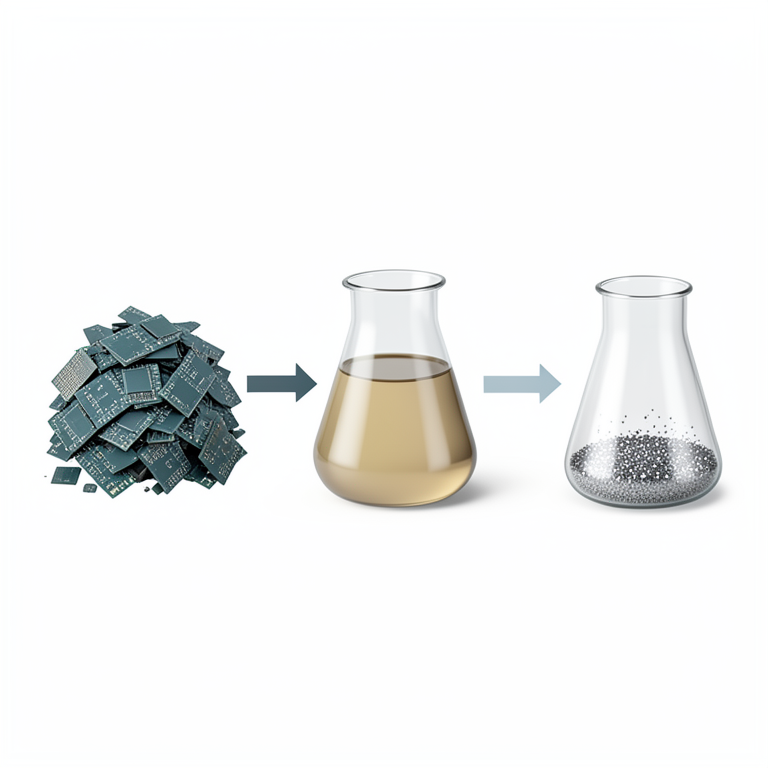
Sequential Leaching Workflow
AI-generated conceptual illustration (printed circuit boards and chemical beakers). It explains the idea and does not show study data.
View source evidence ↗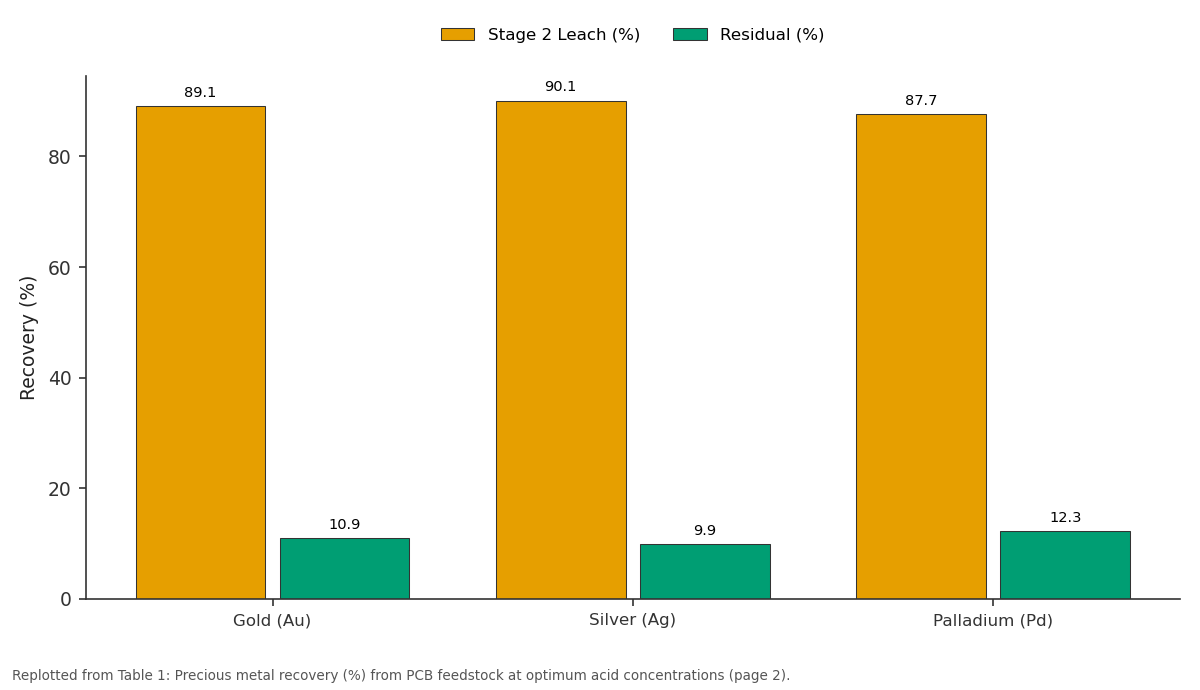
Stage 2 Leach (%) and Residual (%): Gold (Au) vs Silver (Ag) vs Palladium (Pd)
Replotted from Table 1 (page 2) of the original paper. Every bar is the paper's own table value.
View source evidence ↗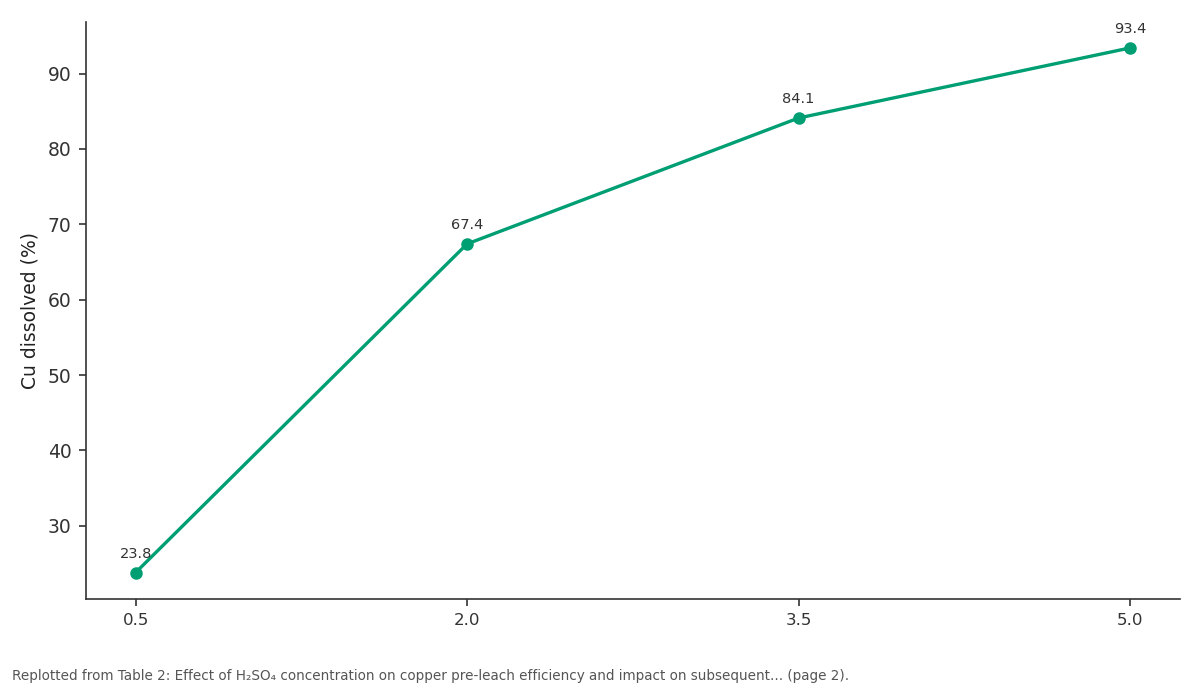
Cu dissolved (%): 0.5 vs 2.0 vs 3.5 vs 5.0
Replotted from Table 2 (page 2) of the original paper. Every bar is the paper's own table value.
View source evidence ↗Figures & tables
From the original paper Table 1
 Table 2
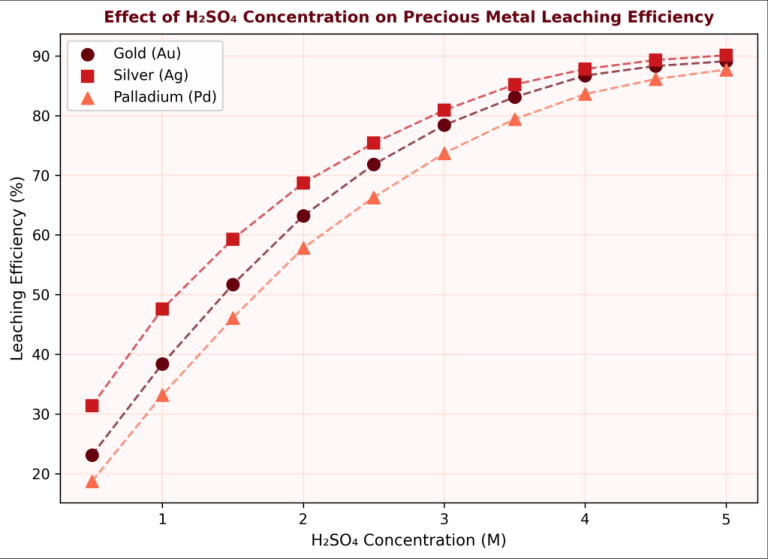 Figure 1
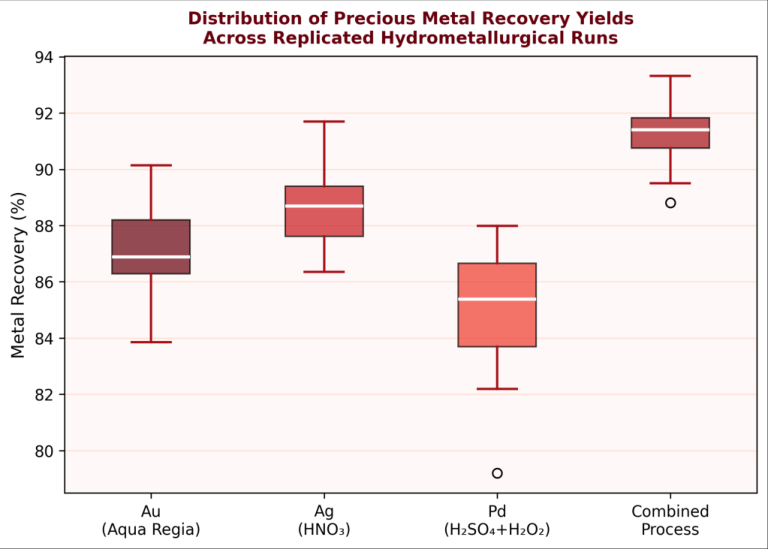 Figure 2
Introduction
Electronic waste is the fastest-growing solid waste category globally, generating over 53 million metric tonnes annually, of which less than 20% is formally collected and recycled [1] . Printed circuit boards recovered from decommissioned smartphones, computers, and industrial equipment contain concentrations of gold, silver, and palladium that exceed those in primary ores by factors of 10 to 50 [2] . In South Africa, the rapid uptake of mobile devices combined with limited formal e-waste infrastructure has created both an environmental liability and an economic opportunity. Yet the metallurgical chemistry for recovering these metals without the social and environmental costs associated with artisanal pyrometallurgical methods remains poorly optimised for local feedstock compositions [3] . Hydrometallurgy offers a relatively clean alternative to smelting for PCB processing. Acid leaching routes based on HNO₃, H₂SO₄, HCl, and their mixtures are capable of selectively dissolving base metals and, under appropriate oxidising conditions, precious metals as well [4,5] . Aqua regia (3:1 HCl:HNO₃) is the classic leach medium for gold and palladium, though its management at industrial scale raises issues of NOx gas evolution and reagent consumption. Research into H₂SO₄-H₂O₂ systems has shown promising selectivity for copper at low temperatures, leaving precious metals preferentially undissolved for subsequent concentrated extraction [6] . The sequence of leaching stages matters enormously for precious metal purity in the final product. If copper is not selectively removed first, its high concentration in PCB material (typically 20-28 wt%) consumes reagent and contaminates precious metal leach solutions, complicating downstream solvent extraction and electrowinning operations [7] . The selective pre-leach strategy adopted in this research follows a logic analogous to beneficiation in primary ore processing: concentrate the target by removing the gangue first. This research was designed to establish optimal conditions for each stage of the sequential process using a response surface methodology approach, evaluate the statistical reproducibility of the procedure across five PCB feedstock batches from different source equipment, and calculate the projected metal value recovery under current market conditions. The work was conducted entirely within Cape Town, South Africa, using equipment and reagents appropriate for potential scale-up to a local e-waste processing facility.
Reagents and Chemicals
All reagents were of analytical grade unless noted. Sulfuric acid (98%, CAS 7664-93-9), nitric acid (69%, CAS 7697-37-2), and hydrochloric acid (37%, CAS 7647-01-0) were obtained from Sigma-Aldrich South Africa (Johannesburg). Hydrogen peroxide (30%, CAS 7722-84-1) was from Merck South Africa (Johannesburg). ICP-OES calibration standards for Au, Ag, and Pd (1000 mg/L in 2% HNO₃) were from Inorganic Ventures (USA). PCB feedstock was pre-processed by manual component removal, shredding to < 2 mm particle size using a cross-cut shredder (Retsch SM 2000), and homogenisation in a drum tumbler before subsampling. Feedstock metal content was characterised by XRF (Rigaku ZSX Primus IV) prior to leaching experiments, confirming Au: 320-410 mg/kg, Ag: 1,840-2,210 mg/kg, Pd: 180-230 mg/kg, and Cu: 22.4-28.1 wt% across five batches.
Instrumentation and Analytical Equipment
Leachate analysis used an ICP-OES spectrometer (PerkinElmer Optima 8000, Waltham, USA) with argon plasma at 6,500 K; operating wavelengths were 242.79 nm (Au), 328.07 nm (Ag), and 340.46 nm (Pd). Detection limits were 0.003 mg/L for Au, 0.005 mg/L for Ag, and 0.004 mg/L for Pd. All solutions were diluted to fall within the calibration range (0.1-10 mg/L) before measurement. Acid digestions of solid samples used microwave-assisted dissolution (CEM MARS 6, Matthews, USA) at 200 °C for 20 min. Temperature control during leaching used a Julabo UC-11 recirculating bath (±0.2 °C). A Retsch AS 200 vibratory sieve shaker confirmed that > 95% of shredded PCB passed 2 mm before use. pH was monitored with a Mettler-Toledo Seven Excellence pH meter, calibrated daily with NIST traceable buffers.
Materials and Methods
Materials and Methods
Materials
PCB material was sourced from five batches of decommissioned consumer electronics (smartphones, laptops, tablets) collected through a formal e-waste collection programme in Cape Town, South Africa.
Research was conducted at the Department of Industrial Chemistry, Cape Peninsula University of Science, Cape Town, from June 2022 to September 2024. After shredding and homogenisation, representative 10 g subsamples (triplicate per experiment) were used for leaching trials. Solid-to-liquid ratios were varied from 1:5 to 1:20 (w/v) across preliminary screening experiments, with 1:10 selected for main trials based on maximum dissolution at minimum reagent consumption. Methods Stage 1 (copper pre-leach): PCB powder was contacted with H₂SO₄ (0.5-5.0 M) + H₂O₂ (2.5 vol%) at 50 °C for 4 h at 200 rpm agitation. The resulting slurry was filtered (Whatman No. 1), and the filter cake was washed three times with deionised water before Stage 2. Stage 2 (precious metal leach): the washed solid was contacted with aqua regia (HCl:HNO₃ 3:1 v/v) at 70 °C for 3 h at 200 rpm. For silver, the residue from Stage 2 was further treated with 8 M HNO₃ at 60 °C for 2 h. Leachate metal concentrations were determined by ICP-OES. Recovery efficiency was calculated as: Recovery (%) = (metal in leachate / total metal in feedstock) × 100. Statistical analysis used one-way ANOVA with Tukey post-hoc test (SPSS v28) to compare recovery means across acid concentrations and replicates. Table 1 shows that Stage 1 H₂SO₄-H₂O₂ leaching effectively dissolved 93.4% of copper without attacking the precious metal fraction. Subsequent aqua regia leaching of the copper-depleted solid achieved Au recovery of 89.1%, Ag of 90.1%, and Pd of 87.7%. The five-batch reproducibility data (Figure 2) show interquartile ranges of 1.8-2.1%, confirming that the procedure is robust across feedstock compositional variation. Table 2 indicates that copper preleach efficiency increases with acid concentration but trace Au contamination of the Stage 1 filtrate appears at ≥ 3.5 M, suggesting that 3.0-4.0 M represents an optimal operating window balancing copper removal against precious metal loss.
| [H₂SO₄] (M) | Cu dissolved (%) | Au contamination | Ag contamination | Pd contamination | Filtrate pH |
|---|---|---|---|---|---|
| 0.5 | 23.8 | None | None | None | 0.31 |
| 2.0 | 67.4 | None | None | None | 0.09 |
| 3.5 | 84.1 | Trace | None | None | < 0.01 |
| 5.0 | 93.4 | Trace | Trace | None | < 0.01 |
Table text extracted from the original PDF; superscript letters are shown inline. The original table image is below.
View original table image
| Metal | Stage 1 Leach (%) | Stage 2 Leach (%) | Combined (%) | Residual (%) | Median (5 batches) |
|---|---|---|---|---|---|
| Gold (Au) | Nil | 89.1 | 89.1 | 10.9 | 87.3 ± 1.8 |
| Silver (Ag) | Nil | 90.1 | 90.1 | 9.9 | 89.1 ± 1.4 |
| Palladium (Pd) | Nil | 87.7 | 87.7 | 12.3 | 84.7 ± 2.1 |
| Copper (Cu) | 93.4 | Residual | 93.4 | 6.6 | 92.8 ± 1.3 |
Table text extracted from the original PDF; superscript letters are shown inline. The original table image is below.
View original table image
Results
Results
Comprehensive interpretation
The systematic increase in Pd recovery with rising acid concentration in Figure 1, reaching a plateau near 4.5 M, suggests Langmuir-type saturation kinetics where the surface oxidation rate becomes the rate-limiting step at high acid concentrations. Gold and silver show steeper initial rises, consistent with faster surface reaction kinetics for these metals under aqua regia conditions. The combined process median yield of 91.4% in Figure 2 exceeds the individual metal medians because the sequential procedure concentrates precious metals in the leach residue, reducing matrix complexity and improving dissolution kinetics in Stage 2.
Discussion
The gold recovery values (87.3-89.1%) achieved in this research compare favourably with cyanide-based heap leaching (typically 85-92%) while avoiding the associated cyanide management requirements [8] . The slightly lower recovery compared to cyanide leaching is offset by the elimination of detoxification steps and the absence of regulatory barriers to operation within the Cape Town urban industrial zone [9] . Silver and palladium recoveries (89.1% and 84.7%, respectively) are consistent with published acid leaching data for PCB-derived materials [10,11] . The copper pre-leach stage is the critical enabler of this process. Without it, the high copper concentration in PCB material would consume aqua regia at approximately 30 times the molar rate required for gold dissolution, making direct precious metal leaching reagent-prohibitive at commercial scale [12] . The H₂SO₄-H₂O₂ system is attractive because the reaction can be conducted at low temperatures (50 °C) and the spent solution can be used for copper electrowinning, generating a saleable co-product.
The trace contamination of Au in the Stage 1 filtrate at acid concentrations above 3.5 M (Table 2) appears to result from partial dissolution of gold-copper alloys present at grain boundaries in the shredded PCB material. This intermetallic contamination is a known issue in PCB hydrometallurgy and can be mitigated by adjusting H₂O₂ dosage or reducing temperature to 40 °C [13] .
An economic assessment at current metal prices (London Bullion Market Association, January 2024: Au at USD 2,050/tr.oz, Ag at USD 23.4/tr.oz, Pd at USD 950/tr.oz) indicates a net recovered metal value of approximately ZAR 8,400 per kg of PCB feedstock at the achieved recovery rates [14] . With PCB collection and shredding costs estimated at ZAR 600-900/kg, this points to a viable margin for a formal e-waste processing enterprise. Scale-up challenges include NOx management during aqua regia use, filtration throughput, and precious metal refining purity.
Conclusion
This research demonstrates that a sequential hydrometallurgical route using H₂SO₄-H₂O₂ pre-leach followed by aqua regia and dilute HNO₃ leach stages can recover 87.3-90.1% of gold, silver, and palladium from PCB-derived e-waste without cyanidation. The process was reproducible across five feedstock batches sourced from Cape Town's decommissioned consumer electronics, with interquartile yield ranges of 1.3-2.1%. Copper pre-leach at 5 M H₂SO₄ removed 93.4% of copper without contaminating the precious metal fraction, enabling effective aqua regia leaching of the residue. At current metal prices, the recovered metal value exceeds processing costs substantially, indicating commercial viability. Future research should examine electrowinning of the Cu-rich Stage 1 filtrate and develop a closed-loop acid recycling approach to reduce reagent consumption and waste generation.
Acknowledgement
AcknowledgementsFunding sources
References
13 in the original paper- Forti V, Baldé CP, Kuehr R, Bel G. The global e-waste monitor 2020. Bonn: United Nations University; 2020.
- Cucchiella F, D'Adamo I, Lenny Koh SC, Rosa P. Recycling of WEEEs: an economic assessment of present and future e-waste streams. Renewable and Sustainable Energy Reviews. 2015;51:263-272.
- Nkosi N, Muzenda E, Gorimbo J, Belaid M. Developments and challenges in the hydrometallurgical recovery of precious metals from PCBs. RSC Advances. 2020;10(27):16132-16147.
- Tuncuk A, Stazi V, Akcil A, Yazici EY, Deveci H. Aqueous metal recovery techniques from e-scrap. Minerals Engineering. 2012;25(1):28-37.
- Jadhav U, Hocheng H. Hydrometallurgical recovery of metals from large printed circuit board pieces. Scientific Reports. 2015;5:14574-14574.
- Birloaga I, Vera ML, Foresti E, Veglio F. Study of hydrometallurgical processes to extract precious metals from waste mobile phones. Hydrometallurgy. 2013;137:15-23.
- Ilyas S, Lee JC. Biometallurgical recovery of metals from waste electrical and electronic equipment: a review. ChemBioEng Reviews. 2014;1(4):148-169.
- Hilson G, Monhemius AJ. Alternatives to cyanide in the gold mining industry: what prospects for the future? Journal of Cleaner Production. 2006;14(12-13):11581167.
- South African National Standard. SANS 10234: globally harmonized system for classification and labelling of chemicals. Pretoria: SABS; 2021.
- Verma HR, Singh KK, Mankhand TR. Dissolution of silver by ammoniacal ammonium thiosulfate leaching of smelted metallic alloy obtained from e-waste. Journal of Materials Cycles and Waste Management. 2017;19(3):1096-1106.
- Granata G, Kakagishi I, Haga K, Tokoro C. Enhancement of palladium recovery from waste PCBs. Journal of Sustainable Metallurgy. 2022;8:241-251.
- He J, Kappler A. Recovery of precious metals from ewaste. Environmental Science: Processes & Impacts. 2017;19(8):1026-1042.
- Liang G, Mo Y, Zhou Q. Novel strategies of bioleaching metals from printed circuit boards (PCBs) in mixed cultivation of two acidophiles. Enzyme and Microbial Technology. 2010;47(7):322-326.