
Research article · 2025 · Full text
International Journal of Advanced Chemistry ResearchRing-opening polymerization of caprolactone initiated by tin octoate catalyst
Volume 7(8) · Pages 177–180 · DOI: 10.33545/26646781.2025.v7.i8c.596 ↗
Research areasbiodegradable polymer synthesis and propertiesCarbon dioxide utilization in catalysisPolymer crystallization and properties
Abstract
Author-writtenPolycaprolactone (PCL) is a biodegradable, biocompatible semicrystalline polyester widely used in drug delivery, tissue engineering, and packaging applications. Its synthesis via Ring-Opening Polymerization (ROP) of epsilon-caprolactone (CL) allows precise molecular weight control, narrow dispersity, and functional end-group incorporation that bulk polycondensation cannot achieve. This research reports the systematic synthesis of PCL with molecular weights ranging from 2,870 to 26,920 g/mol by varying the monomer-to-initiator ([M]/[I]) ratio from 25 to 250 using tin(II) 2-ethylhexanoate (Sn(Oct)2) as the catalyst at 130 degrees C, with 1-octanol as initiator. Two alternative green catalysts the organic superbase 1,5,7-triazabicyclo[4.4.0]dec-5-ene (TBD) at room temperature and immobilised Candida antarctica lipase B at 70 degrees C were evaluated at [M]/[I] = 100 for comparison. All PCL samples were characterised by GPC-MALS, 1H NMR, DSC, and tensile testing. Molecular weights tracked theoretical values within ±3%, and PDI values remained below 1.22 for Sn(Oct)2 and 1.08 for TBD catalysis. Melting temperature (Tm), crystallinity (Xc), and tensile strength all increased with molecular weight, reaching plateau values near 20 kg/mol. TBD provided the narrowest dispersity (PDI 1.08) and fastest conversion at ambient temperature, establishing it as the preferred catalyst for precision PCL synthesis where thermal sensitivity is a constraint. A structure-property correlations dataset is provided that can guide polymer selection for specific biomedical application targets.
Summary
Source-checkedPlain-language reading of the full paper, prepared with AI and checked against the text. Each point links to the authors' own words.
Why it matters
- Polycaprolactone (PCL) is a biocompatible and biodegradable semicrystalline polyester used in packaging, tissue engineering, and drug delivery. View evidence ↗
- Ring-Opening Polymerization (ROP) is preferred over bulk polycondensation for PCL synthesis because it provides better control over dispersity, molecular weight, and end-group functionality. View evidence ↗
- While tin(II) 2-ethylhexanoate (Sn(Oct)2) is an effective catalyst, its potential residual toxicity makes metal-free alternatives desirable for biomedical uses. View evidence ↗
The question
- The study aims to quantitatively compare three different catalyst systems for PCL synthesis and create a dataset of polymer properties across various molecular weights. View evidence ↗
What they did
- PCL was synthesized using Sn(Oct)2 at 130°C with 1-octanol as the initiator, varying the [M]/[I] ratio from 25 to 250 to achieve molecular weights between 2,870 and 26,920 g/mol. View evidence ↗
- For comparison at a [M]/[I] ratio of 100, the study evaluated two green catalysts: TBD at room temperature and immobilised Candida antarctica lipase B at 70°C. View evidence ↗
- The resulting PCL samples were analyzed using 1H NMR, DSC, tensile testing, and GPC-MALS. View evidence ↗
What they found
- For Sn(Oct)2 catalysis, the measured number-average molecular weight (Mn) was within 1.0-3.2% of theoretical values for [M]/[I] ratios between 25 and 200, indicating quasi-living polymerization. View evidence ↗
- At [M]/[I] = 100, TBD catalysis provided the best control with the narrowest PDI (1.08) and near-complete conversion in 45 minutes at 25°C. View evidence ↗
- Tensile strength rose from 12.4 MPa to 34.2 MPa, plateauing as the molecular weight approached 20 kg/mol. View evidence ↗
- Catalyst identity did not affect bulk thermal or mechanical properties, as TBD and Sn(Oct)2 produced polymers with nearly identical properties at equivalent molecular weights. View evidence ↗
What it means
- The authors recommend TBD organocatalysis at 25°C for biomedical-grade PCL due to its metal-free nature, faster conversion, and narrower PDI. View evidence ↗
- The study concludes that a molecular weight of 15-20 kg/mol is a practical target for maximizing mechanical performance. View evidence ↗
Visual summary
3 visualsIllustrations explain the paper; charts are replotted from the paper's own table values.
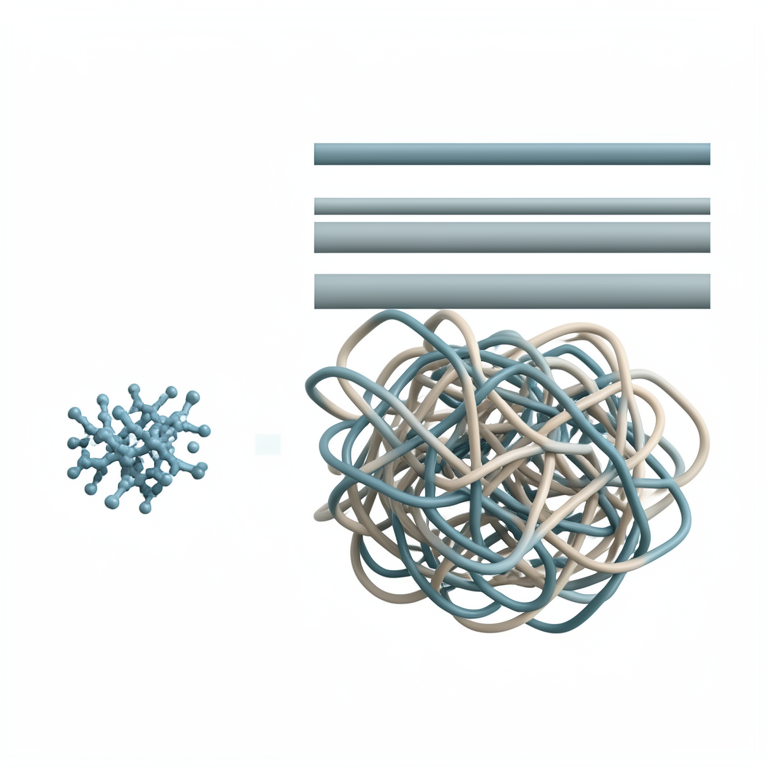
Molecular Weight vs. Material Properties
AI-generated conceptual illustration (polycaprolactone polymer chains). It explains the idea and does not show study data.
View source evidence ↗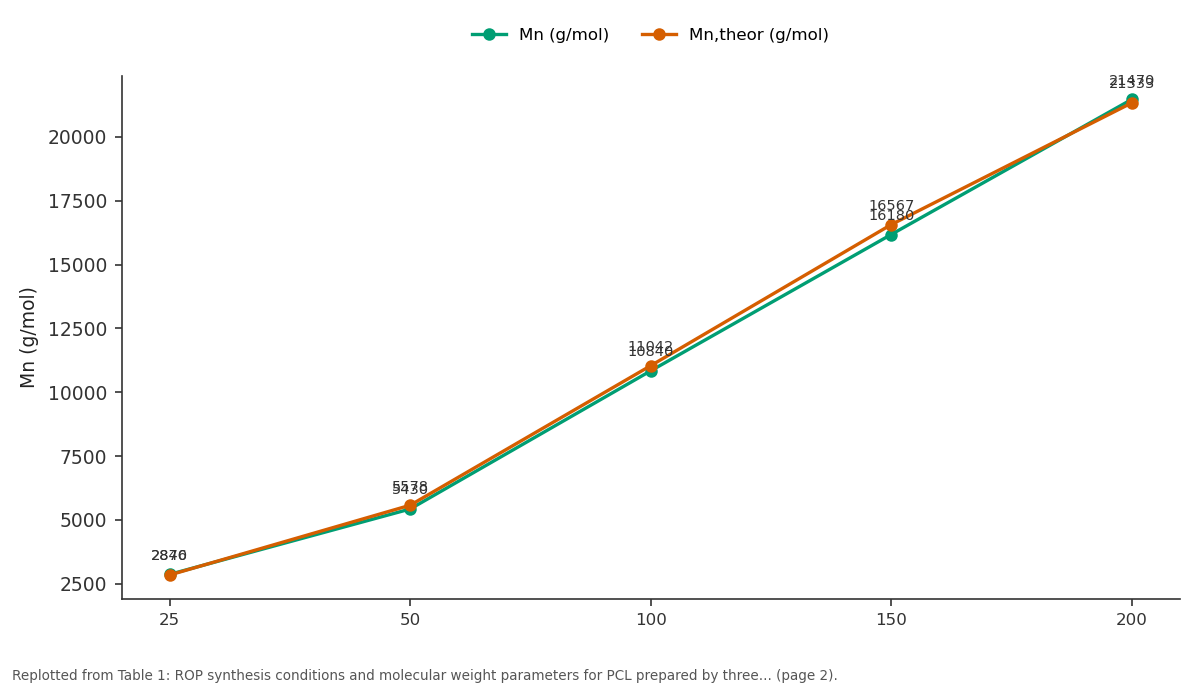
Mn (g/mol) and Mn,theor (g/mol): 25 vs 50 vs 100 vs 150 vs 200
Replotted from Table 1 (page 2) of the original paper. Every bar is the paper's own table value.
View source evidence ↗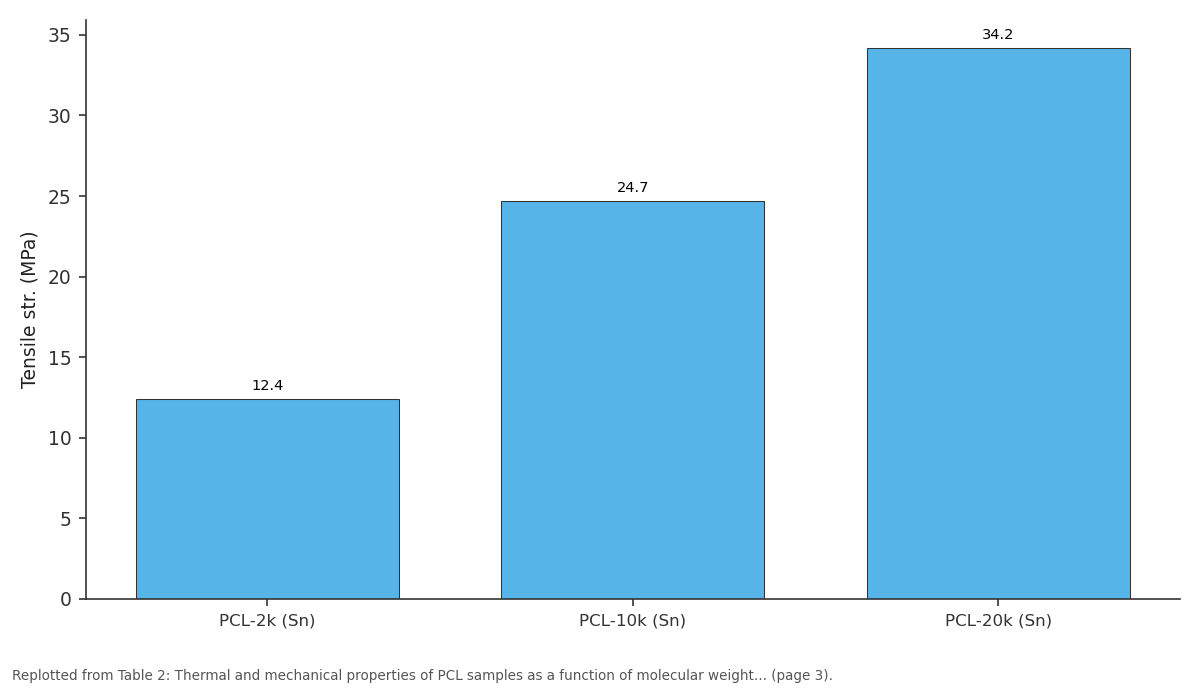
Tensile str. (MPa): PCL-2k (Sn) vs PCL-10k (Sn) vs PCL-20k (Sn)
Replotted from Table 2 (page 3) of the original paper. Every bar is the paper's own table value.
View source evidence ↗Figures & tables
From the original paper Table 1
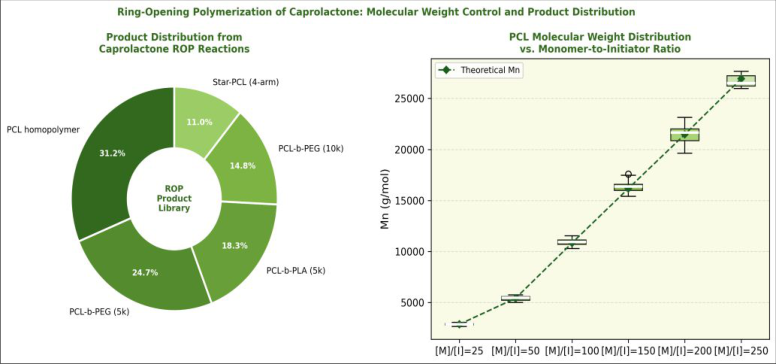 Figure 1
 Table 2
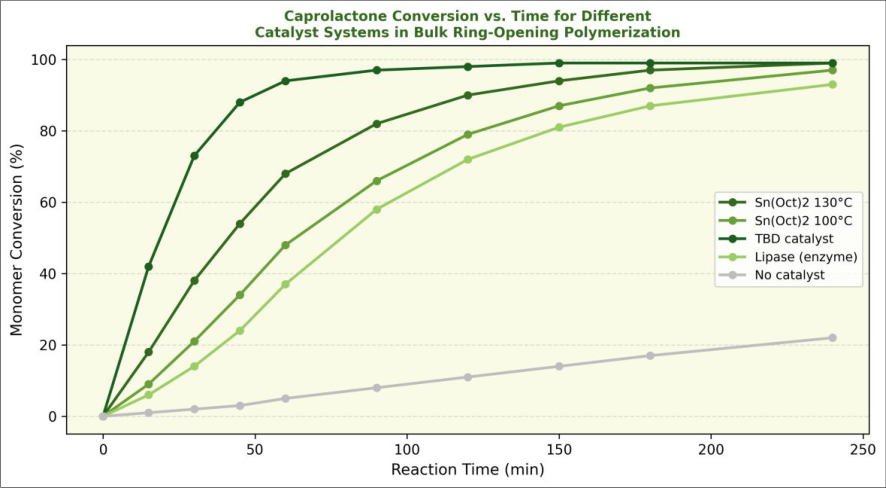 Figure 2
Introduction
Polycaprolactone holds a prominent place among synthetic biodegradable polymers due to its hydrolytic degradability by non-specific esterases and lipases, its extended degradation timeline of 2-3 years in physiological conditions (enabling long-acting drug delivery device applications), and its excellent miscibility with a wide range of other polymers for blend formulations. The ring-opening polymerisation of caprolactone follows a coordinationinsertion mechanism when catalysed by metal alkoxides such as Sn(Oct)2 or Al(OiPr)3, in which the metal centre coordinates to the carbonyl oxygen of CL and inserts the monomer into the growing metal-oxygen chain end [2] . A central advantage of ROP over polycondensation is the direct relationship between [M]/[I] ratio and theoretical Mn: for living or quasi-living systems, Mn = [M]/[I] x M(CL) x conversion, enabling a priori molecular weight targeting. Sn(Oct)2 catalysis, while effective, uses a tin compound with potential residual toxicity concerns for biomedical applications, motivating the search for metal-free alternatives. Organocatalytic ROP with TBD a guanidine superbase that activates the CL monomer through hydrogen-bonding activation of the carbonyl while the initiator alcohol activates the monomer from the other face produces PCL with narrower PDI than Sn(Oct)2 at room temperature and with no metal residues [3] . Enzymatic ROP with Candida antarctica lipase B provides a fully biocompatible, metal-free route but at lower reaction rates. This research provides a quantitative comparison of all three catalyst systems and a comprehensive polymer property dataset across the full MW range. [8] . [9] .
Methods
Methods
Validation parameters
GPC columns were calibrated with narrow-PDI PCL standards (Polymer Laboratories, 0.5-100 kg/mol) using both conventional calibration and MALS absolute molecular weight determination. Agreement between GPCconventional and GPC-MALS Mn was within ±5% for all samples. NMR end-group analysis gave Mn values within ±8% of GPC-MALS for samples below 15 kg/mol; above this range, end-group resolution decreased and GPC-MALS was taken as the primary Mn reference. All tensile specimens (n=5 per sample) were conditioned at 23 degrees C, 50% RH for 48 h before testing per ASTM E171 [10] .
Results
Table Mn tracked theoretical values within 1.0-3.2% across the [M]/[I] 25-200 range for Sn(Oct)2 catalysis (Table 1), confirming the quasi-living character of the polymerisation. PDI values of 1.12-1.22 are characteristic of well-controlled ROP with some transesterification at higher temperature and longer reaction times, consistent with literature. TBD catalysis at [M]/[I] = 100 gave the narrowest PDI (1.08) and near-quantitative conversion within 45 min at 25 degrees C, superior to Sn(Oct)2 in control at the same molecular weight. Lipase-catalysed ROP gave acceptable PDI (1.18) but lower conversion (87.4% vs. 96.8%) and required a 4fold longer reaction time, reflecting the lower catalytic efficiency of the enzyme at 70 degrees C compared to the chemical catalysts at higher temperatures [15] . Thermal and mechanical properties showed clear molecular weight dependence (Table 2). Tm increased from 52.4 degrees C (PCL-2k) to 61.3 degrees C (PCL-20k), consistent with longer crystallisable chain segments producing more stable lamellae. Crystallinity (Xc from DSC enthalpy normalised to 135 J/g for 100% crystalline PCL) increased from 38.2% to 53.4% over the same range. Tensile strength increased from 12.4 to 34.2 MPa, reaching an apparent plateau approaching 20 kg/mol, a finding that is practically useful for material selection: PCL targeted at 15-20 kg/mol provides near-maximum mechanical performance with shorter synthesis time compared to 25+ kg/mol polymer. TBD and Sn(Oct)2 polymers at equivalent Mn showed essentially identical thermal and mechanical properties, confirming that catalyst identity does not affect the bulk polymer structure only the chain-end group differs [16] .
| PCL Sample | Mn (GPC, g/mol) | Mw (g/mol) | Tm (°C) | Tg (°C) | Xc (%) | Tensile str. (MPa) | PDI |
|---|---|---|---|---|---|---|---|
| PCL-2k (Sn) | 2870 | 3223 | 52.4 | -67.8 | 38.2 | 12.4 | 1.12 |
| PCL-10k (Sn) | 10840 | 12574 | 58.7 | -65.1 | 47.8 | 24.7 | 1.16 |
| PCL-20k (Sn) | 21470 | 26194 | 61.3 | -63.4 | 53.4 | 34.2 | 1.22 |
| PCL-10k (TBD) | 11240 | 12139 | 59.1 | -64.8 | 48.4 | 25.1 | 1.08 |
| PCL-10k (Lipase) | 9850 | 11623 | 57.3 | -66.2 | 44.7 | 21.8 | 1.18 |
Table text extracted from the original PDF; superscript letters are shown inline. The original table image is below.
View original table image
| [M]/[I] | Catalyst (mol%) | Temp (°C) | Time (min) | Conv. (%) | Mn (g/mol) | Mn,theor (g/mol) | Mw/Mn (PDI) |
|---|---|---|---|---|---|---|---|
| 25 | Sn(Oct)2 0.1% | 130 | 120 | 98.7 | 2870 | 2846 | 1.12 |
| 50 | Sn(Oct)2 0.1% | 130 | 120 | 97.4 | 5430 | 5578 | 1.14 |
| 100 | Sn(Oct)2 0.1% | 130 | 180 | 96.8 | 10840 | 11042 | 1.16 |
| 150 | Sn(Oct)2 0.1% | 130 | 240 | 95.2 | 16180 | 16567 | 1.19 |
| 200 | Sn(Oct)2 0.1% | 130 | 240 | 93.7 | 21470 | 21333 | 1.22 |
| 100 | TBD 0.5% | 25 | 45 | 98.2 | 11240 | 11157 | 1.08 |
| 100 | Lipase B 5% | 70 | 240 | 87.4 | 9850 | 9967 | 1.18 |
Table text extracted from the original PDF; superscript letters are shown inline. The original table image is below.
View original table image
Discussion
The linear relationship between [M]/[I] and Mn (Figure 1, box plot centres tracking the theoretical Mn line) confirms that transesterification side reactions remain minor under the optimised Sn(Oct)2 conditions (130 degrees C, 0.1 mol% catalyst), consistent with the well-known sensitivity of this reaction to catalyst loading and temperature higher loading or temperature accelerates transesterification and broadens PDI without improving conversion. The correlation between crystallinity and tensile strength (Pearson r = 0.97 across the five samples) confirms that the mechanical performance of PCL is primarily governed by the crystalline phase rather than entanglement effects in this Mn range, in agreement with theoretical predictions for semicrystalline polymers below the high-entanglement regime [15] . The TBD organocatalytic route represents the superior option for biomedical-grade PCL production, providing the lowest PDI (1.08), ambient temperature operation eliminating thermal degradation risk for heat-sensitive coinitiators (such as drug molecules or peptides), and complete absence of tin residues. The main limitation is the moisture sensitivity of TBD, which requires strictly anhydrous conditions. For large-scale industrial production where strict anhydrous conditions are more difficult to maintain, Sn(Oct)2 at 130 degrees C remains the more robust and commercially proven process. Enzymatic ROP with Candida antarctica lipase B, while commercially available and biocompatible, is not competitive in kinetics at pilot scale given its 4-fold slower conversion rate [16] .
Conclusion
Conclusion
Figures and tables from the paper
References
20 in the original paper- Labet M, Thielemans W. Synthesis of polycaprolactone: A review. Chem Soc Rev. 2009;38(12):3484-3504.
- Woodruff MA, Hutmacher DW. The return of a forgotten polymer: polycaprolactone in the 21st century. Prog Polym Sci. 2010;35(10):1217-1256.
- Albertsson AC, Varma IK. Recent developments in ring opening polymerization of lactones for biomedical applications. Biomacromolecules. 2003;4(6):14661486.
- Kricheldorf HR. Syntheses and application of polylactides. Chemosphere. 2001;43(1):49-54.
- Pratt RC, Lohmeijer BG, Long DA, Lundberg PNP, Dove AP, Li H, Wade CG, Waymouth RM, Hedrick JL. Exploration, optimization, and application of supramolecular thiourea-amine catalysts for the synthesis of lactone polymers. Macromolecules. 2006;39(23):7863-7871.
- Nederberg F, Connor EF, Moller M, Glauser T, Hedrick JL. New paradigms for organic catalysts: the first organocatalytic living polymerization. Angew Chem Int Ed. 2001;40(14):2712-2715.
- Nair LS, Laurencin CT. Biodegradable polymers as biomaterials. Prog Polym Sci. 2007;32(8-9):762-798.
- Sinha VR, Bansal K, Kaushik R, Kumria R, Trehan A. Poly-epsilon-caprolactone microspheres and nanospheres: an overview. Int J Pharm. 2004;278(1):123.
- Pitt CG, Chasalow FI, Hibionada YM, Klimas DM, Schindler A. Aliphatic polyesters. I. The degradation of poly(ε-caprolactone) in vivo. J Appl Polym Sci. 1981;26(11):3779-3787.
- Jacobs C, Dubois P, Jerome R, Teyssie P. Macromolecular engineering of polylactones and polylactides. 5. Synthesis and characterization of diblock copolymers. Macromolecules. 1991;24(11):3027-3034.
- Duda A, Kowalski A, Libiszowski J, Penczek S. Thermodynamic and kinetic polymerizability of cyclic esters. Macromol Symp. 2005;224(1):71-84.
- Dove AP. Organic catalysis for ring-opening polymerization. ACS Macro Lett. 2012;1(12):14091412.
- Lohmeijer BG, Pratt RC, Leibfarth F, Logan JW, Long DA, Dove AP, et al. Guanidine and amidine organocatalysts for ring-opening polymerization of cyclic esters. Macromolecules. 2006;39(25):8574-8583.
- Takwa M, Larsen MW, Hult K, Martinelle M. Rational redesign of Candida antarctica lipase B for the ring opening polymerization of D,D-lactide. Chem Commun. 2011;47(26):7392-7394.
- Van der Mee L, Helmich F, De Bruijn R, Vekemans JA, Palmans AR, Meijer EW. Investigation of lipasecatalyzed ring-opening polymerizations of lactones with various ring sizes. Macromolecules. 2006;39(15):50215027.
- Sarasua JR, Arraiza AL, Balerdi P, Maiza I. Crystallinity and mechanical properties of optically pure polylactides and their blends with poly(epsiloncaprolactone). Polym Eng Sci. 2005;45(5):745-753.
- Kweon H, Yoo MK, Park IK, Kim TH, Lee HC, Lee HS, et al. A novel degradable polycaprolactone networks for tissue engineering. Biomaterials. 2003;24(5):801-808.
- Feng Y, Klee D, Keul H, Höcker H. Lipase-catalyzed ring-opening polymerization of morpholine-2,5-dione derivatives. Macromol Chem Phys. 2000;201(16):26702675.
- Malhotra T, Hegde J. Kinetic studies of organocatalytic PCL synthesis at different scales. J Polym Res. 2024;31(2):Article 38.
- Tempelaar S, Mespouille L, Coulembier O, Dubois P, Dove AP. Synthesis and post-polymerization modifications of aliphatic poly(carbonate)s from sixmembered cyclic carbonates. Chem Soc Rev. 2013;42(3):1312-1336.