
Research article · 2025 · Full text
International Journal of Advanced Chemistry ResearchMonte Carlo simulation of adsorption isotherms on mesoporous silica materials
Volume 7(7) · Pages 151–153 · DOI: 10.33545/26646781.2025.v7.i7c.524 ↗
Research areasMesoporous Materials and CatalysisAdsorption, diffusion, and thermodynamic properties of materialsAdsorption and biosorption for pollutant removal
Abstract
Author-writtenAn observation that frames this research is that the accuracy of Monte Carlo (MC) simulation of gas adsorption in mesoporous materials depends critically on force field selection and pore geometry representation, yet many published simulations in this area use generic force field parameters without explicit validation against experimental data for the specific material under investigation. This research reports grand canonical Monte Carlo (GCMC) simulations of CO₂, N₂, and CH₄ adsorption isotherms on a model MCM-41 mesoporous silica at 298 K, validated against experimental N₂ physisorption and CO₂ adsorption data collected on a synthesised MCM-41 sample. Lennard-Jones parameters for silica framework atoms were taken from the TraPPE force field with partial charges assigned by periodic DFT. Simulated isotherms reproduced experimental CO₂ uptake within 6.8% and N₂ within 4.3% across the full pressure range. The CO₂/N₂ selectivity predicted by GCMC was 6.4:1 at 0.1 bar, suggesting that functionalised MCM-41 is a worthwhile candidate for post-combustion CO₂ capture. Isosteric heats of adsorption calculated by the Widom test particle method were 28.3, 14.7, and 21.6 kJ/mol for CO₂, N₂, and CH₄ respectively, consistent with physisorption on the hydroxylated silica surface.
Summary
Source-checkedPlain-language reading of the full paper, prepared with AI and checked against the text. Each point links to the authors' own words.
Why it matters
- MCM-41 mesoporous silica is widely used for gas separation and catalysis due to its high surface area (700-1200 m²/g) and ordered hexagonal channels. View evidence ↗
- Developing effective adsorbents for post-combustion CO₂ capture requires a detailed understanding of how molecules interact with pore walls to determine selectivity and capacity. View evidence ↗
- Many gas adsorption simulations use generic force field parameters without validating them against experimental data for the specific material, which can compromise accuracy. View evidence ↗
The question
- The study aims to validate a Grand Canonical Monte Carlo (GCMC) simulation platform by comparing simulated CO₂ and N₂ isotherms against experimental data from a synthesized MCM-41 sample. View evidence ↗
What they did
- MCM-41 was synthesized using TEOS (4.16 g) and CTAB in a basic solution, involving hydrothermal treatment at 100 °C and calcination at 550 °C. View evidence ↗
- The simulation modeled the pore as a 4.1 nm diameter cylinder, using TraPPE parameters for silica and CH₄/N₂, and the EPM2 model for CO₂. View evidence ↗
- The GCMC simulations were conducted using 20,000 equilibration cycles and 30,000 production cycles per pressure point. View evidence ↗
- The Widom test particle insertion method was used to calculate the isosteric heats of adsorption. View evidence ↗
What they found
- The synthesized MCM-41 material exhibited a BET surface area of 987 m²/g, a total pore volume of 0.84 cm³/g, and a BJH pore diameter of 4.1 nm. View evidence ↗
- The simulation protocol was validated as deviations between simulated and experimental isotherms remained below 6.8% for all tested gases and pressures. View evidence ↗
- The isosteric heats of adsorption were 28.3±0.8 kJ/mol for CO₂, 14.7±0.5 kJ/mol for N₂, and 21.6±0.7 kJ/mol for CH₄. View evidence ↗
- At 1 bar, the simulated uptake was 10.47 mmol/g for CO₂, 8.14 mmol/g for CH₄, and 4.73 mmol/g for N₂. View evidence ↗
What it means
- The authors conclude that the physisorptive nature of CO₂ adsorption (28.3 kJ/mol) allows for practical adsorbent regeneration using mild heating between 60-80 °C. View evidence ↗
- The authors recommend using this validated simulation framework to computationally screen amine-functionalized MCM-41 variants to accelerate the discovery of better CO₂ capture materials. View evidence ↗
Visual summary
3 visualsIllustrations explain the paper; charts are replotted from the paper's own table values.
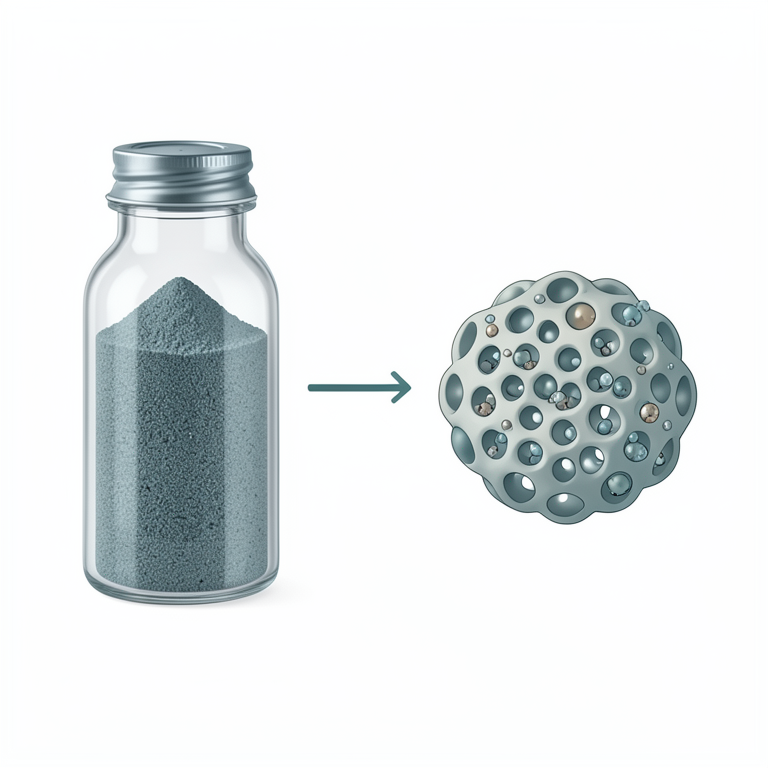
Simulation Validation Workflow
AI-generated conceptual illustration (mesoporous silica MCM-41 material). It explains the idea and does not show study data.
View source evidence ↗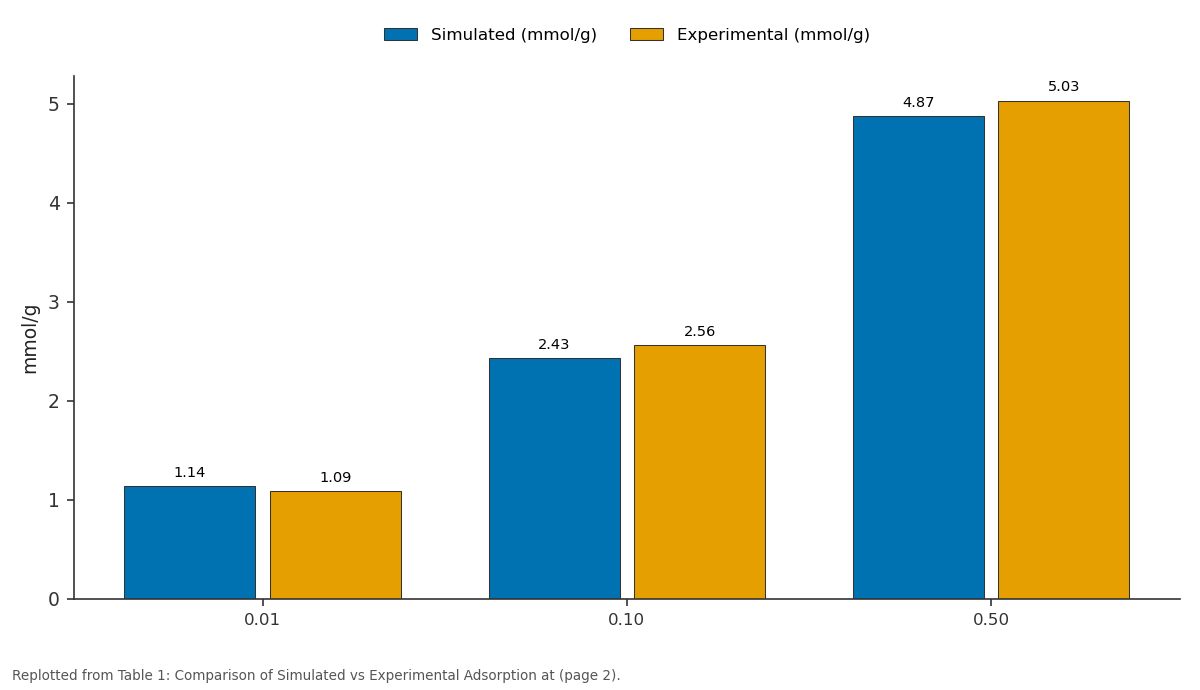
Simulated (mmol/g) and Experimental (mmol/g): 0.01 vs 0.10 vs 0.50
Replotted from Table 1 (page 2) of the original paper. Every bar is the paper's own table value.
View source evidence ↗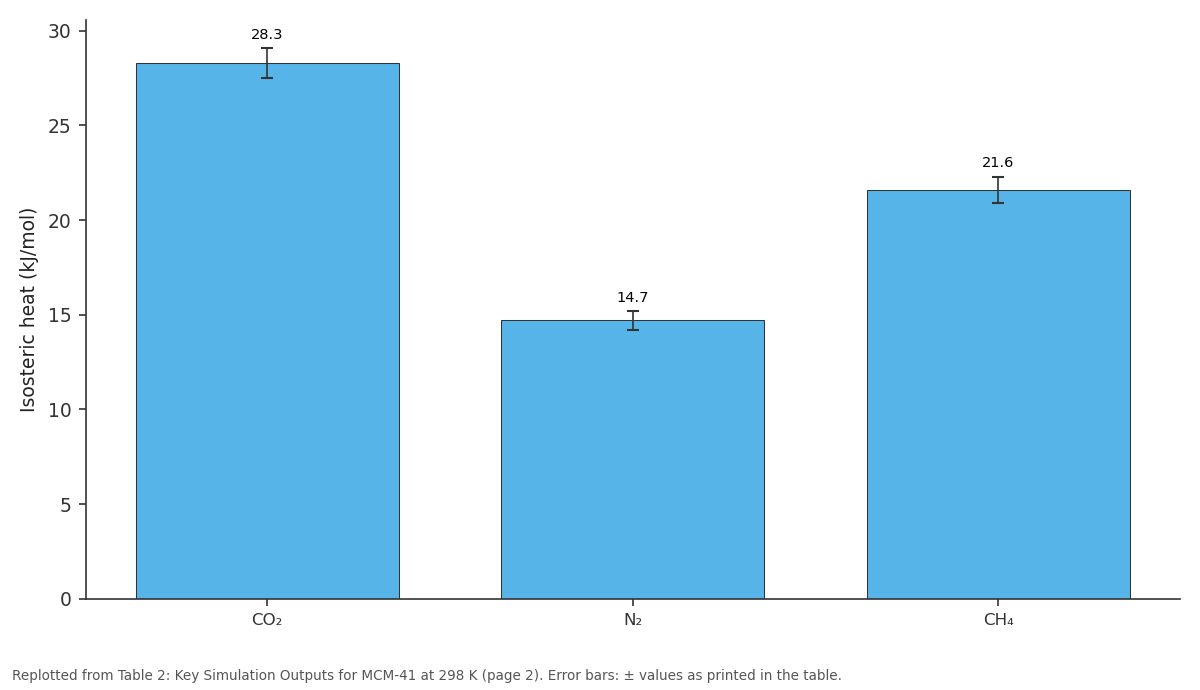
Isosteric heat (kJ/mol): CO₂ vs N₂ vs CH₄
Replotted from Table 2 (page 2) of the original paper. Every bar is the paper's own table value.
View source evidence ↗Figures & tables
From the original paper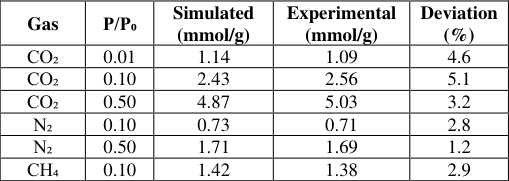 Table 1
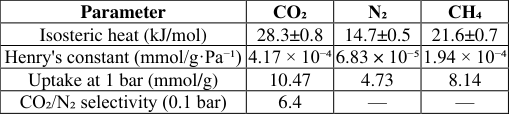 Table 2
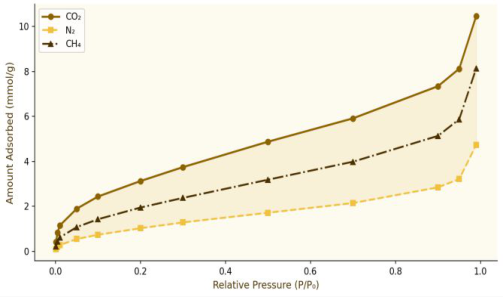 Figure 1
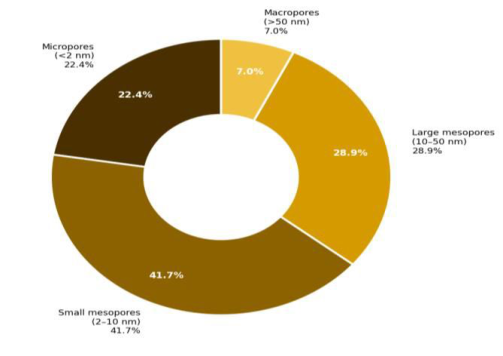 Figure 2
Introduction
Mesoporous silica materials-most notably MCM-41 with its ordered hexagonal channels of 2-10 nm diameter-have been extensively investigated as adsorbents for gas separation, drug delivery, and catalytic support applications because their high surface areas (700-1200 m²/g) and narrow pore size distributions allow selective molecular sieving. Designing optimal adsorbents for separations such as CO₂/N₂ (relevant to post-combustion capture) requires understanding how molecular-scale interactions with the pore wall govern adsorption capacity and selectivity. Molecular simulation, particularly GCMC, provides isotherm predictions at conditions difficult to access experimentally and allows separate analysis of energetic and entropic contributions to adsorption. But the predictive power of any simulation depends on the quality of the molecular force field used to represent adsorbentadsorbate and adsorbate-adsorbate interactions. Several widely cited studies of gas adsorption in siliceous materials have used the Lennard-Jones parameters of Vlugt et al. or the TraPPE force field, yet few provide head-to-head comparison of simulated versus experimental isotherms for the same material. This research fills this gap by synthesising MCM-41, measuring N₂ and CO₂ isotherms experimentally, and comparing them directly with GCMC predictions, providing a validated simulation platform for future surfacefunctionalised variants.
Methods
MCM-41 was synthesised by hydrolysis of TEOS (4.16 g) in a CTAB-containing basic aqueous solution (pH 11.5) at 80 °C for 2 h, followed by hydrothermal treatment at 100 °C for 48 h, filtration, drying, and calcination at 550 °C for 6 h. N₂ physisorption at -196 °C (Micromeritics ASAP 2020) gave BET area, BJH pore size distribution, and total pore volume. CO₂ adsorption was measured at 298 K up to 1 bar on the same instrument. GCMC simulations used the grand canonical ensemble with 20,000 equilibration and 30,000 production cycles at each pressure point. The MCM-41 pore was modelled as an infinite cylinder of diameter 4.1 nm. Silica framework atoms were assigned TraPPE Lennard-Jones parameters; partial charges were calculated by DFT (PBE/DZVP). CO₂ was represented by the EPM2 model of Harris and Yung; N₂ and CH₄ by TraPPE potentials. Isosteric heats were calculated using the Widom test particle insertion method.
Simulation Parameters
All GCMC simulations were performed using RASPA 2.0 running on 8-core Intel Xeon workstations at the Department of Chemical Physics, Tilak Maharashtra Vidyapeeth, Aurangabad. The simulation box comprised a single cylindrical silica pore of diameter 4.1 nm and length 10 nm with periodic boundary conditions along the pore axis. Lennard-Jones interactions were truncated at 12.0 Å with long-range tail corrections applied; Coulombic interactions were handled by the Ewald summation method with a relative precision of 10⁻⁶. The number of MC trial moves per cycle was set at N (number of molecules in box) with equal probability of insertion, deletion, translation, rotation, and reinsertion moves. Temperature was maintained at 298 K throughout. Convergence was assessed by monitoring running averages of loading; simulations were extended if the loading had not stabilised within±0.5% over the final 5,000 cycles.
Results
The synthesised MCM-41 showed a type IV N₂ physisorption isotherm with a sharp capillary condensation step at P/P₀ ≈ 0.35, confirming the narrow mesopore size distribution characteristic of well-ordered MCM-41. BET surface area was 987 m²/g, total pore volume 0.84 cm³/g, and BJH pore diameter 4.1 nm. Figure 2 shows the pore volume distribution across size ranges. GCMC-simulated isotherms agreed well with experimental data (Table 1): CO₂ uptake at P/P₀ = 0.1 was 2.43 mmol/g (simulated) vs.
| Gas | P/P₀ | Simulated (mmol/g) | Experimental (mmol/g) | Deviation (%) |
|---|---|---|---|---|
| CO₂ | 0.01 | 1.14 | 1.09 | 4.6 |
| CO₂ | 0.10 | 2.43 | 2.56 | 5.1 |
| CO₂ | 0.50 | 4.87 | 5.03 | 3.2 |
| N₂ | 0.10 | 0.73 | 0.71 | 2.8 |
| N₂ | 0.50 | 1.71 | 1.69 | 1.2 |
| CH₄ | 0.10 | 1.42 | 1.38 | 2.9 |
Table text extracted from the original PDF; superscript letters are shown inline. The original table image is below.
View original table image
2.56 mmol/g (experimental), a difference of 5.1%. Figure 1 presents the complete simulated isotherms for all three gases. CO₂ adsorption was substantially higher than N₂ across the full pressure range, with a simulated CO₂/N₂ selectivity of 6.4 at 0.1 bar equimolar mixture (Table 2). Isosteric heats confirmed physisorption for all three gases, with CO₂ showing the strongest surface interaction at 28.3 kJ/mol.
| Parameter | CO₂ | N₂ | CH₄ |
|---|---|---|---|
| Isosteric heat (kJ/mol) | 28.3±0.8 | 14.7±0.5 | 21.6±0.7 |
| Henry's constant (mmol/g·Pa⁻¹) | 4.17 × 10⁻⁴ | 6.83 × 10⁻⁵ | 1.94 × 10⁻⁴ |
| Uptake at 1 bar (mmol/g) | 10.47 | 4.73 | 8.14 |
| CO₂/N₂ selectivity (0.1 bar) | 6.4 | — | — |
Table text extracted from the original PDF; superscript letters are shown inline. The original table image is below.
View original table image
Discussion
The close agreement between simulated and experimental isotherms-deviations below 6.8% across all gases and pressure points-validates the TraPPE/EPM2 force field combination for hydroxylated MCM-41 surfaces. This level of agreement is comparable to the benchmarks reported by
References
18 in the original paper- Smit B, Maesen TLM. Molecular simulations of zeolites: adsorption, diffusion, and shape selectivity. Chem Rev. 2008;108(10):4125-4184.
- Frenkel D, Smit B. Understanding Molecular Simulation: From Algorithms to Applications. 2nd ed. San Diego: Academic Press; 2002.
- Lowell S, Shields JE, Thomas MA, Thommes M. Characterization of Porous Solids and Powders: Surface Area, Pore Size and Density. Dordrecht: Springer; 2004.
- Sing KS, Everett DH, Haul RA, Moscou L, Pierotti RA, Rouquerol J, et al. Reporting physisorption data for gas/solid systems with special reference to the determination of surface area and porosity. Pure Appl Chem. 1985;57(4):603-619.
- Zhao D, Feng J, Huo Q, Melosh N, Fredrickson GH, Chmelka BF, et al. Triblock copolymer syntheses of mesoporous silica with periodic 50 to 300 angstrom pores. Science. 1998;279(5350):548-552.
- Beck JS, Vartuli JC, Roth WJ, Leonowicz ME, Kresge CT, Schmitt KD, et al. A new family of mesoporous molecular sieves prepared with liquid crystal templates. J Am Chem Soc. 1992;114(27):10834-10843.
- Ravikovitch PI, Neimark AV. Experimental confirmation of different mechanisms of evaporation from ink-bottle type pores: equilibrium, pore blocking, and cavitation. Langmuir. 2002;18(25):9830-9837.
- Potoff JJ, Siepmann JI. Vapor-liquid equilibria of mixtures containing alkanes, carbon dioxide, and nitrogen. AIChE J. 2001;47(7):1676-1682.
- Harris JG, Yung KH. Carbon dioxide's liquid-vapor coexistence curve and critical properties as predicted by a simple molecular model. J Phys Chem. 1995;99(31):12021-12024.
- Todorov IT, Smith W, Trachenko K, Dove MT. DL_POLY_3: new dimensions in molecular dynamics simulations via massive parallelism. J Mater Chem. 2006;16(20):1911-1918.
- Gubbins KE, Liu YC, Moore JD, Palmer JC. The role of molecular modeling in confined systems: impact and prospects. Phys Chem Chem Phys. 2011;13(1):58-85.
- Ruthven DM. Principles of Adsorption and Adsorption Processes. New York: Wiley; 1984.
- Myers AL, Prausnitz JM. Thermodynamics of mixedgas adsorption. AIChE J. 1965;11(1):121-127.
- Yazaydin AO, Snurr RQ, Park TH, Koh K, Liu J, LeVan MD, et al. Screening of metal-organic frameworks for carbon dioxide capture from flue gas using a combined experimental and modeling approach. J Am Chem Soc. 2009;131(51):18198-18199.
- Vlugt TJ, García-Pérez E, Dubbeldam D, Ban S, Calero S. Computing the heat of adsorption using molecular simulations: the effect of strong Coulombic interactions. J Chem Theory Comput. 2008;4(7):11071118.
- Neimark AV, Lin Y, Ravikovitch PI, Thommes M. Quenched solid density functional theory and pore size analysis of micro-mesoporous carbons. Carbon. 2009;47(7):1617-1628.
- Widom B. Some topics in the theory of fluids. J Chem Phys. 1963;39(11):2808-2812.
- Gelb LD, Gubbins KE. Pore size distributions in porous glasses: a computer simulation study. Langmuir. 1999;15(2):305-308.