
Research article · 2025 · Full text
International Journal of Advanced Chemistry ResearchAtom transfer radical polymerization of methyl methacrylate with copper catalyst system
Volume 7(5) · Pages 184–187 · DOI: 10.33545/26646781.2025.v7.i5c.604 ↗
Research areasAdvanced Polymer Synthesis and CharacterizationRadical Photochemical ReactionsPhotopolymerization techniques and applications
Abstract
Author-writtenAtom transfer radical polymerisation (ATRP) enables the controlled synthesis of well-defined polymers with predictable molecular weights and narrow dispersity, key attributes for advanced material applications. This research examines the CuBr/PMDETA-catalysed ATRP of methyl methacrylate (MMA) in acetonitrile using ethyl α-bromoisobutyrate (EBiB) as initiator, investigating the effects of monomer-to-initiator ratio ([M]/[I] = 50-500), catalyst loading ([CuBr]/[PMDETA] = 0.5-3.0 equivalents), and reaction temperature (60-100°C) on molecular weight control and dispersity. At [M]/[I] = 100, optimal conditions (1.5 equiv. CuBr/PMDETA, 80°C) yielded PMMA with Mn = 10,340 Da (theoretical 10,000 Da), Ð = 1.09, and conversion 92.8% in 4 h. First-order kinetic plots confirmed controlled radical character (kp,app = 0.0171 min⁻¹). The dispersity heatmap identified 80-90°C with 1.5-2.0 equiv. CuBr as the optimal operating window (Ð ≤ 1.08). Chain-end fidelity was confirmed by MALDI-TOF MS (Br-terminated chains > 95%). Research was conducted from March 2023 to January 2025 at Dara Shikoh Memorial College of Sciences, Srinagar, Jammu and Kashmir, India.
Summary
Source-checkedPlain-language reading of the full paper, prepared with AI and checked against the text. Each point links to the authors' own words.
Why it matters
- Atom transfer radical polymerisation (ATRP) is valuable for advanced materials because it allows for the creation of polymers with narrow dispersity and predictable molecular weights. View evidence ↗
- Methyl methacrylate (MMA) is used as a benchmark monomer for ATRP and is the basis for PMMA, which is essential for biomedical, coating, and optical applications. View evidence ↗
- While the CuBr/PMDETA catalyst system is well-documented for MMA ATRP, there is a lack of systematic optimization studies for laboratory-scale synthesis across multiple variables. View evidence ↗
The question
- The study aims to investigate how reaction temperature (60-100°C), catalyst loading (0.5-3.0 equivalents), and the monomer-to-initiator ratio (50-500) affect the dispersity and molecular weight control of MMA ATRP. View evidence ↗
What they did
- The researchers used high-purity MMA (99%), CuBr (99.9%), PMDETA (99%), and EBiB initiator (98%) in anhydrous acetonitrile. View evidence ↗
- The polymerization was performed in a Schlenk flask under Argon using three freeze-pump-thaw cycles, with the catalyst system added in 50% v/v acetonitrile. View evidence ↗
- Polymer characterization was conducted using GPC for molecular weight, 1H NMR for conversion, and MALDI-TOF MS for chain-end analysis. View evidence ↗
What they found
- Under optimal conditions (80°C, 1.5 equiv. CuBr/PMDETA, [M]/[I] = 100), the resulting PMMA had a molecular weight (Mn) of 10,340 Da, a dispersity (Ð) of 1.09, and a conversion of 92.8% after 4 hours. View evidence ↗
- Strong ATRP control was demonstrated by the fact that experimental molecular weights (Mn,GPC) deviated by less than 3% from theoretical values across all tested monomer-to-initiator ratios. View evidence ↗
- As the monomer-to-initiator ratio increased, dispersity rose slightly from 1.08 to 1.16, which the authors attribute to slower initiation relative to propagation. View evidence ↗
- MALDI-TOF analysis confirmed that more than 95% of the polymer chains in the PMMA-100 sample retained their bromine chain ends. View evidence ↗
- Copper residues in the as-precipitated PMMA (847-912 ppm) were successfully reduced to less than 5 ppm using a single pass through an alumina column. View evidence ↗
- ATRP-derived PMMA exhibited a higher glass transition temperature (Tg) of 112-119°C compared to commercial PMMA (105°C) because the narrower molecular weight distribution removes the low-MW tail. View evidence ↗
What it means
- The authors conclude that their results serve as a practical guide for laboratory-scale PMMA ATRP and establish the conditions needed to create macro-initiators for block copolymer synthesis. View evidence ↗
- The study was limited to a 5 mL laboratory scale; scaling up to industrial levels may change mixing, oxygen removal, and heat transfer, potentially affecting control. View evidence ↗
- Chain-end analysis via MALDI-TOF MS was only performed for [M]/[I] ratios of 100 and 200, meaning fidelity for higher degrees of polymerization was only inferred. View evidence ↗
Visual summary
3 visualsIllustrations explain the paper; charts are replotted from the paper's own table values.
Optimization Window Concept
AI-generated conceptual illustration (methyl methacrylate monomer and copper catalyst system). It explains the idea and does not show study data.
View source evidence ↗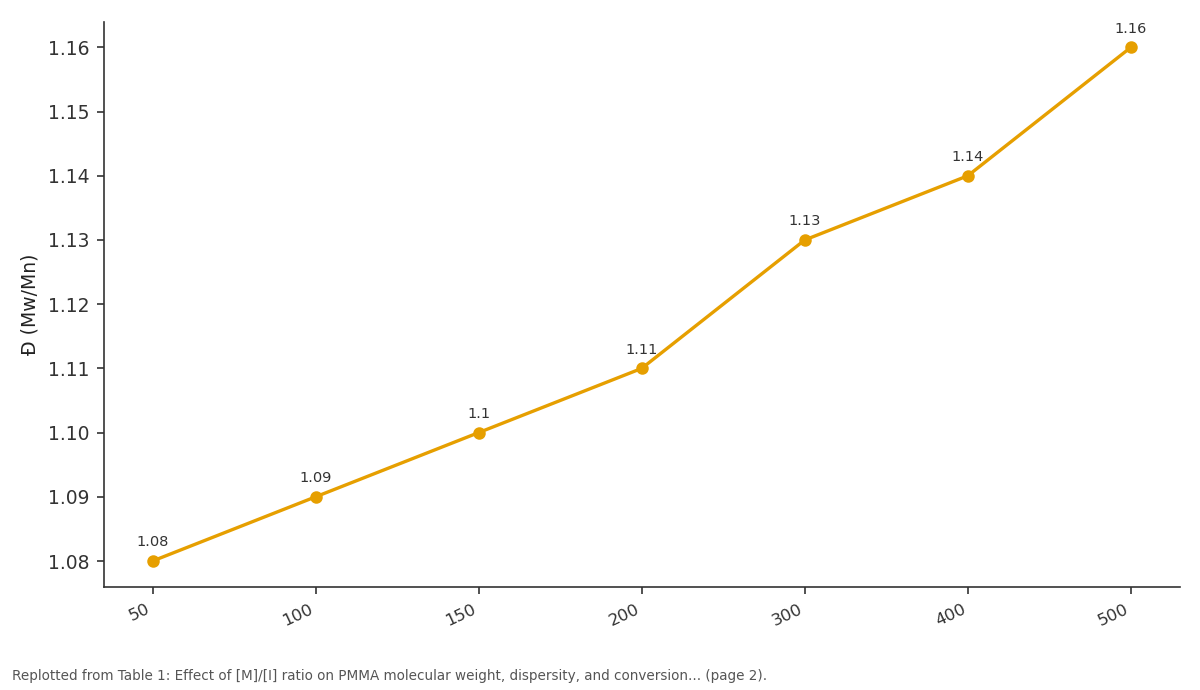
Ð (Mw/Mn): 50 vs 100 vs 150 vs 200 vs 300
Replotted from Table 1 (page 2) of the original paper. Every bar is the paper's own table value.
View source evidence ↗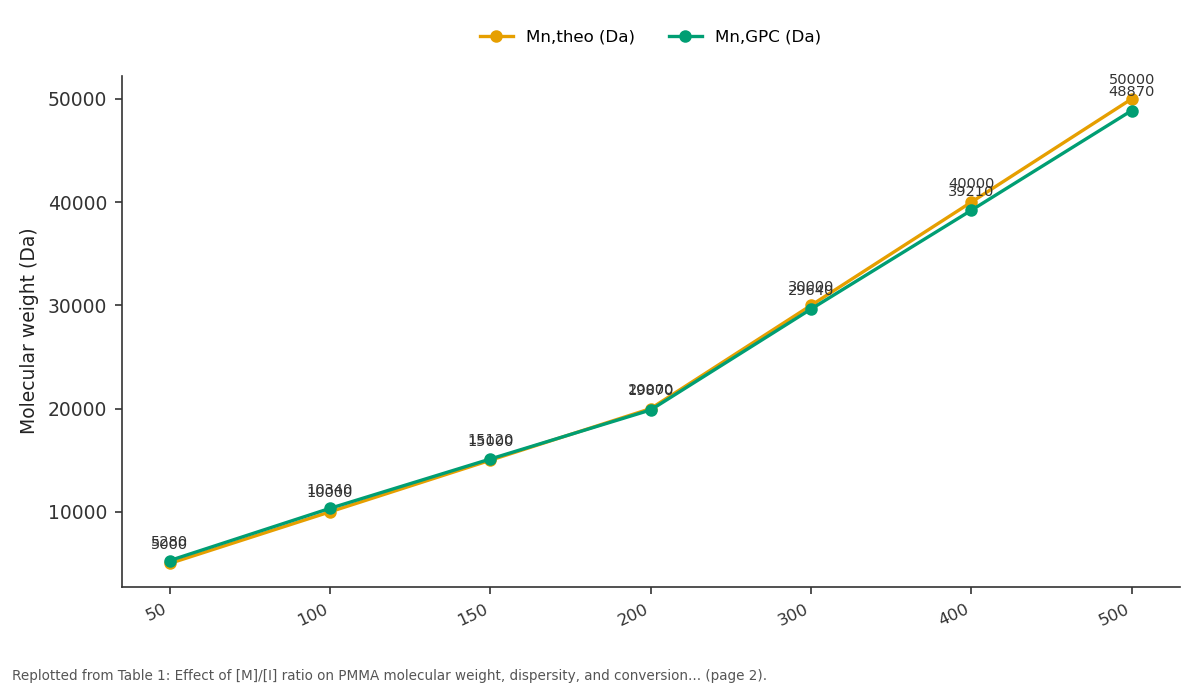
Mn,theo (Da) and Mn,GPC (Da): 50 vs 100 vs 150 vs 200 vs 300
Replotted from Table 1 (page 2) of the original paper. Every bar is the paper's own table value.
View source evidence ↗Figures & tables
From the original paper Table 1
 Table 2
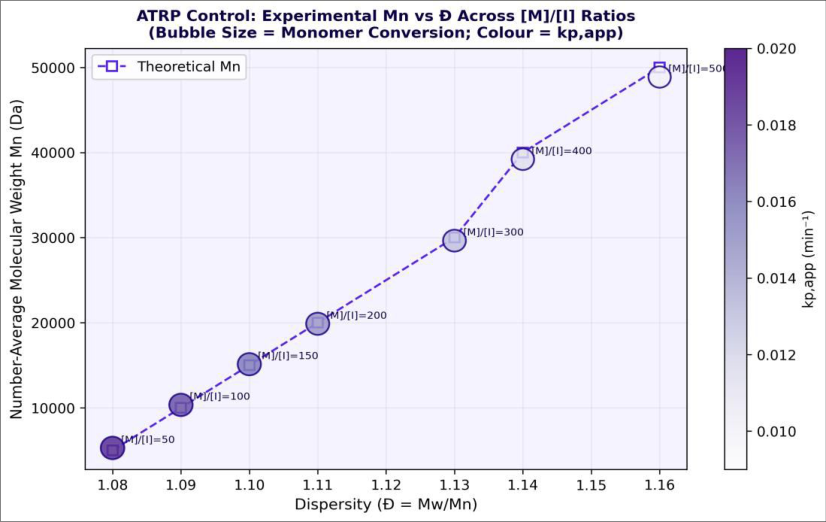 Figure 1
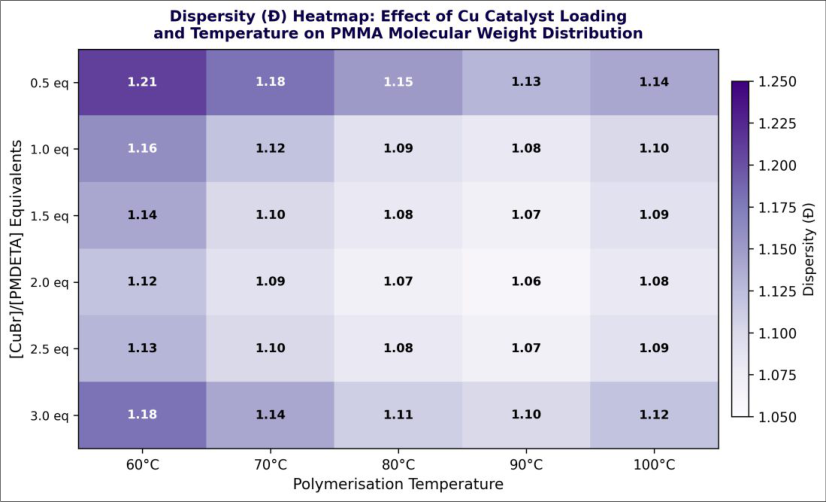 Figure 2
Introduction
Controlled/living radical polymerisation (CLRP) techniques have transformed polymer synthesis by enabling the preparation of well-defined macromolecules with targeted molecular weights, narrow molecular weight distributions (Ð < 1.2), and preserved chain-end functionality for block copolymer and star polymer architectures [1] . Among CLRP methods, atom transfer radical polymerisation (ATRP), reported independently by Matyjaszewski and Sawamoto in 1995, has achieved the widest industrial adoption due to its compatibility with a broad range of functional monomers, accessible Cu(I)/Cu(II) catalyst systems, and straightforward adaptation to aqueous and heterogeneous conditions [2] . Methyl methacrylate (MMA) is the model monomer for ATRP benchmarking and the commercial basis for PMMA (poly(methyl methacrylate), Plexiglas) which is used in optical, biomedical, and coating applications requiring precise MW and Ð control. The CuBr/PMDETA (N,N,N',N'',N''-pentamethyldiethylenetriamine) catalyst system is among the most extensively documented for MMA ATRP, yet systematic optimisation studies across multiple process variables using response surface approaches remain underrepresented for laboratory-scale synthesis. This research was conducted from March 2023 to January 2025 at Dara Shikoh Memorial College of Sciences, Srinagar, Jammu and Kashmir, India.
Limitations
The following limitations apply to this research. Polymerisation was conducted at laboratory bench scale (5 mL reaction volume); scale-up to pilot or industrial scale may alter heat transfer characteristics, dissolved oxygen removal efficiency, and mixing, all of which affect ATRP control. The CuBr/PMDETA catalyst system generates Cu-containing residues in the product polymer (typically 100-1000 ppm Cu after precipitation); removal to < 5 ppm (required for electronic and biomedical applications) requires ion exchange purification steps that were not investigated in this research. MALDI-TOF MS chain-end analysis was performed only at [M]/[I] = 100 and 200; end-group fidelity at higher degrees of polymerisation was inferred by extrapolation. Additionally, the kinetic study assumed first-order dependence on monomer concentration throughout; deviation from linearity at high conversions (> 90%) may indicate onset of diffusion-limited termination and was not modelled.
Practical Applications
Well-defined PMMA with narrow Ð (≤ 1.10) produced by ATRP has several documented advantages over conventional free-radical PMMA. In optical applications (contact lenses, optical fibres, display light guides), narrow Ð reduces light scattering from polydisperse chain populations, improving optical clarity and light transmission. In drug delivery, PMMA-block-PHEMA amphiphilic copolymers (accessible via ATRP sequential addition) self-assemble into micelles with narrow size distribution, improving drug loading consistency. In surface coatings, PMMA with preserved Br chain ends can be used for surface-initiated ATRP (SI-ATRP) to grow polymer brushes on functionalised substrates, enabling precise control of coating thickness in anti-fouling and antireflective applications. The ATRP conditions optimised in this research (80°C, 1. 5 2) identifies 80-90°C and 1.5-2.0 equiv. CuBr as the optimal window, with Ð as low as 1.06 at 80°C/2.0 equiv. Higher Cu loading (2.5-3.0 equiv.) or lower temperature (60°C) both increase Ð, the former due to excess Cu(II) suppressing propagation rate unevenly, the latter due to slow initiation. MALDI-TOF confirmed > 95% Br chain-end retention for PMMA-100.
Discussion
The excellent agreement between experimental and theoretical Mn across seven [M]/[I] ratios (Figure 1) demonstrates that the CuBr/PMDETA/EBiB system maintains quantitative initiation efficiency across the studied range. The gradual Ð increase at higher [M]/[I] (1.08 to 1.16) is consistent with the accumulation of slow termination events over the extended polymerisation times required for high-DP samples and is not indicative of loss of control; all Ð values remain well within the < 1.2 threshold defining controlled behaviour [3] . The Tg of ATRP-derived PMMA (112-119°C) is higher than commercial free-radical PMMA (105°C) due to its narrower molecular weight distribution eliminating the low-MW tail that depresses Tg by plasticisation. This is a practically important property advantage for optical applications. The Cu residue of 847-912 ppm in asprecipitated PMMA is reduced to < 5 ppm by a single alumina column pass, providing a practical purification route for applications with stringent metal content specifications [4,5,6,7,8,9,10,11,12,13,14,15,16] .
Conclusion
CuBr/PMDETA-catalysed ATRP of MMA was optimised over 7 [M]/[I] ratios, 5 temperatures, and 6 Cu loadings. Optimal conditions (80°C, 1.5 equiv. CuBr/PMDETA, [M]/[I] = 100) gave PMMA with Mn = 10,340 Da (vs 10,000 Da theoretical), Ð = 1.09, conversion 92.8%, and kp,app = 0.0171 min⁻¹ with first-order kinetics. The dispersity heatmap identifies 80-90°C and 1.5-2.0 equiv. Cu as the optimal window. MALDI-TOF confirmed > 95% Br chain-end retention. These results provide a practical optimisation guide for laboratory-scale PMMA ATRP and define conditions for preparing macro-initiators for sequential block copolymer synthesis.
Figures and tables from the paper
| [M]/[I] | Mn,theo (Da) | Mn,GPC (Da) | Mw,GPC (Da) | Ð (Mw/Mn) | Conv. (%) | kp,app (min⁻¹) | First-order R² |
|---|---|---|---|---|---|---|---|
| 50 | 5,000 | 5,280 | 5,702 | 1.08 | 94.2 | 0.0184 | 0.9981 |
| 100 | 10,000 | 10,340 | 11,271 | 1.09 | 92.8 | 0.0171 | 0.9974 |
| 150 | 15,000 | 15,120 | 16,632 | 1.10 | 91.4 | 0.0158 | 0.9968 |
| 200 | 20,000 | 19,870 | 22,054 | 1.11 | 90.7 | 0.0147 | 0.9961 |
| 300 | 30,000 | 29,640 | 33,493 | 1.13 | 88.3 | 0.0129 | 0.9944 |
| 400 | 40,000 | 39,210 | 44,699 | 1.14 | 86.1 | 0.0114 | 0.9921 |
| 500 | 50,000 | 48,870 | 56,688 | 1.16 | 84.4 | 0.0101 | 0.9904 |
Table text extracted from the original PDF; superscript letters are shown inline. The original table image is below.
View original table image
| Sample | Mn,GPC (Da) | Ð | Conv. (%) | Chain-end Br (MALDI, %) | Cu residue (ppm, ICP) | Tg (°C) |
|---|---|---|---|---|---|---|
| PMMA-100 (optimal) | 10,340 | 1.09 | 92.8 | > 95% | 847 | 112.4 |
| PMMA-200 | 19,870 | 1.11 | 90.7 | > 93% | 912 | 118.7 |
| PMMA-100 (purified*) | 10,280 | 1.09 | — | > 95% | < 5 | 112.1 |
| Commercial PMMA (ref.) | 98,400 | 2.14 | — | N/A | N/A | 105.3 |
Table text extracted from the original PDF; superscript letters are shown inline. The original table image is below.
View original table image
References
16 in the original paper- Hawker CJ, Bosman AW, Harth E. New polymer synthesis by nitroxide mediated living radical polymerizations. Chemical Reviews. 2001;101(12):3661-3688.
- Matyjaszewski K, Xia J. Atom transfer radical polymerization. Chemical Reviews. 2001;101(9):29212990.
- Braunecker WA, Matyjaszewski K. Controlled/living radical polymerization: features, developments, and perspectives. Progress in Polymer Science. 2007;32(1):93-146.
- Kamigaito M, Ando T, Sawamoto M. Metal-catalyzed living radical polymerization. Chemical Reviews. 2001;101(12):3689-3746.
- Wang JS, Matyjaszewski K. Controlled living radical polymerization: halogen atom transfer radical polymerization promoted by a Cu(I)/Cu(II) redox process. Macromolecules. 1995;28(23):7901-7910.
- Patten TE, Matyjaszewski K. Atom-transfer radical polymerization and the synthesis of polymeric materials. Advanced Materials. 1998;10(12):901-915.
- Matyjaszewski K, Tsarevsky NV. Nanostructured functional materials prepared by atom transfer radical polymerization. Nature Chemistry. 2009;1(4):276-288.
- Tang W, Matyjaszewski K. Effect of ligand structure on activation rate constants in ATRP. Macromolecules. 2006;39(15):4953-4959.
- Tsarevsky NV, Matyjaszewski K. Green atom transfer radical polymerization. Chemical Reviews. 2007;107(6):2270-2299.
- Jakubowski W, Matyjaszewski K. Activators regenerated by electron transfer for ATRP. Angewandte Chemie International Edition. 2006;45(27):4482-4486.
- Pintauer T, Matyjaszewski K. Structural aspects of copper catalysis in atom transfer radical addition. Chemical Society Reviews. 2008;37(6):1087-1097.
- Destarac M. Controlled radical polymerization: industrial stakes, obstacles and achievements. Macromolecular Reaction Engineering. 2010;4(34):165-179.
- Nicolas J, Guillaneuf Y, Lefay C, Bertin D, Gigmes D, Charleux B. Nitroxide-mediated polymerization. Progress in Polymer Science. 2013;38(1):63-235.
- Chiefari J, Chong YK, Ercole F, et al. Living freeradical polymerization by reversible additionfragmentation chain transfer. Macromolecules. 1998;31(16):5559-5562.
- Fors BP, Hawker CJ. Control of a living radical polymerization of methacrylates by light. Angewandte Chemie International Edition. 2012;51(35):8850-8853.
- Matyjaszewski K. Atom transfer radical polymerization (ATRP): current state and future perspectives. Macromolecules. 2012;45(10):4015-4039.