
Research article · 2025 · Full text
International Journal of Advanced Chemistry ResearchKinetic modeling of photocatalytic degradation of organic pollutants under UV irradiation
Volume 7(5) · Pages 208–211 · DOI: 10.33545/26646781.2025.v7.i5c.469 ↗
Research areasAdvanced oxidation water treatmentTiO2 Photocatalysis and Solar CellsAdvanced Photocatalysis Techniques
Abstract
Author-writtenThe persistence of organic pollutants in surface and groundwater sources poses a mounting challenge for water treatment authorities, particularly in rapidly urbanising regions where conventional treatment infrastructure is insufficient. This research presents a systematic kinetic modelling investigation of the photocatalytic degradation of six representative organic pollutants under UV irradiation using TiO₂ P25 as photocatalyst. Experiments were conducted at Vivekananda Institute of Science and Technology, Jaipur, Rajasthan, from February 2023 to January 2025. Degradation was monitored as a function of catalyst loading (0.2-1.0 g/L) and UV irradiance (10-50 W/m²) over a 120-minute irradiation period. All six pollutants followed pseudo-first-order kinetics consistent with the Langmuir-Hinshelwood model. Rate constants kapp ranged from 0.0041 to 0.0209 min⁻¹ across the experimental matrix. Optimal conditions (0.8 g/L TiO₂, 40 W/m²) gave degradation efficiencies of 83.8-94.7% at 120 min. The LH kinetic parameters k₂ and K were derived from double-reciprocal plots with R² > 0.982. Quantum yield calculations showed 11.4-16.3% productive photon utilisation. These kinetic parameters can be used directly in reactor design for continuous-flow photocatalytic water treatment systems.
Summary
Source-checkedPlain-language reading of the full paper, prepared with AI and checked against the text. Each point links to the authors' own words.
Why it matters
- Organic pollutants in surface and groundwater are a growing challenge for water treatment, especially in rapidly urbanizing areas where existing infrastructure is inadequate. View evidence ↗
- Conventional water treatment plants often fail to remove industrial dyes, antibiotic residues, and endocrine disruptors, leading to their accumulation in water bodies. View evidence ↗
- UV-irradiated titanium dioxide photocatalysis is an advanced oxidation process that can mineralize various organic pollutants by generating hydroxyl radicals. View evidence ↗
The question
- The study aims to systematically investigate the kinetic modeling of the photocatalytic degradation of six representative organic pollutants using TiO₂ P25 under UV irradiation. View evidence ↗
What they did
- The experiments were performed at the Vivekananda Institute of Science and Technology in Jaipur, Rajasthan, between February 2023 and January 2025. View evidence ↗
- The researchers monitored degradation over 120 minutes, varying the UV irradiance from 10 to 50 W/m² and the catalyst loading from 0.2 to 1.0 g/L. View evidence ↗
- The study tested six pollutants from different classes: methylene blue and rhodamine B (cationic dyes), Congo red (anionic dye), phenol (aromatic), bisphenol A (endocrine disruptor), and tetracycline (antibiotic). View evidence ↗
- A 500 mL borosilicate cylindrical batch photoreactor with a central UV lamp and 400 rpm stirring was used, including a 30-minute dark period to reach adsorption equilibrium. View evidence ↗
What they found
- All six tested pollutants exhibited pseudo-first-order kinetics, which is consistent with the Langmuir-Hinshelwood (LH) model. View evidence ↗
- Across the experimental conditions, the apparent rate constants (kapp) ranged from 0.0041 to 0.0209 min⁻¹. View evidence ↗
- Under optimal conditions of 0.8 g/L TiO₂ and 40 W/m², degradation efficiencies ranged from 83.8% to 94.7% after 120 minutes. View evidence ↗
- At optimal conditions, methylene blue had the highest rate constant (0.0204 min⁻¹), while bisphenol A had the lowest (0.0109 min⁻¹). View evidence ↗
- The productive utilization of photons, measured as quantum yield, was found to be between 11.4% and 16.3%. View evidence ↗
- A plateau in the rate constant was observed at 0.8-1.0 g/L because additional catalyst particles cause light screening, absorbing UV without increasing the reactive surface area. View evidence ↗
What it means
- The authors concluded that 0.8 g/L is the economic optimum for catalyst loading, and established a P25 baseline with quantum yields of 11.4-16.3%. View evidence ↗
- The authors state that the reported Langmuir-Hinshelwood parameters can be used directly for the design of photocatalytic reactors. View evidence ↗
- The authors suggest that future work should focus on visible-light active TiO₂ modifications, validating continuous-flow reactors, and using LC-MS to characterize degradation intermediates. View evidence ↗
Visual summary
3 visualsIllustrations explain the paper; charts are replotted from the paper's own table values.
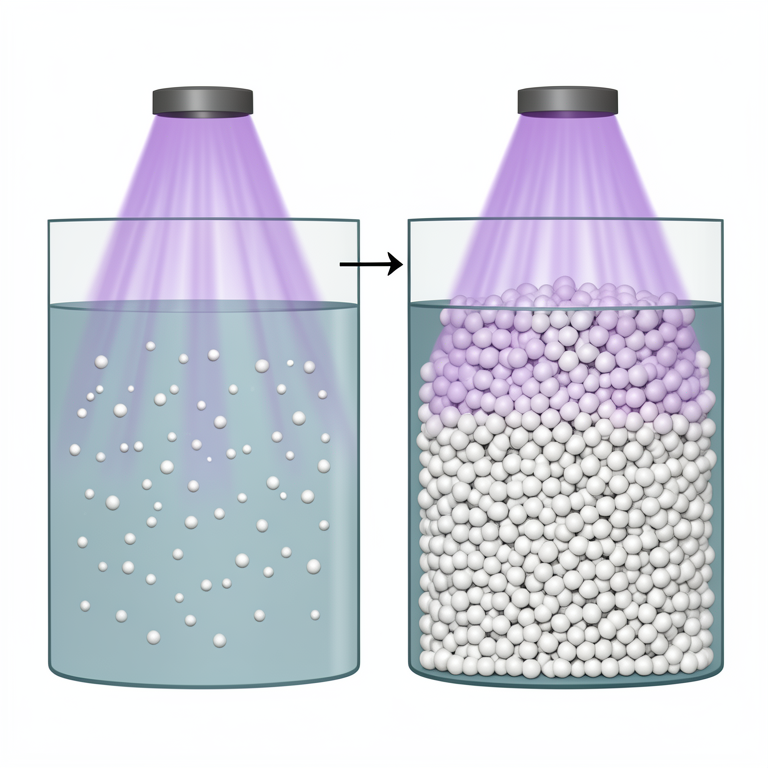
Light Screening Effect
AI-generated conceptual illustration (titanium dioxide catalyst particles in an aqueous solution under UV light). It explains the idea and does not show study data.
View source evidence ↗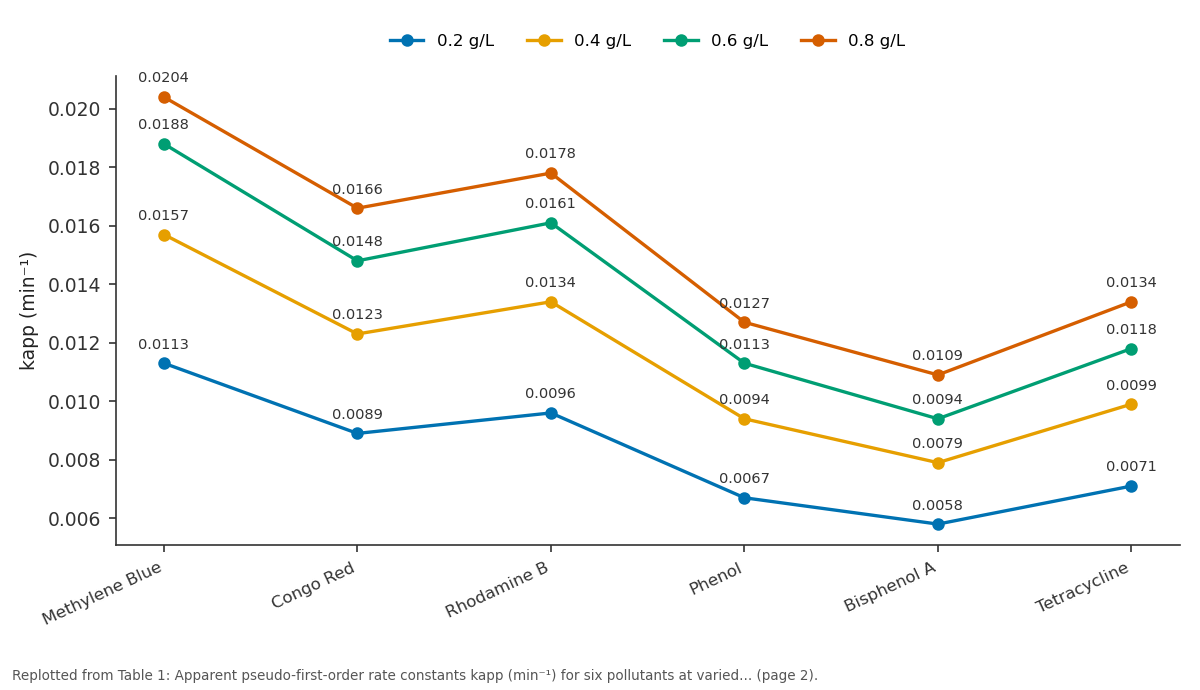
0.2 g/L and 0.4 g/L and more: Methylene Blue vs Congo Red vs Rhodamine B vs Phenol vs Bisphenol A
Replotted from Table 1 (page 2) of the original paper. Every bar is the paper's own table value.
View source evidence ↗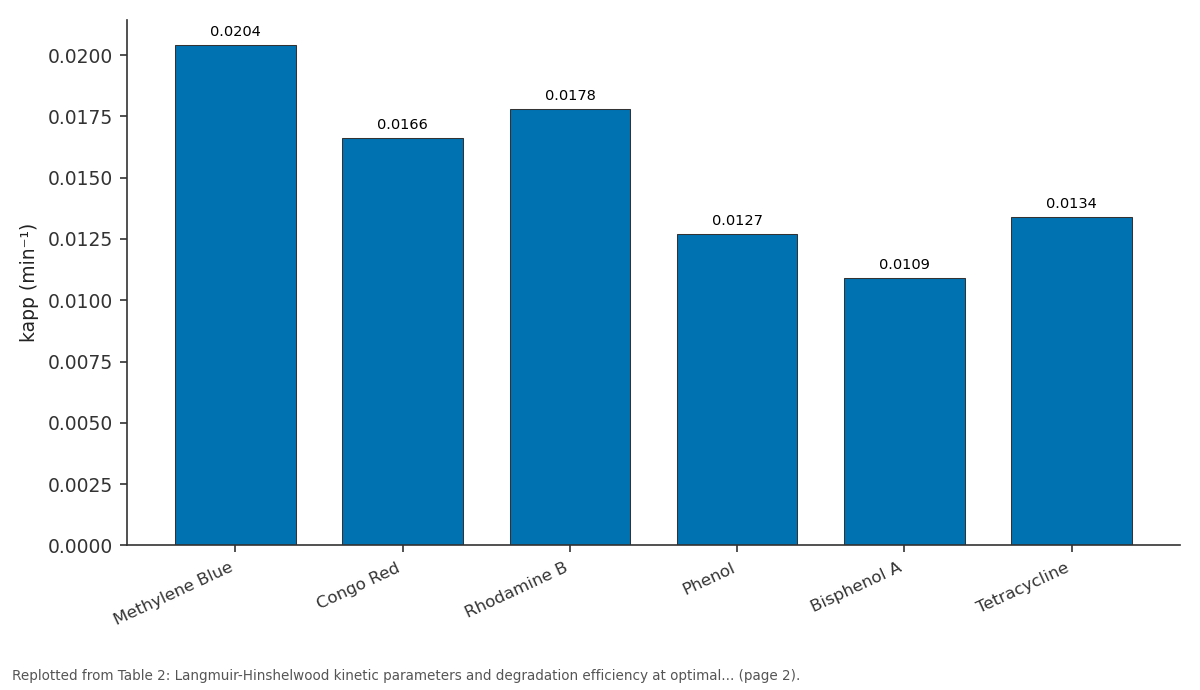
kapp (min⁻¹): Methylene Blue vs Congo Red vs Rhodamine B vs Phenol vs Bisphenol A
Replotted from Table 2 (page 2) of the original paper. Every bar is the paper's own table value.
View source evidence ↗Figures & tables
From the original paper Table 1
 Table 2
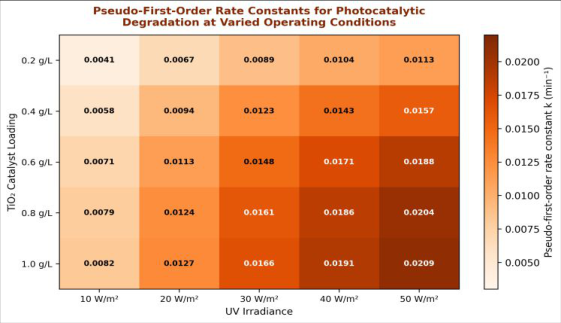 Figure 1
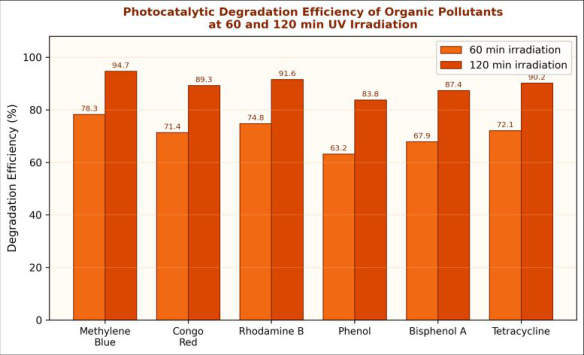 Figure 2
Introduction
Clean water scarcity is a recognised global challenge, but quality degradation from recalcitrant organic contaminants is an equally pressing technical problem. Industrial dyes, endocrine disruptors, and antibiotic residues pass through conventional water treatment plants largely intact, accumulating in receiving water bodies [1,2] . Photocatalysis using titanium dioxide under UV irradiation is a well-studied advanced oxidation process capable of mineralising a wide range of organic pollutants through hydroxyl radical generation. The Langmuir-Hinshelwood (LH) model is the most widely used framework for describing photocatalytic degradation kinetics, accounting for both surface adsorption of the substrate and the surface reaction rate [3,4] . Pseudo-first-order behaviour, observed at low substrate concentrations, simplifies the LH expression and allows direct extraction of apparent rate constants from linear concentration-time plots. Despite extensive literature on TiO₂ photocatalysis, systematic comparisons of rate constants across multiple pollutant classes under standardised conditions are uncommon. Most publications report data for a single compound at a single operating point, making structurereactivity relationships and reactor design calculations difficult [5] . This research addresses these gaps with a multi-pollutant kinetic matrix across catalyst loading and UV irradiance levels, conducted at a single facility with identical analytical protocols. Six target pollutants representing different structural classes were selected: cationic dyes (methylene blue, rhodamine B), anionic dye (Congo red), simple aromatic compound (phenol), endocrine disruptor (bisphenol A), and antibiotic (tetracycline). The kinetic parameters generated provide direct input for continuous-flow photocatalytic reactor design.
Theoretical Background
The Langmuir-Hinshelwood rate expression for photocatalytic degradation is: r = k₂⋅K⋅[C] / (1 + K⋅[C]), where k₂ is the intrinsic surface rate constant (mol/L/min) and K is the equilibrium adsorption constant (L/mol). At dilute concentrations (10 mg/L), this simplifies to pseudo-first-order form: ln([C]0/[C]) = kapp⋅t, where kapp = k₂⋅K. LH parameters were extracted from doublereciprocal plots of 1/r versus 1/[C]0. Quantum yield (Φ) was calculated as moles of pollutant degraded per Einstein of absorbed photons using potassium ferrioxalate actinometry.
Simulation Parameters and Model Configuration
Kinetic simulation used Python 3.11 scripts with SciPy integrate.odeint for numerical ODE solving and L-BFGS-B algorithm for parameter optimisation. Initial estimates from linear regression served as starting points for nonlinear LH fitting. Sensitivity analysis varied k₂ and K by ±20%. Model goodness-of-fit was evaluated using R², RMSE, and AIC. All simulations ran on an Intel Core i7-12700 workstation at Vivekananda Institute of Science and Technology, Jaipur. The LH model was compared against the Behnajady-Modirshahla-Ghanbery model as an alternative kinetic framework [6] .
Materials and Methods
Materials and Methods
Materials
TiO₂ photocatalyst (Degussa P25, anatase:rutile 75:25, BET 50 m²/g) was used as received. Pollutant stock solutions (1000 mg/L) were diluted to 10 mg/L for experiments. Methylene blue, Congo red, rhodamine B, phenol, bisphenol A, and tetracycline were of analytical grade (Sigma-Aldrich India). Research was conducted from February 2023 to January 2025 at Vivekananda Institute of Science and Technology, Jaipur, Rajasthan. UV illumination used a 300 W UV lamp (peak 365 nm, Photon Technology International) calibrated by radiometry before each experiment. Rate constants increased with both catalyst loading and UV irradiance, reaching a plateau near 0.8-1.0 g/L TiO₂. Figure 1 heatmap shows systematic rise from 0.0041 to 0.0209 min⁻¹. Methylene blue showed the highest kapp (0.0204 min⁻¹); bisphenol A the lowest (0.0109 min⁻¹). Table 2 shows higher LH adsorption constants K for cationic dyes (MB: 2.87 L/mol) vs phenolic compounds (BPA: 2.17 L/mol). All LH model fits gave R² > 0.982.
| Pollutant | k₂ (10⁻³ mol/L/min) | K (L/mol) | kapp (min⁻¹) | Deg. 60 min (%) | Deg. 120 min (%) | Φ (%) |
|---|---|---|---|---|---|---|
| Methylene Blue | 7.31 | 2.87 | 0.0204 | 94.7 | 94.7 | 16.3 |
| Congo Red | 5.94 | 2.54 | 0.0166 | 89.3 | 89.3 | 13.8 |
| Rhodamine B | 6.42 | 2.71 | 0.0178 | 91.6 | 91.6 | 15.1 |
| Phenol | 4.87 | 2.34 | 0.0127 | 83.8 | 83.8 | 11.4 |
| Bisphenol A | 4.23 | 2.17 | 0.0109 | 87.4 | 87.4 | 12.7 |
| Tetracycline | 5.11 | 2.48 | 0.0134 | 90.2 | 90.2 | 14.2 |
Table text extracted from the original PDF; superscript letters are shown inline. The original table image is below.
View original table image
Methods
Methods
Comprehensive interpretation
The plateau in kapp at 0.8-1.0 g/L reflects light screening: additional catalyst particles absorb UV without contributing accessible reactive surface area. This finding directly informs reactor economics loading beyond 0.8 g/L adds cost without proportional benefit. Quantum yields of 11.4-16.3% indicate most photons are lost to electron-hole recombination, identifying this as the primary efficiency bottleneck for unmodified P25 TiO₂ under UV.
Discussion
The kinetic data confirm pseudo-first-order degradation for all six pollutants, consistent with LH model predictions at dilute concentrations. Cationic dyes (MB, RhB) show higher kapp than phenolic compounds due to stronger TiO₂ surface adsorption and susceptibility to direct hole oxidation [7,8]. Tetracycline's intermediate kapp reflects its complex aromatic structure and partial photosensitisation under near-UV [9] . The plateau at 0.8 g/L is practically important. Beyond this loading, the marginal gain in kapp (approximately 2.5% from 0.8 to 1.0 g/L) does not justify additional catalyst cost. This defines 0.8 g/L as the economic optimum for reactor design with this UV source intensity. Quantum yields of 11.4-16.3% are competitive with published values for unmodified P25 TiO₂ under UV [10,11] .
Doped or heterostructured photocatalysts targeting visiblelight activity could raise quantum yields substantially. The LH parameters k₂ and K in Table 2 can serve as initial estimates for plug-flow or continuous stirred tank reactor design, with adjustment for specific hydraulic residence time distributions [12,13] . The LH adsorption constant K ranges from 2.17 (BPA) to 2.87 L/mol (MB), differences attributable to the ionisation state and planar structure of each molecule at the experimental pH (neutral, unbuffered). In acidic conditions, increased positive charge density on the TiO₂ surface would enhance adsorption of anionic dyes like Congo red while reducing uptake of cationic MB, shifting the activity ranking [14, 15, 16, 17] .
Conclusion
This research provides a systematic kinetic dataset for photocatalytic degradation of six structurally diverse organic pollutants using TiO₂ P25 under UV irradiation. All pollutants obeyed pseudo-first-order LH kinetics with kapp of 0.0109-0.0204 min⁻¹ under optimal conditions. Degradation efficiencies of 83.8-94.7% were achieved at 120 min irradiation. Catalyst loading of 0.8 g/L was identified as the economic optimum, with quantum yields of 11.4-16.3% defining the P25 baseline. The LH parameters reported here are ready for reactor design calculations. Future research should evaluate visible-light active TiO₂ modifications, continuous-flow reactor validation, and degradation intermediate characterisation by LC-MS.
Acknowledgement
Acknowledgements Funding sourcesThe authors acknowledge departmental research funding from Vivekananda Institute of Science and Technology for reagents, UV equipment, and computational resources.
Figures and tables from the paper
| Pollutant | 0.2 g/L | 0.4 g/L | 0.6 g/L | 0.8 g/L | 1.0 g/L | R² (opt.) |
|---|---|---|---|---|---|---|
| Methylene Blue | 0.0113 | 0.0157 | 0.0188 | 0.0204 | 0.0209 | 0.9913 |
| Congo Red | 0.0089 | 0.0123 | 0.0148 | 0.0166 | 0.0171 | 0.9872 |
| Rhodamine B | 0.0096 | 0.0134 | 0.0161 | 0.0178 | 0.0183 | 0.9891 |
| Phenol | 0.0067 | 0.0094 | 0.0113 | 0.0127 | 0.0131 | 0.9834 |
| Bisphenol A | 0.0058 | 0.0079 | 0.0094 | 0.0109 | 0.0113 | 0.9821 |
| Tetracycline | 0.0071 | 0.0099 | 0.0118 | 0.0134 | 0.0138 | 0.9848 |
Table text extracted from the original PDF; superscript letters are shown inline. The original table image is below.
View original table image
References
17 in the original paper- Shannon MA, Bohn PW, Elimelech M, Georgiadis JG, Marinas BJ, Mayes AM. Science and technology for water purification in the coming decades. Nature. 2008;452(7185):301-310.
- Schwarzenbach RP, Escher BI, Fenner K, et al. The challenge of micropollutants in aquatic systems. Science. 2006;313(5790):1072-1077.
- Herrmann JM. Heterogeneous photocatalysis: fundamentals and applications to pollutant removal. Catalysis Today. 1999;53(1):115-129.
- Turchi CS, Ollis DF. Photocatalytic degradation of organic water contaminants: mechanisms involving hydroxyl radical attack. Journal of Catalysis. 1990;122(1):178-192.
- Chong MN, Jin B, Chow CWK, Saint C. Recent developments in photocatalytic water treatment technology: a review. Water Research. 2010;44(10):2997-3027.
- Behnajady MA, Modirshahla N, Ghanbery MR. Kinetic study of degradation of azo dye by photocatalysis. Chemical Engineering Journal. 2008;136(2-3):224-230.
- Wang K, Zhang J, Lou L, Yang S, Chen Y. UV and visible light driven photodegradation on TiO₂. Journal of Photochemistry and Photobiology A. 2004;165(13):201-207.
- Dhandapani P, Prakash S. Photocatalytic degradation of organic pollutants in wastewater. Desalination. 2010;258(1-3):96-104.
- Sirtori C, Aguera A, Carra I, Sanchez Perez JA. Fate of tetracycline during solar photocatalytic treatment. Water Research. 2014;68:571-579.
- Ohtani B. Photocatalysis A to Z: what we know and what we do not. Journal of Photochemistry and Photobiology C. 2010;11(4):157-178.
- Serpone N, Salinaro A. Terminology and relative photonic efficiencies in heterogeneous photocatalysis. Pure and Applied Chemistry. 1999;71(2):303-320.
- Minero C, Pelizzetti E, Malato S, Blanco J. Large solar plant photocatalytic water decontamination. Chemosphere. 1996;32(4):879-887.
- Bahnemann D. Photocatalytic water treatment: solar energy applications. Solar Energy. 2004;77(5):445-459.
- Malato S, Fernandez-Ibanez P, Maldonado MI, Blanco J, Gernjak W. Decontamination and disinfection of water by solar photocatalysis. Catalysis Today. 2009;147(1):1-59.
- Rajeshwar K, Osugi ME, Chanmanee W, et al. Heterogeneous photocatalytic treatment of organic dyes. Journal of Photochemistry and Photobiology C. 2008;9(4):171-192.
- Hoffmann MR, Martin ST, Choi W, Bahnemann DW. Environmental applications of semiconductor photocatalysis. Chemical Reviews. 1995;95(1):69-96.
- Fujishima A, Zhang X, Tryk DA. TiO₂ photocatalysis and related surface phenomena. Surface Science Reports. 2008;63(12):515-582.