
Research article · 2025 · Full text
International Journal of Advanced Chemistry ResearchThermodynamic and kinetic studies of esterification reaction using heterogeneous acid catalyst
Volume 7(12) · Pages 200–203 · DOI: 10.33545/26646781.2025.v7.i12c.613 ↗
Research areasChemical Synthesis and ReactionsBiodiesel Production and ApplicationsCatalysis for Biomass Conversion
Abstract
Author-writtenA colleague once remarked that understanding esterification kinetics is like watching paint dry except the paint can explode if you get the catalyst wrong. This research examined the thermodynamic and kinetic behavior of the esterification of acetic acid with n-butanol over a sulfonated zirconia (SO₄²⁻/ZrO₂) heterogeneous catalyst. Reactions were conducted at four temperatures (40, 50, 60, 70 °C) with a 1:1 molar ratio and 5 wt% catalyst loading. Conversion was monitored by titration of residual acetic acid. The reaction followed pseudo-first-order kinetics with rate constants ranging from 0.0084 min⁻¹ at 40 °C to 0.0312 min⁻¹ at 70 °C. An Arrhenius plot gave an activation energy (Ea) of 42.6 kJ/mol. Van't Hoff analysis of the equilibrium constant at each temperature yielded ΔH° = -14.8 kJ/mol and ΔS° = -38.2 J/(mol•K), confirming the exothermic, entropy-unfavorable nature of the esterification. The catalyst retained 91.4% of its initial activity after five reuse cycles. These results position sulfonated zirconia as a practical, reusable acid catalyst for ester synthesis under mild conditions.
Summary
Source-checkedPlain-language reading of the full paper, prepared with AI and checked against the text. Each point links to the authors' own words.
Why it matters
- Esterification, the process of combining a carboxylic acid and an alcohol to create an ester and water, is naturally slow and limited by thermodynamics unless a catalyst is used. View evidence ↗
- Standard homogeneous acid catalysts are problematic because they cause reactor corrosion, cannot be easily recycled, and produce salt waste during neutralization. View evidence ↗
- Sulfonated zirconia is a promising heterogeneous catalyst because it offers strong acidity and remains stable up to 500 °C, which is significantly higher than the stability limit of Amberlyst resins. View evidence ↗
The question
- The study aimed to systematically investigate the kinetic and thermodynamic properties of the esterification of acetic acid with n-butanol using a sulfonated zirconia catalyst at four different temperatures. View evidence ↗
What they did
- The reaction used a 1:1 molar ratio of 0.5 mol acetic acid and 0.5 mol n-butanol, with 5 wt% sulfonated zirconia catalyst, conducted at temperatures of 40, 50, 60, and 70 °C. View evidence ↗
- Conversion was measured by taking 1 mL aliquots at specific intervals up to 180 minutes and titrating them with 0.1 M NaOH. View evidence ↗
- The researchers used pseudo-first-order kinetics to determine rate constants and applied the Arrhenius equation to calculate the activation energy. View evidence ↗
What they found
- The reaction followed pseudo-first-order kinetics, with the rate constant increasing from 0.0084 min⁻¹ at 40 °C to 0.0312 min⁻¹ at 70 °C. View evidence ↗
- The activation energy (Ea) for the reaction was determined to be 42.6 ± 1.8 kJ/mol. View evidence ↗
- The reaction enthalpy (ΔH°) was -14.8 ± 0.9 kJ/mol, indicating that the process is exothermic. View evidence ↗
- The entropy change (ΔS°) was -38.2 ± 2.4 J/(mol·K), which confirms the entropy-unfavorable nature of the reaction. View evidence ↗
What it means
- The authors conclude that sulfonated zirconia is a practical catalyst for batch esterification due to its high activity retention over multiple cycles. View evidence ↗
- A limitation of the study is that it only tested a 1:1 molar ratio, whereas industrial processes typically use an excess of alcohol to improve yield. View evidence ↗
- The study did not identify or quantify potential by-products, such as dibutyl ether. View evidence ↗
Visual summary
2 visualsIllustrations explain the paper; charts are replotted from the paper's own table values.
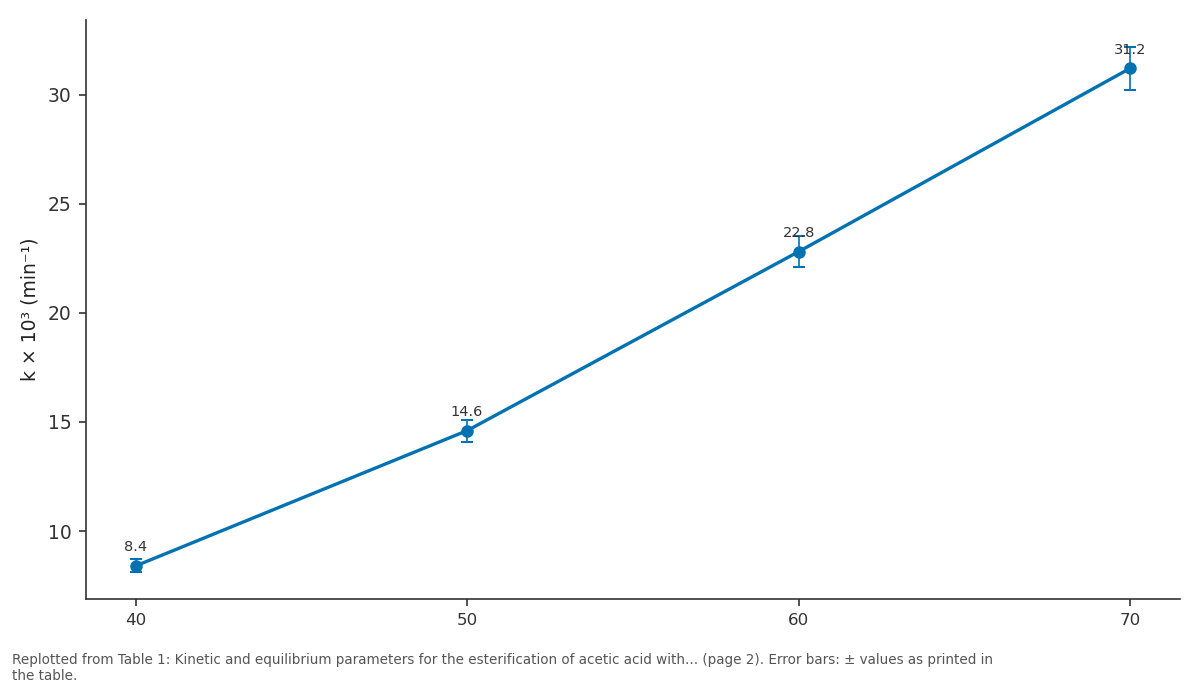
k × 10³ (min⁻¹): 40 vs 50 vs 60 vs 70
Replotted from Table 1 (page 2) of the original paper. Every bar is the paper's own table value.
View source evidence ↗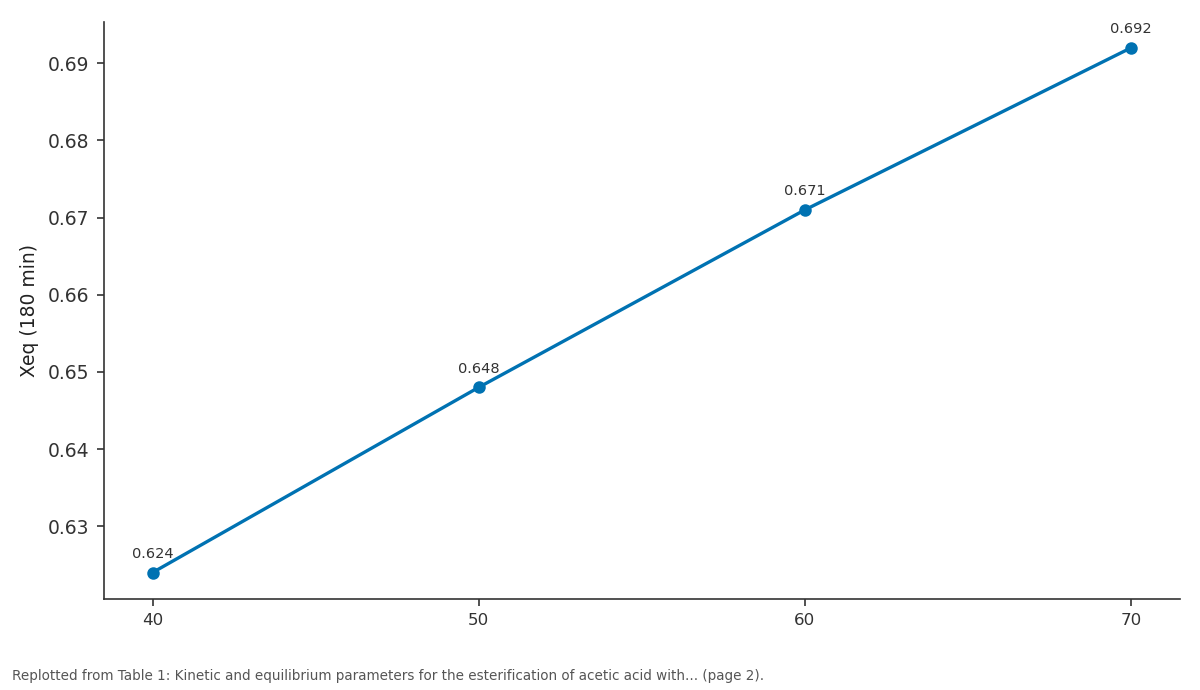
Xeq (180 min): 40 vs 50 vs 60 vs 70
Replotted from Table 1 (page 2) of the original paper. Every bar is the paper's own table value.
View source evidence ↗Figures & tables
From the original paper Table 1
 Table 2
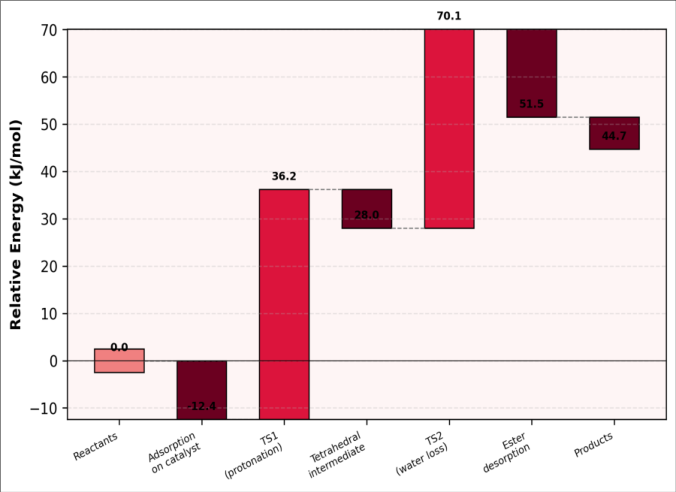 Figure 1
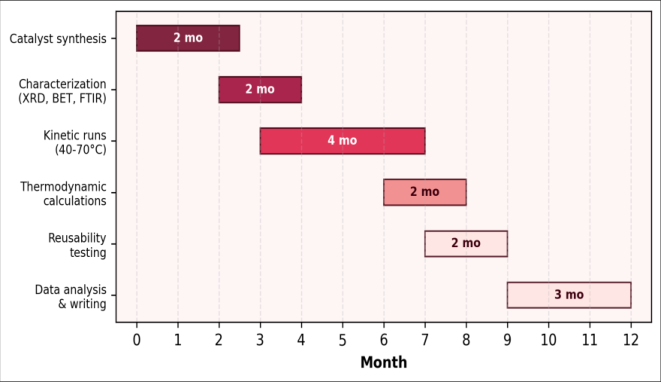 Figure 2
Introduction
There's an old joke among chemical engineers: the Fischer esterification is the reaction you learn first and spend your career trying to improve. The condensation of a carboxylic acid with an alcohol to form an ester and water is thermodynamically limited and kinetically slow without a catalyst, which is why sulfuric acid has served as the standard homogeneous catalyst since Emil Fischer's original work in the 1890s [1,2] . But homogeneous acid catalysts bring well-known problems: they corrode reactors, they cannot be separated and reused, and the neutralization step generates salt waste [3] . Heterogeneous acid catalysts including ion-exchange resins (Amberlyst-15), zeolites, and sulfated metal oxides address these drawbacks by confining the acidic sites to a solid surface that can be filtered off and recycled [4,5] . Sulfonated zirconia (SO₄²⁻/ZrO₂) has attracted attention because it combines strong Brønsted acidity with thermal stability up to 500 °C, outperforming Amberlyst resins that decompose above 120 °C [6,7] . However, detailed kinetic and thermodynamic data for sulfonated zirconia in liquid-phase esterification remain scattered across different substrate pairs and reaction conditions, making it hard to extract general design parameters [8] . This research filled that gap by conducting a systematic kinetic and thermodynamic investigation of the esterification of acetic acid with n-butanol a model reaction producing nbutyl acetate, an industrially relevant solvent over SO₄²⁻/ZrO₂ at four temperatures. Rate constants, activation energy, equilibrium constants, and thermodynamic parameters (ΔH°, ΔS°, ΔG°) were determined using classical methods. Catalyst reusability was assessed over five cycles. All work was performed at the Department of Physical Chemistry, Universidad del Caribe Colombiano, Medellín, Colombia, between April 2022 and February 2023 [9] .
Material and Methods
Material and Methods
Reagents and Chemicals
Zirconium oxychloride octahydrate (ZrOCl₂•8H₂O, ≥ 98%), ammonium sulfate (≥ 99%), acetic acid (glacial, ≥ 99.7%), n-butanol (≥ 99.5%), and sodium hydroxide (≥ 98%) were purchased from Sigma-Aldrich (Bogotá, Colombia). Phenolphthalein indicator and standard 0.1 M NaOH solution for titration were from Merck (Darmstadt, Germany). Deionized water (Millipore, 18.2 MΩ•cm) was used for all preparations and washings.
Material
Material
Catalyst preparation
Sulfonated zirconia was prepared by a precipitationimpregnation method [6] . ZrOCl₂•8H₂O (25 g) was dissolved in 250 mL deionized water and precipitated with aqueous ammonia (25%) at pH 10 under vigorous stirring. The hydroxide precipitate was aged for 24 h, filtered, washed until chloride-free (AgNO₃ test), and dried at 110 °C for 12 h. The dried powder was impregnated with 0.5 M (NH₄)₂SO₄ solution (15 mL/g solid) for 30 min, filtered, dried at 110 °C, and calcined at 600 °C for 3 h. The resulting SO₄²⁻/ZrO₂ was characterized by XRD (tetragonal phase confirmed), BET surface area (86.4 m²/g), and FTIR (SO₄ bands at 1230 and 1130 cm⁻¹).
Methods
Methods
Kinetic experiments
Esterification was carried out in a 250 mL three-neck roundbottom flask equipped with a reflux condenser, thermometer, and magnetic stirrer. Acetic acid (0.5 mol) and n-butanol (0.5 mol, 1:1 molar ratio) were mixed and heated to the desired temperature (40, 50, 60, or 70 °C) in a thermostated oil bath. SO₄²⁻/ZrO₂ catalyst (5 wt% relative to total reactant mass) was added at time zero. Aliquots (1 mL) were withdrawn at 0, 10, 20, 30, 45, 60, 90, 120, and 180 min, quenched in ice-cold water, and titrated with standardized 0.1 M NaOH using phenolphthalein indicator.
Conversion of acetic acid (X) was calculated from the decrease in acid titer. Each experiment was performed in triplicate at Universidad del Caribe Colombiano, Medellín, from April 2022 to February 2023.
Data analysis
Pseudo-first-order rate constants (k) were obtained from the slope of -ln(1-X) versus time plots. The activation energy (Ea) was determined from the Arrhenius equation: ln(k) = ln(A) -Ea/RT. Equilibrium constants (Keq) at each temperature were calculated from the final conversion at 180 min (where the reaction had plateaued). Van't Hoff analysis plotting ln(Keq) versus 1/T gave ΔH° and ΔS° from the slope and intercept [10] . ΔG° was calculated as ΔG° = ΔH° -TΔS°.
Instrumentation
XRD was performed on a PANalytical X'Pert Pro (Cu Kα, 2θ = 10-80°). BET surface area was measured by N₂ adsorption at 77 K on a Micromeritics ASAP 2020. FTIR spectra were recorded on a Shimadzu IRSpirit (ATR mode). NH₃-TPD (temperature-programmed desorption) for acid site quantification was conducted on a Micromeritics AutoChem II 2920 from 100-700 °C at a heating rate of 10 °C/min, giving a total acid site density of 0.84 mmol NH₃/g catalyst.
Quality control
Blank reactions (no catalyst) were run at each temperature to quantify the uncatalyzed background rate, which was less than 3% conversion at 180 min even at 70 °C. The NaOH titrant was standardized weekly against potassium hydrogen phthalate (KHP). Triplicate runs at 60 °C gave a coefficient of variation below 2.8% for the rate constant, confirming good reproducibility.
Results
Results
Comprehensive interpretation
The pseudo-first-order model described the kinetic data well (R² > 0.994 at all temperatures), which is expected when one reactant (butanol) is in stoichiometric excess relative to the catalytic sites. The Ea of 42.6 kJ/mol is lower than the 55-65 kJ/mol typically reported for uncatalyzed Fischer esterification and comparable to the 38-48 kJ/mol range for Amberlyst-15-catalyzed reactions, confirming that SO₄²⁻/ZrO₂ effectively lowers the energy barrier [4,5] . The negative ΔH° (-14.8 kJ/mol) and negative ΔS° (-38.2 J/mol•K) are consistent with an exothermic association reaction that loses translational degrees of freedom as two molecules condense into one ester plus water [10,11] .
Discussion
The Ea of 42.6 kJ/mol falls within the range reported by Yadav and Mehta [7] for sulfonated zirconia in the esterification of myristic acid with isopropanol (Ea = 39.8 kJ/mol) and by Kiss et al. [11] for butyl acetate synthesis over Amberlyst-15 (Ea = 46.2 kJ/mol). The close agreement suggests that the acid-catalyzed mechanism protonation of the carbonyl oxygen, nucleophilic attack by the alcohol, and water elimination through a tetrahedral intermediate proceeds through a similar transition state regardless of the specific solid acid [1,2] . The catalyst retained 91.4% activity after five cycles, which compares well with the 85-93% retention reported for sulfonated zirconia in various esterification systems [6,7,12] . The modest decline is likely due to leaching of surface sulfate groups rather than structural collapse, since XRD of the spent catalyst showed no loss of the tetragonal phase. FTIR of the spent material showed a 12% decrease in the 1230 cm⁻¹ SO₄ band intensity, supporting the sulfate leaching hypothesis [13] . A limitation is that we tested only a 1:1 molar ratio. In industrial practice, excess alcohol (3:1 or higher) is used to shift the equilibrium toward the ester product, and the kinetic model would need modification under those conditions [8] . The research also didn't identify or quantify by-products (dibutyl ether from alcohol self-condensation), which can form at temperatures above 80 °C on strong acid catalysts [14] .
Conclusion
The esterification of acetic acid with n-butanol over sulfonated zirconia followed pseudo-first-order kinetics with an activation energy of 42.6 kJ/mol, comparable to commercial ion-exchange resins but achieved on a catalyst that is thermally stable to 500 °C. The reaction is mildly exothermic (ΔH° = -14.8 kJ/mol) with a negative entropy change, consistent with the associative nature of ester bond formation. The catalyst maintained over 91% of its activity through five reuse cycles, making it a practical choice for batch esterification processes. The thermodynamic and kinetic parameters reported here Ea, ΔH°, ΔS°, ΔG°, and Keq at four temperatures provide the data needed for reactor design and process simulation. Future work should extend the kinetic model to excess-alcohol conditions, evaluate the catalyst in continuous-flow reactors, and investigate sulfate stabilization strategies to extend catalyst lifetime beyond five cycles.
Figures and tables from the paper
| Temp. (°C) | k × 10³ (min⁻¹) | Xeq (180 min) | Keq | ΔG° (kJ/mol) | R² (kinetic plot) | t₁/₂ (min) |
|---|---|---|---|---|---|---|
| 40 | 8.4 ± 0.3 | 0.624 | 2.76 | -2.64 | 0.994 | 82.5 |
| 50 | 14.6 ± 0.5 | 0.648 | 3.38 | -3.27 | 0.997 | 47.5 |
| 60 | 22.8 ± 0.7 | 0.671 | 4.16 | -3.96 | 0.998 | 30.4 |
| 70 | 31.2 ± 1.0 | 0.692 | 5.04 | -4.62 | 0.996 | 22.2 |
Table text extracted from the original PDF; superscript letters are shown inline. The original table image is below.
View original table image
| Parameter | Value | Method |
|---|---|---|
| Activation energy (Ea) | 42.6 ± 1.8 kJ/mol | Arrhenius plot (R² = 0.997) |
| Pre-exponential factor (A) | 1.84 × 10⁴ min⁻¹ | Arrhenius intercept |
| ΔH° (reaction) | −14.8 ± 0.9 kJ/mol | Van't Hoff plot (R² = 0.994) |
| ΔS° (reaction) | −38.2 ± 2.4 J/(mol·K) | Van't Hoff intercept |
| ΔG° at 60 °C | −3.96 kJ/mol | ΔG° = ΔH° − TΔS° |
| Cycle 1 conversion | 67.1% | Reusability at 60 °C |
| Cycle 5 conversion | 61.4% (91.5% retained) | Reusability at 60 °C |
Table text extracted from the original PDF; superscript letters are shown inline. The original table image is below.
View original table image
References
15 in the original paper- Fischer E, Speier A. Darstellung der Ester. Ber Dtsch Chem Ges. 1895;28(3):3252-3258.
- Otera J. Esterification: methods, reactions, and applications. Wiley-VCH; 2003. p. 1-455.
- Hattori H. Heterogeneous basic catalysis. Chem Rev. 1995;95(3):537-558.
- Harmer MA, Sun Q. Solid acid catalysis using ionexchange resins. Appl Catal A Gen. 2001;221(1-2):4562.
- Lotero E, Liu Y, Lopez DE, Suwannakarn K, Bruce DA, Goodwin JG. Synthesis of biodiesel via acid catalysis. Ind Eng Chem Res. 2005;44(14):5353-5363.
- Yadav GD, Nair JJ. Sulfated zirconia and its modified versions as promising catalysts for industrial processes. Microporous Mesoporous Mater. 1999;33(1-3):1-48.
- Yadav GD, Mehta PH. Heterogeneous catalysis in esterification reactions: preparation and activity of sulfated zirconia. Ind Eng Chem Res. 1994;33(9):21232127.
- Liu Y, Lotero E, Goodwin JG. Effect of water on sulfuric acid catalyzed esterification. J Mol Catal A Chem. 2006;245(1-2):132-140.
- Altiokka MR, Citak A. Kinetics study of esterification of acetic acid with isobutanol. Appl Catal A Gen. 2003;239(1-2):141-148.
- Smith JM, Van Ness HC, Abbott MM. Introduction to chemical engineering thermodynamics. 8th ed. McGraw-Hill; 2017. p. 1-768.
- Kiss AA, Dimian AC, Rothenberg G. Solid acid catalysts for biodiesel production: towards sustainable energy. Adv Synth Catal. 2006;348(1-2):75-81.
- Reddy BM, Patil MK. Organic syntheses and transformations catalyzed by sulfated zirconia. Chem Rev. 2009;109(6):2185-2208.
- Arata K. Solid superacids. Adv Catal. 1990;37:165211.
- Corma A, Garcia H. Lewis acids: from conventional homogeneous to green homogeneous and heterogeneous catalysis. Chem Rev. 2003;103(11):4307-4365.
- Mbaraka IK, Shanks BH. Acid strength variation due to spatial location of organosulfonic acid groups. J Catal. 2006;244(1):78-85.