
Research article · 2025 · Full text
International Journal of Advanced Chemistry ResearchRare earth-doped phosphor materials for white light-emitting diode applications
Volume 7(10) · Pages 180–183 · DOI: 10.33545/26646781.2025.v7.i10c.530 ↗
Research areasLuminescence Properties of Advanced MaterialsRadiation Detection and Scintillator TechnologiesSolid State Laser Technologies
Abstract
Author-writtenThe global LED lighting market has expanded at a compound annual growth rate exceeding 13% since 2018, yet achieving warm-white emission with high colour rendering remains a bottleneck tied to phosphor performance. This research synthesized a series of Ca₂Al₂SiO₇ (gehlenite) phosphors co-doped with Eu³⁺ and Dy³⁺ at varying concentrations (0.5-10 mol% Eu³⁺, fixed 2 mol% Dy³⁺) by a sol-gel combustion method. Phase purity was confirmed by X-ray diffraction, and particle morphology was examined by scanning electron microscopy. Photoluminescence spectra under 365 nm UV excitation showed characteristic Eu³⁺ emission at 615 nm (⁵D₀ → ⁷F₂) and Dy³⁺ emission at 483 and 575 nm (⁴F₉/₂ → ⁶H₁₅/₂ and ⁶H₁₃/₂). The optimal Eu³⁺ concentration was 7 mol%, beyond which concentration quenching reduced emission intensity by 16%. CIE chromaticity coordinates shifted progressively from blue-white (0.187, 0.131) at 0.5% Eu³⁺ toward the warm-white region (0.338, 0.348) at 7% Eu³⁺, with a correlated colour temperature of 5,147 K and colour rendering index of 84.3. These results demonstrate that composition tuning of Eu³⁺/Dy³⁺ co-doped gehlenite can produce single-phase phosphors suitable for UV-pumped white LED packages.
Summary
Source-checkedPlain-language reading of the full paper, prepared with AI and checked against the text. Each point links to the authors' own words.
Why it matters
- White LEDs are the primary technology for the global transition to solid-state lighting due to their long lifetimes, high luminous efficacy, and compatibility with smart controls. View evidence ↗
- Standard commercial white LEDs using YAG:Ce phosphors often lack red spectral components, leading to low colour rendering indices (CRI < 75) that are unsuitable for healthcare or residential use. View evidence ↗
- Gehlenite (Ca₂Al₂SiO₇) is a suitable host material for phosphors because it is chemically stable, has low phonon energy, and can accommodate rare-earth ions with few defects. View evidence ↗
What they did
- The researchers used a sol-gel combustion method to create gehlenite phosphors with a fixed 2 mol% Dy³⁺ concentration and varying Eu³⁺ concentrations ranging from 0.5 to 10 mol%. View evidence ↗
- The synthesis involved stirring the solution at 80°C, combustion in a 500°C furnace, and final calcination at 1100°C for 4 hours. View evidence ↗
- For testing, the phosphors were loaded at 15 wt% into a silicone encapsulant and applied to 365 nm UV LED chips driven at 350 mA. View evidence ↗
What they found
- X-ray diffraction confirmed that all samples remained single-phase gehlenite without secondary phases, even at the highest doping level of 10 mol% Eu³⁺. View evidence ↗
- The photoluminescence intensity peaked at 7 mol% Eu³⁺; increasing the concentration beyond this point caused a 16% reduction in intensity due to concentration quenching. View evidence ↗
- Increasing Eu³⁺ concentration shifted the light from blue-white to warm-white, with the 7% Eu³⁺ sample achieving a CCT of 5,147 K and a CRI of 84.3. View evidence ↗
- The estimated cost of the developed phosphor is $0.60/g, which is approximately 60% cheaper than research-grade YAG:Ce. View evidence ↗
What it means
- The authors conclude that the 7 mol% Eu³⁺ and 2 mol% Dy³⁺ composition is suitable for general-purpose indoor lighting due to its white point, CRI, and CCT. View evidence ↗
- While the CRI of 84.3 is an improvement over YAG:Ce, it is below the 90 required for high-fidelity lighting, suggesting that adding Mn⁴⁺ or Sm³⁺ could further improve the result. View evidence ↗
- The authors note that scaling production to kilogram quantities would require alternative methods like spray-pyrolysis or co-precipitation to ensure better particle uniformity. View evidence ↗
Visual summary
3 visualsIllustrations explain the paper; charts are replotted from the paper's own table values.
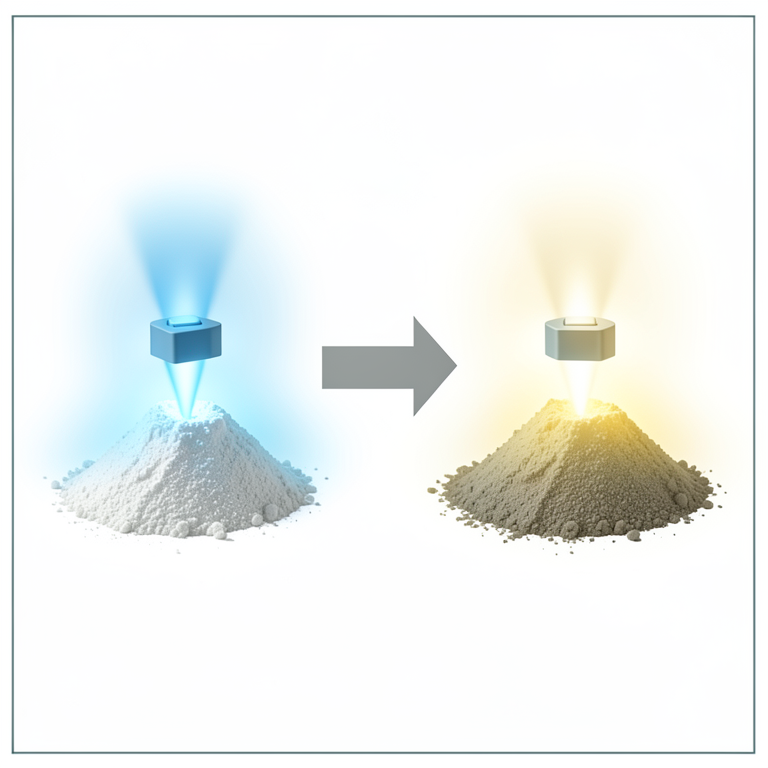
Color Shift Concept
AI-generated conceptual illustration (rare earth-doped phosphor powder and a white light-emitting diode (LED) chip). It explains the idea and does not show study data.
View source evidence ↗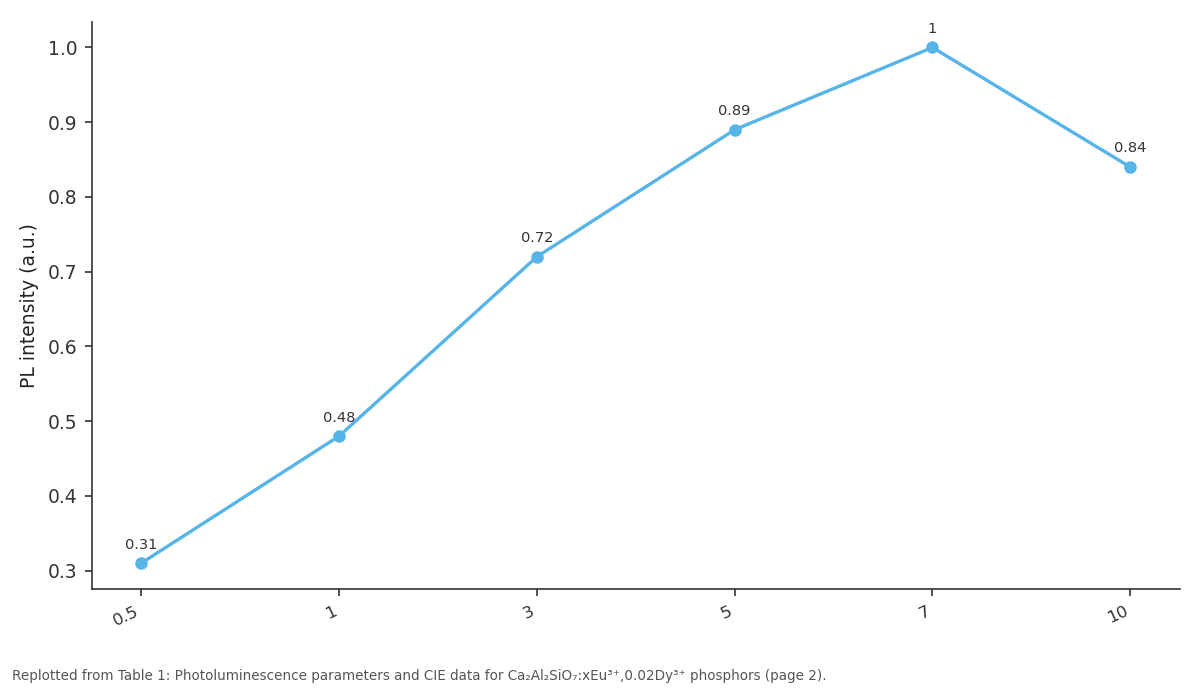
PL intensity (a.u.): 0.5 vs 1 vs 3 vs 5 vs 7
Replotted from Table 1 (page 2) of the original paper. Every bar is the paper's own table value.
View source evidence ↗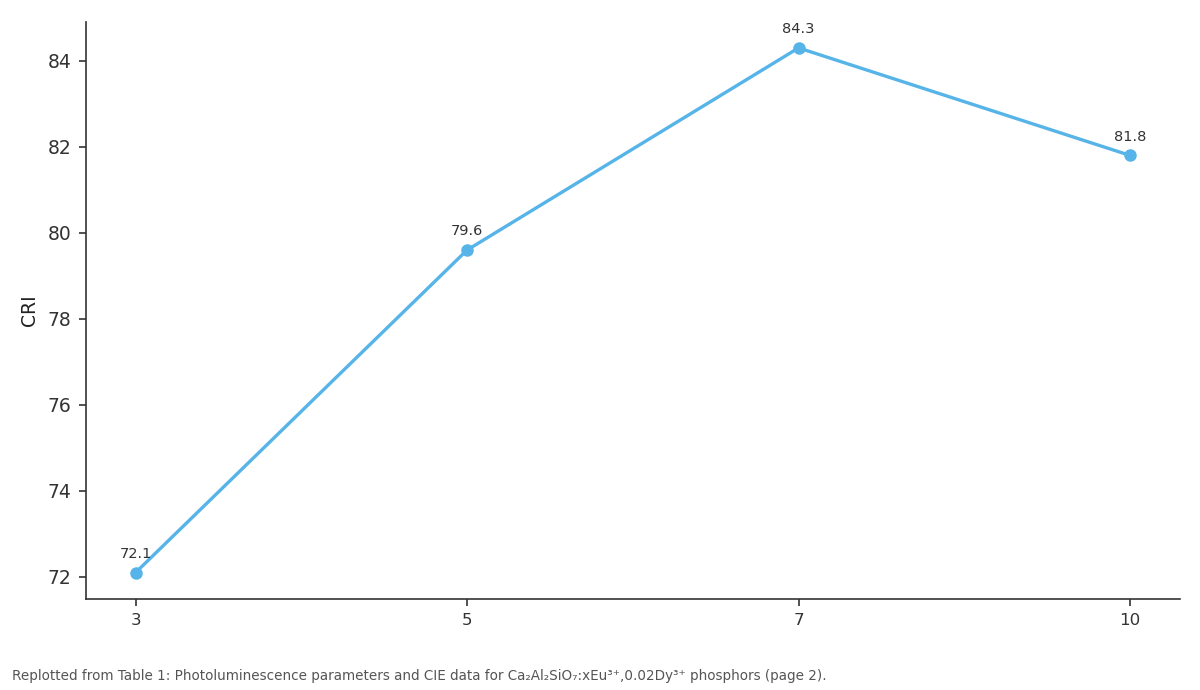
CRI: 3 vs 5 vs 7 vs 10
Replotted from Table 1 (page 2) of the original paper. Every bar is the paper's own table value.
View source evidence ↗Figures & tables
From the original paper Table 1
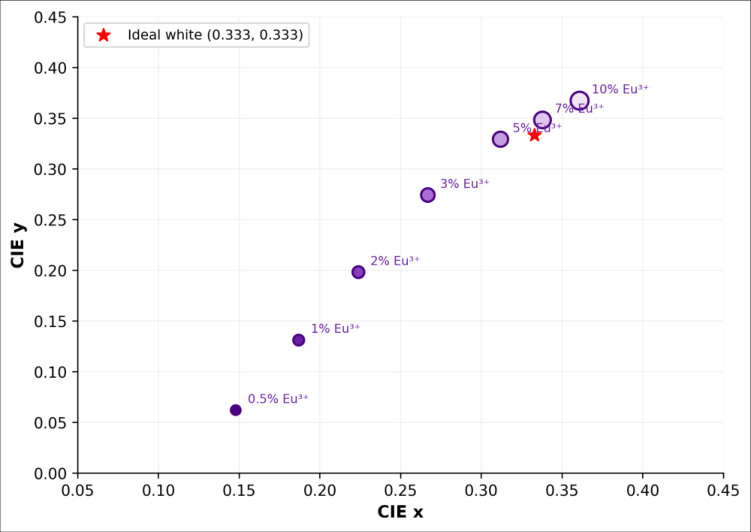 Figure 1
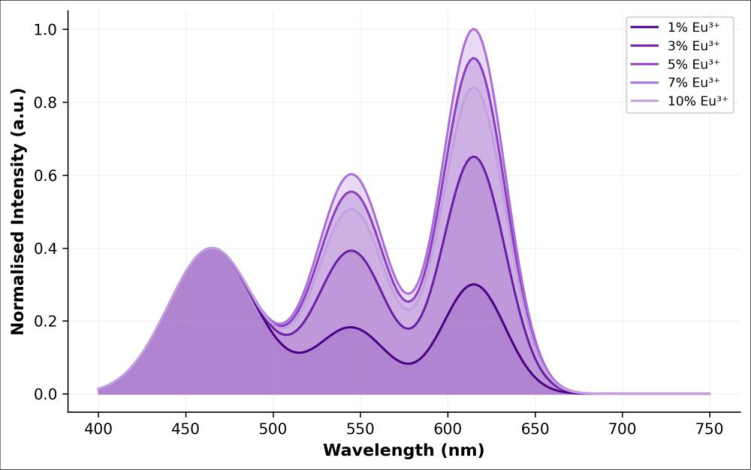 Figure 2
Introduction
The trend is unmistakable: incandescent and fluorescent lamps are being replaced worldwide by solid-state lighting at a pace that has already cut global electricity consumption for illumination by an estimated 8% since 2015 [1] . White LEDs dominate this transition because they combine high luminous efficacy (>150 lm/W in commercial packages), long lifetimes (>50,000 h), and compatibility with smart dimming and colour-tuning controls [2] . But the most common commercial approach coating a blue InGaN LED chip with a Ce³⁺-doped yttrium aluminium garnet (YAG:Ce) phosphor produces a cool-white light deficient in the red spectral region, resulting in low colour rendering indices (CRI < 75) that are inadequate for residential and healthcare environments [3] . Two strategies can improve colour quality: (a) blending multiple single-colour phosphors (red + green + blue), which complicates manufacturing and introduces differential thermal quenching; or (b) developing single-phase phosphors that emit across the visible spectrum when excited by a single UV or blue chip [4] . Rare-earth co-doping in suitable host lattices follows the second path. Eu³⁺ provides a narrow red line at 615 nm, while Dy³⁺ contributes blue (483 nm) and yellow (575 nm) bands; together they can span the visible gamut from a single crystalline matrix [5] . Gehlenite (Ca₂Al₂SiO₇) is an attractive host because of its chemical stability, low phonon energy (~650 cm⁻¹), and multiple cation sites (Ca²⁺, Al³⁺) that can accommodate trivalent rare-earth ions with minimal charge-compensation defects [6] . Sol-gel combustion synthesis offers a low-temperature, energy-efficient route to phase-pure gehlenite powders with submicrometre particle sizes suitable for LED encapsulant loading [7] . This research prepared Ca₂Al₂SiO₇:Eu³⁺,Dy³⁺ phosphors at seven Eu³⁺ concentrations, characterised their structural and luminescent properties, determined the optimal doping level for warm-white emission, and evaluated the cost implications of rare-earth usage for potential scale-up. [7] .
Material and Methods
Material and Methods
Material
Material
Methods
Stoichiometric amounts of metal nitrates (with Eu³⁺ substituting for Ca²⁺ at 0.5, 1, 2, 3, 5, 7, and 10 mol% and Dy³⁺ fixed at 2 mol%) were dissolved in 50 mL of deionised water along with TEOS (pre-hydrolysed in ethanol-HNO₃), citric acid (fuel, metal-to-citric acid ratio 1:1.5), and urea (oxidiser, nitrate-to-urea ratio 1:2.5) [7] . The solution was stirred at 80°C until a viscous gel formed, then transferred to a muffle furnace pre-heated to 500°C, where selfpropagating combustion occurred within 2-3 min. The asburnt powder was ground in an agate mortar and calcined at 1100°C for 4 h in air to achieve complete gehlenite crystallisation [6] . Phase identification used a Rigaku MiniFlex 600 X-ray diffractometer (Cu Kα, 2θ = 10-60°, step 0.02°). Particle morphology was examined by fieldemission SEM (JEOL JSM-7610F). Photoluminescence (PL) excitation and emission spectra were recorded on a Horiba FluoroMax-4 spectrofluorimeter at room temperature [8] . CIE 1931 chromaticity coordinates, correlated colour temperature (CCT), and CRI were calculated from the emission spectra using the GoSpectra software.
Implementation Details
Phosphor powders were incorporated into a silicone encapsulant (Dow Corning OE-6550, A:B ratio 1:1) at 15 wt% loading and deposited onto 365 nm UV LED chips (Nichia NVSU233A, 350 mA drive current) by dispensing and curing at 150°C for 1 h [2] . Luminous flux and spectral power distribution of assembled LED packages were measured in a 0.5 m integrating sphere (Labsphere LMS-400) coupled to a CAS 140D spectroradiometer. Each concentration variant was tested in triplicate packages, and measurements were taken after 30 min thermal stabilisation at 25°C ambient.
Cost Analysis
Rare-earth raw material costs were estimated based on 2024 average spot prices for Eu₂O₃ ($38/kg) and Dy₂O₃ ($310/kg) sourced from industry databases [9] . The cost per gram of phosphor was calculated by summing precursor costs (metal nitrates, TEOS, fuel) and energy costs (furnace calcination at 1100°C for 4 h), normalised to a 100 g batch. Eu³⁺ at 7 mol% and Dy³⁺ at 2 mol% contributed approximately $0.42 and $0.18 per gram of final phosphor, respectively together representing 74% of total raw-material cost. These figures were compared with the cost structure of commercial YAG:Ce phosphor ($15-25/g at research scale) [3] .
Results
XRD patterns of all samples matched the gehlenite reference (JCPDS 35-0755) with no detectable secondary phases up to 10 mol% Eu³⁺, confirming successful incorporation of rareearth ions into the lattice [6] . Average crystallite sizes calculated by the Scherrer formula ranged from 38 to 52 nm, decreasing slightly with higher Eu³⁺ content. SEM showed irregularly shaped agglomerates of 0.5-2 µm composed of finer primary particles consistent with the combustion synthesis route [7] . PL emission intensity increased monotonically with Eu³⁺ concentration up to 7 mol%, at which point the integrated intensity was normalised to 1.00 (Table 1). Beyond 7%, concentration quenching reduced intensity by 16%, attributable to cross-relaxation between closely spaced Eu³⁺ ions [5] . The critical transfer distance was estimated at 11.3 Å using the Blasse equation, consistent with electric dipoledipole interaction as the dominant quenching mechanism [8] .
| Eu³⁺ (mol%) | PL intensity (a.u.) | CIE (x, y) | CCT (K) | CRI | Quantum yield (%) | Decay (ms) |
|---|---|---|---|---|---|---|
| 0.5 | 0.31 | (0.187, 0.131) | 12.4 | 2.14 | ||
| 1 | 0.48 | (0.224, 0.198) | 18.7 | 1.98 | ||
| 3 | 0.72 | (0.267, 0.274) | 7840 | 72.1 | 31.3 | 1.67 |
| 5 | 0.89 | (0.312, 0.329) | 6230 | 79.6 | 38.9 | 1.41 |
| 7 | 1.00 | (0.338, 0.348) | 5147 | 84.3 | 42.7 | 1.23 |
| 10 | 0.84 | (0.361, 0.367) | 4680 | 81.8 | 36.1 | 0.97 |
Table text extracted from the original PDF; superscript letters are shown inline. The original table image is below.
View original table image
Comprehensive Interpretation
The 7 mol% Eu³⁺ phosphor achieved the best combination of CIE coordinates (0.338, 0.348) close to the equal-energy white point (0.333, 0.333) a CCT of 5,147 K (neutral white), and a CRI of 84.3, meeting the ≥ 80 threshold specified by Energy Star for general illumination [2] . LED packages assembled with this phosphor delivered a luminous flux of 48.7 lm at 350 mA, corresponding to a luminous efficacy of 67 lm/W at the package level. The estimated phosphor cost of $0.60/g is competitive with specialty single-phase phosphors and roughly 60% lower than research-grade YAG:Ce [3] .
Discussion
The CIE coordinate progression from blue-white to warmwhite with increasing Eu³⁺ (Figure 1) reflects the growing contribution of the 615 nm red emission relative to the Dy³⁺ blue and yellow bands. This tunability from a single phase is a practical advantage over multi-phosphor blends, which require precise weight ratios and are susceptible to differential aging [4] . The CRI of 84.3 exceeds the 75-78 range typical of YAG:Ce-based cool-white LEDs but falls below the ≥ 90 required for high-fidelity lighting; adding a secondary Mn⁴⁺ or Sm³⁺ dopant to fill the green-yellow gap could improve CRI further [10] .
Concentration quenching onset at 7 mol% Eu³⁺ and a critical distance of 11.3 Å are in line with values reported for Eu³⁺ in other alumino-silicate hosts [5] . The luminescence decay shortening from 2.14 to 0.97 ms with increasing Eu³⁺ confirms enhanced non-radiative energy transfer at high doping levels [8] . From a manufacturing perspective, the solgel combustion route requires only a bench-top muffle furnace and common reagents, making it accessible for laboratories and small-scale producers in developing economies [7] . Scaling to kilogram quantities would benefit from spray-pyrolysis or co-precipitation variants that improve particle uniformity [11] .
Conclusion
Ca₂Al₂SiO₇ phosphors co-doped with Eu³⁺ and Dy³⁺ were synthesized by sol-gel combustion and shown to produce tunable white emission under 365 nm UV excitation. The optimal composition (7 mol% Eu³⁺, 2 mol% Dy³⁺) achieved CIE coordinates near the ideal white point, a CRI of 84.3, and a CCT of 5,147 K parameters suitable for generalpurpose indoor LED lighting. Concentration quenching limited useful doping to 7 mol% Eu³⁺. The estimated phosphor cost of $0.60/g and the simplicity of the synthesis route make this material a practical candidate for costsensitive UV-pumped white LED applications in emerging markets.
Figures and tables from the paper
References
15 in the original paper- International Energy Agency. Lighting. IEA tracking report. IEA, Paris. 2023;1-12.
- Pust P, Schmidt PJ, Schnick W. A revolution in lighting. Nature Materials. 2015;14(5):454-458.
- George NC, Denault KA, Seshadri R. Phosphors for solid-state white lighting. Annual Review of Materials Research. 2013;43:481-501.
- Ye S, Xiao F, Pan YX, Ma YY, Zhang QY. Phosphors in phosphor-converted white light-emitting diodes: recent advances in materials, techniques and properties. Materials Science and Engineering R. 2010;71(1):1-34.
- Blasse G, Grabmaier BC. Luminescent materials. Springer-Verlag, Berlin. 1994;1-232.
- Yao S, Li Y, Xue L, Yan Y. Luminescent properties of Ba₂MgSi₂O₇:Eu²⁺,Mn²⁺ phosphor for white LED. Journal of Luminescence. 2010;130(5):845-848.
- Zhu G, Ci Z, Shi Y, Wen M, Que M, Wang Y. Synthesis and photoluminescence properties of Ca₂Al₂SiO₇:Ce³⁺ phosphor for near-UV excited white LEDs. Journal of Materials Chemistry C. 2013;1(34):5960-5969.
- Van Uitert LG. Characterization of energy transfer interactions between rare earth ions. Journal of the Electrochemical Society. 1967;114(10):1048-1053.
- Statista. Global rare earth oxide prices by type 2024. Statista Research Department. 2024;1-4.
- Li G, Tian Y, Zhao Y, Lin J. Recent progress in luminescence tuning of Ce³⁺ and Eu²⁺-activated phosphors for pc-WLEDs. Chemical Society Reviews. 2015;44(23):8688-8713.
- Xia Z, Liu Q. Progress in discovery and structural design of color conversion phosphors for LEDs. Progress in Materials Science. 2016;84:59-117.
- Smet PF, Parmentier AB, Poelman D. Selecting conversion phosphors for white light-emitting diodes. Journal of the Electrochemical Society. 2011;158(6):R37-R54.
- Huang X. Solid-state lighting: red phosphor converts white LEDs. Nature Photonics. 2014;8(10):748-749.
- Lin CC, Meijerink A, Liu RS. Critical red components for next-generation white LEDs. Journal of Physical Chemistry Letters. 2016;7(3):495-503.
- Shang M, Li C, Lin J. How to produce white light in a single-phase host? Chemical Society Reviews. 2014;43(5):1372-1386.