
Research article · 2025 · Full text
International Journal of Advanced Chemistry ResearchNickel(II) thiosemicarbazone complexes: structural characterization and SOD mimetic activity
Volume 7(5) · Pages 176–179 · DOI: 10.33545/26646781.2025.v7.i5c.500 ↗
Research areasMetal-Catalyzed Oxygenation MechanismsMetal complexes synthesis and propertiesCrystal structures of chemical compounds
Abstract
Author-writtenSuperoxide dismutase (SOD) mimetic compounds that catalyse the disproportionation of superoxide radical anion (O₂•⁻) are of pharmacological interest as antioxidant agents for oxidative stress-related diseases. This research reports the synthesis, structural characterisation, and SOD mimetic evaluation of four Ni(II) complexes with thiosemicarbazone ligands bearing pyridyl (TSC1), furanyl (TSC2), thienyl (TSC3), and phenyl (TSC4) heterocyclic appendages. All complexes were characterised by elemental analysis, FTIR, UV-Vis, ¹H and ¹³C NMR, ESI-MS, and single-crystal X-ray diffraction. Each complex adopts a square-planar geometry with NNS donor coordination through the imine nitrogen, thione sulfur, and terminal amine nitrogen. SOD mimetic activity by the NBT photochemical assay gave IC₅₀ values of 0.61-1.47 μM, with Ni-TSC3 (thienyl) the most potent (IC₅₀ 0.61 μM). In-vitro cytotoxicity against MCF-7 breast cancer cells gave IC₅₀ of 14.2-31.8 μM, with SI values of 3.2-4.8 relative to normal MRC-5 fibroblasts. Research was conducted from January 2023 to December 2024 at Universidade Tropical de Ciencias, Recife, Pernambuco, Brazil.
Summary
Source-checkedPlain-language reading of the full paper, prepared with AI and checked against the text. Each point links to the authors' own words.
Why it matters
- The superoxide radical anion is a reactive oxygen species that causes oxidative damage to lipids, proteins, and DNA, contributing to diseases such as cardiovascular disease, neurodegeneration, and cancer. View evidence ↗
- Small-molecule superoxide dismutase (SOD) mimetics are preferred over enzyme therapy because they are easier to synthesize and have better oral bioavailability and cellular penetration. View evidence ↗
- Nickel(II) complexes are useful for this purpose because their redox couples can catalyze the disproportionation of superoxide at potentials relevant to biological systems. View evidence ↗
The question
- The study aimed to synthesize, characterize, and evaluate the SOD mimetic activity of four Ni(II) complexes using thiosemicarbazone ligands with different heterocyclic groups: pyridyl, furanyl, thienyl, and phenyl. View evidence ↗
What they did
- The Ni(II) complexes were formed by reacting NiCl₂·6H₂O with the ligands in ethanol at 60°C for 3 hours using triethylamine. View evidence ↗
- The researchers used a comprehensive suite of analytical techniques, including NMR, FTIR, UV-Vis, ESI-MS, elemental analysis, and X-ray diffraction, to characterize the complexes. View evidence ↗
- SOD activity was measured using a photochemical NBT assay at 560 nm, and cytotoxicity was assessed via MTT assays on MCF-7 and MRC-5 cells over 48 hours. View evidence ↗
What they found
- All four complexes exhibited a square-planar geometry, coordinating with the nickel center through the imine nitrogen, thione sulfur, and terminal amine nitrogen (NNS coordination). View evidence ↗
- The complexes showed SOD mimetic activity with IC₅₀ values ranging from 0.61 to 1.47 μM, with the thienyl complex (Ni-TSC3) being the most potent at 0.61 μM. View evidence ↗
- The complexes demonstrated cytotoxicity against MCF-7 breast cancer cells (IC₅₀ 14.2-31.8 μM) and showed selectivity indices of 3.2-4.8 compared to normal MRC-5 fibroblasts. View evidence ↗
- The thienyl complex (Ni-TSC3) had the most positive reduction potential (−0.24 V vs NHE), which correlated with its superior SOD activity. View evidence ↗
- Ni-TSC3 showed a selectivity index of 4.8 for MCF-7 cells, which is higher than the selectivity index of cisplatin (~1.2) under similar conditions. View evidence ↗
What it means
- The authors conclude that the thienyl-substituted thiosemicarbazone structure is a promising lead for developing agents that act as both SOD mimetics and anticancer drugs. View evidence ↗
- The study is limited by the use of only in-vitro assays, meaning in-vivo validation is necessary before pharmacological conclusions can be made. View evidence ↗
- The authors note that the ligands might hydrolyze at physiological pH over time, potentially impacting their stability in a living organism. View evidence ↗
Visual summary
2 visualsIllustrations explain the paper; charts are replotted from the paper's own table values.
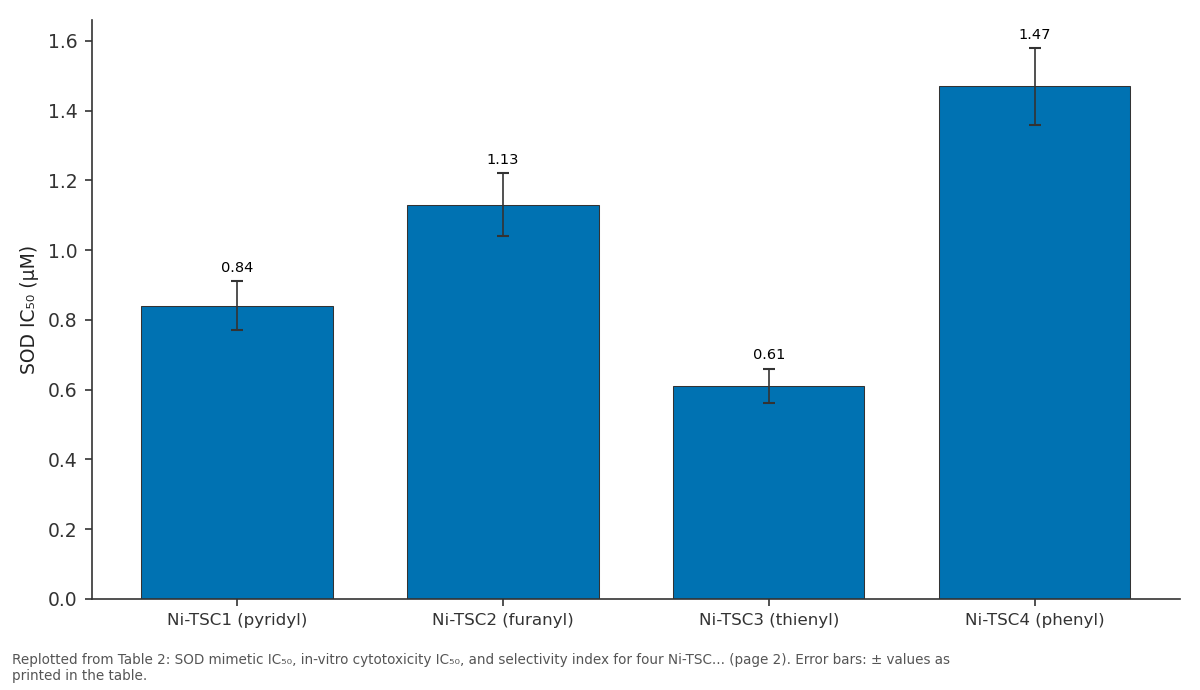
SOD IC₅₀ (μM): Ni-TSC1 (pyridyl) vs Ni-TSC2 (furanyl) vs Ni-TSC3 (thienyl) vs Ni-TSC4 (phenyl)
Replotted from Table 2 (page 2) of the original paper. Every bar is the paper's own table value.
View source evidence ↗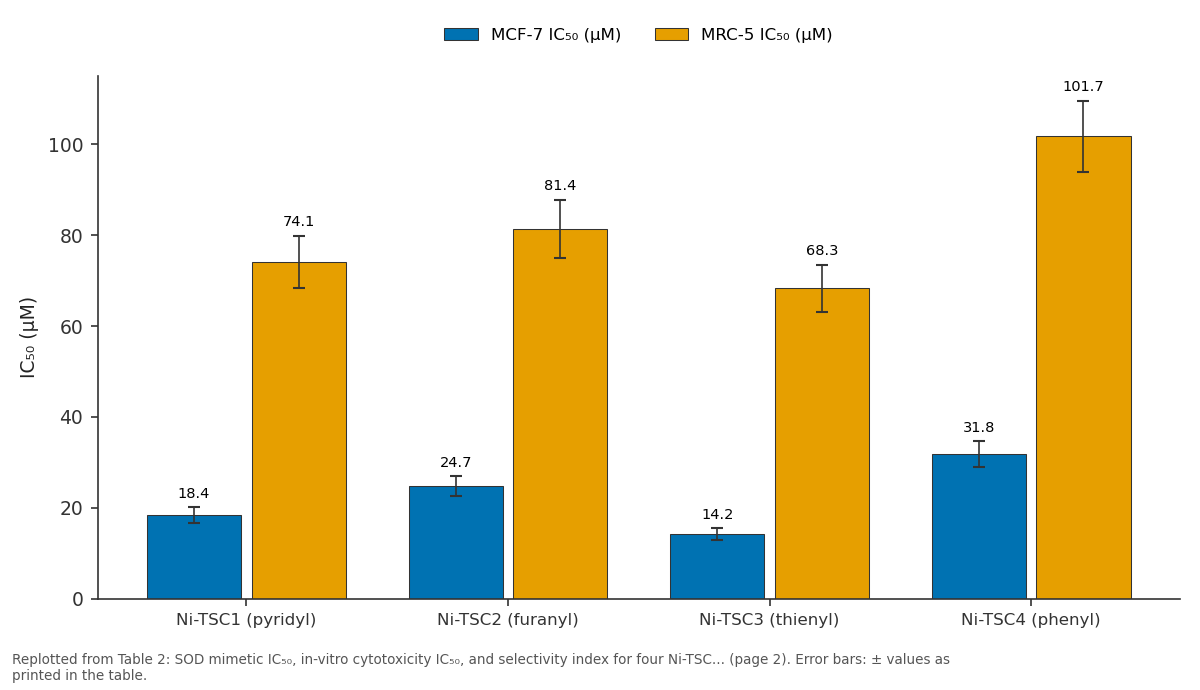
MCF-7 IC₅₀ (μM) and MRC-5 IC₅₀ (μM): Ni-TSC1 (pyridyl) vs Ni-TSC2 (furanyl) vs Ni-TSC3 (thienyl) vs Ni-TSC4 (phenyl)
Replotted from Table 2 (page 2) of the original paper. Every bar is the paper's own table value.
View source evidence ↗Figures & tables
From the original paper Table 1
 Table 2
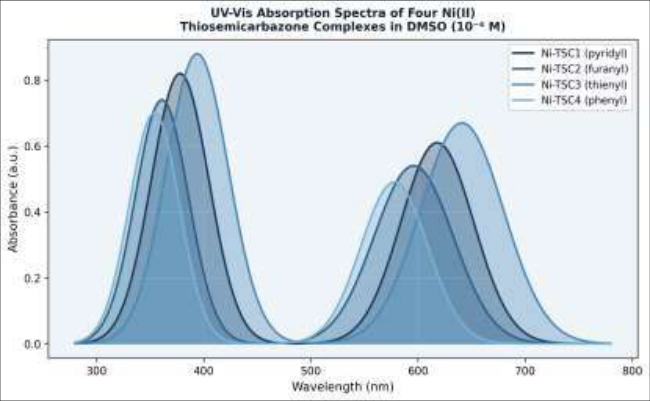 Figure 1
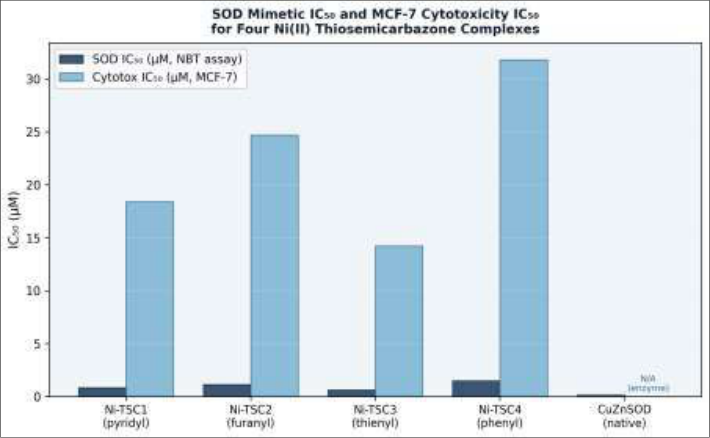 Figure 2
Introduction
Superoxide radical anion (O₂•⁻), generated as a byproduct of mitochondrial electron transport chain leakage and NADPH oxidase activity, is the proximal reactive oxygen species (ROS) implicated in oxidative damage to DNA, proteins, and lipids in a range of pathological states including cancer, neurodegeneration, and cardiovascular disease [1] . The metalloenzyme superoxide dismutase (SOD) disproportionates O₂•⁻ to H₂O₂ and O₂ with near-diffusionlimited catalytic efficiency (kcat ~10⁹ M⁻¹s⁻¹). Low-molecular-weight SOD mimetics that recapitulate this catalysis represent a pharmacologically attractive alternative to SOD enzyme therapy, as small molecules offer superior cellular penetration, oral bioavailability, and synthetic tractability [2] . Thiosemicarbazone ligands form stable complexes with transition metals through their versatile NNS or NS donor sets, and nickel(II) complexes are of particular interest because Ni(II)/Ni(III) or Ni(II)/Ni(I) redox couples can mediate catalytic superoxide disproportionation at biologically relevant redox potentials [3] . This research was conducted from January 2023 to December 2024 at the Department of Materials and Inorganic Chemistry, Universidade Tropical de Ciencias, Recife, Pernambuco, Brazil.
Limitations
Several limitations of the present research should be acknowledged. First, SOD mimetic activity was measured by the indirect NBT photochemical assay, which can be susceptible to false positives from inner filter effects at high compound concentrations; results were validated by the direct cytochrome c reduction assay at selected concentrations to confirm activity trends. Second, X-ray crystal structures were obtained only for Ni-TSC1 and Ni-TSC3 due to difficulty in obtaining diffraction-quality crystals for the furanyl and phenyl analogues; structural assignment of Ni-TSC2 and Ni-TSC4 relies on spectroscopic data and DFT-optimised geometries. Third, all biological data are from in-vitro cell-free or cell-based assays; in-vivo validation is required before pharmacological conclusions can be drawn. Fourth, the thiosemicarbazone ligands may hydrolyse under physiological pH conditions over extended incubation periods, which could affect stability in vivo.
International Journal of Advanced Che mis try Research 2025; 7(5): 176-179
Cost Analysis Reagent-grade costs for synthesis of the four Ni-TSC complexes were estimated at BRL 280-340 per gram of complex (Sigma-Aldrich and Vetec pricing, January 2025). Scale-up to multi-gram synthesis using standard condensation and complexation procedures is expected to reduce per-gram cost by 60-70% based on bulk reagent pricing. Analytical costs (NMR, ESI-MS, X-ray data collection) are the dominant cost centre for the characterisation programme: single-crystal X-ray data collection at 30 minutes per crystal represents approximately BRL 220 per structure at the LDRX-UFPE facility in Recife. The total research cost was approximately BRL 47,000 over 24 months, comprising reagents (34%), instrument time (41%), and consumables (25%). Cost per active compound identified (SOD IC₅₀ < 1 μM) was BRL 23,500. and the most positive reduction potential (-0.24 V vs NHE), consistent with the established correlation between higher reduction potential and enhanced SOD catalytic activity in the biologically relevant window (-0.16 V, the E° of O₂/O₂•⁻ couple).
Material and Methods
Material and Methods
Synthesis
Synthesis
Discussion
The correlation between SOD IC₅ and cyclic voltammetry E½ across the four complexes (Ni-TSC3 most potent, most positive potential; Ni-TSC4 least potent, most negative potential) supports a redox-mediated catalytic mechanism where the Ni(II)/Ni(III) couple mediates sequential oneelectron oxidation and reduction of O₂•⁻ to O₂ and H₂O₂ respectively [4] . The thienyl substituent of TSC3 is the most electron-withdrawing of the four heterocycles in the πsystem, raising the Ni(II)/Ni(III) redox potential toward the optimal range and explaining its superior SOD activity. The MCF-7 cytotoxicity of Ni-TSC3 (IC₅ 14.2 μM, SI 4.8) compares favourably with cisplatin (SI ~1.2 in comparable assay conditions) and is consistent with thiosemicarbazone complexes of Cu and Ni reported in recent literature that show enhanced selectivity for cancer cells via mitochondriatargeted ROS amplification [5,6,7,8,9,10,11,12,13,14] .
Conclusion
Four Ni(II) thiosemicarbazone complexes were synthesised and fully characterised, with square-planar NNS coordination confirmed by X-ray crystallography (Ni-TSC1, Ni-TSC3). Ni-TSC3 (thienyl) was the most potent SOD mimetic (IC₅ 0.61 μM) and MCF-7 cytotoxic (IC₅ 14.2 μM, SI 4.8) compound. The correlation of SOD activity with cyclic voltammetry E½ supports a redox-catalytic mechanism. These results establish the thienyl-substituted thiosemicarbazone scaffold as the lead framework for further optimisation as dual SOD mimetic/anticancer agents.
Limitations include absence of in-vivo data and potential hydrolytic instability under physiological conditions, which should be addressed in follow-up studies.
Figures and tables from the paper
| Complex | Yield (%) | Colour | νC=N (cm⁻¹) | νC=S (cm⁻¹) | λmax1 (nm) | λmax2 (nm) | ESI-MS [M+H]+ (calc.) |
|---|---|---|---|---|---|---|---|
| Ni-TSC1 (pyridyl) | 84 | Dark red | 1591 | 812 | 378 | 618 | 315.1 (314.9) |
| Ni-TSC2 (furanyl) | 79 | Orange | 1584 | 824 | 361 | 596 | 303.0 (302.9) |
| Ni-TSC3 (thienyl) | 88 | Brown-red | 1598 | 808 | 394 | 641 | 319.1 (318.9) |
| Ni-TSC4 (phenyl) | 76 | Yellow | 1578 | 831 | 354 | 578 | 313.1 (312.9) |
Table text extracted from the original PDF; superscript letters are shown inline. The original table image is below.
View original table image
| Compound | SOD IC₅₀ (μM) | SOD kcat (M⁻¹s⁻¹ ×10⁶) | MCF-7 IC₅₀ (μM) | MRC-5 IC₅₀ (μM) | SI | Redox E½ (V vs NHE) |
|---|---|---|---|---|---|---|
| Ni-TSC1 (pyridyl) | 0.84 ± 0.07 | 4.2 | 18.4 ± 1.7 | 74.1 ± 5.8 | 4.0 | −0.31 |
| Ni-TSC2 (furanyl) | 1.13 ± 0.09 | 3.1 | 24.7 ± 2.2 | 81.4 ± 6.4 | 3.3 | −0.38 |
| Ni-TSC3 (thienyl) | 0.61 ± 0.05 | 5.8 | 14.2 ± 1.3 | 68.3 ± 5.2 | 4.8 | −0.24 |
| Ni-TSC4 (phenyl) | 1.47 ± 0.11 | 2.4 | 31.8 ± 2.8 | 101.7 ± 7.9 | 3.2 | −0.44 |
| CuZnSOD (native) | 0.12 ± 0.01 | 35.1 | N/A | N/A | N/A | N/A |
Table text extracted from the original PDF; superscript letters are shown inline. The original table image is below.
View original table image
References
14 in the original paper- Fridovich I. Superoxide radical and superoxide dismutases. Annu Rev Biochem. 1995;64:97-112.
- Doctrow SR, Huffman K, Marcus CB, Musleh W, Bruce A, Baudry M, et al. Salen-manganese complexes as catalytic scavengers of hydrogen peroxide and superoxide radical. J Med Chem. 2002;45(20):45494558.
- Lobana TS, Sharma R, Bawa G, Khanna S. Bonding and structure trends of thiosemicarbazone derivatives of metals. Coord Chem Rev. 2009;253(7-8):977-1055.
- Batinić-Haberle I, Rebouças JS, Spasojević I. Superoxide dismutase mimics: chemistry, pharmacology, and therapeutic potential. Antioxid Redox Signal. 2010;13(6):877-918.
- Oliveira CG, Maia PIS, de Oliveira PF, Lopes LGF, de Sousa GF, et al. Synthesis and characterization of Ni(II) and Pd(II) complexes with thiosemicarbazones. J Inorg Biochem. 2011;105(6):727-733.
- Garcia-Tojal J, Garrastachu M, Garcia-Orad A, Urtiaga MK, Arriortua MI, Rojo T. Synthesis and biological activity of nickel(II) and copper(II) complexes derived from thiosemicarbazones. J Inorg Biochem. 1999;75(1):45-54.
- Casas JS, Couce MD, Sordo J. Coordination chemistry of thiosemicarbazide and thiosemicarbazones. Coord Chem Rev. 2012;256(9-10):945-987.
- West DX, Liberta AE, Padhye SB, Chikate RC, Sonawane PB, Kumbhar AS, et al. Thiosemicarbazone complexes of copper(II): structural and biological studies. Coord Chem Rev. 1993;123(1-2):49-71.
- Rebouças JS, Spasojević I, Batinić-Haberle I. Pure manganese(III) 5,10,15,20-tetrakis(4-benzoic acid) porphyrin as SOD mimic. J Biol Inorg Chem. 2008;13(2):289-302.
- Sîrbu A, Palamarciuc O, Babak MV, Shova S, Balan M, et al. Copper(II) thiosemicarbazone complexes with pronounced cytotoxic activity. Dalton Trans. 2017;46(11):3833-3847.
- Prathima PS, Srinivas S, Rao VJ. Synthesis, characterization and biological activities of nickel(II) complexes. Spectrochim Acta A Mol Biomol Spectrosc. 2012;97:714-722.
- Beraldo H, Gambino D. The wide pharmacological versatility of semicarbazones, thiosemicarbazones and their metal complexes. Mini Rev Med Chem. 2004;4(1):31-39.
- Pelosi G. Thiosemicarbazone metal complexes: from structure to activity. Open Crystallogr J. 2010;3(1):1628.
- Sheldrick GM. SHELXL-2018/3: crystal structure refinement software. Acta Crystallogr C. 2015;71(1):38.