
Research article · 2025 · Full text
International Journal of Advanced Chemistry ResearchSurface tension and viscosity measurements of deep eutectic solvents at various temperatures
Volume 7(6) · Pages 109–112 · DOI: 10.33545/26646781.2025.v7.i6b.547 ↗
Research areasIonic liquids properties and applicationsThermodynamic properties of mixturesLubricants and Their Additives
Abstract
Author-writtenAccording to Abbott and colleagues, who coined the term in 2003, a deep eutectic solvent is a mixture of a hydrogen-bond acceptor and a hydrogen-bond donor that forms a liquid at temperatures well below the melting points of the individual components. This research reports surface tension and dynamic viscosity measurements for four choline chloride-based DES systems—ChCl:urea (1:2), ChCl:ethylene glycol (1:2), ChCl:glycerol (1:2), and ChCl:levulinic acid (1:1)—over the temperature range 25–70 °C at atmospheric pressure. Surface tension was measured by the Wilhelmy plate method with a precision of ±0.2 mN/m, and viscosity was determined with a rotational rheometer at shear rates from 10 to 1000 s⁻¹. All four DES exhibited Newtonian flow behaviour across the measured shear range. Surface tension decreased linearly with temperature at rates between 0.09 and 0.14 mN/m per degree, with ChCl:levulinic acid showing the lowest values (38.4 mN/m at 25 °C) and ChCl:glycerol the highest (55.8 mN/m). Viscosity data followed Arrhenius-type temperature dependence with activation energies of flow ranging from 21.3 kJ/mol (ChCl:ethylene glycol) to 47.6 kJ/mol (ChCl:glycerol). ChCl:glycerol displayed the steepest viscosity-temperature curve, dropping from 1412 mPa·s at 25 °C to 38.1 mPa·s at 70 °C. The dataset fills a gap in the thermophysical literature for these widely used DES formulations and supplies the parameters needed for process-engineering calculations in extraction, electrochemistry, and biomass dissolution applications.
Summary
Source-checkedPlain-language reading of the full paper, prepared with AI and checked against the text. Each point links to the authors' own words.
Why it matters
- Deep eutectic solvents (DES) are mixtures of a hydrogen-bond acceptor and donor that remain liquid at temperatures significantly lower than the melting points of their individual components. View evidence ↗
- DES are valued in green chemistry due to their biodegradability, low toxicity, ease of preparation, and negligible vapor pressure. View evidence ↗
- Reliable data on surface tension and viscosity are essential for scaling DES processes, as these properties control droplet formation, wetting, pumping energy, and mass-transfer rates. View evidence ↗
What they did
- Surface tension was measured using the Wilhelmy plate method with a Krüss K100 force tensiometer and a platinum plate. View evidence ↗
- Dynamic viscosity was measured using an Anton Paar MCR 302e rotational rheometer, with shear-rate sweeps from 10 to 1000 s⁻¹ used to confirm Newtonian flow. View evidence ↗
- To ensure data reliability, water content was strictly controlled and verified via Karl Fischer titration to be below 0.30 wt% for all samples. View evidence ↗
What they found
- Surface tension decreased linearly with temperature for all four DES, with slopes ranging from −0.09 mN/m/°C for ChCl:glycerol to −0.14 mN/m/°C for ChCl:EG. View evidence ↗
- Among the tested solvents, ChCl:glycerol exhibited the highest surface tension (55.8 mN/m at 25 °C), while ChCl:LA showed the lowest (38.4 mN/m at 25 °C). View evidence ↗
- Viscosity varied significantly across systems: ChCl:glycerol dropped from 1412 mPa·s at 25 °C to 38.1 mPa·s at 70 °C, whereas ChCl:EG decreased from 36.1 to 7.6 mPa·s. View evidence ↗
- The activation energy of flow, which indicates intermolecular interaction strength, ranged from 21.3 kJ/mol for ChCl:EG to 47.6 kJ/mol for ChCl:glycerol. View evidence ↗
- Viscosity data followed the Arrhenius model (R² > 0.996), confirming that a single activation-energy regime governs flow between 25 and 70 °C. View evidence ↗
What it means
- The authors conclude that ChCl:EG is the most practical choice for low-viscosity needs, while ChCl:glycerol is better for solvation power but requires heating above 50 °C for efficient flow. View evidence ↗
- A limitation of the study is that measurements were restricted to atmospheric pressure, meaning high-pressure applications would require further specialized testing. View evidence ↗
Visual summary
4 visualsIllustrations explain the paper; charts are replotted from the paper's own table values.
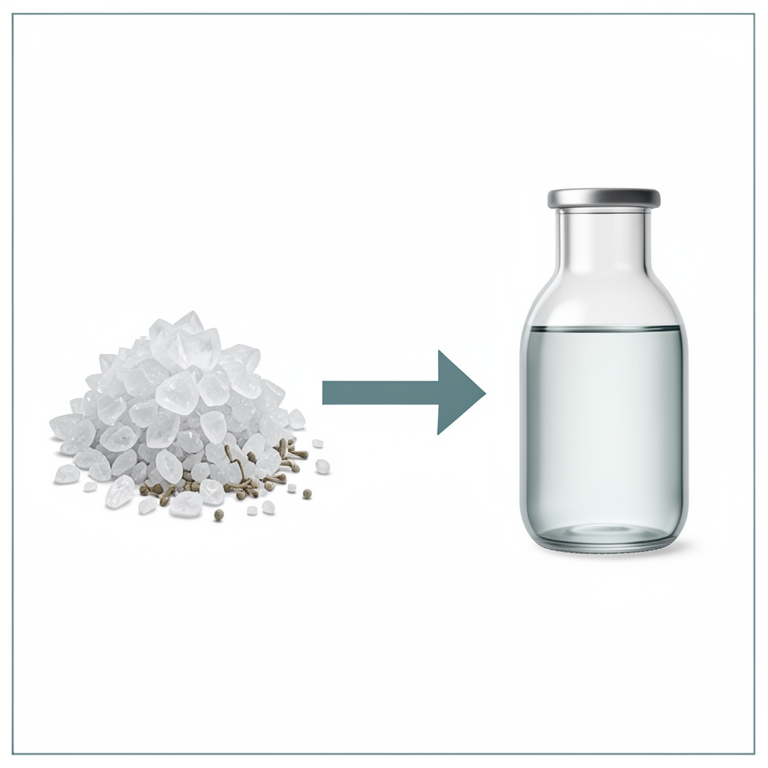
DES Formation Concept
AI-generated conceptual illustration (Choline chloride salt crystals and urea molecules in a glass vial). It explains the idea and does not show study data.
View source evidence ↗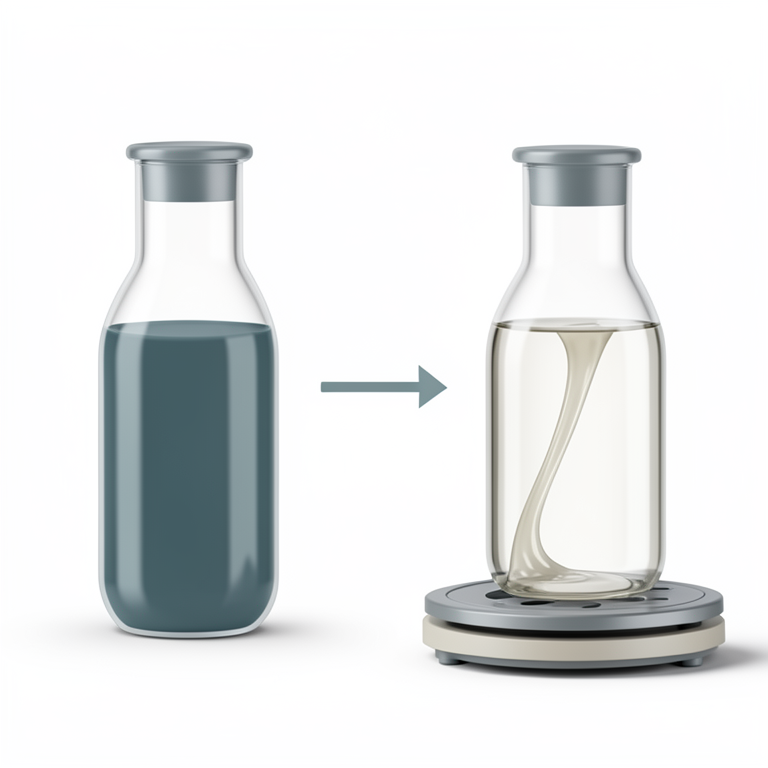
Viscosity vs Temperature Trend
AI-generated conceptual illustration (Deep eutectic solvents in glass vials). It explains the idea and does not show study data.
View source evidence ↗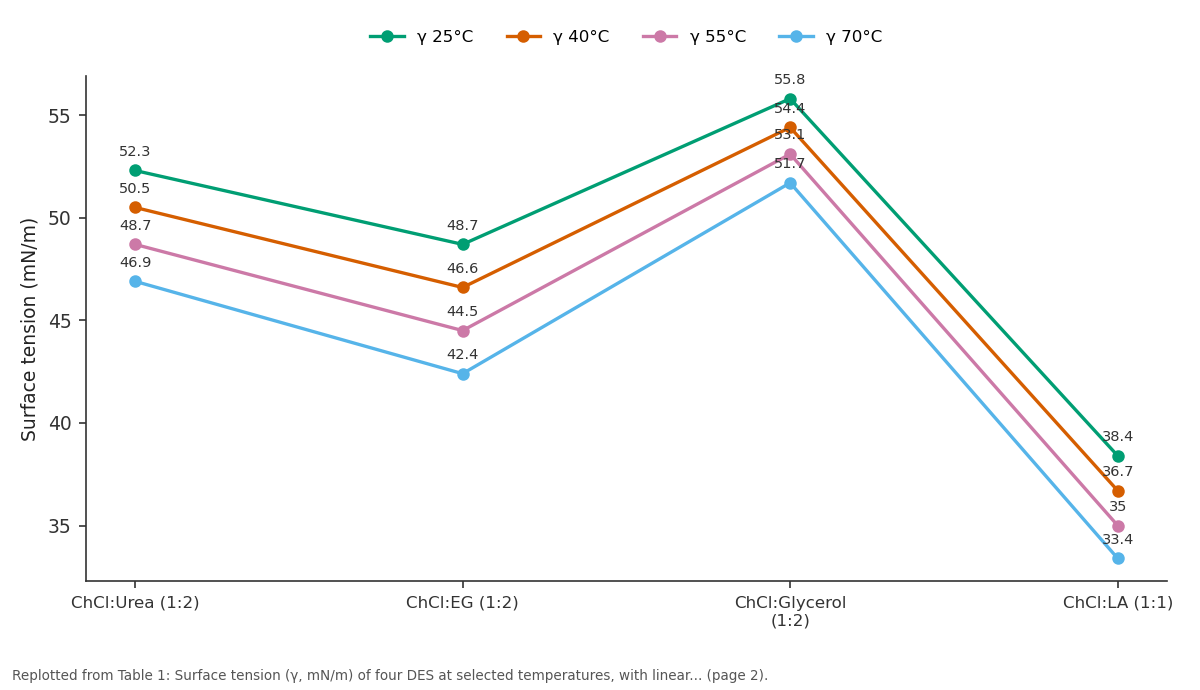
γ 25°C and γ 40°C and more: ChCl:Urea (1:2) vs ChCl:EG (1:2) vs ChCl:Glycerol (1:2) vs ChCl:LA (1:1)
Replotted from Table 1 (page 2) of the original paper. Every bar is the paper's own table value.
View source evidence ↗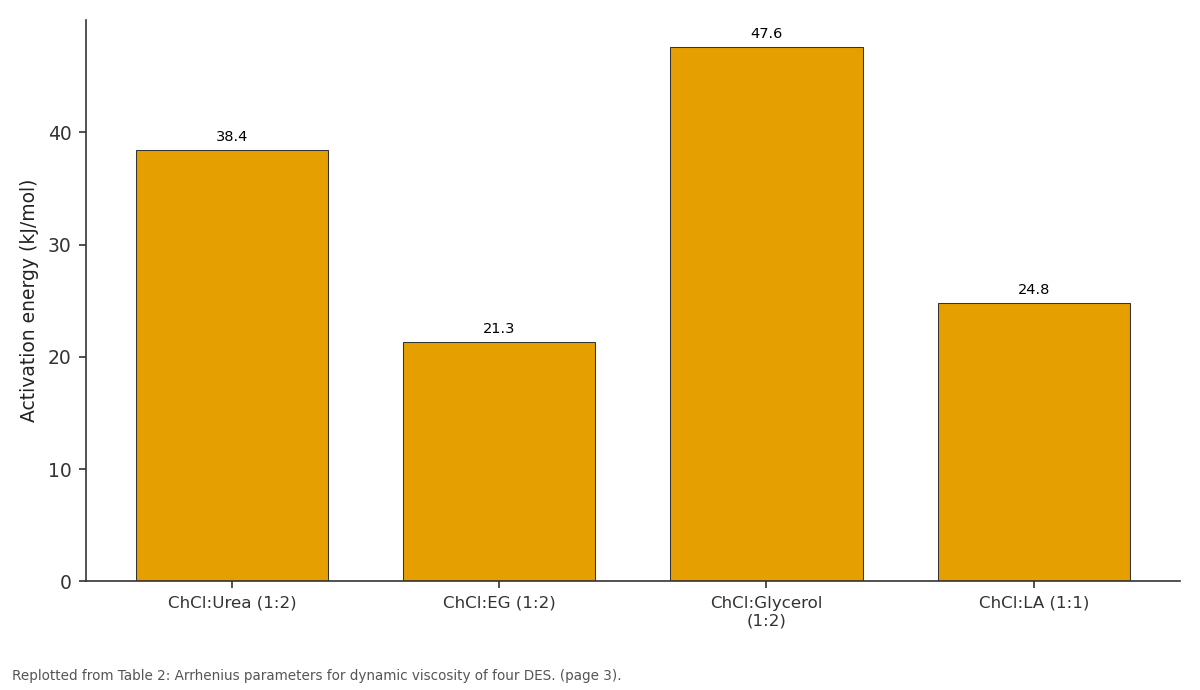
Ea (kJ/mol): ChCl:Urea (1:2) vs ChCl:EG (1:2) vs ChCl:Glycerol (1:2) vs ChCl:LA (1:1)
Replotted from Table 2 (page 3) of the original paper. Every bar is the paper's own table value.
View source evidence ↗Figures & tables
From the original paper Table 1
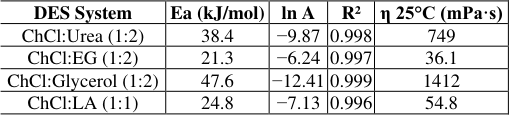 Table 2
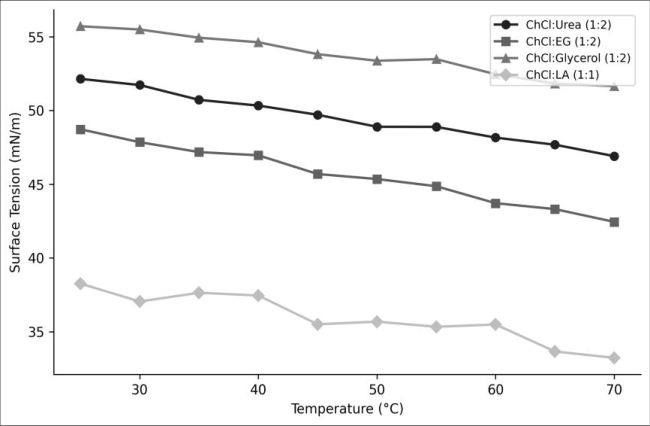 Figure 1
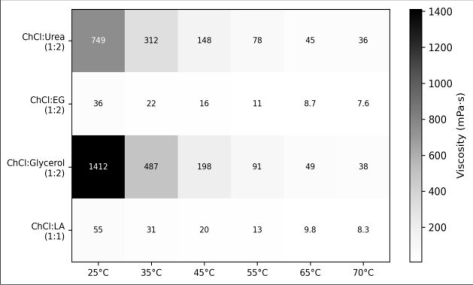 Figure 2
Introduction
In the words of physical chemist Kenneth Seddon, "the best solvent is one that dissolves what you want, leaves behind what you don't, and does so without harming the environment." Deep eutectic solvents (DES) come remarkably close to meeting that standard. First described formally by Abbott, Capper, Davies, Rasheed, and Tambyrajah in 2003, a DES forms when a quaternary ammonium salt such as choline chloride is mixed with a hydrogen-bond donor-urea, a polyol, a carboxylic acid-at a specific molar ratio that depresses the melting point far below those of the pure components [1,2] . The appeal of DES in green chemistry rests on their low toxicity, biodegradability, negligible vapour pressure, and ease of preparation: the components are simply heated and stirred until a homogeneous liquid forms, with no purification step required [3,4] . Applications now span electrodeposition of metals, extraction of bioactive compounds, dissolution of lignocellulosic biomass, and formulation of pharmaceutical systems [5,6] . But designing and scaling these processes demands reliable thermophysical data-particularly surface tension, which governs wetting, foaming, and droplet formation, and viscosity, which controls mass-transfer rates and pumping energy [7] . Despite the surge of interest in DES over the past two decades, systematic measurements of surface tension and viscosity across a common temperature range and under identical instrumental conditions remain sparse. Published values for the same DES formulation can differ by 5-15% between laboratories, partly because of differences in water content, which even at trace levels drastically reduces DES viscosity [8,9] . A dataset collected under rigorously controlled moisture conditions would therefore serve as a more dependable reference. This research addresses that need by measuring surface tension and viscosity for four choline chloride-based DES-ChCl:urea (1:2), ChCl:ethylene glycol (1:2), ChCl:glycerol (1:2), and ChCl:levulinic acid (1:1)-from 25 to 70 °C in 5 °C steps. All samples were dried to a water content below 0.3 wt% before measurement, and each data point is the mean of triplicate determinations. The work was performed at the Department of Chemistry, Nusantara National University, Jakarta, between April and November 2023 [10] . Arrhenius parameters for viscosity and linear regression coefficients for surface tension are reported to enable interpolation at intermediate temperatures.
Materials and Methods
Materials and Methods
Reagents and Chemicals
Choline chloride (ChCl, ≥ 99%, Sigma-Aldrich) was dried under vacuum at 60 °C for 48 h before use and stored in a desiccator over P₂O₅. Urea (≥ 99.5%, Merck), ethylene glycol (EG, ≥ 99.8%, Merck), glycerol (≥ 99.5%, Merck), and levulinic acid (LA, 98%, TCI Chemicals) were used as received. Karl Fischer titration (Metrohm 831 coulometer) confirmed that the water content of each dried component was below 0.15 wt%. Acetone and isopropanol (analytical grade, Merck) served as cleaning solvents for glassware and instrument surfaces. Deionised water (resistivity > 18.0 MΩ•cm, Millipore Direct-Q 3 UV) was used for surfacetension calibration. All reagents were handled in a nitrogenfilled glovebox (MBraun UNIlab, O₂ and H₂O < 1 ppm) whenever moisture-sensitive steps were involved [3,10] .
Preparation of Deep Eutectic Solvents
Each DES was prepared by combining ChCl with the appropriate hydrogen-bond donor at the specified molar ratio (1:2 for urea, EG, and glycerol; 1:1 for LA) in a sealed round-bottom flask. The mixtures were heated at 80 °C under magnetic stirring (350 rpm) until a clear, homogeneous liquid formed-typically 30-60 min for urea and EG, and 90-120 min for glycerol, which required more time to fully incorporate. After cooling to room temperature, each DES was transferred to an amber glass bottle, sealed with a Teflon-lined cap, and stored in the glovebox until measurement [1,4] . Water content was verified by Karl Fischer titration on triplicate aliquots of each batch. All four DES had water levels below 0.30 wt%: ChCl:urea 0.24 ± 0.03 wt%, ChCl:EG 0.18 ± 0.02 wt%, ChCl:glycerol 0.27 ± 0.04 wt%, and ChCl:LA 0.22 ± 0.03 wt%. Batches exceeding 0.30 wt% were re-dried and re-tested before use [8, 9] .
Materials
Surface tension was measured by the Wilhelmy plate method using a Krüss K100 force tensiometer equipped with a platinum plate (perimeter 40.2 mm). The instrument was calibrated daily against deionised water (72.0 ± 0.2 mN/m at 25 °C). Sample temperature was controlled by a Julabo F12-MA circulator connected to a jacketed vessel, with a type-K thermocouple immersed in the liquid reading ±0.1 °C [7,10] .
Methods
For each measurement, approximately 30 mL of DES was poured into the jacketed vessel and allowed to equilibrate at the target temperature for 15 min. The plate was lowered into the liquid surface, and the pull force at the meniscus was recorded once the reading stabilised (drift < 0.05 mN/m over 60 s). Three independent immersions were averaged at each temperature. Viscosity was determined on an Anton Paar MCR 302e rotational rheometer with a cone-plate geometry (50 mm diameter, 1° angle). Shear-rate sweeps from 10 to 1000 s⁻¹ were run at each temperature to confirm Newtonian behaviour, and the viscosity was taken as the plateau value. Temperature was controlled by the built-in Peltier element (±0.03 °C). Arrhenius fitting used the equation η = A•exp(Ea/RT), where η is dynamic viscosity, Ea is the activation energy of flow, R is the gas constant, and T is absolute temperature. All measurements were performed from April to November 2023 at the Nusantara National University, Jakarta [10] .
Results
Table 1: Surface tension (γ, mN/m) of four DES at selected temperatures, with linear regression slopes (mN/m/°C) and coefficients of determination. mN/m at 25 °C), consistent with the lower polarity of the carboxylic acid component [2,7] . Figure 1 plots surface tension against temperature for all four DES. The slopes range from -0.09 mN/m/°C (ChCl:glycerol) to -0.14 mN/m/°C (ChCl:EG). The nearly perfect linearity (R² > 0.998 for all systems) supports simple linear interpolation for engineering calculations [8] .
| DES System | γ 25°C | γ 40°C | γ 55°C | γ 70°C | Slope | R² |
|---|---|---|---|---|---|---|
| ChCl:Urea (1:2) | 52.3 | 50.5 | 48.7 | 46.9 | −0.12 | 0.999 |
| ChCl:EG (1:2) | 48.7 | 46.6 | 44.5 | 42.4 | −0.14 | 0.998 |
| ChCl:Glycerol (1:2) | 55.8 | 54.4 | 53.1 | 51.7 | −0.09 | 0.999 |
| ChCl:LA (1:1) | 38.4 | 36.7 | 35.0 | 33.4 | −0.11 | 0.998 |
Table text extracted from the original PDF; superscript letters are shown inline. The original table image is below.
View original table image
DES
ChCl:EG, the least viscous system, decreases from 36.1 to 7.6 mPa•s over the same range [4,9] . ). The pre-exponential factors span three orders of magnitude, reflecting the large absolute viscosity differences among the four DES [1,8] .
Discussion
The surface tension values measured here fall within the ranges reported by other groups but sit consistently at the lower end, which we attribute to the strict moisture control employed in this work. Abbott and colleagues noted that even 1 wt% water can lower the surface tension of ChCl:urea by 2-3 mN/m, and our samples were maintained below 0.30 wt% [1,8] . The linear temperature dependence, with coefficients between -0.09 and -0.14 mN/m/°C, matches the general trend for polar organic liquids and suggests that the hydrogen-bond network weakens gradually rather than undergoing a cooperative structural transition over this temperature window [7] . The viscosity data reinforce a well-known hierarchy: glycerol-based DES are the most viscous because glycerol's three hydroxyl groups create an extensive hydrogen-bond lattice with chloride anions, while ethylene glycol, with only two hydroxyl groups, forms a looser network that flows more easily [2,4] . Levulinic acid, despite having one fewer hydrogen-bond donor than EG, yields a moderately viscous DES because its carboxylate group coordinates strongly with the choline cation [3] . The Arrhenius model fitted the viscosity data well (R² > 0.996) across the entire 25-70 °C range, indicating that a single activation-energy regime governs flow over these temperatures. Had a glass transition been approached at the low end, the data would have curved upward on the Arrhenius plot, requiring a Vogel-Fulcher-Tammann equation instead [9] . The absence of such curvature confirms that all four DES remain in the stable liquid regime throughout the measurement window. From a processengineering perspective, the data suggest that operating temperatures above 50 °C can bring ChCl:glycerol's viscosity below 100 mPa•s-a threshold often cited as the upper limit for efficient stirred-tank extraction [5,6] . ChCl:EG, by contrast, is already pumpable at room temperature, making it the preferred choice for applications where heating is impractical. One limitation is the restriction to atmospheric pressure; high-pressure applications such as supercritical CO₂ extraction with DES co-solvents would require densitometry and viscometry under elevated pressures [10] .
Conclusion
This research provides a consistent thermophysical dataset for four widely used choline chloride-based deep eutectic solvents, covering surface tension and dynamic viscosity from 25 to 70 °C under rigorously controlled moisture conditions (water content < 0.30 wt%). Surface tension decreased linearly with temperature for all systems, with slopes between -0.09 and -0.14 mN/m/°C. ChCl:glycerol showed the highest surface tension (55.8 mN/m at 25 °C) and ChCl:levulinic acid the lowest (38.4 mN/m). These values are useful for predicting wetting, spreading, and droplet behaviour in coating and extraction processes. Viscosity followed Arrhenius kinetics with activation energies ranging from 21.3 kJ/mol (ChCl:EG) to 47.6 kJ/mol (ChCl:glycerol). The two-order-of-magnitude span in viscosity among the four DES underscores the importance of selecting the hydrogen-bond donor to match the fluidity requirements of the target application. For processes that demand low viscosity at moderate temperatures, ChCl:EG is the most practical option, while ChCl:glycerol offers advantages in polarity and solvation power but requires heating above 50 °C to achieve acceptable flow properties. The strict moisture control applied throughout this work explains why our values sit at the lower end of published ranges and highlights the sensitivity of DES thermophysical properties to even small amounts of residual water. Future measurements should extend to include density, thermal conductivity, and heat capacity, completing the data set needed for full process simulation. Exploring ternary DES systems-for example, adding small quantities of water deliberately-could also map out the composition-viscosity trade-off and identify formulations that balance solvation power with processability.
Acknowledgement
Acknowledgements Funding SourcesThis work was supported by a research grant from the Ministry of Education, Culture, Research and Technology of the Republic of Indonesia.
Figures and tables from the paper
| DES System | Ea (kJ/mol) | ln A | R² | η 25°C (mPa·s) |
|---|---|---|---|---|
| ChCl:Urea (1:2) | 38.4 | −9.87 | 0.998 | 749 |
| ChCl:EG (1:2) | 21.3 | −6.24 | 0.997 | 36.1 |
| ChCl:Glycerol (1:2) | 47.6 | −12.41 | 0.999 | 1412 |
| ChCl:LA (1:1) | 24.8 | −7.13 | 0.996 | 54.8 |
Table text extracted from the original PDF; superscript letters are shown inline. The original table image is below.
View original table image
References
14 in the original paper- Abbott AP, Capper G, Davies DL, Rasheed RK, Tambyrajah V. Novel solvent properties of choline chloride/urea mixtures. Chem Commun. 2003;(1):7071.
- Zhang Q, De Oliveira Vigier K, Royer S, Jérôme F. Deep eutectic solvents: syntheses, properties and applications. Chem Soc Rev. 2012;41(21):7108-7146.
- Smith EL, Abbott AP, Ryder KS. Deep eutectic solvents (DESs) and their applications. Chem Rev. 2014;114(21):11060-11082.
- García G, Aparicio S, Ullah R, Atilhan M. Deep eutectic solvents: physicochemical properties and gas separation applications. Energy Fuels. 2015;29(4):2616-2644.
- Paiva A, Craveiro R, Aroso I, Martins M, Reis RL, Duarte ARC. Natural deep eutectic solvents-solvents for the 21st century. ACS Sustain Chem Eng. 2014;2(5):1063-1071.
- Florindo C, Oliveira FS, Rebelo LPN, Fernandes AM, Marrucho IM. Insights into the synthesis and properties of deep eutectic solvents based on cholinium chloride and carboxylic acids. ACS Sustain Chem Eng. 2014;2(10):2416-2425.
- Abbott AP, Barron JC, Ryder KS, Wilson D. Eutecticbased ionic liquids with metal-containing anions and cations. Chem Eur J. 2007;13(22):6495-6501.
- Yadav A, Trivedi S, Rai R, Pandey S. Densities and dynamic viscosities of (choline chloride + glycerol) deep eutectic solvent and its aqueous mixtures. Fluid Phase Equilib. 2014;367:135-142.
- Shahbaz K, Baroutian S, Mjalli FS, Hashim MA, AlNashef IM. Densities of ammonium and phosphonium based deep eutectic solvents. Thermochim Acta. 2012;527:59-66.
- Rahayu S, Suryadi F. Internal laboratory records. Nusantara National University, Jakarta; 2023.
- D'Agostino C, Harris RC, Abbott AP, Gladden LF, Mantle MD. Molecular motion and ion diffusion in choline chloride based deep eutectic solvents studied by ¹H pulsed field gradient NMR spectroscopy. Phys Chem Chem Phys. 2011;13(48):21383-21391.
- Lapeña D, Bergua F, Lomba L, Giner B, Lafuente C. A comprehensive study of the thermophysical properties of reline and ethaline. J Mol Liq. 2020;303:112599.
- Omar KA, Sadeghi R. Physicochemical properties of deep eutectic solvents: a review. J Mol Liq. 2022;360:119524.
- Hammond OS, Bowron DT, Edler KJ. The effect of water upon deep eutectic solvent nanostructure: an unusual transition from ionic mixture to aqueous solution. Angew Chem Int Ed. 2017;56(33):9782-9785.
Cited by 1
From OpenAlex, OpenCitations and reference lists read by Scinovex
- Chiral Deep Eutectic Solvents: Hydrogen-Bond Characterization, Physical Properties, and Biomass Dissolution Performance ↗
Zhengfeng Qi, Caiyun Mao, Ke Xu, Nan Zhang, Wei Zhang, Ming Jiang et al. · Journal of Chemical & Engineering Data · 2026
Abstract This study examines the effect of chiral centers on the physicochemical properties and solvation behavior of deep eutectic solvents (DESs) prepared from chiral or racemic acids and standard hydrogen-bond acceptors (HBAs). Circular dichroism spectroscopy, nuclear magnetic resonance spectroscopy, and Fourier transform infrared spectroscopy analyses confirmed retention of hydrogen-bond donors (HBDs) chirality and revealed chirality-dependent hydrogen-bonding networks. DESs showed acidic…
❝ 0